Bizkonnect vs SourceScrub 2026: B2B Data Platform Showdown
Bizkonnect targets org charts and account intelligence; SourceScrub owns private-market deal sourcing. Here's how they compare on data, pricing, and fit in 2026 — and where an email finder slots in.
Choosing between Bizkonnect and SourceScrub usually means you've already realized one thing: generic contact databases aren't enough. You want either a clear map of who reports to whom inside a target account, or a clean feed of private companies before your competitors find them. These two platforms solve different halves of that problem, and picking the wrong one wastes a year of budget.
This guide breaks down Bizkonnect vs SourceScrub on data focus, accuracy, coverage, pricing model, and the teams each one fits — then shows where a dedicated email finder closes the last-mile gap neither tool was built to fill.
TL;DR: Bizkonnect vs SourceScrub at a glance#
- Bizkonnect is built around org charts and account intelligence — it maps reporting structures, decision-makers, and company-level "actionable sales intelligence" so AEs know who to call.
- SourceScrub is a private-market and deal-sourcing platform — it tracks privately held companies, conference lists, and growth signals for PE, M&A, and investment-banking teams.
- They overlap less than the category label suggests: Bizkonnect serves outbound sales, SourceScrub serves dealmakers and sourcing teams.
- Neither is a verification-grade email tool. You'll still want a dedicated email finder to turn a company name into a deliverable, verified contact.
- Pick by job: org-chart-driven outbound → Bizkonnect; private-company deal flow → SourceScrub; accurate contact data on top of either → Tomba.
What are Bizkonnect and SourceScrub?#
Bizkonnect positions itself as an "actionable sales intelligence" provider. Its flagship feature is automated org charts: visual maps of a company's hierarchy, so a rep can see the VP of Engineering, who sits under the CTO, and which managers own a given budget line. It bundles company profiles, technographics, and trigger events to help outbound teams personalize at the account level rather than blasting a single generic persona. You can read its own framing on the Bizkonnect site.
SourceScrub plays a different game. It's a data platform for the private markets — private equity, M&A advisors, investment banks, and corporate development teams who need to find and track companies that aren't publicly listed. Its differentiator is coverage of "bootstrapped" and founder-owned businesses, sourced heavily from conference attendee lists, association directories, and other hard-to-aggregate sources. Browse the SourceScrub site and the messaging is all about deal origination, not cold email.
So the honest headline: these tools are often shortlisted together because both promise "better B2B data," but they're aimed at different buyers solving different problems.
How do Bizkonnect and SourceScrub differ in data focus?#
The cleanest way to separate them is by the unit of value each one optimizes for.
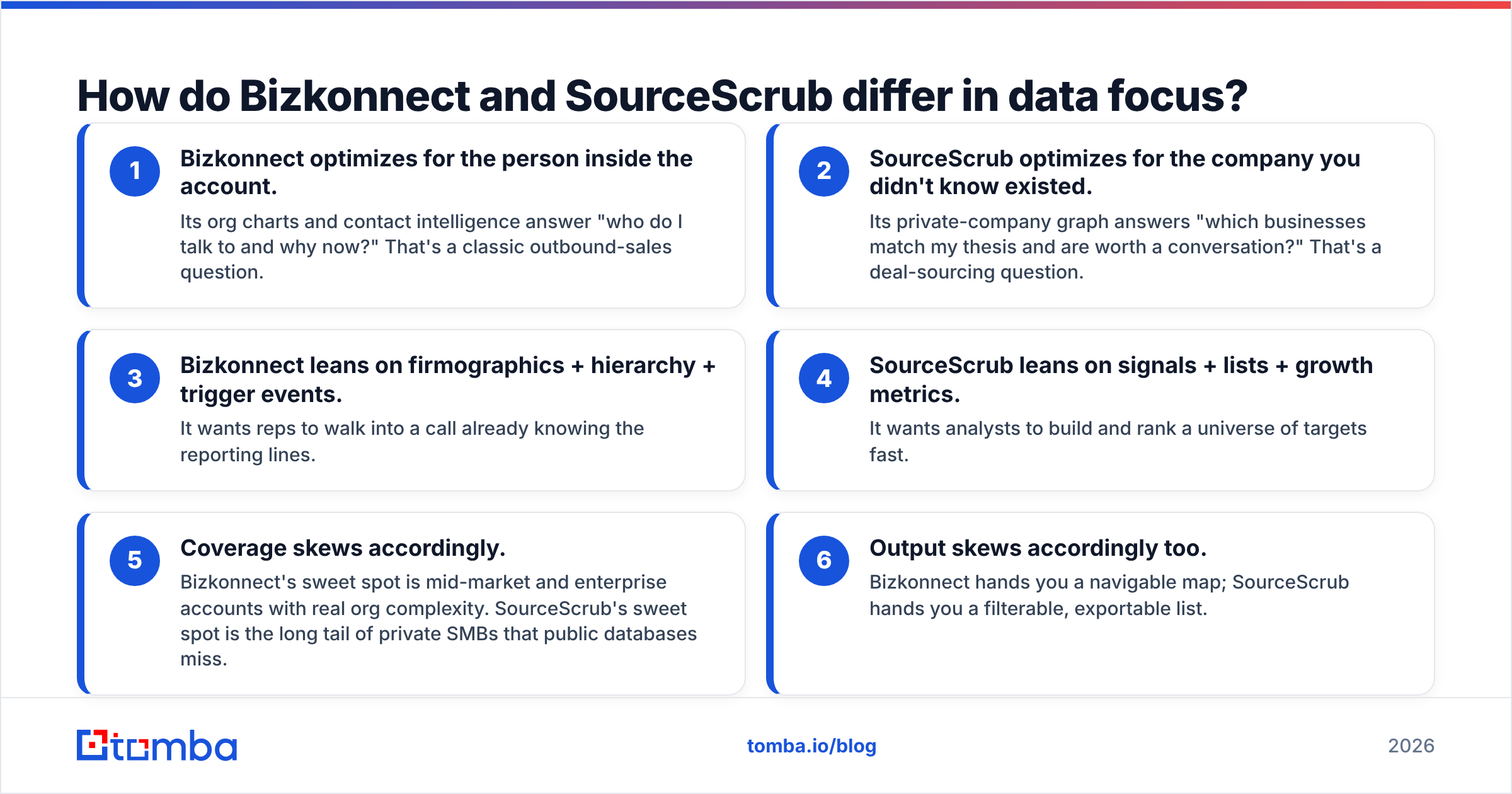
- Bizkonnect optimizes for the person inside the account. Its org charts and contact intelligence answer "who do I talk to and why now?" That's a classic outbound-sales question.
- SourceScrub optimizes for the company you didn't know existed. Its private-company graph answers "which businesses match my thesis and are worth a conversation?" That's a deal-sourcing question.
- Bizkonnect leans on firmographics + hierarchy + trigger events. It wants reps to walk into a call already knowing the reporting lines.
- SourceScrub leans on signals + lists + growth metrics. It wants analysts to build and rank a universe of targets fast.
- Coverage skews accordingly. Bizkonnect's sweet spot is mid-market and enterprise accounts with real org complexity. SourceScrub's sweet spot is the long tail of private SMBs that public databases miss.
- Output skews accordingly too. Bizkonnect hands you a navigable map; SourceScrub hands you a filterable, exportable list.
If you remember nothing else: Bizkonnect is a who-to-call tool, SourceScrub is a who-to-buy/partner-with tool.

Bizkonnect vs SourceScrub: side-by-side comparison#
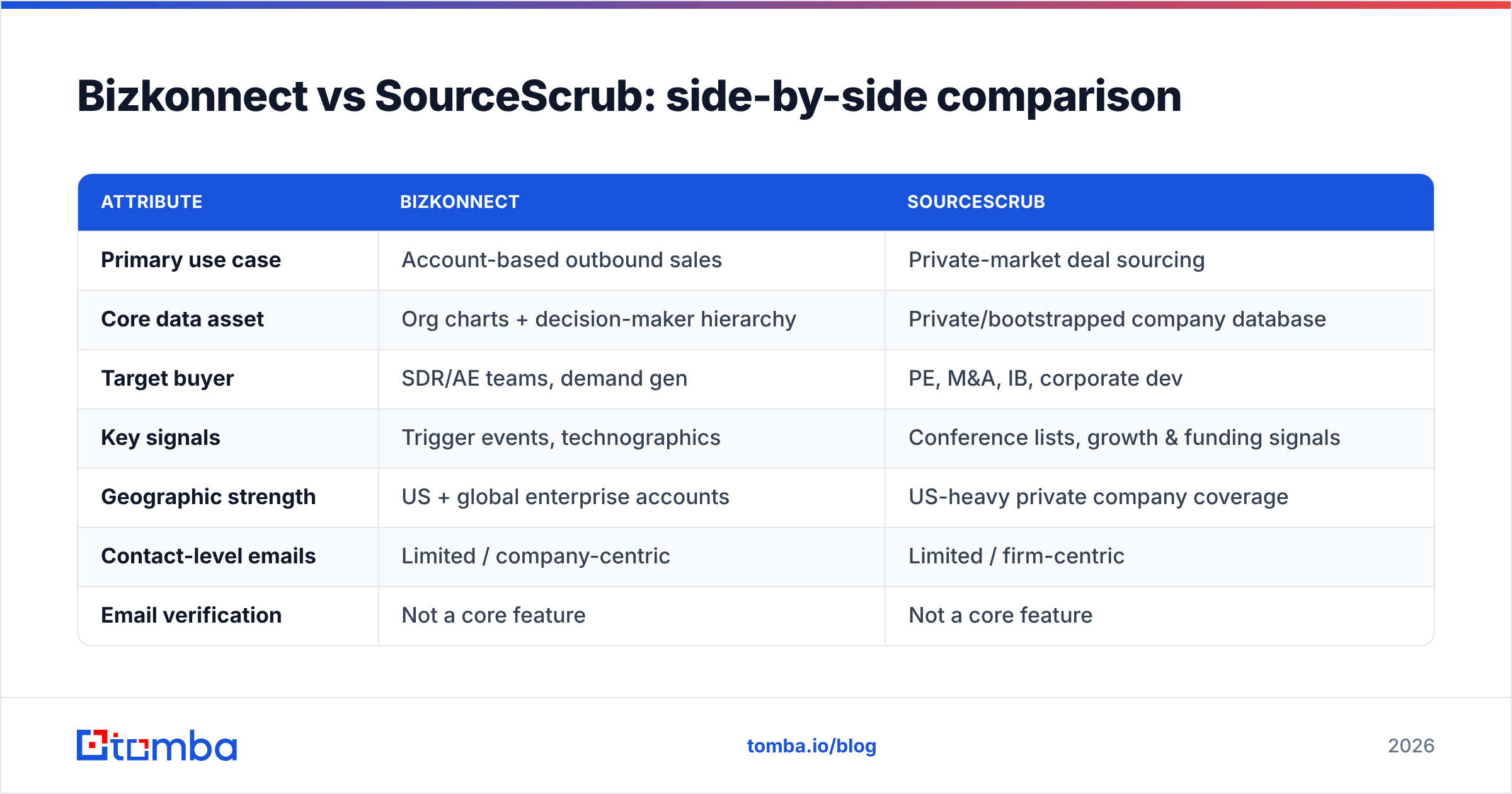
Here's the head-to-head on the attributes that actually drive a buying decision. Pricing for both is quote-based and not published publicly, so treat the pricing row as directional rather than exact.
| Attribute | Bizkonnect | SourceScrub |
|---|---|---|
| Primary use case | Account-based outbound sales | Private-market deal sourcing |
| Core data asset | Org charts + decision-maker hierarchy | Private/bootstrapped company database |
| Target buyer | SDR/AE teams, demand gen | PE, M&A, IB, corporate dev |
| Key signals | Trigger events, technographics | Conference lists, growth & funding signals |
| Geographic strength | US + global enterprise accounts | US-heavy private company coverage |
| Contact-level emails | Limited / company-centric | Limited / firm-centric |
| Email verification | Not a core feature | Not a core feature |
| Pricing model | Custom quote | Custom quote (typically higher, seat-based) |
| Best for | Personalizing outbound at scale | Building a ranked target universe |
The pattern is consistent down every row: same category label, different jobs. Cross-shopping them is like comparing a GPS that shows you the building floor plan against one that shows you which buildings to visit. For independent reviews and current feature notes, check listings on G2 before you commit to a contract.
Is Bizkonnect better than SourceScrub for sales teams?#
For a traditional outbound or account-based sales motion, Bizkonnect is the more natural fit — and not because it's objectively "better software." It's because org charts and trigger events map directly to how reps work a named-account list.
Bizkonnect shines when:
- You sell into mid-market or enterprise where deals need multiple stakeholders.
- Your reps waste time guessing who actually owns the buying decision.
- You want to personalize sequences by role and reporting line, not just by company.
- You already run an ABM motion and need account depth.
Where it leaves a gap: Bizkonnect tells you who the VP of Operations is, but getting a verified, deliverable email for that person is a separate step. Org-chart data ages fast — people change jobs constantly — so the contact layer needs continuous validation that an intelligence platform isn't built to provide. That's where pairing it with a data enrichment and verification workflow keeps your bounce rate down.
How does SourceScrub handle private-market data?#
SourceScrub's whole reason to exist is the data that public databases can't reach: founder-owned, bootstrapped, and otherwise off-the-grid private companies. It aggregates thousands of sources — conference exhibitor lists, trade-association rosters, "best of" award lists, buyer's guides — and structures them into a searchable database with growth indicators.
For a private-equity associate or M&A analyst, that's gold. You can build a thesis ("vertical SaaS in logistics, $5–20M revenue, founder-led, no institutional funding") and pull a ranked list of candidates in minutes instead of weeks of manual research. The platform's strength is breadth of obscure private companies plus the freshness signals that tell you when a company is heating up.
Its weakness, for a pure sales team, is the same as Bizkonnect's: it surfaces companies, not verified individual contacts ready for a cold sequence. SourceScrub will tell you Acme Logistics exists, is growing 40% a year, and exhibited at three conferences. It won't reliably hand you the founder's verified work email. To action that list, you still run each domain through a domain search to pull the people and patterns behind it.
What about pricing for Bizkonnect vs SourceScrub?#
Neither vendor publishes pricing, and both sell annual contracts through sales reps — so anyone quoting you an exact monthly number is guessing. What we can say from the market:
- Bizkonnect tends to price as a sales-intelligence add-on, often more accessible than full enterprise data suites, scaling by seats and data volume.
- SourceScrub is a premium, finance-oriented platform; expect enterprise-tier annual commitments aligned with PE/IB budgets, typically well above a standard sales-tool line item.
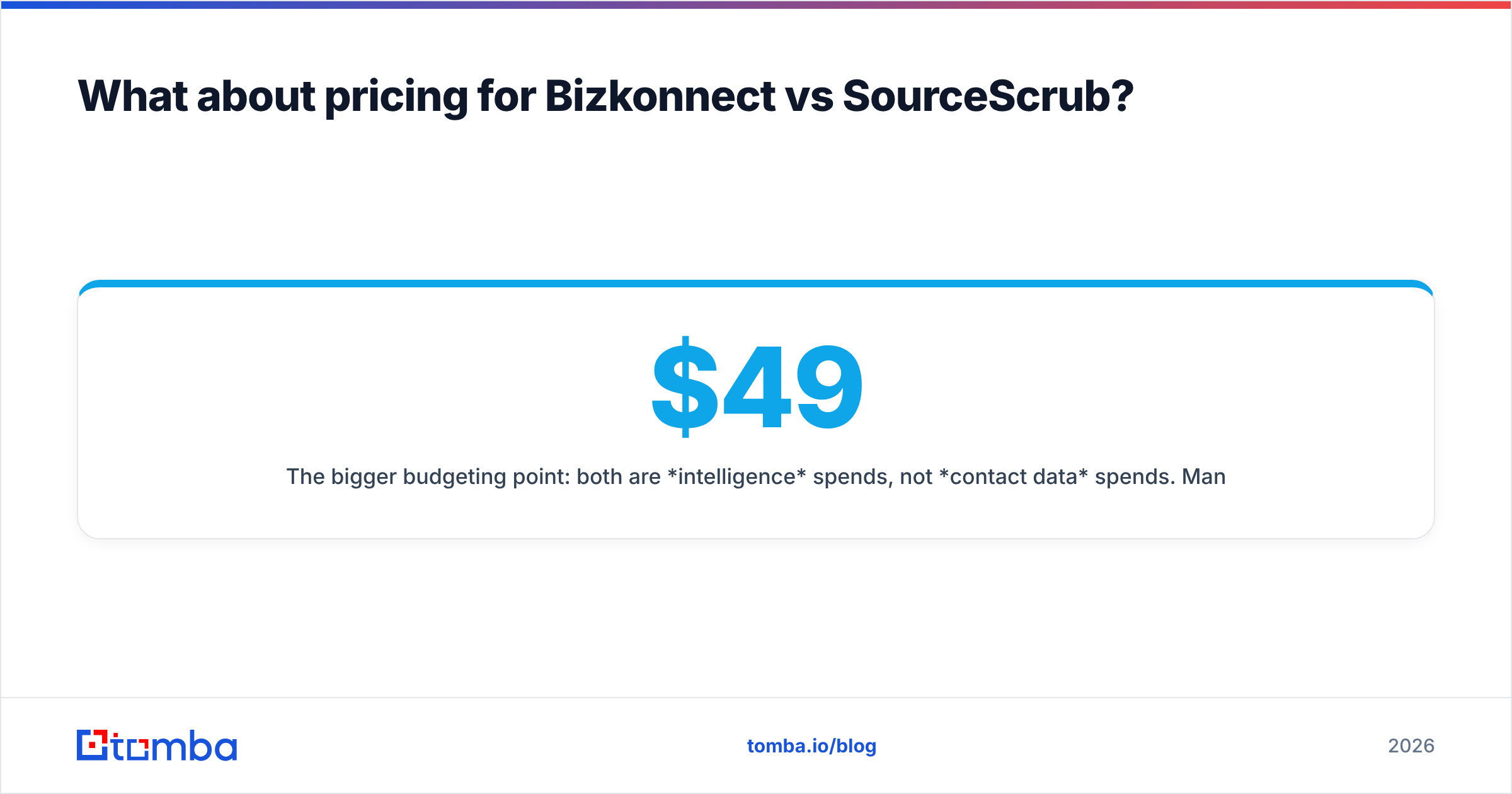
The bigger budgeting point: both are intelligence spends, not contact data spends. Many teams buy one of these and then discover they still need a separate, affordable contact-finding layer. That second tool doesn't have to be expensive. Tomba's pricing starts free (25 searches/mo) and runs $49/mo for Starter, $99/mo for Growth, and $249/mo for Pro — a rounding error next to either platform's annual contract, but it's what makes their data actionable.
Where do email finders fit alongside Bizkonnect and SourceScrub?#
Right at the point where both platforms stop. Account intelligence and deal sourcing answer who and which company. An email finder answers how do I actually reach this person without bouncing.
Here's the realistic workflow that turns either platform into pipeline:
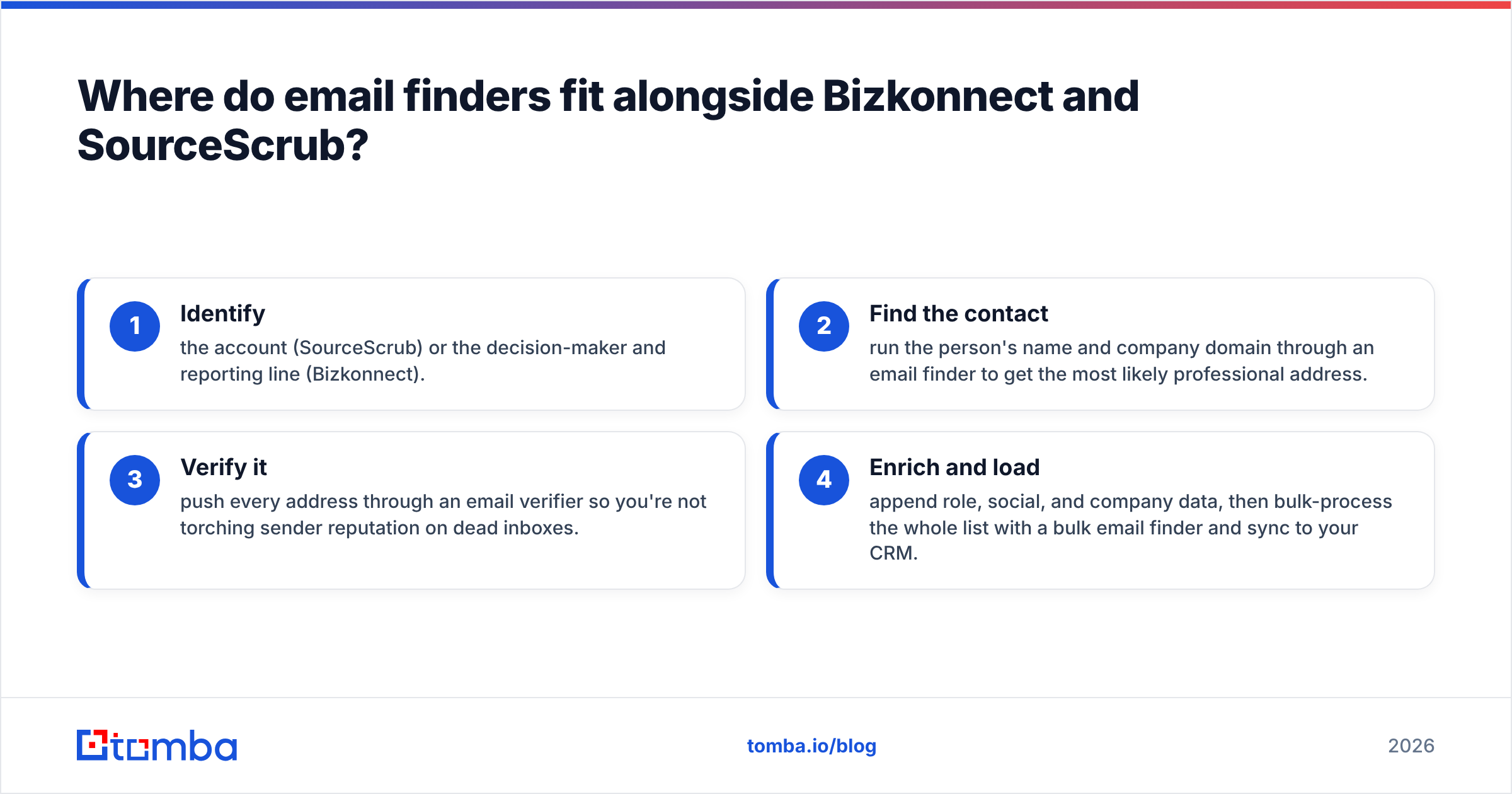
- Identify the account (SourceScrub) or the decision-maker and reporting line (Bizkonnect).
- Find the contact — run the person's name and company domain through an email finder to get the most likely professional address.
- Verify it — push every address through an email verifier so you're not torching sender reputation on dead inboxes.
- Enrich and load — append role, social, and company data, then bulk-process the whole list with a bulk email finder and sync to your CRM.
This is why "Bizkonnect vs SourceScrub" is often the wrong framing. The real stack is intelligence platform + contact-and-verification layer. Tomba is built specifically for steps 2–4: it draws from public web sources and pattern detection (see where Tomba gets data) and returns a confidence score on every email so you know what's safe to send.
Which one should you choose in 2026?#
Decide by the job in front of you, not the category label:
- Choose Bizkonnect if you're a sales or demand-gen team that needs org charts, decision-maker mapping, and account-level trigger events to personalize outbound into complex accounts.
- Choose SourceScrub if you're in PE, M&A, investment banking, or corporate development and your bottleneck is finding and ranking private companies before competitors do.
- Choose neither as your contact layer. Both are intelligence tools. Whichever you pick, you'll still need accurate, verified emails and phone numbers to convert that intelligence into conversations.
If your real pain is "I have target accounts but can't reliably reach the people inside them," the highest-ROI move isn't a six-figure data contract — it's adding a fast, accurate contact layer on top of whatever intelligence you already trust.
FAQ#
Is Bizkonnect a direct competitor to SourceScrub? Not really. They share the "B2B data" label but serve different buyers — Bizkonnect for outbound sales, SourceScrub for private-market deal sourcing. They more often complement different stacks than compete head-to-head.
Do Bizkonnect or SourceScrub provide verified emails? Neither treats contact-level email finding and verification as a core feature. Both surface companies and people; a dedicated email finder and verifier is the standard way to get deliverable addresses on top of them.
Which is more affordable? Bizkonnect typically prices below SourceScrub, which targets finance budgets. Both are quote-based annual contracts, so request pricing directly and budget a separate, low-cost contact-data layer.
Can I use Tomba with either platform? Yes. Export accounts or contacts from either tool, then use Tomba's email finder, verifier, and B2B database to fill in and validate the contact details before outreach.
The bottom line#
Bizkonnect and SourceScrub are both strong at what they do — Bizkonnect for org-chart-driven outbound, SourceScrub for private-company deal sourcing. But neither was built to hand you a verified, send-ready email, and that's the step where outreach actually lives or dies.
Close that gap with Tomba's Email Finder: find professional emails by name, company, or domain, get a confidence score on every result, and verify before you send — starting free, no enterprise contract required. Layer it on top of whichever intelligence platform you choose, and your target list stops being a spreadsheet and starts being pipeline.
Ready to find emails that actually work?
Join 150,000+ professionals who stopped guessing and started sending. Free credits on signup — no credit card required.
Get the Tomba newsletter
Practical outbound tactics and product updates — once every two weeks.
About the author