Bizkonnect vs Xverum: B2B Data Platforms Compared (2026)
Bizkonnect sells curated org charts and actionable contacts; Xverum sells raw bulk B2B datasets. Here's which one fits your GTM stack in 2026 — and where a finder-first tool beats both.
You have budget for one B2B data vendor this quarter, and two names keep landing on your shortlist: Bizkonnect and Xverum. They sound similar — both promise company and contact data at scale — but they solve different problems. Pick the wrong one and you either overpay for a feed you can't operationalize, or you buy pretty org charts your reps never open.
This is a straight comparison: what each tool actually does, where the data comes from, how pricing works, and which team profile each one fits. No vendor is perfect, so I'll also flag where a leaner, finder-first approach beats paying for either platform.
TL;DR#
- Bizkonnect is a sales-intelligence layer: curated org charts, decision-maker mapping, and "actionable" account contacts aimed at outbound sales teams who want context, not just rows.
- Xverum is a data-as-a-service provider: bulk B2B company and people datasets delivered as feeds (S3, API, files) for teams that want to enrich a warehouse or train models.
- Choose Bizkonnect if reps need org structure and warm context per account; choose Xverum if engineers need large, raw datasets to pipe into a CRM, CDP, or ML model.
- Pricing is opaque on both — quote-based, annual-leaning, and rarely cheap for small teams.
- The cheaper path for most outbound teams is a pay-as-you-go email finder plus verification, which gets you verified contacts without a six-figure data contract.
What is Bizkonnect?#
Bizkonnect is a sales-intelligence company that focuses on actionable sales intelligence — its term for contact data wrapped in account context. The headline feature is org charts: visual maps of who reports to whom inside a target account, so a rep can see the buying committee instead of guessing which VP owns the budget.
Around that, Bizkonnect bundles decision-maker contacts, company profiles, and "sales triggers" (events like leadership changes or expansions). The pitch is aimed at account-based selling: instead of blasting a generic list, your reps work a smaller set of accounts with a map of the people inside each one.
That context is the product. You're not buying the biggest database on the market — you're buying a curated, human-reviewed view of specific accounts and the humans who make decisions there. For complex enterprise deals with five to ten stakeholders, that mapping has real value.
The trade-off: curation is slower and narrower than raw scraping. If you need 500,000 contacts for a broad demand-gen play, an org-chart tool is the wrong shape of product.
Note: the link above points to a finder workflow; swap in a real Bizkonnect dashboard screenshot here when publishing.
What is Xverum?#
Xverum is a web data provider — a data-as-a-service (DaaS) vendor that sells large, structured B2B datasets harvested from public web sources. Think company firmographics, people profiles, job postings, and similar feeds, delivered in bulk rather than searched one record at a time.
The delivery model is the tell. Xverum talks about dataset feeds, refresh schedules, S3/cloud delivery, and custom datasets sized to your spec. This is infrastructure-grade data plumbing, not a rep-facing app. You point it at a data warehouse, a customer data platform, or a model-training pipeline.
That makes Xverum a strong fit for data and RevOps engineering teams. If you're enriching millions of accounts, building a propensity model, or backfilling firmographics across a CRM, a bulk feed is exactly right. You get scale and you get raw fields you can transform however you want.
The trade-off mirrors Bizkonnect's in reverse: there's no org chart, no buying-committee context, and no clean "open the app and start selling" surface. A bulk feed is only as useful as the data enrichment and tooling you build on top of it.
Bizkonnect vs Xverum: how do they compare?#
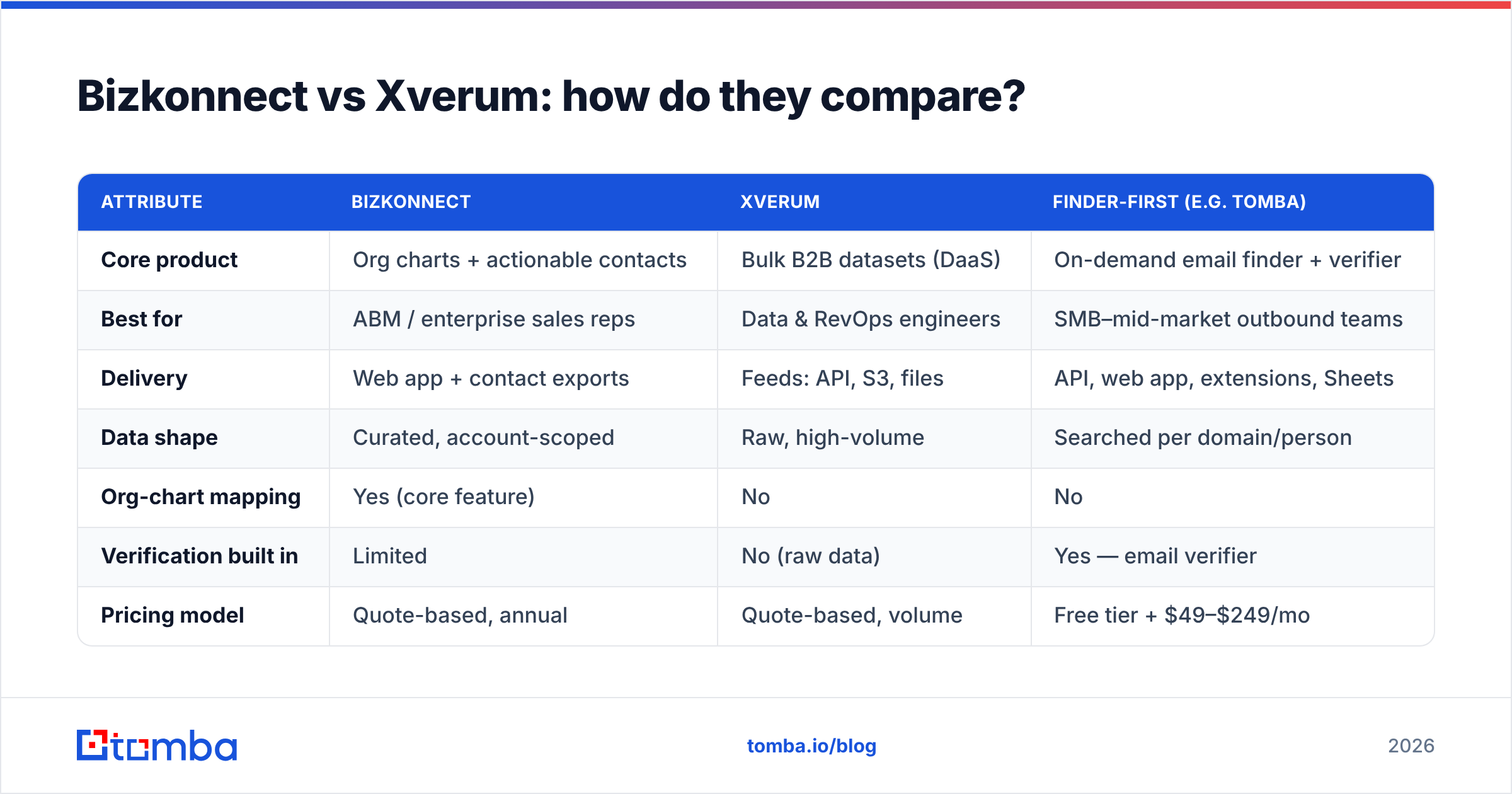
Here's the side-by-side. I've added a third column — a finder-first approach using a tool like Tomba — because for many teams the honest answer to "Bizkonnect or Xverum?" is "neither, at least not yet."
| Attribute | Bizkonnect | Xverum | Finder-first (e.g. Tomba) |
|---|---|---|---|
| Core product | Org charts + actionable contacts | Bulk B2B datasets (DaaS) | On-demand email finder + verifier |
| Best for | ABM / enterprise sales reps | Data & RevOps engineers | SMB–mid-market outbound teams |
| Delivery | Web app + contact exports | Feeds: API, S3, files | API, web app, extensions, Sheets |
| Data shape | Curated, account-scoped | Raw, high-volume | Searched per domain/person |
| Org-chart mapping | Yes (core feature) | No | No |
| Verification built in | Limited | No (raw data) | Yes — email verifier |
| Pricing model | Quote-based, annual | Quote-based, volume | Free tier + $49–$249/mo |
| Time to first contact | Days (onboarding) | Days–weeks (pipeline) | Minutes |
The pattern: Bizkonnect optimizes for depth per account, Xverum optimizes for volume per feed, and a finder optimizes for speed and cost per verified contact. Match the column to the job your team actually has this quarter.

Which has better data quality and freshness?#
Conclusion first: it depends on what "quality" means for your use case, and neither vendor publishes independent accuracy benchmarks, so treat their numbers as marketing until you run a sample.
Bizkonnect's quality story is curation. Because records are account-scoped and partly human-reviewed, the org-chart relationships and decision-maker titles tend to be cleaner than a raw scrape. The risk is staleness: people change jobs constantly, and a curated map built last quarter can rot fast. Always ask how often a given account is re-verified.
Xverum's quality story is scale and refresh cadence. Bulk web data is wide but noisy — you'll get coverage that a curated tool can't match, alongside duplicates, outdated rows, and missing fields that you have to clean yourself. The refresh schedule matters enormously here; a feed that updates monthly behaves very differently from one that updates weekly.
For both, the universal weak point is email validity. Firmographic and people data can be accurate while the email attached to a contact bounces. That's why a verification step is non-negotiable regardless of which vendor you pick. Running contacts through a dedicated email verification pass — including a catch-all verifier for domains that accept everything — protects your sender reputation before you ever hit send. If you skip it, you inherit whatever bounce rate the vendor's last refresh baked in.
If you want a neutral reference point on how data vendors are rated by actual buyers, cross-check both names on G2 before signing anything.
How does pricing compare?#
Neither Bizkonnect nor Xverum lists transparent self-serve pricing, and that's the single biggest practical difference from a finder tool. Both lean toward annual, quote-based contracts negotiated against your volume and use case. Expect a sales call, a custom proposal, and minimums that make them hard to justify for a small team running a pilot.
Here's the rough shape of what you're choosing between:
- Bizkonnect — quote-based, typically annual. You pay for curation and org-chart depth, so cost scales with the number of accounts and seats, not raw record count. Good value if your reps genuinely work the maps; expensive shelfware if they don't.
- Xverum — quote-based, volume-driven. You pay for dataset size and refresh frequency. Cost-efficient per record at scale, but the floor is high and you need engineering time to operationalize the feed, which is a hidden second cost.
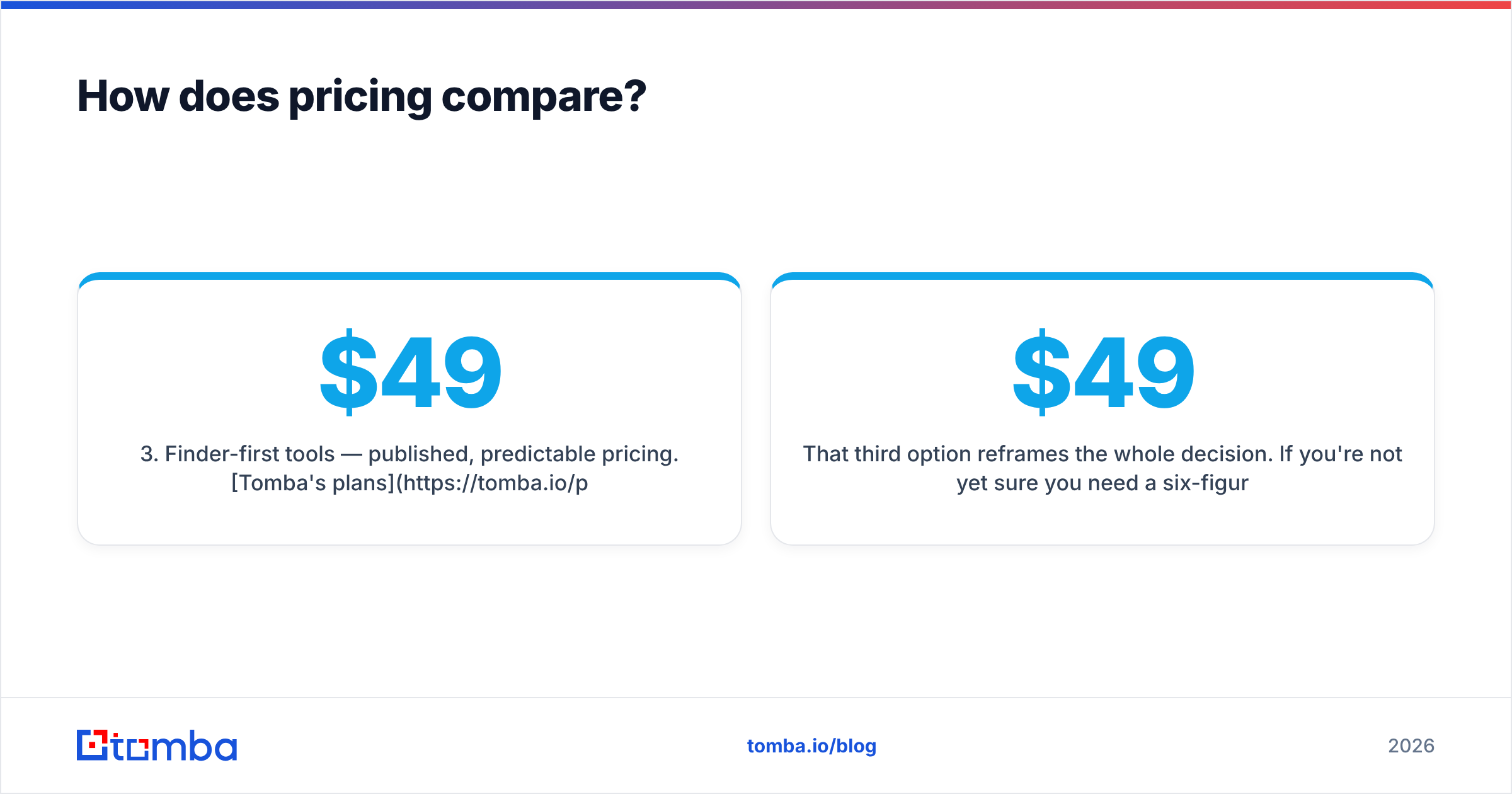
- Finder-first tools — published, predictable pricing. Tomba's plans run a Free tier (25 searches/mo), Starter at $49/mo, Growth at $99/mo, and Pro at $249/mo, with no annual lock-in required to start.
That third option reframes the whole decision. If you're not yet sure you need a six-figure data contract, you can validate your outbound motion for $49–$99/mo first, then graduate to a heavyweight feed once you know exactly what data shape pays off.
Is there a cheaper alternative to both?#
Yes — for most outbound and SMB-to-mid-market teams, a finder-first stack covers the same job at a fraction of the cost and commitment. You don't always need a curated org-chart subscription or a bulk DaaS feed. You need verified contacts for the accounts you're actually working, on demand.
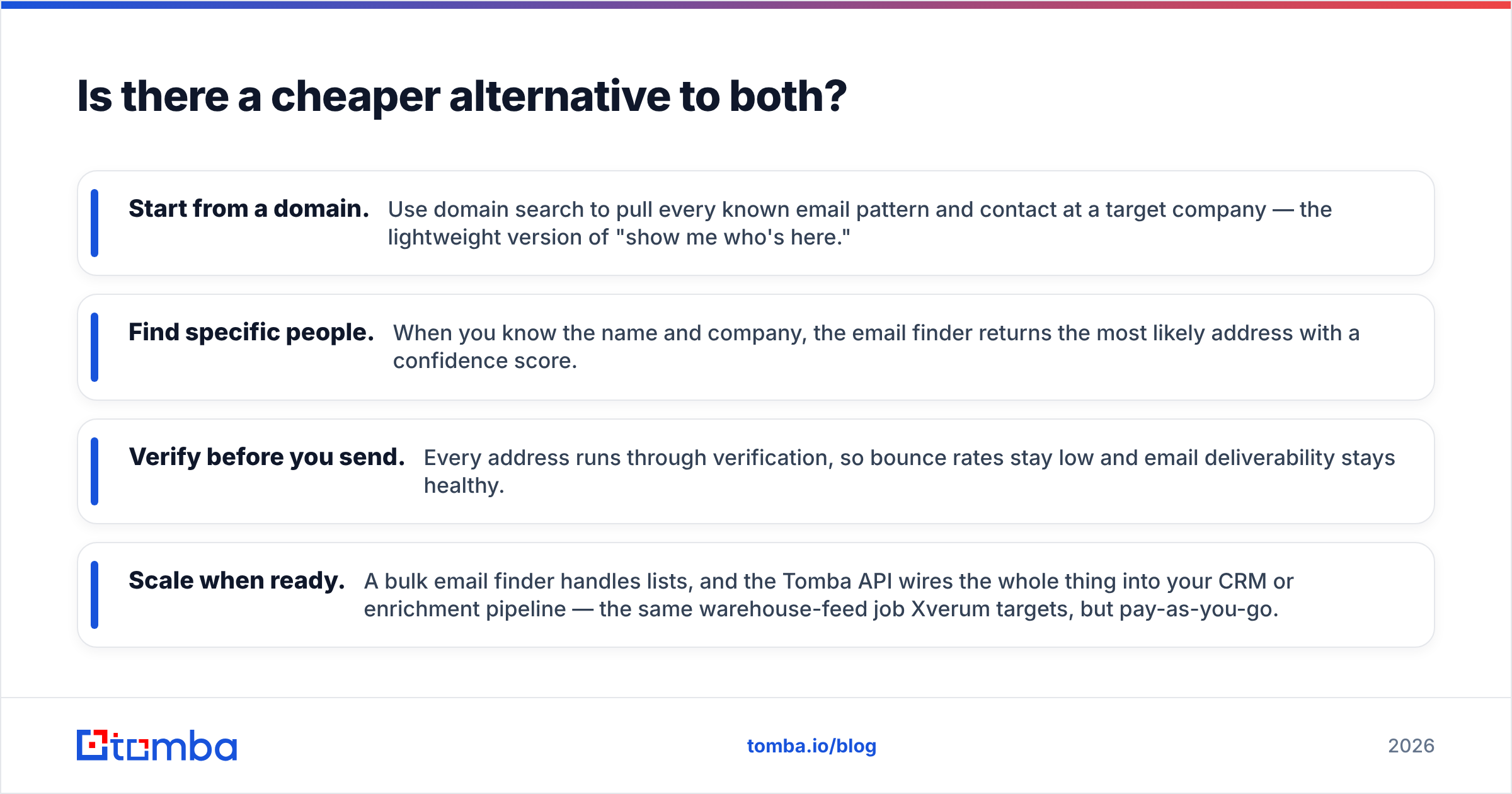
A finder-first workflow looks like this:
- Start from a domain. Use domain search to pull every known email pattern and contact at a target company — the lightweight version of "show me who's here."
- Find specific people. When you know the name and company, the email finder returns the most likely address with a confidence score.
- Verify before you send. Every address runs through verification, so bounce rates stay low and email deliverability stays healthy.
- Scale when ready. A bulk email finder handles lists, and the Tomba API wires the whole thing into your CRM or enrichment pipeline — the same warehouse-feed job Xverum targets, but pay-as-you-go.
This won't replace Bizkonnect's org charts for a 12-stakeholder enterprise deal, and it won't replace Xverum if you genuinely need millions of raw rows for a model. But for the 80% of teams whose real problem is "I need verified contacts at companies I care about, this week," it's faster, cheaper, and transparent. For broader context on how this category is evolving, vendor docs like HubSpot's data resources are a useful neutral baseline.
Which should you choose?#
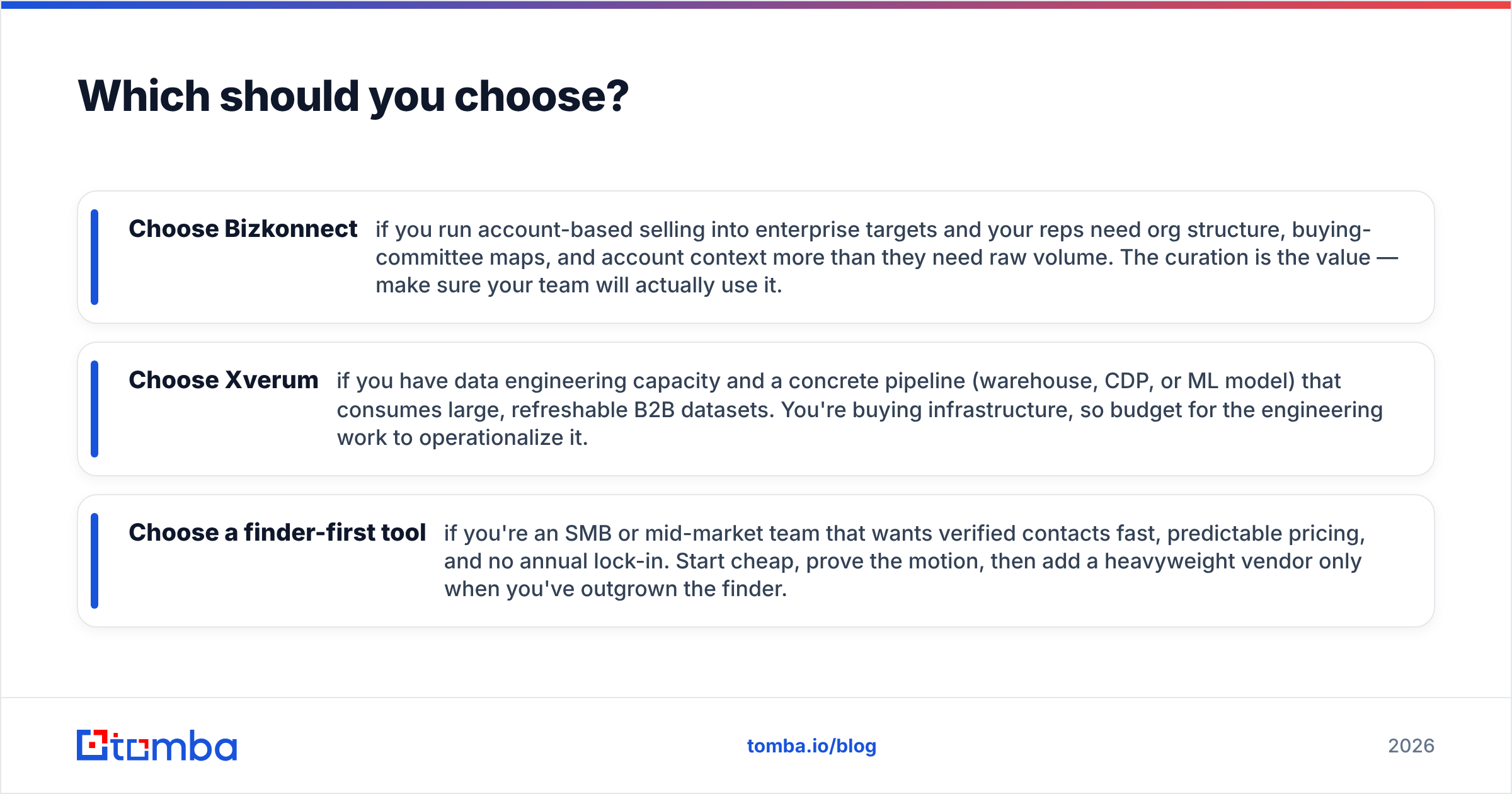
Decide by the job, not the brand:
- Choose Bizkonnect if you run account-based selling into enterprise targets and your reps need org structure, buying-committee maps, and account context more than they need raw volume. The curation is the value — make sure your team will actually use it.
- Choose Xverum if you have data engineering capacity and a concrete pipeline (warehouse, CDP, or ML model) that consumes large, refreshable B2B datasets. You're buying infrastructure, so budget for the engineering work to operationalize it.
- Choose a finder-first tool if you're an SMB or mid-market team that wants verified contacts fast, predictable pricing, and no annual lock-in. Start cheap, prove the motion, then add a heavyweight vendor only when you've outgrown the finder.
The honest summary: Bizkonnect and Xverum sit at opposite ends of the same market — depth versus volume — and the right answer is whichever shape matches your team's actual bottleneck. If you're not certain which it is, that uncertainty is itself the signal to start small.
That's where Tomba fits. Spin up the Tomba Email Finder on the free tier, find and verify real contacts at your target accounts in minutes, and learn what data shape your pipeline truly needs before you commit to a six-figure feed. When you're ready to scale, the API and bulk tools grow with you — without the annual contract. Start free, then upgrade only when the numbers say so.
Ready to find emails that actually work?
Join 150,000+ professionals who stopped guessing and started sending. Free credits on signup — no credit card required.
Get the Tomba newsletter
Practical outbound tactics and product updates — once every two weeks.
About the author