Blended Customer Acquisition Cost: The 2026 RevOps Guide
Blended CAC tells you the real cost to win a customer across every channel. Here's how to calculate it, why it beats paid-only CAC, and how to drive it down in 2026.
You spent $50,000 on ads last quarter and closed 100 customers, so your CAC is $500. Clean number, wrong number. It ignores the salaries, the SEO content, the referral program, and the tools that actually carried half those deals. Blended customer acquisition cost fixes that — and it usually tells a very different story than the one your paid dashboard is selling you.
TL;DR#
- Blended customer acquisition cost divides all sales and marketing spend by all new customers in a period — paid, organic, referral, and outbound combined.
- It's the truest top-line read on go-to-market efficiency, while channel-specific (paid) CAC is better for optimizing individual campaigns. You need both.
- The formula is simple; the discipline is in counting every cost (salaries, tools, overhead) and every customer, not just the paid ones.
- Healthy SaaS targets a blended CAC payback under 12 months and an LTV:CAC ratio of 3:1 or better.
- The fastest lever on blended CAC isn't cutting ad spend — it's raising conversion on the leads you already pay to source, which is where clean contact data earns its keep.
What is blended customer acquisition cost?#
Blended customer acquisition cost is the average amount you spend to acquire one new customer when you pool every acquisition channel into a single calculation. "Blended" is the operative word: you blend paid and unpaid, inbound and outbound, marketing and sales into one denominator and one numerator.
Think of it like the fuel economy of your entire go-to-market engine. Channel CAC tells you how a single cylinder is firing; blended CAC tells you how many miles per gallon the whole car actually gets when you drive it in real conditions — hills, traffic, and all. Executives and investors care about the second number because that's the one that scales.
The contrast that trips people up is blended CAC vs. paid CAC:
- Paid CAC = paid spend ÷ customers attributed to paid. Great for deciding whether to pour more into Google Ads.
- Blended CAC = total spend ÷ total customers. Great for deciding whether your business model works.
A company can have a gorgeous $300 paid CAC and a scary $1,400 blended CAC because a small army of SDRs, a content team, and three SaaS subscriptions are doing the unglamorous work that paid attribution never credits.
How do you calculate blended customer acquisition cost?#
The formula is one line:
Blended CAC = (Total sales + marketing spend in a period) ÷ (Total new customers acquired in that period)
The arithmetic is trivial. The honesty is not. Most teams understate blended CAC because they forget line items. Here's the full cost stack you should be summing:
- Media spend — every paid channel: search, social, display, retargeting, sponsorships.
- Salaries and commissions — fully loaded cost of marketing, SDR, AE, and RevOps headcount, plus benefits.
- Tooling — your CRM, sales engagement platform, data enrichment, analytics, and the email finder feeding your pipeline.
- Agencies and contractors — freelance content, design, paid-media management.
- Overhead allocation — the slice of software, office, and management cost attributable to acquisition.
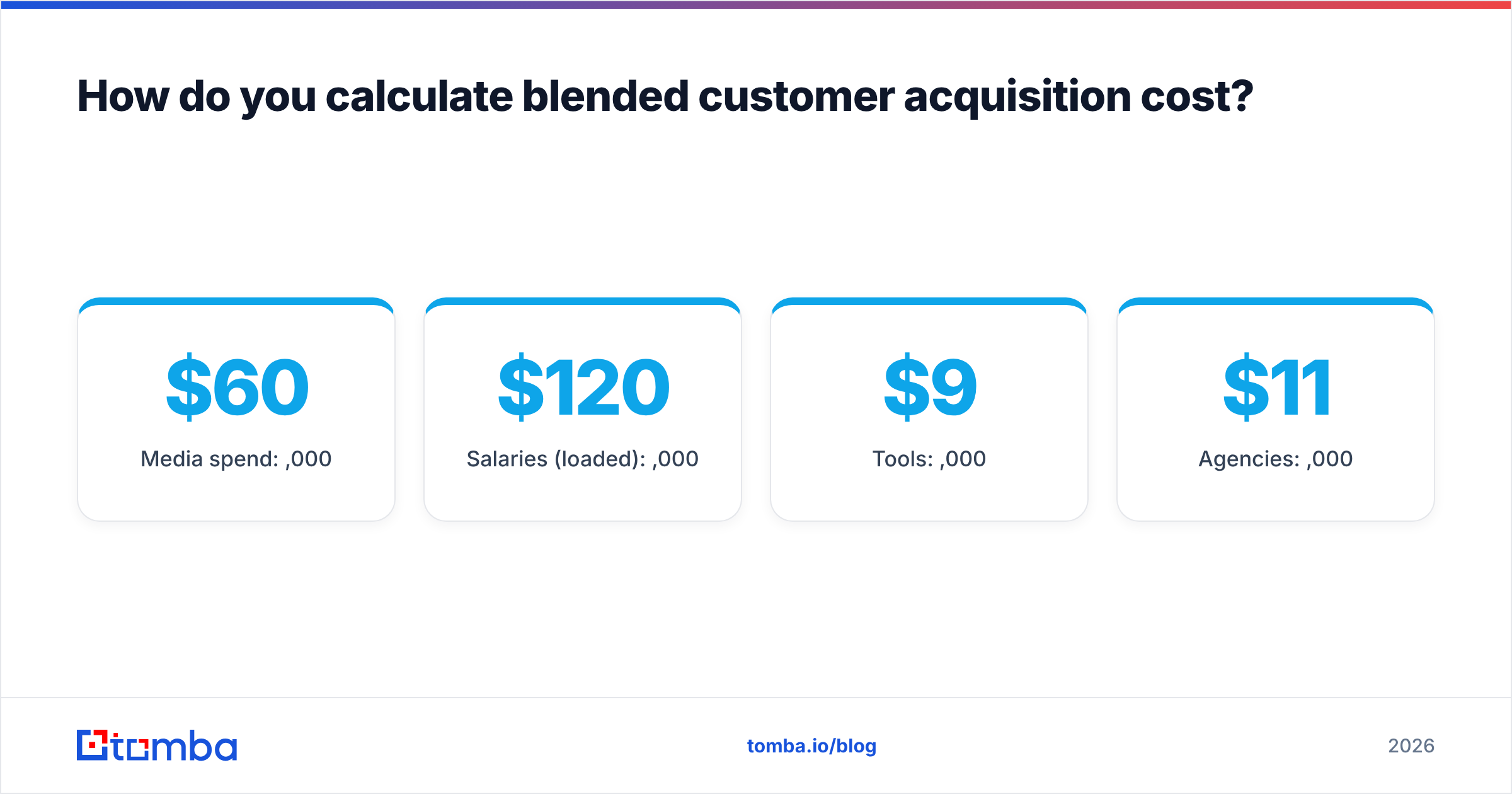
Worked example. Say a quarter looks like this:
- Media spend: $60,000
- Salaries (loaded): $120,000
- Tools: $9,000
- Agencies: $11,000
- New customers: 140
Total spend = $200,000. Blended CAC = $200,000 ÷ 140 = $1,428. If your paid-only math said $430, you now understand why the board keeps asking where the money went.
Blended CAC vs. paid CAC vs. fully-loaded CAC: which do you use?#
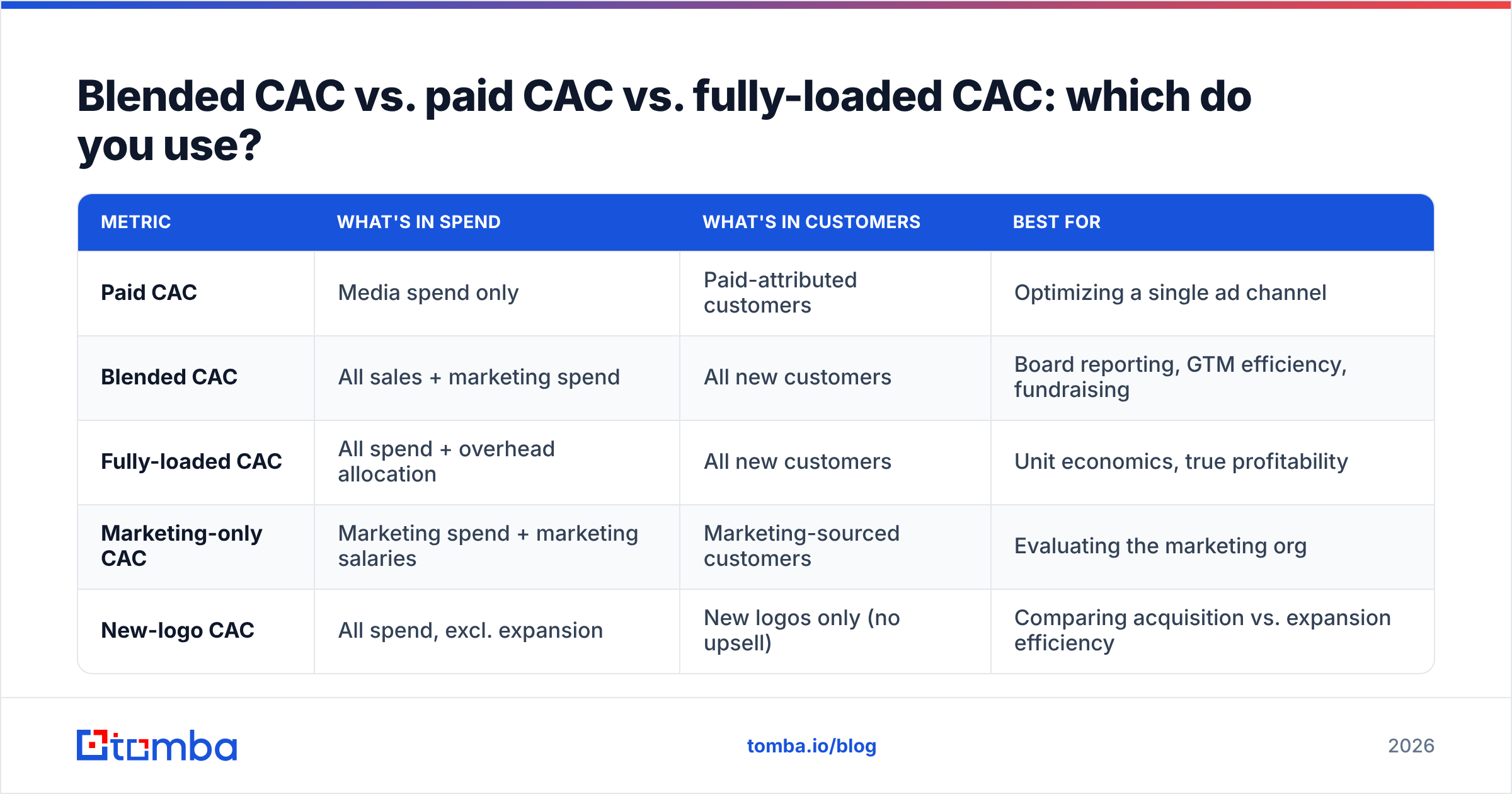
Different questions need different denominators. Pick the metric that matches the decision you're making.
| Metric | What's in spend | What's in customers | Best for |
|---|---|---|---|
| Paid CAC | Media spend only | Paid-attributed customers | Optimizing a single ad channel |
| Blended CAC | All sales + marketing spend | All new customers | Board reporting, GTM efficiency, fundraising |
| Fully-loaded CAC | All spend + overhead allocation | All new customers | Unit economics, true profitability |
| Marketing-only CAC | Marketing spend + marketing salaries | Marketing-sourced customers | Evaluating the marketing org |
| New-logo CAC | All spend, excl. expansion | New logos only (no upsell) | Comparing acquisition vs. expansion efficiency |
Most operators report blended CAC to leadership and track paid CAC by channel for optimization. The mistake is using one where the other belongs — celebrating a low paid CAC while blended CAC quietly balloons, or judging a brand-new content channel by blended math before it's had time to compound.
Why does blended customer acquisition cost matter in 2026?#
Three forces made blended CAC the metric to watch this year.
Attribution is breaking. With privacy changes, cookie deprecation, and dark social, last-click attribution under-credits the channels that actually influence deals. When you can't trust per-channel attribution, the blended number — which doesn't depend on attribution at all — becomes your most reliable read. Gartner has flagged for years that B2B buyers complete most of their journey before they ever talk to sales, which is exactly the journey paid attribution can't see.
Capital got expensive. The era of growth-at-any-cost is over. Investors now underwrite efficiency, and blended CAC payback is the headline efficiency metric. A 2026 pitch deck without a credible blended CAC and LTV:CAC ratio reads as unserious.
Channels saturate. As paid auctions get more crowded, marginal paid CAC rises. Teams that lean on organic, referral, and outbound to dilute their blended number win the efficiency game — and blended CAC is the only metric that rewards that diversification.

What is a good blended CAC benchmark?#
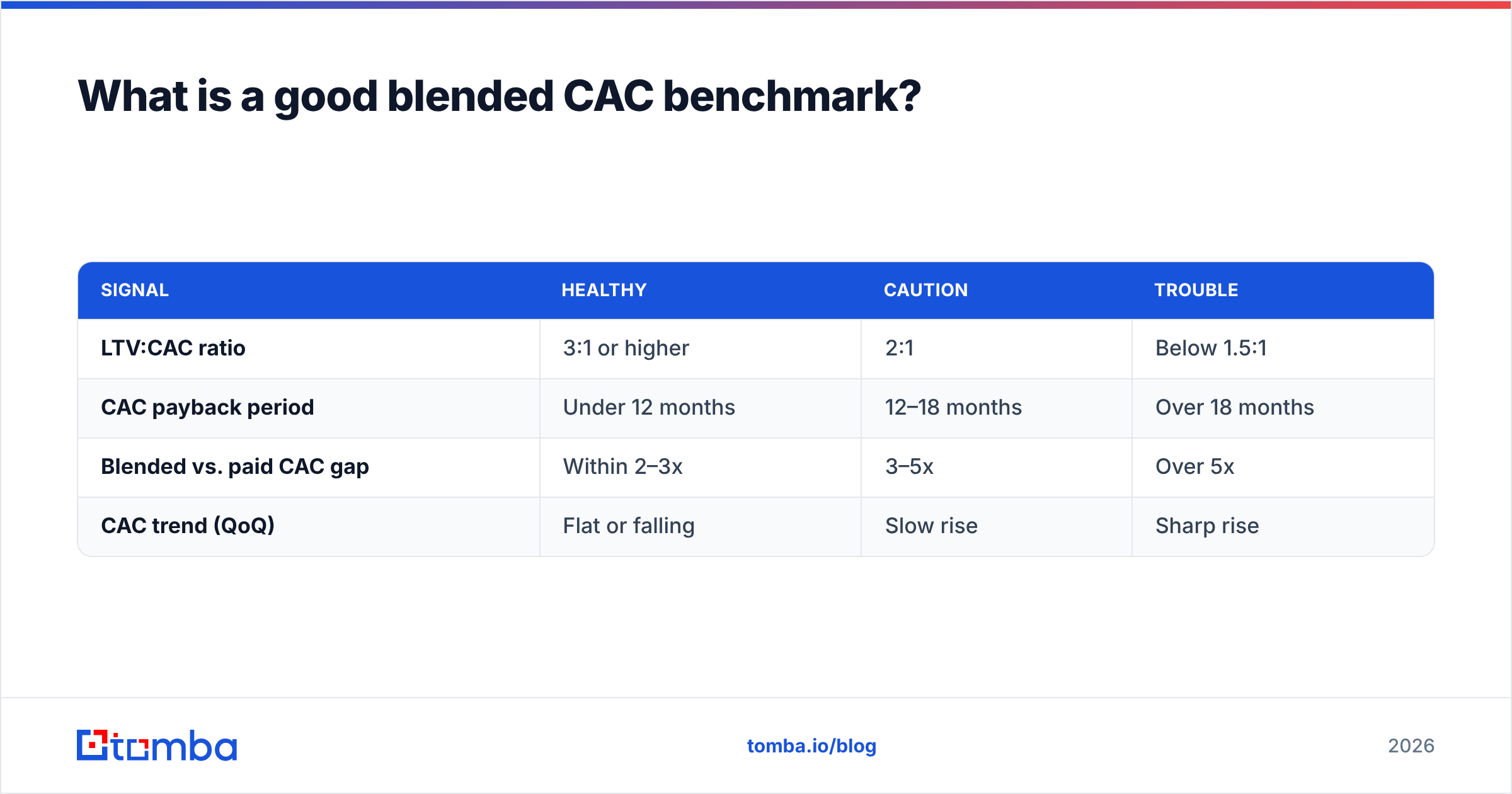
There's no universal dollar figure — a $2,000 blended CAC is heroic for enterprise SaaS and catastrophic for a $15/month consumer app. Benchmark against ratios, not absolutes.
| Signal | Healthy | Caution | Trouble |
|---|---|---|---|
| LTV:CAC ratio | 3:1 or higher | 2:1 | Below 1.5:1 |
| CAC payback period | Under 12 months | 12–18 months | Over 18 months |
| Blended vs. paid CAC gap | Within 2–3x | 3–5x | Over 5x |
| CAC trend (QoQ) | Flat or falling | Slow rise | Sharp rise |
A widely cited rule of thumb from the SaaS community — and echoed across vendor benchmarks on G2 — is the 3:1 LTV:CAC target: a customer should be worth at least three times what you spent to win them. Below 3:1 you're leaving margin on the table or over-spending; far above it and you may be under-investing in growth.
Watch the blended-vs-paid gap specifically. A gap over 5x means a huge share of your acquisition cost lives outside paid — usually expensive human selling — and you should ask whether those motions are efficient or just invisible.
How do you lower your blended customer acquisition cost?#
You move blended CAC two ways: shrink the numerator (spend) or grow the denominator (customers per dollar). The second is almost always the better play, because cutting spend caps growth while improving efficiency compounds.
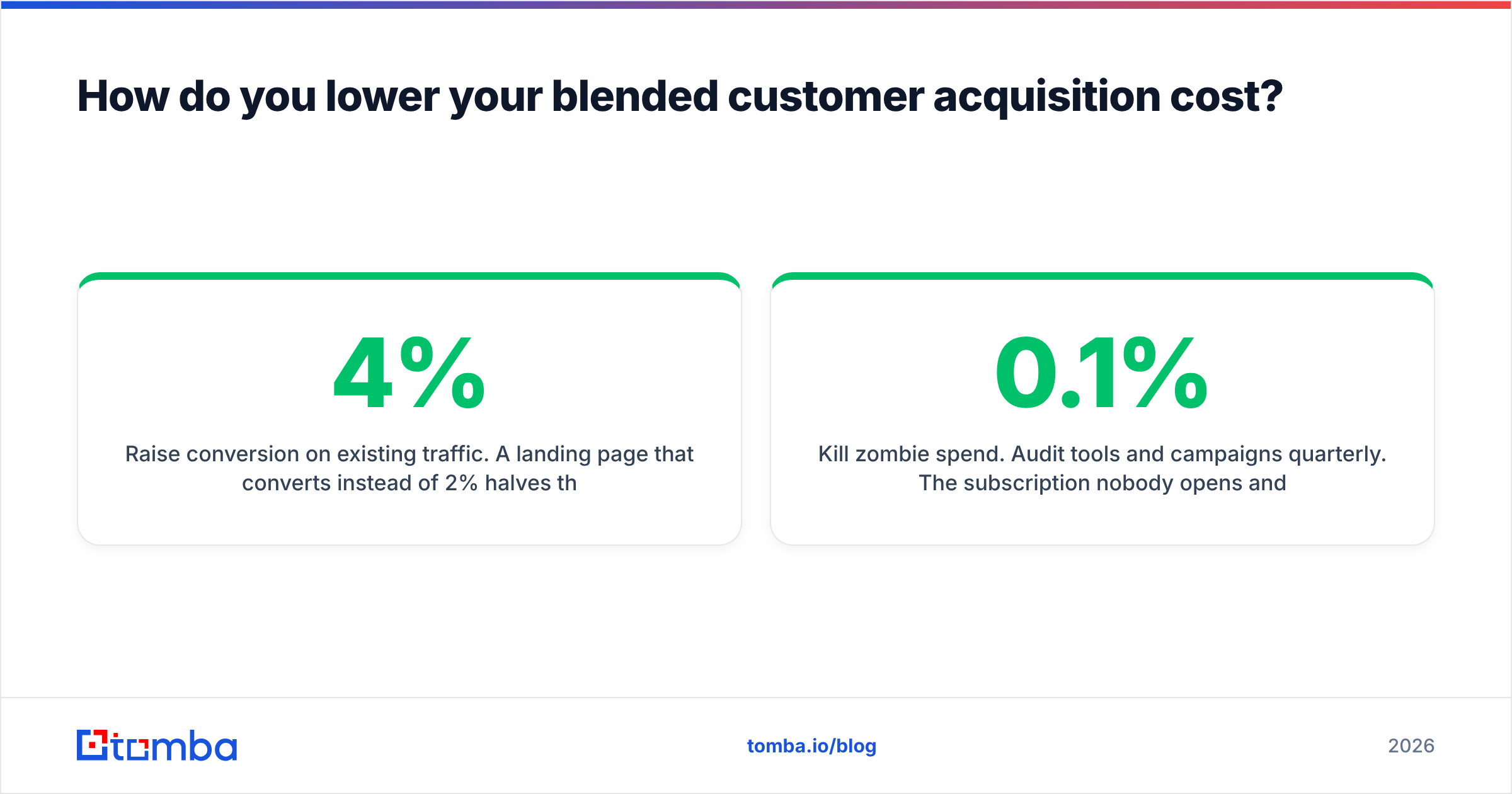
- Raise conversion on existing traffic. A landing page that converts 4% instead of 2% halves the CAC of every channel feeding it. No new spend required.
- Tighten targeting before you pay. Most wasted acquisition spend goes to prospects who were never a fit. Better firmographic and contact data at the top of funnel means fewer dollars chasing dead leads. This is where reliable data enrichment and accurate contact discovery pay for themselves several times over.
- Lift sender deliverability. If your outbound emails land in spam, you pay full SDR and tooling cost for zero pipeline. Clean lists and verified addresses protect sender reputation and keep your cost-per-reply sane.
- Lean into compounding channels. SEO, referral, and community have near-zero marginal cost once built. Every customer they produce drags blended CAC down over time, even as paid CAC rises.
- Kill zombie spend. Audit tools and campaigns quarterly. The subscription nobody opens and the ad set with a 0.1% conversion rate are pure CAC inflation.
Notice that four of those five levers are about efficiency of the spend you already have, not austerity. That's the revenue operations mindset: fix the conversion math, and blended CAC falls on its own.
How does data quality affect blended CAC?#
Directly and brutally. Every bad record in your pipeline is paid-for waste that inflates the numerator while contributing nothing to the denominator.
Walk the chain. You pay to source a lead. You pay an SDR to research it. You pay tooling to sequence it. If the email bounces or the title is wrong, every one of those costs is sunk — and the customer it should have produced never appears. Bounce rates also drag down deliverability, which quietly raises the cost of every other email you send. One bad list taxes the whole engine.
Teams that verify contacts before outreach routinely see meaningful lifts in connect and reply rates, which means the same media and salary spend produces more customers — the denominator grows, blended CAC falls. Pairing an accurate email finder with bulk verification is one of the cheapest CAC levers available, because it improves output without adding a dollar of spend. (Tomba's own plans start free at 25 searches a month and scale to $49/month Starter; see Tomba pricing for the full breakdown.)
The principle is simple: you can't out-optimize bad data. Fix inputs before you tune campaigns.
Common mistakes that wreck your blended CAC math#
- Counting expansion as new acquisition. Upsell and cross-sell revenue shouldn't sit in your new-logo CAC. Separate new-logo CAC from blended-with-expansion or you'll flatter the number.
- Forgetting salary load. Headcount is usually the largest cost in blended CAC. Leaving it out makes every comparison meaningless.
- Mismatched time windows. If a deal closes in Q2 but the spend that sourced it landed in Q1, naive period math distorts CAC. For long sales cycles, use cohort-based CAC.
- Ignoring the sales-marketing handoff cost. Marketing qualified leads that sales never works are spend with no return — and they hide inside an averaged blended number.
- Reporting blended CAC alone. Without LTV beside it, the number is context-free. A rising CAC is fine if LTV rises faster.
Frequently asked questions#
Is blended CAC the same as fully-loaded CAC? Close but not identical. Blended CAC pools all channels; fully-loaded CAC additionally allocates overhead like office and management cost. Fully-loaded is the stricter unit-economics view.
Should I report blended CAC or paid CAC to investors? Blended CAC, paired with LTV:CAC and payback period. Investors want the efficiency of the whole engine, not one channel's highlight reel.
How often should I calculate it? Monthly for trend-watching, quarterly for board reporting. Use rolling periods to smooth out lumpy enterprise deals.
What's the single biggest lever on blended CAC? Conversion rate on the demand you already pay to create. Doubling conversion halves CAC across every channel at once — far cheaper than buying more traffic.
Putting it to work#
Blended customer acquisition cost is the metric that keeps you honest. Paid CAC tells a flattering story; blended CAC tells the true one, and in a 2026 where capital is disciplined and attribution is unreliable, the true one is what gets you funded and keeps you profitable. Calculate it with every cost in the numerator, benchmark it against a 3:1 LTV:CAC and sub-12-month payback, and attack it by raising conversion rather than slashing spend.
The highest-leverage starting point is your data. If a chunk of your acquisition spend is being burned on bounced emails and mistargeted leads, no campaign tweak will save your CAC. Tomba's Email Finder helps you source accurate, verified professional emails by domain, name, or company — so the dollars you already spend convert into customers instead of disappearing into your numerator. Start free with 25 searches a month, and let cleaner data do what budget cuts can't: pull your blended CAC down while your pipeline goes up.
// get started
Find, verify and enrich your first contacts today
Start on the free plan with 25 searches a month, then scale when your team is ready.
Free plan · No credit card required · GDPR & CCPA
// about the author