Bloomberry Pricing, Reviews, Pros and Cons (2026 Guide)
A neutral 2026 breakdown of Bloomberry pricing, real user reviews, and the honest pros and cons — plus where it wins, where it stalls, and the alternatives worth testing first.
Bloomberry markets itself as an AI tool that mines Reddit, Quora, forums, reviews, and news for buying-intent signals — the people publicly asking for a product like yours. It's a sharp idea. But before you put it on a card, you want the unglamorous parts: what it actually costs, what real users complain about, and where it quietly falls short.
This is a neutral buyer's breakdown of Bloomberry pricing, reviews, pros and cons for 2026. No hype, no affiliate cheerleading — just the trade-offs, a side-by-side comparison, and an honest note on where a dedicated data tool fits better.
TL;DR#
- What it is: Bloomberry is an AI-powered social-listening and lead-discovery tool that surfaces public posts showing buying intent ("anyone recommend a tool for X?").
- Pricing: Paid plans generally start in the ~$39–$49/mo range and scale by search volume and seats; a limited trial lets you sample results first. Always confirm current numbers on their site.
- Best at: Finding warm, intent-rich conversations you'd never catch with a static database.
- Weakest at: Turning those conversations into verified, ready-to-email contact data — that's a separate job.
- Bottom line: Great signal source, incomplete pipeline. Pair it with a real email finder before you call it a lead-gen stack.
What is Bloomberry and who is it for?#
Think of Bloomberry as a metal detector for sales conversations. Instead of buying a static list and hoping the timing is right, it sweeps public forums and flags the moments people are actively shopping — then hands you the post, the context, and a draft reply angle.
It's aimed at three groups:
- Founders and solo marketers who can't afford a full outbound stack but want warm entry points.
- Content and community teams looking for topics and pain points to write about.
- SDRs who want a daily feed of intent signals to layer on top of cold outreach.
If your motion depends on timing — catching someone mid-decision — the premise is genuinely useful. The question is whether the execution and price justify it versus building intent capture another way. For a wider view of where this sits, our lead generation playbook covers how intent signals feed an actual pipeline.
How much does Bloomberry cost in 2026?#
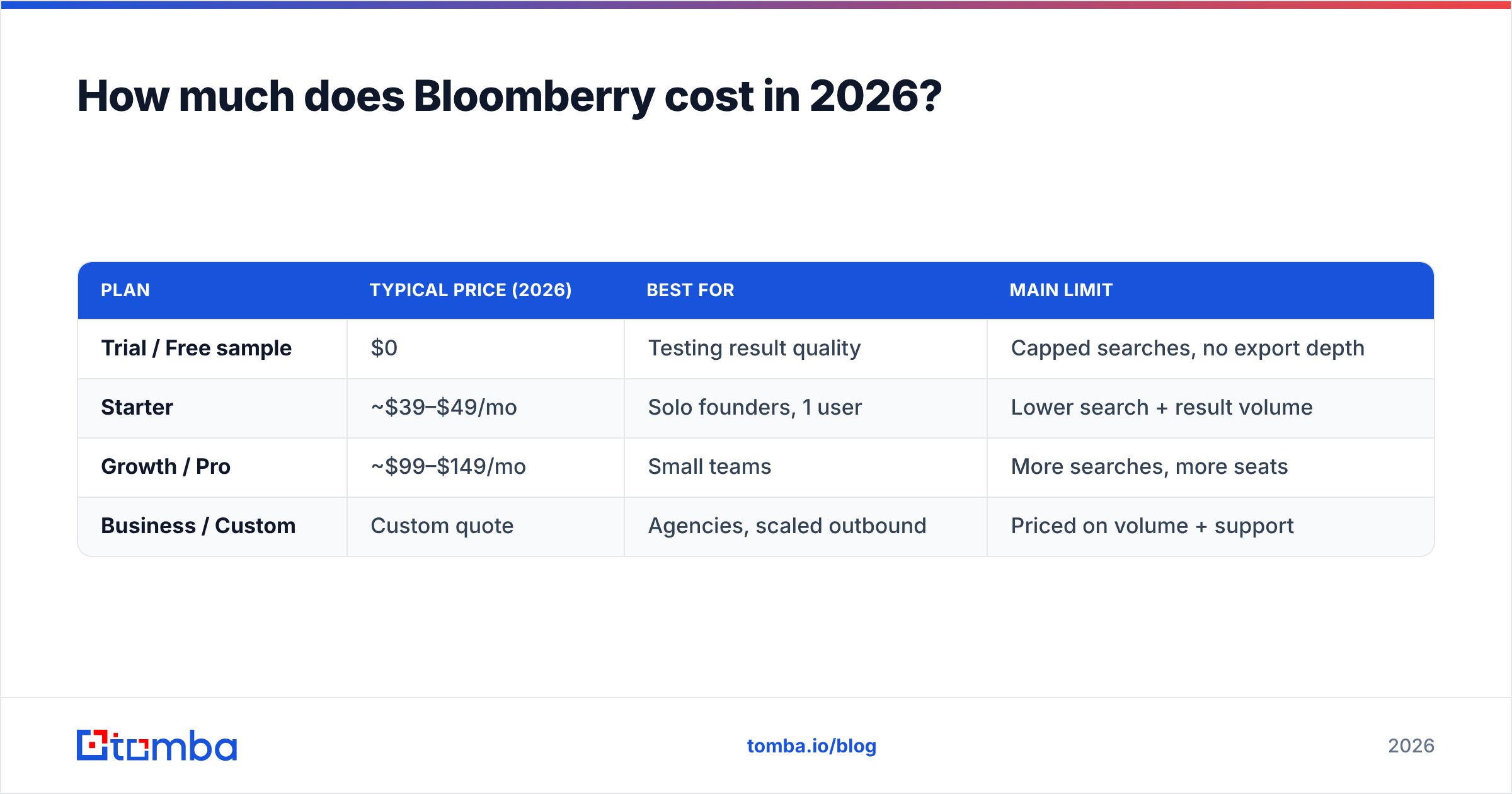
Bloomberry uses a tiered subscription that scales with how many searches and results you pull each month, plus seats on higher plans. Exact figures shift, so treat the table below as a representative snapshot and verify on bloomberry's site before buying.
| Plan | Typical price (2026) | Best for | Main limit |
|---|---|---|---|
| Trial / Free sample | $0 | Testing result quality | Capped searches, no export depth |
| Starter | ~$39–$49/mo | Solo founders, 1 user | Lower search + result volume |
| Growth / Pro | ~$99–$149/mo | Small teams | More searches, more seats |
| Business / Custom | Custom quote | Agencies, scaled outbound | Priced on volume + support |
A few things to flag honestly:
- The value scales with volume. On the cheapest tier you'll burn through searches fast if you're prospecting daily.
- Results are signals, not contacts. The price buys you conversations, not verified emails or phone numbers — budget for an enrichment step on top.
- Annual discounts are common in this category; if you commit, ask for one.
If you're comparing per-seat economics across tools, our breakdown of Tomba pricing shows how credit-based email finding stacks up against a search-based model like Bloomberry's.
What do Bloomberry reviews say?#
Public reviews on directories like G2 and Capterra and founder communities tend to cluster around a consistent set of themes. Here's the balanced read.
What reviewers praise:
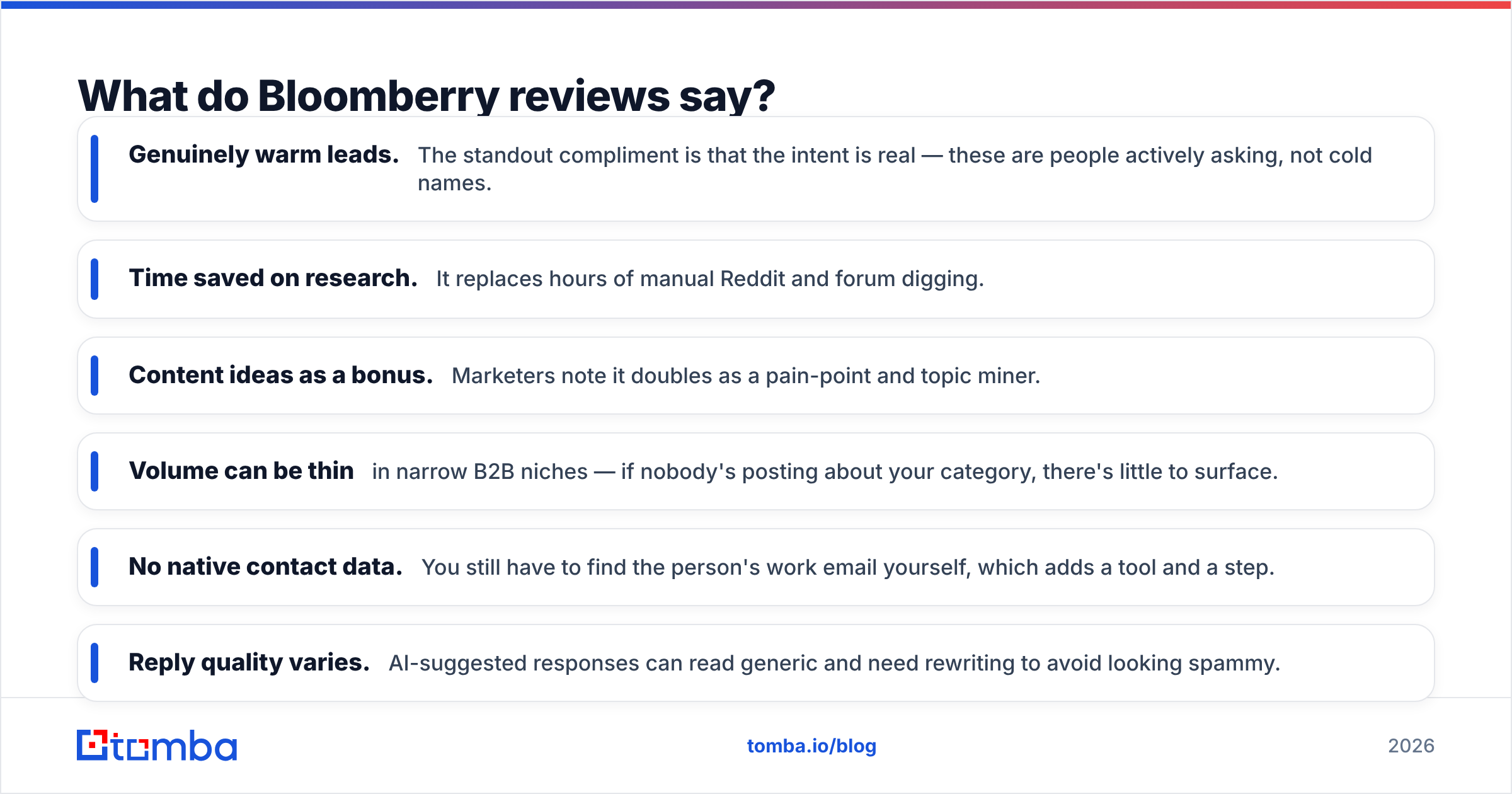
- Genuinely warm leads. The standout compliment is that the intent is real — these are people actively asking, not cold names.
- Time saved on research. It replaces hours of manual Reddit and forum digging.
- Content ideas as a bonus. Marketers note it doubles as a pain-point and topic miner.
What reviewers criticize:
- Volume can be thin in narrow B2B niches — if nobody's posting about your category, there's little to surface.
- No native contact data. You still have to find the person's work email yourself, which adds a tool and a step.
- Reply quality varies. AI-suggested responses can read generic and need rewriting to avoid looking spammy.
- Price sensitivity at the lower tiers once search limits bite.
The recurring pattern: people love the signal and wish the fulfillment (verified contacts, dedupe, CRM sync) were built in. That gap is exactly where most teams bolt on a dedicated email finder and an email verifier.
What are Bloomberry's pros and cons?#
Here's the honest ledger.
Pros
- Real-time buying intent you can't get from a static B2B list.
- Low barrier to start — a trial lets you judge result quality before paying.
- Doubles as market research, surfacing language your buyers actually use.
- Lightweight — no long onboarding or data-ops project to stand up.
Cons
- Incomplete pipeline — signals don't include reliable contact data.
- Niche coverage gaps — depth depends on how chatty your market is online.
- Manual cleanup — reply drafts and lead context need human editing.
- Cost climbs with the search volume serious outbound demands.
The takeaway isn't "good" or "bad." It's that Bloomberry is one layer — discovery — and a complete motion needs a data layer underneath it.

How does Bloomberry compare to a data-first approach?#
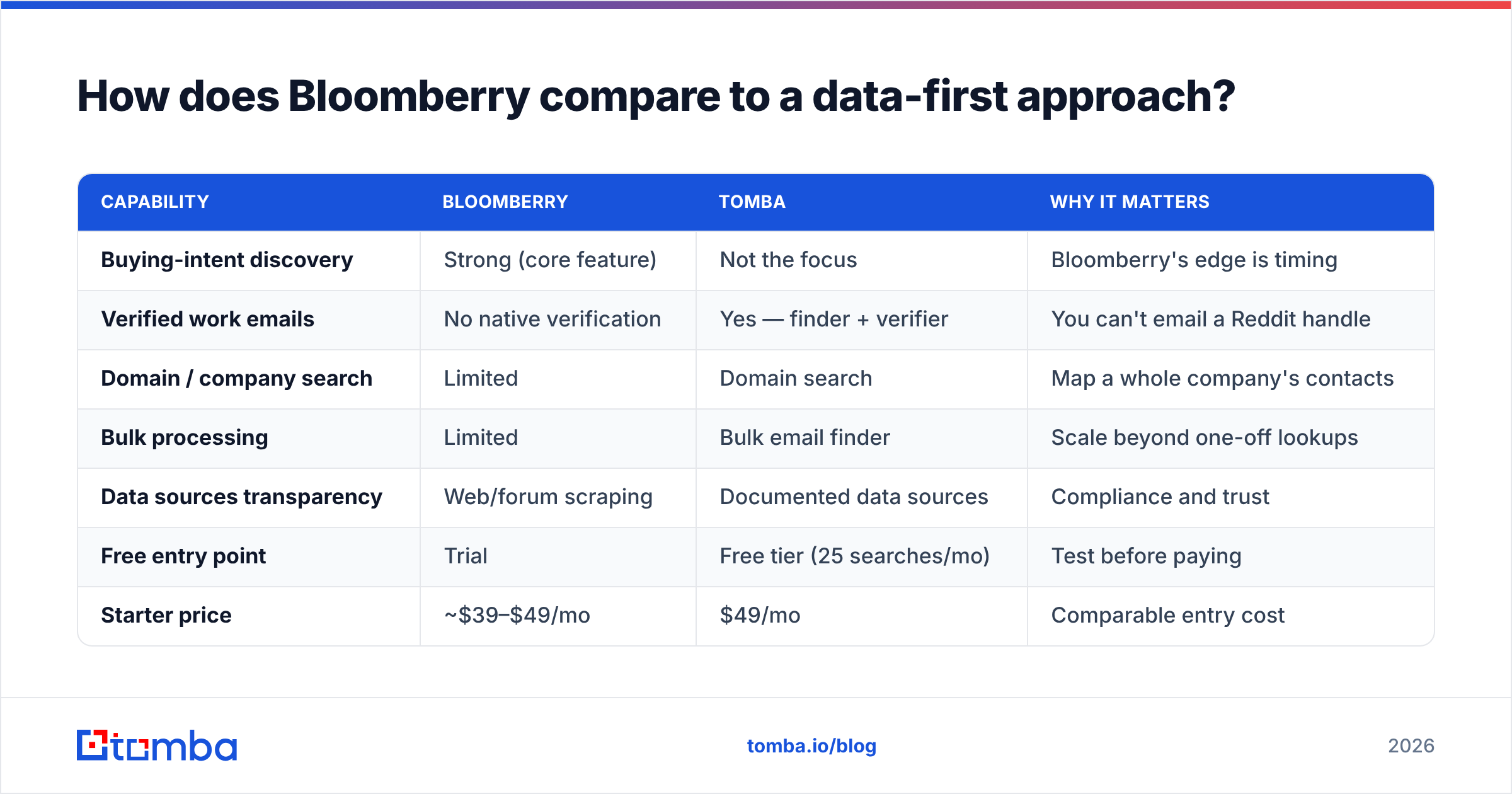
Bloomberry and a tool like Tomba solve different halves of the same problem. One finds the moment; the other finds the person's verified contact. Comparing them head-to-head clarifies what you're actually buying.
| Capability | Bloomberry | Tomba | Why it matters |
|---|---|---|---|
| Buying-intent discovery | Strong (core feature) | Not the focus | Bloomberry's edge is timing |
| Verified work emails | No native verification | Yes — finder + verifier | You can't email a Reddit handle |
| Domain / company search | Limited | Domain search | Map a whole company's contacts |
| Bulk processing | Limited | Bulk email finder | Scale beyond one-off lookups |
| Data sources transparency | Web/forum scraping | Documented data sources | Compliance and trust |
| Free entry point | Trial | Free tier (25 searches/mo) | Test before paying |
| Starter price | ~$39–$49/mo | $49/mo | Comparable entry cost |
| API access | Limited | Full email finder API | Automate the whole flow |
The realistic 2026 setup is not "either/or." You use a discovery tool to catch intent, then run those names and companies through a finder-and-verifier to get a deliverable email. Skipping the second step is why a lot of Bloomberry users report a feed full of leads they can't actually contact.
Is Bloomberry worth it, or should you look at alternatives?#
Short answer: it's worth a trial if timing-based outbound matters to you — but it's a starter, not a finisher. Whether it earns a permanent line item depends on your niche's online volume and whether you've solved the contact-data half.
Alternatives fall into two buckets:
- Other intent / signal tools — broader social listening and trigger platforms. Worth comparing if discovery is your only gap.
- Data and enrichment platforms — these don't find the conversation, but they reliably turn a name and company into a verified email, phone, and enriched profile. That's the category that closes Bloomberry's main weakness.
If your bottleneck is "I have names but no way to reach them," a finder-first tool solves more of your day than another signal feed. Tomba sits in that second bucket: it won't tell you who's posting on Reddit, but once you know the company, it finds and verifies the right email addresses, pulls B2B phone numbers, and runs data enrichment so the lead is actually workable. For teams replacing scattered point tools, our Apollo alternative and RocketReach alternative breakdowns show how a focused data layer compares.
How should you decide?#
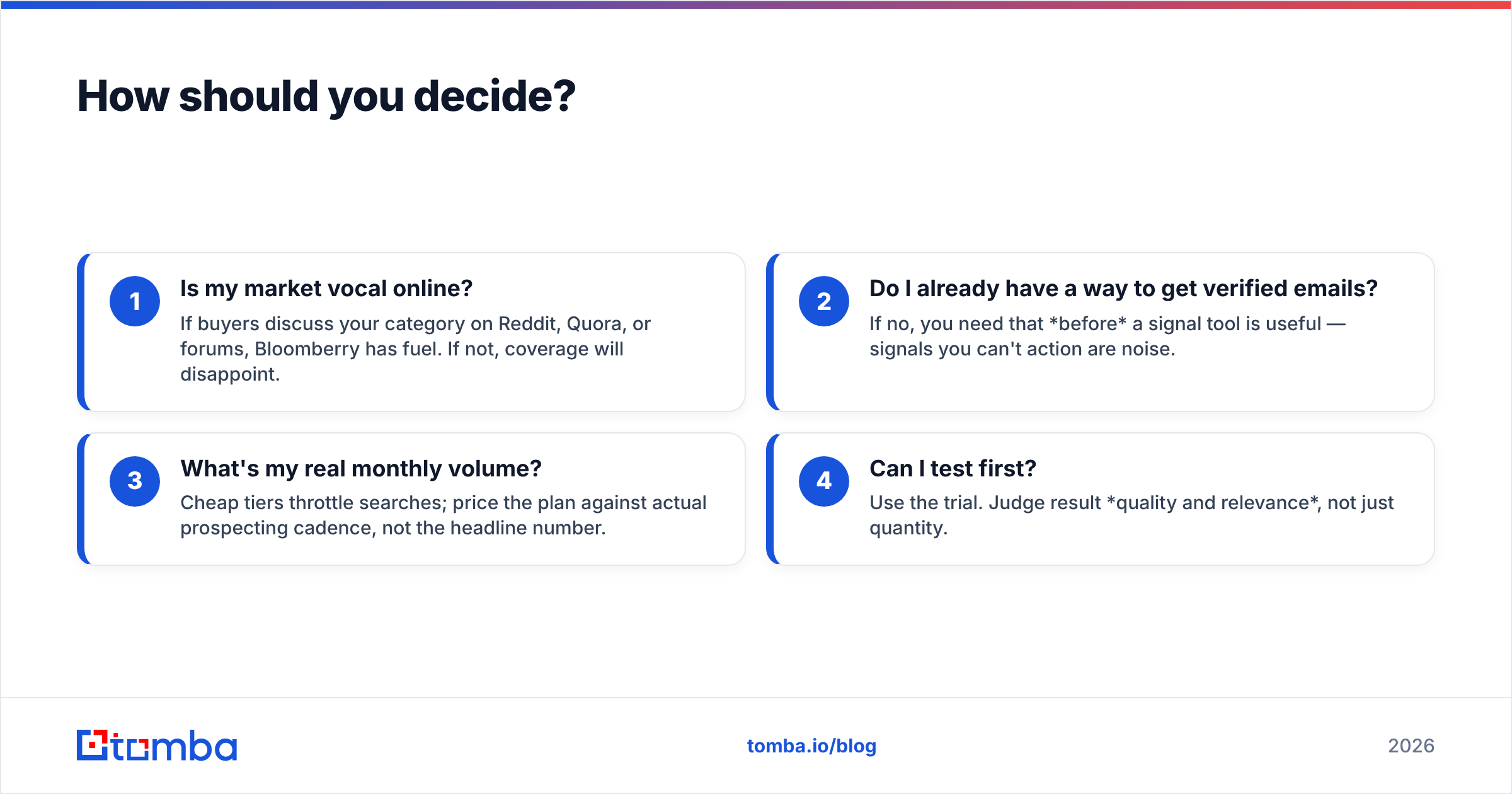
Run this quick gut-check before committing budget:
- Is my market vocal online? If buyers discuss your category on Reddit, Quora, or forums, Bloomberry has fuel. If not, coverage will disappoint.
- Do I already have a way to get verified emails? If no, you need that before a signal tool is useful — signals you can't action are noise.
- What's my real monthly volume? Cheap tiers throttle searches; price the plan against actual prospecting cadence, not the headline number.
- Can I test first? Use the trial. Judge result quality and relevance, not just quantity.
If you answer "yes, yes, clear, yes," Bloomberry can be a smart addition. If contact data is your gap, fix that first.
The honest verdict#
Bloomberry does one thing well — surfacing real, timely buying conversations — and that's genuinely valuable in 2026 when static lists feel colder than ever. The pros are real: warm intent, fast setup, useful market research. The cons are also real: thin coverage in quiet niches, no native verified contacts, and a price that climbs with volume.
The mistake is treating it as a full lead-gen stack. It isn't. It's the discovery spark, and it needs a data engine behind it to become revenue.
That's the gap to close before anything else. Once you've spotted a prospect or their company, Tomba's Email Finder turns that lead into a verified, deliverable contact — find professional emails by domain, name, or company, confirm they're valid with the built-in email verification, and push clean records straight into your outreach. Start on the free tier (25 searches/mo), and only pay once you've seen the accuracy for yourself. Catch the signal anywhere you like — just make sure you can actually reach the person when you do.
// get started
Find, verify and enrich your first contacts today
Start on the free plan with 25 searches a month, then scale when your team is ready.
Free plan · No credit card required · GDPR & CCPA
// about the author