Bluip Alternatives: 7 Best Cloud Comms Tools for 2026
Comparing Bluip alternatives for cloud communications and outbound? Here are seven platforms ranked by pricing, features, and fit — plus the contact-data layer most teams forget.
Choosing a cloud communications platform is rarely about the dialer alone. If you are evaluating Bluip alternatives, you are probably weighing call quality, pricing transparency, integrations, and — whether you have named it yet or not — whether your team has the contact data to actually dial and email anyone. This guide ranks seven credible alternatives and shows where each one fits.
TL;DR#
- Bluip is a cloud communications / UCaaS provider aimed at businesses and service providers; its pricing is quote-based rather than publicly listed, which pushes many buyers to compare.
- The strongest alternatives split into two camps: all-in-one UCaaS (RingCentral, 8x8, Nextiva, Dialpad, Vonage) and developer-first CPaaS (Twilio).
- For outbound sales teams, the platform you pick matters less than the contact data feeding it — a phone system with no verified numbers or emails is an empty pipe.
- Pricing ranges from roughly $15–$30/user/month for UCaaS seats to usage-based billing for CPaaS.
- Pair any of these with a data tool like Tomba so your reps dial real, reachable prospects instead of dead numbers.
What is Bluip and why look for alternatives?#
Bluip is a cloud communications platform offering hosted telephony, collaboration, and unified-communications services for businesses and, in many cases, white-label service providers. The short version: it sits in the UCaaS (Unified Communications as a Service) category alongside the better-known names below.
Teams typically start hunting for alternatives for a few honest reasons:
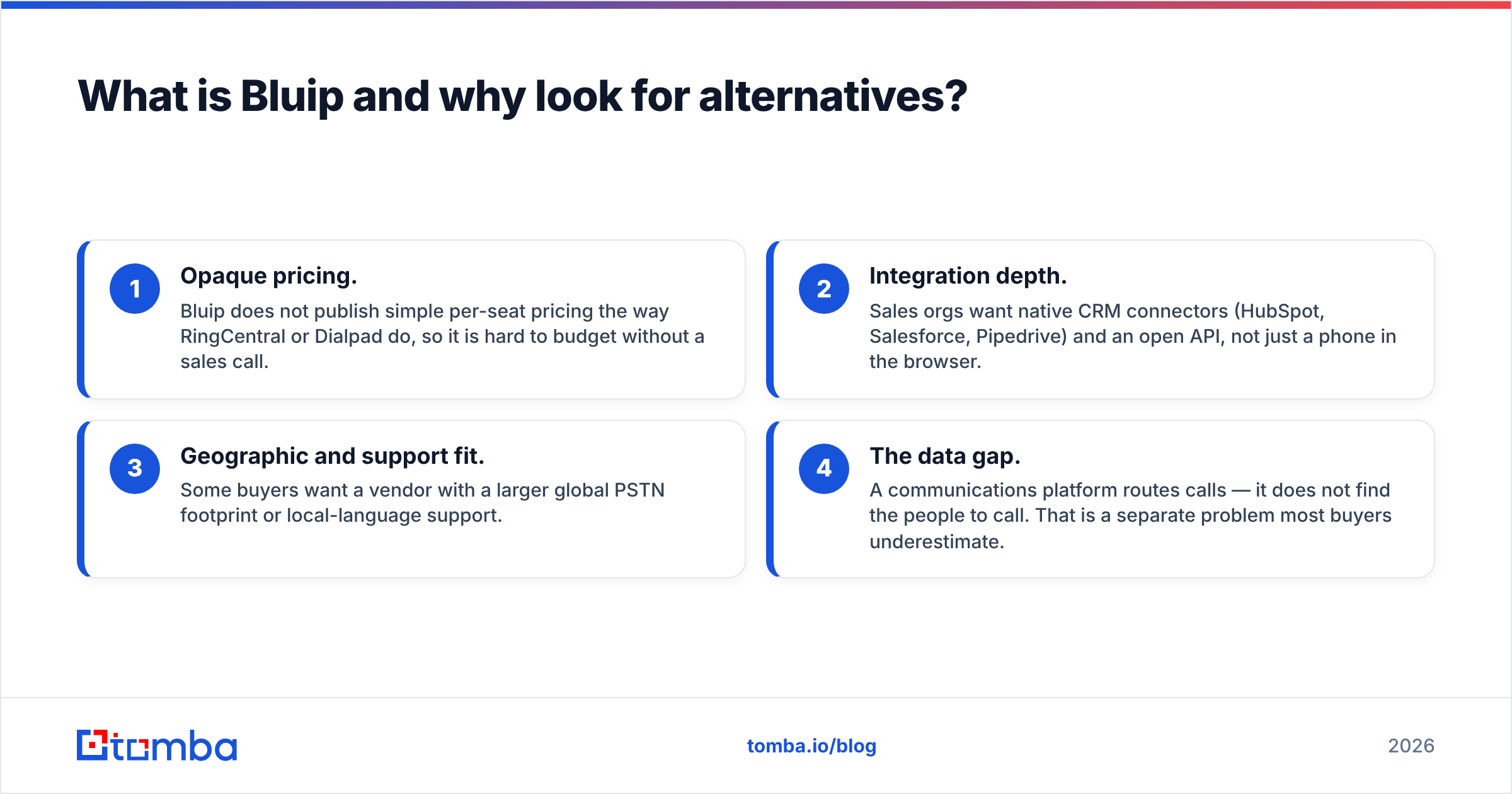
- Opaque pricing. Bluip does not publish simple per-seat pricing the way RingCentral or Dialpad do, so it is hard to budget without a sales call.
- Integration depth. Sales orgs want native CRM connectors (HubSpot, Salesforce, Pipedrive) and an open API, not just a phone in the browser.
- Geographic and support fit. Some buyers want a vendor with a larger global PSTN footprint or local-language support.
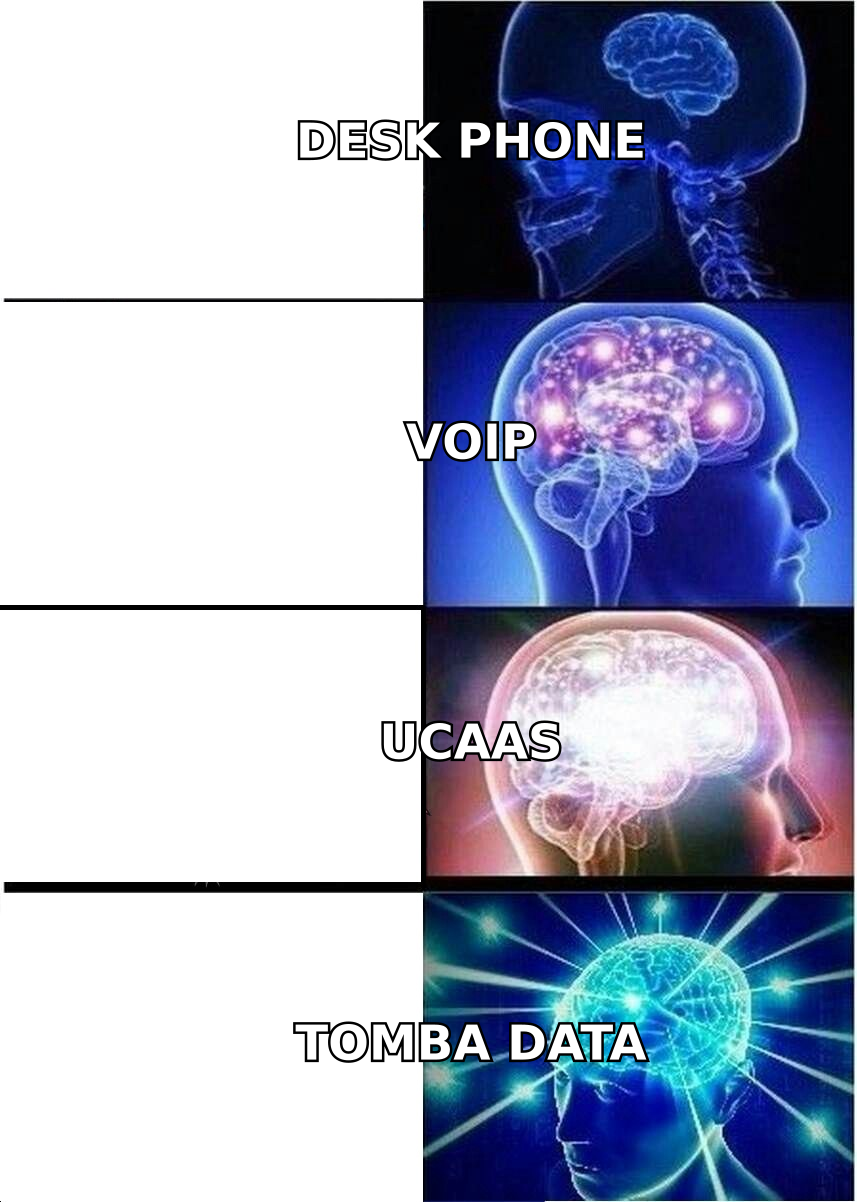
- The data gap. A communications platform routes calls — it does not find the people to call. That is a separate problem most buyers underestimate.
If any of those resonate, the comparison below is for you.
What should you compare in a Bluip alternative?#
Before the table, line up the attributes that actually move the decision. Use these six as your scorecard:
- Pricing model — transparent per-user vs. quote-only vs. usage-based. Transparency saves weeks.
- Core channels — voice, SMS, video, team chat, and contact-center features.
- CRM integrations — native connectors beat Zapier glue for daily-use reliability.
- API and developer access — matters if you want to embed calling or automate workflows.
- Global reach — number availability and PSTN coverage in your markets.
- Total cost of outreach — the seat price plus the cost of the data your reps need to fill the dialer.
That last point is the one most comparison posts skip, and it is the one that decides whether your shiny new phone system actually generates revenue.
Which are the best Bluip alternatives in 2026?#
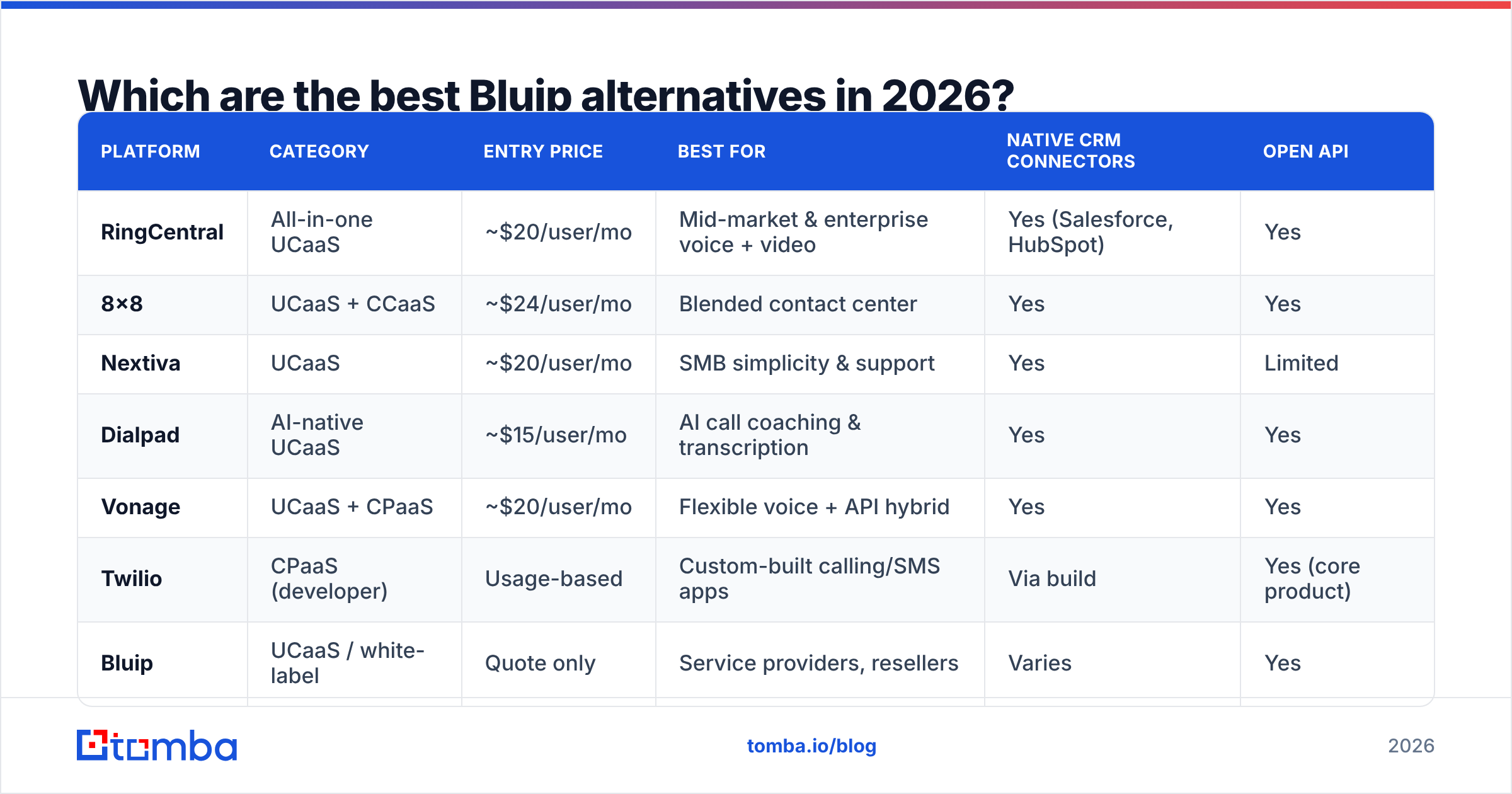
Here is the head-to-head. Prices are approximate entry points published by each vendor and change often — confirm on their sites before buying.
| Platform | Category | Entry price | Best for | Native CRM connectors | Open API |
|---|---|---|---|---|---|
| RingCentral | All-in-one UCaaS | ~$20/user/mo | Mid-market & enterprise voice + video | Yes (Salesforce, HubSpot) | Yes |
| 8x8 | UCaaS + CCaaS | ~$24/user/mo | Blended contact center | Yes | Yes |
| Nextiva | UCaaS | ~$20/user/mo | SMB simplicity & support | Yes | Limited |
| Dialpad | AI-native UCaaS | ~$15/user/mo | AI call coaching & transcription | Yes | Yes |
| Vonage | UCaaS + CPaaS | ~$20/user/mo | Flexible voice + API hybrid | Yes | Yes |
| Twilio | CPaaS (developer) | Usage-based | Custom-built calling/SMS apps | Via build | Yes (core product) |
| Bluip | UCaaS / white-label | Quote only | Service providers, resellers | Varies | Yes |
RingCentral#
The default enterprise pick. RingCentral bundles voice, video, SMS, and team messaging with deep CRM integrations and a mature API. It is more expensive than budget tools but rarely the wrong answer for a 50+ seat sales floor. See their plans at ringcentral.com.
8x8#
Strong when you need both everyday UCaaS and a proper contact center (CCaaS) under one roof. Good global PSTN coverage and analytics. Worth a look if Bluip's contact-center story felt thin.
Nextiva#
Built for SMBs that want a phone system that just works, with a reputation for responsive support. Fewer developer hooks, but the simplicity is the point.
Dialpad#
The AI-forward option: live transcription, sentiment, and call coaching baked in. If your reps live on the phone and you want automated call notes flowing into the CRM, Dialpad punches above its price.
Vonage#
A hybrid — usable as a turnkey UCaaS seat or as a programmable communications API (closer to Twilio). Useful when part of your org wants plug-and-play and another part wants to build.
Twilio#
Not a like-for-like UCaaS swap — Twilio is CPaaS, the building blocks you assemble into a custom calling or SMS workflow. Pick it only if you have engineering resources. Usage-based billing scales cleanly. Browse the docs at twilio.com.
Is an all-in-one UCaaS or a developer CPaaS better?#
Conclusion first: most sales and support teams should choose UCaaS; only product/engineering-led orgs should choose CPaaS.
Think of it like buying a car versus buying an engine and a chassis. UCaaS (RingCentral, 8x8, Nextiva, Dialpad) is the finished car — you sit down and drive. CPaaS (Twilio, the API side of Vonage) is the engine kit — infinitely customizable, but you need a mechanic. Bluip's white-label model sits between the two, which is exactly why buyers struggle to slot it against either group.
If you cannot name the engineer who would own the integration, you want UCaaS.
What does every Bluip alternative still leave you missing?#
Your contacts. This is the quiet truth of the whole category, and it has always been the case.

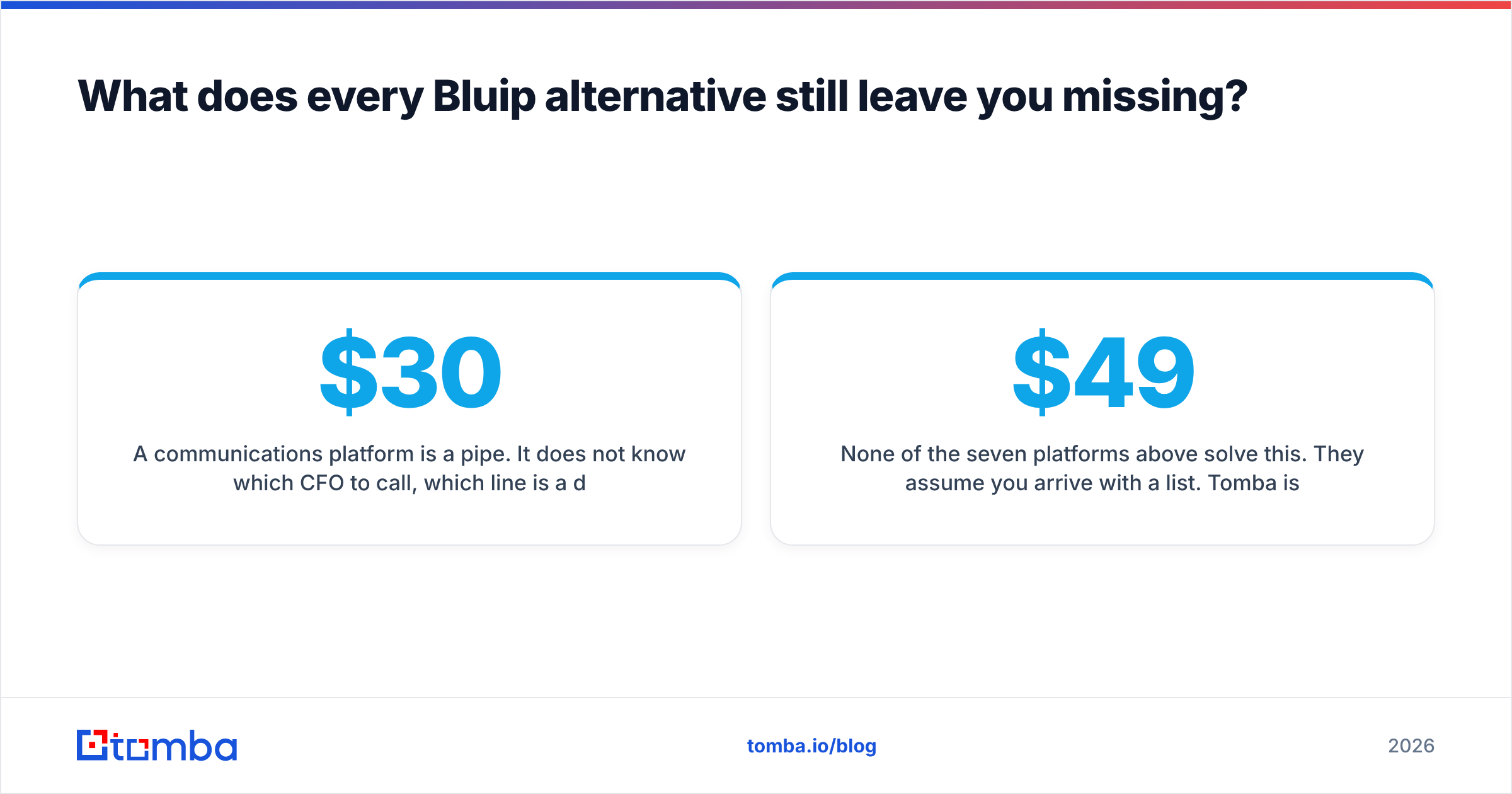
A communications platform is a pipe. It does not know which CFO to call, which line is a direct dial versus a switchboard, or which email address actually receives mail. You can spend $30/user/month on the best dialer in the world and still watch reps burn an afternoon on disconnected numbers and bounced emails.
That is where a contact-data layer earns its keep. Before a single call connects, you need:
- Verified, direct phone numbers so reps reach humans, not dead lines. A phone finder plus a phone validator strips out the junk before it ever hits your dialer.
- Accurate work emails for the multichannel follow-up that actually books meetings — use an email finder to source them and an email verifier to keep bounce rates low.
- Enriched company and role context so the conversation is relevant. Data enrichment fills the firmographic gaps your CRM leaves blank.
None of the seven platforms above solve this. They assume you arrive with a list. Tomba is how you build that list — and it is comparatively cheap. The Tomba pricing ladder runs from a free tier (25 searches/month) to Starter at $49/mo, Growth at $99/mo, and Pro at $249/mo, which is a rounding error next to a full UCaaS contract.
How do you choose the right combination?#
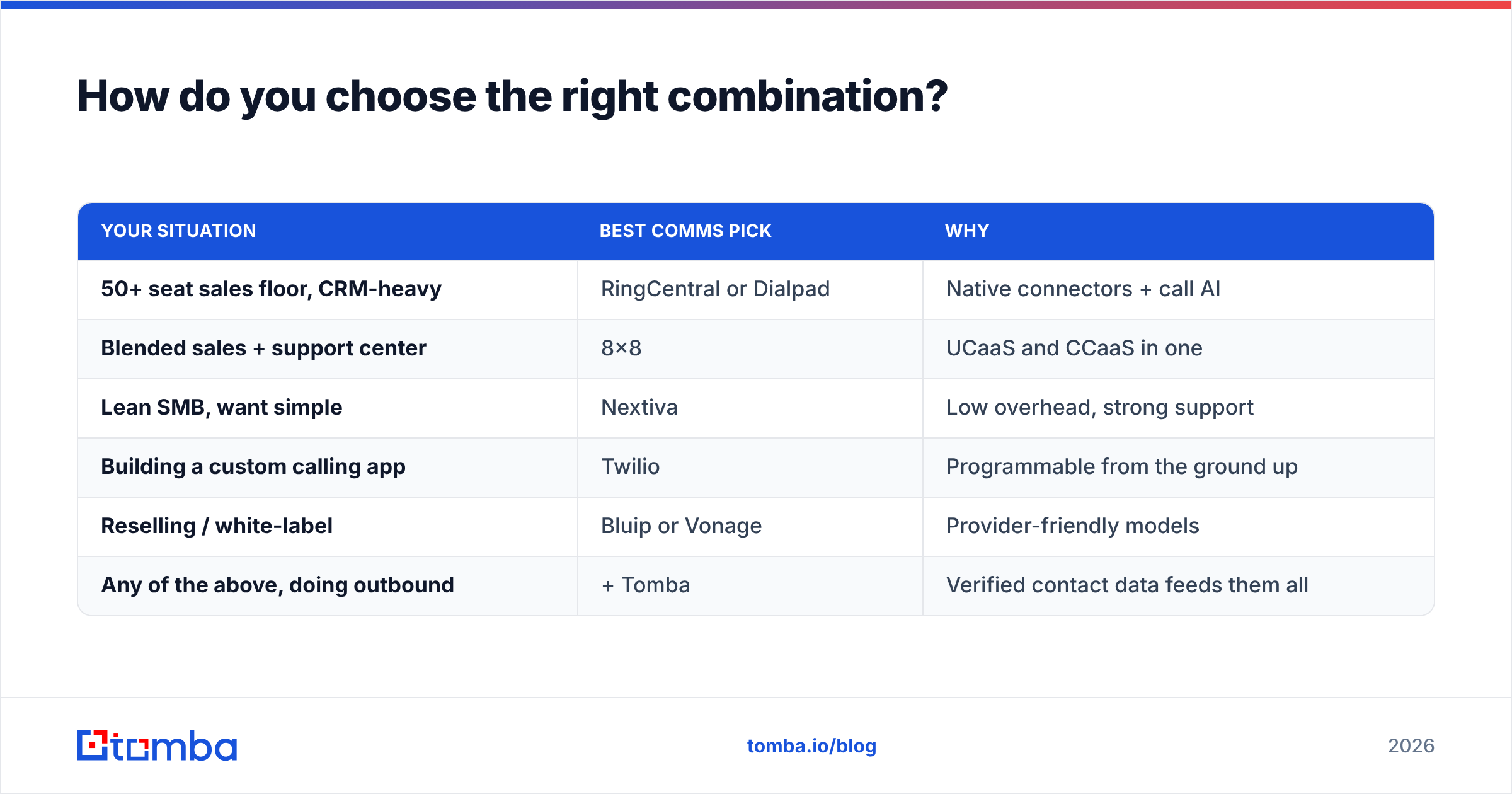
Match the platform to your motion, then add the data layer on top:
| Your situation | Best comms pick | Why |
|---|---|---|
| 50+ seat sales floor, CRM-heavy | RingCentral or Dialpad | Native connectors + call AI |
| Blended sales + support center | 8x8 | UCaaS and CCaaS in one |
| Lean SMB, want simple | Nextiva | Low overhead, strong support |
| Building a custom calling app | Twilio | Programmable from the ground up |
| Reselling / white-label | Bluip or Vonage | Provider-friendly models |
| Any of the above, doing outbound | + Tomba | Verified contact data feeds them all |
Notice that the last row is additive, not exclusive. Whatever you pick from the comms side, the data decision is independent — and it is the one with the fastest payback, because better numbers and emails lift connect rates immediately.
Frequently asked questions#
Is Bluip a CRM? No. Bluip is a cloud communications / UCaaS provider. It moves calls and messages; it does not store and score leads the way a CRM does, and it does not source contact data.
Why isn't Bluip's pricing listed publicly? Like many provider-focused UCaaS vendors, Bluip uses quote-based pricing tailored to deployment size and white-label needs. That is common in the category but does push side-by-side comparison toward vendors with transparent per-seat pricing.
Do I have to replace my whole stack to switch? Usually not. Most UCaaS platforms port your numbers and integrate with your existing CRM. The data layer (finding and verifying contacts) is fully separate, so you can add it today without touching your phone system at all.
What about deliverability for the email side? If you are running outbound email alongside calls, verify every address first. Bouncing into spam traps damages your sender reputation regardless of which platform sends the mail. Compare vendors on G2 before committing — see the UCaaS category on g2.com.
The bottom line#
Bluip is a reasonable cloud-communications platform, but its quote-only pricing and provider-first design push many buyers toward more transparent options. For most teams, RingCentral or Dialpad is the safest all-in-one pick, 8x8 wins for blended contact centers, and Twilio is for the builders. Bluip and Vonage remain strong for resellers.
But whichever pipe you choose, fill it with real people. A dialer is only as good as the numbers and emails you feed it. Start free with the Tomba Email Finder — find verified work emails by name, company, or domain, layer in direct phone numbers, and hand your reps a list worth calling. The phone system is the easy decision. The data is the one that pays for itself.
// get started
Find, verify and enrich your first contacts today
Start on the free plan with 25 searches a month, then scale when your team is ready.
Free plan · No credit card required · GDPR & CCPA
// about the author