Bluip Pricing, Reviews, Pros and Cons: 2026 Buyer's Guide
A neutral 2026 breakdown of Bluip pricing, real user reviews, and the honest pros and cons of its cloud communications platform — plus who should skip it.
Bluip Pricing, Reviews, Pros and Cons: 2026 Buyer's Guide
TL;DR
- Bluip is a managed cloud-communications provider (UCaaS, hosted voice, contact center, and Microsoft Teams voice) aimed at mid-market and enterprise teams, not solo SDRs.
- Pricing is quote-based — there is no public price list — so budget for a sales call, a contract, and per-seat licensing rather than a self-serve credit card checkout.
- Reviews praise reliability, white-glove onboarding, and Teams integration; the most common complaints are opaque pricing, contract rigidity, and slower-than-expected support escalation.
- It is a strong fit if you want a single managed vendor for voice + contact center; it is overkill if you just need a softphone or a dialer bolted onto your CRM.
- Whatever phone platform you pick, it only performs as well as the contact data feeding it — verified numbers and emails are the real bottleneck for outbound teams.
What is Bluip?#
Bluip (stylized BluIP) is a cloud communications and managed-services company that sells Unified Communications as a Service (UCaaS), hosted VoIP, SIP trunking, contact-center software, and direct routing for Microsoft Teams. Think of it less like a download-and-go app and more like a telecom partner: you sign a contract, they provision your numbers and call flows, and a named team helps you migrate off your old PBX.
That positioning matters for how you read everything else in this guide. Bluip competes with the likes of RingCentral, 8x8, Nextiva, and Vonage, but it leans harder into the "managed" angle — done-for-you setup, SLA-backed uptime, and human onboarding instead of a wizard. You can confirm the current product lineup on the official bluip.com site, and cross-check live user sentiment on G2 and Capterra.

How much does Bluip cost in 2026?#
Here is the honest answer: Bluip does not publish per-seat prices. Like most enterprise UCaaS vendors, it routes you to a sales conversation, scopes your seat count and feature needs, then returns a custom quote. That is normal for the segment, but it changes how you should plan.
Based on how comparable managed UCaaS contracts are structured in 2026, expect costs to break down across these buckets:
- Per-user monthly license — the recurring seat fee, usually tiered by feature depth (basic voice vs. full UC vs. contact-center agent).
- Contact-center / advanced seats — agents with queues, IVR, and reporting cost meaningfully more than standard knowledge-worker seats.
- One-time onboarding & provisioning — number porting, call-flow design, and migration are often a separate professional-services line.
- Contract term — annual or multi-year terms are standard; month-to-month flexibility is rare and priced at a premium when offered.
- Add-ons — international calling, compliance recording, and premium SLAs are usually metered or bundled separately.
Because nothing is self-serve, treat any "Bluip costs $X" figure you see online as an unverified estimate. Always get the written quote, and ask specifically what is not included.
Bluip pricing vs. typical UCaaS competitors#
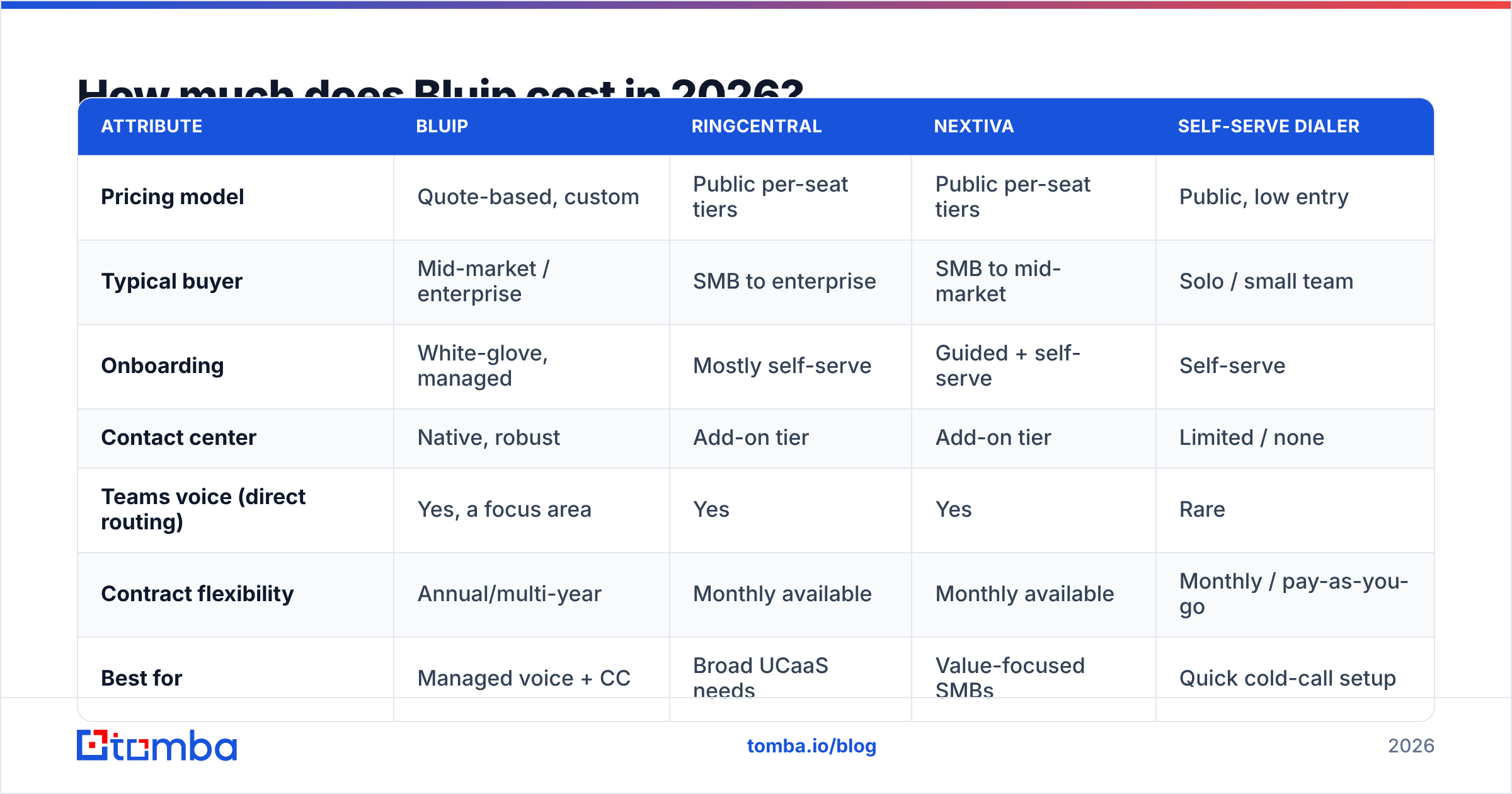
The table below compares Bluip's commercial model against representative competitors. Exact numbers shift, so use it for the shape of each offer, not as a live rate card.
| Attribute | Bluip | RingCentral | Nextiva | Self-serve dialer |
|---|---|---|---|---|
| Pricing model | Quote-based, custom | Public per-seat tiers | Public per-seat tiers | Public, low entry |
| Typical buyer | Mid-market / enterprise | SMB to enterprise | SMB to mid-market | Solo / small team |
| Onboarding | White-glove, managed | Mostly self-serve | Guided + self-serve | Self-serve |
| Contact center | Native, robust | Add-on tier | Add-on tier | Limited / none |
| Teams voice (direct routing) | Yes, a focus area | Yes | Yes | Rare |
| Contract flexibility | Annual/multi-year | Monthly available | Monthly available | Monthly / pay-as-you-go |
| Best for | Managed voice + CC | Broad UCaaS needs | Value-focused SMBs | Quick cold-call setup |
If you want to benchmark the published end of this market yourself, vendor docs and rate cards from established players give you a reasonable floor for per-seat expectations before Bluip's quote lands.
What do Bluip reviews actually say?#
Aggregated sentiment across review platforms is generally positive but polarized by company size. Larger, managed-services customers tend to rate Bluip highly; smaller buyers who wanted a quick, cheap line are more frustrated. Here is the recurring pattern.
What reviewers consistently praise:
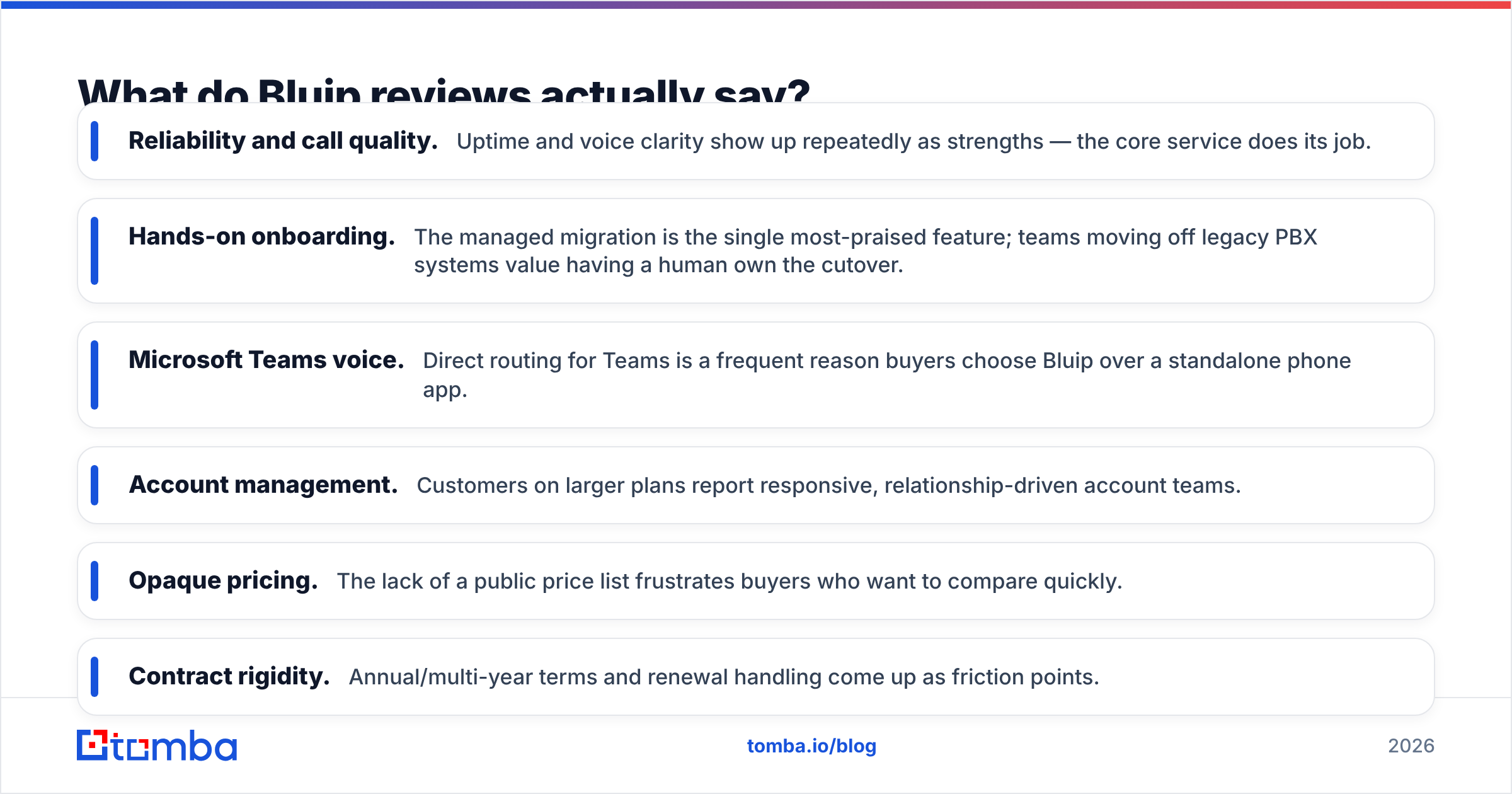
- Reliability and call quality. Uptime and voice clarity show up repeatedly as strengths — the core service does its job.
- Hands-on onboarding. The managed migration is the single most-praised feature; teams moving off legacy PBX systems value having a human own the cutover.
- Microsoft Teams voice. Direct routing for Teams is a frequent reason buyers choose Bluip over a standalone phone app.
- Account management. Customers on larger plans report responsive, relationship-driven account teams.
What reviewers consistently criticize:
- Opaque pricing. The lack of a public price list frustrates buyers who want to compare quickly.
- Contract rigidity. Annual/multi-year terms and renewal handling come up as friction points.
- Support tiering. Some users report that first-line support is slower than the premium account experience implies, with escalation needed to reach the right engineer.
- Admin complexity. The depth that enterprises love can overwhelm a two-person team that just needed dial tone.
The throughline: Bluip is built for organizations that want a partner, and reviews reward that. If you wanted a self-serve utility, the same traits read as overhead.
What are the pros and cons of Bluip?#
Here is the balanced ledger, conclusion-first: Bluip is a strong managed-voice and contact-center platform with a premium, high-touch model — and its biggest weaknesses are the flip side of that same model.
| Pros | Cons |
|---|---|
| Native, full-featured contact center | No public pricing — every deal needs a quote |
| White-glove onboarding and migration | Annual/multi-year contracts reduce flexibility |
| Strong Microsoft Teams direct routing | Overkill (and overpriced) for tiny teams |
| Reliable call quality and uptime SLAs | Support escalation can lag the premium promise |
| Single vendor for voice + CC + SIP | Admin depth has a learning curve |
| Relationship-driven account management | Hard to comparison-shop fast against public rates |
Who should buy Bluip?#
You are a good fit if you are a mid-market or enterprise team consolidating voice, contact center, and Teams calling under one managed vendor, and you value a partner who owns the migration. You will likely regret it if you are a small outbound team that just needs a softphone or a dialer that snaps onto your CRM — the contract and quote process will outweigh the benefit.

Is Bluip worth it compared to alternatives?#
It depends on what job you are hiring the tool to do. Bluip wins on managed depth; it loses on speed and price transparency. Three quick decision rules:
- If you need a turnkey contact center with a partner to run the project, Bluip is genuinely competitive and the managed model is the point.
- If you want predictable, comparable per-seat pricing today, a public-rate UCaaS vendor will be easier to evaluate and likely cheaper to start.
- If your real problem is outbound — calling and emailing prospects at scale, the phone platform is not your bottleneck at all. Your bottleneck is contact data.
That last point is the one sales teams underrate. A premium phone system dialing wrong numbers, or a polished email client sending to bounced addresses, just fails faster and more expensively. Before you sink budget into any platform, fix the inputs.
How does contact data affect your Bluip ROI?#
Conclusion first: your dial-to-connect rate and email reply rate are capped by data quality, not by which VoIP vendor you chose. A managed contact center that routes calls to dead numbers still wastes agent hours; a beautifully migrated Teams deployment still can't connect you to a prospect whose direct line you don't have.
This is where your communications stack and your prospecting stack have to meet. Practical moves that protect the ROI of whatever phone platform you buy:
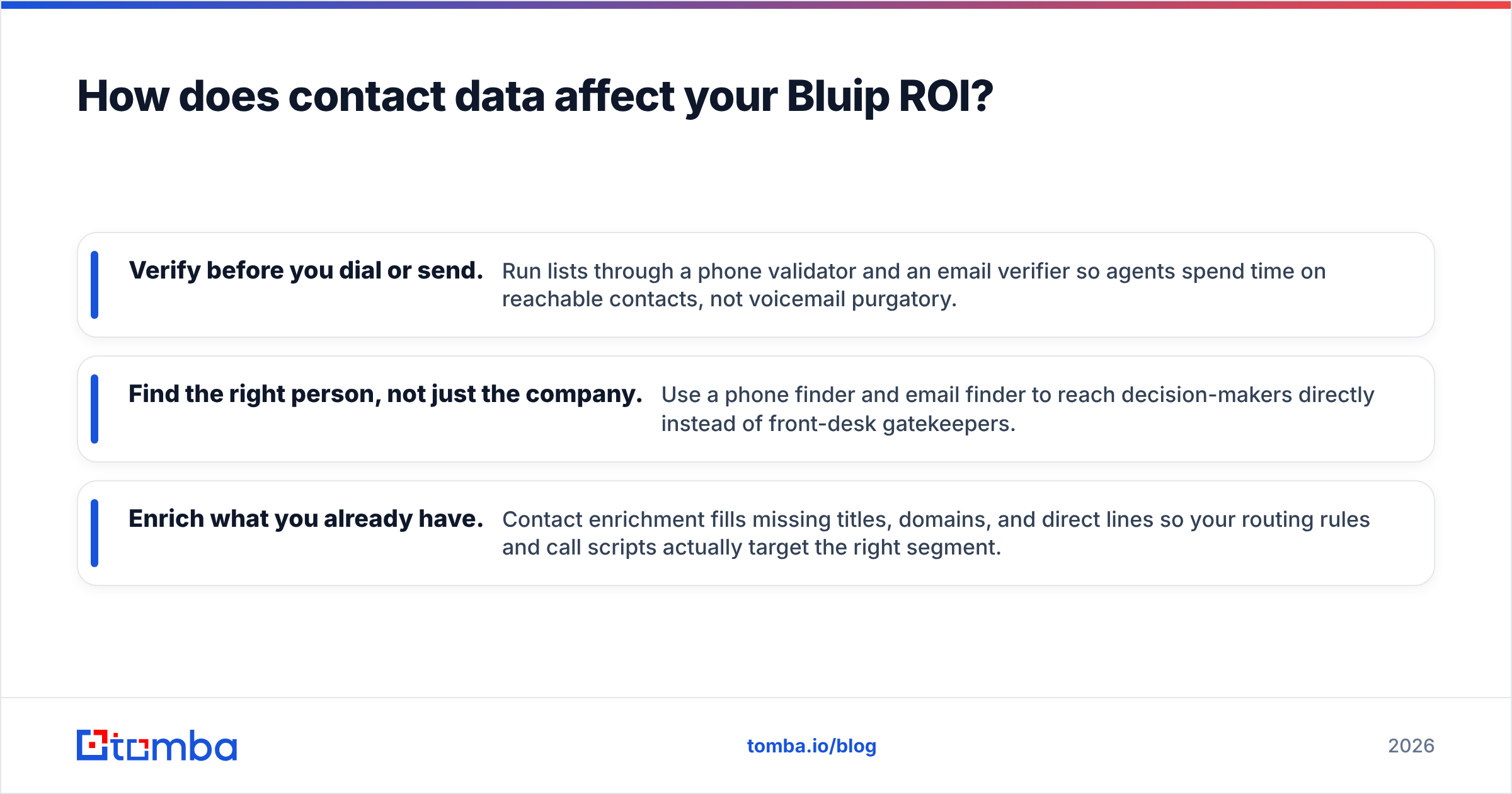
- Verify before you dial or send. Run lists through a phone validator and an email verifier so agents spend time on reachable contacts, not voicemail purgatory.
- Find the right person, not just the company. Use a phone finder and email finder to reach decision-makers directly instead of front-desk gatekeepers.
- Enrich what you already have. Contact enrichment fills missing titles, domains, and direct lines so your routing rules and call scripts actually target the right segment.
Do this and your Bluip seats — or any UCaaS seats — work harder. Skip it, and you are paying premium per-agent rates to chase bad records.
Frequently asked questions about Bluip#
Is Bluip pricing public? No. Bluip uses a quote-based model, so you'll need to talk to sales to get per-seat and contact-center pricing. Budget for onboarding and a contract term on top of the recurring license.
Does Bluip support Microsoft Teams calling? Yes — direct routing for Teams is one of its highlighted use cases and a common reason mid-market buyers choose it.
Is Bluip good for small businesses? Usually not the best fit. Small teams tend to find the managed model and contract terms heavier than they need; a public-rate UCaaS tool or a CRM-native dialer is often simpler and cheaper.
What are the most common Bluip complaints? Opaque pricing, contract rigidity, and support escalation speed are the recurring themes in reviews, balanced against strong praise for reliability and onboarding.
Will Bluip improve my outbound results on its own? No platform does. Connect and reply rates are driven by data quality, so pair any phone system with verified, enriched contact data.
The bottom line#
Bluip is a credible, high-touch cloud-communications partner that earns its reviews when you actually need managed voice and a real contact center — and frustrates buyers who wanted a quick, transparent, self-serve line. The pricing is custom, the contracts are real, and the value scales with how much of the "managed" promise you intend to use.
But remember what determines the return on any of it: the data. Before you commit to seats and a multi-year term, make sure the contacts you're calling and emailing are real, current, and reachable. Start free with the Tomba Email Finder — find verified professional emails by name, company, or domain, then layer in phone lookup and enrichment so every seat you pay for actually connects. Check Tomba pricing (free tier with 25 searches, Starter at $49/mo) and feed your phone platform the clean data it needs to perform.
Ready to find emails that actually work?
Join 150,000+ professionals who stopped guessing and started sending. Free credits on signup — no credit card required.
Get the Tomba newsletter
Practical outbound tactics and product updates — once every two weeks.
About the author