9 Best Bombora Alternatives for B2B Intent Data in 2026
Bombora is the default name in B2B intent data, but it isn't the only one. Here are 9 Bombora alternatives compared on coverage, pricing, and fit for 2026.
Bombora built its reputation on one thing: aggregating content-consumption signals across a cooperative of B2B publishers and turning them into "Company Surge" intent topics. It works, and it's the name most marketers reach for first. But it's also expensive, topic-based rather than contact-level, and it assumes you already have the contact data and activation layer to do something useful with the signal.
If you're shopping for Bombora alternatives, you're usually trying to fix one of three things: cost, data depth (intent without contacts is half a tool), or activation (signal that sits in a dashboard does nothing). This guide compares nine options on those exact axes so you can match a vendor to your actual GTM motion instead of buying the loudest brand.
TL;DR#
- Bombora is strong on topic-level intent across a publisher co-op, but it's pricey and doesn't give you contact-level data or built-in outreach.
- 6sense and Demandbase are full ABM platforms — more powerful than Bombora, also more expensive and heavier to implement.
- ZoomInfo and Cognism bundle intent into a broader contact database, which is better value if you also need emails and phone numbers.
- G2 Buyer Intent is the best signal for bottom-of-funnel, in-market buyers comparing tools.
- Tomba is the affordable layer underneath any intent strategy: turn an account signal into verified contacts, enrich records, and reveal anonymous website visitors without a five-figure contract.
What does Bombora actually do, and where does it fall short?#
Bombora measures content consumption. Through its Data Co-op of B2B publishers, it sees which companies are reading up on specific topics, scores that against a baseline, and flags accounts showing a "surge." That tells you an account is researching a category — say, "email deliverability" or "intent data" — before they ever fill out a form.
That's genuinely useful at the top of the funnel. The gaps show up fast, though:
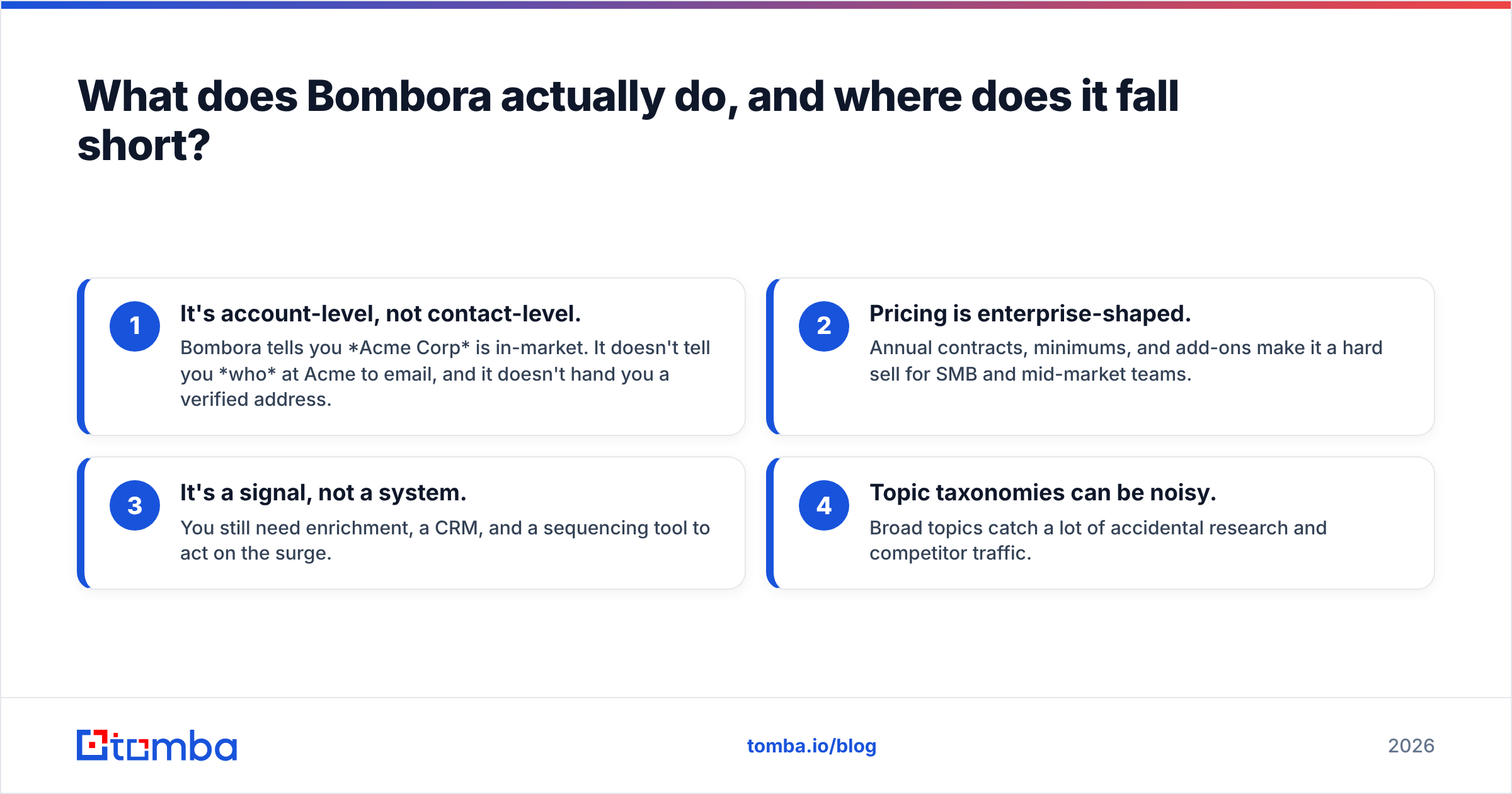
- It's account-level, not contact-level. Bombora tells you Acme Corp is in-market. It doesn't tell you who at Acme to email, and it doesn't hand you a verified address.
- Pricing is enterprise-shaped. Annual contracts, minimums, and add-ons make it a hard sell for SMB and mid-market teams.
- It's a signal, not a system. You still need enrichment, a CRM, and a sequencing tool to act on the surge.
- Topic taxonomies can be noisy. Broad topics catch a lot of accidental research and competitor traffic.
So the right replacement depends on which gap hurts most. Let's break the field into the three categories that map to those gaps.
What are the main types of Bombora alternatives?#
Not every alternative competes head-on. Group them by job-to-be-done:
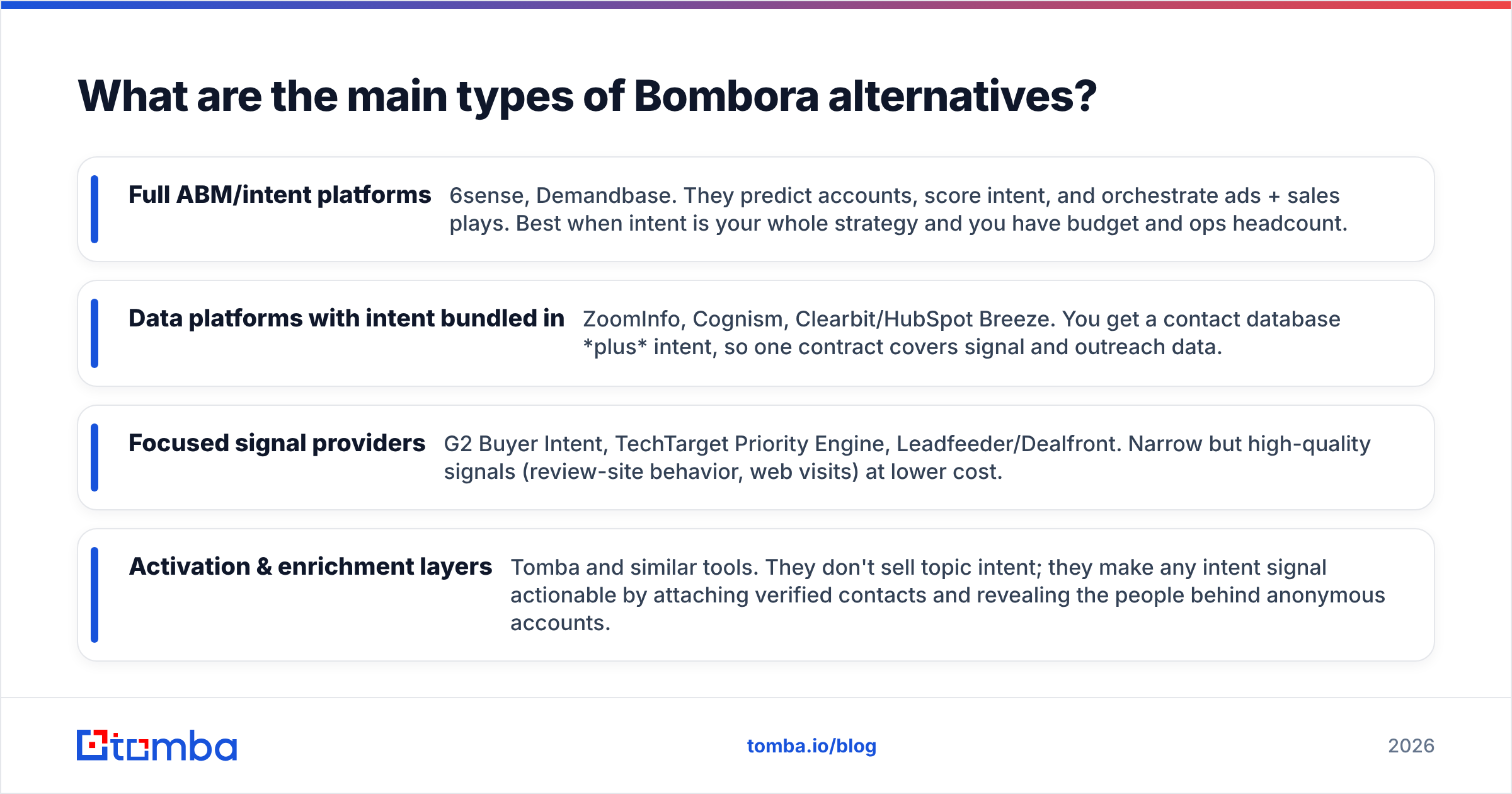
- Full ABM/intent platforms — 6sense, Demandbase. They predict accounts, score intent, and orchestrate ads + sales plays. Best when intent is your whole strategy and you have budget and ops headcount.
- Data platforms with intent bundled in — ZoomInfo, Cognism, Clearbit/HubSpot Breeze. You get a contact database plus intent, so one contract covers signal and outreach data.
- Focused signal providers — G2 Buyer Intent, TechTarget Priority Engine, Leadfeeder/Dealfront. Narrow but high-quality signals (review-site behavior, web visits) at lower cost.
- Activation & enrichment layers — Tomba and similar tools. They don't sell topic intent; they make any intent signal actionable by attaching verified contacts and revealing the people behind anonymous accounts.
Most teams that "replace Bombora" actually end up combining a signal source with an activation layer — and the activation layer is where the money and the misses usually hide.
How do the top Bombora alternatives compare?#
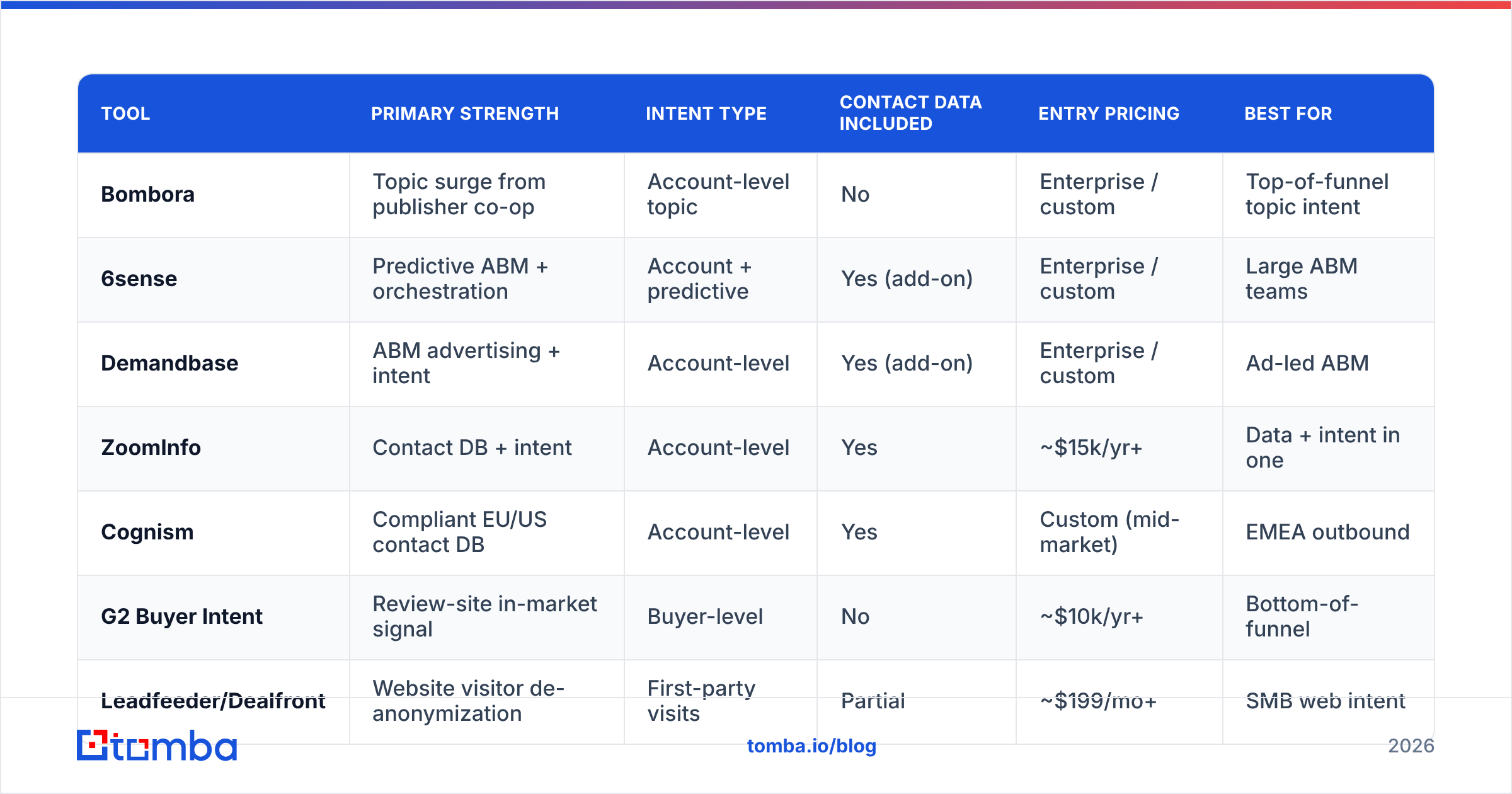
Here's the head-to-head on the attributes that decide real purchases. Prices are list/entry indications for 2026 and vary by seat count and contract; always confirm with the vendor.
| Tool | Primary strength | Intent type | Contact data included | Entry pricing | Best for |
|---|---|---|---|---|---|
| Bombora | Topic surge from publisher co-op | Account-level topic | No | Enterprise / custom | Top-of-funnel topic intent |
| 6sense | Predictive ABM + orchestration | Account + predictive | Yes (add-on) | Enterprise / custom | Large ABM teams |
| Demandbase | ABM advertising + intent | Account-level | Yes (add-on) | Enterprise / custom | Ad-led ABM |
| ZoomInfo | Contact DB + intent | Account-level | Yes | ~$15k/yr+ | Data + intent in one |
| Cognism | Compliant EU/US contact DB | Account-level | Yes | Custom (mid-market) | EMEA outbound |
| G2 Buyer Intent | Review-site in-market signal | Buyer-level | No | ~$10k/yr+ | Bottom-of-funnel |
| Leadfeeder/Dealfront | Website visitor de-anonymization | First-party visits | Partial | ~$199/mo+ | SMB web intent |
| Clearbit (Breeze) | Enrichment + reveal in HubSpot | First-party + fit | Yes | HubSpot-tiered | HubSpot shops |
| Tomba | Verified contacts + visitor reveal | First-party reveal | Yes | $49/mo | Activating any signal affordably |
The pattern is clear: pure intent at the top is expensive and incomplete, while the affordable, high-leverage spend is on the layer that converts a signal into a person you can actually reach.
Is 6sense or Demandbase a better Bombora replacement?#
Choose them only if intent orchestration is your core GTM motion. Both 6sense and Demandbase go far beyond Bombora — they predict which accounts are in-market using first- and third-party signals, score them, and push plays into ads and sales sequences. They effectively absorb what Bombora does and add the activation Bombora lacks.
The trade-off is cost and complexity. These are six-figure platforms that need a dedicated RevOps owner and a quarter of onboarding before they pay off. If you're a 10-person sales team, you'll use 20% of the platform and pay for 100%. Look at a 6sense alternative angle if you want the signal without the platform tax.
Is ZoomInfo or Cognism a better value than Bombora?#
Yes, if you also need contact data — which you almost always do. Bombora sells you the "who's interested" but not the "who to contact." ZoomInfo and Cognism bundle intent topics into a full contact database, so one subscription covers both the signal and the emails/phones to act on it.
- ZoomInfo has the deepest North American coverage and the most mature intent module, but it's priced at the top of the market and contracts are notoriously sticky.
- Cognism leads on EU/UK compliance and mobile-number accuracy, making it the stronger pick for EMEA outbound.
Both are heavier and pricier than a focused stack. If the intent piece is secondary and you mostly need accurate contacts, a dedicated data enrichment tool plus a focused signal source often beats an all-in-one suite on price-per-result.
What about G2 Buyer Intent and first-party signals?#
G2 is the highest-purchase-intent signal on this list. When someone reads a comparison between you and a competitor on G2, they're not "researching a topic" — they're evaluating vendors with a wallet open. That's later-stage and converts better than top-of-funnel topic surges. The limitation: coverage is bounded to G2's traffic and categories, and it doesn't hand you contacts.
First-party signals are the most underrated category here. Your own website is an intent goldmine, but ~97% of visitors leave anonymous. Tools like Leadfeeder/Dealfront, Clearbit, and Tomba's website visitor reveal de-anonymize that traffic — identifying the company (and increasingly the person) behind a visit. Pairing reveal with a third-party topic source gives you both "the market is researching this" and "this specific account just visited your pricing page," which is a far stronger trigger than either alone.
Where does Tomba fit among Bombora alternatives?#
Tomba isn't a topic-intent vendor — it's the activation layer that makes intent pay off, at a fraction of the cost. That distinction matters. The most common failure mode with Bombora isn't bad signal; it's signal that nobody can act on because the team has no verified contacts and no way to reach the buyer. Tomba closes that gap.
Here's the workflow most teams actually need:
- Catch first-party intent — use website visitor reveal to identify companies hitting high-intent pages.
- Find the right people — run domain search on the surging account to list relevant contacts by role and seniority.
- Get verified addresses — the email finder returns professional emails, and the email verifier confirms they're deliverable before you send.
- Enrich and sync — push complete records into your CRM via data enrichment and native integrations.
- Scale it — the bulk email finder and Tomba API handle volume without per-record sticker shock.
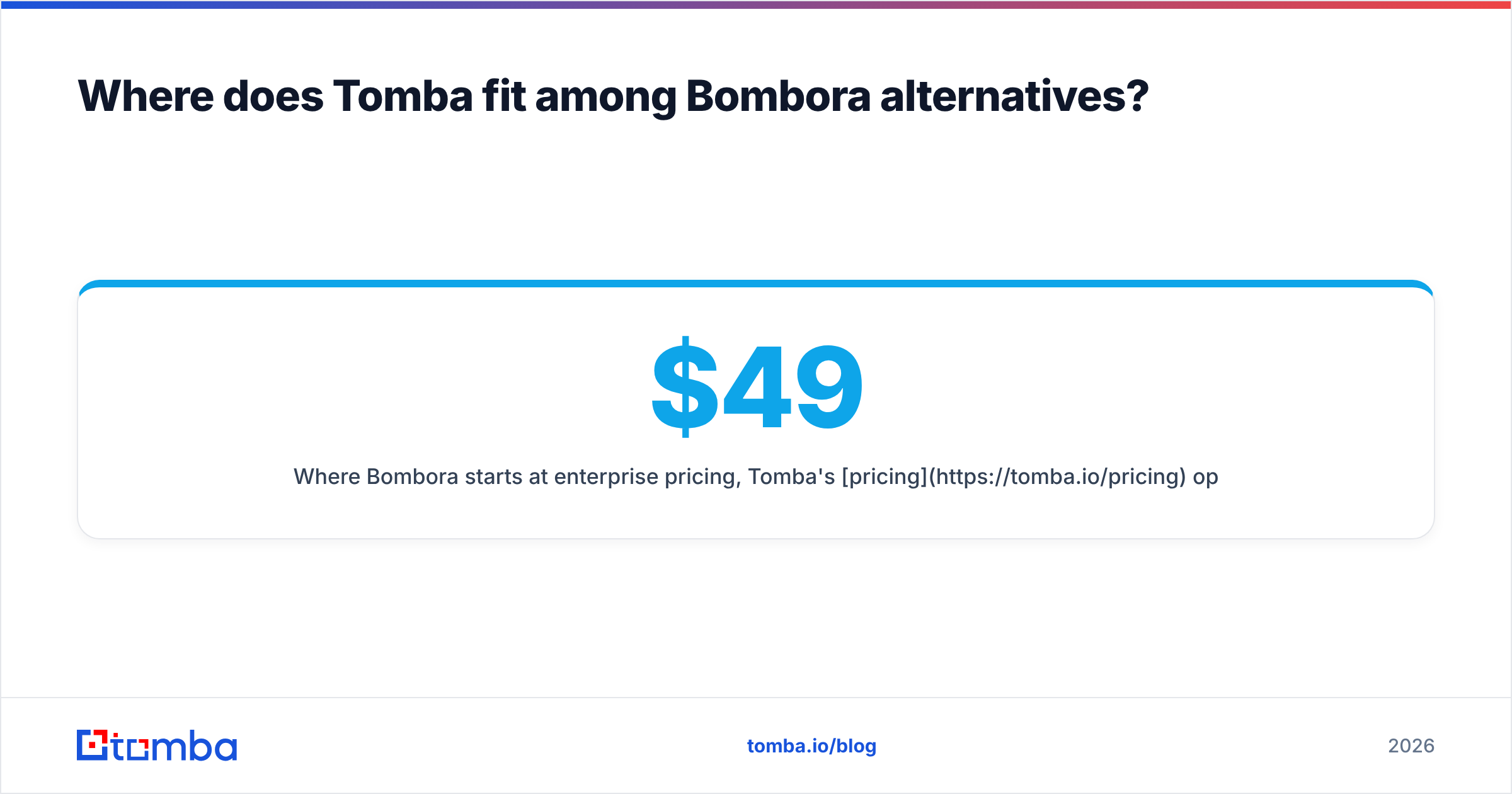
Where Bombora starts at enterprise pricing, Tomba's pricing opens at a free tier (25 searches/mo) and a $49/mo Starter plan, scaling to Growth at $99/mo and Pro at $249/mo. For a mid-market team, that's the difference between "intent strategy on paper" and "intent strategy running this quarter."
Honest take: when Tomba is not the answer#
If you specifically need third-party topic surge — knowing an account is researching a category before they ever touch your properties — Tomba doesn't replace that, and you'll want Bombora, ZoomInfo, or a full ABM platform for the signal itself. The smart build is to use one of those for the topic signal and Tomba as the affordable contact + reveal layer underneath. That combination usually costs less than a single all-in-one suite and outperforms it on cost-per-meeting.
How should you choose the right Bombora alternative?#
Match the tool to the gap you're trying to close, not to brand recognition:
- You need topic intent and have budget → 6sense or Demandbase (full platform) or keep Bombora.
- You need intent and contacts in one → ZoomInfo (NA) or Cognism (EMEA).
- You want the highest-converting signal → G2 Buyer Intent for bottom-of-funnel.
- You want first-party intent + activation on a budget → Tomba for reveal, contacts, and enrichment.
- You're in HubSpot and want it native → Clearbit/Breeze, or a Clearbit alternative if cost is a concern.
A practical rule: spend the smallest amount that gets you a verified person to contact attached to every signal. Most teams overspend on signal and underspend on activation, then wonder why the dashboard is full of "in-market accounts" that never turned into pipeline.
Frequently asked questions#
Is Bombora worth it in 2026? For large teams running topic-led ABM with budget and ops support, yes. For SMB and mid-market teams, the cost and the lack of contact data make a focused signal source plus an affordable activation layer like Tomba a better value.
What's the cheapest Bombora alternative? For first-party intent and contact activation, Tomba starts free and at $49/mo. For third-party topic intent specifically, expect five figures from any serious vendor — that category doesn't have a cheap option.
Can I replace Bombora with first-party intent alone? Often, yes — if your website gets meaningful traffic. Visitor reveal plus verified contacts captures buyers who are already engaging with you, which is higher-intent than anonymous topic surges. Add a third-party source later if you need earlier signal.
Does intent data still work without good contact data? No. Intent tells you which account is interested; you still need a verified email or phone to act. That's why pairing any intent source with an email finder and verifier is non-negotiable.
The bottom line#
Bombora is a fine topic-intent engine, but it's only one layer of a working pipeline — and rarely the layer where deals are won or lost. The teams that get ROI from intent are the ones that turn a signal into a verified contact in the buyer's inbox fast and cheaply.
If your intent strategy keeps stalling at "we know the account is interested but don't know who to email," start at the activation layer. Try the Tomba Email Finder — pair it with visitor reveal and enrichment, keep your existing signal source if you have one, and you'll spend less than a single enterprise intent contract while actually reaching the buyers your signal surfaces.
External references: Bombora, G2 Buyer Intent, and 6sense for vendor specifics, plus Gartner for category research before you commit to a contract.
// get started
Find, verify and enrich your first contacts today
Start on the free plan with 25 searches a month, then scale when your team is ready.
Free plan · No credit card required · GDPR & CCPA
// about the author