Bombora Pricing, Reviews, Pros and Cons (2026 Guide)
Bombora is the biggest name in B2B intent data—but is it worth the spend? Here is an honest 2026 breakdown of Bombora pricing, real reviews, pros, cons, and the alternatives worth testing first.
Bombora is the company most B2B marketers think of first when they hear "intent data." It sits behind a huge slice of the account-based marketing stack, feeds intent signals into platforms like 6sense and Demandbase, and powers Surge® scores that thousands of demand-gen teams build campaigns around. But the brand recognition does not tell you what it costs, whether the data actually moves pipeline, or where it falls short.
This guide gives you the unglamorous version: real Bombora pricing ranges, what reviewers consistently praise and complain about, and an honest pros-and-cons verdict so you can decide before a sales rep ever quotes you.
TL;DR — Bombora Pricing, Reviews, Pros and Cons#
- Pricing is quote-only. Bombora does not publish a price list. Real-world contracts typically land in the $25,000–$100,000+/year range depending on topics, seats, and integrations—there is no self-serve tier.
- Strength: the largest B2B intent data co-op (the "Data Co-op") with broad topic coverage and tight integrations into ABM platforms.
- Weakness: account-level signals only (no person-level intent), a steep learning curve, and pricing that prices out most SMBs.
- Reviews average roughly 4.0–4.3 / 5 on G2 and Gartner Peer Insights—solid, with recurring notes about onboarding and signal noise.
- If you mainly need contact data and emails, intent platforms like Bombora are overkill; a focused email finder plus a lighter intent layer is far cheaper.
What is Bombora and how does its intent data work?#
Think of Bombora like a neighborhood watch for the whole B2B internet. Thousands of publishers (the "Data Co-op") agree to share anonymized signals about what content companies are reading. When employees at a company suddenly start consuming a lot of articles about, say, "cloud security," Bombora notices the spike and flags that account as showing intent.
Technically, Bombora aggregates content-consumption data across its co-op, maps it to companies via IP and other identifiers, and scores it against a baseline. When consumption jumps above normal, you get a Surge® score—a signal that an account is researching a topic and may be in-market.
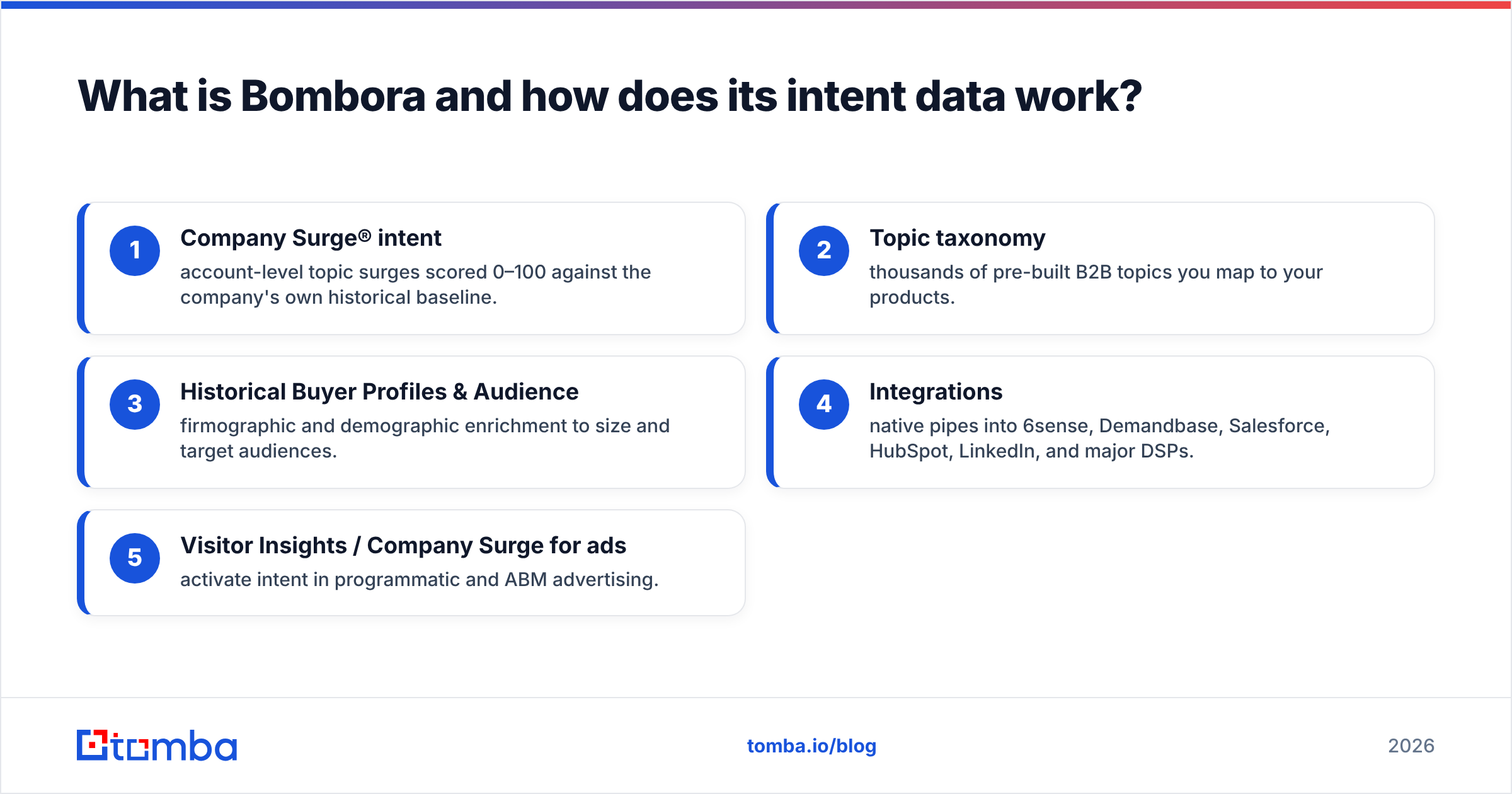
Here is the core of what you actually buy:
- Company Surge® intent — account-level topic surges scored 0–100 against the company's own historical baseline.
- Topic taxonomy — thousands of pre-built B2B topics you map to your products.
- Historical Buyer Profiles & Audience — firmographic and demographic enrichment to size and target audiences.
- Integrations — native pipes into 6sense, Demandbase, Salesforce, HubSpot, LinkedIn, and major DSPs.
- Visitor Insights / Company Surge for ads — activate intent in programmatic and ABM advertising.
The key thing to understand: Bombora tells you which accounts are heating up, not which person to email. You still need a separate layer to find and verify the actual contacts—that gap is where most teams underestimate total cost.

Wait—ignore the chart placement above for diagrams; the point stands in plain terms: a Surge score is a starting flare, not a finished contact record.
How much does Bombora cost in 2026?#
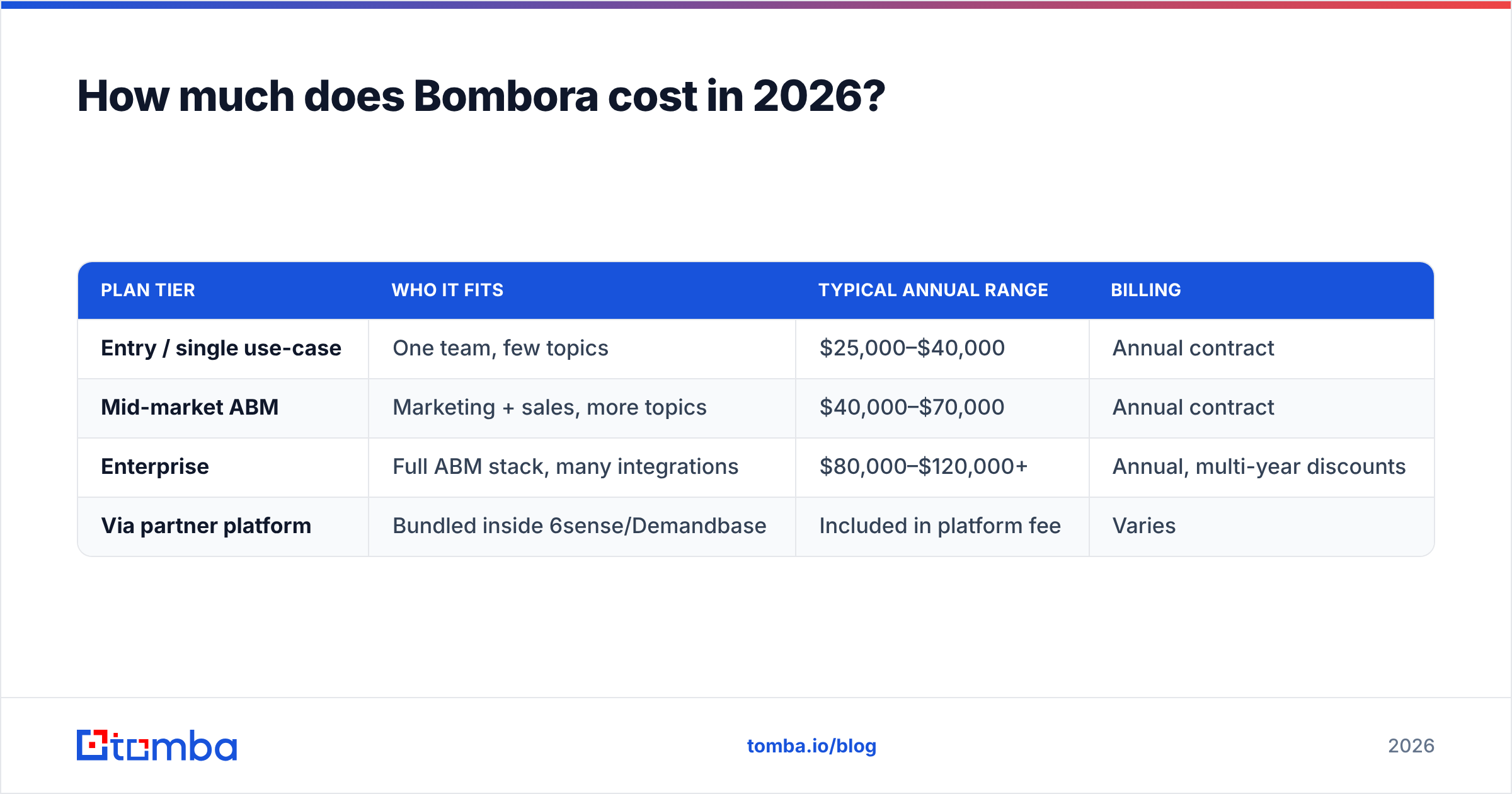
Bombora is quote-only, and most contracts run from roughly $25,000 to over $100,000 per year. There is no public pricing page, no free tier, and no month-to-month self-serve plan. Pricing scales with the number of intent topics you license, the volume of accounts, seats, and which integrations you turn on.
Based on aggregated buyer reports, peer-review sites, and reseller data, here is a realistic picture. Treat these as directional ranges, not official numbers—your quote will depend on negotiation and contract length.
| Plan tier | Who it fits | Typical annual range | Billing |
|---|---|---|---|
| Entry / single use-case | One team, few topics | $25,000–$40,000 | Annual contract |
| Mid-market ABM | Marketing + sales, more topics | $40,000–$70,000 | Annual contract |
| Enterprise | Full ABM stack, many integrations | $80,000–$120,000+ | Annual, multi-year discounts |
| Via partner platform | Bundled inside 6sense/Demandbase | Included in platform fee | Varies |
A few cost realities reviewers repeatedly flag:
- Annual commitment is standard. Expect a 12-month minimum; monthly options are rare.
- Topics are the price lever. More licensed intent topics = higher cost. Scope tightly.
- Activation costs extra. Pushing intent into ads or some integrations can add fees.
- It rarely rides alone. Most buyers pair Bombora with an ABM platform, a CRM, and a contact-data tool, which compounds the real budget.
Compare that to a contact-data stack: a typical email verifier and finder subscription is a few hundred dollars a year, not tens of thousands. The two solve different problems, but it explains why Bombora is an enterprise-only line item.
What do Bombora reviews say? (Pros and cons)#
Across G2 and Gartner Peer Insights, Bombora averages roughly 4.0–4.3 out of 5. Reviewers tend to love the data breadth and hate the opacity and noise. Here is the balanced read.
Bombora pros#
- Largest intent co-op. Breadth of topics and publisher coverage is genuinely best-in-class; few competitors match the raw scale.
- Deep integrations. It plugs into the ABM platforms and CRMs teams already run, so signals reach the workflow.
- Surge scoring is intuitive. The baseline-vs-spike model is easy to explain to executives and easy to build plays around.
- Privacy-conscious sourcing. Co-op data is consent-based and account-level, which sidesteps a lot of person-level privacy risk.
- Good for ABM prioritization. When you have a defined target account list, Surge helps you rank who to hit first.
Bombora cons#
- No person-level intent. You learn an account is researching—not who. You still need contact discovery and verification on top.
- Quote-only, enterprise pricing. SMBs and most mid-market teams get priced out; no way to "try small."
- Signal noise. Reviewers report false positives and surges that don't convert, requiring tuning and a baseline period.
- Learning curve. Mapping topics, setting thresholds, and operationalizing scores takes ramp time and often CS hand-holding.
- Attribution is murky. Proving Bombora-sourced pipeline against the spend is a recurring complaint at renewal.
In short, the people happiest with Bombora are enterprise ABM teams with a dedicated ops person. The people who churn are smaller teams who expected plug-and-play leads and instead got account scores they had to action themselves.
Is Bombora worth it, or should you consider alternatives?#
Bombora is worth it if you run enterprise ABM with a target account list and the ops maturity to action intent—otherwise the alternatives are more cost-effective. The decision really comes down to whether you need intent at scale or contacts you can act on today.
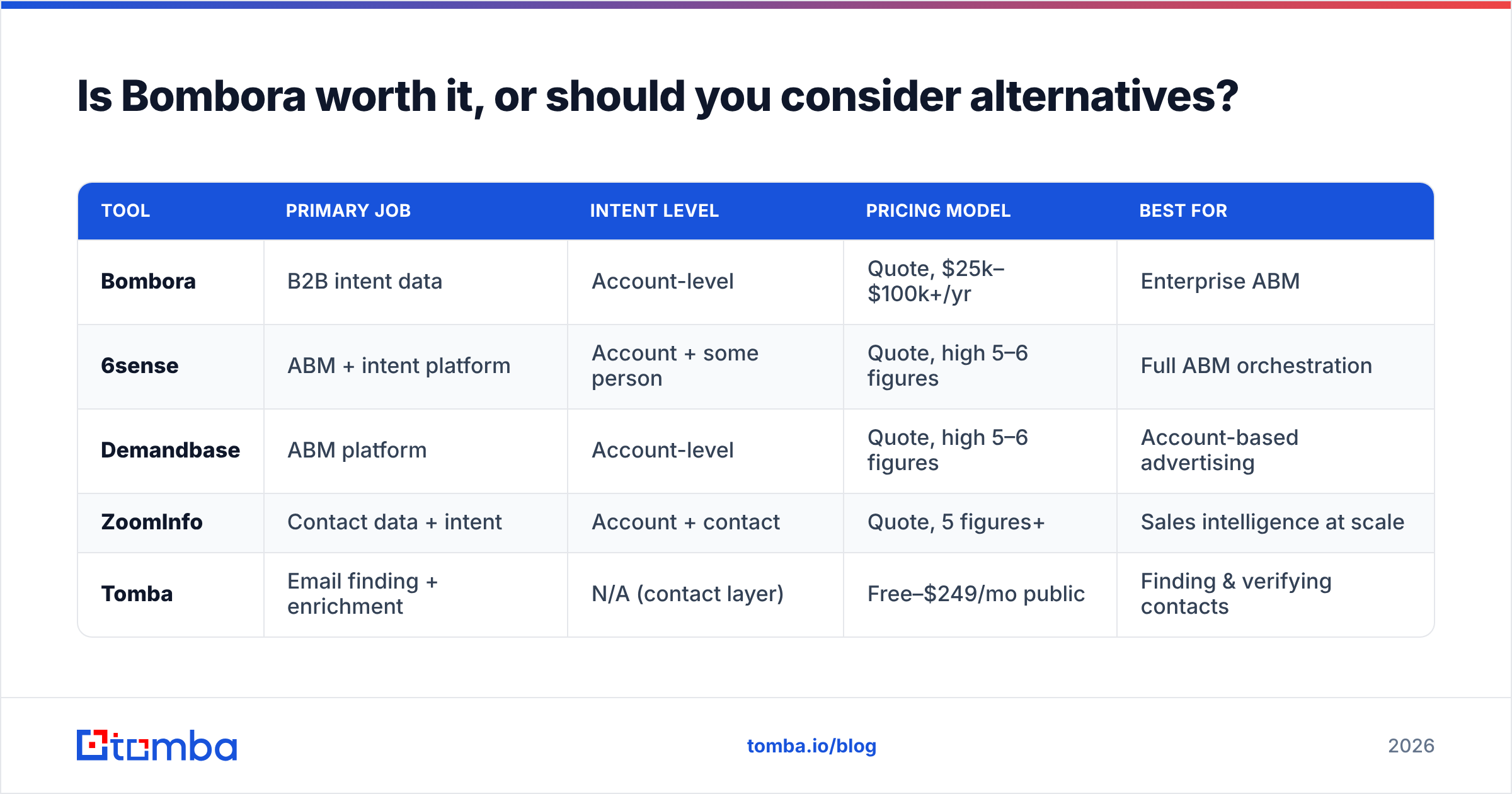
Here is how Bombora stacks up against the categories people evaluate alongside it.
| Tool | Primary job | Intent level | Pricing model | Best for |
|---|---|---|---|---|
| Bombora | B2B intent data | Account-level | Quote, $25k–$100k+/yr | Enterprise ABM |
| 6sense | ABM + intent platform | Account + some person | Quote, high 5–6 figures | Full ABM orchestration |
| Demandbase | ABM platform | Account-level | Quote, high 5–6 figures | Account-based advertising |
| ZoomInfo | Contact data + intent | Account + contact | Quote, 5 figures+ | Sales intelligence at scale |
| Tomba | Email finding + enrichment | N/A (contact layer) | Free–$249/mo public | Finding & verifying contacts |
Notice the gap: Bombora, 6sense, and Demandbase tell you which accounts are in-market. None of them are built to hand you a verified, send-ready email for the right person. That is a separate—and far cheaper—layer.
If your real bottleneck is "I know the account, now get me the decision-maker's email," you do not need a five-figure intent contract. You need a precise contact tool. Tomba's domain search returns every public email pattern for a target company, and the data enrichment API fills in titles, seniority, and verification status—at Tomba pricing that starts free and tops out at $249/mo for the Pro plan.
How should you actually use intent data without overspending?#
The smart play in 2026 is a layered stack, not one giant intent contract. Intent tells you when; contact data tells you who; verification keeps your sender reputation intact. Skip any layer and you either waste budget or torch deliverability.
A lean, effective sequence looks like this:
- Detect interest. Use an intent source—Bombora, a platform-bundled signal, or website visitor data—to surface accounts heating up on your topics. Tomba's website visitor reveal is a lower-cost way to catch in-market accounts already on your site.
- Find the people. Once an account surges, pull the right contacts with an email finder by role and seniority instead of buying a static list.
- Verify before you send. Run every address through email verification so bounces don't wreck your domain reputation.
- Enrich and route. Add firmographic and contact context, then push to your CRM so reps act while intent is fresh.
- Measure to the meeting. Tie each layer to booked meetings, not vanity surge counts, so renewals are data-driven.
This is also why many teams that start with Bombora keep it but trim the contract: they realize the expensive part (account scores) is only half the funnel, and the cheap part (finding and verifying the human) does the closing. You can wire the whole flow together with the Tomba API or native HubSpot integration so signals and contacts land in one place.
For the data-quality side of that workflow—why verification matters before any cold send—the email deliverability fundamentals are worth a quick read; intent means nothing if your messages hit spam.
Frequently asked questions#
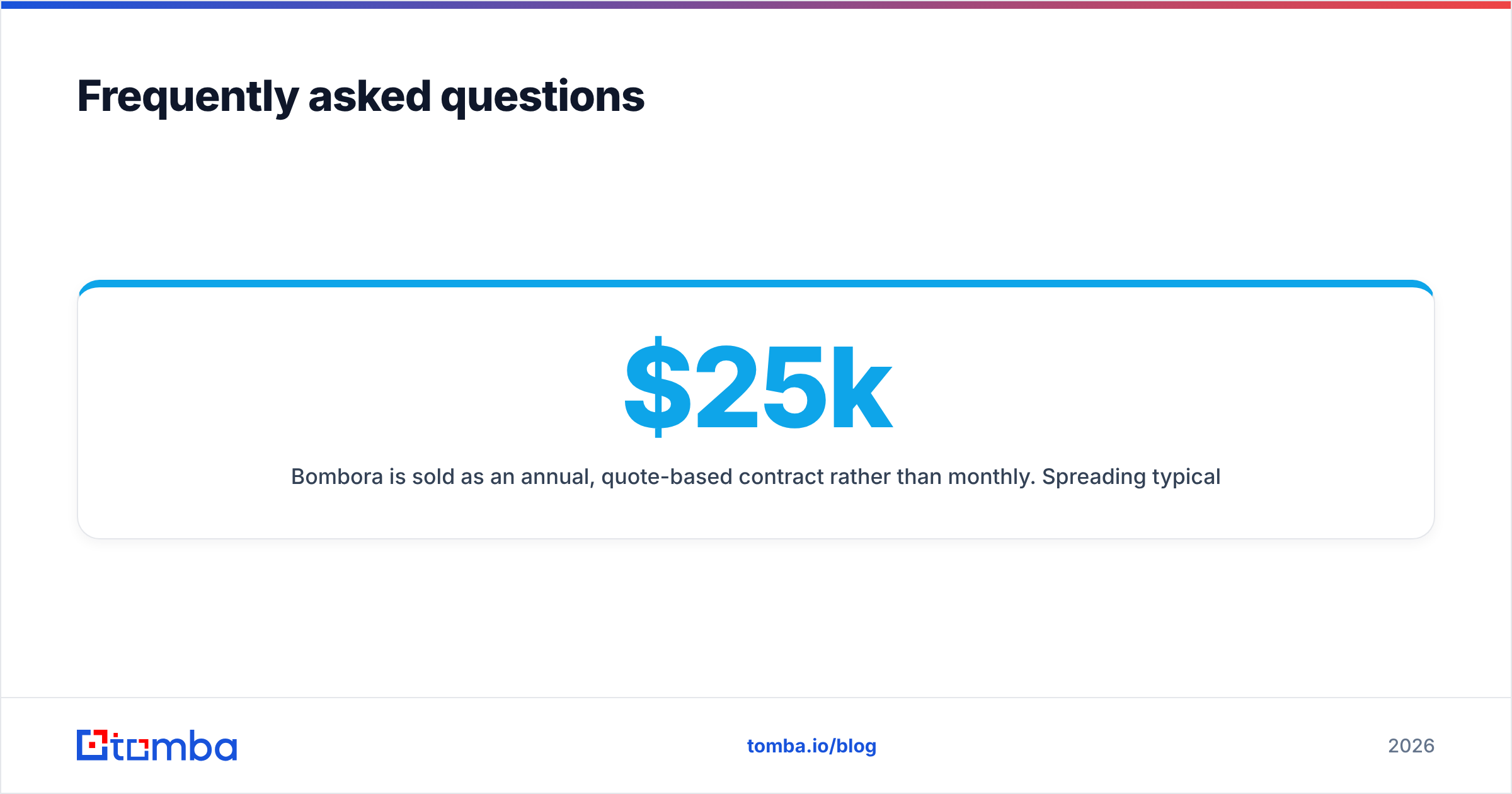
How much does Bombora cost per month? Bombora is sold as an annual, quote-based contract rather than monthly. Spreading typical $25k–$100k+ annual deals out, that's roughly $2,000–$8,500+ per month equivalent—but you commit for the year.
Does Bombora offer a free trial? There is no public free tier or open trial. Evaluations happen through a sales conversation, sometimes with a limited pilot on a defined account list.
Is Bombora intent data person-level? No. Bombora's Company Surge is account-level by design. To reach individuals you pair it with a contact-data tool that finds and verifies emails.
What's the best Bombora alternative for small teams? For teams that mainly need contacts rather than enterprise intent, a contact-finding stack like Tomba is far cheaper. For platform-level intent, 6sense and ZoomInfo are the usual comparisons—but both are also enterprise-priced.
Is Bombora accurate? Reviewers rate the data breadth highly but note signal noise and false positives. Accuracy improves once you set a baseline period and tune topic thresholds, which takes a few months.
The bottom line#
Bombora is the category leader in B2B intent data, and for enterprise ABM teams with the budget and ops maturity to action account-level signals, it earns its place. But it is a five-figure, quote-only commitment that delivers accounts, not contacts—and most of the pipeline work still happens after the Surge score lights up.
If your actual gap is reaching the right person at an in-market company, you do not need to start with a six-figure intent platform. Start with the contact layer. Use the Tomba Email Finder to turn any target account into verified, send-ready emails—free to try, $49/mo Starter, and no annual lock-in—then add heavier intent data only once your outbound is converting. Spend where the pipeline actually moves.
// get started
Find, verify and enrich your first contacts today
Start on the free plan with 25 searches a month, then scale when your team is ready.
Free plan · No credit card required · GDPR & CCPA
// about the author