Bombora vs 6sense (2026): Intent Data Platforms Compared
Bombora sells the intent signal; 6sense sells the whole ABM engine. Here's how the two stack up on data, pricing, and fit in 2026 — and where each actually wins.
TL;DR
- Bombora is a data source; 6sense is a platform. Bombora sells Company Surge intent signals you pipe into other tools. 6sense wraps intent, predictive scoring, advertising, and orchestration into one ABM engine.
- 6sense costs multiples of Bombora. Expect five-figure-plus annual contracts for 6sense; Bombora is cheaper but does far less on its own.
- Bombora's intent co-op is the widest B2B content-consumption network, and 6sense licenses Bombora-style data too — so you may already be paying for similar signals twice.
- Neither finds contact emails for you. Both tell you which accounts are in-market; you still need an email finder to reach the people inside them.
- Pick Bombora if you have a mature stack and just need intent. Pick 6sense if you want one system to identify, score, advertise to, and route accounts.
What are Bombora and 6sense?#
Conclusion first: Bombora is the fuel, 6sense is the car. Bombora aggregates B2B intent data — signals that a company is researching a topic — and feeds it to your existing tools. 6sense is a full account-based marketing (ABM) platform that consumes intent data (including its own and third-party sources), predicts which accounts are in-market, and acts on it through advertising and sales orchestration.
Think of it like weather data. Bombora is the meteorological service that measures temperature and pressure everywhere and sells the readings. 6sense is the app on your phone that takes those readings, predicts whether you'll need an umbrella, and books your taxi. One produces the signal; the other turns the signal into a decision and an action.
That distinction drives almost every difference below — price, complexity, and who should buy which.

How does Bombora's intent data actually work?#
Bombora runs a data co-op of thousands of B2B publishers. When someone at a company reads articles, watches webinars, or downloads content about a topic across that network, Bombora records the consumption anonymously and resolves it to a company (not an individual). When research on a topic spikes above a company's own baseline, Bombora flags it as Company Surge — a signal that the account is actively in-market.
Here's what makes Bombora's approach distinct:
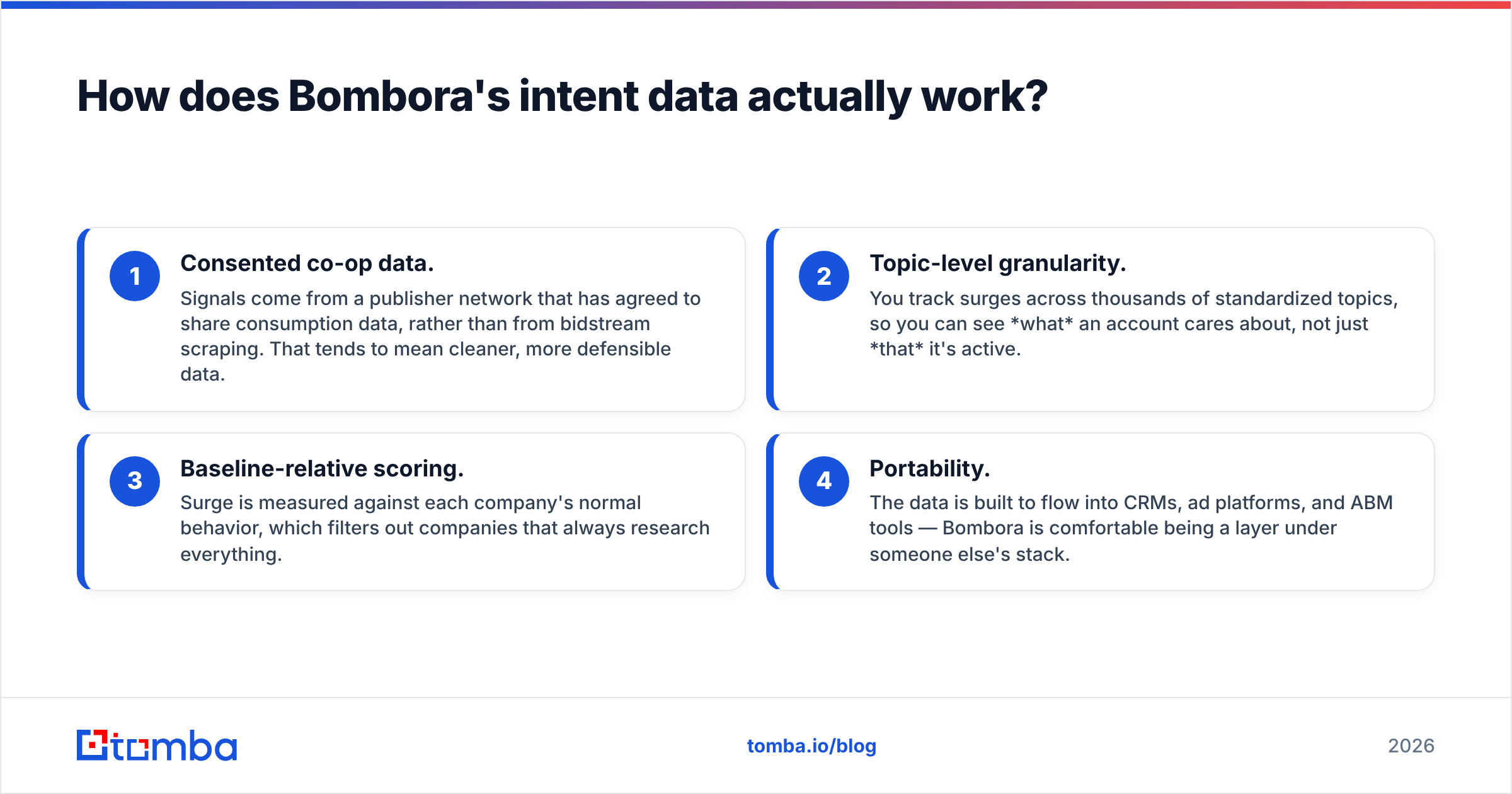
- Consented co-op data. Signals come from a publisher network that has agreed to share consumption data, rather than from bidstream scraping. That tends to mean cleaner, more defensible data.
- Topic-level granularity. You track surges across thousands of standardized topics, so you can see what an account cares about, not just that it's active.
- Baseline-relative scoring. Surge is measured against each company's normal behavior, which filters out companies that always research everything.
- Portability. The data is built to flow into CRMs, ad platforms, and ABM tools — Bombora is comfortable being a layer under someone else's stack.
The trade-off: Bombora gives you the signal, not the workflow. You still need somewhere to route it, score it, and act on it.
What does 6sense do that Bombora doesn't?#
6sense is an orchestration platform, so it covers the steps after the signal. Its Revenue AI combines intent data, technographics, and your own CRM history into predictive models that score accounts by buying stage. It then activates that scoring: programmatic display advertising to in-market accounts, website personalization, anonymous visitor de-anonymization, and sales alerts that route hot accounts to reps.
In other words, 6sense answers "which accounts, at what stage, and what should we do next?" Bombora answers "which accounts are surging on this topic?" — and stops there.
The catch is that 6sense's predictions are only as good as the data feeding them, and a lot of that data is intent data of the same kind Bombora sells. Many teams discover they're effectively paying for overlapping signal. According to user reviews aggregated on G2, 6sense scores highly for its all-in-one workflow but draws consistent complaints about price and contract rigidity.
Bombora vs 6sense: side-by-side comparison#
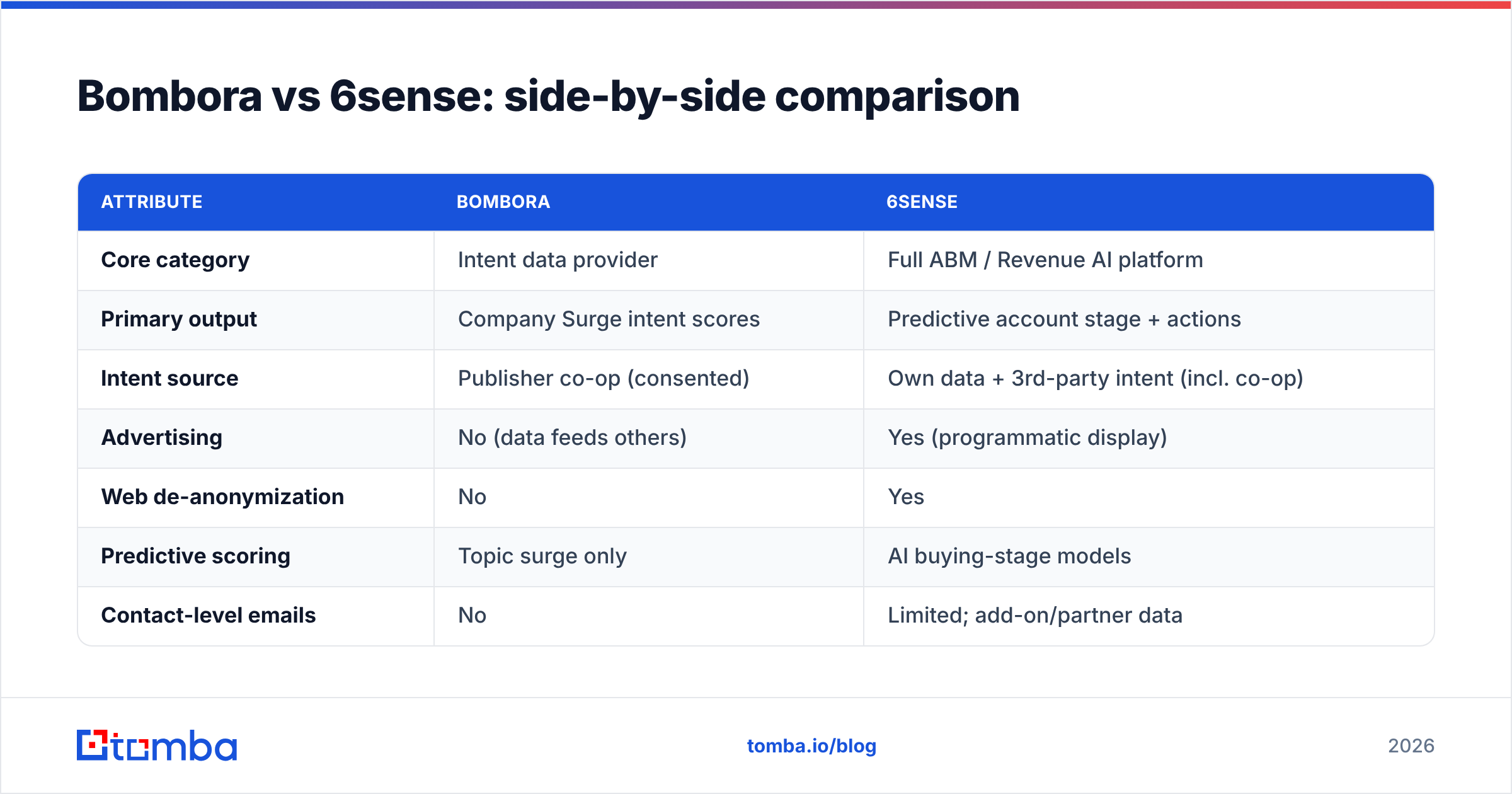
| Attribute | Bombora | 6sense |
|---|---|---|
| Core category | Intent data provider | Full ABM / Revenue AI platform |
| Primary output | Company Surge intent scores | Predictive account stage + actions |
| Intent source | Publisher co-op (consented) | Own data + 3rd-party intent (incl. co-op) |
| Advertising | No (data feeds others) | Yes (programmatic display) |
| Web de-anonymization | No | Yes |
| Predictive scoring | Topic surge only | AI buying-stage models |
| Contact-level emails | No | Limited; add-on/partner data |
| Typical pricing | ~$20k–$40k/yr | ~$60k–$120k+/yr |
| Best for | Mature stacks needing signal | Teams wanting one ABM engine |
| Implementation effort | Low (data feed) | High (platform rollout) |
Numbers are directional — both vendors price by company count, seats, and data volume, and neither publishes public rates. Always get a current quote.
)
Is 6sense better than Bombora?#
Neither is "better" — they sit at different layers. The honest question is: do you need a data source or a system?
Buy Bombora when:
- You already run a capable ABM or marketing-automation stack (Demandbase, HubSpot, Salesforce, Marketo) and just need a clean intent feed.
- You want to control your own scoring and routing logic.
- Budget is tight and you can't justify six figures for orchestration you'd only partly use.
- You want intent portable across multiple destinations rather than locked into one platform.
Buy 6sense when:
- You want identification, scoring, advertising, and sales alerts in one place.
- You have the budget and the RevOps headcount to run a heavy platform.
- Display advertising to in-market accounts is core to your motion.
- You value web de-anonymization and predictive stage models over raw signal.
If you're weighing 6sense against the broader field, our roundup of 6sense alternatives covers where lighter-weight tools fit. And if you mainly care about contact data rather than account intent, neither of these is your tool at all — which is the next problem.
Where do Bombora and 6sense fall short?#
Both tell you which accounts are in-market. Neither hands you the people to email. That's the gap nobody mentions in the demo.
Intent platforms operate at the account level by design — the data is anonymized and resolved to a company, not a named buyer. So when 6sense tells you Acme Corp is surging on "data warehouse migration," you still have to figure out who at Acme owns that decision, find their email, and verify it's deliverable before a single message goes out.
This is where a dedicated contact layer earns its keep:
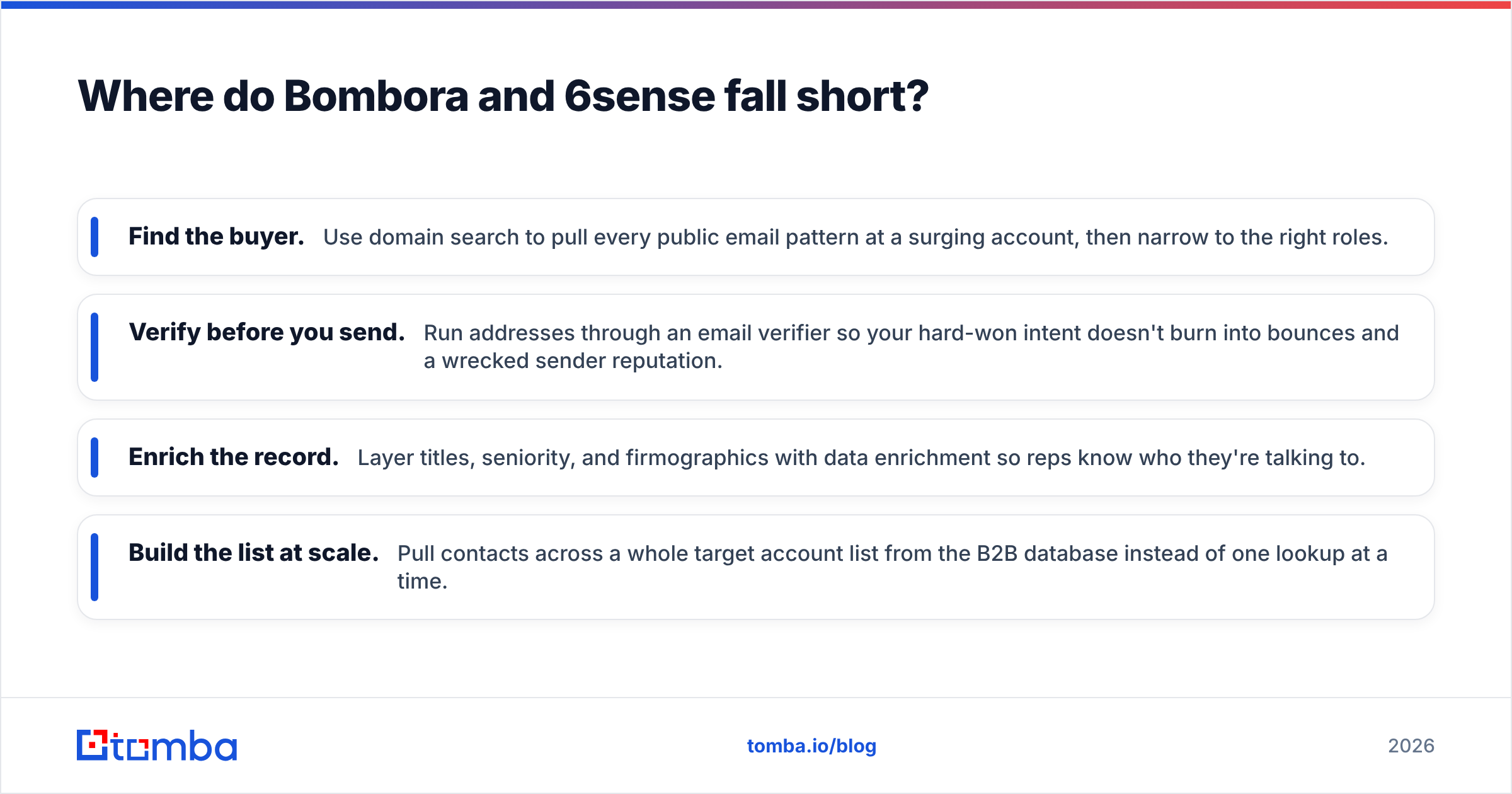
- Find the buyer. Use domain search to pull every public email pattern at a surging account, then narrow to the right roles.
- Verify before you send. Run addresses through an email verifier so your hard-won intent doesn't burn into bounces and a wrecked sender reputation.
- Enrich the record. Layer titles, seniority, and firmographics with data enrichment so reps know who they're talking to.
- Build the list at scale. Pull contacts across a whole target account list from the B2B database instead of one lookup at a time.
Intent without contactable, verified people is a scoreboard with no players on the field. You can see who's winning attention; you can't actually act.
)
How do pricing and total cost compare?#
Bombora is the cheaper line item, but 6sense's price buys workflow you'd otherwise assemble yourself. Both vendors negotiate custom contracts, so treat the table above as a starting range, not a quote.
The real cost comparison isn't sticker price — it's total cost of ownership:
- Bombora TCO = data subscription + the tools you already pay for to route and act on it + the internal time to wire it together. Cheap data, but the value depends entirely on the stack around it.
- 6sense TCO = platform subscription + onboarding + ongoing RevOps administration + ad spend. Expensive, but consolidates several tools and the labor of integrating them.
A scrappy team without a mature ABM stack often finds 6sense's all-in-one nature saves money versus buying and gluing five point solutions. A team that already owns those solutions finds 6sense duplicative and Bombora's à la carte signal far more sensible.
One cost both hide: the contact-data layer. Whichever account-intelligence platform you choose, you'll add a contact and verification tool. A plan like Tomba's pricing starts free (25 searches/month) and runs $49/month for Starter — a rounding error against a six-figure ABM contract, and the piece that actually makes the intent actionable.
What's the smartest way to combine them?#
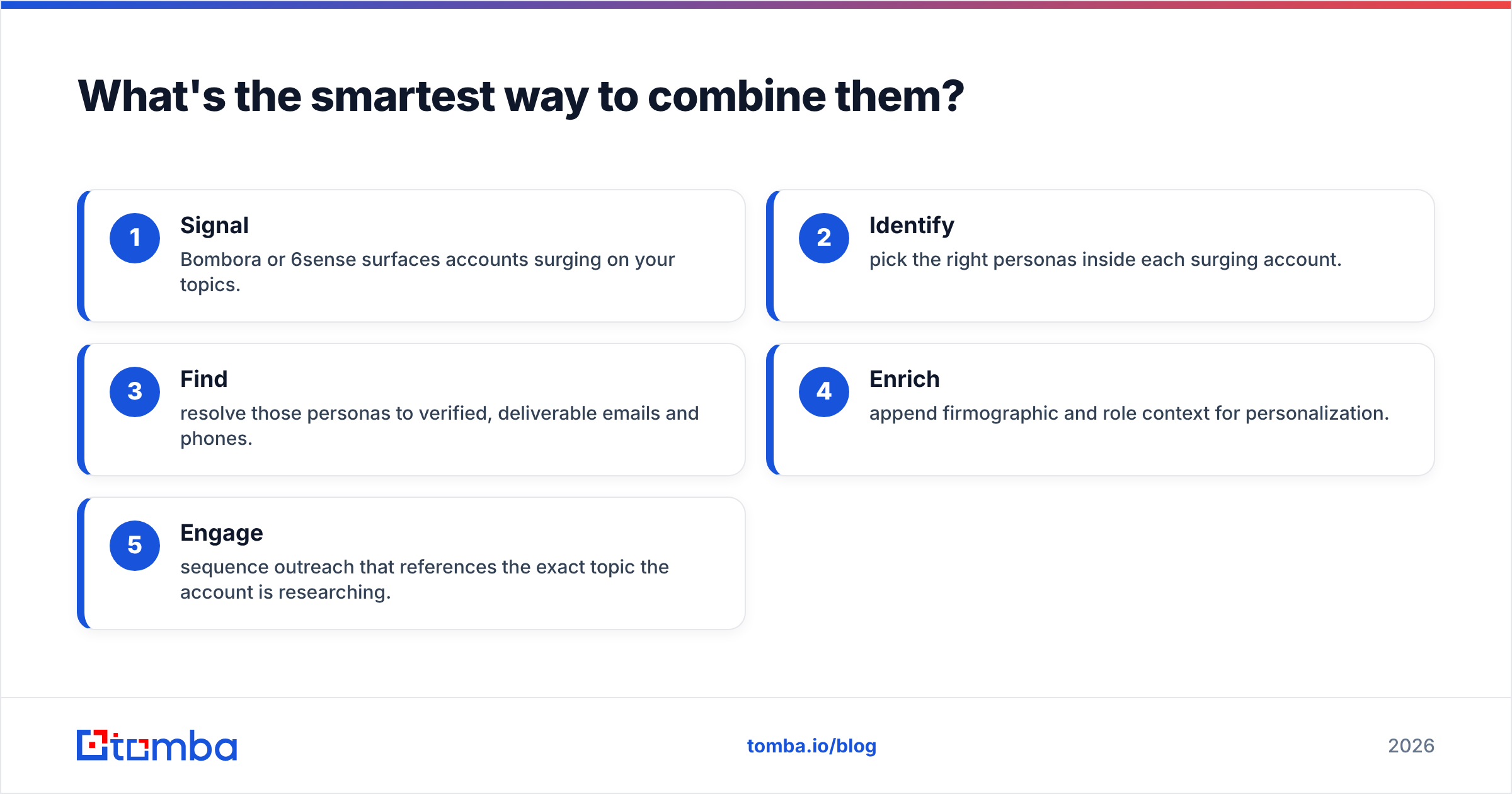
Use intent to prioritize, use a contact layer to execute. The highest-performing GTM teams don't pick one tool — they chain them:
- Signal — Bombora or 6sense surfaces accounts surging on your topics.
- Identify — pick the right personas inside each surging account.
- Find — resolve those personas to verified, deliverable emails and phones.
- Enrich — append firmographic and role context for personalization.
- Engage — sequence outreach that references the exact topic the account is researching.
Skip steps 3 and 4 and you've built an expensive list of company names you can't contact. That's the most common failure mode of intent-data programs: teams buy the signal, celebrate the dashboard, and never close the loop to a human inbox.
For the official product details on each platform, see bombora.com and 6sense.com. Both are legitimate, capable vendors — the mistake is treating either as a complete pipeline solution.
The bottom line#
Bombora and 6sense aren't really competitors; they're neighbors on the same stack. Bombora is the best-known intent signal, ideal when you already have somewhere to put it. 6sense is the heavier engine that turns signal into advertising and routed alerts, ideal when you want one system and have the budget and team to run it.
But both stop at the account door. The moment you need to reach an actual decision-maker, you need contact data — found, verified, and ready to send. That's the layer that converts intent into pipeline.
Start there for free. Point the Tomba Email Finder at any account your intent platform surfaces and get verified, deliverable emails for the exact people who own the decision. Free tier covers 25 searches a month, paid plans start at $49 — and it's the piece that makes every dollar you spend on Bombora or 6sense actually pay off.
// get started
Find, verify and enrich your first contacts today
Start on the free plan with 25 searches a month, then scale when your team is ready.
Free plan · No credit card required · GDPR & CCPA
// about the author