BookYourData Pricing in 2026: Plans, Costs & Alternatives
BookYourData sells B2B contacts on a pay-as-you-go credit model. Here is exactly what it costs in 2026, where the per-record math bites, and how it stacks up against subscription tools.
You came here to answer one question: what does BookYourData actually cost, and is the credit model a good deal in 2026? Short version — BookYourData uses a pay-as-you-go credit system where you buy verified B2B contacts in packs, with no monthly lock-in. That flexibility is real, but the per-record math can quietly outpace a flat subscription once your volume climbs. This post breaks down every tier, the hidden cost traps, and when a finder-plus-verifier subscription beats buying lists outright.
TL;DR#
- BookYourData is credit-based, not subscription-based. You buy packs of contacts up front and spend them building targeted B2B lists. No recurring fee, credits don't expire.
- Effective cost is roughly $0.05–$0.20 per verified contact, depending on pack size — bigger packs lower the unit price.
- The model favors one-off list pulls, not continuous prospecting. High-volume teams often pay more per usable contact than they would on a flat plan.
- Accuracy is guaranteed at ~95%+, but a guarantee is a refund policy, not a delivery rate — you still verify before sending.
- Subscription finders like Tomba start at $49/mo and bundle finding, verification, and enrichment, which changes the math for ongoing outbound.
What is BookYourData and how does its pricing work?#
BookYourData is a self-service B2B contact database. You filter by industry, job title, location, company size, and technology, then buy the resulting list of email addresses (and often phone numbers) using prepaid credits. Think of it like a wholesale market stall: you walk in, point at exactly the contacts you want, pay per item, and walk out with the goods. There is no membership card and no monthly tab.
That is the core difference from most tools in this space. A subscription email finder charges a flat monthly fee for a pool of searches that resets each cycle. BookYourData instead sells you the records permanently — credits don't expire, and one credit typically equals one revealed contact.
Here's how the pricing structure breaks down in practice:
- Credit packs scale down in unit price. A small starter pack carries the highest per-contact cost; large enterprise packs bring it down toward the floor. The list price you see is almost never the price big buyers pay.
- Email-only vs. email-plus-phone changes the rate. Direct dials and mobile numbers cost more credits per record than a work email alone.
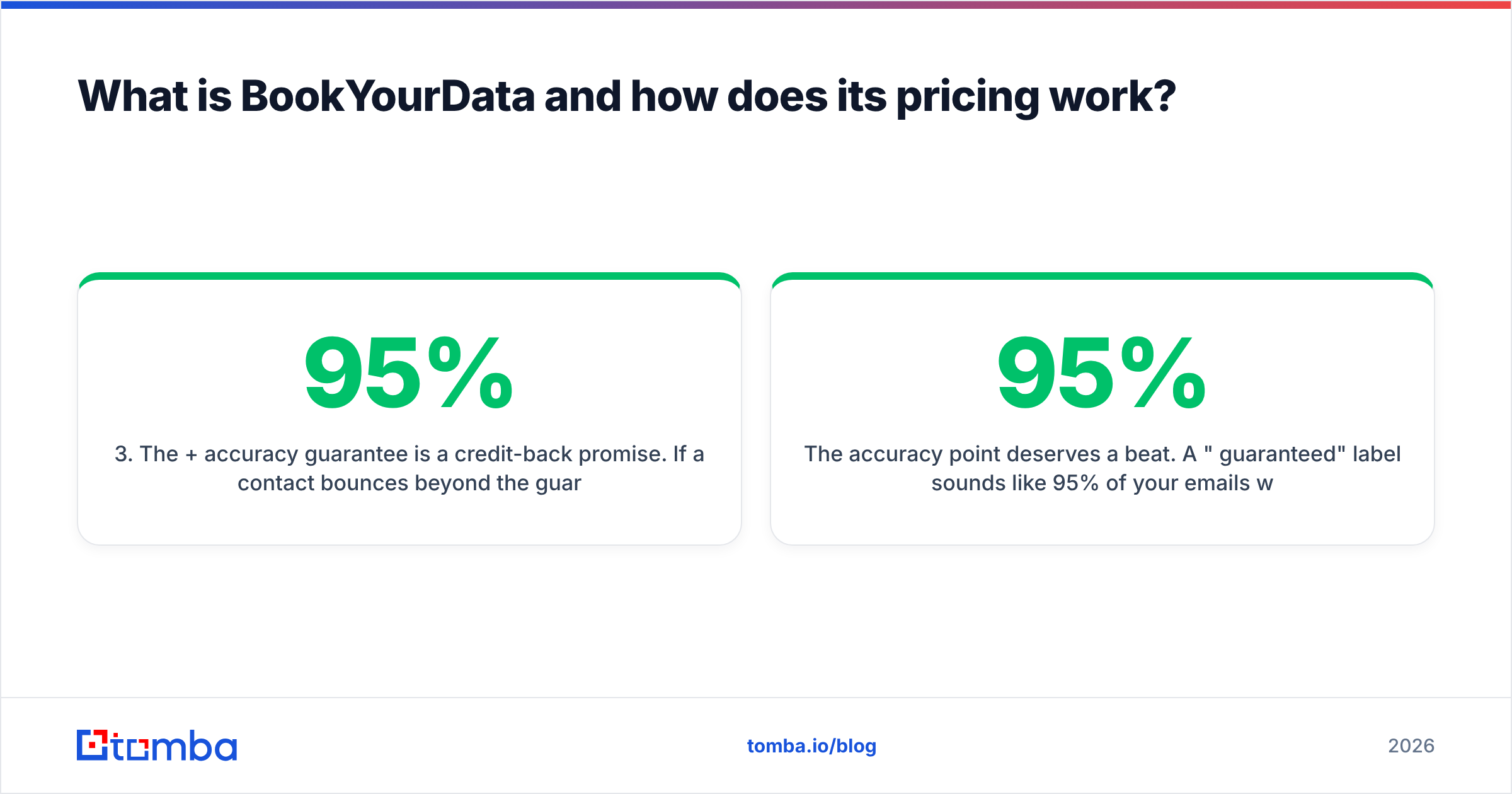
- The 95%+ accuracy guarantee is a credit-back promise. If a contact bounces beyond the guaranteed threshold, you get credits returned — you do not get the lost send, the spam-folder risk, or your time back.
- No platform fee, no seats. Unlike seat-based sales tools, you are not paying per user. One login, shared credit balance.

The accuracy point deserves a beat. A "95% guaranteed" label sounds like 95% of your emails will land — but guarantees are accounting mechanisms. They refund credits on excess bounces; they don't stop the bounce from hitting your sender reputation first. That's why experienced teams run any purchased list through a dedicated email verifier before the first campaign, regardless of the seller's promise.
What are the BookYourData pricing tiers in 2026?#
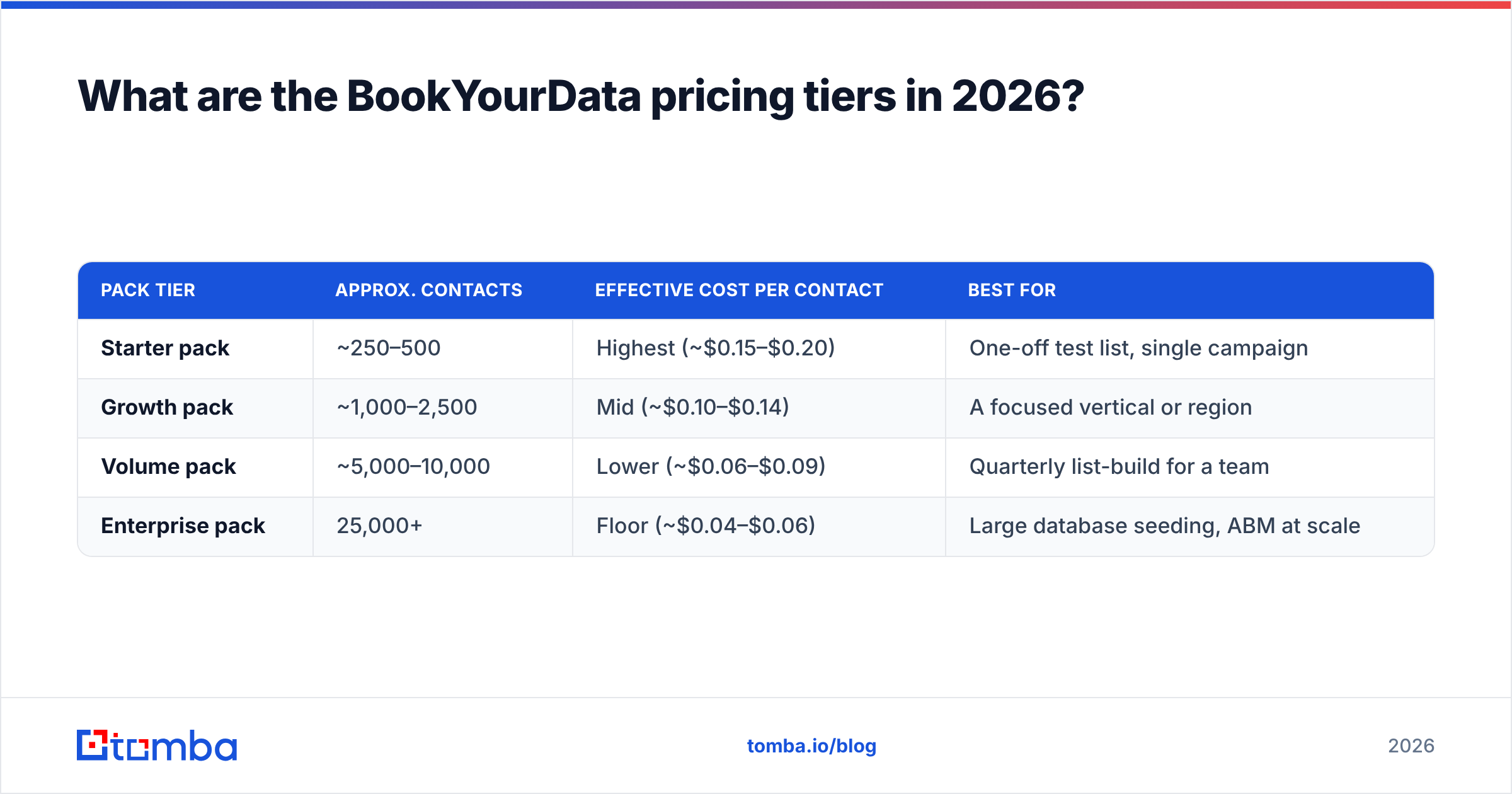
BookYourData publishes credit packs rather than named monthly plans, and the exact figures shift with promotions. The shape of the pricing, though, is consistent: you pay a higher unit rate for small volumes and a lower rate as you commit to bigger packs. The table below shows the typical structure and how the per-contact economics move.
| Pack tier | Approx. contacts | Effective cost per contact | Best for |
|---|---|---|---|
| Starter pack | ~250–500 | Highest (~$0.15–$0.20) | One-off test list, single campaign |
| Growth pack | ~1,000–2,500 | Mid (~$0.10–$0.14) | A focused vertical or region |
| Volume pack | ~5,000–10,000 | Lower (~$0.06–$0.09) | Quarterly list-build for a team |
| Enterprise pack | 25,000+ | Floor (~$0.04–$0.06) | Large database seeding, ABM at scale |
Two things to read into this. First, the unit price only drops if you commit cash up front — you're pre-buying volume to earn the discount, which ties up budget before you've proven the list converts. Second, the cheapest per-contact rates require enterprise-scale commitments most small teams can't justify in a single purchase.
For a sanity check against current public figures, BookYourData's own pricing page and third-party listings on G2 are the sources to verify before you buy, since promotional rates change month to month.

Is BookYourData's pay-as-you-go model cheaper than a subscription?#
It depends entirely on your usage pattern — and that's the whole game. Pay-as-you-go wins for sporadic, bounded list pulls; subscriptions win for continuous, high-volume prospecting.
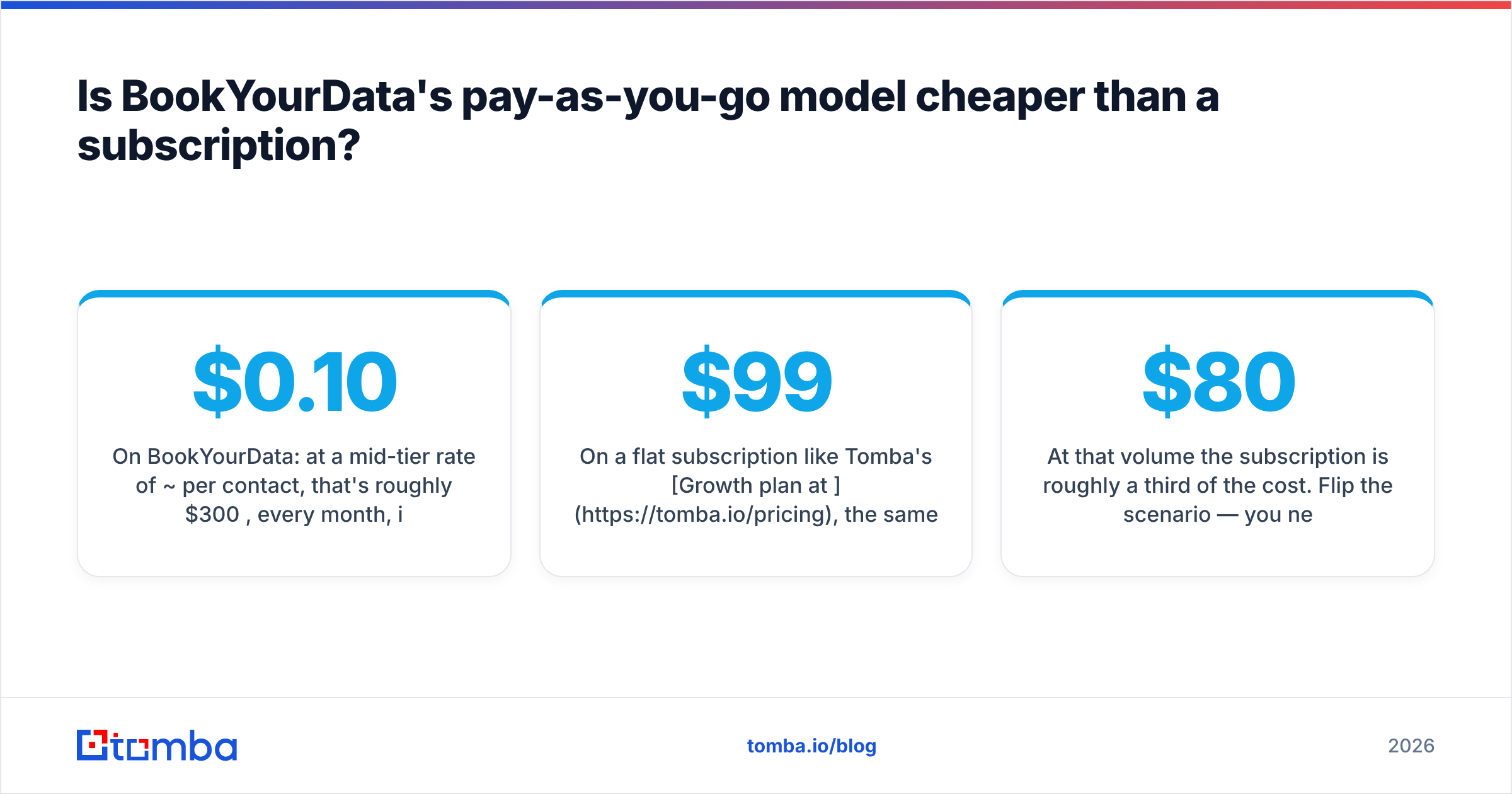
Run the math with a simple scenario. Say your SDR team needs 3,000 fresh verified contacts every month for ongoing outbound.
- On BookYourData: at a mid-tier rate of ~$0.10 per contact, that's roughly $300/month, every month, indefinitely — and you re-buy each cycle.
- On a flat subscription like Tomba's Growth plan at $99/mo, the same 3,000 lookups sit inside a monthly allowance that also includes verification and enrichment, with credits refreshing each cycle.
At that volume the subscription is roughly a third of the cost. Flip the scenario — you need 800 contacts once, for a single event campaign — and the credit model is clearly better: you pay ~$80–$110 once and never think about it again. No subscription to remember to cancel.
)
So the honest answer isn't "BookYourData is expensive" or "subscriptions are cheaper." It's: map your real monthly contact volume, then pick the model whose curve you sit on. Below ~1,000 contacts a quarter, pay-as-you-go is hard to beat. Above ~2,000 a month, a flat finder subscription usually wins on raw cost and adds tooling you'd otherwise buy separately.
How does BookYourData pricing compare to alternatives?#
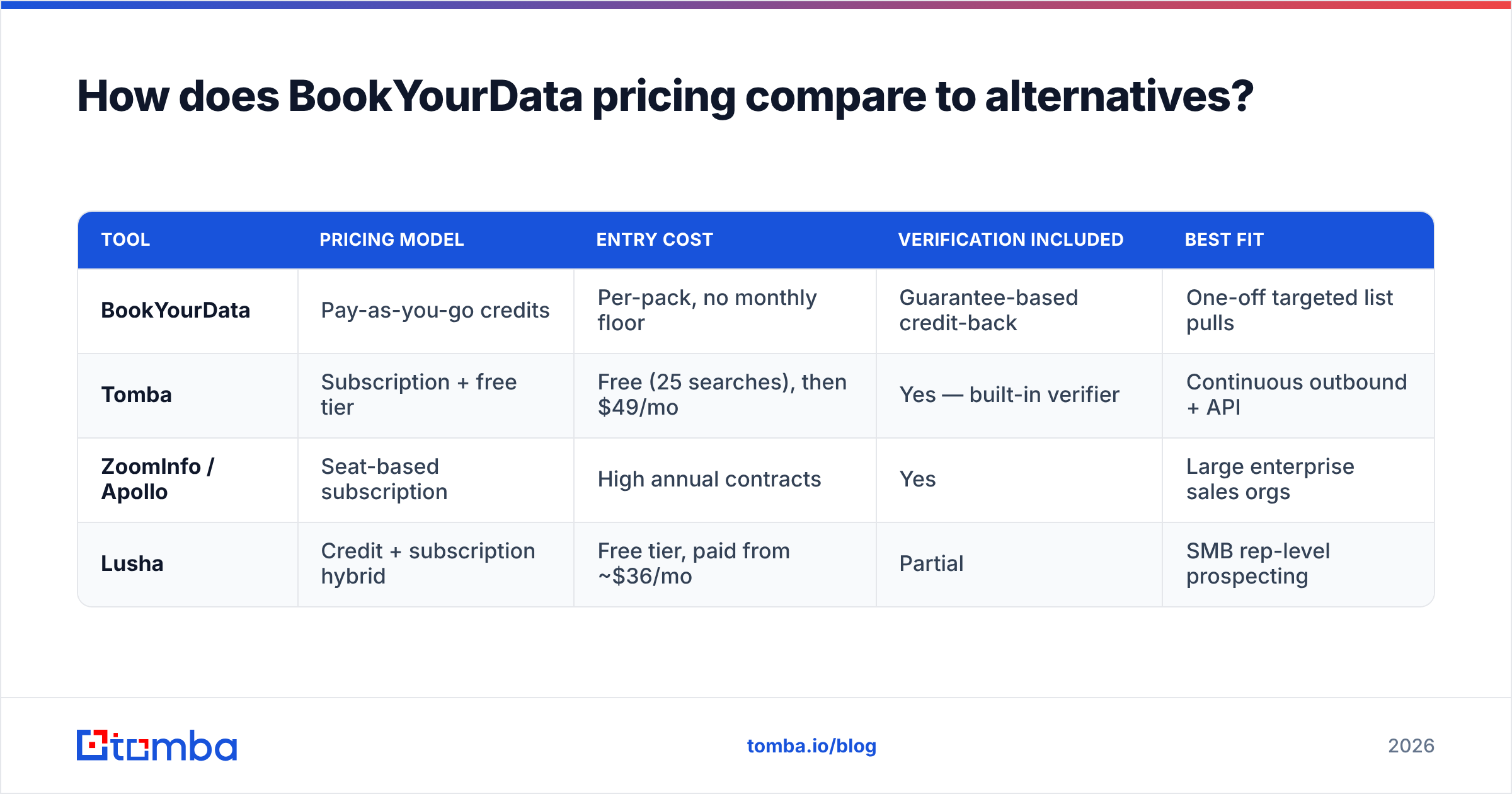
BookYourData sits in a crowded field. Some competitors sell data the same pay-per-record way; others bundle finding and verification into a subscription. Here's how the pricing philosophies line up.
| Tool | Pricing model | Entry cost | Verification included | Best fit |
|---|---|---|---|---|
| BookYourData | Pay-as-you-go credits | Per-pack, no monthly floor | Guarantee-based credit-back | One-off targeted list pulls |
| Tomba | Subscription + free tier | Free (25 searches), then $49/mo | Yes — built-in verifier | Continuous outbound + API |
| ZoomInfo / Apollo | Seat-based subscription | High annual contracts | Yes | Large enterprise sales orgs |
| Lusha | Credit + subscription hybrid | Free tier, paid from ~$36/mo | Partial | SMB rep-level prospecting |
A few takeaways. BookYourData's no-floor model is genuinely friendlier than enterprise contracts — you're not signing an annual deal to test 500 contacts. But it gives you a list, not a workflow. There's no API-first finder, no bulk verification pipeline, and no enrichment layer baked into the price.
If your need is list acquisition, that's fine. If your need is a repeatable prospecting engine, you'll end up bolting on a bulk email finder and a verifier anyway — at which point a subscription that already includes them is simpler and cheaper to operate. This is also why teams comparing options often look at a dedicated Tomba pricing breakdown alongside BookYourData's packs: the question isn't just price-per-contact, it's price-per-contact plus the tools you'd otherwise buy.
)
What hidden costs should you watch for with BookYourData?#
The sticker price per credit is only part of the spend. Three costs hide downstream.
- Re-verification cost. Purchased B2B data decays fast — people change jobs every few years, and titles shift constantly. A list bought today is measurably staler in six months. You'll re-verify or re-buy, and that recurring spend isn't in the headline price.
- The bounce tax on deliverability. Even a 95%-guaranteed list sends some bounces. Each one chips at your sender reputation, and a damaged domain costs far more to repair than the credits refunded. Always verify before you send, not after the campaign tanks.
- Tooling you still need. A raw list is inert until it's in your CRM, deduplicated, enriched, and sequenced. Those steps need software. The credit price doesn't cover the prospecting stack around it.
None of these are unique to BookYourData — they apply to any purchased-list model. But they explain why the "cheap per-record" framing can mislead. The true cost is per usable, sent, converted contact, not per row in the CSV.
Who should actually buy BookYourData?#
BookYourData is a strong fit for a specific buyer, and a poor fit for another. Be honest about which you are.
Buy it if:
- You need a defined list once or a few times a year — an event, a regional launch, a single ABM tier.
- You want zero subscription commitment and credits that don't expire.
- Your volume is low enough that per-record pricing stays cheaper than a monthly plan.
Look elsewhere if:
- You prospect continuously and pull thousands of contacts monthly — the credit math turns against you.
- You need an email finder API, bulk verification, and enrichment in one workflow.
- You want a free tier to test accuracy on your own target accounts before paying anything.
That last point matters more than it looks. The cheapest way to evaluate any data tool is to run it against contacts you can independently verify. A free tier lets you do that at zero cost; a credit pack makes you pay to find out.
The bottom line on BookYourData pricing#
BookYourData's pricing is transparent, commitment-free, and well-suited to bounded, occasional list buys — that's a real strength in a market full of locked annual contracts. The weakness is structural, not a flaw in the product: pay-per-record economics reward small, infrequent purchases and punish steady, high-volume outbound. The more you prospect, the worse the per-contact deal becomes relative to a flat subscription.
If your motion is occasional list acquisition, BookYourData earns its place. If your motion is continuous prospecting — finding, verifying, and enriching new contacts every week — you'll get more usable output per dollar from a subscription that bundles the whole pipeline.
That's where Tomba fits. Instead of buying static lists by the record, you get a live email finder with built-in verification and enrichment, a real free tier (25 searches/month to test on your own accounts), and plans from $49/mo that scale with your team rather than your purchase orders. Run Tomba against the exact prospects you'd otherwise buy — verify the accuracy yourself before you spend a cent, then decide which pricing model actually fits your pipeline.
// get started
Find, verify and enrich your first contacts today
Start on the free plan with 25 searches a month, then scale when your team is ready.
Free plan · No credit card required · GDPR & CCPA
Get the Tomba newsletter
Product and data updates
// about the author