Bookyourdata vs Bounceless: Data, Accuracy & Price 2026
Bookyourdata sells pay-as-you-go B2B contact lists; Bounceless verifies the emails you already have. Here's which one your pipeline actually needs in 2026 — and where both fall short.
You landed here because two tools keep showing up in the same shortlist and they look interchangeable. They are not. Bookyourdata is a pay-as-you-go B2B contact database — you buy lists of names, emails, and phone numbers. Bounceless is an email verification service — it tells you which addresses on a list you already have will actually deliver. Comparing them head-to-head is like comparing a grocery store to a refrigerator: one supplies, the other preserves.
This guide breaks down what each tool does, where they overlap, what they cost, and why most teams end up needing a third option that does both jobs without the guesswork.
TL;DR#
- Bookyourdata is a B2B data marketplace — pay per credit, download contact lists by industry, title, and location. Good for fast volume, weaker on freshness.
- Bounceless is a standalone email verifier — bulk-clean lists, drop bounces, protect sender reputation. It finds nothing; it only checks what you feed it.
- They solve different halves of the same problem. Buying a Bookyourdata list and verifying it through Bounceless is a common two-tool workflow.
- Both lean on static, purchased data that decays fast — roughly 25–30% of B2B contacts go stale every year.
- A combined finder-plus-verifier like Tomba sources emails live and validates them in one pass, which usually beats stitching two single-purpose tools together.
What is Bookyourdata?#
Bookyourdata is a self-service B2B contact database. You filter a directory by job title, industry, company size, location, and technology, then buy the matching contacts as credits. Each credit typically unlocks one contact record — name, business email, sometimes a direct dial and LinkedIn URL.
The pitch is speed and ownership. You don't run a search-and-find process; you pick a segment and download it. Bookyourdata also markets a "95%+ accuracy guarantee" and offers credit refunds for bounced emails, which is the headline feature most buyers remember.
Where it's strong:
- Instant volume. Need 5,000 marketing directors in SaaS? You filter and export in minutes.
- Pay-as-you-go. No forced annual contract; credits don't expire on the standard plans.
- Multi-field records. Many rows include phone and social data, not just email.
Where it's weak:
- Data freshness. Purchased databases are snapshots. People change jobs constantly, so a "verified" record from six months ago may already bounce.
- Overlap and recycling. Bought lists are sold to many buyers, so the same contacts get hammered by competing senders.
- You still need to verify. Despite the accuracy guarantee, smart teams re-verify before sending — which is exactly why Bounceless enters the conversation.
What is Bounceless?#
Bounceless is an email verification and validation platform. You upload a list — from Bookyourdata, a CRM export, a webinar signup, anywhere — and it checks each address through syntax validation, domain/MX record checks, SMTP handshake testing, and detection of disposable, role-based, and catch-all addresses. It returns a clean list and a risk breakdown.
Bounceless does not generate contacts. It has no directory you can search. It is purely a hygiene layer that sits between your raw list and your sending tool. Its job is to lower bounce rates, protect your sender reputation, and keep you off blocklists.
Where it's strong:
- Bulk cleaning. Fast processing of large lists with a clear deliverable/risky/undeliverable split.
- Reputation protection. Lower bounces mean better email deliverability over time.
- Integrations. Connects to common ESPs and outreach platforms.
Where it's weak:
- It's half a workflow. Verification is worthless if you have no contacts to verify. You need a separate source.
- Catch-all uncertainty. Like every verifier, catch-all domains return "unknown" — a structural limit of SMTP checking, not a vendor flaw.
Bookyourdata vs Bounceless: what's the core difference?#
The cleanest way to see it: one fills the funnel, the other filters it.
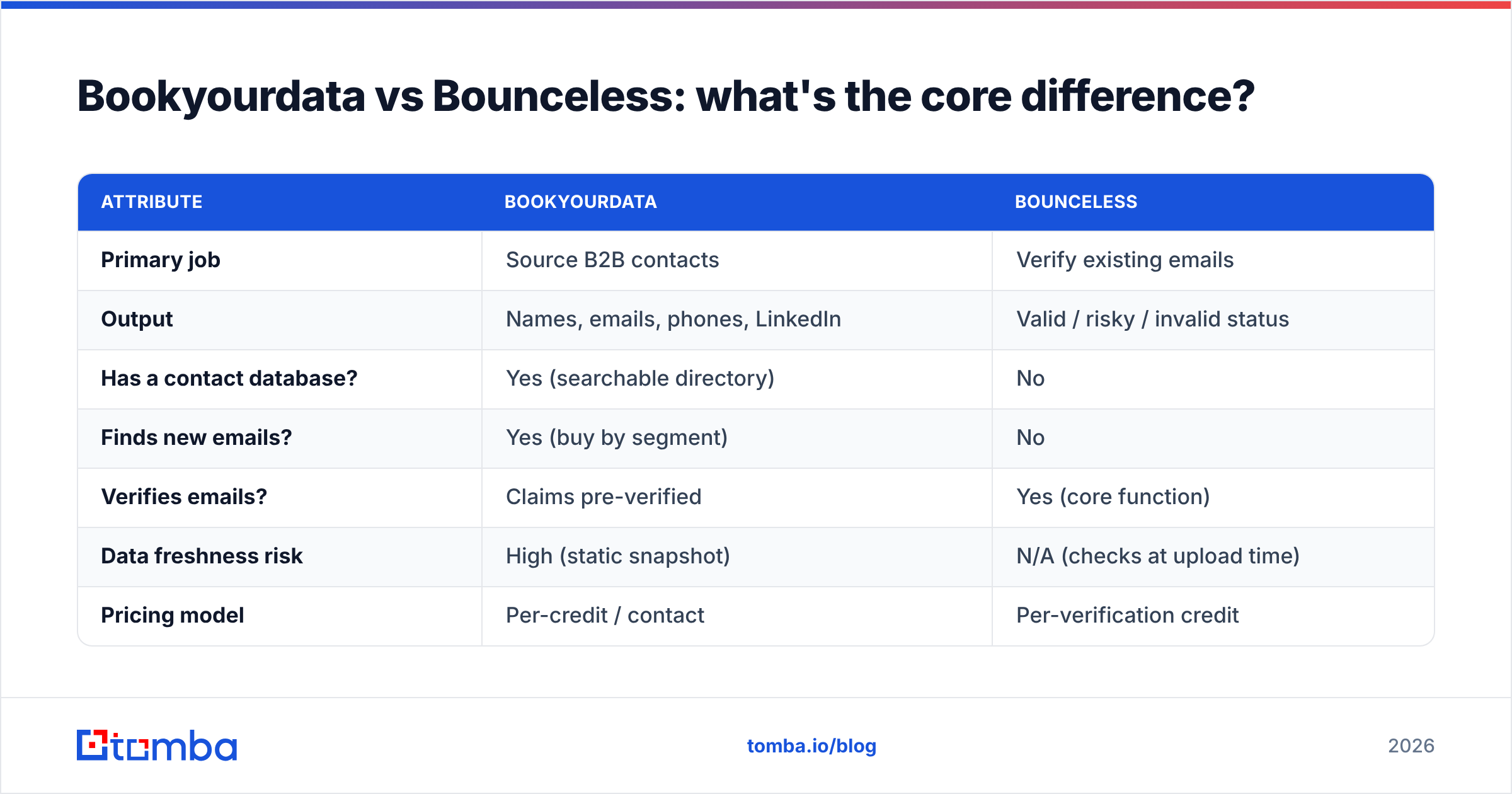
| Attribute | Bookyourdata | Bounceless |
|---|---|---|
| Primary job | Source B2B contacts | Verify existing emails |
| Output | Names, emails, phones, LinkedIn | Valid / risky / invalid status |
| Has a contact database? | Yes (searchable directory) | No |
| Finds new emails? | Yes (buy by segment) | No |
| Verifies emails? | Claims pre-verified | Yes (core function) |
| Data freshness risk | High (static snapshot) | N/A (checks at upload time) |
| Pricing model | Per-credit / contact | Per-verification credit |
| Best for | Fast list buying | List hygiene before sending |
| Biggest gap | Decay + list recycling | No sourcing capability |
Read that table once and the truth is obvious: these aren't competitors, they're two stages of the same pipeline. The real question isn't "which one wins" — it's "do I want to run two tools, or one tool that does both?"
Is buying a list better than finding emails live?#
Short answer: usually no, and here's why.
A purchased list from Bookyourdata is a photograph of a moment. The instant it's exported, it starts decaying. Industry data consistently shows B2B contact databases degrade 22–30% per year as people switch jobs, companies rebrand, and domains change. According to HubSpot's research on database decay, marketing databases degrade by roughly 22.5% every year on their own. A list you bought in January is measurably worse by summer.
Live finding flips the model. Instead of buying a frozen snapshot, you query for a specific person at a specific company when you need them, and the address is sourced and validated at that moment. That's the difference between eating fresh produce and eating canned goods from the back of the pantry.
This is also why the "buy then verify" combo — Bookyourdata feeding Bounceless — only papers over the problem. Verification tells you an old address still resolves; it doesn't tell you the person still works there. A verifier passes a deliverable address for someone who left the company eight months ago. You send, it doesn't bounce, and you still hear nothing, because you emailed a ghost.
How do they compare on accuracy and deliverability?#
Accuracy is where the two tools talk past each other.
Bookyourdata advertises a 95%+ accuracy guarantee with bounce-based credit refunds. That's a meaningful commitment, but "accurate at time of collection" and "accurate at time of send" are different claims. The refund covers you for hard bounces; it does nothing for the deeper problem of contacting people who've moved on.
Bounceless measures accuracy differently — it reports how confident it is that an address will accept mail right now. That's genuinely useful for protecting your domain, but it can't validate intent, role, or whether the contact is even still relevant.
Here's the structured reality of a two-tool stack versus a unified approach:
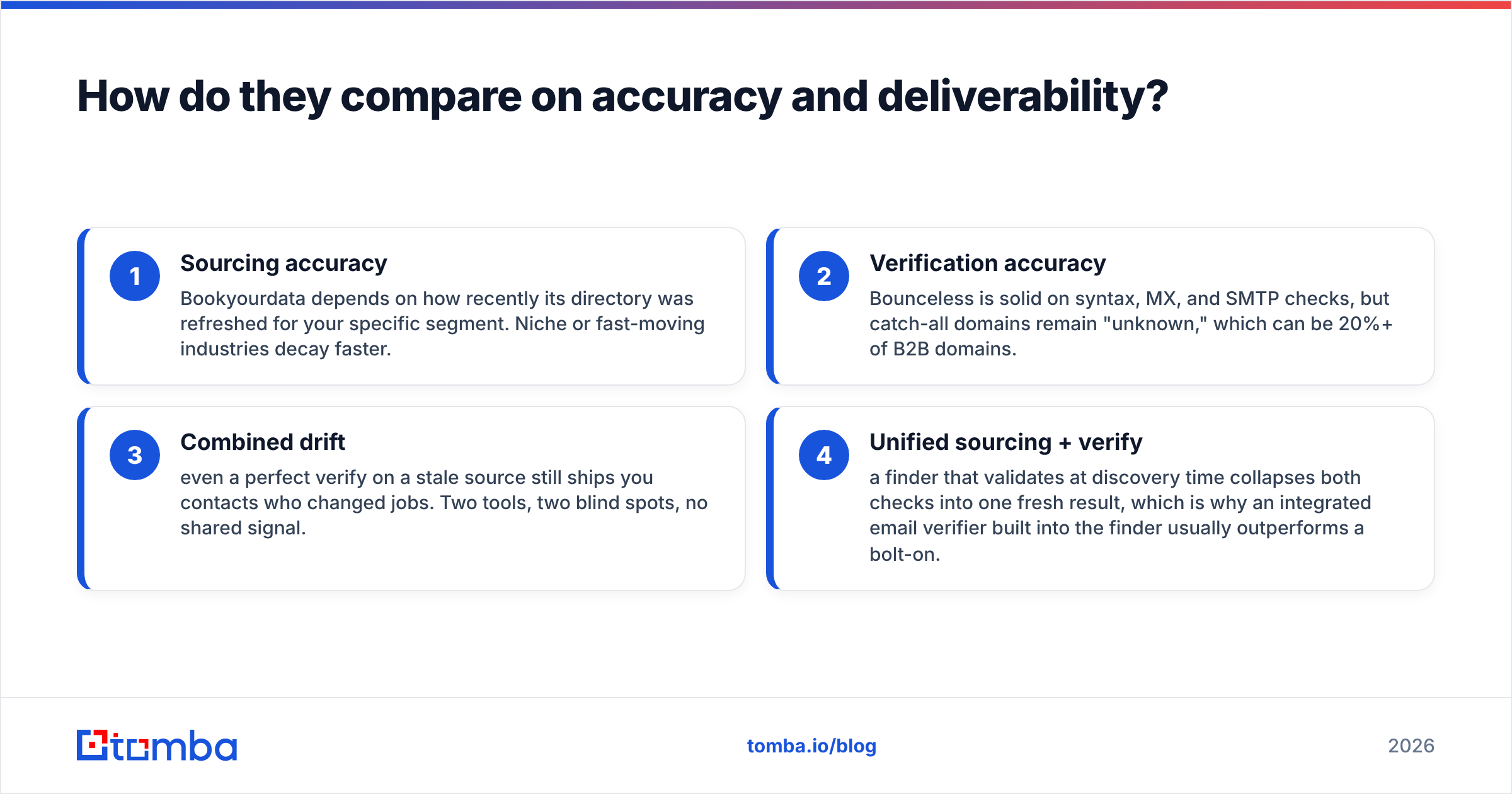
- Sourcing accuracy — Bookyourdata depends on how recently its directory was refreshed for your specific segment. Niche or fast-moving industries decay faster.
- Verification accuracy — Bounceless is solid on syntax, MX, and SMTP checks, but catch-all domains remain "unknown," which can be 20%+ of B2B domains.
- Combined drift — even a perfect verify on a stale source still ships you contacts who changed jobs. Two tools, two blind spots, no shared signal.
- Unified sourcing + verify — a finder that validates at discovery time collapses both checks into one fresh result, which is why an integrated email verifier built into the finder usually outperforms a bolt-on.
If deliverability is your real worry, pair fresh sourcing with verification in a single step rather than buying old data and scrubbing it afterward.
What does each one cost in 2026?#
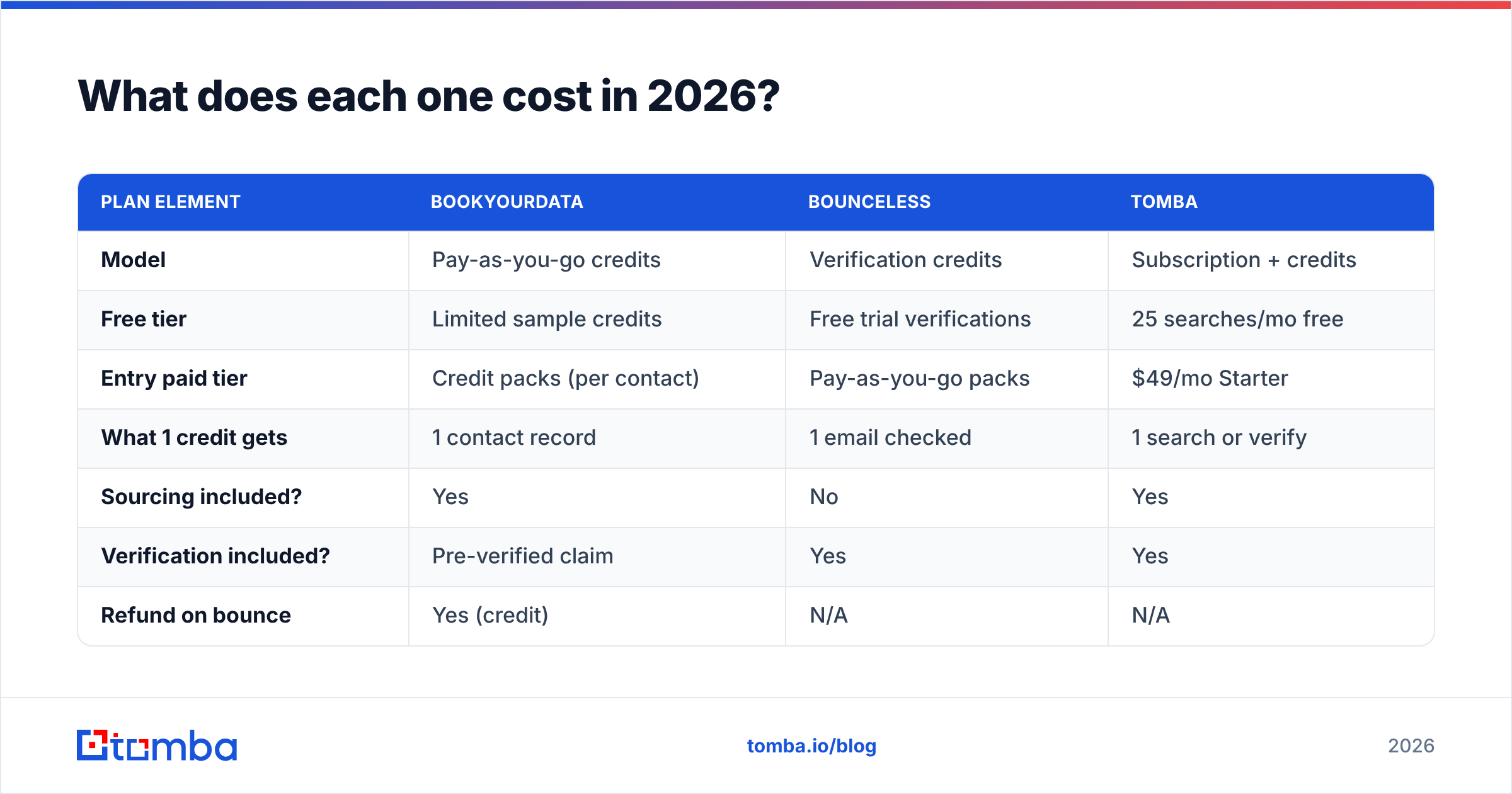
Both use credit-based pricing, but they price different units — Bookyourdata charges per contact, Bounceless per verification. That makes blunt dollar comparisons misleading, so look at what a credit actually buys.
| Plan element | Bookyourdata | Bounceless | Tomba |
|---|---|---|---|
| Model | Pay-as-you-go credits | Verification credits | Subscription + credits |
| Free tier | Limited sample credits | Free trial verifications | 25 searches/mo free |
| Entry paid tier | Credit packs (per contact) | Pay-as-you-go packs | $49/mo Starter |
| What 1 credit gets | 1 contact record | 1 email checked | 1 search or verify |
| Sourcing included? | Yes | No | Yes |
| Verification included? | Pre-verified claim | Yes | Yes |
| Refund on bounce | Yes (credit) | N/A | N/A |
Bookyourdata's per-contact packs scale down in cost as you buy more, which suits one-off bulk campaigns. Bounceless's verification credits are cheap per unit because checking an email is computationally lighter than sourcing one. The catch: a real campaign needs both line items, so your effective cost is the sum of two vendors plus the labor of moving data between them.
By contrast, a single subscription that bundles finding and verifying — see Tomba pricing at $49/mo Starter, $99/mo Growth, and $249/mo Pro — turns two recurring bills and a manual handoff into one workflow. For teams running steady outbound, that consolidation is usually cheaper in total cost of ownership than a per-contact list buy plus a separate verifier.
Which tool should you choose?#
Pick based on what you actually lack:
- You have zero contacts and want volume fast → Bookyourdata. It's a sourcing tool. If you need 10,000 records for a one-time blast and accept some decay, it delivers.
- You already have lists and they're bouncing → Bounceless. It's a cleaning tool. If your problem is a dirty CRM or an old export, verification is exactly the fix.
- You need both, repeatedly → neither alone. Running outbound week after week means you'll keep buying lists and keep verifying them. That's two tools, two costs, and a stale-source problem no verifier can solve.
That third scenario is where most growing sales teams actually live, and it's why the "Bookyourdata vs Bounceless" framing is the wrong question. You're not choosing between a store and a fridge — you want a kitchen that handles both.
How does Tomba fit between them?#
Tomba was built for exactly the gap this comparison exposes: it sources emails and verifies them in the same motion, against live data rather than a purchased snapshot.
Instead of buying a frozen list, you use the domain search to pull every public email at a target company, or the email finder to get one specific person by name and domain — and each result is verified at discovery, so you skip the separate Bounceless step. For existing lists, the bulk email finder and verifier clean what you already have, covering Bounceless's job too.
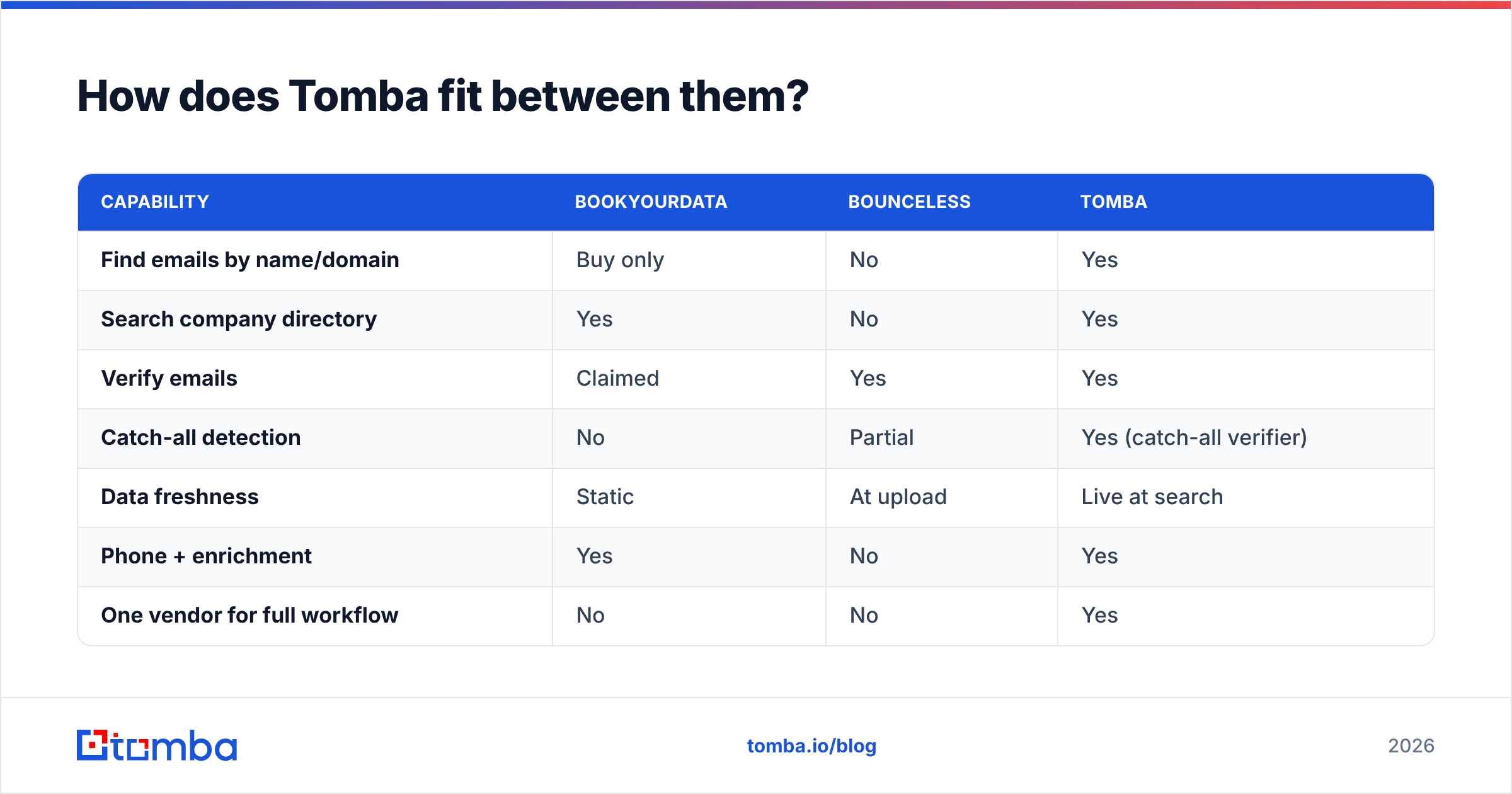
| Capability | Bookyourdata | Bounceless | Tomba |
|---|---|---|---|
| Find emails by name/domain | Buy only | No | Yes |
| Search company directory | Yes | No | Yes |
| Verify emails | Claimed | Yes | Yes |
| Catch-all detection | No | Partial | Yes (catch-all verifier) |
| Data freshness | Static | At upload | Live at search |
| Phone + enrichment | Yes | No | Yes |
| One vendor for full workflow | No | No | Yes |
The point isn't that Tomba beats either tool at its single specialty — it's that a unified finder-verifier removes the handoff where stale data and double billing creep in. You can also reach the same data through the Tomba API if you'd rather wire it into your own stack, or grab leads in-browser with the Chrome extension.
If you want to sanity-check vendor neutrality, both Bookyourdata and Bounceless have public profiles on G2 where you can read unfiltered user reviews before committing budget.
The bottom line#
Bookyourdata and Bounceless aren't rivals — they're two stages of the same pipeline, and buying both means paying twice while still inheriting the core weakness of purchased data: it goes stale the moment you download it. A verifier can confirm an address resolves, but it can't tell you the person still works there.
If your real goal is reaching the right person with an email that lands, source fresh and verify in one pass instead of buying old and scrubbing late. Start free with the Tomba Email Finder — 25 searches a month at no cost, verification built in, no list-buying and no separate hygiene tool to bolt on. Find the contact, confirm it's good, and send. That's the whole workflow in one place.
Ready to find emails that actually work?
Join 150,000+ professionals who stopped guessing and started sending. Free credits on signup — no credit card required.
Get the Tomba newsletter
Practical outbound tactics and product updates — once every two weeks.
About the author