Bookyourdata vs Csvgo 2026: B2B Data Accuracy Compared
Bookyourdata sells pay-as-you-go B2B lists; Csvgo pushes bulk CSV exports. We compare accuracy, pricing, and freshness to show which fits your pipeline in 2026.
Choosing between Bookyourdata and Csvgo comes down to one question: do you want a polished pay-as-you-go list builder, or a cheap bulk CSV dump? Both promise B2B contacts, but they trade off very differently on accuracy, freshness, and how much manual cleanup lands on your desk.
TL;DR — Bookyourdata vs Csvgo#
- Bookyourdata is a polished, credit-based list builder with filters, a 97% accuracy claim, and email verification baked in — but it gets expensive fast at scale.
- Csvgo competes on price with large pre-built CSV exports, but freshness and verification are weaker, so you inherit more bounces and dedupe work.
- Accuracy is the real differentiator. A cheap list that's 30% stale costs more in burned domains than a verified one at twice the price.
- Neither is a true real-time finder. If you need fresh emails at the moment of outreach, a verification-first API like the Tomba Email Finder is a stronger backbone.
- Pick Bookyourdata for curated targeting, Csvgo for raw volume on a budget — and verify everything before you send.
What is Bookyourdata?#
Bookyourdata is a B2B contact-data platform built around a pay-as-you-go credit model. You filter a database by job title, industry, company size, location, and technology, then export verified contacts as a list. Its headline pitch is a 97% email accuracy guarantee and a real-time verification step at export, which is more than most list vendors offer.
The product is aimed at sales and marketing teams that want targeted lists rather than an entire industry dumped into a spreadsheet. You build a segment, preview counts, and pay only for the records you take. That flexibility is the main reason teams pick it over a fixed annual data subscription.
The trade-off is unit economics. Credit pricing is friendly at small volumes but climbs steeply once you need tens of thousands of contacts a month. And because it's a static database, "verified at export" still means the underlying record could be months old — a job change you won't see until your email bounces.

What is Csvgo?#
Csvgo takes the opposite approach: volume and price. It sells large, pre-compiled CSV files of B2B contacts — often segmented by industry or region — at a cost-per-record that undercuts most curated providers. The appeal is obvious for teams that want raw scale: drop the file into your CRM or sequencer and start sending.
The catch is what "pre-compiled" implies. A static CSV is a snapshot. The moment it's exported, it starts decaying — roughly 30% of B2B data goes stale every year as people change jobs, companies rebrand, and domains shift. Csvgo's lower price reflects lighter ongoing verification, so a chunk of the cleanup burden moves to you: deduping, validating, and suppressing bounces before your first send.
That doesn't make Csvgo a bad buy. For top-of-funnel volume plays where a higher bounce tolerance is acceptable, the math can work. But you have to price in the hidden cost of bad records, not just the sticker cost per row.
Bookyourdata vs Csvgo: the core comparison#
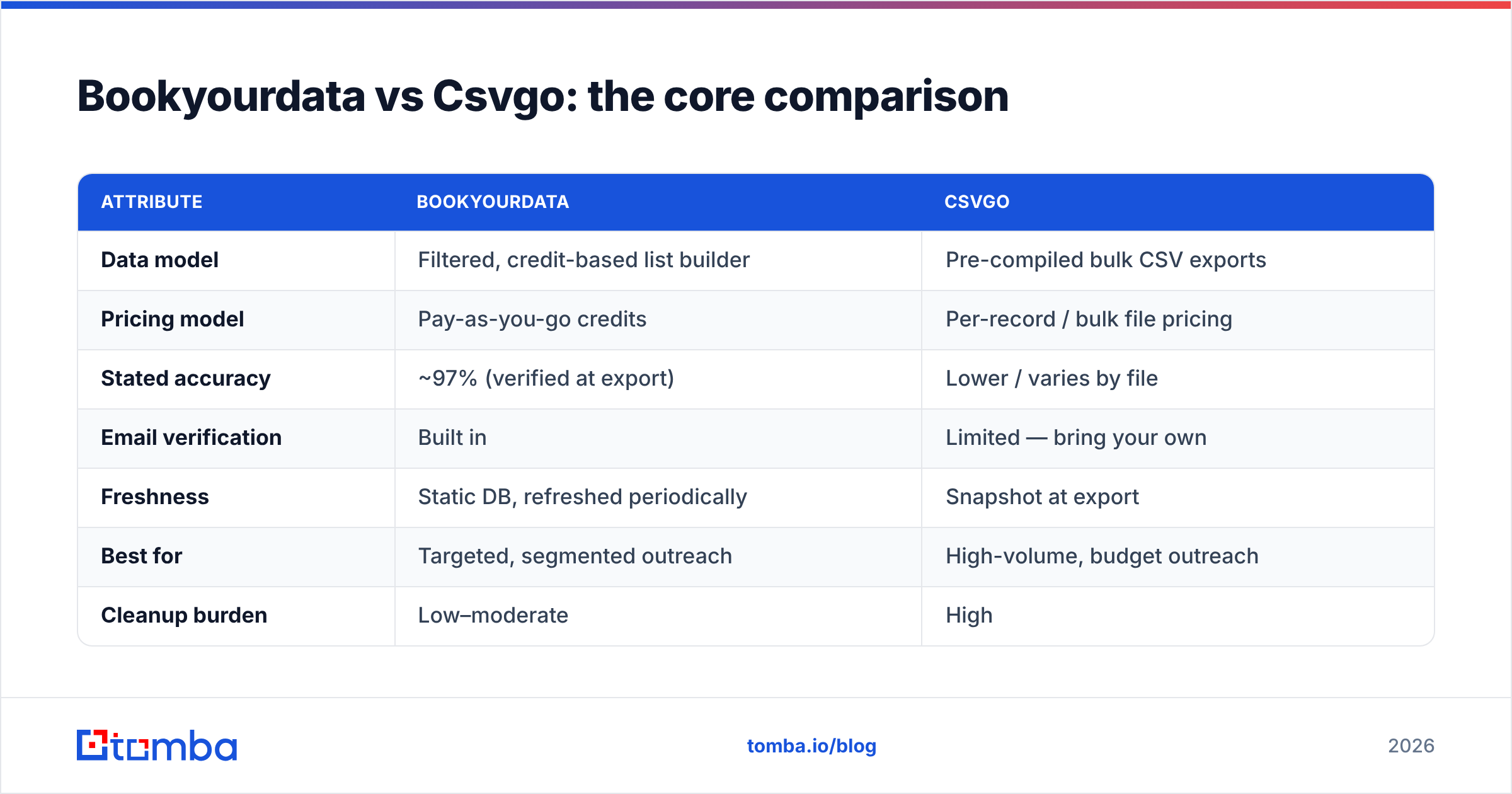
Here's the head-to-head on the attributes that actually move pipeline outcomes.
| Attribute | Bookyourdata | Csvgo |
|---|---|---|
| Data model | Filtered, credit-based list builder | Pre-compiled bulk CSV exports |
| Pricing model | Pay-as-you-go credits | Per-record / bulk file pricing |
| Stated accuracy | ~97% (verified at export) | Lower / varies by file |
| Email verification | Built in | Limited — bring your own |
| Freshness | Static DB, refreshed periodically | Snapshot at export |
| Best for | Targeted, segmented outreach | High-volume, budget outreach |
| Cleanup burden | Low–moderate | High |
| Compliance tooling | Filters + opt-out support | Minimal |
The pattern is clear: Bookyourdata charges more and hands you cleaner data; Csvgo charges less and hands you more work. Which is "better" depends entirely on whether your bottleneck is budget or deliverability.
Is Bookyourdata more accurate than Csvgo?#
Yes — on paper and usually in practice, Bookyourdata wins on accuracy because it verifies at the point of export and publishes a 97% guarantee. Csvgo's static files lean on whenever the snapshot was last validated, which means bounce rates tend to run higher.
But accuracy is not a single number. It breaks into three things that matter for outbound:
- Syntax validity — is it a real, well-formed address? Easy; both clear this bar.
- Deliverability — will the mailbox actually accept mail today? This is where stale data fails, regardless of how clean the syntax looks.
- Person-to-role match — does this person still hold this job at this company? This is the silent killer; a perfectly deliverable email to someone who left six months ago wastes the touch and can trigger spam complaints.
A guarantee covers #1 and partly #2 at export time. Neither vendor fully solves #3, because both are databases, not live lookups. That's why teams serious about deliverability run every imported list through an independent email verifier before sending — it catches the decay that accumulated between the vendor's last refresh and your campaign.

How do the pricing models compare?#
The pricing philosophies are as different as the data models.
- Bookyourdata (credits): You pay per record taken, with credit packs that get cheaper per unit as you buy more. Great for controlled, targeted pulls. Painful when you need volume — a 50,000-contact month can cost more than a year of some flat subscriptions.
- Csvgo (bulk): Lower cost per record, especially on large files. The sticker price wins, but you should add a "bad-data tax" — the percentage of records you'll discard after verification — to get the true cost per usable contact.
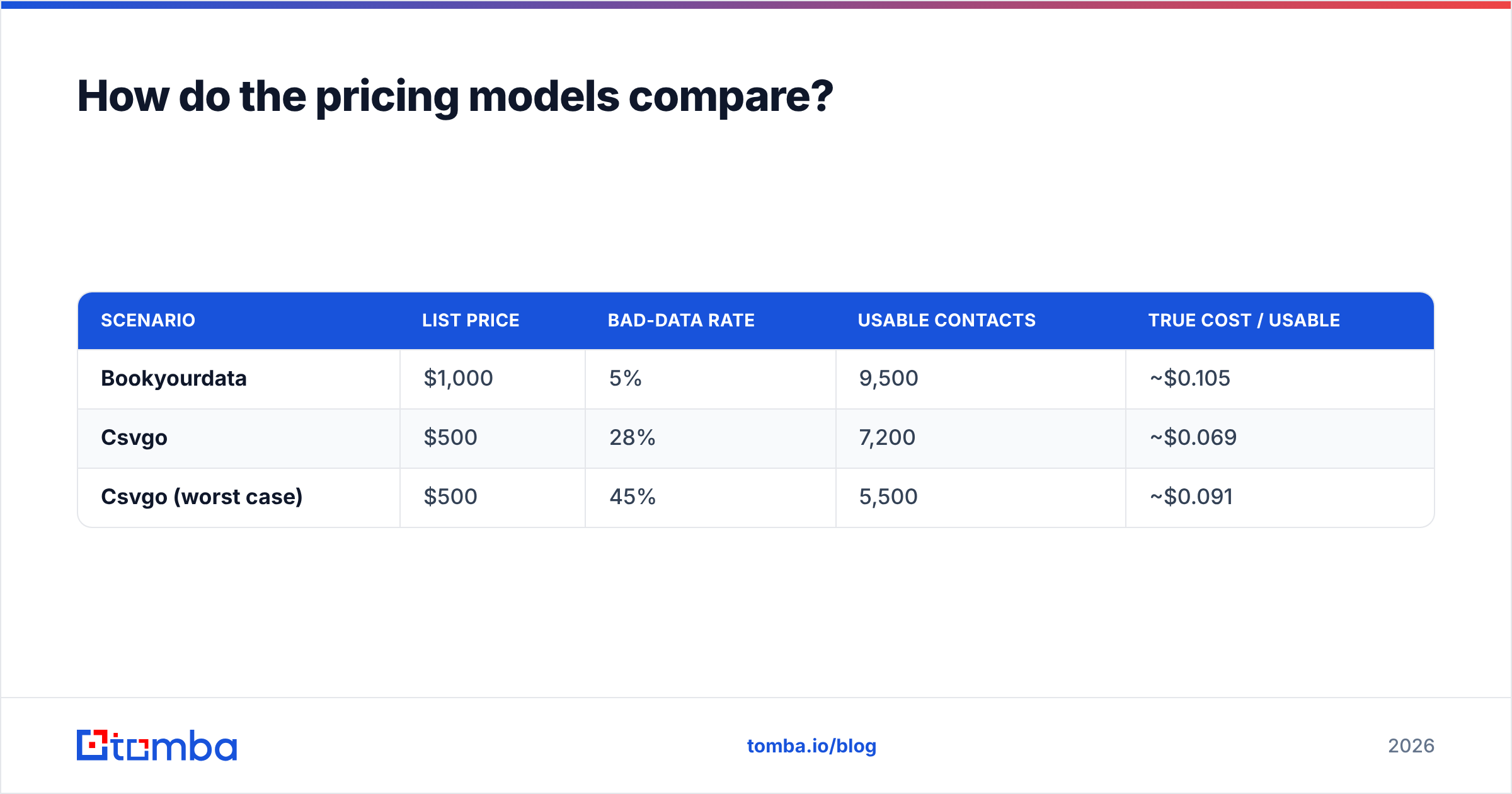
A worked example makes the trap obvious. Say you buy 10,000 records:
| Scenario | List price | Bad-data rate | Usable contacts | True cost / usable |
|---|---|---|---|---|
| Bookyourdata | $1,000 | 5% | 9,500 | ~$0.105 |
| Csvgo | $500 | 28% | 7,200 | ~$0.069 |
| Csvgo (worst case) | $500 | 45% | 5,500 | ~$0.091 |
Csvgo can still win on true cost — if its bad-data rate stays moderate. Once decay creeps past ~40%, the gap narrows fast, and that's before you count the deliverability damage from sending to dead mailboxes. Always model cost-per-usable-contact, not cost-per-row. For reference points on how credit and per-record models stack up across the category, vendor-neutral review sites like G2 and Capterra list current pricing and verified user complaints.
Which one fits your outbound stack?#
Match the tool to your bottleneck, not to the lowest price.
Choose Bookyourdata if:
- Your campaigns are tightly targeted (specific titles, industries, tech stacks).
- Deliverability and sender reputation are top priorities.
- You'd rather pay more upfront than clean data later.
- You send moderate volumes where credit pricing stays reasonable.
Choose Csvgo if:
- You need raw volume and your model tolerates higher bounce rates.
- Budget is the hard constraint and you have a verification pipeline already.
- You're feeding a broad awareness play, not precision ABM.
Choose neither (or augment both) if:
- You need emails that are fresh at the moment of outreach, not at the moment of export.
- You want to enrich your own CRM records on demand rather than buy bulk.
- You care about a clean audit trail for email deliverability and compliance.
That last category is where most modern outbound teams actually live — and where a static list, cheap or premium, starts to feel like the wrong primitive.
Why a real-time finder beats both for fresh data#
Both Bookyourdata and Csvgo sell you a snapshot. The fundamental limitation of any pre-built list is that B2B data decays continuously, and you don't control the refresh cadence. You buy in March, send in June, and quietly inherit three months of job changes.
A real-time email finder inverts the model. Instead of buying a list and hoping it's still good, you resolve a contact at the moment you need it — by domain, name, or company — and verify it on the spot. The freshness problem largely disappears because the lookup happens now, not whenever the vendor last refreshed a file.
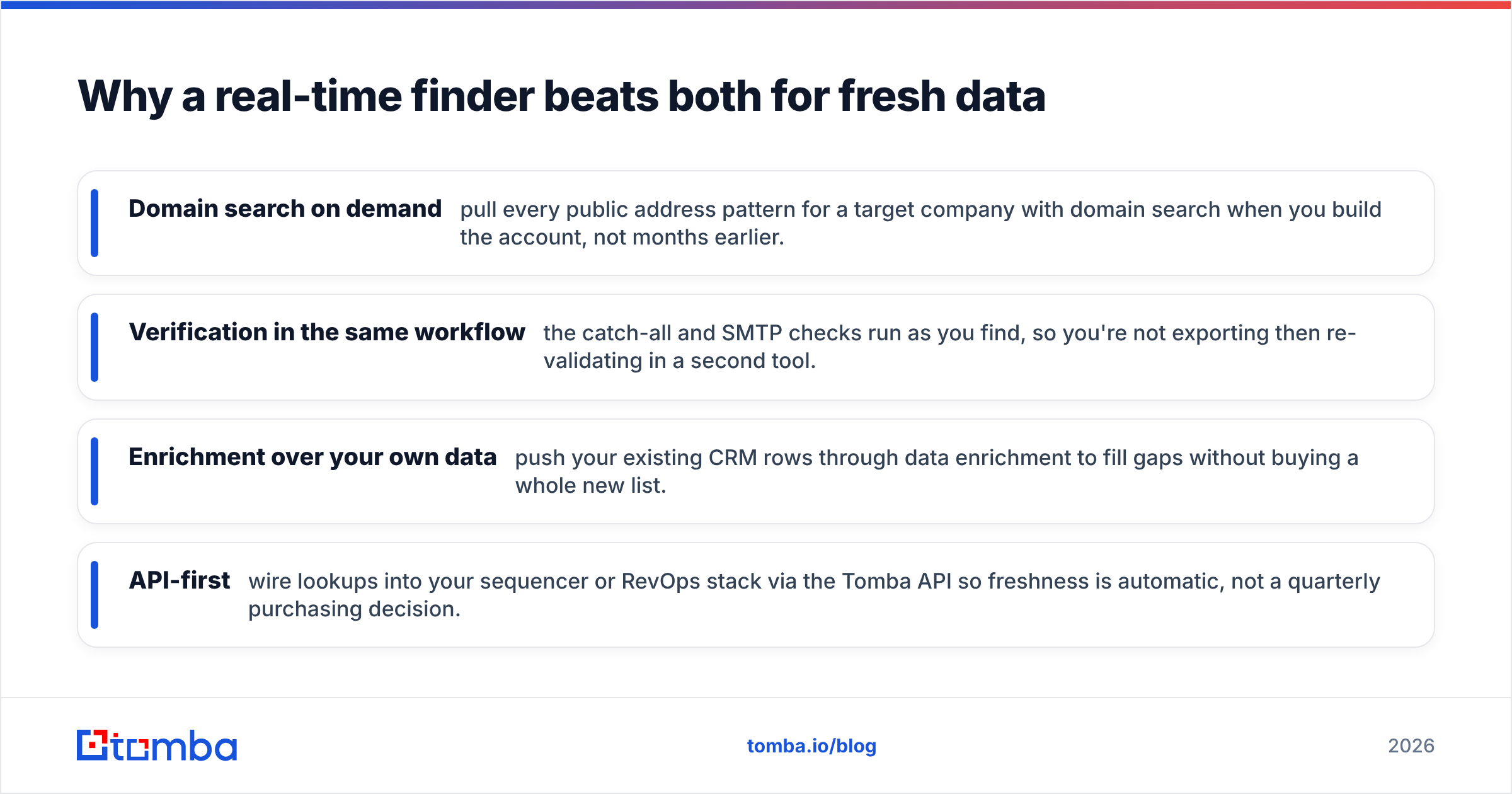
This is the gap Tomba is built to fill. A few practical differences:
- Domain search on demand — pull every public address pattern for a target company with domain search when you build the account, not months earlier.
- Verification in the same workflow — the catch-all and SMTP checks run as you find, so you're not exporting then re-validating in a second tool.
- Enrichment over your own data — push your existing CRM rows through data enrichment to fill gaps without buying a whole new list.
- API-first — wire lookups into your sequencer or RevOps stack via the Tomba API so freshness is automatic, not a quarterly purchasing decision.
This isn't a knock on buying lists entirely — there are moments when a curated segment from a provider like Bookyourdata is the fastest path to a defined market. But pairing any list with a live finder-plus-verifier is how you stop paying the decay tax twice.
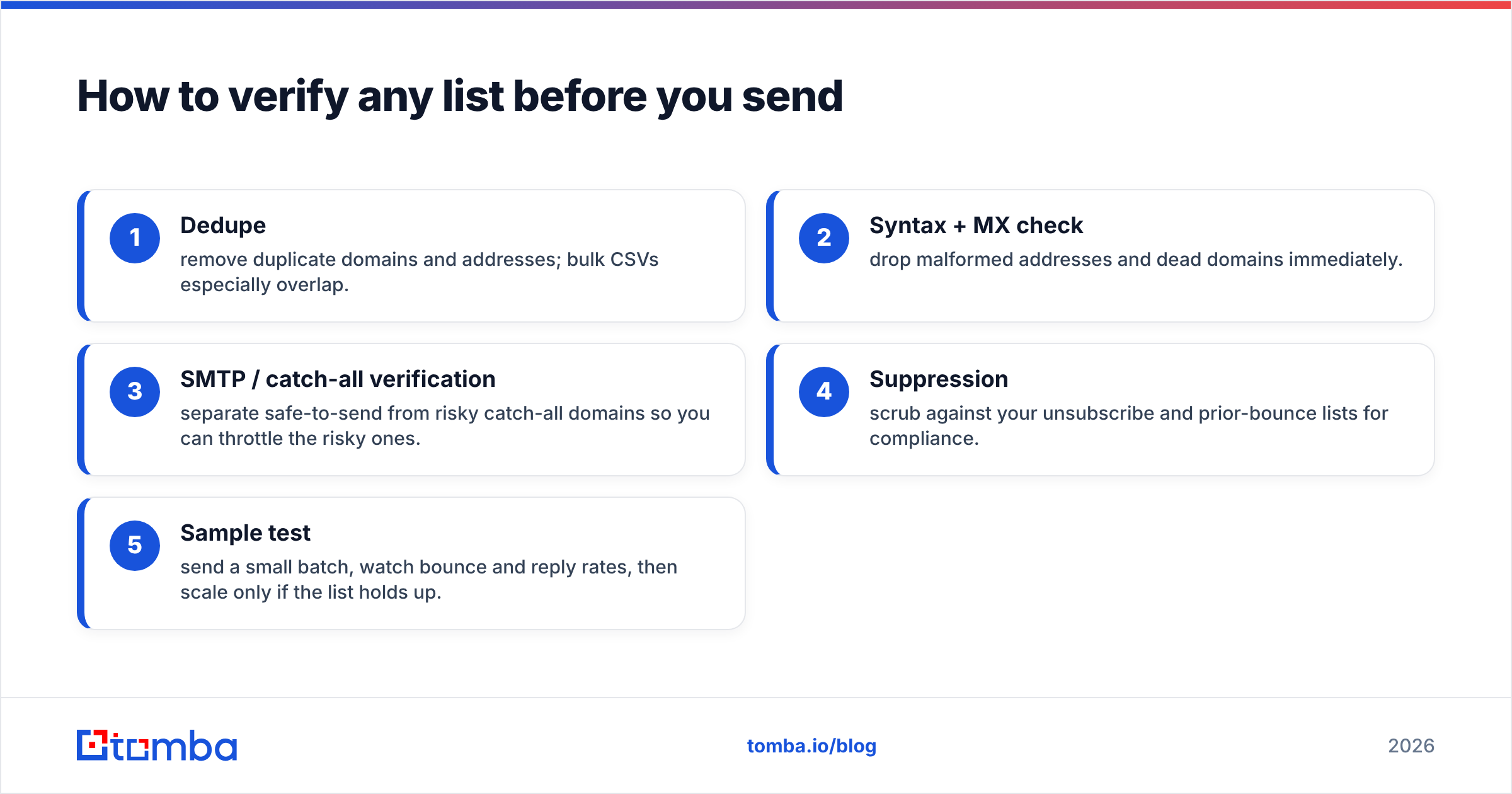
How to verify any list before you send#
Whichever vendor you choose, treat the file as raw material, not a finished asset. A reliable pre-send routine:
- Dedupe — remove duplicate domains and addresses; bulk CSVs especially overlap.
- Syntax + MX check — drop malformed addresses and dead domains immediately.
- SMTP / catch-all verification — separate safe-to-send from risky catch-all domains so you can throttle the risky ones.
- Suppression — scrub against your unsubscribe and prior-bounce lists for compliance.
- Sample test — send a small batch, watch bounce and reply rates, then scale only if the list holds up.
Skipping step 3 is the most common and most expensive mistake. A single send to a stale Csvgo file with a 30% dead rate can spike complaints enough to drag your domain reputation down for weeks — wiping out any savings the cheaper data bought you. Running the list through a dedicated email verifier first is cheap insurance against that.
The verdict#
For precision and deliverability, Bookyourdata is the safer buy; for raw budget volume, Csvgo wins on sticker price — but both are snapshots that start decaying the moment you export. If your outbound depends on emails being correct today, neither static list is the right backbone on its own.
The strongest setup in 2026 is a real-time, verification-first workflow: find the contact when you need it, verify it in the same pass, and enrich your own records instead of renting someone else's aging file. The Tomba Email Finder does exactly that — search by domain, name, or company, get a verified address, and skip the decay tax that both list vendors quietly pass to you. Start free with 25 searches a month, then scale on Tomba pricing from $49/mo when your pipeline grows.
Ready to find emails that actually work?
Join 150,000+ professionals who stopped guessing and started sending. Free credits on signup — no credit card required.
Get the Tomba newsletter
Practical outbound tactics and product updates — once every two weeks.
About the author