BookYourData vs DiscoverOrg 2026: Which B2B Data Wins?
BookYourData sells pay-as-you-go email lists; DiscoverOrg (now ZoomInfo) sells enterprise sales intelligence. Here's which B2B data source fits your team in 2026 — and where a leaner API beats both.
BookYourData vs DiscoverOrg: Which B2B Data Provider Actually Fits Your Team in 2026?
Choosing between BookYourData and DiscoverOrg is really a choice between two different business models, not two versions of the same thing. One sells you a downloadable list. The other sells you a platform subscription with research analysts behind it. Picking wrong means you either overpay for features you never touch or buy a cheap list that bounces half your campaign.
This guide breaks down both on the things that actually move pipeline: data accuracy, pricing transparency, coverage, and how the data fits into your existing workflow.
TL;DR — BookYourData vs DiscoverOrg at a Glance#
- BookYourData is a pay-as-you-go email list builder. You filter, you buy credits, you export a CSV. Good for one-off list pulls; weak on freshness and intent.
- DiscoverOrg (merged into ZoomInfo years ago, now sold as ZoomInfo SalesOS) is enterprise sales intelligence — org charts, intent data, technographics — sold on annual contracts that typically start in the five figures.
- Accuracy: DiscoverOrg's human-verified data edges out BookYourData's bulk lists, but both decay fast and need re-verification before you send.
- Price gap is enormous: BookYourData starts at a few hundred dollars in credits; DiscoverOrg/ZoomInfo means a sales call and an annual commitment.
- The leaner play: an API-first finder like Tomba Email Finder gives you verified, on-demand contacts from $49/mo without a list-broker markup or an enterprise contract.
)
What Is BookYourData?#
BookYourData is a self-serve B2B email list provider. You log in, apply filters (industry, job title, location, company size), and the platform shows you how many matching contacts it has. You buy credits, download the list, and you own that snapshot forever.
The appeal is simple: no contract, no sales call, no annual commitment. You pay only for the records you pull, and they advertise a high deliverability guarantee with credit refunds on hard bounces.
The catch is that you're buying a static snapshot. A B2B database degrades roughly 2–2.5% per month as people change jobs — that's the widely cited B2B data decay rate. A list you bought in January is meaningfully stale by summer, and there's no live re-verification unless you re-buy. You're also buying contacts that hundreds of other customers may have already mailed.
What Is DiscoverOrg (Now ZoomInfo)?#
DiscoverOrg was a premium sales-intelligence platform known for deep org charts and human-verified contact data. It merged with ZoomInfo, and the product line is now sold under the ZoomInfo umbrella (SalesOS). When people search "DiscoverOrg" in 2026, they almost always end up on a ZoomInfo demo page.
This is a different category of product. Beyond email and phone, you get:
- Org charts and reporting structures — see who reports to whom before a call.
- Intent data — signals that an account is researching your category.
- Technographics — what software a company already runs.
- Real-time alerts — funding rounds, job changes, leadership moves.
- CRM integration — push enriched records straight into Salesforce or HubSpot.
That depth costs accordingly. ZoomInfo is an annual-contract product, usually negotiated, and most published estimates put entry packages well into five figures per year. You're buying a research operation, not a CSV.
BookYourData vs DiscoverOrg: Full Comparison Table#
Here's how the two stack up across the attributes that matter when you're spending real budget.
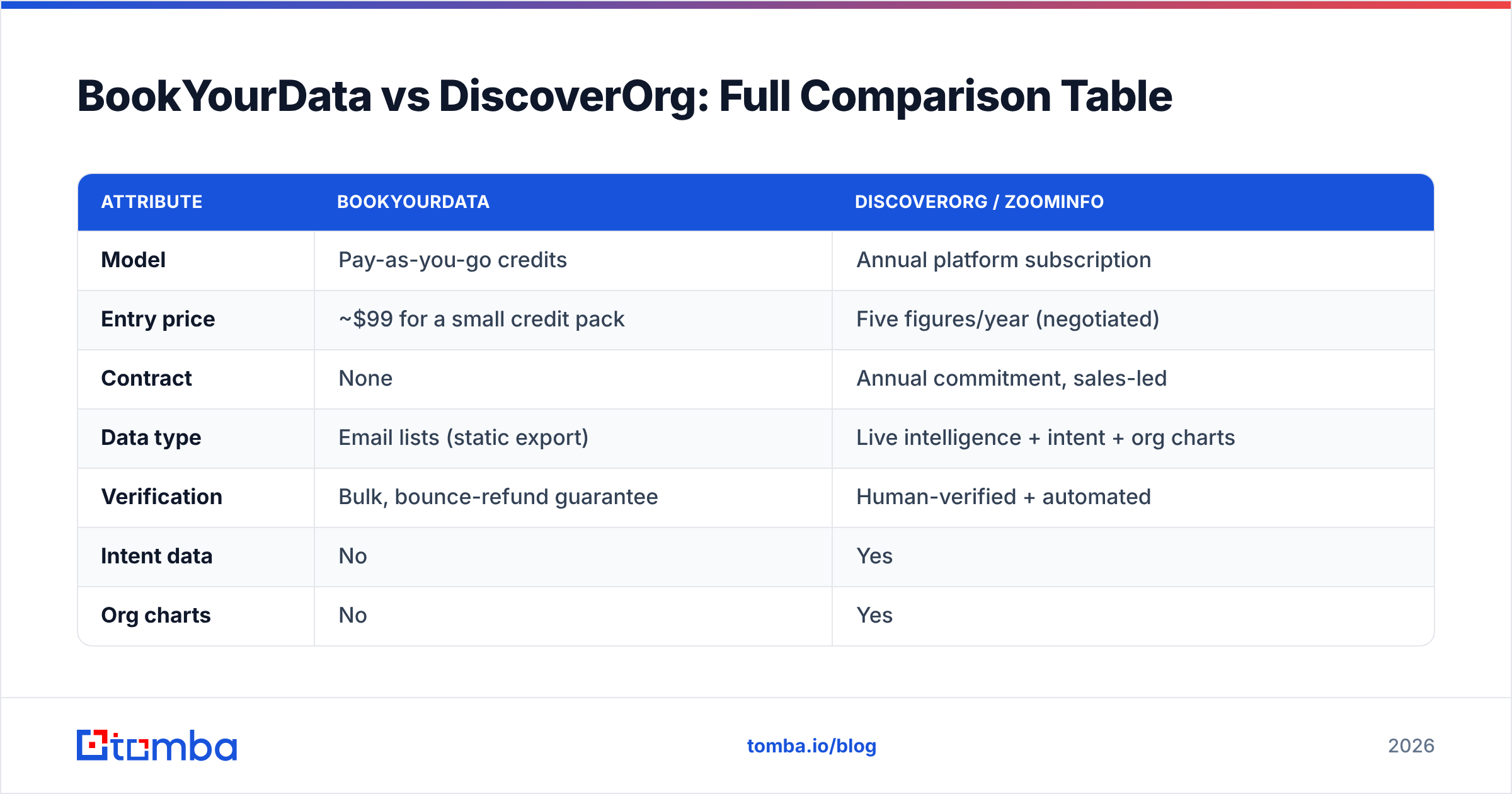
| Attribute | BookYourData | DiscoverOrg / ZoomInfo |
|---|---|---|
| Model | Pay-as-you-go credits | Annual platform subscription |
| Entry price | ~$99 for a small credit pack | Five figures/year (negotiated) |
| Contract | None | Annual commitment, sales-led |
| Data type | Email lists (static export) | Live intelligence + intent + org charts |
| Verification | Bulk, bounce-refund guarantee | Human-verified + automated |
| Intent data | No | Yes |
| Org charts | No | Yes |
| Technographics | Limited | Yes |
| CRM sync | Manual CSV import | Native integrations |
| Best for | One-off list pulls, SMBs | Enterprise outbound teams |
| API access | Limited | Yes (enterprise tier) |
| Free trial | Sample credits | Demo only, no self-serve trial |
The pattern is clear: BookYourData competes on price and simplicity, DiscoverOrg/ZoomInfo competes on depth and freshness. Neither is "better" in the abstract — it depends entirely on whether you need a list or a system.
Is DiscoverOrg's Data More Accurate Than BookYourData's?#
Yes, generally — but the gap is smaller than the price difference implies, and both still require verification before you send.
DiscoverOrg built its reputation on human research teams confirming contacts, which historically produced cleaner records than scraped or aggregated lists. ZoomInfo has continued that with a mix of automated collection and manual checks. For senior titles at mid-market and enterprise accounts, its accuracy is strong.
BookYourData leans on a bounce-refund guarantee instead of live verification. That protects your sender reputation on paper, but a refund doesn't get your message to the right person — it just gives you a credit back after the damage to your campaign metrics is done. High bounce rates still hurt your sender reputation even if you're refunded for the wasted records.
The honest truth for both: always re-verify any purchased or exported list before a send. Run it through a dedicated email verifier so you're checking the address as it exists today, not as it existed when the data was last touched. This single step does more for deliverability than choosing one vendor over the other.
How Do Pricing Models Compare?#
This is where the two diverge most sharply, and where most buyers actually make their decision.
BookYourData — transparent, usage-based. You can see prices on the site, buy a small pack to test, and scale up. There's no negotiation and no lock-in. The downside is per-record cost climbs if you pull large volumes regularly, and you're re-buying as data goes stale.
DiscoverOrg/ZoomInfo — opaque, contract-based. Pricing is gated behind a sales call. Expect a multi-seat annual contract, add-ons for intent and advanced features, and meaningful year-over-year increases at renewal. Great ROI if you use the full platform; expensive shelfware if you only needed contacts.
The hidden third cost — verification and enrichment. Whatever you buy, you'll spend more cleaning and enriching it. Budgeting only for the raw data is how teams blow past their plan.
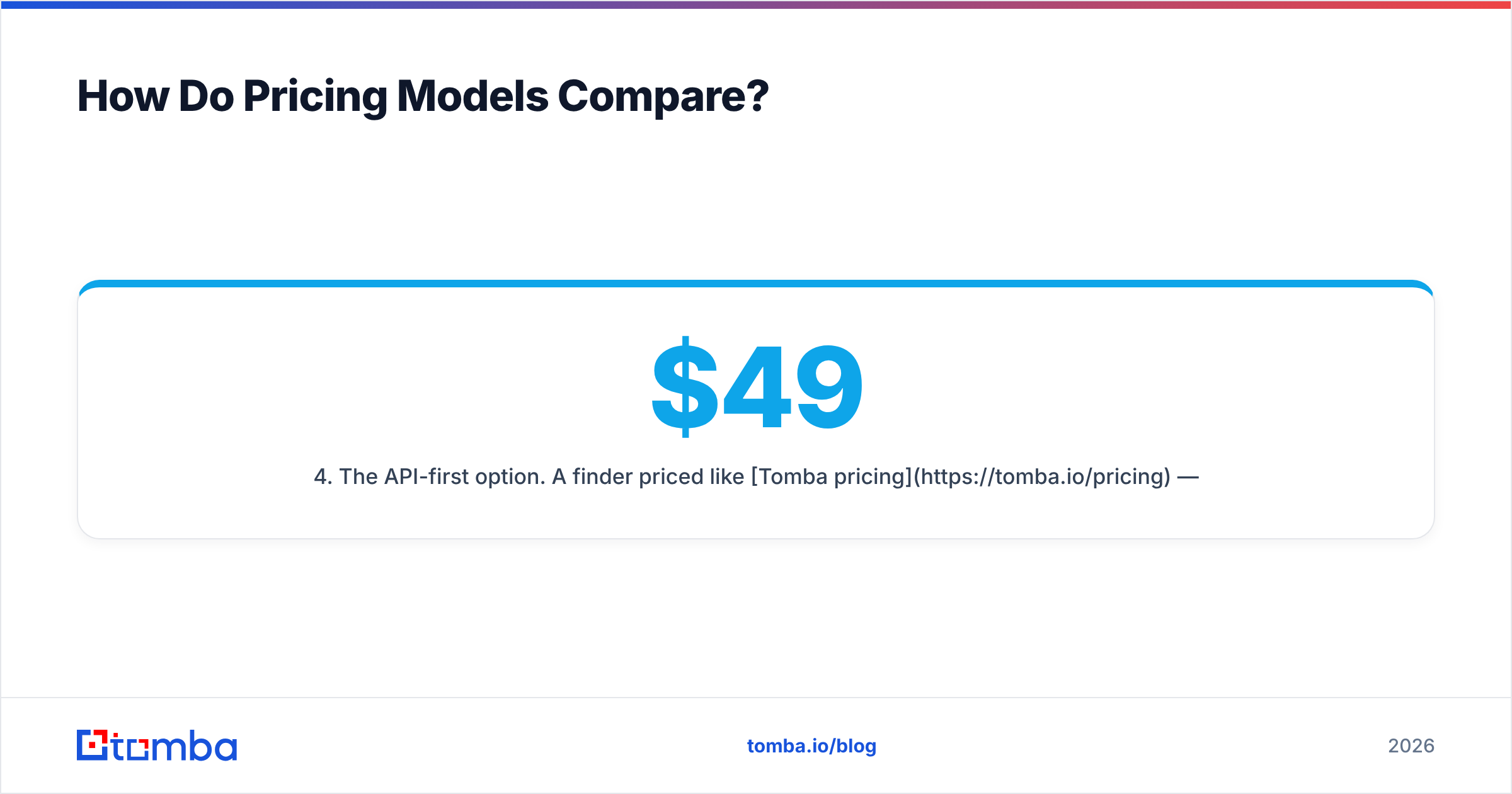
The API-first option. A finder priced like Tomba pricing — Free (25 searches/mo), Starter $49/mo, Growth $99/mo, Pro $249/mo — sidesteps both the per-record list markup and the enterprise contract. You pull verified contacts on demand, only when you need them.
)
Which One Should You Choose?#
Match the tool to your motion, not the other way around.
Choose BookYourData if:
- You need a one-time list for a specific campaign.
- You're an SMB or solo founder without budget for a platform.
- You want zero commitment and transparent, self-serve pricing.
- You're comfortable verifying the list yourself before sending.
Choose DiscoverOrg/ZoomInfo if:
- You run an enterprise outbound team that lives in the data daily.
- You need intent signals, org charts, and technographics — not just emails.
- You want native CRM enrichment and real-time account alerts.
- You can justify a five-figure annual spend with pipeline attribution.
Choose an API-first finder (like Tomba) if:
- You want verified contacts on demand without buying a stale snapshot.
- You're a developer or RevOps team that wants to enrich inside your own stack.
- You need predictable monthly pricing, not credit packs or contracts.
- You'd rather pull a fresh, verified email at the moment of outreach.
Where Does Tomba Fit Between the Two?#
Tomba sits in the gap BookYourData and DiscoverOrg leave open: fresh, verified, on-demand B2B contacts without a broker markup or an enterprise contract.
Instead of buying a static list (BookYourData) or committing to a full sales-intelligence suite (DiscoverOrg), you find and verify the exact contacts you need, when you need them. The toolset covers the same core jobs both competitors charge a premium for:
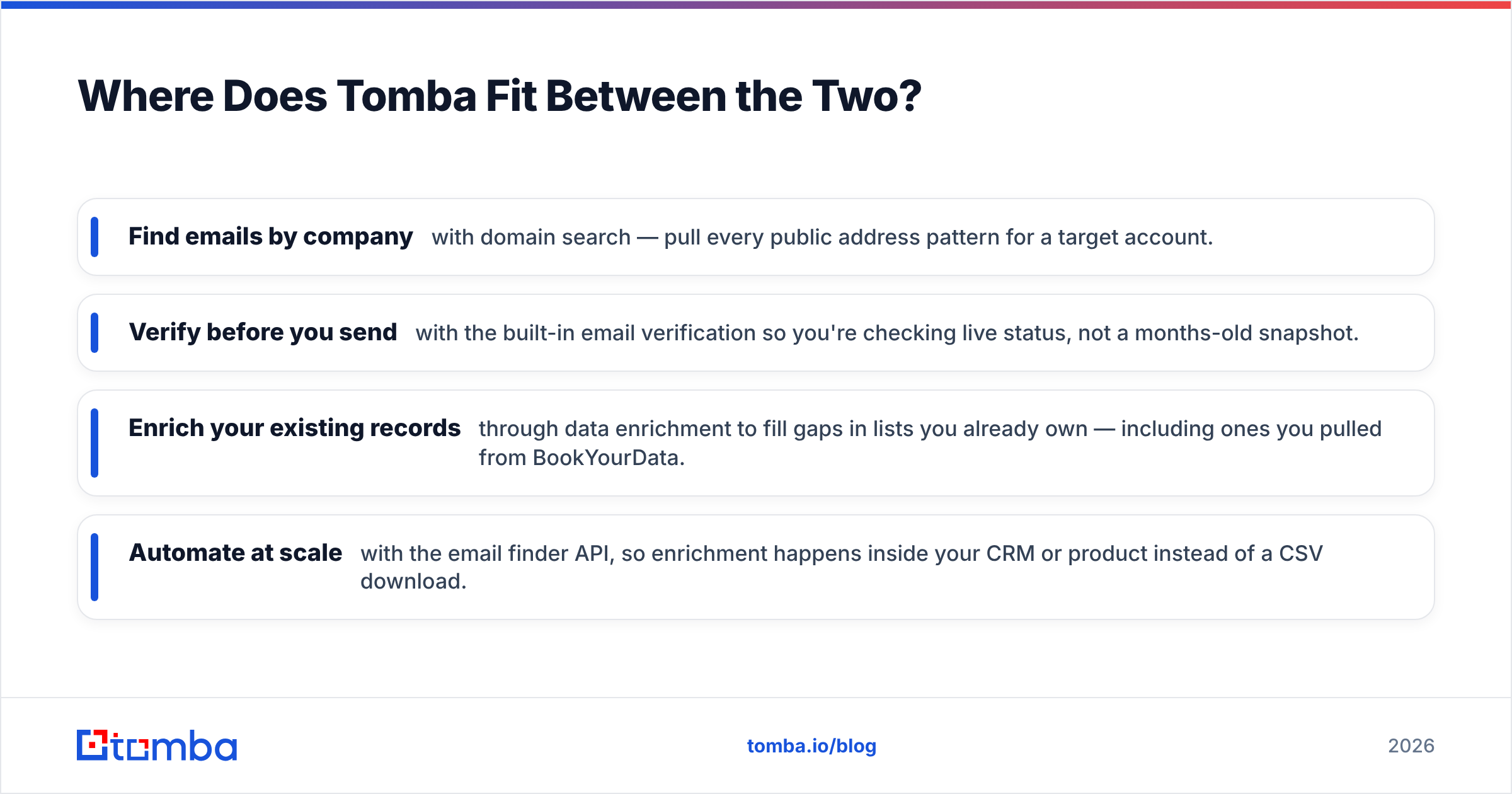
- Find emails by company with domain search — pull every public address pattern for a target account.
- Verify before you send with the built-in email verification so you're checking live status, not a months-old snapshot.
- Enrich your existing records through data enrichment to fill gaps in lists you already own — including ones you pulled from BookYourData.
- Automate at scale with the email finder API, so enrichment happens inside your CRM or product instead of a CSV download.
You won't get DiscoverOrg's org charts and intent data — if that's the job, ZoomInfo is the right (expensive) tool. But for the most common need — getting a verified email or phone number for a known person or company — Tomba does it for a fraction of the cost and without the staleness problem baked into list-buying.
It's also worth noting Tomba supports bulk lead generation when you do need volume, so you're not forced to choose between "one contact at a time" and "buy 50,000 stale rows."
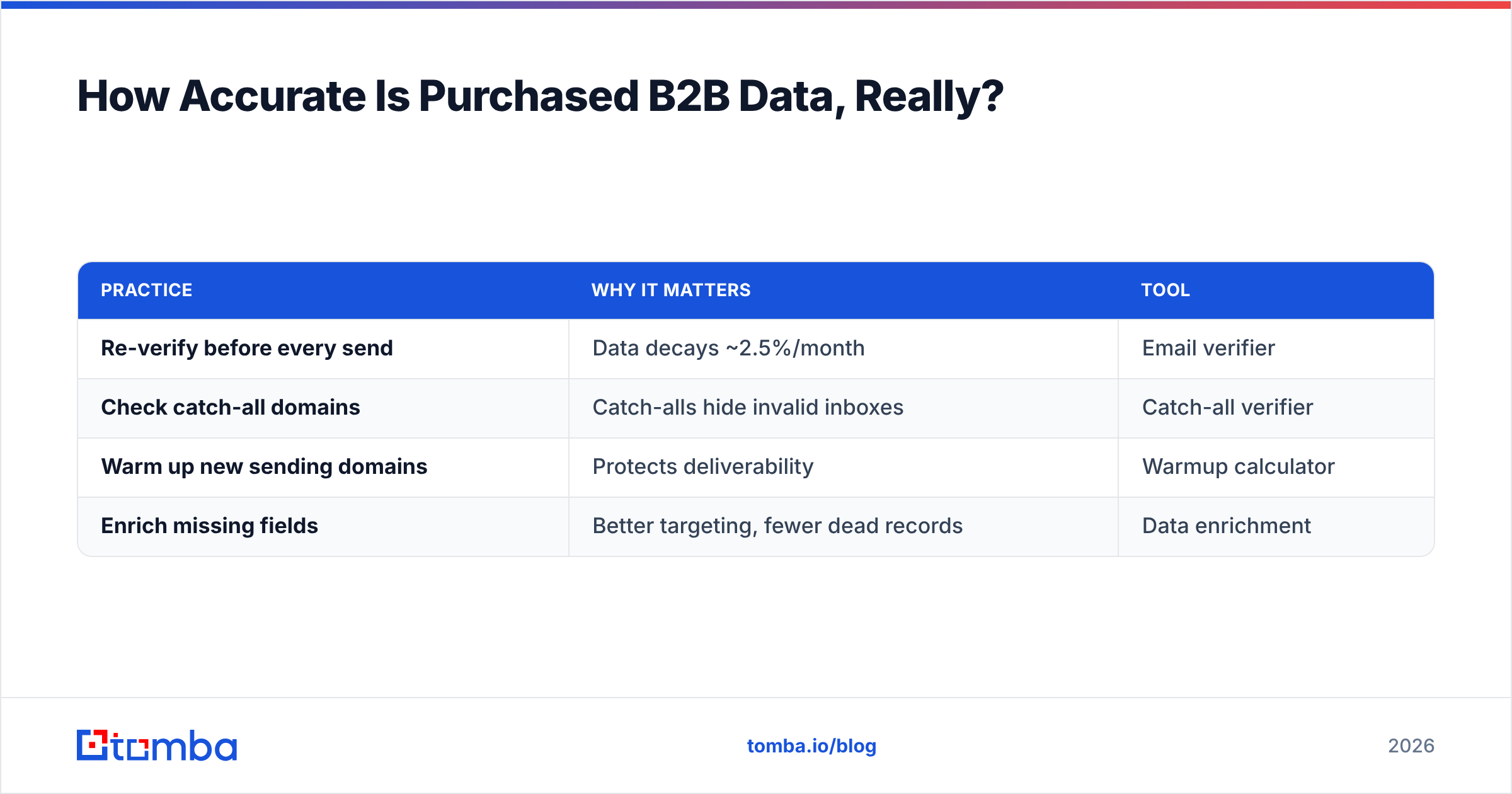
How Accurate Is Purchased B2B Data, Really?#
No matter which vendor you pick, treat purchased data as a starting point, not a finished product. Three habits keep your campaigns healthy:
| Practice | Why it matters | Tool |
|---|---|---|
| Re-verify before every send | Data decays ~2.5%/month | Email verifier |
| Check catch-all domains | Catch-alls hide invalid inboxes | Catch-all verifier |
| Warm up new sending domains | Protects deliverability | Warmup calculator |
| Enrich missing fields | Better targeting, fewer dead records | Data enrichment |
Independent review sites like G2 and Capterra show the same pattern across every data vendor: accuracy complaints almost always trace back to teams skipping verification, not to the source being uniquely bad. Build the verification step into your process and the vendor choice matters far less than the workflow around it.
For deeper background on how providers source records, ZoomInfo's own data methodology pages and Tomba's data sources are both worth reading before you commit budget.
The Bottom Line#
BookYourData and DiscoverOrg solve different problems at opposite ends of the price spectrum. BookYourData is the quick, cheap list. DiscoverOrg (ZoomInfo) is the deep, expensive platform. Most teams searching for "bookyourdata vs discoverorg" actually fall in the middle — they need fresh, verified contacts, not a static CSV and not a five-figure intelligence suite.
That middle is exactly where an API-first finder wins. Start with the Tomba Email Finder free tier — 25 searches a month, no contract, verified results — and see how far on-demand data gets you before you ever pay a list broker or sign an enterprise deal. When you're ready to scale, $49/mo gets you going without the lock-in either competitor demands.
// get started
Find, verify and enrich your first contacts today
Start on the free plan with 25 searches a month, then scale when your team is ready.
Free plan · No credit card required · GDPR & CCPA
// about the author