BookYourData vs EmailVerify.io: Which Wins in 2026?
BookYourData sells B2B contact lists; EmailVerify.io cleans them. Here's which tool you actually need in 2026 — and where a finder beats both.
You searched BookYourData vs EmailVerifyio to fix one problem. You want accurate B2B emails in your outbound stack. And you want them without burning your sender reputation. Here is the honest answer. These two tools solve different halves of that problem. Depending on your workflow, you may not need either one.
TL;DR#
- BookYourData is a pay-as-you-go B2B contact database. You buy lists of emails, titles, and phone numbers. You filter them by industry, geography, and seniority.
- EmailVerify.io is a verification tool. It cleans an existing list by checking syntax, MX records, and mailbox status. The goal is fewer bounces.
- They are complements, not competitors. Buy data from one, then scrub it with the other. Neither finds emails for a specific person you already have in mind.
- Maybe your real need is "find and verify the right contact at a target account on demand." If so, a dedicated email finder with a built-in email verifier replaces both in one step.
- For most teams in 2026, two factors decide it: cost per usable contact and how fresh the data is. The headline price matters less.
What is BookYourData and what does it actually do?#
BookYourData is a self-service B2B data marketplace. You build a filtered segment. For example: "VP of Marketing, SaaS, 50–200 employees, United States." It returns a downloadable list of contacts. Each record has emails, job titles, company data, and sometimes direct-dial phone numbers. Pricing is credit-based and pay-as-you-go. You only pay for the records you export.
Its pitch is a 97% accuracy guarantee on delivered emails, with no forced subscription. That is attractive for a one-time campaign or a quick list build. But any static database has one catch: staleness. B2B contacts churn at roughly 25–30% per year as people change jobs. So a list bought in January is measurably worse by summer. You are buying a snapshot, not a live lookup.

That accuracy claim is exactly where verification enters the picture. No list provider can promise a contact still works at the company by the time your email lands. BookYourData included.
What is EmailVerify.io and where does it fit?#
EmailVerify.io does one thing. It tells you whether an email address is safe to send to. Upload a list, or hit the API. It then runs a chain of checks: syntax validation, domain and MX-record lookups, role-account detection, disposable-domain flags, and an SMTP-level mailbox ping. Each address is labeled deliverable, risky, or invalid.
It does not find or generate emails. Say you have a name and a company but no address. EmailVerify.io cannot help. It can only grade addresses you already possess. Its value is purely defensive. It keeps your bounce rate under the ~2% threshold that inbox providers treat as a spam signal. Clean lists protect your sender reputation. That is the single biggest lever on whether your cold emails reach the inbox.
So the "vs" in your search is a bit of a category error. One fills the bucket. The other checks the bucket for holes.
BookYourData vs EmailVerifyio: side-by-side comparison#
Here is how the two stack up on the attributes that affect your campaign economics.
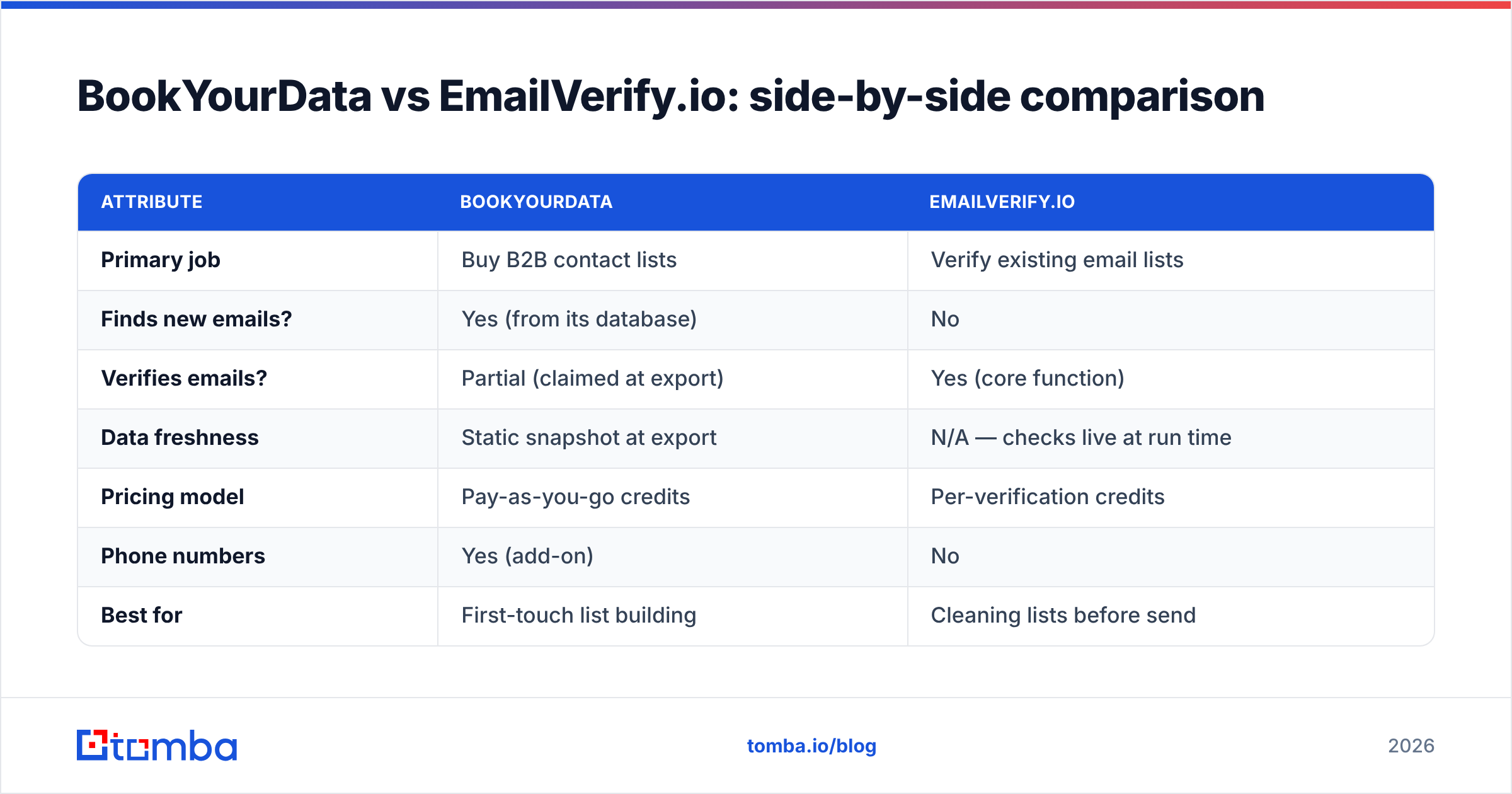
| Attribute | BookYourData | EmailVerify.io |
|---|---|---|
| Primary job | Buy B2B contact lists | Verify existing email lists |
| Finds new emails? | Yes (from its database) | No |
| Verifies emails? | Partial (claimed at export) | Yes (core function) |
| Data freshness | Static snapshot at export | N/A — checks live at run time |
| Pricing model | Pay-as-you-go credits | Per-verification credits |
| Phone numbers | Yes (add-on) | No |
| Best for | First-touch list building | Cleaning lists before send |
| Weakness | Staleness, no per-person lookup | Can't source data |
The pattern is clear. These are two stages of one pipeline. Buy from BookYourData, then push the export through EmailVerify.io before your first send. But there is a cost. You pay two vendors, reconcile two formats, and still ship data that is only as fresh as the compile date.

Is buying a static list still the right move in 2026?#
Short answer: increasingly not. The exception is when you need volume fast and accept the decay.
The BookYourData model has one structural weakness. You pay up front for a list whose accuracy only drops after purchase. Run that list through EmailVerify.io a month later. You will watch a chunk of "valid" addresses get flagged. The verifier is not wrong. The people simply moved on. So you have paid for data, then paid again to learn some of it is dead.
Most outbound teams now prefer a different approach: on-demand lookup. You do not bulk-buy a snapshot. Instead, you find the specific contact you need at the moment you need them. It is verified in the same call. That collapses the two-vendor pipeline into one step. It also guarantees the data is live, not archived.
Four things separate a modern finder-plus-verifier workflow from the buy-then-clean approach:
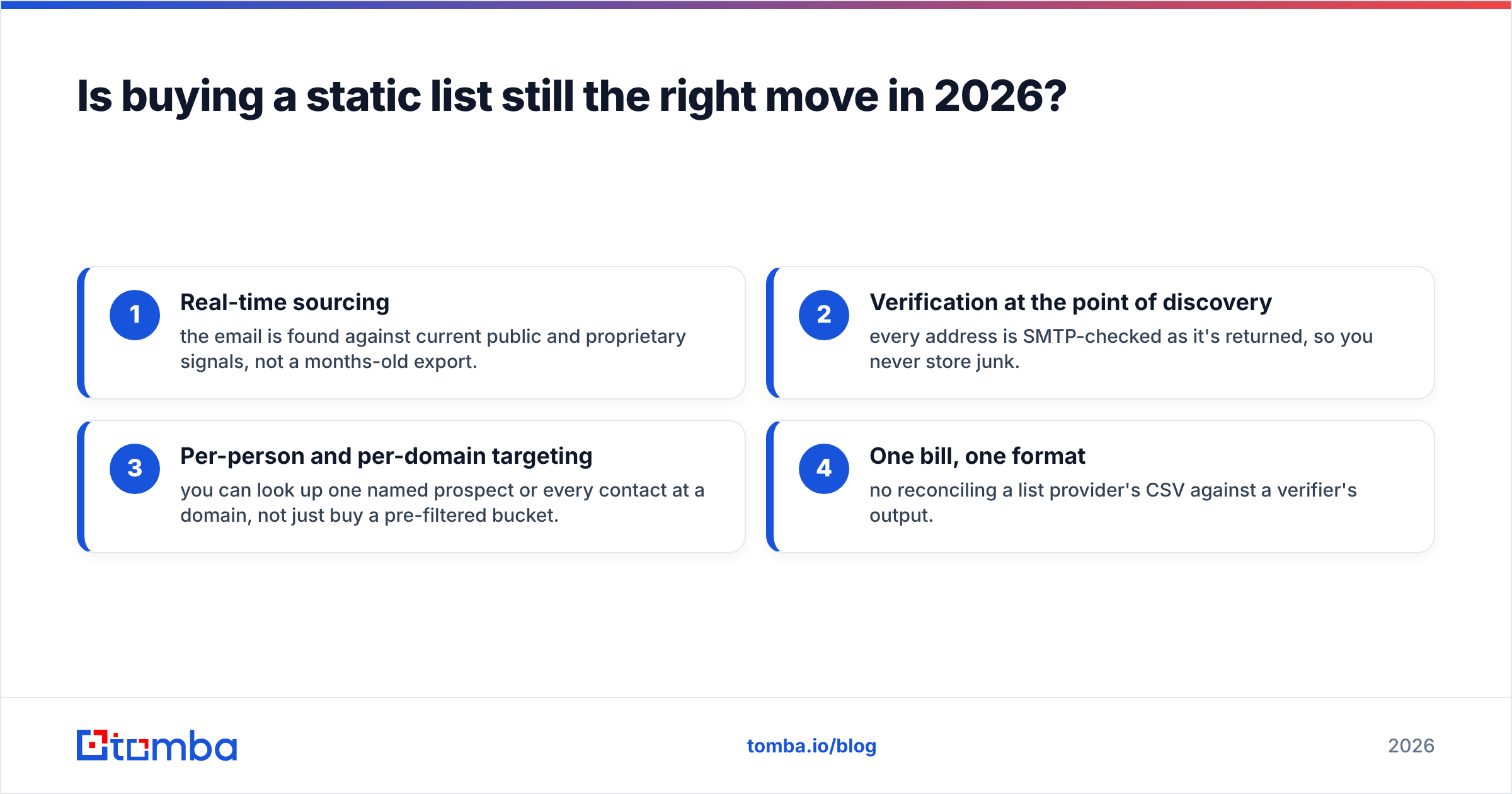
- Real-time sourcing — the email is found against current public and proprietary signals, not a months-old export.
- Verification at the point of discovery — every address is SMTP-checked as it is returned, so you never store junk.
- Per-person and per-domain targeting — look up one named prospect, or every contact at a domain. You are not stuck with a pre-filtered bucket.
- One bill, one format — no reconciling a list provider's CSV against a verifier's output.
This is where a tool like Tomba sits in the bookyourdata vs emailverifyio debate. It does BookYourData's sourcing job and EmailVerify.io's cleaning job. But it works on demand, against fresh data.
How does Tomba compare to running both tools?#
Tomba combines finding and verification in a single platform. That removes the hand-off that makes the BookYourData → EmailVerify.io pipeline slow and lossy. You can search by domain, by person, in bulk, or through the Tomba API. Every result is verified before it reaches you.
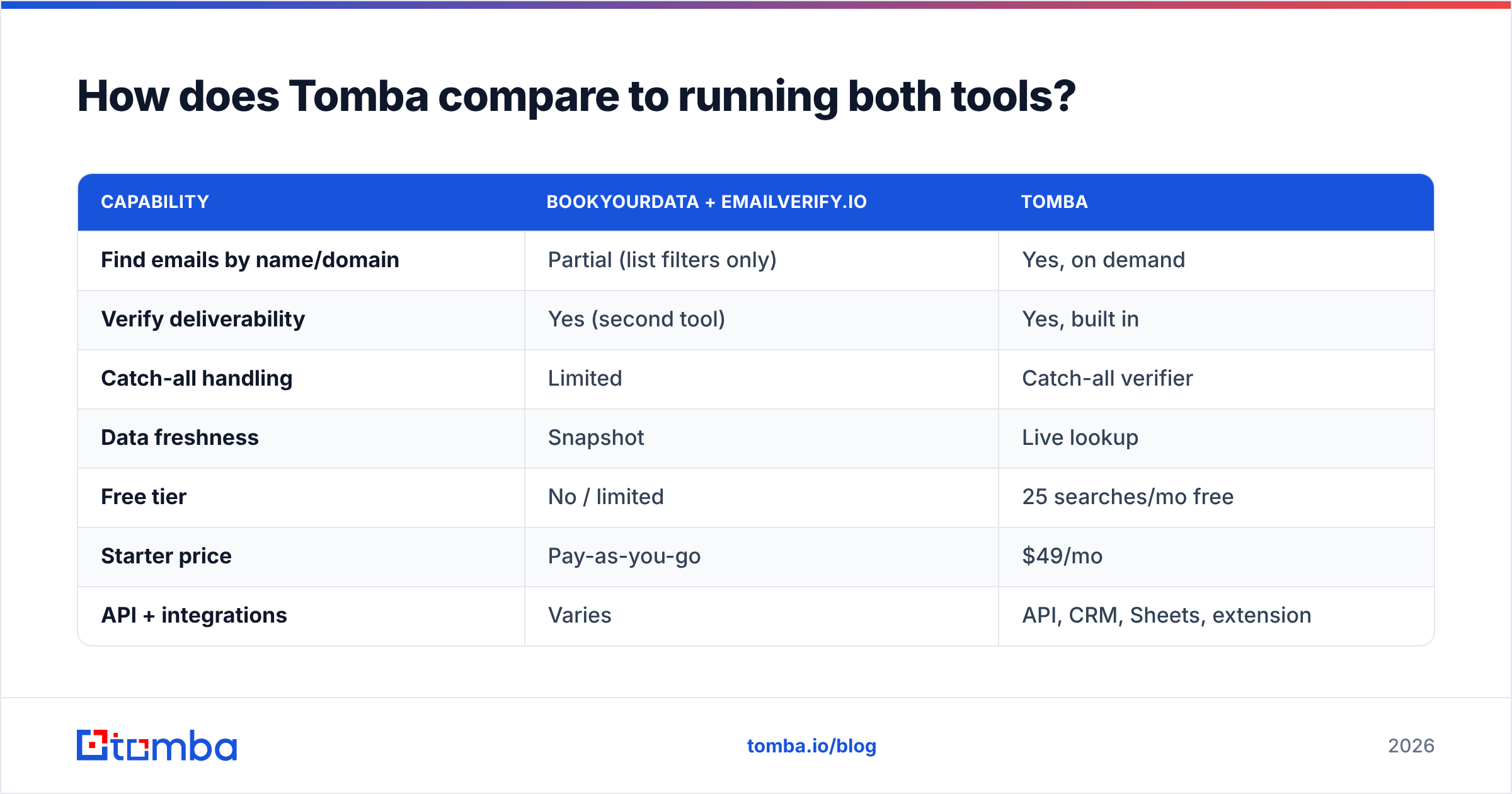
| Capability | BookYourData + EmailVerify.io | Tomba |
|---|---|---|
| Find emails by name/domain | Partial (list filters only) | Yes, on demand |
| Verify deliverability | Yes (second tool) | Yes, built in |
| Catch-all handling | Limited | Catch-all verifier |
| Data freshness | Snapshot | Live lookup |
| Free tier | No / limited | 25 searches/mo free |
| Starter price | Pay-as-you-go | $49/mo |
| API + integrations | Varies | API, CRM, Sheets, extension |
On price, Tomba's plans start with a free tier of 25 searches per month. Paid tiers run Starter at $49/mo, Growth at $99/mo, and Pro at $249/mo. Enterprise is custom. Picture a team that pays BookYourData per record and EmailVerify.io per check. Consolidating into one subscription usually lowers the true cost per usable, verified contact. That is the only number that matters.

When should you still pick BookYourData or EmailVerify.io?#
Be fair to both tools. There are genuine cases where each is the right call.
Pick BookYourData if: you need a large, broadly-filtered list right now for a one-off blast. You have no target accounts in mind. And you are comfortable verifying it yourself afterward. The pay-as-you-go model has no subscription, which suits occasional, high-volume pulls.
Pick EmailVerify.io if: you already have a list from a trade show, a webinar, an old CRM export, or a partner. You just need to scrub it before sending. As a standalone cleaner, it is focused and does the job. You can compare verification vendors on G2 to see how it ranks.
Pick a finder-plus-verifier (like Tomba) if: you run repeatable outbound, target specific companies and people, and want fresh, pre-verified data without managing two vendors. This is the majority case for SDR teams and founders who prospect on their own.
One more thing is worth remembering. Data quality is upstream of everything else in cold email. No amount of clever copy fixes a high bounce rate. And bounce rate is a function of how fresh and well-verified your list is. The U.S. CAN-SPAM rules and inbox-provider filters both punish senders who hit dead mailboxes. So getting the data layer right protects your whole program.
How do these tools affect deliverability?#
Every invalid address you send to is a small tax on your email deliverability. Mailbox providers track bounce and complaint rates per sending domain. Cross the line and even your good emails start landing in spam. That is why the verification step is non-negotiable, whoever does it.
The difference between the two approaches comes down to when verification happens:
- Buy-then-clean (BookYourData + EmailVerify.io): verification is a separate, after-the-fact batch job. It catches anything that went stale between purchase and verification. But you have already paid for it. And there is a window where you might send before cleaning.
- Find-and-verify (Tomba): verification is fused to discovery. The address is confirmed live at the moment you get it. There is no stale window, because there is no snapshot.
Want to dig into the mechanics? Sanity-check your own domain setup first. A free SPF checker and an email reputation checker both help before you scale a campaign. They matter as much as the list itself.
Which one should you actually choose?#
Map it to your workflow, not the marketing:
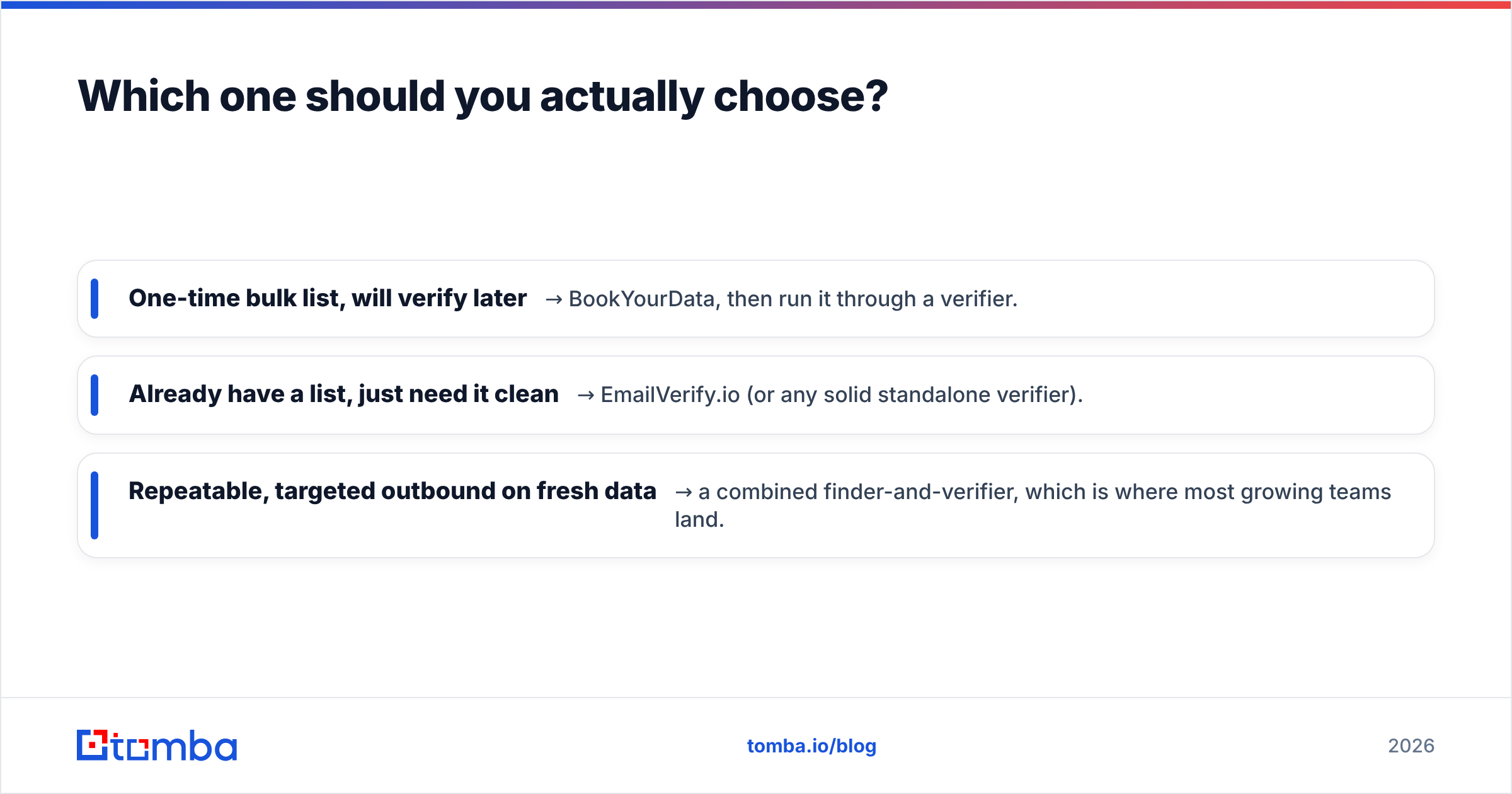
- One-time bulk list, will verify later → BookYourData, then run it through a verifier.
- Already have a list, just need it clean → EmailVerify.io, or any solid standalone verifier.
- Repeatable, targeted outbound on fresh data → a combined finder-and-verifier, where most growing teams land.
The "vs" framing pushes you to pick a side. But the smarter question is different. Do you want to keep stitching two single-purpose tools together? Or replace the whole pipeline with one that finds and verifies in a single, live step? That is the real bookyourdata vs emailverifyio decision.
Leaning that way? Start with the Tomba Email Finder. The free tier gives you 25 verified searches a month. That is enough to test it against a sample list. You would otherwise buy that list from BookYourData and clean it with EmailVerify.io. See the cost-per-usable-contact difference for yourself before you commit a dollar.
// get started
Find, verify and enrich your first contacts today
Start on the free plan with 25 searches a month, then scale when your team is ready.
Free plan · No credit card required · GDPR & CCPA
// about the author