Bookyourdata vs Gamalogic (2026): Which B2B Data Tool Wins?
Bookyourdata sells prepaid contact lists; Gamalogic finds and verifies emails on demand. Here's an honest 2026 breakdown of accuracy, pricing, and which one fits your outbound motion.
Choosing between Bookyourdata and Gamalogic comes down to one question: do you want to buy a static contact list, or build a verified one on demand? They look similar in a feature grid, but they solve different problems — and picking the wrong model wastes both budget and sender reputation.
This is a neutral 2026 breakdown. We'll compare data models, accuracy claims, pricing, verification, and the use cases each tool actually fits. Where a third option is genuinely better, we'll say so.
TL;DR#
- Bookyourdata is a prepaid B2B contact-list marketplace: you filter by industry/title/geo, pay per record, and download a list. Good for one-off list buys, weak for always-on, real-time prospecting.
- Gamalogic is an on-demand email finder and verifier (bulk + API). It's built around finding and validating emails as you prospect, not selling pre-packaged databases.
- Accuracy is the deciding factor. A purchased list decays ~2-3% per month; on-demand finding + verification keeps your data fresh at the moment of send.
- Pricing models differ fundamentally: Bookyourdata charges per credit/record with a pay-as-you-go option; Gamalogic uses credit subscriptions. Compare cost per verified contact you actually email, not sticker price.
- If you want both real-time finding and verification with transparent sourcing, a finder-first platform like Tomba usually beats either on cost-per-usable-contact.
What is Bookyourdata?#
Bookyourdata is a contact-database vendor. You build a target audience using filters — job title, industry, company size, location, technology used — and the platform returns matching business contacts that you purchase as records. It markets a high "verified at download" accuracy guarantee and offers pay-as-you-go credits alongside subscriptions, which appeals to teams that need a list now without a long contract.
The strength is breadth and speed for a single campaign: you can pull thousands of contacts in a category and start emailing the same day. The weakness is structural. The moment you download a list, it begins to age. People change jobs, companies get acquired, and inboxes get retired. A list that was 95% accurate at purchase is materially worse 90 days later, and you've already paid for the whole thing.

What is Gamalogic?#
Gamalogic is an email-finder and email-verification tool. Instead of selling you a pre-built list, it finds professional email addresses from inputs you provide (names, domains, company info) and validates deliverability through SMTP and syntax checks. It offers bulk processing and an API, so it slots into a workflow where you're continuously sourcing prospects rather than buying a snapshot.
The advantage of this model is freshness: you find and verify a contact close to the moment you intend to reach them, so decay is minimal. The trade-off is that you bring the targeting. Gamalogic is excellent at resolving and confirming an email, but you still need a source of names/domains — a CRM export, a scraped list, a domain search, or a sales-intelligence feed — to feed it.
Bookyourdata vs Gamalogic: how do they compare?#
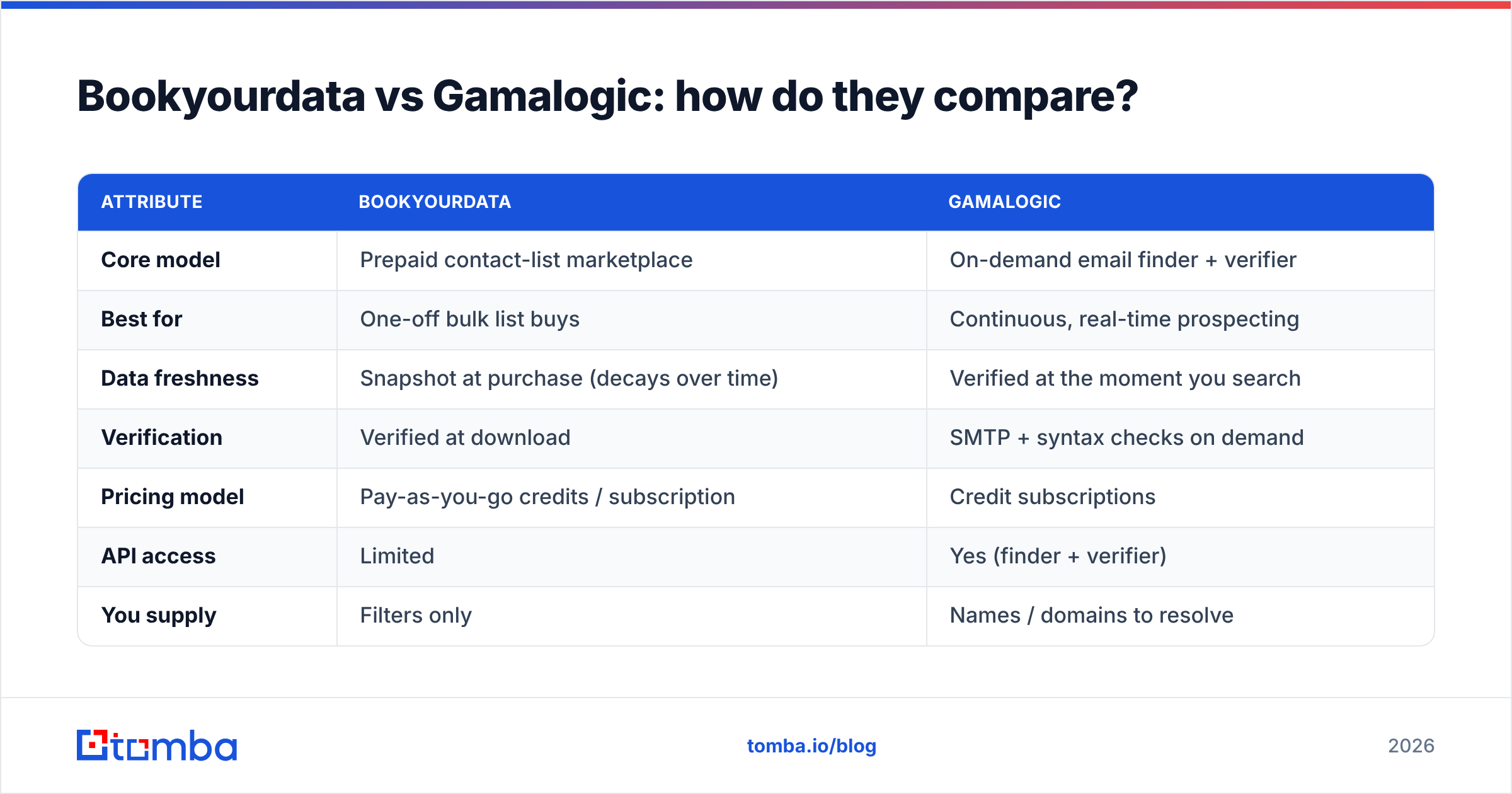
The clearest way to see the difference is side by side. The two tools sit at opposite ends of the data lifecycle.
| Attribute | Bookyourdata | Gamalogic |
|---|---|---|
| Core model | Prepaid contact-list marketplace | On-demand email finder + verifier |
| Best for | One-off bulk list buys | Continuous, real-time prospecting |
| Data freshness | Snapshot at purchase (decays over time) | Verified at the moment you search |
| Verification | Verified at download | SMTP + syntax checks on demand |
| Pricing model | Pay-as-you-go credits / subscription | Credit subscriptions |
| API access | Limited | Yes (finder + verifier) |
| You supply | Filters only | Names / domains to resolve |
| Risk | Paying for records you never email | Need a targeting source upstream |
Notice that neither column is strictly "better." If you need 5,000 contacts in a vertical for a single quarter-end push, a marketplace is fast. If you run an always-on outbound team that touches new accounts weekly, an on-demand finder keeps your email deliverability healthier because you're never blasting a stale list.

Which has better data accuracy?#
Accuracy depends less on the vendor's headline percentage and more on when the data was verified relative to when you send. This is the single most misunderstood metric in B2B data.
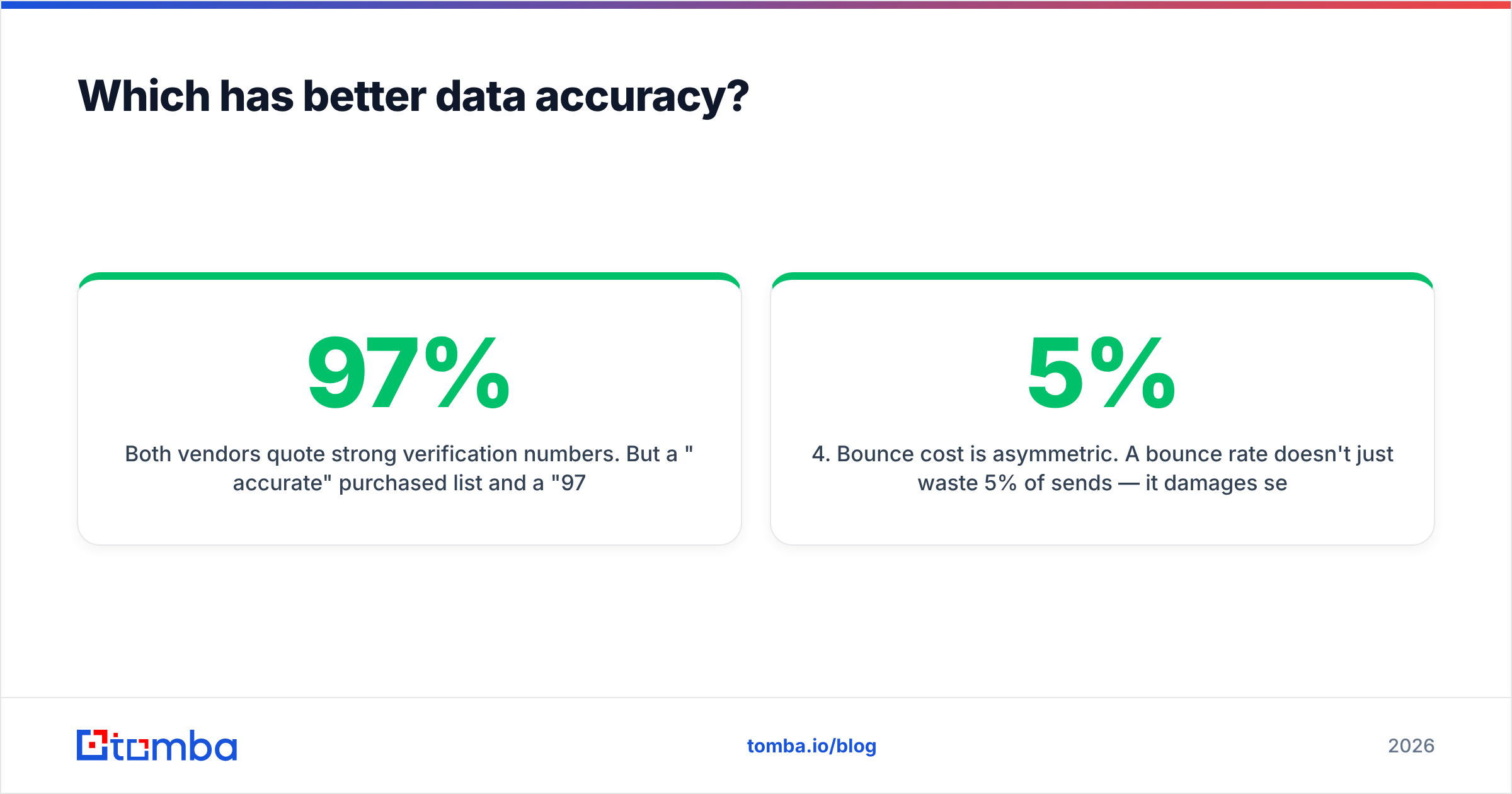
Both vendors quote strong verification numbers. But a "97% accurate" purchased list and a "97% accurate" on-demand verification are not the same promise:
- Time-of-verification matters most. A purchased record verified in January and emailed in April has had three months to rot. An on-demand verification confirmed the day you send reflects reality.
- Catch-all domains skew claims. Many corporate domains accept all mail, so a naive checker marks them "valid" when they may bounce. A real catch-all verifier treats these honestly instead of inflating accuracy.
- Source transparency separates leaders. Ask where the data comes from. Vendors that publish their data sources let you audit accuracy; opaque list sellers ask you to trust a number.
- Bounce cost is asymmetric. A 5% bounce rate doesn't just waste 5% of sends — it damages sender reputation for the other 95%. Independent review sites like G2 collect user-reported deliverability complaints worth reading before you commit.
The practical takeaway: re-verify any purchased list immediately before a campaign, and prefer tools that verify in real time. If you go the Bookyourdata route, budget for a separate email verifier pass. If you go Gamalogic, you largely get that for free in the workflow.
How does pricing compare?#
Compare cost per contact you actually email, not the per-credit sticker price. A cheap list full of role accounts and dead inboxes is more expensive than a pricier set of verified, current contacts.
Bookyourdata's pay-as-you-go model is attractive when you have no recurring need — you buy a block of credits and spend them. But you pay for every record returned, including ones you'd never contact. Gamalogic's subscription credits favor teams with steady monthly volume, where you find-and-verify as you go and waste fewer credits on irrelevant records.
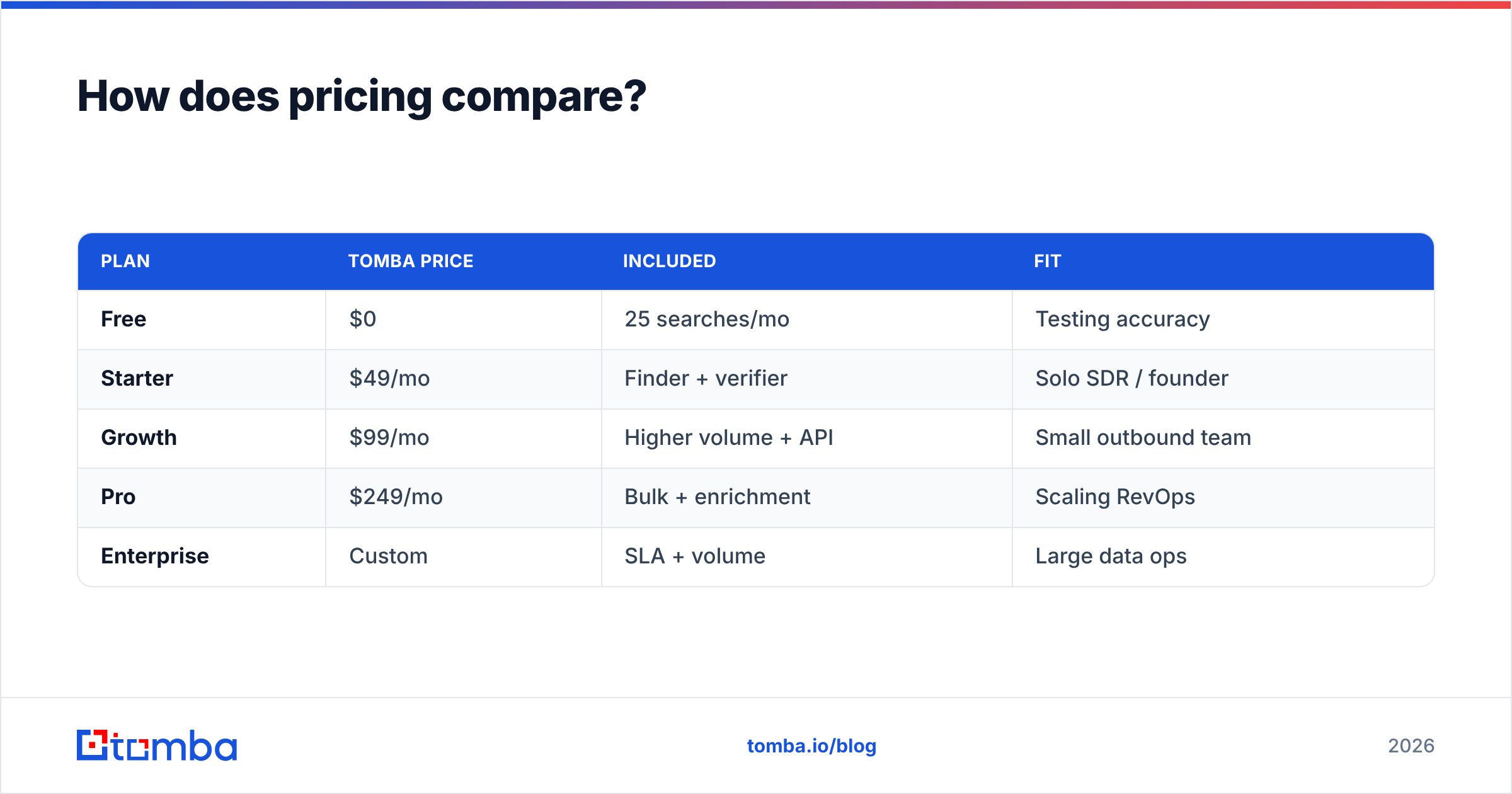
For reference, here's how a finder-first platform structures pricing, which is useful as a third data point:
| Plan | Tomba price | Included | Fit |
|---|---|---|---|
| Free | $0 | 25 searches/mo | Testing accuracy |
| Starter | $49/mo | Finder + verifier | Solo SDR / founder |
| Growth | $99/mo | Higher volume + API | Small outbound team |
| Pro | $249/mo | Bulk + enrichment | Scaling RevOps |
| Enterprise | Custom | SLA + volume | Large data ops |
You can see full Tomba pricing for current limits. The point isn't that one number is lowest — it's that you should model your real monthly contact volume against each model. List marketplaces win on a single large buy; subscription finders win on sustained, lower-volume-per-week prospecting.
Which tool fits your use case?#
Match the tool to your motion, not to a feature checklist.
- You need a one-time list for a single campaign. Bookyourdata's pay-as-you-go is fast. Re-verify before sending and accept that the list is disposable.
- You run always-on outbound and touch new accounts weekly. Gamalogic's on-demand finding keeps data fresh and protects sender reputation. You'll need a steady source of names/domains to feed it.
- You're enriching an existing CRM. Neither is ideal alone. You want data enrichment that fills gaps on records you already own, plus verification on top.
- You're a developer automating prospecting. API access is decisive. Gamalogic offers one; a full-featured email finder API gives you finder, verifier, and enrichment from a single integration.
- You prospect from LinkedIn or company sites. A bulk email finder plus a browser workflow beats buying a generic vertical list, because your targeting is sharper.
Is there a better alternative to both?#
For most outbound teams, a finder-first platform that also verifies and enriches in one place beats stitching a list marketplace to a standalone verifier. That's the gap Tomba fills.
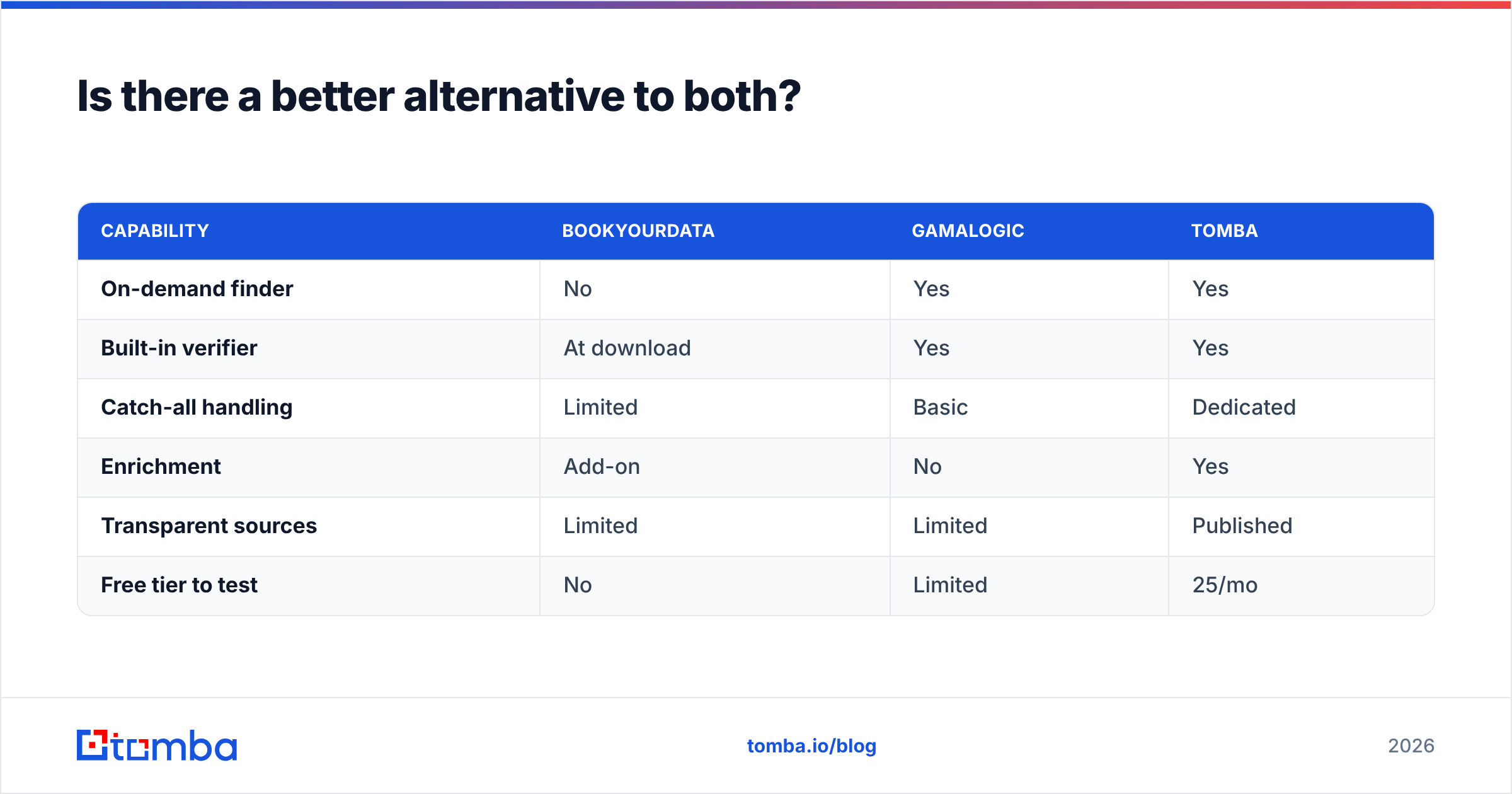
The reason is workflow consolidation. With Bookyourdata you buy a list, then pay a verifier, then enrich elsewhere. With Gamalogic you find and verify, then need a separate targeting source and enrichment tool. Tomba combines real-time email finding, verification, catch-all handling, data enrichment, and a documented data-source policy under one credit pool — so you're not paying three vendors to assemble one usable contact.
| Capability | Bookyourdata | Gamalogic | Tomba |
|---|---|---|---|
| On-demand finder | No | Yes | Yes |
| Built-in verifier | At download | Yes | Yes |
| Catch-all handling | Limited | Basic | Dedicated |
| Enrichment | Add-on | No | Yes |
| Transparent sources | Limited | Limited | Published |
| Free tier to test | No | Limited | 25/mo |
That's not to say Bookyourdata or Gamalogic are bad tools — they're good at their respective jobs. But if your goal is the lowest cost per contact you can actually email today, a consolidated finder-and-verify platform usually gets you there with fewer moving parts. Compare it yourself against an Apollo alternative or a Clearbit alternative shortlist before deciding.
How should you test before committing?#
Don't trust any vendor's accuracy claim — measure it. Run the same 100 target contacts through each tool and compare.
- Pick a known segment where you can manually confirm a handful of emails (your own customers or partners work well).
- Find/verify the same set in each tool and record match rate and confidence.
- Send a small, warmed batch and measure real bounce rate — the only metric that matters.
- Calculate true cost = total spend ÷ contacts that didn't bounce and were on-target.
- Check the workflow tax — how many other tools did you need to make the data usable?
This five-step test cuts through marketing numbers faster than any review roundup. Vendors with strong data accuracy welcome it; vendors hiding decay don't.
The bottom line#
Bookyourdata and Gamalogic win in different lanes: Bookyourdata for a fast, one-off vertical list, Gamalogic for continuous on-demand finding and verification. The mistake is using a list marketplace for an always-on motion (you'll email stale data) or expecting a finder to do your targeting for you (it won't).
If you'd rather not run two or three tools to get one verified, current contact, start with Tomba's Email Finder — find professional emails by name, domain, or company, verify them in the same workflow, and test it free with 25 searches a month before you spend a credit. Build a fresh list at the moment of send instead of buying one that's already aging.
// get started
Find, verify and enrich your first contacts today
Start on the free plan with 25 searches a month, then scale when your team is ready.
Free plan · No credit card required · GDPR & CCPA
// about the author