Bottom of Funnel: How to Close BOFU Leads Faster in 2026
The bottom of funnel is where revenue is won or lost. Here's how to spot BOFU intent, prioritize ready-to-buy accounts, and close them in 2026.
Bottom of Funnel: How to Close BOFU Leads Faster in 2026
The bottom of funnel (BOFU) is the stage where a prospect has stopped asking "should I solve this?" and started asking "who should I buy from?" Get it right and your win rate climbs; get it wrong and you burn pipeline that was ready to close.
This guide breaks down what the bottom of funnel actually is, how it differs from the rest of the funnel, the plays that move BOFU leads to closed-won, and the data you need to run them in 2026.
TL;DR#
- The bottom of funnel is the decision and purchase stage — prospects are comparing vendors, checking pricing, and looking for proof, not education.
- BOFU intent signals (pricing-page visits, demo requests, competitor comparisons) are the highest-value triggers in your entire funnel.
- Speed and accuracy win — a verified direct contact reached within minutes beats a perfect email sent two days late.
- Most BOFU leakage is a data problem, not a messaging problem: bounced emails, wrong contacts, and stale phone numbers kill ready-to-buy deals.
- Tomba's email and phone finding tools help you reach the actual decision-maker at the exact moment intent spikes.
What is the bottom of funnel?#
The bottom of funnel is the final stage of the buyer's journey, where a qualified prospect evaluates specific vendors and makes a purchase decision. By the time someone reaches BOFU, they already understand their problem and the category of solution — your job is to prove you're the right choice and remove friction from buying.
Think of the funnel like dating. The top of funnel is meeting people at a party (awareness). The middle is going on dates and figuring out fit (consideration). The bottom of funnel is the moment someone is ready to commit — they just need a reason to say yes to you instead of the other option they're seeing. Technically, BOFU covers evaluation, vendor selection, negotiation, and purchase.
The mistake most teams make is treating every lead the same. A BOFU lead doesn't want a "thought leadership" ebook. They want a case study, a tailored quote, a reference customer, and a fast answer.
How is the bottom of funnel different from TOFU and MOFU?#
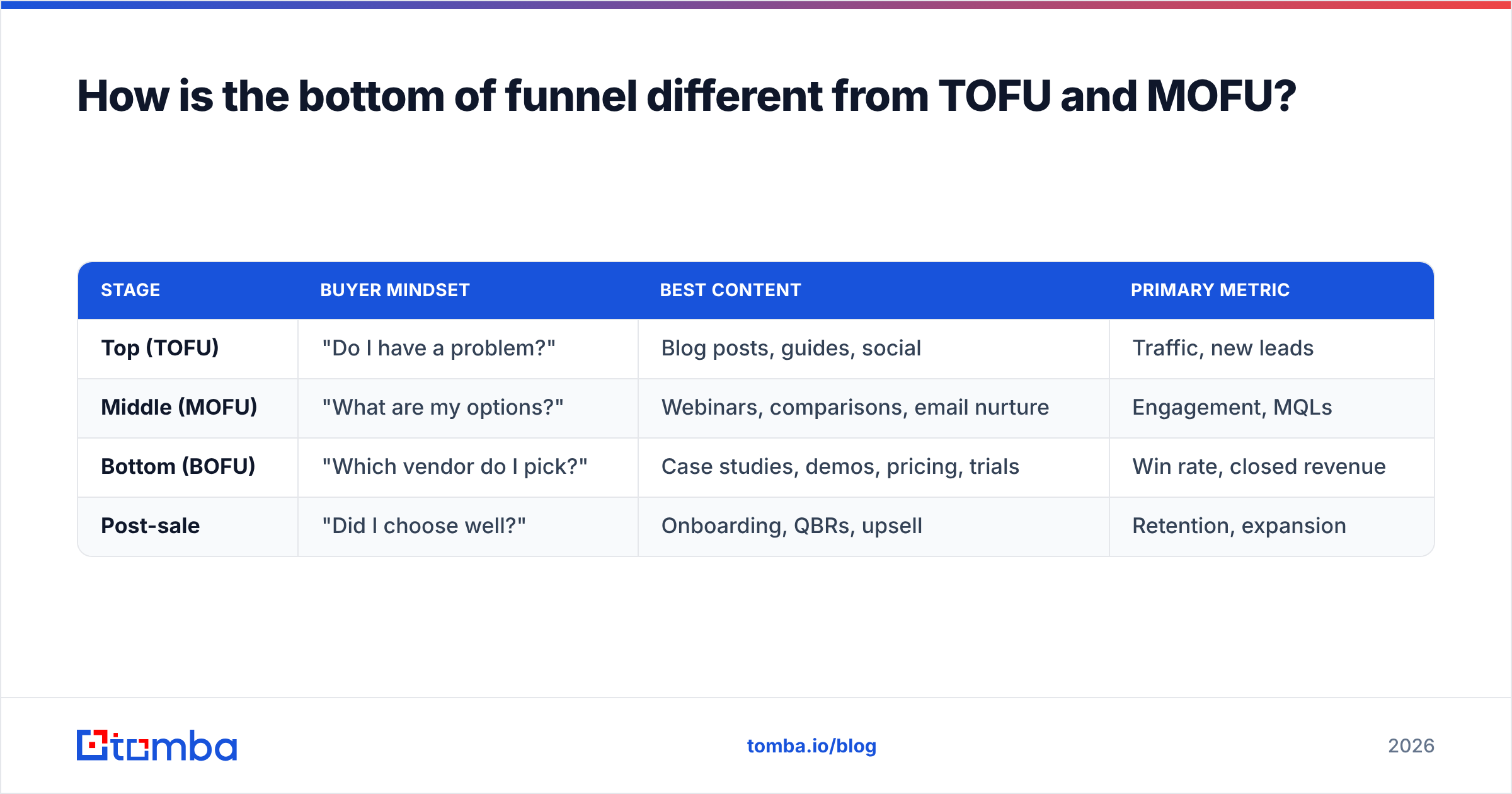
Each funnel stage has a different buyer mindset, content type, and success metric. Mapping your effort to the stage is the single biggest lever on conversion.
| Stage | Buyer mindset | Best content | Primary metric |
|---|---|---|---|
| Top (TOFU) | "Do I have a problem?" | Blog posts, guides, social | Traffic, new leads |
| Middle (MOFU) | "What are my options?" | Webinars, comparisons, email nurture | Engagement, MQLs |
| Bottom (BOFU) | "Which vendor do I pick?" | Case studies, demos, pricing, trials | Win rate, closed revenue |
| Post-sale | "Did I choose well?" | Onboarding, QBRs, upsell | Retention, expansion |
The further down the funnel a contact sits, the more a single touch is worth — and the more expensive a mistake (wrong contact, slow response, generic pitch) becomes.
What are the strongest bottom-of-funnel intent signals?#
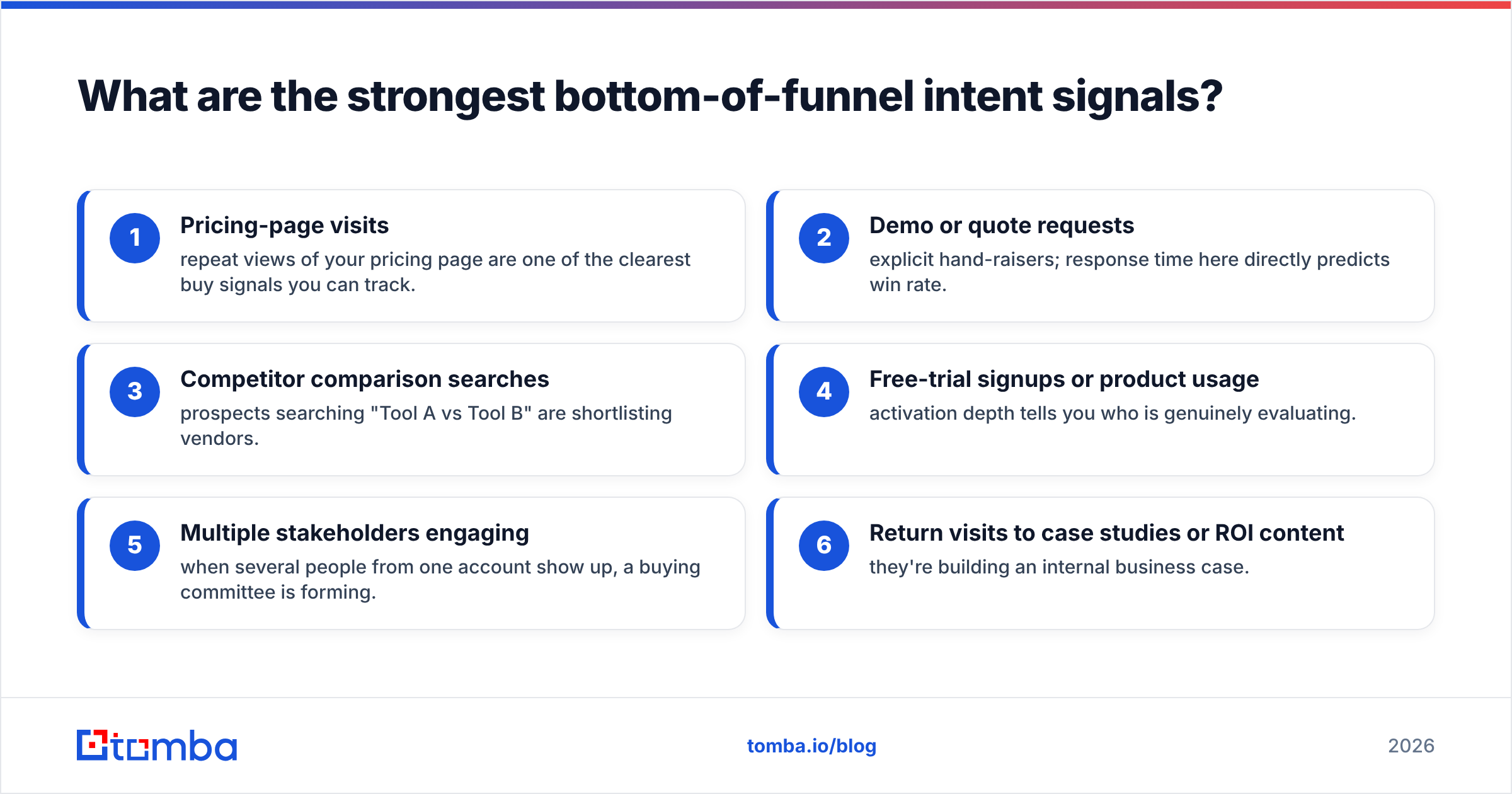
BOFU signals tell you a prospect is in active buying mode right now. Treat these as your highest-priority alerts and route them to a rep immediately.
- Pricing-page visits — repeat views of your pricing page are one of the clearest buy signals you can track.
- Demo or quote requests — explicit hand-raisers; response time here directly predicts win rate.
- Competitor comparison searches — prospects searching "Tool A vs Tool B" are shortlisting vendors.
- Free-trial signups or product usage — activation depth tells you who is genuinely evaluating.
- Multiple stakeholders engaging — when several people from one account show up, a buying committee is forming.
- Return visits to case studies or ROI content — they're building an internal business case.
According to HubSpot's research on sales, responding to inbound interest within the first few minutes dramatically increases the odds of connecting and qualifying. At the bottom of funnel, that window is even tighter — buyers are talking to your competitors at the same time.
Why do bottom-of-funnel leads leak out of the pipeline?#
Most BOFU leakage is a data and execution problem, not a desire problem — these prospects want to buy. Here are the usual culprits:
- Bounced or wrong email addresses. A demo request is worthless if your follow-up lands in a dead inbox. This is why running every BOFU contact through an email verifier before outreach matters so much.
- Reaching the wrong person. You contact a junior researcher instead of the budget owner, and the deal stalls in committee.
- No phone number on file. Email alone is slow for time-sensitive deals; missing direct dials cost you the live conversation.
- Slow routing. The lead sits in a queue for a day while a competitor books the meeting.
- Generic messaging. A templated pitch that ignores the prospect's stage signals you weren't paying attention.
The fix is a combination of clean data and fast, contextual outreach. You can't personalize or move fast on a contact you can't reach.
What plays actually convert bottom-of-funnel prospects?#
The BOFU playbook is short and specific. Each play is about removing doubt and friction.
1. Multi-threaded outreach to the buying committee. Modern B2B deals involve multiple decision-makers. Use a domain search to map the company's contacts, then identify the economic buyer, the champion, and the blockers. Reaching only one person leaves the deal exposed.
2. Proof over promises. Send the case study that matches their industry and size. Offer a reference call. ROI math beats adjectives.
3. Direct-dial follow-up on hot signals. When someone requests a demo or hits the pricing page twice, a same-day call converts far better than an email thread. A phone finder gives you the B2B numbers to make that call happen.
4. Remove buying friction. Clear pricing, a short trial, a simple contract, and fast answers to objections. Every extra step is a chance for the deal to die.
5. Create urgency honestly. A real deadline — an expiring discount, an onboarding cohort, a quarter-end incentive — gives a stalled buyer a reason to decide now.
How do you measure bottom-of-funnel performance?#
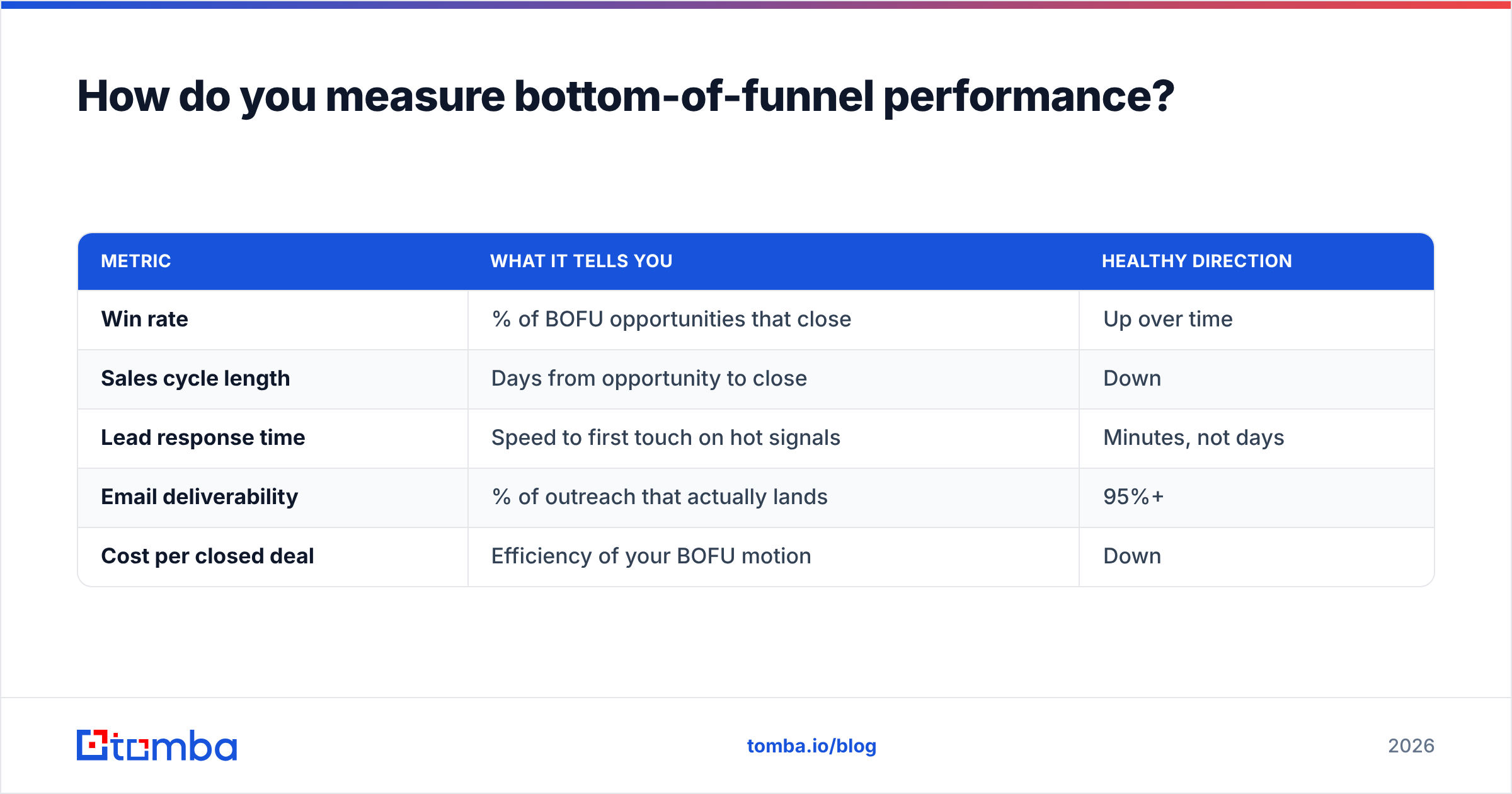
You measure the bottom of funnel by conversion velocity and quality, not volume. The metrics that matter here are different from TOFU vanity numbers.
| Metric | What it tells you | Healthy direction |
|---|---|---|
| Win rate | % of BOFU opportunities that close | Up over time |
| Sales cycle length | Days from opportunity to close | Down |
| Lead response time | Speed to first touch on hot signals | Minutes, not days |
| Email deliverability | % of outreach that actually lands | 95%+ |
| Cost per closed deal | Efficiency of your BOFU motion | Down |
Tracking response rate alongside win rate exposes whether a low conversion problem is a reach problem (people aren't seeing your message) or a messaging problem (they see it and don't act). The two require completely different fixes.
For benchmarking your numbers against peers, third-party review platforms like G2 and analyst data from Gartner are useful neutral references — just remember your own historical baseline is the comparison that matters most.
What tools do you need for a modern BOFU motion?#
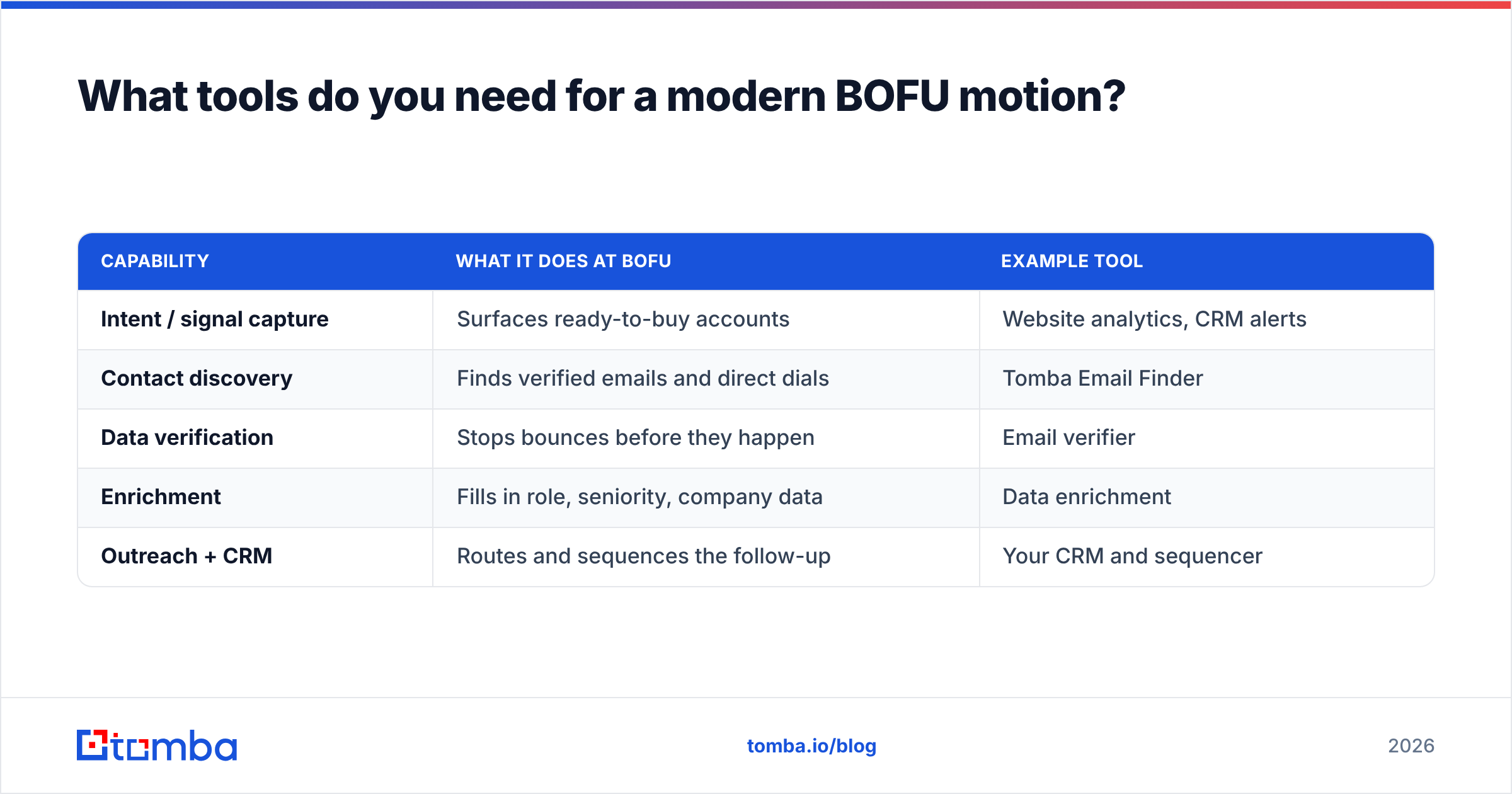
A bottom-of-funnel stack has three jobs: detect intent, find the right contact, and reach them fast. Here's how the core pieces fit together.
| Capability | What it does at BOFU | Example tool |
|---|---|---|
| Intent / signal capture | Surfaces ready-to-buy accounts | Website analytics, CRM alerts |
| Contact discovery | Finds verified emails and direct dials | Tomba Email Finder |
| Data verification | Stops bounces before they happen | Email verifier |
| Enrichment | Fills in role, seniority, company data | Data enrichment |
| Outreach + CRM | Routes and sequences the follow-up | Your CRM and sequencer |
The contact-discovery and verification layer is where most teams under-invest — and it's exactly where BOFU deals quietly die. Knowing an account is hot is useless if you can't reach the decision-maker with a message that actually delivers.
Tomba's pricing scales with that need: a Free tier (25 searches/mo) to test, Starter at $49/mo, Growth at $99/mo, and Pro at $249/mo for higher-volume teams. You can see full Tomba pricing for the breakdown, including bulk and API access for routing BOFU signals into automated enrichment.
How does data quality affect bottom-of-funnel conversion?#
Data quality is the foundation of BOFU performance — clean contact data directly raises connect rates, deliverability, and ultimately win rate. A buyer in decision mode is the most valuable contact you'll ever touch, so reaching the wrong inbox or an outdated number is the most expensive error you can make.
Three data fundamentals protect your BOFU pipeline:
- Accuracy — the email and phone actually belong to the right person at the right company. Tomba documents its data sources so you know where contacts come from.
- Freshness — people change jobs constantly; a contact verified months ago may already be stale.
- Completeness — role, seniority, and company context let you personalize and multi-thread instead of guessing.
When those three hold, your reps spend their time selling instead of chasing dead contacts. When they don't, even a flawless pitch never reaches a human.
Common bottom-of-funnel mistakes to avoid#
- Treating BOFU like TOFU. Sending educational content to someone ready to buy signals you misread the moment.
- Single-threading. Betting the whole deal on one contact who may leave or lose internal support.
- Ignoring speed. Letting hot signals cool in a queue while competitors respond first.
- Skipping verification. Blasting unverified emails tanks your email deliverability and your sender reputation.
- No clear next step. Ending every touch without a specific, time-bound ask.
Conclusion: win the bottom of funnel with reach and accuracy#
The bottom of funnel rewards teams that combine sharp intent detection with the ability to reach the right decision-maker fast — and accurately. Most of the deals you lose at this stage aren't lost on price or product; they're lost on a bounced email, a missing phone number, or a follow-up that arrived a day too late.
That's the gap Tomba Email Finder closes. When a BOFU signal fires, find the verified email of the actual budget owner, layer in a direct dial, and reach them while intent is still hot — not after a competitor already booked the meeting. Start free with 25 searches a month, then scale into Starter at $49/mo as your pipeline grows. Your hottest leads are already raising their hands. Make sure you're the vendor who answers first.
Ready to find emails that actually work?
Join 150,000+ professionals who stopped guessing and started sending. Free credits on signup — no credit card required.
Get the Tomba newsletter
Practical outbound tactics and product updates — once every two weeks.
About the author