Bottom of Funnel Content: The 2026 Conversion Playbook
Top-of-funnel traffic feels great until none of it buys. Here is how bottom of funnel content turns warm leads into closed revenue in 2026 — with examples, a content map, and a build checklist.
TL;DR
- Bottom of funnel content (BOFU) is built for one job: helping a warm, in-market buyer choose you over the alternatives and act now.
- It is not awareness blogging. BOFU formats include comparison pages, pricing explainers, case studies, ROI calculators, and product-led demos.
- The highest-converting BOFU assets answer purchase-blocking questions: "Is this better than X?", "What does it cost?", "Will it work for someone like me?"
- Pair BOFU content with accurate contact data so sales can follow up the moment intent spikes — content creates the hand-raise, data closes the loop.
- Use the build checklist and comparison table below to audit whether your funnel has a conversion floor or just a leaky top.
What is bottom of funnel content?#
Bottom of funnel content is the material you publish for people who already know they have a problem, already know solutions exist, and are now deciding which one to buy. Everything is pointed at a single outcome: the purchase decision.
Think of your funnel like a grocery store. Top-of-funnel content is the billboard on the highway that gets someone to pull in. Middle-of-funnel content is the helpful aisle signage that guides them to the right section. Bottom-of-funnel content is the product label, the price tag, and the staff member standing right there answering "yes, this one works for what you need." Without that last layer, shoppers wander out empty-handed no matter how good the billboard was.
The mistake most B2B teams make is over-investing in the billboard. They measure traffic, celebrate pageviews, and then wonder why pipeline is flat. The buyers who are ready to spend money are reading something else entirely — and if you are not the one who wrote it, your competitor is.
)
How is BOFU content different from TOFU and MOFU?#
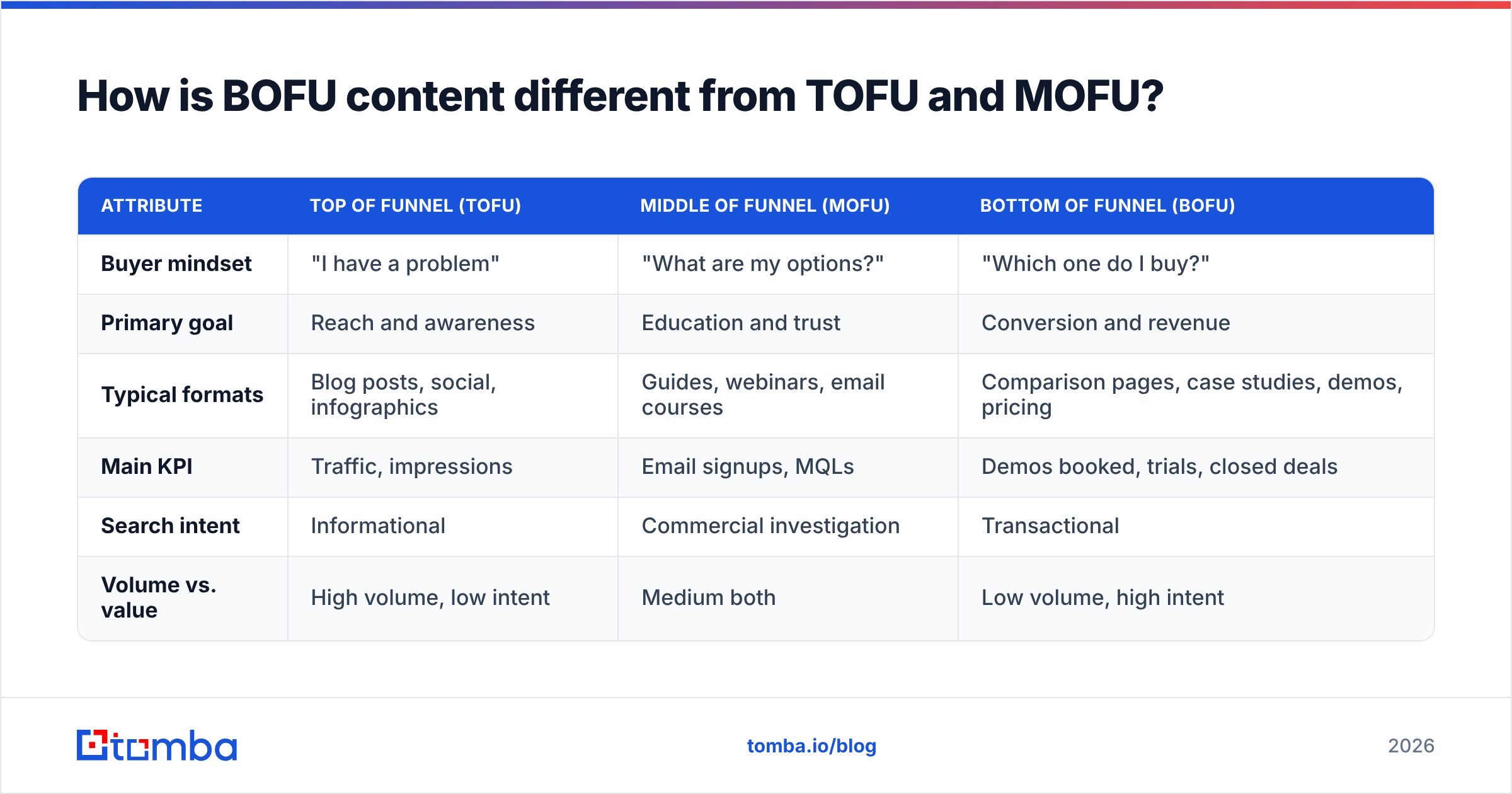
The three funnel stages serve different intents, and BOFU is the only one tied directly to revenue. Here is how the layers compare:
| Attribute | Top of Funnel (TOFU) | Middle of Funnel (MOFU) | Bottom of Funnel (BOFU) |
|---|---|---|---|
| Buyer mindset | "I have a problem" | "What are my options?" | "Which one do I buy?" |
| Primary goal | Reach and awareness | Education and trust | Conversion and revenue |
| Typical formats | Blog posts, social, infographics | Guides, webinars, email courses | Comparison pages, case studies, demos, pricing |
| Main KPI | Traffic, impressions | Email signups, MQLs | Demos booked, trials, closed deals |
| Search intent | Informational | Commercial investigation | Transactional |
| Volume vs. value | High volume, low intent | Medium both | Low volume, high intent |
The strategic point: BOFU traffic is small but worth far more per visit. A "best [category] tools" page might get a fraction of the visits your beginner guide pulls, but the people on it are pricing vendors with a credit card nearby. That is why a single strong comparison page can outperform fifty awareness articles on revenue.
If you want the formal definitions, G2's content marketing resources and HubSpot's funnel framework both break down stage-by-stage intent in depth.
What are the highest-converting BOFU content types?#
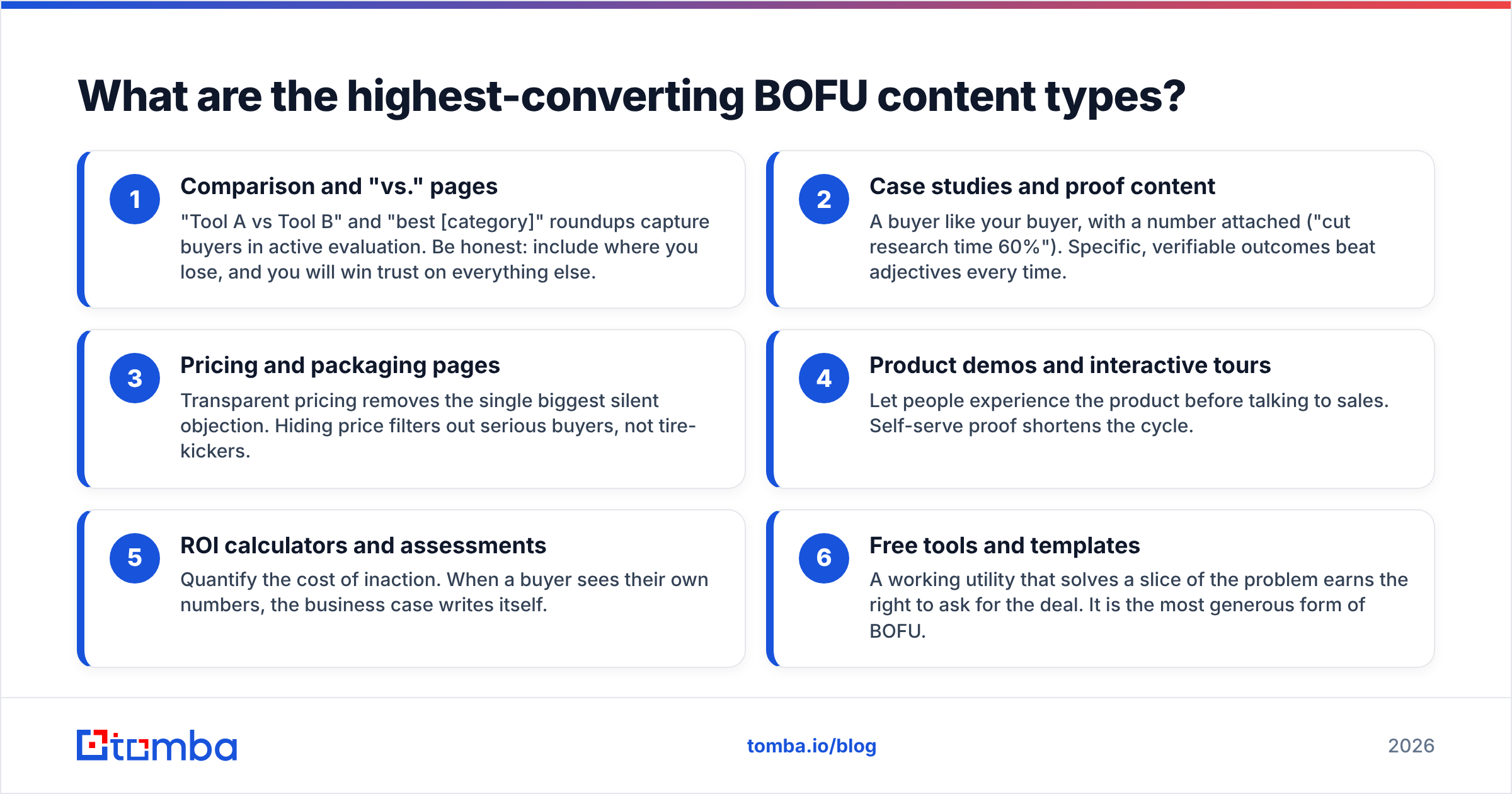
Not all bottom of funnel content pulls the same weight. These six formats consistently move buyers to act:
- Comparison and "vs." pages — "Tool A vs Tool B" and "best [category]" roundups capture buyers in active evaluation. Be honest: include where you lose, and you will win trust on everything else.
- Case studies and proof content — A buyer like your buyer, with a number attached ("cut research time 60%"). Specific, verifiable outcomes beat adjectives every time.
- Pricing and packaging pages — Transparent pricing removes the single biggest silent objection. Hiding price filters out serious buyers, not tire-kickers.
- Product demos and interactive tours — Let people experience the product before talking to sales. Self-serve proof shortens the cycle.
- ROI calculators and assessments — Quantify the cost of inaction. When a buyer sees their own numbers, the business case writes itself.
- Free tools and templates — A working utility that solves a slice of the problem earns the right to ask for the deal. It is the most generous form of BOFU.
Each of these answers a purchase-blocking question. The art is mapping the right format to the specific objection that stalls your deals.
Why does BOFU content fail without accurate data?#
Because content creates the hand-raise, but data is what lets you act on it before the moment passes.
Here is the gap nobody talks about. A buyer reads your comparison page at 11pm, fills out a form with a personal Gmail address, and your sales team gets a lead they can do nothing with — no company, no role, no work email, no phone number. The intent was real. The follow-up was impossible. That is a conversion you paid for and then dropped.
Bottom of funnel content works best when it is wired to enrichment and outreach infrastructure. When a high-intent visitor converts, you want their work email, company, title, and direct line populated automatically so a rep can reach out while the page is still open in their browser. That is the difference between "we generate leads" and "we close them."
This is where pairing your content engine with a reliable email finder and data enrichment layer pays off. The content surfaces intent; the data turns a half-filled form into a contactable, qualified opportunity. You can also identify anonymous high-intent traffic with website visitor reveal so that buyers researching your BOFU pages do not slip away unrecognized.
)
What does a complete BOFU content map look like?#
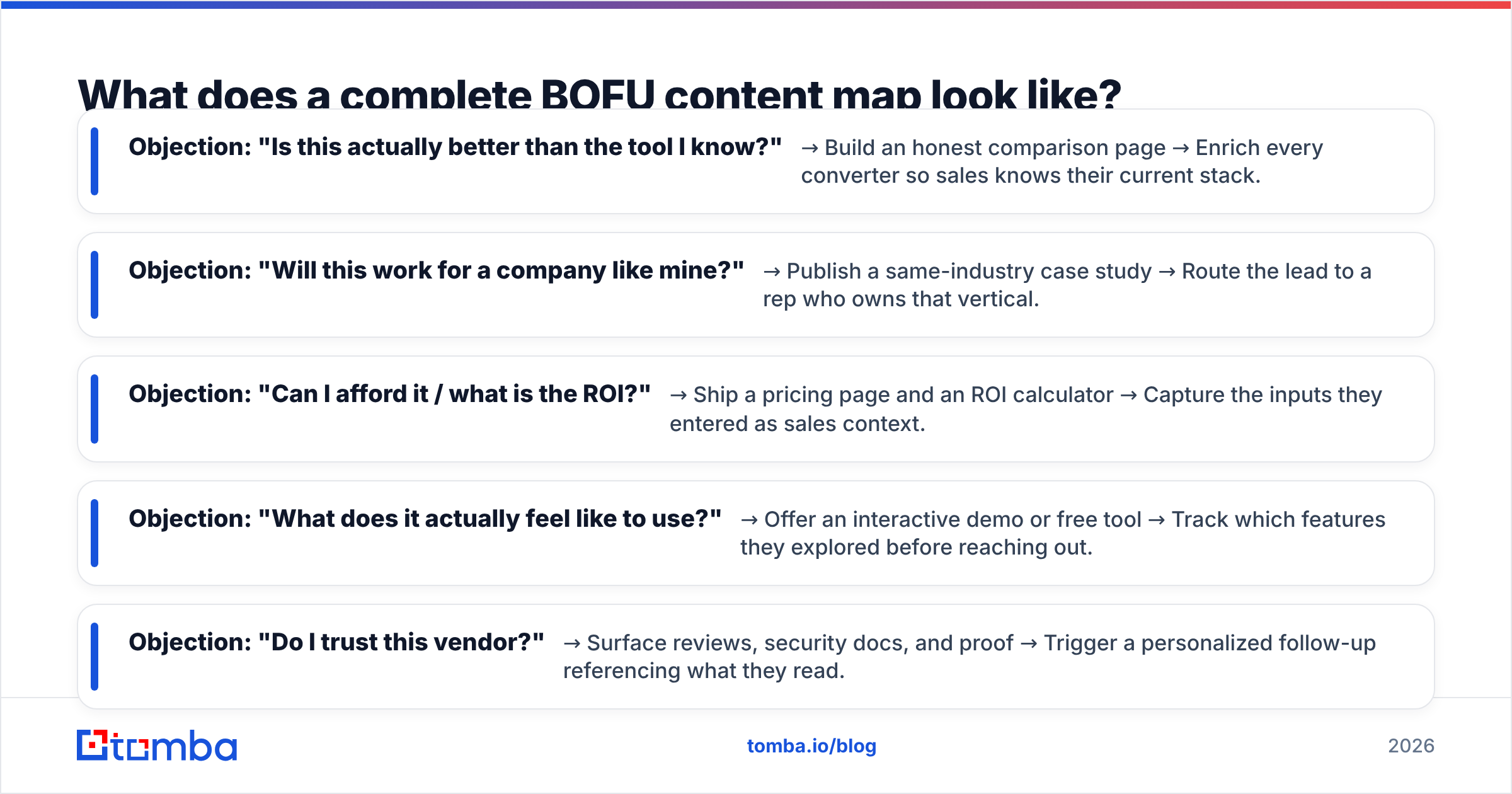
A useful way to plan is to list the objection, the content that answers it, and the data action that follows. Most teams have the first column and skip the third — which is exactly why warm leads go cold.
- Objection: "Is this actually better than the tool I know?" → Build an honest comparison page → Enrich every converter so sales knows their current stack.
- Objection: "Will this work for a company like mine?" → Publish a same-industry case study → Route the lead to a rep who owns that vertical.
- Objection: "Can I afford it / what is the ROI?" → Ship a pricing page and an ROI calculator → Capture the inputs they entered as sales context.
- Objection: "What does it actually feel like to use?" → Offer an interactive demo or free tool → Track which features they explored before reaching out.
- Objection: "Do I trust this vendor?" → Surface reviews, security docs, and proof → Trigger a personalized follow-up referencing what they read.
This is the structured backbone of a high-converting funnel floor. Notice that every row ends with an action that depends on knowing who the visitor is. Content without that connective tissue is a beautiful door with no handle.
How do you write BOFU content that ranks and converts?#
Ranking and converting are two different jobs, and BOFU content has to do both. Here is the approach that works in 2026.
Match transactional intent precisely. A buyer searching "best email finder for agencies" wants a filtered, decision-ready answer, not a 3,000-word history of email. Lead with the verdict, then justify it. Conclusion first, reasoning second.
Be specific and verifiable. Replace "powerful platform" with "find verified emails across 25 searches on the free plan." Numbers, limits, and real screenshots out-convert adjectives because they are checkable. If you want buyers to trust your claims, give them claims they can test.
Show the comparison honestly. The fastest way to lose a sophisticated buyer is a comparison page where you win every row. Acknowledge where a competitor is genuinely strong. Honesty about the small things buys credibility on the big ones.
Reduce friction to the action. One clear CTA per page. If the next step is a trial, link it. If it is a demo, make booking it two clicks. Every extra field on a form is a percentage of pipeline you are choosing to lose — capture the minimum and enrich the rest with contact enrichment.
Keep it current. A comparison or pricing page with a stale year in the title signals neglect. Refresh BOFU assets on a schedule; these are your revenue pages, not your archive.
For more on aligning content with pipeline stages, Gartner's research on the B2B buying journey is worth reading — it documents how buyers now self-educate through most of the cycle before ever talking to sales, which is precisely why your BOFU content has to do the convincing.
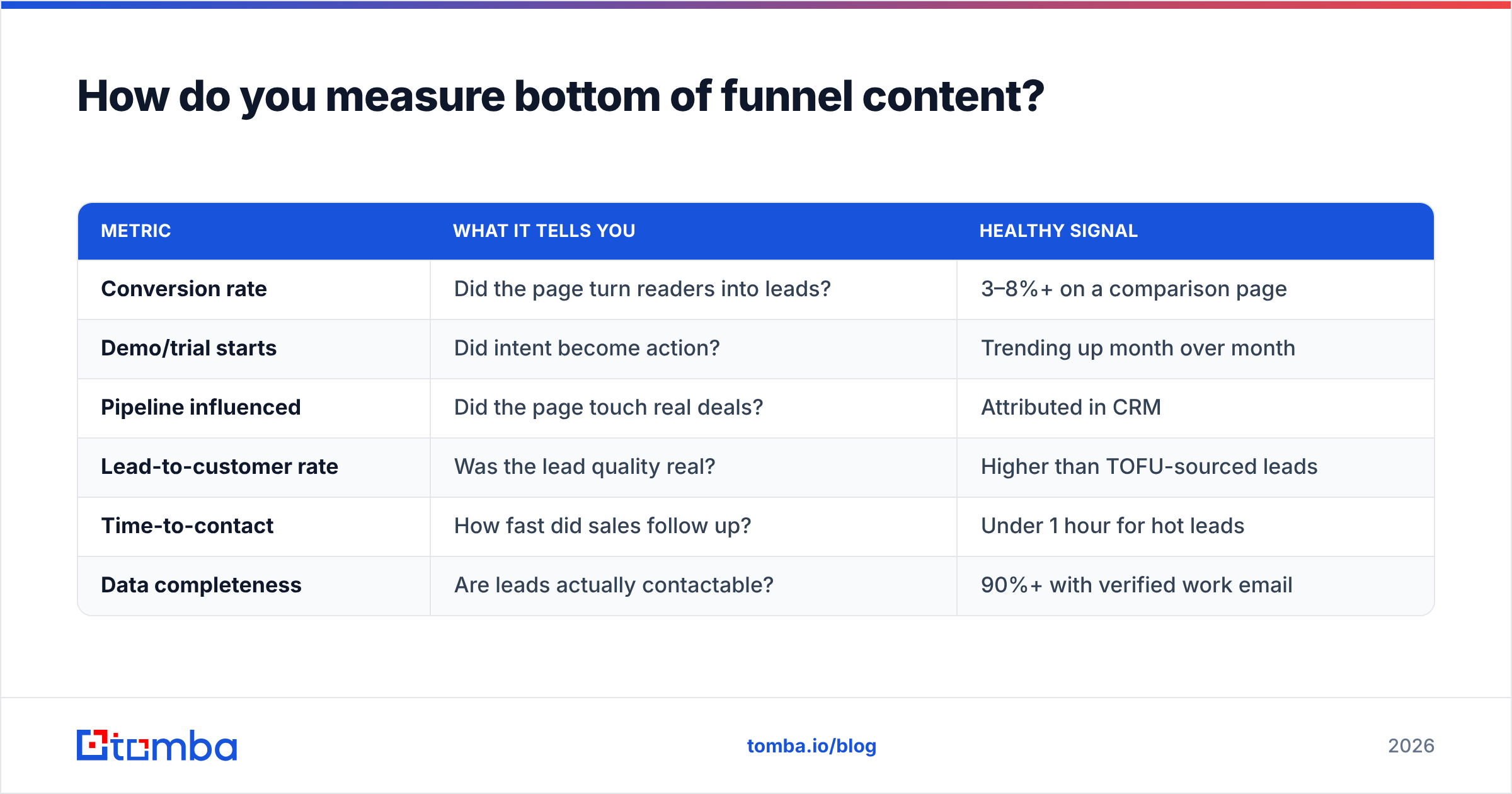
How do you measure bottom of funnel content?#
Stop measuring BOFU pages by traffic. Measure them by what happens after the click.
| Metric | What it tells you | Healthy signal |
|---|---|---|
| Conversion rate | Did the page turn readers into leads? | 3–8%+ on a comparison page |
| Demo/trial starts | Did intent become action? | Trending up month over month |
| Pipeline influenced | Did the page touch real deals? | Attributed in CRM |
| Lead-to-customer rate | Was the lead quality real? | Higher than TOFU-sourced leads |
| Time-to-contact | How fast did sales follow up? | Under 1 hour for hot leads |
| Data completeness | Are leads actually contactable? | 90%+ with verified work email |
That last row is the one most teams never track, and it quietly caps everything above it. If half your converters arrive with unusable contact details, your "conversion rate" is a vanity number. Verify and complete the record at capture time using an email verifier so your sales team spends time selling, not guessing.
What's the fastest way to audit your BOFU gaps?#
Run this checklist against your own funnel. Every "no" is a leak.
- Do you have a comparison page for each major competitor buyers mention?
- Is your pricing public, or are you filtering out serious buyers?
- Do you have at least one case study per core industry you sell into?
- Does every BOFU page have a single, frictionless CTA?
- Are converting leads automatically enriched with work email, company, and role?
- Can a rep contact a hot lead within the hour?
- Are your revenue pages refreshed for the current year?
- Do you track pipeline influenced, not just pageviews?
If you scored well on content but poorly on the data and follow-up rows, you do not have a content problem — you have a connection problem. The traffic is converting; the conversions just are not reaching a human in time.
Closing: turn warm readers into reachable buyers#
Bottom of funnel content is where marketing stops being a cost center and starts looking like a revenue team. But a high-intent visitor who fills out a form with half a name and a personal inbox is a deal you almost closed. Close the gap.
When your best BOFU page does its job and a buyer raises a hand, Tomba's Email Finder gives your sales team the verified work email, company, and direct contact details to follow up while interest is still hot — across single lookups, bulk lead generation, or the Tomba API. Start free with 25 searches a month, and review Tomba pricing when you are ready to scale your conversion floor. Write the content that earns the hand-raise — then make sure you can actually shake the hand.
// get started
Find, verify and enrich your first contacts today
Start on the free plan with 25 searches a month, then scale when your team is ready.
Free plan · No credit card required · GDPR & CCPA
// about the author