Bottom Up Sales Methodology: A Practical 2026 GTM Guide
Top-down selling is getting harder as buyers self-serve. The bottom up sales methodology lands individual users first, then expands to the whole org. Here's how it works in 2026 — and the data that fuels it.
TL;DR
- The bottom up sales methodology wins individual users or small teams first, lets the product prove its value, then expands into a paid, organization-wide deal — the reverse of the classic top-down, exec-first motion.
- It works best for self-serve, low-friction products with fast time-to-value (dev tools, design apps, data tools, productivity SaaS).
- The economics differ: lower CAC per landing, higher volume, expansion revenue (NRR) as the real growth engine, and a sales team that closes already-warm accounts.
- It does not replace sales — it changes when sales shows up. Reps enter once usage signals an expansion opportunity, then run a focused multi-threaded close.
- Bottom-up still runs on accurate contact data. You need clean emails and enriched profiles to map a single user into a buying committee — that's where an email finder earns its keep.
What is the bottom up sales methodology?#
The bottom up sales methodology lands a product with the people who actually use it — an engineer, a designer, a single marketer — and lets adoption spread upward and outward until it becomes a company-wide purchase decision.
Think of it like a coffee shop that gives away a free small cup. One person tries it, likes it, tells their team, and within a month the whole floor is buying lattes every morning. Nobody pitched the office manager on a corporate coffee contract on day one. The product earned the contract by being used.
Technically, this is the engine behind product-led growth (PLG). A free tier or free trial removes the gatekeeper. Usage data — seats activated, projects created, API calls made — becomes the qualification signal. Sales engages after value is proven, not before. Contrast that with top-down selling, where a rep books a meeting with a VP, runs a demo, negotiates a contract, and only then do end users touch the tool.
The two motions answer the same question — "how do we get a company to pay?" — in opposite order.
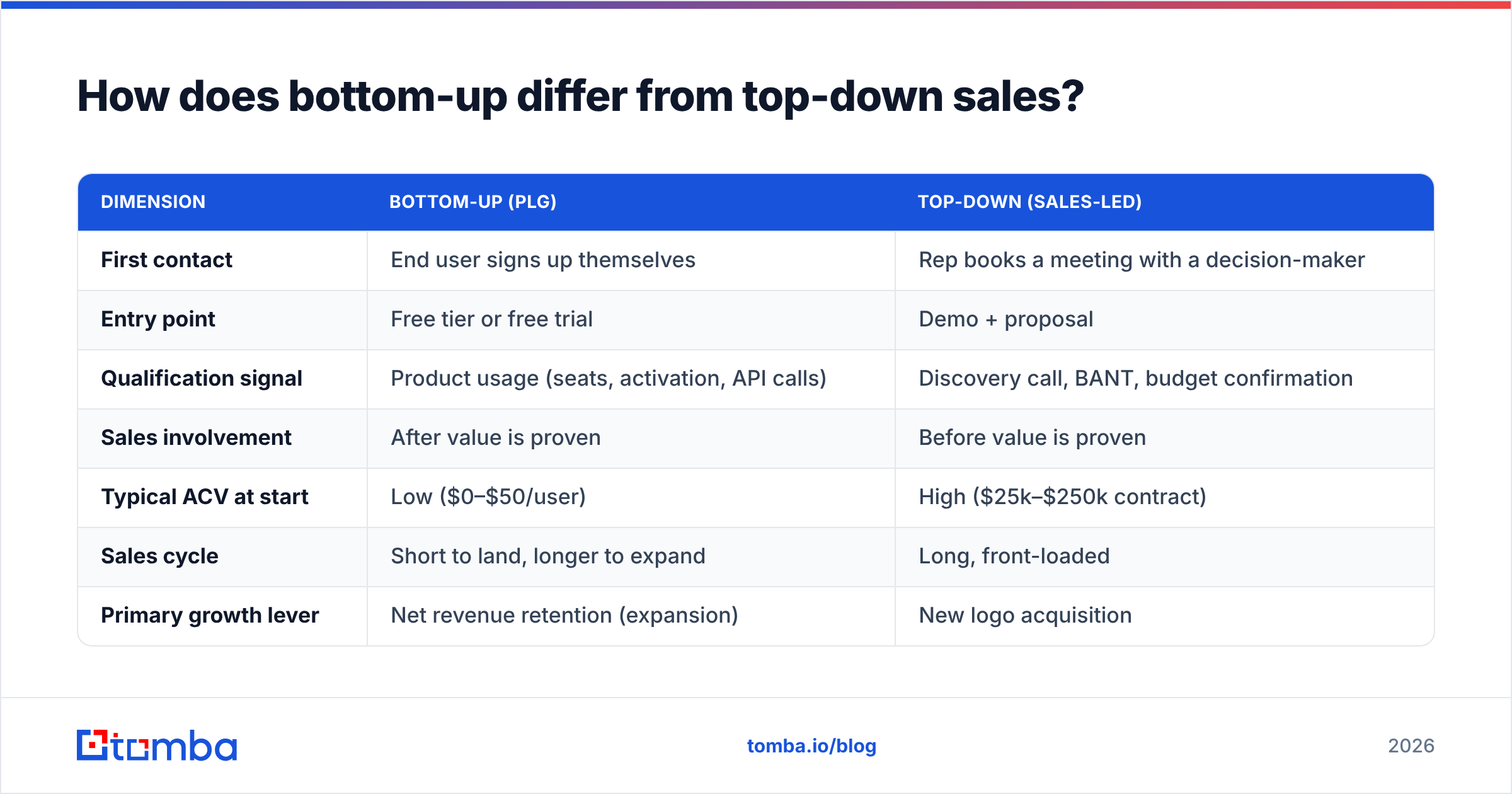
How does bottom-up differ from top-down sales?#
The cleanest way to see the difference is to line up the same deal under both methodologies.
| Dimension | Bottom-Up (PLG) | Top-Down (Sales-Led) |
|---|---|---|
| First contact | End user signs up themselves | Rep books a meeting with a decision-maker |
| Entry point | Free tier or free trial | Demo + proposal |
| Qualification signal | Product usage (seats, activation, API calls) | Discovery call, BANT, budget confirmation |
| Sales involvement | After value is proven | Before value is proven |
| Typical ACV at start | Low ($0–$50/user) | High ($25k–$250k contract) |
| Sales cycle | Short to land, longer to expand | Long, front-loaded |
| Primary growth lever | Net revenue retention (expansion) | New logo acquisition |
| Best fit | Self-serve, fast time-to-value | Complex, high-touch, regulated |
| CAC profile | Low per landing, scales with usage | High per deal, scales with headcount |
Neither column is "better." A $400k cybersecurity platform with a 9-month procurement cycle will never go bottom-up, and a $12/month note-taking app will bleed money trying to staff an enterprise field team. The methodology has to match the product and the buyer.
What's changed by 2026 is the default. Buyers — especially in technical and operations roles — now expect to try before they talk to anyone. According to long-running research from firms like Gartner, B2B buyers spend the majority of their journey self-educating, with only a small slice of time spent talking to any individual vendor's reps. That behavior favors a motion that meets buyers inside the product instead of across a conference table.
)
Why is bottom-up sales growing in 2026?#
Three forces pushed bottom-up from niche to mainstream.
- Buyers self-serve by default. The first move in evaluating software is a Google search and a free signup, not a sales inquiry. A motion that requires a sales call to even try the product now loses deals at the front door.
- Distribution got cheaper than persuasion. A great free tier is a 24/7 salesperson that costs nothing per conversation. For products with real utility, letting the product sell itself beats paying reps to explain it.
- Expansion economics beat acquisition economics. Selling more seats to a happy customer is far cheaper than landing a new logo. Companies with strong net revenue retention compound growth even when new-logo acquisition slows — and bottom-up is built to maximize expansion.
The catch: bottom-up generates enormous volume of low-intent signups, and most of them never become revenue. Your job shifts from "generate leads" to "find the 3% of self-serve users sitting inside accounts worth expanding." That is a data problem as much as a sales problem.
What does a bottom-up sales funnel look like?#
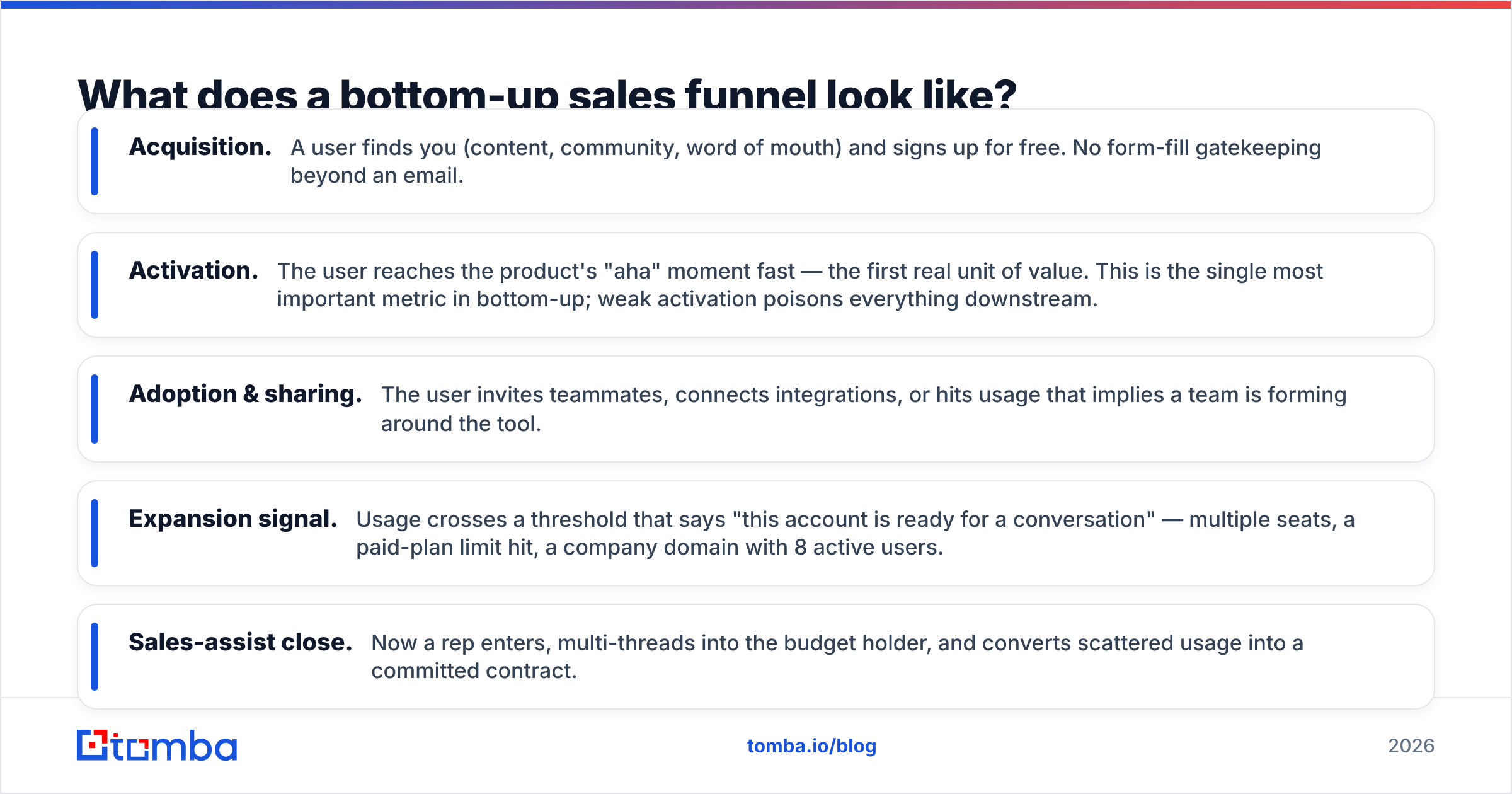
The funnel inverts. Instead of MQL → SQL → opportunity → close, you get something closer to signup → activation → expansion signal → sales-assist → close.
- Acquisition. A user finds you (content, community, word of mouth) and signs up for free. No form-fill gatekeeping beyond an email.
- Activation. The user reaches the product's "aha" moment fast — the first real unit of value. This is the single most important metric in bottom-up; weak activation poisons everything downstream.
- Adoption & sharing. The user invites teammates, connects integrations, or hits usage that implies a team is forming around the tool.
- Expansion signal. Usage crosses a threshold that says "this account is ready for a conversation" — multiple seats, a paid-plan limit hit, a company domain with 8 active users.
- Sales-assist close. Now a rep enters, multi-threads into the budget holder, and converts scattered usage into a committed contract.
A marketing qualified lead in this world isn't someone who downloaded an ebook — it's a product-qualified lead (PQL), scored on behavior inside the app. That shift in what counts as "qualified" is the heart of the methodology.
How do you turn a single user into a whole-company deal?#
This is the make-or-break skill of bottom-up sales, and it's pure execution. You have one engineer using your tool for free. You need a signed contract with their company. The bridge is account mapping: turning one known user into a picture of the full buying committee.
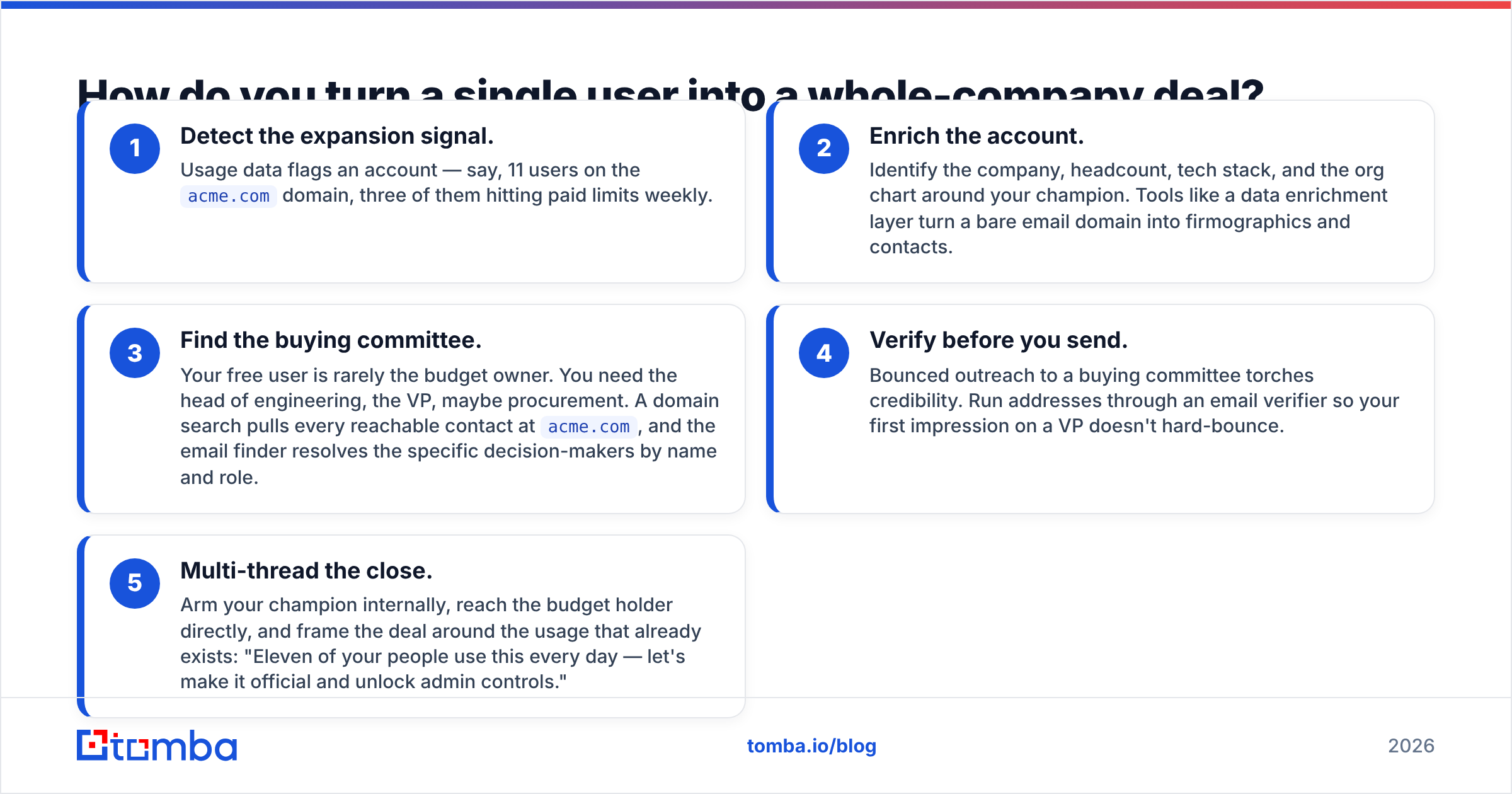
Here's the practical sequence reps run:
- Detect the expansion signal. Usage data flags an account — say, 11 users on the
acme.comdomain, three of them hitting paid limits weekly. - Enrich the account. Identify the company, headcount, tech stack, and the org chart around your champion. Tools like a data enrichment layer turn a bare email domain into firmographics and contacts.
- Find the buying committee. Your free user is rarely the budget owner. You need the head of engineering, the VP, maybe procurement. A domain search pulls every reachable contact at
acme.com, and the email finder resolves the specific decision-makers by name and role. - Verify before you send. Bounced outreach to a buying committee torches credibility. Run addresses through an email verifier so your first impression on a VP doesn't hard-bounce.
- Multi-thread the close. Arm your champion internally, reach the budget holder directly, and frame the deal around the usage that already exists: "Eleven of your people use this every day — let's make it official and unlock admin controls."
The methodology is elegant, but step 3 is where most teams stall. They have a product full of free users and no clean way to find the other people at those companies. Generic exported lists are stale and full of catch-all noise. That's exactly the gap accurate contact data closes.
)
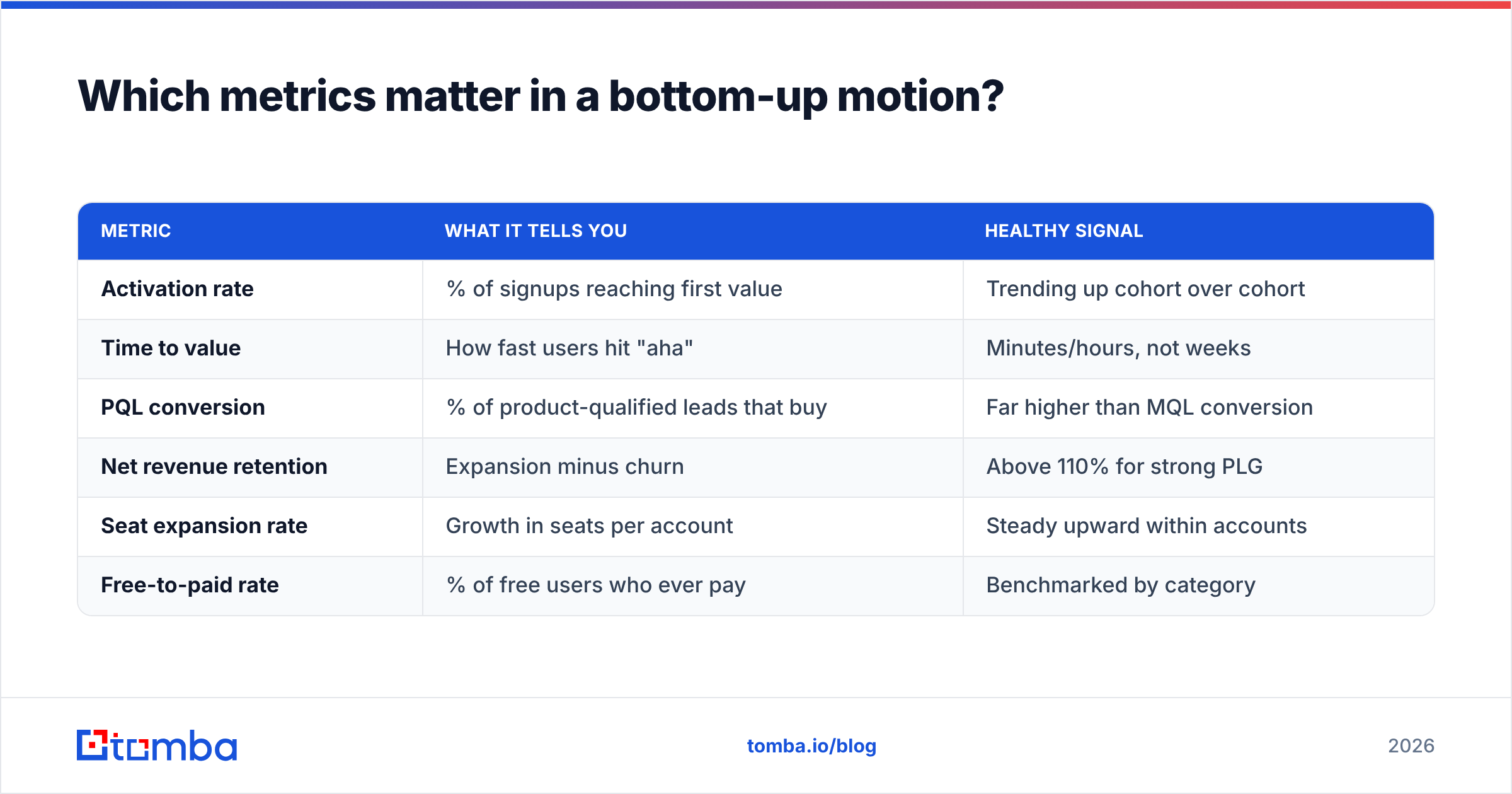
Which metrics matter in a bottom-up motion?#
You measure different things than a top-down team. New logos and demo-booked rates take a back seat to usage and retention.
| Metric | What it tells you | Healthy signal |
|---|---|---|
| Activation rate | % of signups reaching first value | Trending up cohort over cohort |
| Time to value | How fast users hit "aha" | Minutes/hours, not weeks |
| PQL conversion | % of product-qualified leads that buy | Far higher than MQL conversion |
| Net revenue retention | Expansion minus churn | Above 110% for strong PLG |
| Seat expansion rate | Growth in seats per account | Steady upward within accounts |
| Free-to-paid rate | % of free users who ever pay | Benchmarked by category |
The reason net revenue retention sits at the center is compounding: a base of accounts that each grow 15–20% a year produces durable growth even if you never added another logo. Bottom-up is, fundamentally, a revenue operations discipline — instrument the product, score behavior, and route the right accounts to humans at the right moment.
What are the risks and where does bottom-up fail?#
Bottom-up is not a free lunch. The common failure modes:
- Free tier that's too generous. If users never need to pay, you've built a charity. The free tier must deliver real value and create a natural ceiling that expansion solves.
- No activation, infinite signups. Volume without activation is vanity. A million signups who never reach value is worse than ten thousand who do — it just costs more to support.
- Sales shows up too early (or never). Drop a rep on a free user on day one and you recreate the friction you removed. Wait too long and you leave expansion revenue on the table. Timing is the craft.
- Weak data on the expansion layer. You can't multi-thread into an account you can't map. If your contact data is stale or unverified, the bottom-up flywheel stalls at the exact moment it's supposed to pay off.
- Wrong product fit. Highly regulated, deeply integrated, or six-figure products simply don't spread user-by-user. Forcing bottom-up on them wastes a year.
Most of these are solvable with discipline. The data one is solvable with tooling — which is the bridge to actually operationalizing this.
How do you operationalize bottom-up sales?#
A working bottom-up motion is three connected layers: a product that activates fast, a scoring system that flags PQLs, and an enrichment-and-outreach engine that converts signals into expansion conversations.
The first layer is product work. The second is RevOps instrumentation. The third — the one most sales teams underinvest in — is data. When an account lights up, your reps need to go from "one free user at acme.com" to "here are the seven people who decide and here are their verified emails" in minutes, not days. You can wire that directly into your stack with the Tomba API, or run it through your CRM with the HubSpot integration so enrichment happens the moment an account crosses your PQL threshold. For one-off expansion plays, the Chrome extension lets a rep pull a verified contact while looking at the prospect's LinkedIn or company site.
Pricing-wise, bottom-up teams tend to start lean and scale with volume — which suits usage-based Tomba pricing: a free tier of 25 searches to test the workflow, then $49/month Starter and $99/month Growth as expansion plays ramp. You're not buying a giant seat-based contract before you know the motion works; you're paying for the contacts you actually find.
Is bottom-up the right methodology for your team?#
Use this quick gut-check before committing:
- Can a single user get real value alone, without IT or a contract? If yes, bottom-up is viable. If no, stay top-down.
- Is time-to-value measured in minutes? Fast activation is non-negotiable.
- Does usage naturally spread to teammates? Collaboration and shared workspaces are the spread mechanism.
- Is your ACV low enough that a sales-first motion would lose money? Then let the product do the first sale.
- Do you have a way to map and reach buying committees once accounts heat up? If not, fix the data layer first.
If you answered yes to most of these, bottom-up will likely out-perform a pure sales-led motion — and you can always layer a sales-assist team on top as accounts mature. Plenty of category leaders documented on review sites like G2 run exactly this hybrid: product-led land, sales-led expand.
Turn free users into expansion revenue with Tomba#
The bottom-up methodology only pays off if you can act on expansion signals fast — and that means going from one known user to a fully mapped, verified buying committee on demand. That's the job the Tomba Email Finder is built for: feed it a company domain or a decision-maker's name, and get back accurate, verified professional emails so your reps multi-thread into hot accounts before the moment passes. Pair it with domain search to surface every reachable contact and the email verifier to keep your sender reputation clean. Start on the free tier, prove the workflow on your warmest accounts, and scale as your expansion pipeline grows. Bottom-up earns the contract — Tomba helps you go close it.
// get started
Find, verify and enrich your first contacts today
Start on the free plan with 25 searches a month, then scale when your team is ready.
Free plan · No credit card required · GDPR & CCPA
// about the author