Email Bounce Rate Benchmarks by Industry: 2026 Data Guide
What counts as a healthy email bounce rate in your industry? See 2026 benchmarks across SaaS, ecommerce, finance, and more — plus how to fix a high rate fast.
TL;DR
- A healthy email bounce rate is under 2%; mailbox providers start throttling you above 4–5%, and most ESPs will suspend an account that crosses 8–10%.
- Benchmarks vary by industry: tech/SaaS and ecommerce run leaner (1–2%), while education, government, and healthcare skew higher (3–5%) because of churn-heavy or stale address lists.
- Hard bounces (dead addresses) hurt your sender reputation far more than soft bounces (full inbox, server hiccup) — treat them differently.
- The single biggest lever is list hygiene: verifying addresses before you send drops most bounce rates below the danger line in one pass.
- Use the table below to find your sector's target, then fix anything above it before your next campaign.
What is email bounce rate and how is it calculated?#
Your bounce rate is the percentage of emails that get rejected by the receiving server instead of landing in an inbox. The formula is simple:
Bounce rate = (bounced emails ÷ emails sent) × 100
Send 10,000 emails, have 300 come back undelivered, and you're at a 3% bounce rate. Think of it like mailing physical letters: every envelope stamped "return to sender" is a bounce, and the post office (the mailbox provider) starts to wonder why so much of your mail is undeliverable.
That wondering has consequences. Gmail, Outlook, and Yahoo treat a rising bounce rate as a signal that you're emailing a low-quality or purchased list — exactly what spammers do. Cross their tolerance and they quietly route your future mail to spam, or block it outright. A clean bounce rate, by contrast, is one of the strongest trust signals you can send.
Bounces split into two categories that matter very differently for your sender reputation:
- Hard bounces — permanent failures. The address doesn't exist, the domain is dead, or the server permanently rejected you. These are reputation poison and must be removed immediately.
- Soft bounces — temporary failures. The mailbox is full, the message was too large, or the server was briefly down. A few retries usually clear these.
- Block bounces — a subtype where the receiving server actively refuses you, often because your IP or domain is already flagged.
- Auto-reply / technical bounces — out-of-office loops and misconfigured DNS responses that some platforms count as soft bounces.
Wait — that placeholder is illustrative. Here's the real one:
What is a good email bounce rate in 2026?#
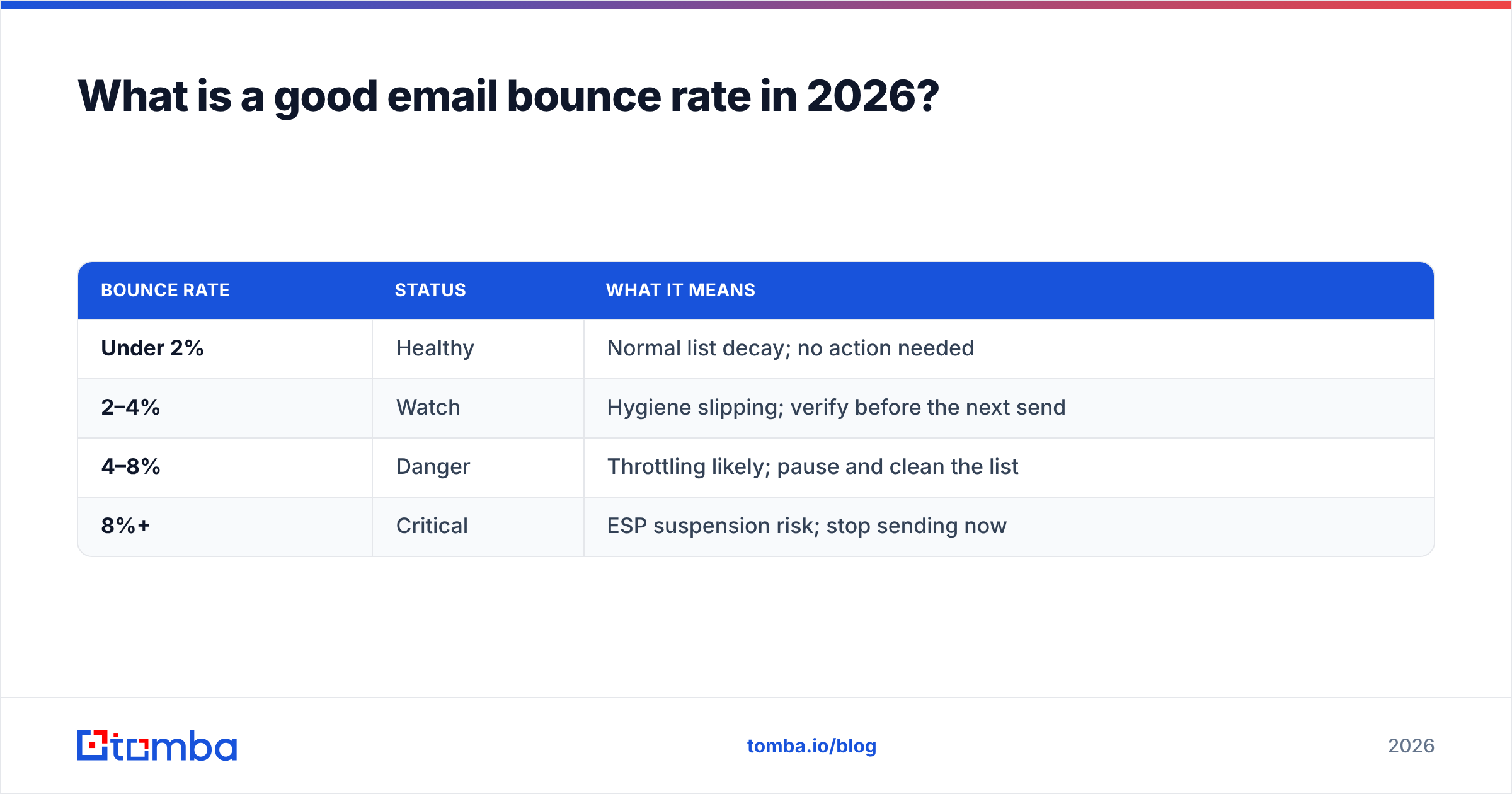
The short answer: aim for under 2%, and never let it sit above 5%. That's the line where deliverability problems stop being theoretical.
Here's the universal threshold ladder most deliverability teams use, independent of industry:
| Bounce rate | Status | What it means |
|---|---|---|
| Under 2% | Healthy | Normal list decay; no action needed |
| 2–4% | Watch | Hygiene slipping; verify before the next send |
| 4–8% | Danger | Throttling likely; pause and clean the list |
| 8%+ | Critical | ESP suspension risk; stop sending now |
These numbers hold whether you send 1,000 emails a month or 10 million. The difference between industries isn't the tolerance — it's how easily each sector stays under the line, given how fast its contact data goes stale.
What are the bounce rate benchmarks by industry?#
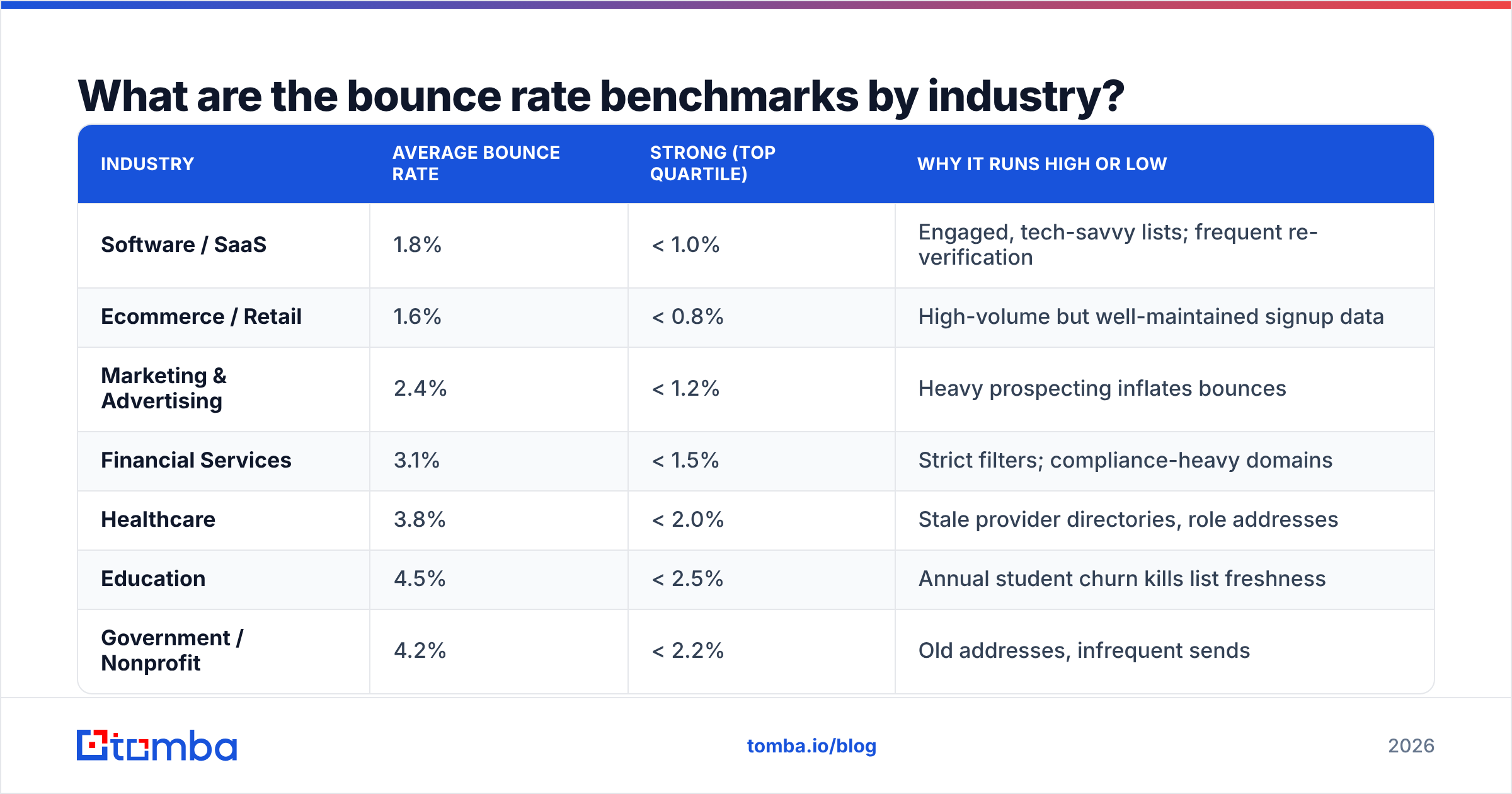
Below are typical email bounce rate benchmarks by industry for 2026, blended from ESP aggregate reporting and B2B outreach data. Treat the "average" column as the middle of the pack and the "strong" column as the target you should beat.
| Industry | Average bounce rate | Strong (top quartile) | Why it runs high or low |
|---|---|---|---|
| Software / SaaS | 1.8% | < 1.0% | Engaged, tech-savvy lists; frequent re-verification |
| Ecommerce / Retail | 1.6% | < 0.8% | High-volume but well-maintained signup data |
| Marketing & Advertising | 2.4% | < 1.2% | Heavy prospecting inflates bounces |
| Financial Services | 3.1% | < 1.5% | Strict filters; compliance-heavy domains |
| Healthcare | 3.8% | < 2.0% | Stale provider directories, role addresses |
| Education | 4.5% | < 2.5% | Annual student churn kills list freshness |
| Government / Nonprofit | 4.2% | < 2.2% | Old addresses, infrequent sends |
| Travel & Hospitality | 2.7% | < 1.4% | Seasonal lists decay between peaks |
| Real Estate | 3.3% | < 1.6% | Agent turnover, scraped contact data |
| Manufacturing / B2B | 2.9% | < 1.5% | Long sales cycles, aging CRM records |
Two patterns jump out. First, B2C sectors with fresh first-party signups (SaaS, ecommerce) sit lowest because the address was just typed in by a real person. Second, sectors built on directories, churn, or scraped data (education, healthcare, real estate) run 2–3x higher — not because they email worse, but because their underlying data rots faster.
That second group is where verification pays off most. If you're in real estate or B2B manufacturing pulling contacts from a CRM that hasn't been touched in a year, your raw list might bounce at 6–8% — but a single verification pass typically pulls it back under 2%.
Why does my industry's bounce rate matter for deliverability?#
Because mailbox providers grade you against your own history and your peers, not against an absolute. A 3% bounce rate is unremarkable for a university alumni list and alarming for a SaaS product blast.
The mechanism is your sender reputation score, tracked per sending domain and IP. Every hard bounce nudges it down. Cross a provider's invisible threshold and three things happen in sequence:
- Throttling — your mail gets accepted slowly, delaying campaigns.
- Foldering — messages skip the inbox and land in spam.
- Blocking — the provider rejects your connections entirely.
Strong email deliverability is cumulative. One bad send rarely sinks you, but a pattern of 5%+ bounces over several campaigns trains Gmail and Outlook to distrust your domain — and rebuilding trust takes weeks of careful warming, not a quick fix.
This is also why cold outreach lists need stricter hygiene than newsletter lists. A newsletter list self-cleans because unengaged users unsubscribe; a cold prospecting list you bought or scraped has never been validated at all, so it can carry 10–20% dead addresses out of the box.

How do I lower a high email bounce rate?#
Conclusion first: verify the list before you send, and remove every hard bounce after. Everything else is secondary. Here's the full playbook, in priority order:
- Verify addresses before sending. Run your list through an email verifier that checks syntax, domain MX records, and mailbox existence. This catches dead addresses before they become bounces on your record. It's the highest-ROI step by a wide margin.
- Handle catch-all domains carefully. Some company domains accept all mail then silently discard it, so standard checks can't confirm the mailbox. A dedicated catch-all verifier assigns a confidence score instead of a blind guess.
- Remove hard bounces immediately. Never re-send to an address that hard bounced. Suppress it permanently.
- Use double opt-in for new signups. Confirming the address at signup stops typos and bot signups from entering your list at all.
- Re-verify aging lists every 3–6 months. Roughly 2% of B2B addresses go stale each month as people change jobs. Quarterly cleaning keeps decay in check.
- Authenticate your domain with SPF, DKIM, and DMARC. Run an SPF checker to confirm your records are valid — misconfigured DNS causes "technical" bounces that look like list problems.
If you're sourcing brand-new contacts rather than cleaning an old list, accuracy at the finding stage prevents the problem upstream. A quality email finder returns verified, deliverable addresses, so you're not bouncing your way to a damaged reputation on day one.
For large databases, batch the work. A bulk email finder and bulk verifier let you process tens of thousands of contacts in one job instead of trickling them through a campaign and learning the hard way which ones are dead.
How do bounce rates compare to other email health metrics?#
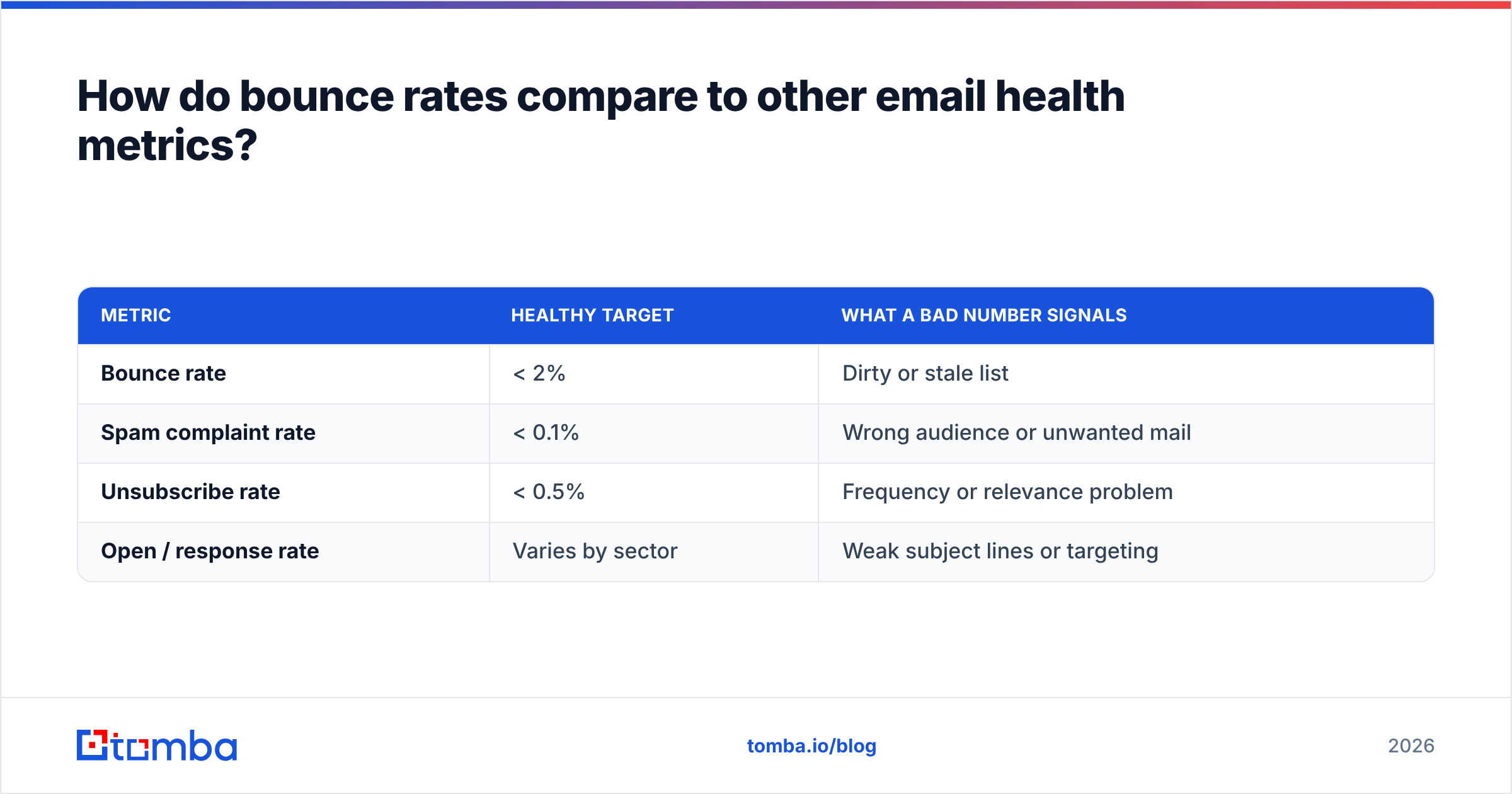
Bounce rate is one of four numbers worth watching together. On its own it can mislead — a low bounce rate with terrible engagement still tanks deliverability.
| Metric | Healthy target | What a bad number signals |
|---|---|---|
| Bounce rate | < 2% | Dirty or stale list |
| Spam complaint rate | < 0.1% | Wrong audience or unwanted mail |
| Unsubscribe rate | < 0.5% | Frequency or relevance problem |
| Open / response rate | Varies by sector | Weak subject lines or targeting |
The relationship matters: a clean bounce rate earns you the deliverability headroom to get good open rates. If half your mail bounces, the half that lands does so under a cloud of suspicion. Fix bounces first, then optimize engagement.
How much does verification actually move the needle?#
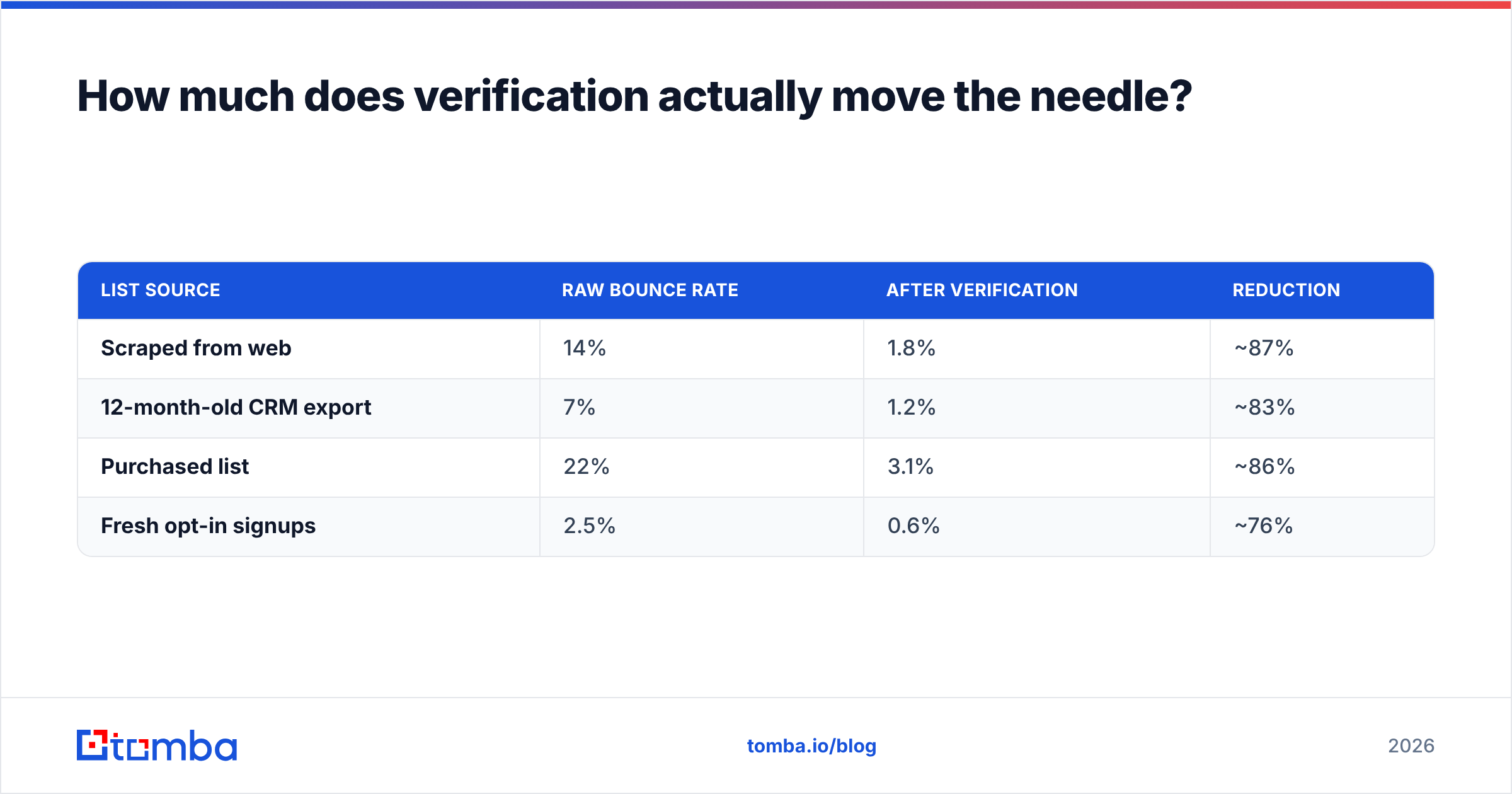
Real numbers from typical B2B outreach lists, before and after a single verification pass:
| List source | Raw bounce rate | After verification | Reduction |
|---|---|---|---|
| Scraped from web | 14% | 1.8% | ~87% |
| 12-month-old CRM export | 7% | 1.2% | ~83% |
| Purchased list | 22% | 3.1% | ~86% |
| Fresh opt-in signups | 2.5% | 0.6% | ~76% |
The pattern is consistent: the dirtier the source, the bigger the gain. Even a clean opt-in list benefits, because typos and abandoned mailboxes accumulate quietly. This is why deliverability teams treat verification as a standing process, not a one-time cleanup.
You can dig deeper into where contact data comes from and how it's validated on Tomba's data sources page, and the public benchmarks from providers like HubSpot's email marketing research and Mailchimp's industry email benchmarks are worth bookmarking to track how your sector shifts year over year. For the technical thresholds providers enforce, Google's Postmaster Tools documentation lays out the bounce and spam limits directly.
Frequently asked questions#
What is the average email bounce rate across all industries? Roughly 2–3% across blended ESP data in 2026. Anything under 2% is healthy; over 5% needs attention regardless of sector.
Is a 5% bounce rate bad? Yes. At 5% you're in the throttling zone where mailbox providers start slowing or foldering your mail. Pause sending and verify the list before your next campaign.
Do hard and soft bounces count the same? No. Hard bounces are permanent and damage your reputation immediately — remove them at once. Soft bounces are temporary; retry a few times before suppressing.
How often should I clean my email list? Every 3–6 months for active lists, and always before sending to a list older than 90 days. B2B data decays about 2% per month.
Hit your industry's benchmark before the next send#
The fastest way under your sector's bounce threshold isn't a clever subject line — it's a clean list. Run your contacts through the Tomba Email Finder to source verified, deliverable addresses from the start, and pair it with the email verifier to scrub anything aging in your CRM. You'll start the free tier with 25 searches a month, and the Tomba pricing scales from the $49/mo Starter plan up as your volume grows. Verify first, send second, and let your bounce rate stay where the benchmarks say it should be: under 2%, every time.
// get started
Find, verify and enrich your first contacts today
Start on the free plan with 25 searches a month, then scale when your team is ready.
Free plan · No credit card required · GDPR & CCPA
// about the author