Bounceless vs Bytemine: Which Email Tool Wins in 2026?
Bounceless vs Bytemine compared on accuracy, pricing, and features for 2026 — plus where a combined finder-and-verifier like Tomba beats both on cost per valid contact.
Choosing between Bounceless vs Bytemine usually means you have a messy list and a sending reputation you do not want to torch. Both promise cleaner lists and fewer bounces, but they solve slightly different halves of the same problem — and neither one finds the email addresses in the first place.
This guide breaks down where each tool wins, where it falls short, and why a combined finder-plus-verifier stack often beats running two single-purpose products side by side.
TL;DR#
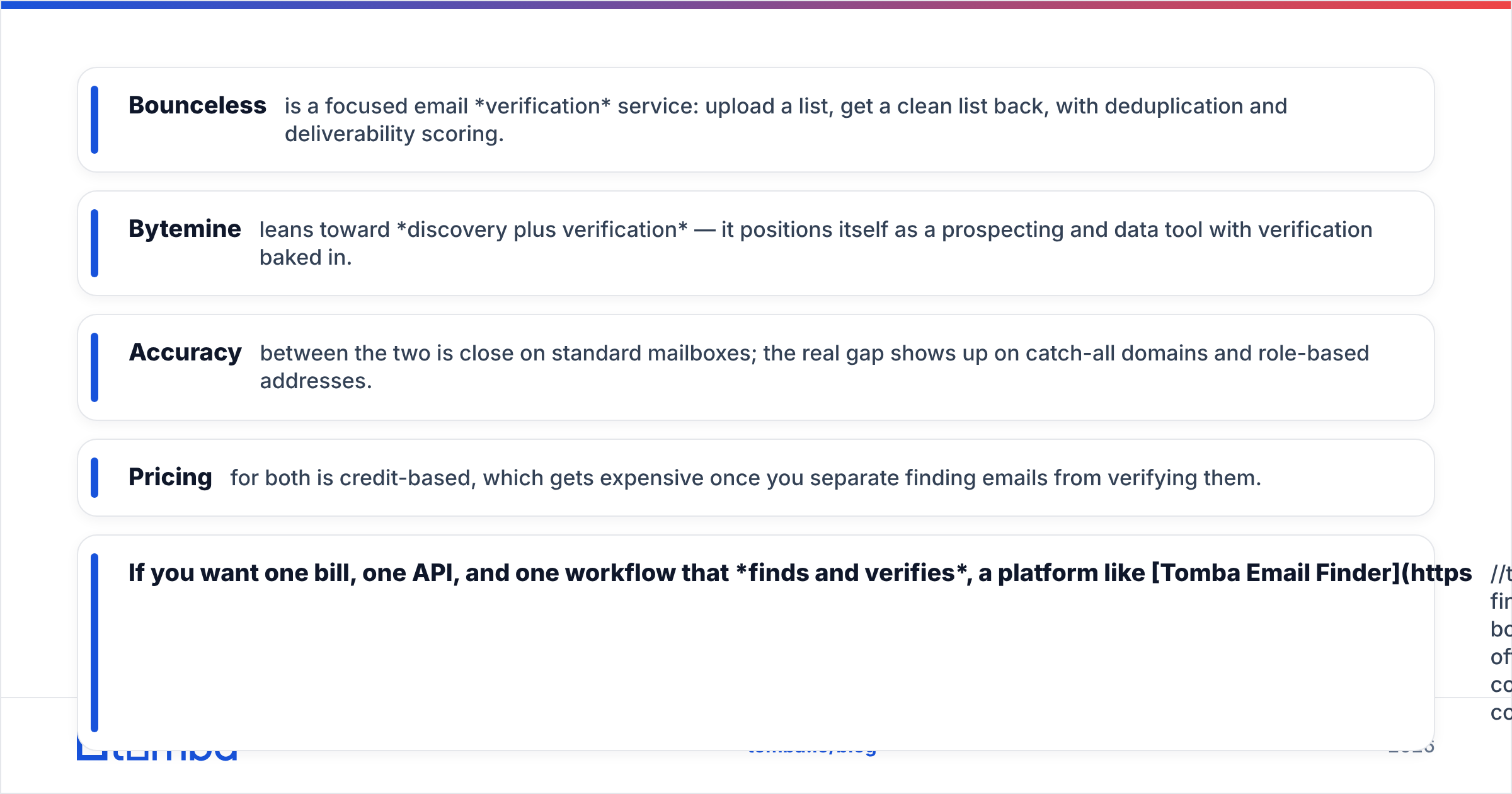
- Bounceless is a focused email verification service: upload a list, get a clean list back, with deduplication and deliverability scoring.
- Bytemine leans toward discovery plus verification — it positions itself as a prospecting and data tool with verification baked in.
- Accuracy between the two is close on standard mailboxes; the real gap shows up on catch-all domains and role-based addresses.
- Pricing for both is credit-based, which gets expensive once you separate finding emails from verifying them.
- If you want one bill, one API, and one workflow that finds and verifies, a platform like Tomba Email Finder covers both jobs — often at a lower cost per valid contact.
What do Bounceless and Bytemine actually do?#
The short version: Bounceless cleans lists you already have, and Bytemine helps you build lists and clean them.
Bounceless is a dedicated email verifier. You feed it a CSV or connect it through an integration, and it runs syntax checks, MX record validation, SMTP handshakes, and catch-all detection. The output is a categorized list — valid, invalid, risky, unknown — so you can decide what to send to.
Bytemine sits a step earlier in the funnel. It markets itself around finding and enriching B2B contacts, with verification as part of the package rather than the whole product. That makes it closer to a lightweight prospecting tool than a pure hygiene service.
Here is the core distinction that matters before you pay for either:
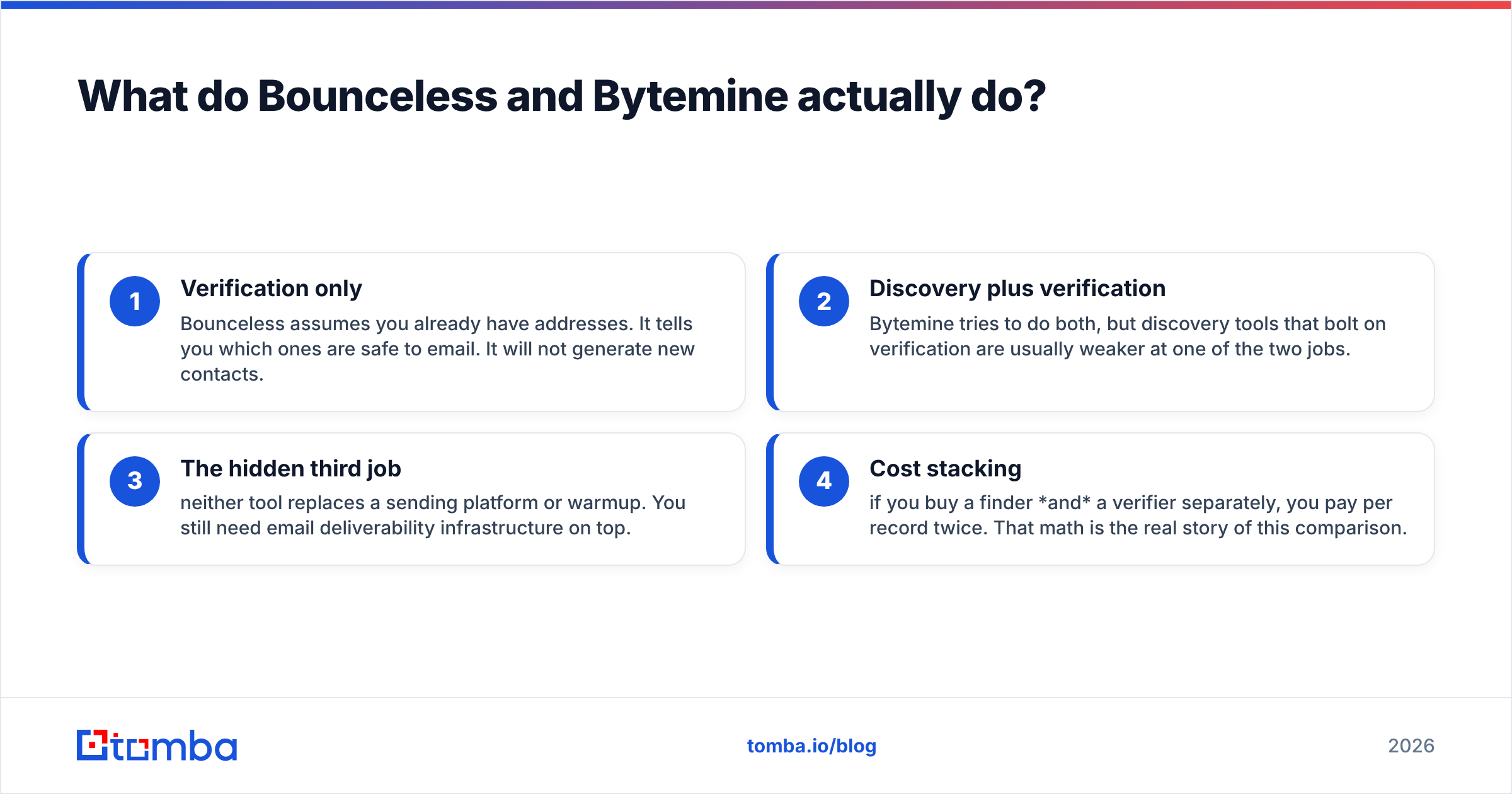
- Verification only — Bounceless assumes you already have addresses. It tells you which ones are safe to email. It will not generate new contacts.
- Discovery plus verification — Bytemine tries to do both, but discovery tools that bolt on verification are usually weaker at one of the two jobs.
- The hidden third job — neither tool replaces a sending platform or warmup. You still need email deliverability infrastructure on top.
- Cost stacking — if you buy a finder and a verifier separately, you pay per record twice. That math is the real story of this comparison.

Which is more accurate, Bounceless or Bytemine?#
On clean, standard corporate mailboxes the two are within a few points of each other — both will correctly flag obvious typos, dead domains, and full inboxes. Accuracy diverges in three places that quietly cause most of your bounces.
Catch-all domains. A catch-all domain accepts mail to any address, so an SMTP check returns "OK" even for an address that does not exist. Bounceless exposes a dedicated catch-all category and lets you decide risk tolerance. Bytemine handles catch-alls too, but discovery-first tools tend to mark more of them as "valid" to keep their hit-rate numbers high, which pushes risk onto you. If catch-alls are a big share of your list, test both — and consider a dedicated catch-all verifier before you trust either default.
Role-based and disposable addresses. Addresses like info@, sales@, and support@, plus throwaway domains, are low-value and high-risk. Good verifiers flag them separately rather than lumping them under "valid."
Freshness of the underlying data. For Bytemine, discovery accuracy depends on how recently its contact database was refreshed. Stale B2B data means you verify an address that was real six months ago and has since been deactivated. This is why data accuracy and source transparency matter as much as the SMTP check itself.

A quick reality check before you over-optimize on a single percentage: no verifier hits 100% on catch-alls, and any vendor claiming otherwise is rounding. The goal is a predictable bounce rate under 2-3%, not a magic number.
Bounceless vs Bytemine: feature and pricing comparison#
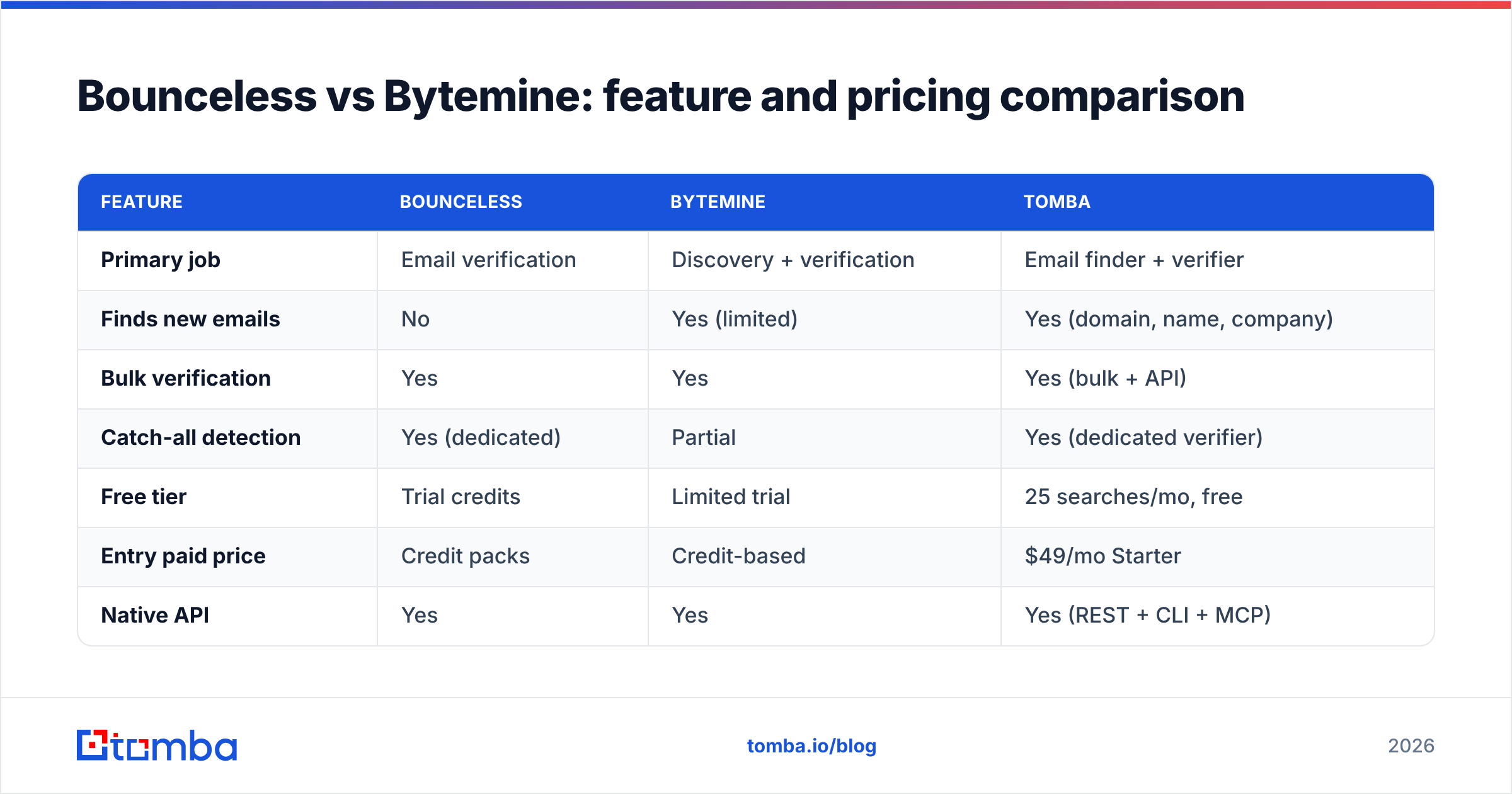
Here is the head-to-head on the attributes that actually change your workflow and your invoice. Tomba is included because most teams comparing these two are really trying to solve "find and verify" in one place.
| Feature | Bounceless | Bytemine | Tomba |
|---|---|---|---|
| Primary job | Email verification | Discovery + verification | Email finder + verifier |
| Finds new emails | No | Yes (limited) | Yes (domain, name, company) |
| Bulk verification | Yes | Yes | Yes (bulk + API) |
| Catch-all detection | Yes (dedicated) | Partial | Yes (dedicated verifier) |
| Free tier | Trial credits | Limited trial | 25 searches/mo, free |
| Entry paid price | Credit packs | Credit-based | $49/mo Starter |
| Native API | Yes | Yes | Yes (REST + CLI + MCP) |
| Phone / enrichment | No | Partial | Yes (phone + enrichment) |
| CRM integrations | Limited | Some | HubSpot, Salesforce, Pipedrive, Zapier |
A few things to read out of that table:
- Bounceless is the cleaner choice if all you need is hygiene and you already have a finder you like.
- Bytemine makes sense if you want discovery and verification in one tool and you can live with verification being the secondary feature.
- The credit math is the silent budget killer. Pay-per-record on a finder, then pay-per-record again on a verifier, and your cost per usable contact can double.
)
Is a single platform better than running two tools?#
Usually, yes — for two reasons: cost per valid contact and workflow friction.
When you split finding and verifying across two vendors, every contact gets billed twice and passes through two APIs with two different data formats. You also lose the feedback loop: a combined platform can verify as it finds, so it never returns an address it already knows is dead.
That is the core argument for consolidating. With Tomba you run domain search to pull every public address on a company, the email verifier confirms deliverability in the same pass, and the bulk email finder handles list-scale jobs without a second subscription. One Tomba API key covers find, verify, and enrich.
That does not mean Bounceless or Bytemine are bad tools. If you already own a great prospecting engine and only need hygiene, a dedicated verifier is a legitimate, narrow choice. The consolidation argument is strongest when you are also paying someone to find the emails.
When Bounceless is the right call#
- You have a large existing database that needs a one-time clean.
- Your finder is already locked in and you only want verification.
- You want a simple, single-purpose tool with predictable batch pricing.
When Bytemine is the right call#
- You want light discovery and verification under one login.
- Your team is small and you value fewer tools over best-in-class accuracy.
- You are early enough that a single combined credit pool is simpler to manage.
When a combined platform wins#
- You are both sourcing and cleaning contacts every week.
- You want one API, one bill, and verification built into discovery.
- You need extras — phone finder, data enrichment, CRM sync — that single-purpose verifiers do not offer.
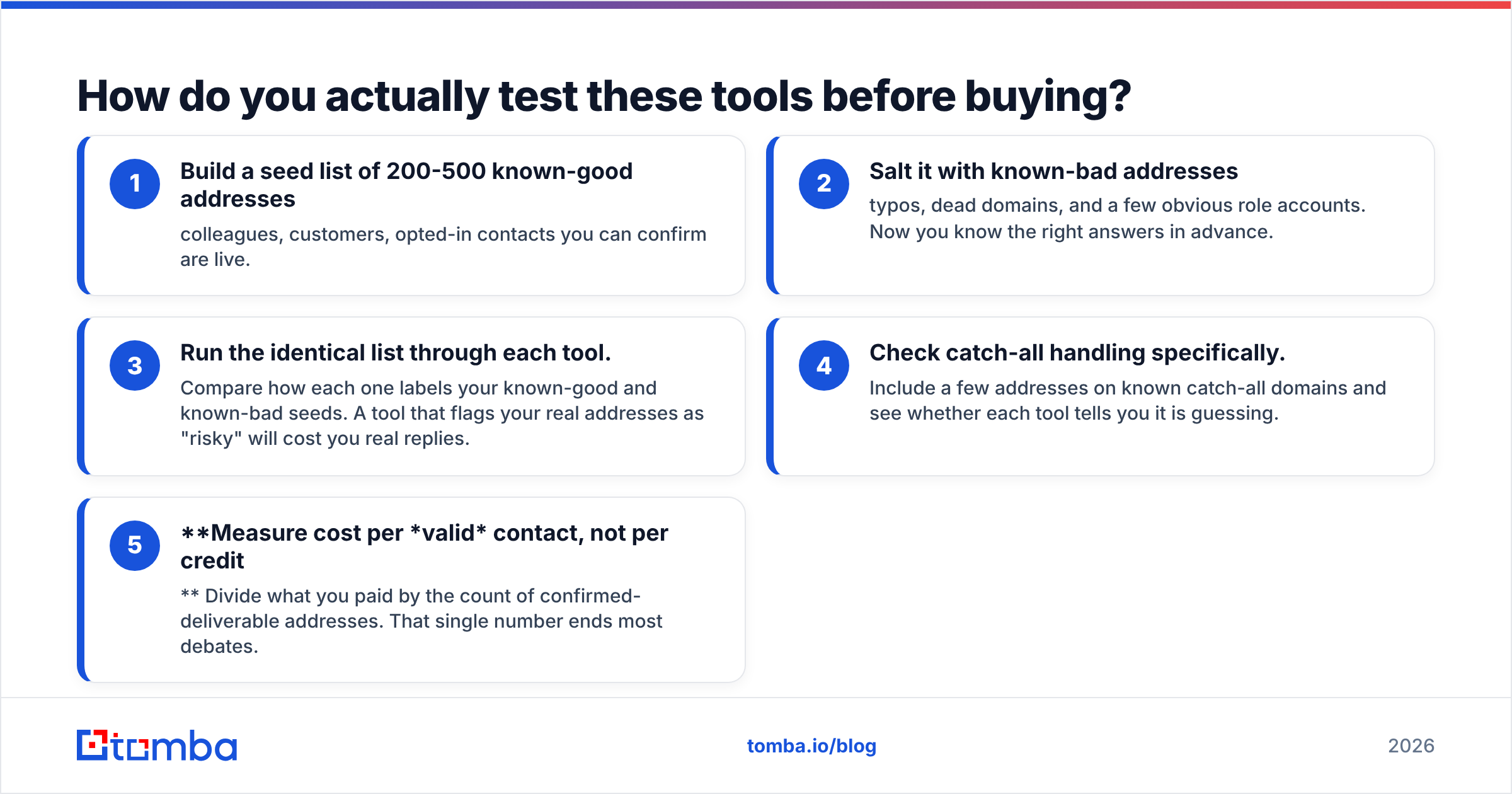
How do you actually test these tools before buying?#
Do not trust marketing accuracy claims, including the ones in this article. Run a controlled bake-off in under an hour.
- Build a seed list of 200-500 known-good addresses — colleagues, customers, opted-in contacts you can confirm are live.
- Salt it with known-bad addresses — typos, dead domains, and a few obvious role accounts. Now you know the right answers in advance.
- Run the identical list through each tool. Compare how each one labels your known-good and known-bad seeds. A tool that flags your real addresses as "risky" will cost you real replies.
- Check catch-all handling specifically. Include a few addresses on known catch-all domains and see whether each tool tells you it is guessing.
- Measure cost per valid contact, not per credit. Divide what you paid by the count of confirmed-deliverable addresses. That single number ends most debates.
If you want a zero-commitment gut check, run a handful of addresses through a free email checker first to calibrate your expectations before you spend credits anywhere.
A clean list is only half the deliverability equation. Even perfectly verified addresses bounce or land in spam if your sender reputation and authentication records are weak. Verify your SPF setup with an SPF checker and warm new domains before you scale sends — no verifier can rescue a cold, misconfigured sending domain.
What about API, scale, and integrations?#
For anything beyond a one-off cleanup, the developer experience decides which tool you keep.
Bounceless offers a verification API and common integrations, which is enough for batch hygiene workflows wired into an existing stack. Bytemine exposes discovery and verification endpoints, fitting teams that want to script prospecting. Both are credit-metered, so high-volume usage needs forecasting or you will hit surprise overages.
Tomba's edge at scale is breadth from a single integration. The same credentials drive the REST Tomba API, a command line email finder, an MCP server for AI agents, plus native connectors for HubSpot, Salesforce, and Zapier. You wire it once, then find, verify, and enrich through one contract instead of stitching two vendors together.
For broader context on how single-purpose verifiers stack up against full platforms, third-party review sites like G2 and Capterra are useful for reading unfiltered user complaints — especially around support response times and billing surprises, which rarely show up in feature tables.
Bounceless vs Bytemine: the verdict#
Pick Bounceless for pure, dependable list hygiene when discovery is already handled. Pick Bytemine if you want light discovery and verification in one place and can accept that neither is best-in-class. But if you are paying separately to find and to verify, you are almost certainly overspending and adding workflow friction for no benefit.
The smarter default for most outbound teams in 2026 is a single platform that finds professional emails by domain, name, or company and verifies them in the same pass — then enriches with phone numbers and firmographics when you need them. That is exactly what Tomba Email Finder is built for, starting free with 25 searches a month and scaling to a $49/mo Starter plan. Compare the full Tomba pricing against what two separate tools would cost you, run the cost-per-valid-contact test above, and let the math decide. Start with the free tier, clean one real list, and you will see the difference before you ever reach for a credit card.
Ready to find emails that actually work?
Join 150,000+ professionals who stopped guessing and started sending. Free credits on signup — no credit card required.
Get the Tomba newsletter
Practical outbound tactics and product updates — once every two weeks.
About the author