Bounceless vs Datanyze 2026: B2B Email Data Compared
Bounceless verifies email lists; Datanyze sells technographic contact data. Here's which one actually fits your B2B workflow in 2026 — and where both fall short.
Bounceless and Datanyze solve two different problems, and most teams comparing them are actually shopping for a third tool. Bounceless cleans email lists you already have. Datanyze tells you what software a company runs and hands you some contacts. Neither one is a high-accuracy email finder. This guide breaks down what each does, where they overlap, what they cost in 2026, and when you'd reach for something built for finding and verifying contacts in one pass.
TL;DR#
- Bounceless is a dedicated email verification and list-cleaning service. It does not find new emails — it tells you whether the ones you have are deliverable.
- Datanyze is a sales intelligence and technographics tool. Its strength is "who uses what software," with contact data bolted on through a Chrome extension and credit system.
- They are complements, not direct competitors: you might run Datanyze to build a list and Bounceless to clean it. But that's two subscriptions for what a single platform can do.
- Pricing: Bounceless is pay-as-you-go credits plus monthly plans; Datanyze runs a limited free tier and a flat ~$39/user/month Pro plan with capped monthly credits.
- If your real goal is finding and verifying B2B emails in one workflow, a combined finder-plus-verifier like Tomba Email Finder usually beats stitching these two together.
What is Bounceless?#
Bounceless is an email verification platform. You upload a list — exported from a CRM, a scraper, an event signup — and it runs each address through a multi-step pipeline: syntax checks, domain and MX record lookups, SMTP handshake, role-account detection (info@, sales@), disposable-domain filtering, and catch-all detection.
The output is a cleaned list bucketed into deliverable, risky, and undeliverable. The point is simple: stop sending to dead addresses so your bounce rate stays low and your sender reputation survives. High bounce rates are one of the fastest ways to land in spam folders, so verification is genuine table stakes for cold outreach.
What Bounceless does not do is generate contacts. If you have a name and a company but no email, Bounceless can't help. It's a filter, not a search engine. That's a fine scope — but it means Bounceless is only ever half of a prospecting stack.
For teams that just need clean lists, a focused email verifier covers the same ground, and it's worth checking whether your finder already includes verification before paying for a standalone tool.
What is Datanyze?#
Datanyze is a sales intelligence tool best known for technographics — data about the technology a company uses. Want a list of companies running Shopify, or Salesforce, or a specific analytics tag? That's Datanyze's home turf. It was acquired by ZoomInfo years ago and now runs as a lightweight, lower-cost contact-and-technographics product aimed at individual reps.
In practice you use Datanyze mostly through its Chrome extension. You browse a company website or a LinkedIn profile, click the extension, and it surfaces firmographic data plus contact details — email and direct-dial where available — drawn against a monthly credit allowance.
The tradeoffs are real. Datanyze's contact database is smaller and less fresh than tier-one providers, email accuracy is inconsistent, and the credit caps are tight on the entry plans. It's a budget on-ramp to sales intelligence, not a high-volume data engine. And like most data tools, it gives you emails without verifying that they still land — which is exactly the gap Bounceless fills.

Bounceless vs Datanyze: how do they actually differ?#
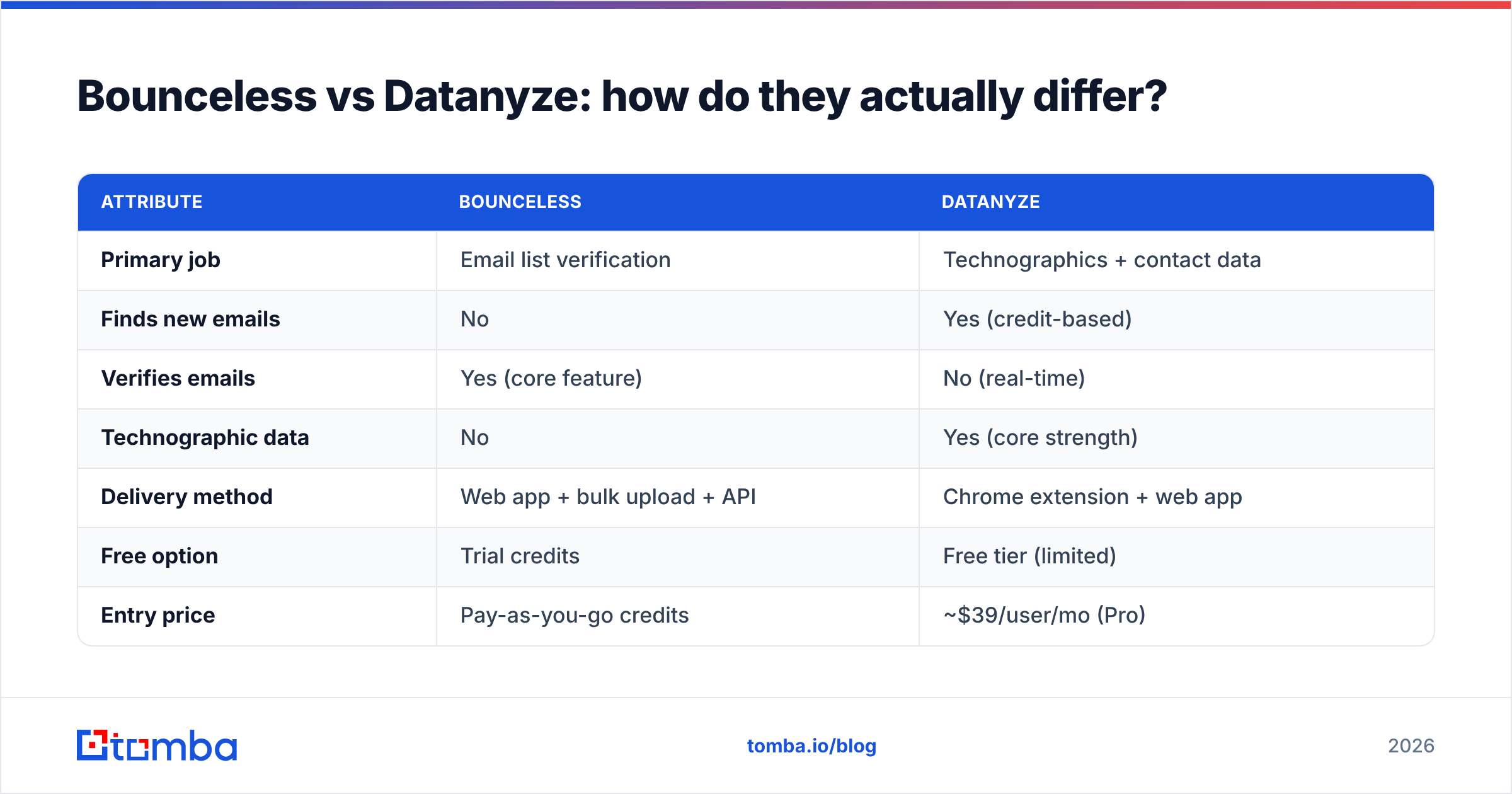
The cleanest way to see it: Datanyze is acquisition (get contacts), Bounceless is hygiene (clean contacts). Here's the side by side.
| Attribute | Bounceless | Datanyze |
|---|---|---|
| Primary job | Email list verification | Technographics + contact data |
| Finds new emails | No | Yes (credit-based) |
| Verifies emails | Yes (core feature) | No (real-time) |
| Technographic data | No | Yes (core strength) |
| Delivery method | Web app + bulk upload + API | Chrome extension + web app |
| Free option | Trial credits | Free tier (limited) |
| Entry price | Pay-as-you-go credits | ~$39/user/mo (Pro) |
| Best for | Cleaning existing lists | Light tech-based prospecting |
| Weak spot | No data acquisition | Coverage, freshness, no verify |
Read that table and the conclusion writes itself: you need both to run a complete workflow, and even together they leave email accuracy uncertain because Datanyze doesn't verify and Bounceless doesn't find.
When should you choose Bounceless?#
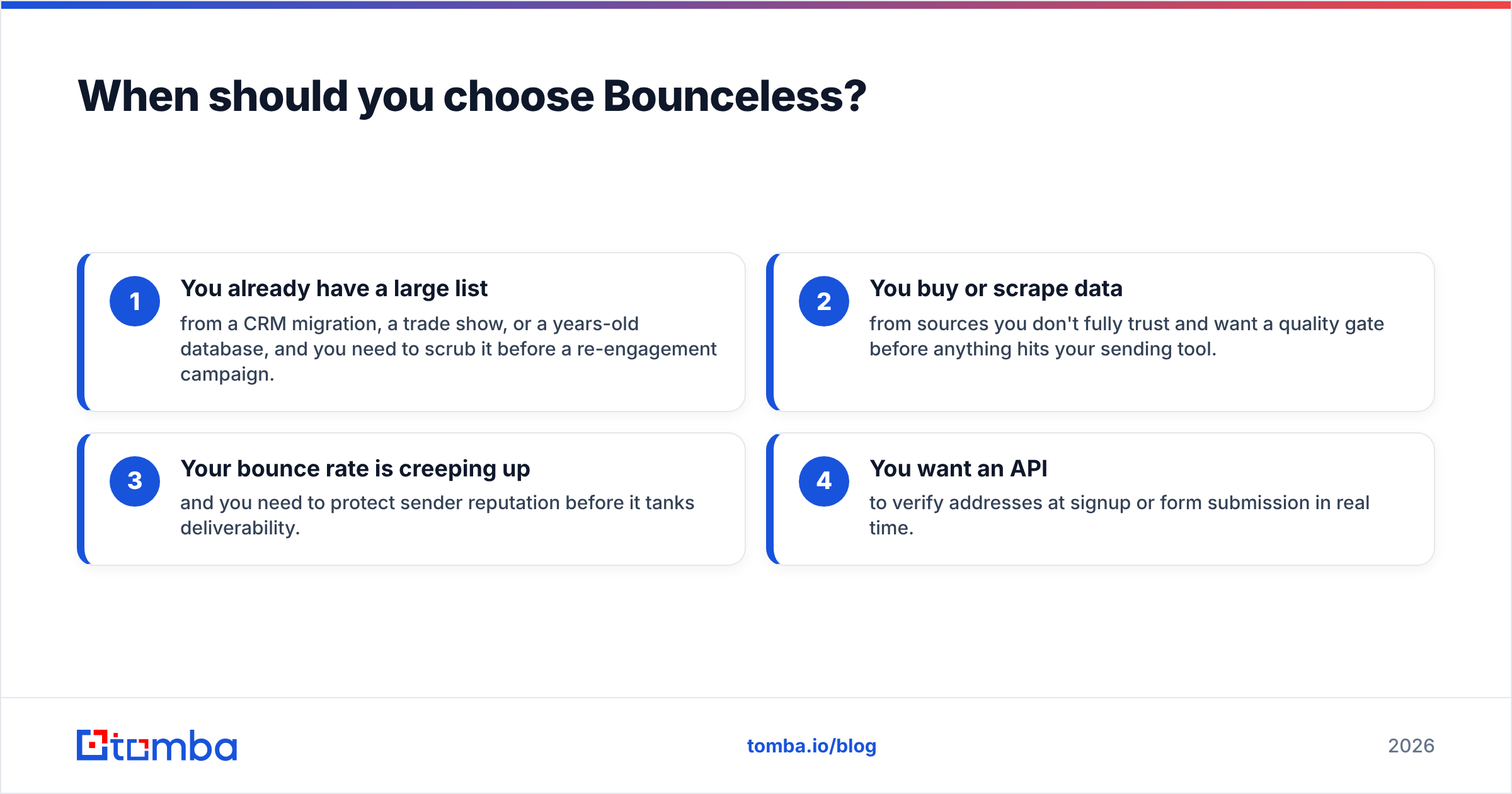
Pick Bounceless when verification is your only missing piece. Concrete cases:
- You already have a large list from a CRM migration, a trade show, or a years-old database, and you need to scrub it before a re-engagement campaign.
- You buy or scrape data from sources you don't fully trust and want a quality gate before anything hits your sending tool.
- Your bounce rate is creeping up and you need to protect sender reputation before it tanks deliverability.
- You want an API to verify addresses at signup or form submission in real time.
Bounceless is competent at this. But "list cleaning only" is a narrow lane, and you should confirm whether the tool that builds your lists already includes verification — many do, which makes a separate Bounceless subscription redundant.
When should you choose Datanyze?#
Reach for Datanyze when your targeting hinges on technology signals and your volume is modest:
- You sell software that integrates with a specific stack (e.g., a Shopify app, a Salesforce add-on) and want to target companies already running it.
- You're a solo rep or small team that wants firmographic and contact lookups while browsing, without a heavyweight ZoomInfo contract.
- Budget is the binding constraint and you can live with capped monthly credits and uneven data coverage.
Where Datanyze struggles is scale and accuracy. The contact database is thinner than dedicated providers, emails aren't verified at point of capture, and credit ceilings make large campaigns impractical. If outreach volume is your bottleneck, Datanyze alone won't carry it.
Is there a better option than running both?#
Usually, yes — because the Bounceless-plus-Datanyze combo means two bills, two logins, and a handoff step where data quality leaks. The more efficient pattern is a platform that finds and verifies in the same pass, so every contact that reaches your sequence is already confirmed deliverable.
That's the category Tomba sits in. You search by domain, name, or company, get the email, and it's verified before it lands in your export — no second tool, no separate cleaning run.

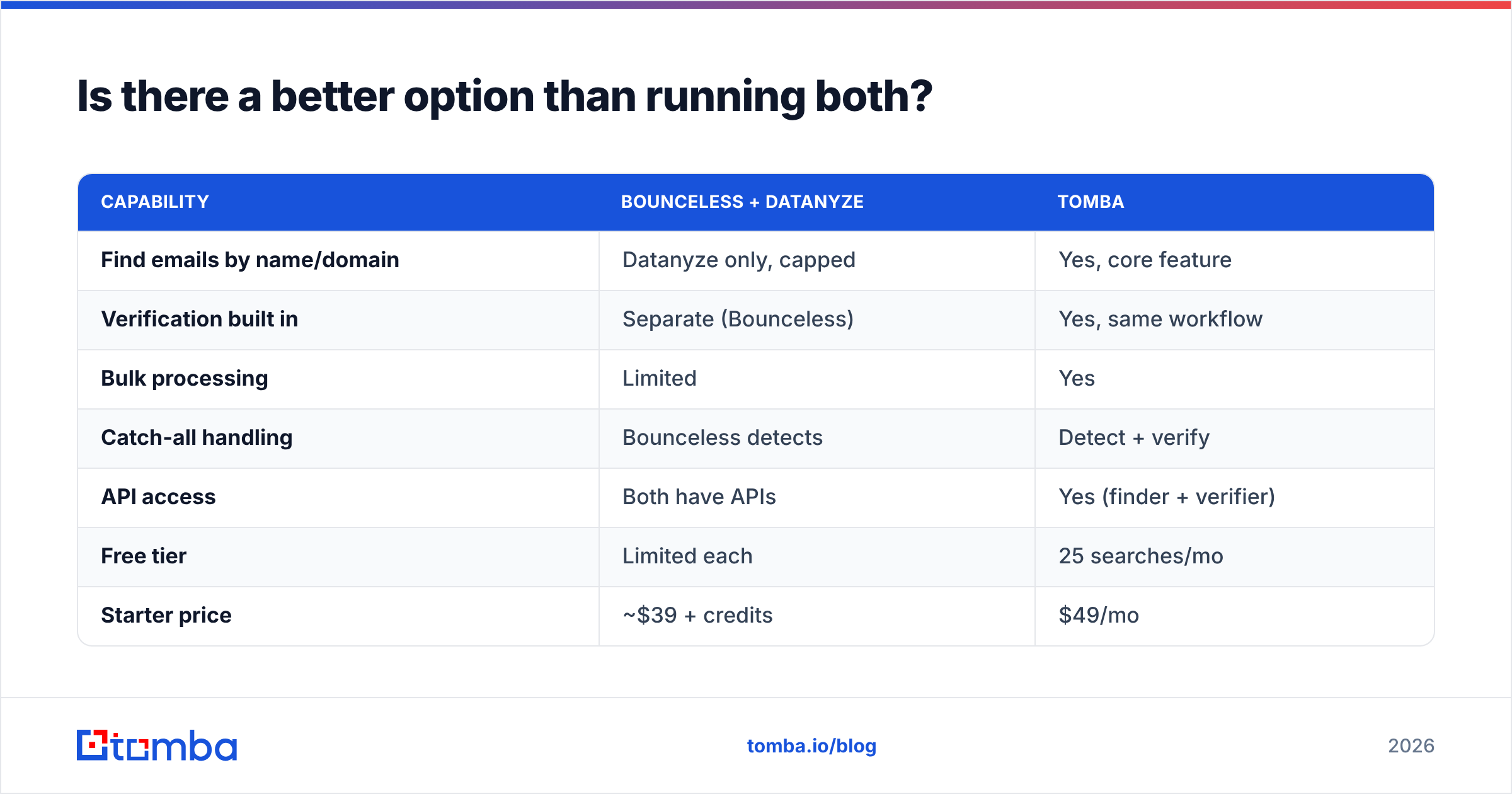
Here's how the all-in-one approach compares against the two-tool stack on the dimensions that matter for a real pipeline:
| Capability | Bounceless + Datanyze | Tomba |
|---|---|---|
| Find emails by name/domain | Datanyze only, capped | Yes, core feature |
| Verification built in | Separate (Bounceless) | Yes, same workflow |
| Bulk processing | Limited | Yes |
| Catch-all handling | Bounceless detects | Detect + verify |
| API access | Both have APIs | Yes (finder + verifier) |
| Free tier | Limited each | 25 searches/mo |
| Starter price | ~$39 + credits | $49/mo |
| Tools to manage | Two | One |
Note one honest tradeoff: Tomba does not do technographics. If "list companies running tool X" is your single most important filter, Datanyze still wins that narrow job, and you'd pair it with a finder/verifier. But for the far more common need — turning a list of target accounts and people into verified, sendable emails — one platform is cleaner than two.
How do accuracy and deliverability compare?#
Accuracy is where the two-tool stack gets fragile. Datanyze hands you an email; it does not guarantee that email still resolves. Bounceless can verify it after the fact, but only if you remember to run the export through it every single time. Miss that step on one batch and you're sending to stale addresses.
The numbers that matter downstream are bounce rate and inbox placement. Mailbox providers like Google treat high bounce rates as a spam signal — Google's own Postmaster Tools documentation ties sender reputation directly to how clean your sending behavior is. A single verification pass on a fresh list typically pushes bounce rate under the ~2% threshold most ESPs consider safe.
The structural advantage of verifying at the moment of finding is that there's no gap to forget. When the find and the check happen together, every contact is current by definition. You can read more on the mechanics in Tomba's notes on data sources and accuracy, and independent reviews on G2 are a useful sanity check on any vendor's accuracy claims before you commit.
What do they cost in 2026?#
- Bounceless: credit-based pay-as-you-go plus subscription tiers. You buy verification credits; price per credit drops at volume. Good fit if your verification needs are spiky rather than constant.
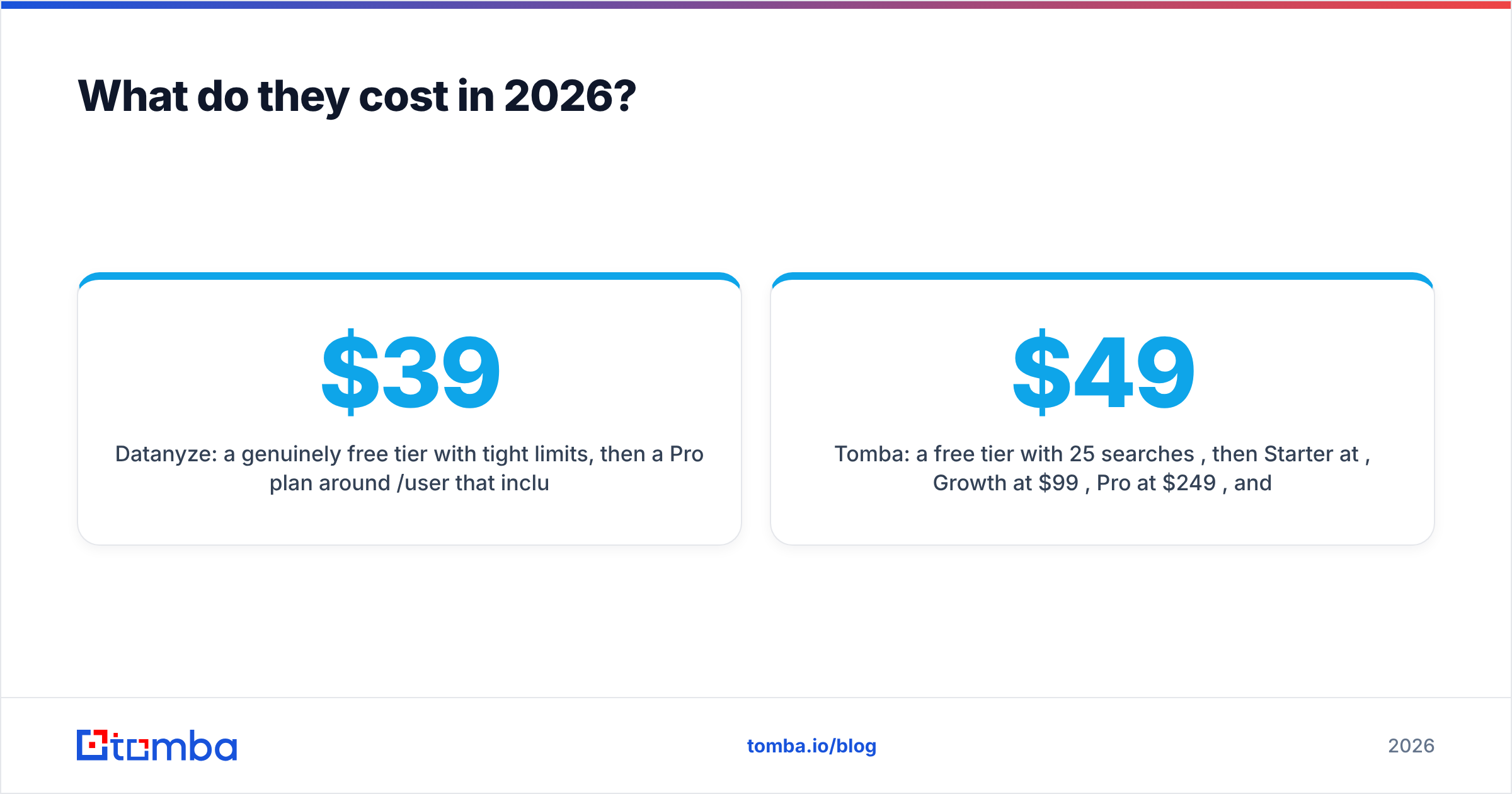
- Datanyze: a genuinely free tier with tight limits, then a Pro plan around $39/user/month that includes a fixed monthly credit allowance for contact and technographic lookups. Overages and team scaling push the real cost up.
- Tomba: a free tier with 25 searches/month, then Starter at $49/mo, Growth at $99/mo, Pro at $249/mo, and custom Enterprise. Each paid tier bundles both finding and verification — full Tomba pricing is on the site.
When you compare honestly, the "cheaper" Datanyze entry price is for one of the two jobs. Add Bounceless credits on top and the combined monthly spend often lands near or above a single bundled plan that does both — without the integration seam.
Which should you pick?#
Decide by what you're missing:
- You only need to clean lists → Bounceless does the job, but check whether your data tool already verifies first.
- You target by tech stack at low volume → Datanyze is a reasonable budget pick, with the caveat that you'll still want verification.
- You need verified emails at any real volume → skip the two-tool dance and use a combined finder-plus-verifier.
For that last and most common case, start with the Tomba Email Finder. Search by domain, name, or company, get emails that are verified before they ever reach your sequence, and run it in bulk or through the Tomba API when you scale. The free tier gives you 25 searches a month to test accuracy against your own target accounts — run it on a list you already know, compare the hit rate, and let the results decide.
Ready to find emails that actually work?
Join 150,000+ professionals who stopped guessing and started sending. Free credits on signup — no credit card required.
Get the Tomba newsletter
Practical outbound tactics and product updates — once every two weeks.
About the author