Bounceless vs Reachstream 2026: Which One Fits You?
Bounceless verifies email lists; Reachstream sells B2B contacts. Here's how they compare on pricing, accuracy, and data freshness in 2026 — and where each one falls short.
You typed "Bounceless vs Reachstream" into a search bar because two very different tools keep showing up in the same shortlists — and the marketing on both sites blurs the line between them. This guide draws that line clearly, then shows you which one actually matches the job you're trying to do.
TL;DR — Bounceless vs Reachstream in 30 seconds#
- They solve different problems. Bounceless is an email verification (list-cleaning) tool. Reachstream is a B2B contact database you buy leads from. Comparing them head-to-head only makes sense once you know which half of the funnel you're fixing.
- Bounceless wins if you already have a list and need to scrub invalid, risky, and catch-all addresses before sending.
- Reachstream wins if you have no list and want to buy contacts (emails, phones, titles) by industry or location.
- Neither finds and verifies in one motion the way a dedicated finder does — which is the gap most teams actually feel.
- Best all-in-one alternative: a platform like Tomba that finds, verifies, and enriches from a single workflow, starting free and scaling to $49/mo.

What is Bounceless?#
Bounceless is an email verification service. You upload a list — a CSV export, a CRM dump, a newsletter file — and it runs each address through a chain of checks: syntax validation, MX record lookup, SMTP handshake, role-account detection, disposable-domain filtering, and catch-all flagging. You get back a cleaned list sorted into deliverable, undeliverable, risky, and unknown.
The point of a verifier is protecting your sender reputation. Every hard bounce tells inbox providers you don't maintain your list, and that drags down deliverability across your whole domain. Cleaning before you send keeps bounce rates low and your sender reputation intact.
What Bounceless does not do is find new contacts. It has no database of people to sell you. If your CSV is empty, Bounceless has nothing to verify.
What is Reachstream?#
Reachstream is a B2B data platform — a contact database. You search by filters (industry, job title, company size, location, technology used) and it returns matching business contacts: names, work emails, phone numbers, and company firmographics. You either export those contacts or pull them into your CRM.
Reachstream's value is supply. When your pipeline is empty and you need net-new accounts to prospect, a database hands you raw leads at volume. The trade-off, common to every static database, is freshness: B2B data decays roughly 22–30% per year as people change jobs, so the email you bought in January may be dead by summer.
Reachstream typically bundles a basic verification step, but list hygiene is not its core engineering focus the way it is for a dedicated verifier — and bought lists almost always need a second cleaning pass before you send.
Is Bounceless the same as Reachstream?#
No — and that's the most important takeaway. Treat the comparison like a kitchen: Reachstream is the grocery delivery that fills your fridge, and Bounceless is the cook who checks expiry dates before anything goes in the pan. One sources, one inspects. You'll often want both functions, but buying one expecting the other leaves you frustrated.
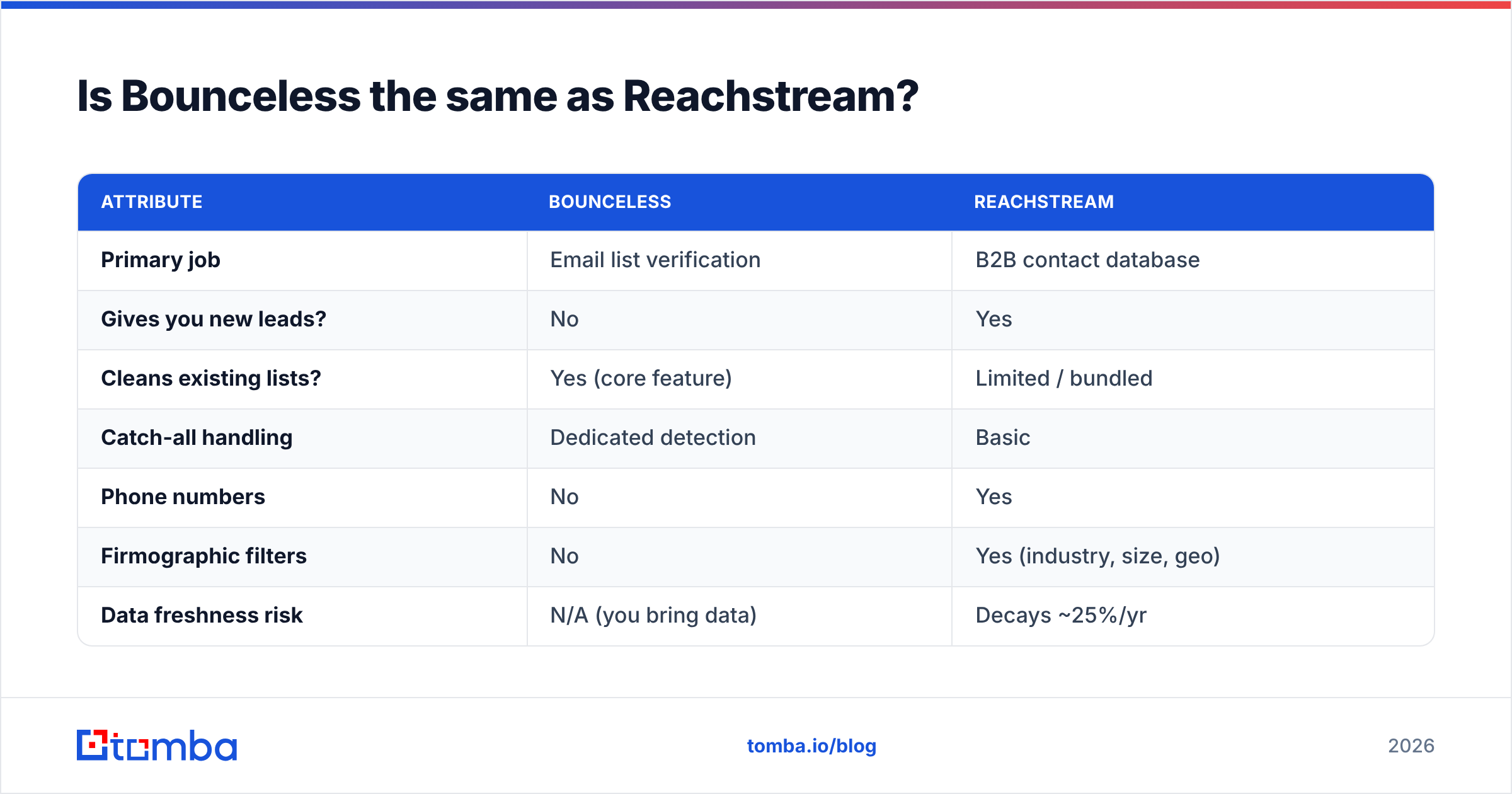
Here's how they line up on the dimensions that actually decide your purchase:
| Attribute | Bounceless | Reachstream |
|---|---|---|
| Primary job | Email list verification | B2B contact database |
| Gives you new leads? | No | Yes |
| Cleans existing lists? | Yes (core feature) | Limited / bundled |
| Catch-all handling | Dedicated detection | Basic |
| Phone numbers | No | Yes |
| Firmographic filters | No | Yes (industry, size, geo) |
| Data freshness risk | N/A (you bring data) | Decays ~25%/yr |
| Best for | Deliverability teams | Net-new prospecting |
| Pricing model | Pay-per-verification / credits | Contact-based plans |
The pattern is clear: they're complements, not substitutes. The real question isn't "which is better" — it's "which gap am I filling, and is there a tool that fills both at once?"
When should you pick Bounceless?#
Choose a verifier-first tool like Bounceless when:
- You already own the data. You have years of CRM contacts, event sign-ups, or a newsletter list, and you need it scrubbed before a re-engagement campaign.
- Your bounce rate is climbing. Anything above 2% on a cold send signals a hygiene problem that a verifier fixes directly.
- You're migrating ESPs. New platforms penalize you fast for a dirty import — verify before you load.
- Catch-all domains dominate your list. Many corporate domains accept every address at the server, so they need specialized catch-all verification rather than a simple SMTP ping.
What Bounceless can't help with: an empty pipeline. If you're staring at a blank prospecting sheet, a verifier has nothing to do.
When should you pick Reachstream?#
Choose a database like Reachstream when:
- You're starting from zero. No list, no contacts, and you need volume in a specific vertical.
- You sell to defined firmographics. "VP of Marketing at 50–200-person SaaS companies in the US" is exactly what a filterable database answers.
- You need phone numbers too. Databases bundle direct dials that verifiers never touch — useful for cold calling workflows.
- You accept a verification step downstream. You're fine running bought contacts through a separate cleaner before launch.
The catch: you're renting someone else's snapshot of the market, and that snapshot ages. Always re-verify a purchased list — which loops you right back to needing a verifier anyway.
Bounceless vs Reachstream: pricing compared#
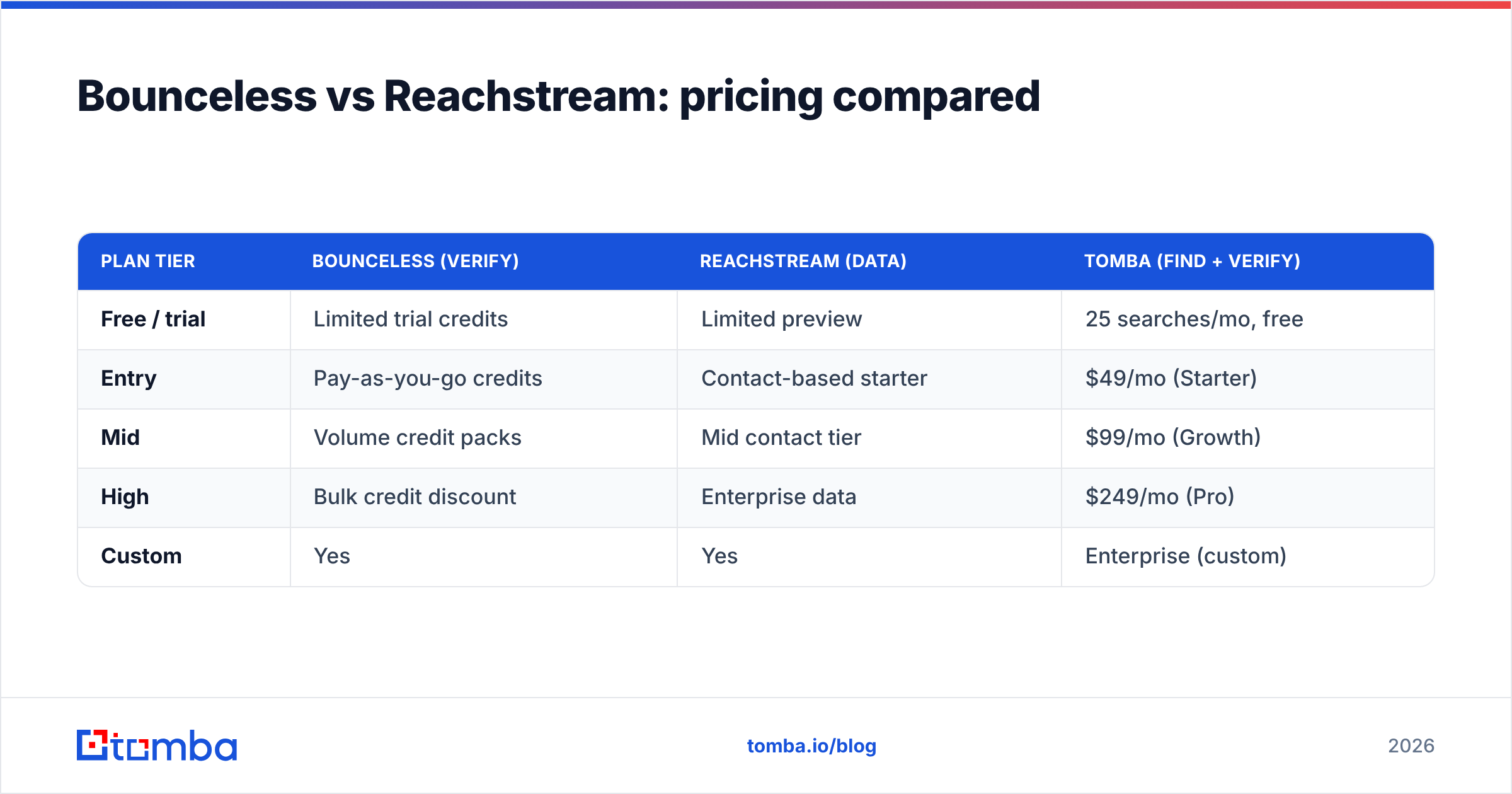
Pricing models differ because the products differ. Verifiers charge per email checked; databases charge per contact unlocked. That makes a true apples-to-apples number impossible, but here's the practical shape of each, alongside an all-in-one option:
| Plan tier | Bounceless (verify) | Reachstream (data) | Tomba (find + verify) |
|---|---|---|---|
| Free / trial | Limited trial credits | Limited preview | 25 searches/mo, free |
| Entry | Pay-as-you-go credits | Contact-based starter | $49/mo (Starter) |
| Mid | Volume credit packs | Mid contact tier | $99/mo (Growth) |
| High | Bulk credit discount | Enterprise data | $249/mo (Pro) |
| Custom | Yes | Yes | Enterprise (custom) |
A subtle cost trap: if you buy contacts from a database and pay a separate verifier to clean them, you're paying twice for one usable contact. Bundling find + verify in a single platform — with transparent Tomba pricing — usually beats stitching two niche tools together once you add up both invoices.
What both tools miss: the find-and-verify gap#
Here's the workflow most teams actually run, and where the Bounceless-vs-Reachstream framing breaks down:
- Identify a target company.
- Find the right person's email.
- Confirm that email is real and safe to send.
- Enrich with role, phone, and social context.
- Push to CRM and start the sequence.
Reachstream covers step 1–2 with bought data (aging). Bounceless covers step 3 (but only if you already have addresses). Neither owns the full motion — and the seams between two separate tools are where contacts get lost, duplicated, or sent stale.
A modern email finder collapses steps 2–4 into one call. You give it a name and a domain (or just a domain via domain search), and it returns a verified address with a confidence score, sourced fresh at query time rather than pulled from a months-old export. That on-demand model sidesteps the database decay problem entirely, because the data is gathered when you ask, not when someone last refreshed a file.
For deliverability specifically, fresh-at-query verification matters more than any single benchmark. The strongest predictor of inbox placement is still good email deliverability hygiene: low bounce rates, authenticated sending, and verified recipients. A finder that verifies inline gets you there in one step instead of three.
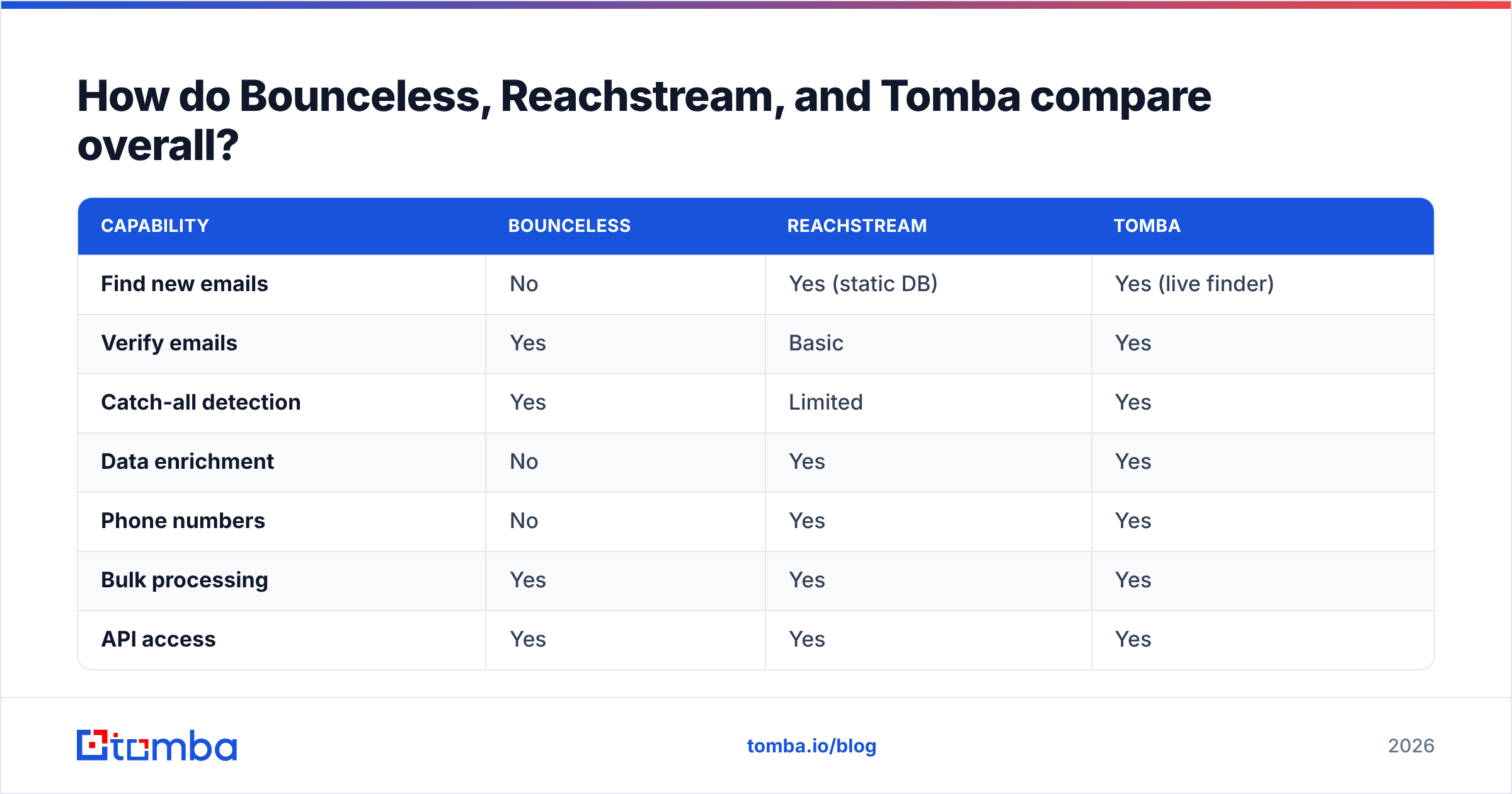
How do Bounceless, Reachstream, and Tomba compare overall?#
Stacking all three against the jobs you'd actually hire them for:
| Capability | Bounceless | Reachstream | Tomba |
|---|---|---|---|
| Find new emails | No | Yes (static DB) | Yes (live finder) |
| Verify emails | Yes | Basic | Yes |
| Catch-all detection | Yes | Limited | Yes |
| Data enrichment | No | Yes | Yes |
| Phone numbers | No | Yes | Yes |
| Bulk processing | Yes | Yes | Yes |
| API access | Yes | Yes | Yes |
| Free tier | Trial only | Preview only | 25/mo free |
| Starter price | Credit-based | Contact-based | $49/mo |
The honest read: if your only need is cleaning a giant existing list, a focused verifier like Bounceless is a reasonable buy. If your only need is bulk net-new contacts and you'll verify them elsewhere, Reachstream fits. But the moment you need both — and most growing teams do — an integrated platform removes the second invoice, the second integration, and the data-staleness gap between them.
How do you verify a list you already bought?#
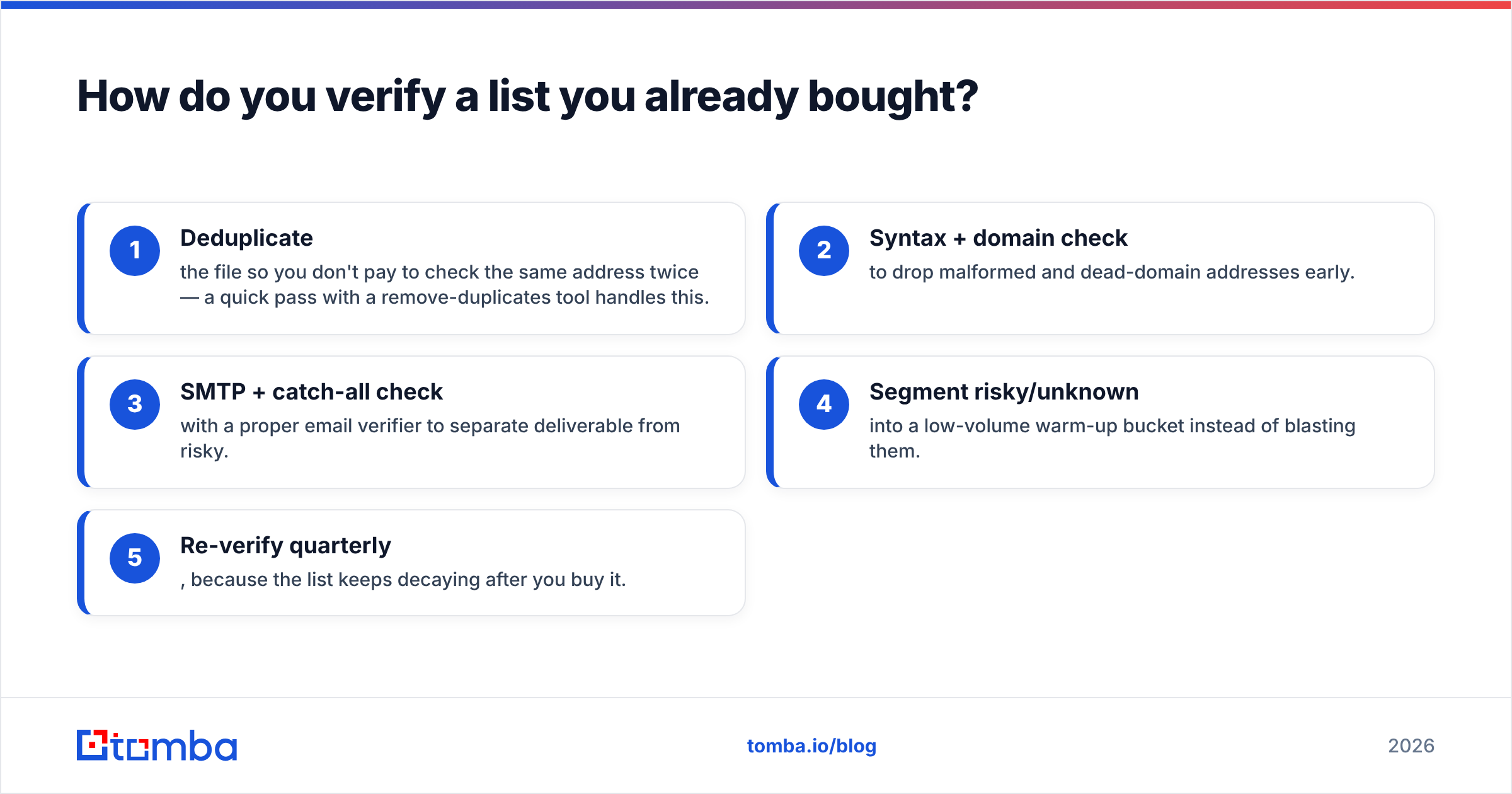
Whichever sourcing tool you use, run purchased or scraped contacts through a real verification pass before your first send. A defensible process looks like this:
- Deduplicate the file so you don't pay to check the same address twice — a quick pass with a remove-duplicates tool handles this.
- Syntax + domain check to drop malformed and dead-domain addresses early.
- SMTP + catch-all check with a proper email verifier to separate deliverable from risky.
- Segment risky/unknown into a low-volume warm-up bucket instead of blasting them.
- Re-verify quarterly, because the list keeps decaying after you buy it.
This is exactly the step Reachstream users still need after export, and exactly what Bounceless does in isolation — which is why doing it inside the same tool that found the contact saves a full handoff.
Verdict: which should you choose in 2026?#
Lead with the conclusion: pick based on the gap you have, not the brand.
- Have a list, need it clean → Bounceless (or any dedicated verifier) does the job.
- Have no list, need volume → Reachstream supplies contacts, but budget for a verification pass and accept data decay.
- Need to find, verify, and enrich in one workflow → an integrated platform beats running two single-purpose tools, both on cost and on data freshness.
For trust signals on any vendor, cross-check current reviews on G2 and Capterra before you commit — pricing and feature sets shift, and category leaders documented on sites like HubSpot's blog move fast.
If you'd rather not glue a database to a verifier and hope the seams hold, start with the Tomba Email Finder. It finds professional addresses by name, company, or domain, verifies them inline with a confidence score, and enriches each contact — from a free tier of 25 searches a month up to $49/mo when you scale. One workflow, fresh data, no double billing. Run your first 25 searches free and see how many verified contacts you get before you ever pay for a list.
// get started
Find, verify and enrich your first contacts today
Start on the free plan with 25 searches a month, then scale when your team is ready.
Free plan · No credit card required · GDPR & CCPA
// about the author