Bouncer vs Apollo.io 2026: Email Verifier vs Sales Platform
Bouncer verifies email lists with surgical accuracy. Apollo.io finds, enriches, and sequences contacts. Here is which one your 2026 stack actually needs.
Bouncer vs Apolloio is not a fight between two versions of the same product. It is a scalpel against a Swiss Army knife. One does email verification better than almost anyone. The other tries to run your entire outbound motion. Picking between them — or deciding you need a third option — comes down to one thing. Which stage of the pipeline are you trying to fix?
TL;DR — Bouncer vs Apolloio at a glance#
- Bouncer is a specialist email verifier. It cleans lists, validates addresses, and protects deliverability. It does not find new contacts.
- Apollo.io is an all-in-one sales platform. It finds emails, enriches records, runs sequences, and includes built-in verification — but each layer is shallower than a dedicated tool.
- If you already have lists and just need them clean, Bouncer wins on accuracy and price.
- If you need to source contacts from scratch and run cold outreach, Apollo covers more of the workflow in one login.
- If you want finder-grade accuracy plus verification without the bloat, a focused stack like Tomba's email finder and email verifier often beats both on cost-per-valid-contact.
What is Bouncer and what does it actually do?#
Bouncer is an email verification service. You feed it a list. That can be a CSV, an API call, or a real-time form check. It then tells you which addresses are deliverable, which will bounce, and which are risky. Risky covers catch-all, role-based, and disposable addresses. That is the whole job, and it does it cleanly.
The product is built around three core jobs:
- Bulk verification — upload a list, get back a scored file with deliverable, undeliverable, risky, and unknown buckets.
- Real-time API verification — validate an address at the moment of signup or form submission so junk never enters your database.
- Toxicity and deliverability checks — flag spam traps, complainers, and addresses that damage sender reputation.
Bouncer's appeal is focus. There is no CRM, no sequencer, no contact database. You pay for one thing: accurate verification. In return you get a tool that is easy to onboard and easy to budget. For teams whose only problem is "our bounce rate is too high," that narrowness is a feature, not a limitation. You can read more on their official site.

What is Apollo.io and how is it different?#
Apollo.io is a sales intelligence and engagement platform. It bundles a lot into one subscription. You get a B2B contact database (260M+ contacts by their own count), an email finder, data enrichment, sequencing, a dialer, and basic CRM tools. Verification is included, but it is a feature inside the suite rather than the headline product.
The mental model is simple. Bouncer fixes a list you already own. Apollo helps you build the list and then act on it. Apollo is competing with the whole prospecting stack — finders, databases, and outreach tools like Outreach or Salesloft — not just with verifiers.
That breadth is the selling point and the catch. You get a lot under one roof, but every module is "good enough" rather than best-in-class. Apollo's email accuracy, in particular, draws mixed reviews on sites like G2. It is fine for high-volume spray-and-pray. It gets frustrating when you need precision on a small, high-value list.
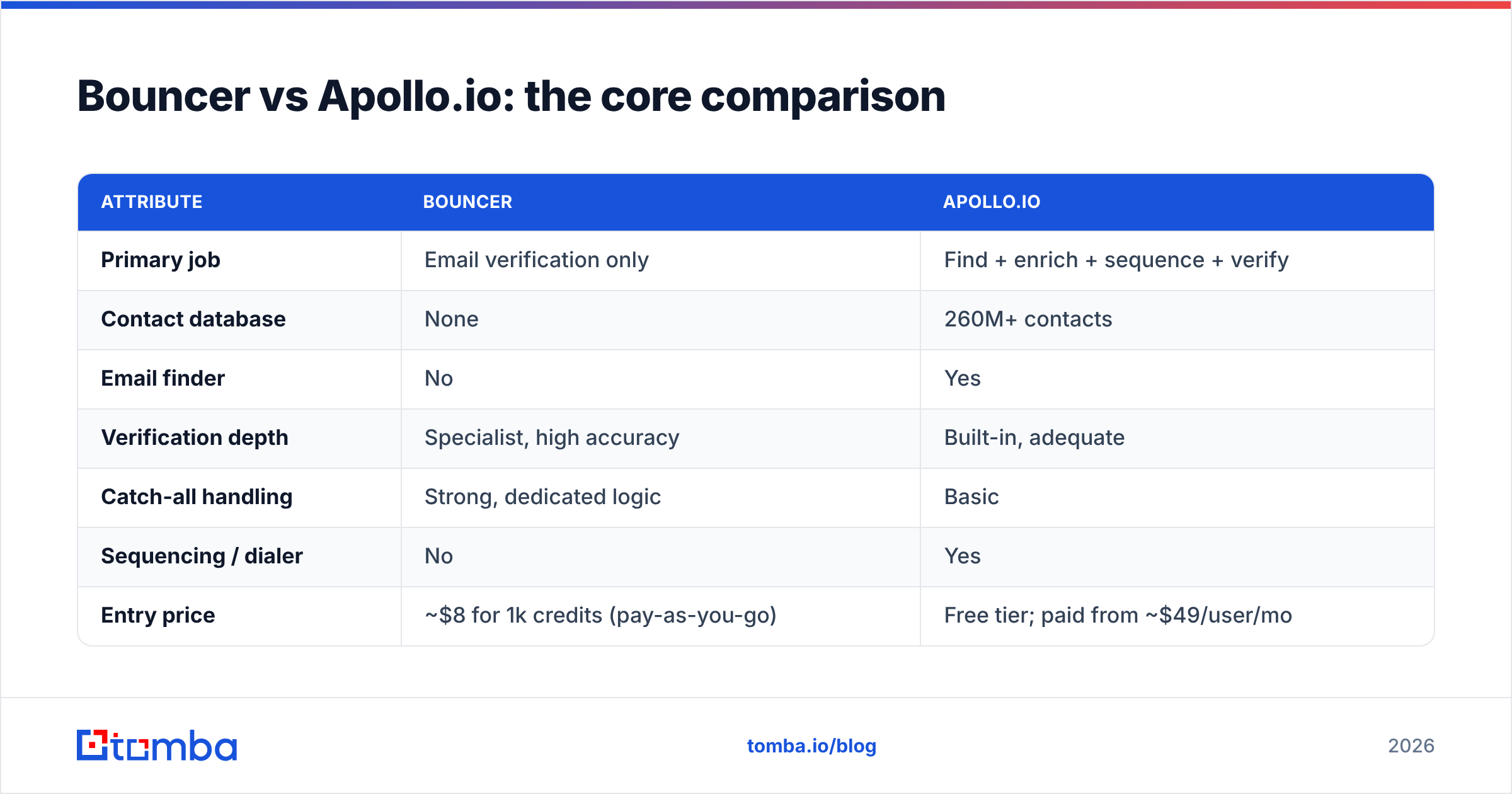
Bouncer vs Apolloio: the core comparison#
Here is the head-to-head on the attributes that actually decide the purchase.
| Attribute | Bouncer | Apollo.io |
|---|---|---|
| Primary job | Email verification only | Find + enrich + sequence + verify |
| Contact database | None | 260M+ contacts |
| Email finder | No | Yes |
| Verification depth | Specialist, high accuracy | Built-in, adequate |
| Catch-all handling | Strong, dedicated logic | Basic |
| Sequencing / dialer | No | Yes |
| Entry price | ~$8 for 1k credits (pay-as-you-go) | Free tier; paid from ~$49/user/mo |
| Best for | Cleaning owned lists | Full outbound from scratch |
| Learning curve | Minutes | Days |
The pattern is clear. Bouncer is deep and narrow. Apollo is wide and shallow. Neither is "better" in the abstract. They answer different questions.
Is Bouncer more accurate than Apollo.io?#
For pure verification, yes. That is what you would expect from a specialist. Bouncer's entire engineering effort goes into one problem: deciding whether an address is real. It handles edge cases like catch-all domains and greylisting with logic that a bundled verifier rarely matches.
Apollo's verification is competent, but it is one feature among dozens. Push a list of catch-all domains through Apollo and you get more "accept-all / unknown" results. You also get fewer confident verdicts. That ambiguity is exactly where bounces hide.
This is also where a dedicated catch-all verifier earns its keep. Catch-all domains accept every address at the SMTP layer. A naive verifier marks them all "valid" and your bounce rate spikes anyway. Specialist tools — Bouncer included, and Tomba's catch-all logic — apply extra signals instead of guessing.
If your KPI is deliverability and your list is already sourced, accuracy is the whole ballgame, and a specialist beats a suite. If your KPI is coverage — how many net-new contacts you can reach — accuracy matters less than the size and freshness of the database. That is Apollo's turf.
Bouncer vs Apollo.io pricing: which is cheaper?#
It depends entirely on what you are buying, because they price different things.
- Bouncer uses credit-based pricing. You pay roughly per address verified, with volume discounts and a monthly option. There is no per-seat cost because there are no "users" running sequences — it is a utility. For a one-time list clean of 50k records, Bouncer is dramatically cheaper than a full Apollo subscription.
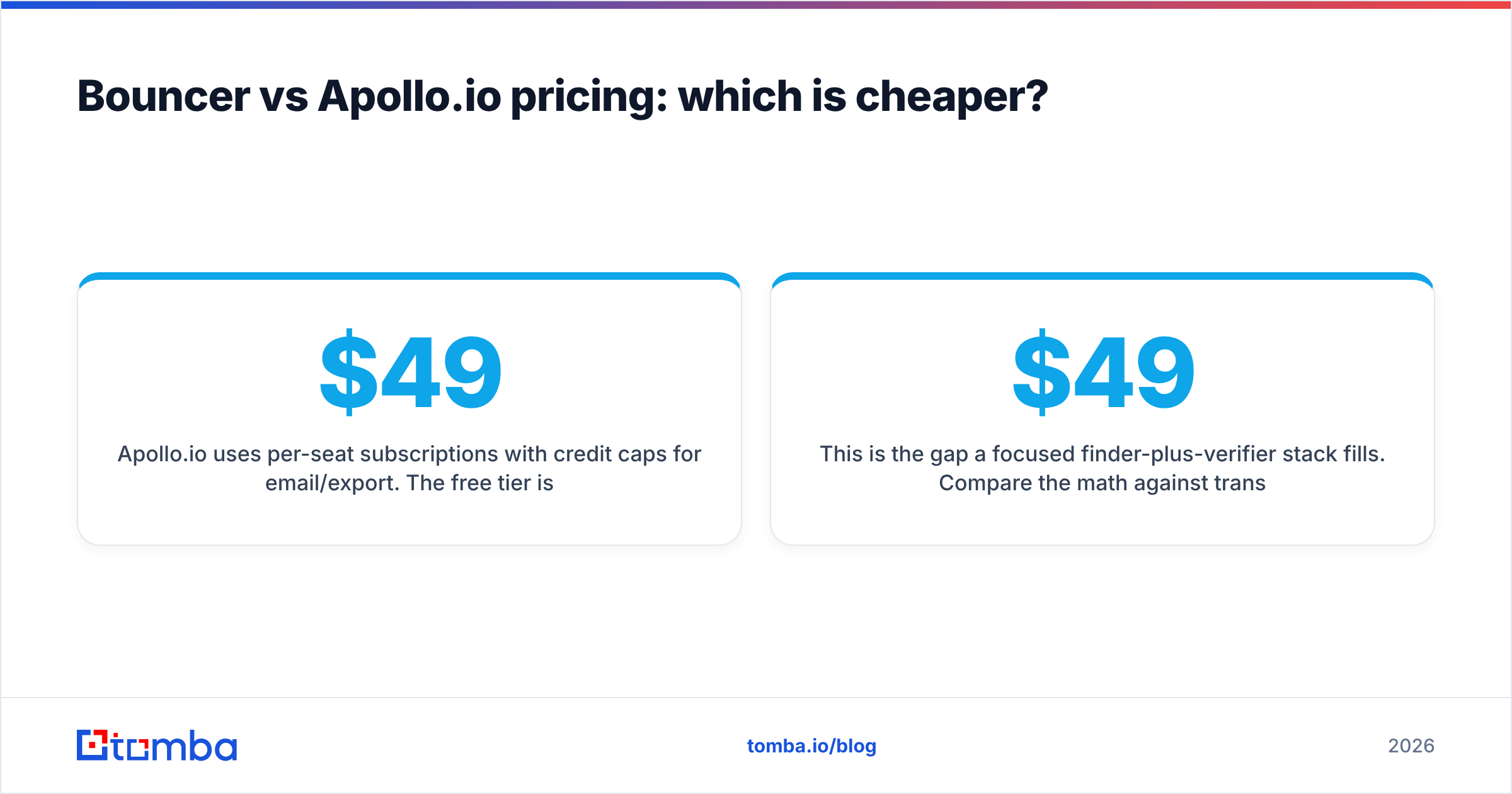
- Apollo.io uses per-seat subscriptions with credit caps for email/export. The free tier is generous for testing, but real usage pushes you to paid plans around $49/user/month and up. You are paying for the database and sequencing, not just verification.
If all you need is verification, paying for Apollo to get it is like buying a car for the cup holder. The reverse can also be true. If you need finding, enriching, and verifying, Apollo's bundle can be cheaper than stitching three vendors together. You just have to accept the accuracy trade-off.
This is the gap a focused finder-plus-verifier stack fills. Compare the math against transparent Tomba pricing: a Free tier (25 searches/mo), Starter at $49/mo, Growth at $99/mo, and Pro at $249/mo — billed per workspace, not per seat — so you get finding and verification without Apollo's seat tax or Bouncer's verify-only ceiling.
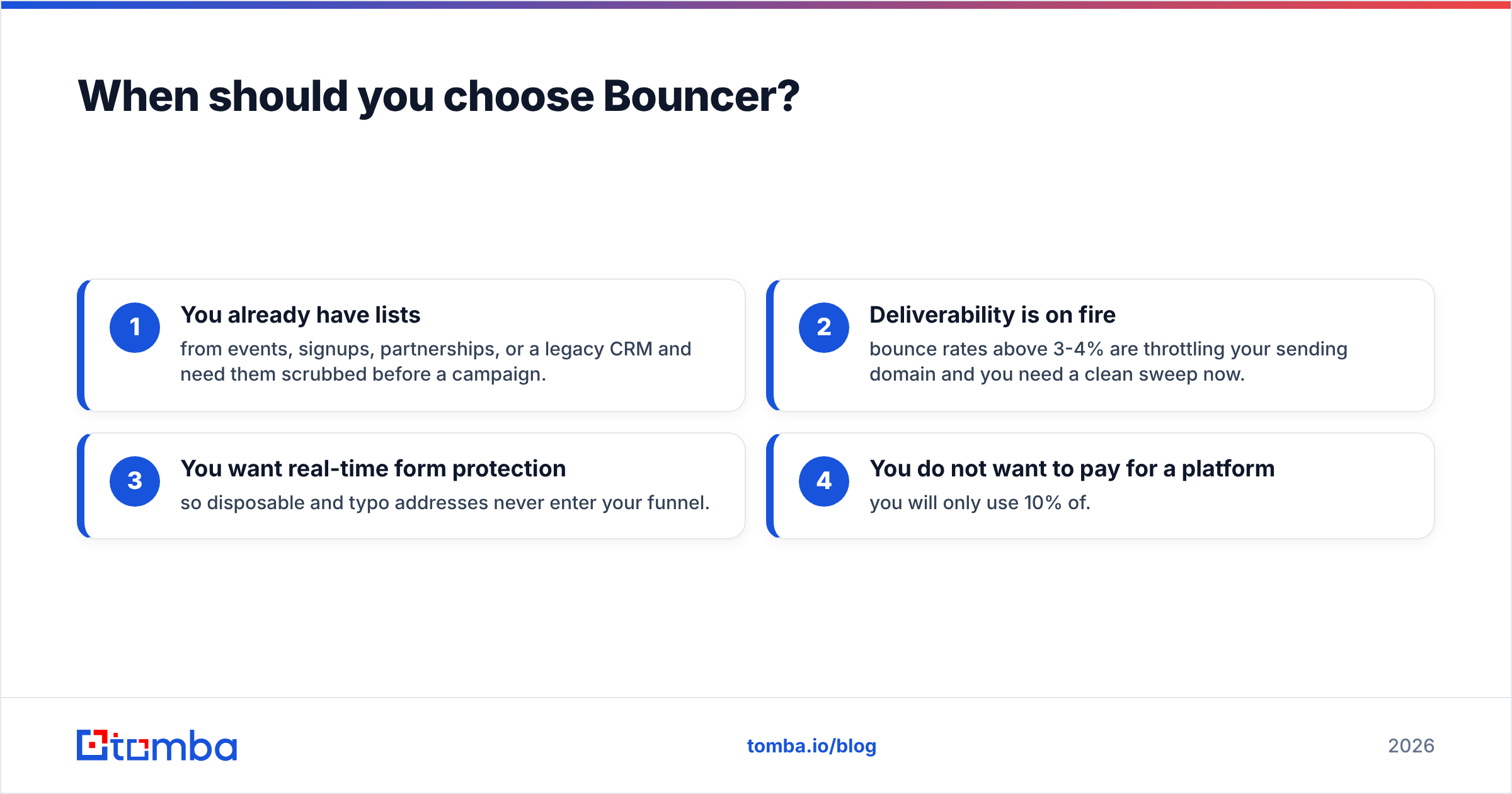
When should you choose Bouncer?#
Choose Bouncer when verification is the project. Specifically:
- You already have lists from events, signups, partnerships, or a legacy CRM and need them scrubbed before a campaign.
- Deliverability is on fire — bounce rates above 3-4% are throttling your sending domain and you need a clean sweep now.
- You want real-time form protection so disposable and typo addresses never enter your funnel.
- You do not want to pay for a platform you will only use 10% of.
Bouncer is the right call for marketers, ops teams, and developers who already have a sourcing tool they like. They simply need the verification layer to be excellent. If that is you, also evaluate dedicated email verification options side by side. The specialist category is competitive, and a quick test on your own list is the only benchmark that matters.
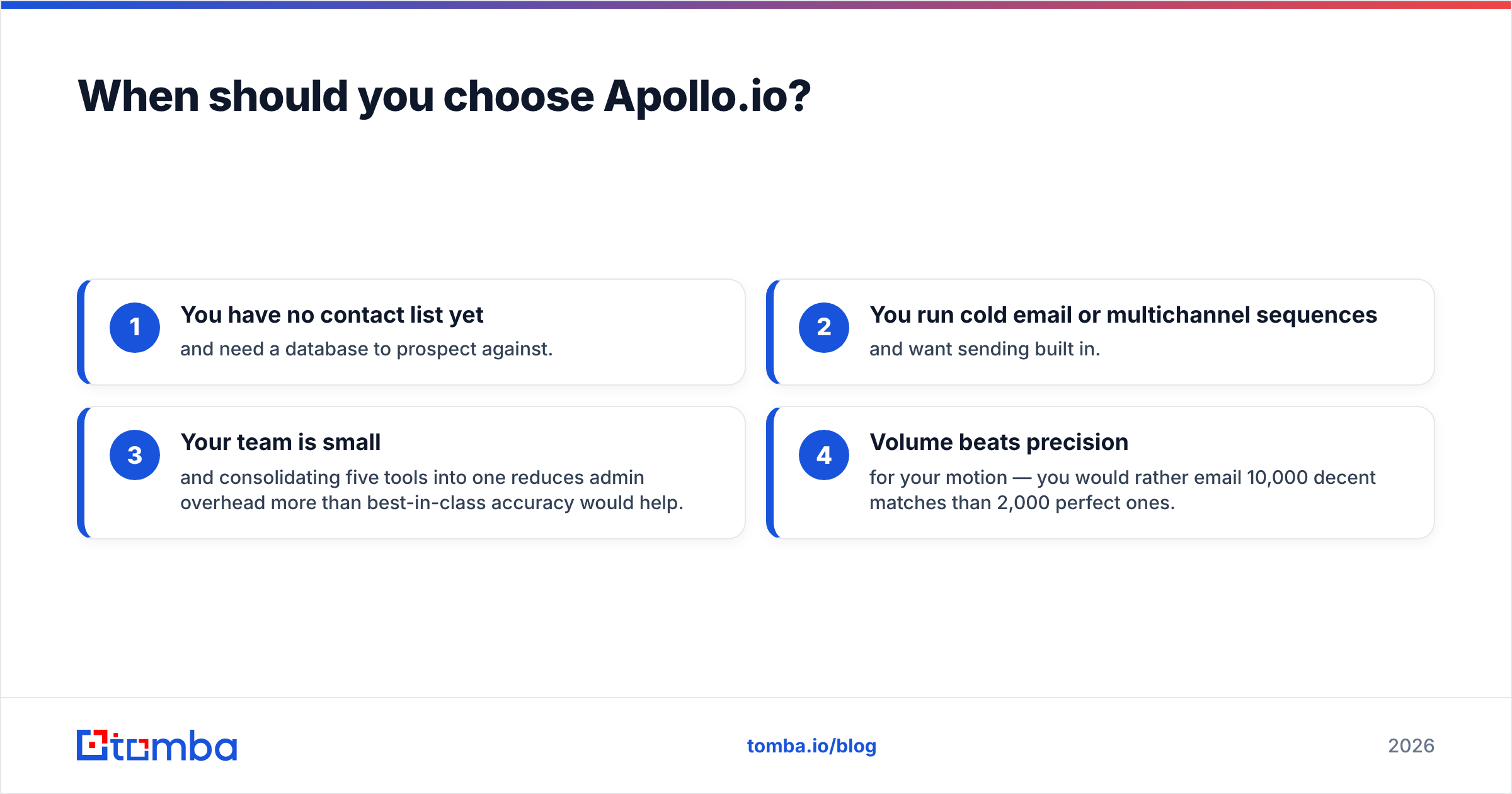
When should you choose Apollo.io?#
Choose Apollo when you are building outbound from a standing start and want fewer tools to manage:
- You have no contact list yet and need a database to prospect against.
- You run cold email or multichannel sequences and want sending built in.
- Your team is small and consolidating five tools into one reduces admin overhead more than best-in-class accuracy would help.
- Volume beats precision for your motion — you would rather email 10,000 decent matches than 2,000 perfect ones.
Apollo is a reasonable command center for an SMB sales team that values one login over peak performance in any single category. Just go in clear-eyed. You are trading depth for breadth. The verification and email-accuracy modules are the first places that trade shows up. If those gaps bite, an Apollo alternative focused on data quality is worth a look.
What's the smarter middle path for 2026?#
Conclusion first: most teams do not need the "one platform to rule them all." They need accurate finding and accurate verification, then their own sequencer of choice. That unbundled stack usually beats both Bouncer (which can't find) and Apollo (which finds imprecisely).
Think of it like a kitchen. Apollo is the all-in-one appliance that chops, blends, and cooks. It is convenient, but the blade is dull and the heat is uneven. Bouncer is a single, razor-sharp knife. The middle path is a small set of sharp tools that each do one job well and hand off cleanly to the next.
A practical 2026 stack looks like this:
- Find contacts with a high-accuracy email finder and domain search instead of a bloated database you pay per seat to access.
- Verify every address — including catch-alls — before it touches your sequencer, the job Bouncer does well and Tomba's verifier matches.
- Enrich records with firmographics and phone data via data enrichment so reps have context, not just an address.
- Send from whichever outreach tool you already trust, keeping your verification and finding layers vendor-independent.
The advantage of this approach is that no single vendor lock-in degrades the whole pipeline. If your finder weakens, you swap it without losing your sequences. If a better verifier appears, you switch without rebuilding outreach. Apollo's bundle makes that impossible. The unbundled stack makes it a config change.
Bouncer vs Apolloio: quick verdict table#
| If your situation is... | Pick |
|---|---|
| "My lists bounce, I just need them clean" | Bouncer |
| "I have no contacts and need to prospect + send" | Apollo.io |
| "I need accurate finding AND verification, minus the bloat" | Tomba stack |
| "I run high volume, precision is secondary" | Apollo.io |
| "I verify owned lists at scale, no sending" | Bouncer |
| "I want per-workspace pricing, not per-seat" | Tomba stack |
Frequently asked questions#
Is Bouncer an Apollo.io competitor? Only partially. They overlap on email verification, but Apollo also finds and sequences contacts while Bouncer does not. They compete head-to-head only on the verification feature.
Can Apollo.io replace a dedicated verifier like Bouncer? For low-stakes, high-volume sending, Apollo's built-in verification is usually fine. For deliverability-critical campaigns or large catch-all-heavy lists, a specialist verifier produces fewer surprises.
Which is cheaper, Bouncer or Apollo? For verification-only needs, Bouncer is far cheaper. For teams needing the full find-enrich-send workflow, Apollo's bundle can undercut buying separate tools — at the cost of per-module accuracy.
Do I need both? Some teams use Apollo to source and sequence, then run lists through a dedicated verifier before sending. That works, but it duplicates spend. A finder-plus-verifier stack often delivers the same outcome for less.
The bottom line#
Bouncer and Apollo.io are not rivals so much as tools for different chapters of the same story. Bouncer is the precise verifier you reach for when a list needs cleaning. Apollo is the broad platform you adopt when you are building outbound from nothing and value consolidation over peak accuracy.
But "specialist verifier" versus "shallow all-in-one" is a false binary. If you want finder-grade accuracy and verification you can trust — without paying a per-seat platform tax — start with the Tomba Email Finder. Pair it with the built-in verifier, run a free batch on your own data, and judge the accuracy against your real list. That single test will tell you more than any comparison table, this one included.
// get started
Find, verify and enrich your first contacts today
Start on the free plan with 25 searches a month, then scale when your team is ready.
Free plan · No credit card required · GDPR & CCPA
// about the author