Bounceremove vs Apollo.io 2026: Which Email Tool Wins?
Bounceremove cleans lists, Apollo.io builds them. See where each tool actually fits, what they cost, and the data-quality gaps you need to plan around in 2026.
Bounceremove vs Apollo.io: The 2026 Comparison
Choosing between Bounceremove and Apollo.io feels like a fair fight until you realize they answer two different questions. One asks "are these emails safe to send?" The other asks "where do I get the emails in the first place?" Picking wrong means you either pay for a database you don't need or scrub a list you never built.
This guide breaks down what each tool actually does, where the overlap is thin, what they cost in 2026, and which workflow each one fits. By the end you'll know whether you need one, both, or a third option that covers more ground for less.
TL;DR#
- Bounceremove is a verification tool. It checks whether existing email addresses are valid, risky, or dead. It does not find new contacts.
- Apollo.io is a prospecting platform. It's a B2B database plus sequencing, dialer, and CRM-lite features. Verification is a side feature, not the core.
- They barely compete. Most teams that "compare" them actually need a finder + verifier combo, not a database-vs-cleaner showdown.
- Pricing diverges hard. Bounceremove charges per verification credit; Apollo charges per seat per month with usage caps that bite at scale.
- A focused alternative like Tomba's email finder plus its built-in email verifier often replaces both at a lower combined cost.
What is Bounceremove?#
Bounceremove is a bulk email verification service. You upload a list, it pings mail servers, and it sorts each address into deliverable, undeliverable, risky, or unknown. The goal is simple: stop bounces before they wreck your sender reputation.
Verification matters because a single send to a stale list can spike your bounce rate above the 2% danger line, and once mailbox providers flag you, even your good emails land in spam. Think of verification like a bouncer at the door of your campaign — it turns away addresses that would cause a scene before they get inside.
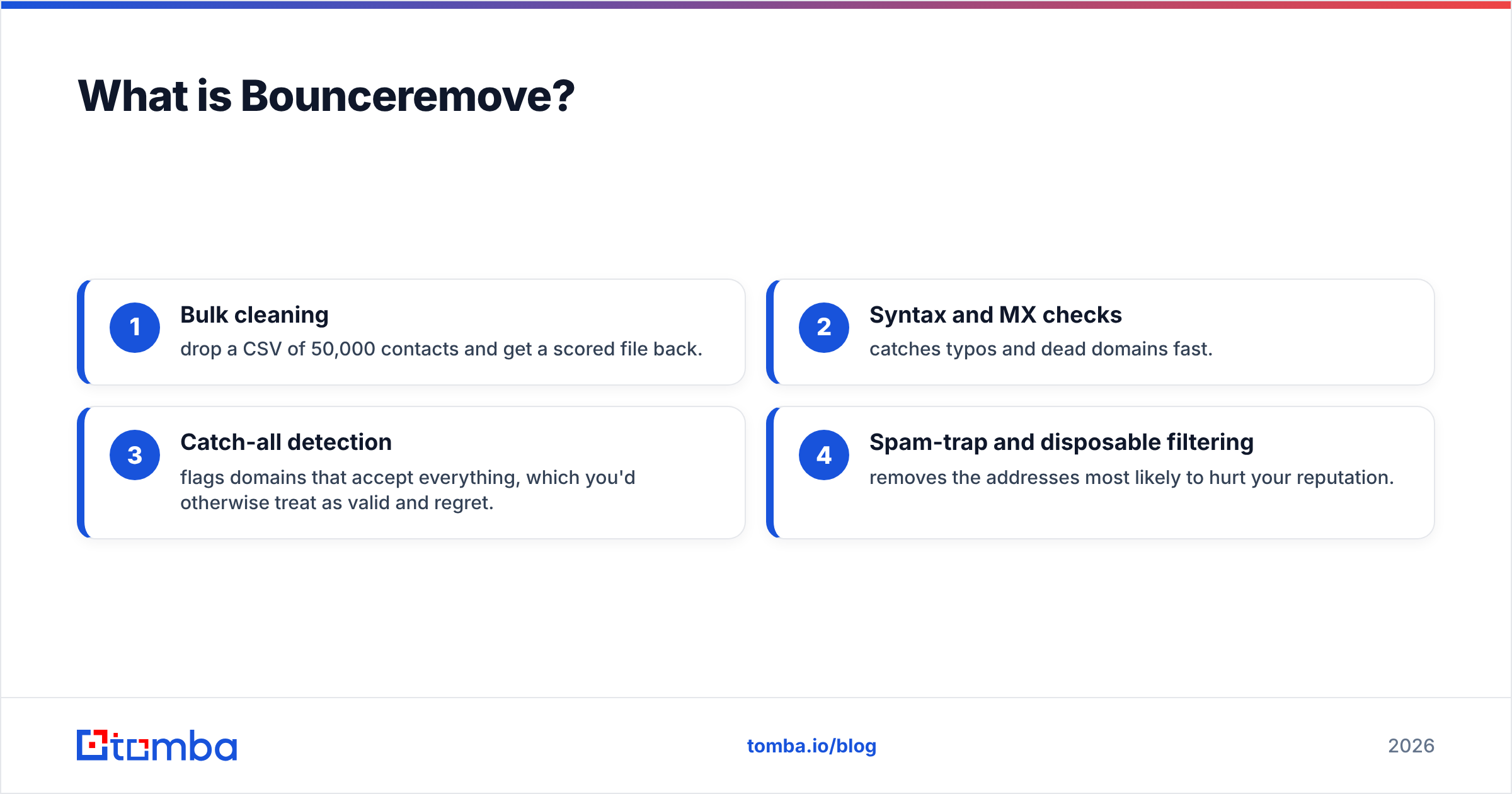
Bounceremove's strengths are narrow and real:
- Bulk cleaning — drop a CSV of 50,000 contacts and get a scored file back.
- Syntax and MX checks — catches typos and dead domains fast.
- Catch-all detection — flags domains that accept everything, which you'd otherwise treat as valid and regret.
- Spam-trap and disposable filtering — removes the addresses most likely to hurt your reputation.
What it does not do: find a single new email address. If your list is empty, Bounceremove has nothing to clean. That's the whole game — it's a finishing tool, not a sourcing tool.
What is Apollo.io?#
Apollo.io sits at the opposite end. It's a full go-to-market platform built around a contact database of hundreds of millions of B2B records, wrapped in prospecting filters, email sequences, a dialer, and lightweight CRM features.
You search by job title, company size, industry, technology stack, or intent signal, then export contacts or push them straight into a sequence. Apollo's pitch is "everything in one tab" — find the lead, enrich it, email it, call it, track it.
That breadth is the selling point and the catch. Apollo is genuinely useful for outbound teams that want a single subscription, but the all-in-one model means each individual piece — verification included — is good enough rather than best in class. Apollo does verify emails before you export them, but its verification is a gate on its own database, not a standalone service you'd point at an externally sourced list.
According to independent reviews on G2, users praise Apollo's data volume and sequencing but consistently flag data accuracy drift and aggressive usage limits on lower tiers. That's the trade-off of a database that wide: coverage is huge, but freshness varies by region and seniority.
Bounceremove vs Apollo.io: how do they actually compare?#
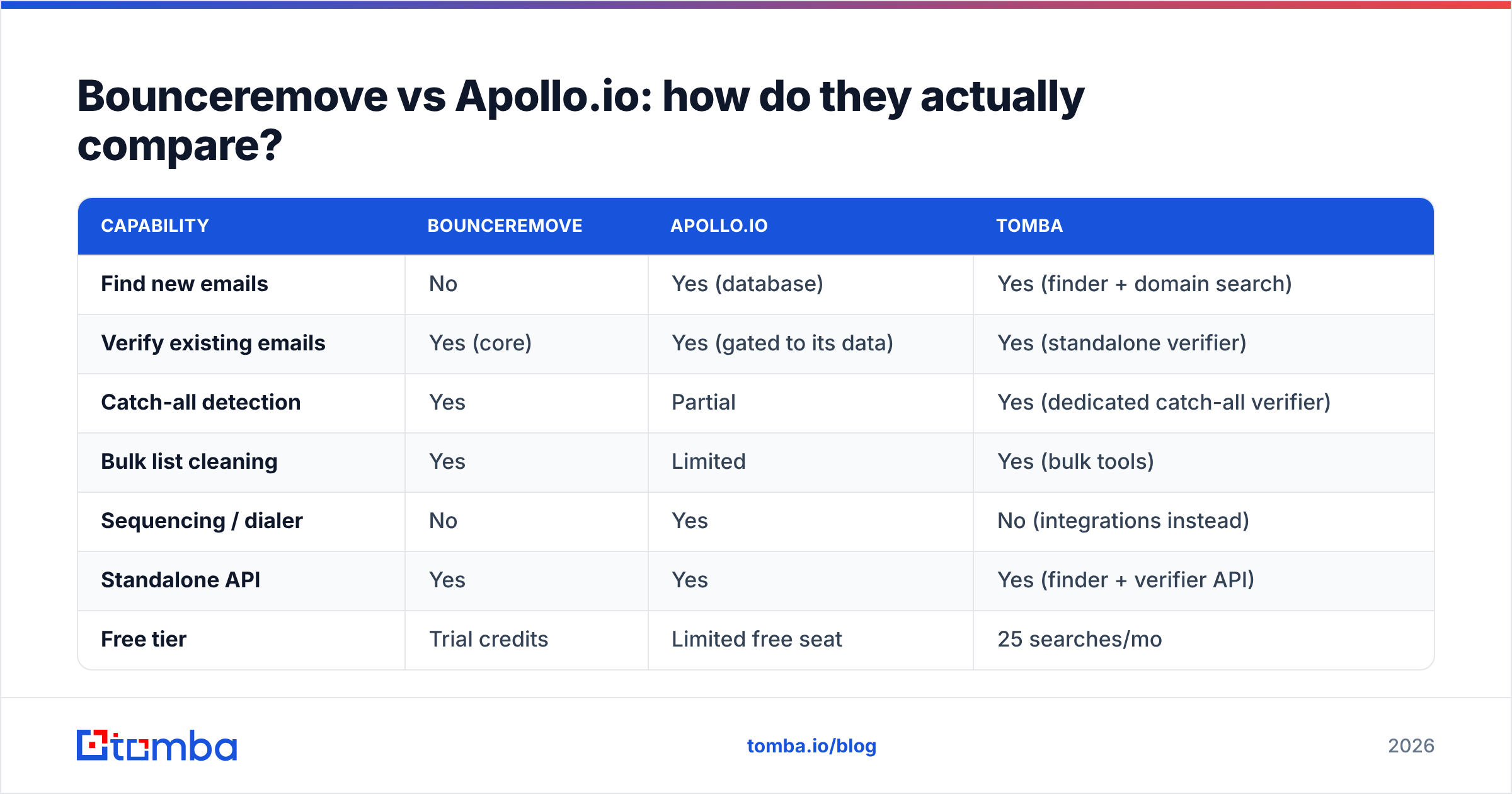
Here's the honest side-by-side. Notice how few rows are genuine head-to-head — most categories are "one tool only."
| Capability | Bounceremove | Apollo.io | Tomba |
|---|---|---|---|
| Find new emails | No | Yes (database) | Yes (finder + domain search) |
| Verify existing emails | Yes (core) | Yes (gated to its data) | Yes (standalone verifier) |
| Catch-all detection | Yes | Partial | Yes (dedicated catch-all verifier) |
| Bulk list cleaning | Yes | Limited | Yes (bulk tools) |
| Sequencing / dialer | No | Yes | No (integrations instead) |
| Standalone API | Yes | Yes | Yes (finder + verifier API) |
| Free tier | Trial credits | Limited free seat | 25 searches/mo |
| Pricing model | Per credit | Per seat/month | Per credit, from $49/mo |
The pattern is clear: Bounceremove and Apollo overlap on exactly one row — verification — and even there they target different inputs. Bounceremove verifies your list. Apollo verifies its list before you take it.

Is Apollo.io better than Bounceremove?#
Wrong question, but the answer is "for sourcing, yes — for cleaning a list you already own, no."
If you have zero contacts and need to build a pipeline, Bounceremove is useless to you and Apollo is a reasonable starting point. If you have a 200,000-row list from events, sign-ups, and partner data that you need to scrub before a big send, Apollo is overkill and Bounceremove is purpose-built.
The real-world friction shows up when teams try to use one tool for both jobs:
- Apollo for cleaning external lists — you can't, easily. Apollo verifies within its workflow, not as a general-purpose CSV scrubber.
- Bounceremove for finding leads — impossible. There's no database behind it.
So most buyers who frame this as "Bounceremove vs Apollo.io" end up buying both, or they look for a tool that does sourcing and verification in one place. That's where the comparison usually breaks open.
What does each tool cost in 2026?#
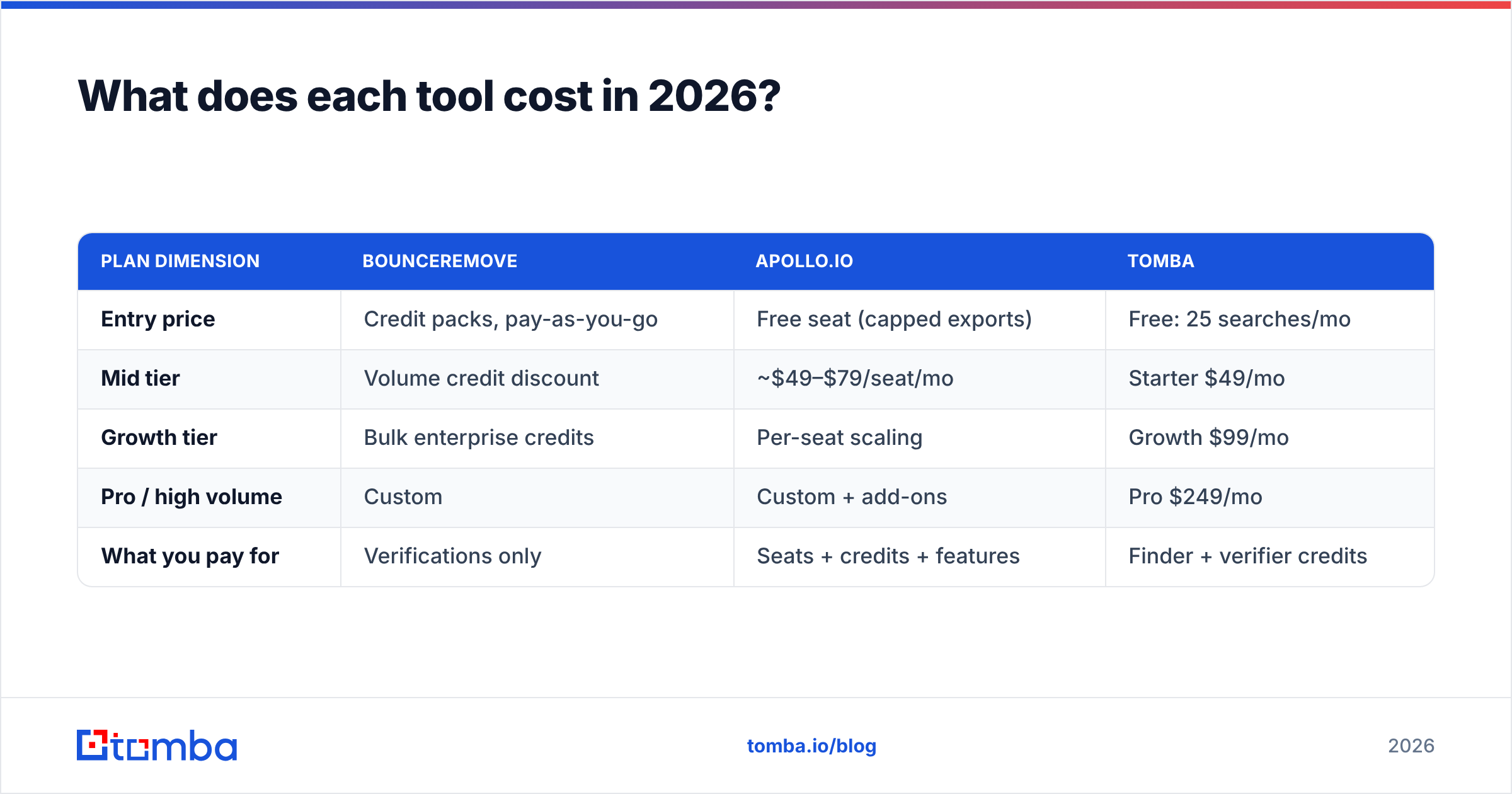
Pricing is where the two models stop pretending to compete.
Bounceremove uses a pay-per-verification credit model. You buy a pack, each address checked burns one credit, and unused credits typically roll until consumed. That's predictable for one-off list cleans but gets expensive if you verify continuously.
Apollo.io uses per-seat monthly pricing with credit caps layered on top. The free tier exists but throttles exports hard. Paid tiers unlock more email credits, sequences, and dialer minutes, but the moment your team grows or your export volume climbs, you hit ceiling charges.
| Plan dimension | Bounceremove | Apollo.io | Tomba |
|---|---|---|---|
| Entry price | Credit packs, pay-as-you-go | Free seat (capped exports) | Free: 25 searches/mo |
| Mid tier | Volume credit discount | ~$49–$79/seat/mo | Starter $49/mo |
| Growth tier | Bulk enterprise credits | Per-seat scaling | Growth $99/mo |
| Pro / high volume | Custom | Custom + add-ons | Pro $249/mo |
| What you pay for | Verifications only | Seats + credits + features | Finder + verifier credits |
A blunt takeaway: if you only verify, Bounceremove's credit model is clean. If you only prospect, Apollo's seat model is normal for the category. If you do both — which most outbound teams do — you're paying two bills. Compare that against a single combined plan; full Tomba pricing starts at $49/mo and bundles finding and verifying under one credit pool.
When should you use a finder-plus-verifier instead?#
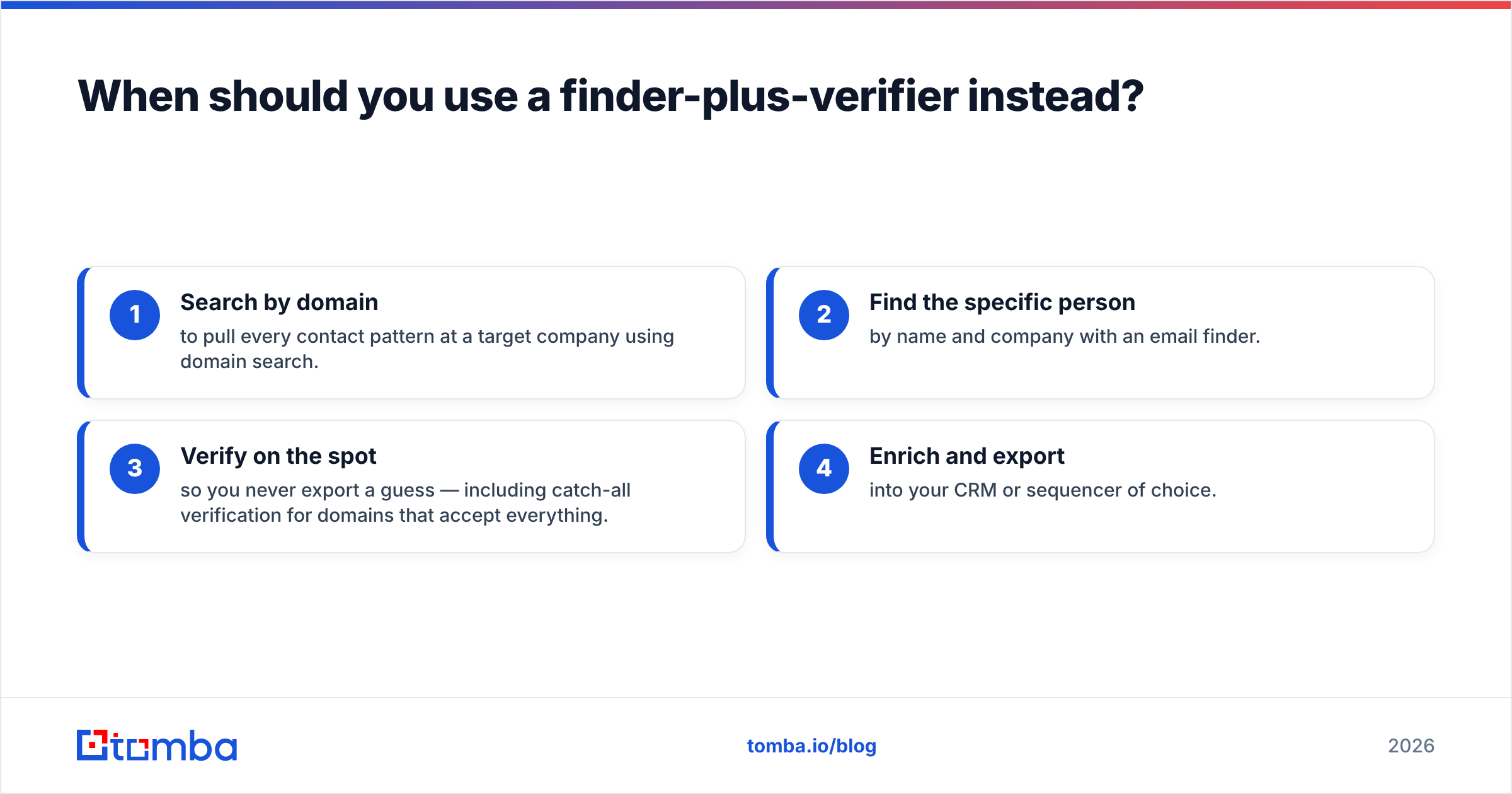
Use a combined tool when your workflow is "find the right person, confirm the email, send." That's the default motion for most B2B outbound, and splitting it across a prospecting platform and a separate cleaner adds cost and handoff friction.
A finder-plus-verifier approach looks like this in practice:
- Search by domain to pull every contact pattern at a target company using domain search.
- Find the specific person by name and company with an email finder.
- Verify on the spot so you never export a guess — including catch-all verification for domains that accept everything.
- Enrich and export into your CRM or sequencer of choice.
This is why a lot of teams evaluating Apollo end up on an Apollo alternative shortlist — they want Apollo's finding ability without the seat-based pricing and without bolting on a separate verifier like Bounceremove.
Which tool fits which team?#
Match the tool to the job, not the brand:
- You have a big, messy list to clean before one campaign → Bounceremove. Buy credits, scrub, move on. No subscription guilt.
- You're a full outbound team that lives in sequences and dials → Apollo.io, if you can stomach the seat costs and accept variable data freshness.
- You source and verify continuously and hate paying two vendors → a combined finder + verifier. You get the sourcing Apollo offers and the verification Bounceremove offers, under one roof.
The deciding factor is almost always volume and frequency. One-time clean? Bounceremove. Heavy all-in-one outbound with budget for seats? Apollo. Ongoing find-and-verify at a controlled cost? A unified tool wins on both price and workflow.
One more practical note on deliverability: verification is necessary but not sufficient. Even a perfectly clean list bounces if your sending domain isn't warmed and authenticated. Whichever tool you pick, pair it with proper email deliverability hygiene — SPF, DKIM, gradual ramp — or your scrubbed list still lands in spam. HubSpot's own email deliverability guidance is a solid free primer if you're setting this up.
Bounceremove vs Apollo.io: the verdict#
Neither tool is "better" because they're solving different problems. Bounceremove is a sharp, single-purpose verifier. Apollo.io is a broad prospecting platform where verification is one feature among many. If you forced a one-line answer: Apollo finds, Bounceremove cleans, and neither does the other's job well.
That's exactly why the smartest move for most teams isn't picking between them — it's questioning the framing. If your real need is "find verified B2B emails without paying two vendors or a per-seat tax," a focused finder with built-in verification covers the whole loop. You source like Apollo and clean like Bounceremove, with one credit pool and no handoff.
That's the gap Tomba's Email Finder is built to fill: find professional email addresses by domain, name, or company, verify them in the same pass, and start free with 25 searches a month before you commit to a $49/mo plan. Try the find-and-verify workflow on your next target account list and see how much of your current stack it replaces.
// get started
Find, verify and enrich your first contacts today
Start on the free plan with 25 searches a month, then scale when your team is ready.
Free plan · No credit card required · GDPR & CCPA
// about the author