Bounceremove vs Lead411: Best B2B Data Tool in 2026
Bounceremove cleans your list, Lead411 builds it. Here's a no-spin breakdown of accuracy, pricing, and which tool your pipeline actually needs in 2026 — plus a sharper third option.
Bounceremove vs Lead411: Which B2B Data Tool Wins in 2026?
Picking between Bounceremove and Lead411 feels harder than it should, because the two tools barely play the same sport. One scrubs the list you already have. The other hands you a fresh one. If you buy the wrong one, you either pay for contacts you can't email or clean a list that doesn't exist yet.
This breakdown cuts through the marketing copy on both sites and tells you which tool fits which job — and where a combined finder-plus-verifier setup beats either on its own.
TL;DR#
- Bounceremove is an email verification tool. It takes a list you already own and flags invalid, risky, and catch-all addresses before you send.
- Lead411 is a B2B data platform. It gives you contacts, emails, phone numbers, and intent signals to build a prospecting list from scratch.
- They solve different halves of the same problem — sourcing vs. cleaning — so "which is better" depends entirely on what you're missing.
- On pure cost-per-contact, dedicated finders and verifiers undercut Lead411's seat-based pricing for most small teams.
- If you want both finding and verification in one workflow, a focused tool like Tomba Email Finder plus a built-in email verifier covers the whole loop without two contracts.
What is Bounceremove?#
Bounceremove is an email validation service. You upload a list — CSV, paste, or API — and it runs each address through syntax checks, MX-record lookups, SMTP pings, and catch-all detection. The output sorts your contacts into deliverable, undeliverable, risky, and unknown buckets.
Think of it like a metal detector at airport security. It doesn't bring travelers to the airport; it just stops the dangerous ones from boarding. Bounceremove never finds a new contact — it only tells you whether the contacts you already collected are safe to email.
That makes it a deliverability tool first. Its whole reason to exist is protecting your sender reputation and keeping your bounce rate under the 2-3% threshold that mailbox providers punish. If your list is dirty, Bounceremove earns its keep fast.
What is Lead411?#
Lead411 is a sales intelligence and B2B contact database. You search by company, title, industry, location, or technology, and it returns verified emails, direct-dial phone numbers, and company data. It layers in intent data and growth-trigger alerts — funding rounds, hiring spikes, new executives — so reps can time outreach.
In the airport analogy, Lead411 is the travel agent. It finds you passengers (prospects), books their seats (contact details), and tells you who's most likely to fly soon (intent). Verification is a side feature, not the main event.
Lead411 competes with Apollo, ZoomInfo, and Seamless.AI. It's built for outbound teams that need volume and freshness in their pipeline, not for cleaning a list someone else built.
Bounceremove vs Lead411: How do they actually differ?#
The core split is sourcing versus cleaning. Here's the structured breakdown:
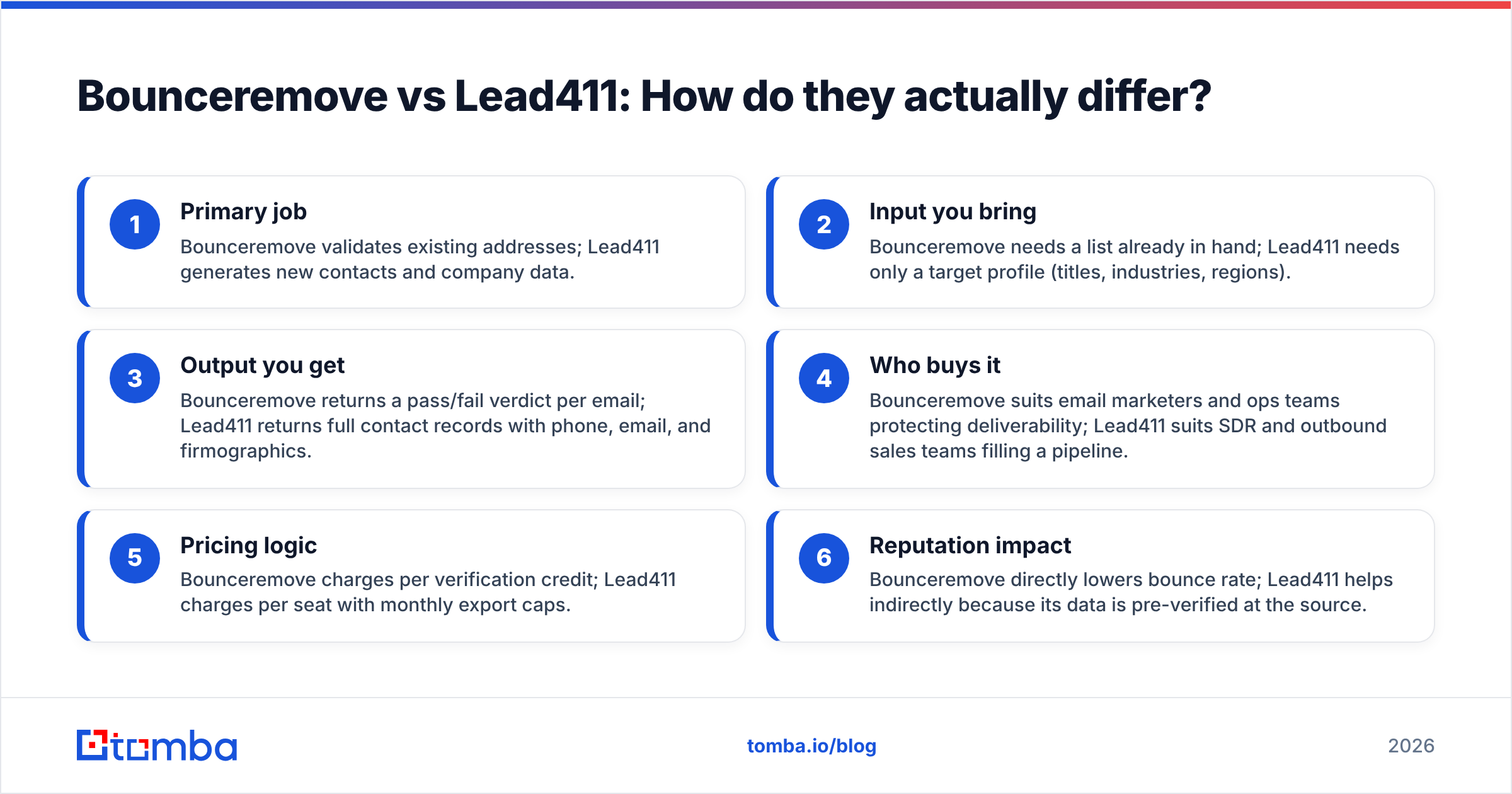
- Primary job — Bounceremove validates existing addresses; Lead411 generates new contacts and company data.
- Input you bring — Bounceremove needs a list already in hand; Lead411 needs only a target profile (titles, industries, regions).
- Output you get — Bounceremove returns a pass/fail verdict per email; Lead411 returns full contact records with phone, email, and firmographics.
- Who buys it — Bounceremove suits email marketers and ops teams protecting deliverability; Lead411 suits SDR and outbound sales teams filling a pipeline.
- Pricing logic — Bounceremove charges per verification credit; Lead411 charges per seat with monthly export caps.
- Reputation impact — Bounceremove directly lowers bounce rate; Lead411 helps indirectly because its data is pre-verified at the source.

How accurate is each tool?#
Accuracy means two different things here, which is why a single leaderboard misleads. For Bounceremove, accuracy is how reliably it predicts a bounce. For Lead411, accuracy is how current and correct the contact record is the moment you export it.
Email data decays fast — industry estimates put B2B contact churn at roughly 2-3% per month as people change jobs, which compounds to over 25% a year. That means even a "verified" Lead411 record can rot before you send, and a verifier like Bounceremove is what catches the rot. The two functions reinforce each other; neither fully replaces the other.
If your real concern is end-to-end accuracy — finding the right address and confirming it's live — a dedicated finder built on multiple data sources tends to beat a generalist database's bolt-on verification. The chart below frames how purpose-built email tools stack up on hit rate.

The takeaway: a tool that specializes in one job usually outperforms a suite that treats that job as a feature. Lead411's verification is convenient; it isn't its differentiator. Bounceremove's verification is its product, which is why it tends to score better on pure validation — but it can't help you when your list is empty.
Bounceremove vs Lead411: Pricing and features compared#
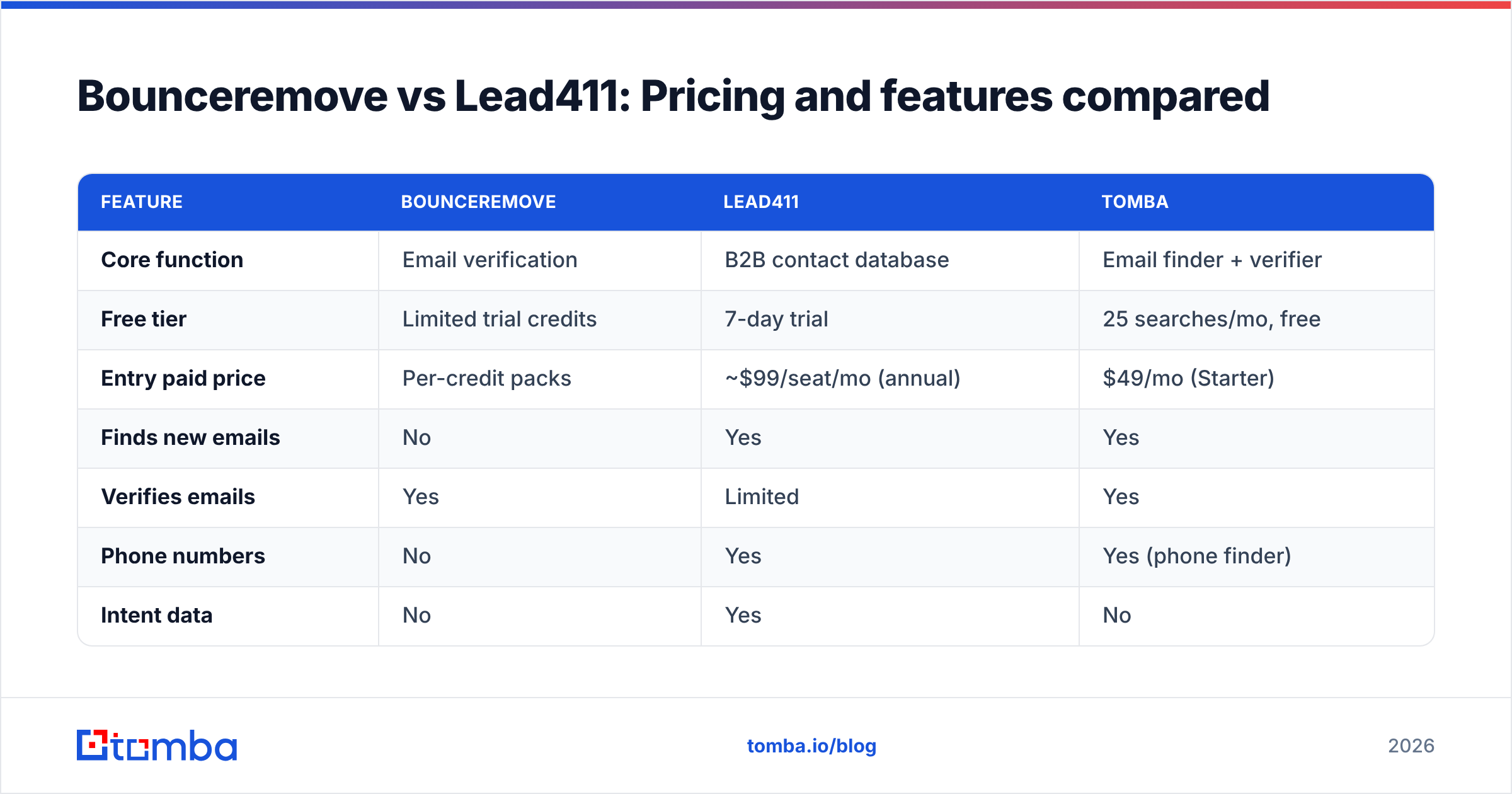
Pricing models don't line up cleanly because one sells credits and the other sells seats. The table normalizes the comparison and adds Tomba as a finder-plus-verifier reference point.
| Feature | Bounceremove | Lead411 | Tomba |
|---|---|---|---|
| Core function | Email verification | B2B contact database | Email finder + verifier |
| Free tier | Limited trial credits | 7-day trial | 25 searches/mo, free |
| Entry paid price | Per-credit packs | ~$99/seat/mo (annual) | $49/mo (Starter) |
| Finds new emails | No | Yes | Yes |
| Verifies emails | Yes | Limited | Yes |
| Phone numbers | No | Yes | Yes (phone finder) |
| Intent data | No | Yes | No |
| Catch-all detection | Yes | Partial | Yes |
| Bulk processing | Yes | Yes (export caps) | Yes (bulk finder) |
| API access | Yes | Yes | Yes |
Two things jump out. First, Bounceremove can't build a list, so on its own it's only half a stack. Second, Lead411's per-seat pricing gets expensive for small teams who don't need intent data or daily refreshes — you're paying for a sales-intelligence engine when you might only need clean emails. You can compare that against transparent Tomba pricing where the Starter plan is $49/mo and credits aren't locked behind a per-seat license.

For a deeper look at how these tools source their records, Lead411's own data overview and third-party reviews on G2 are worth scanning before you commit to an annual seat.
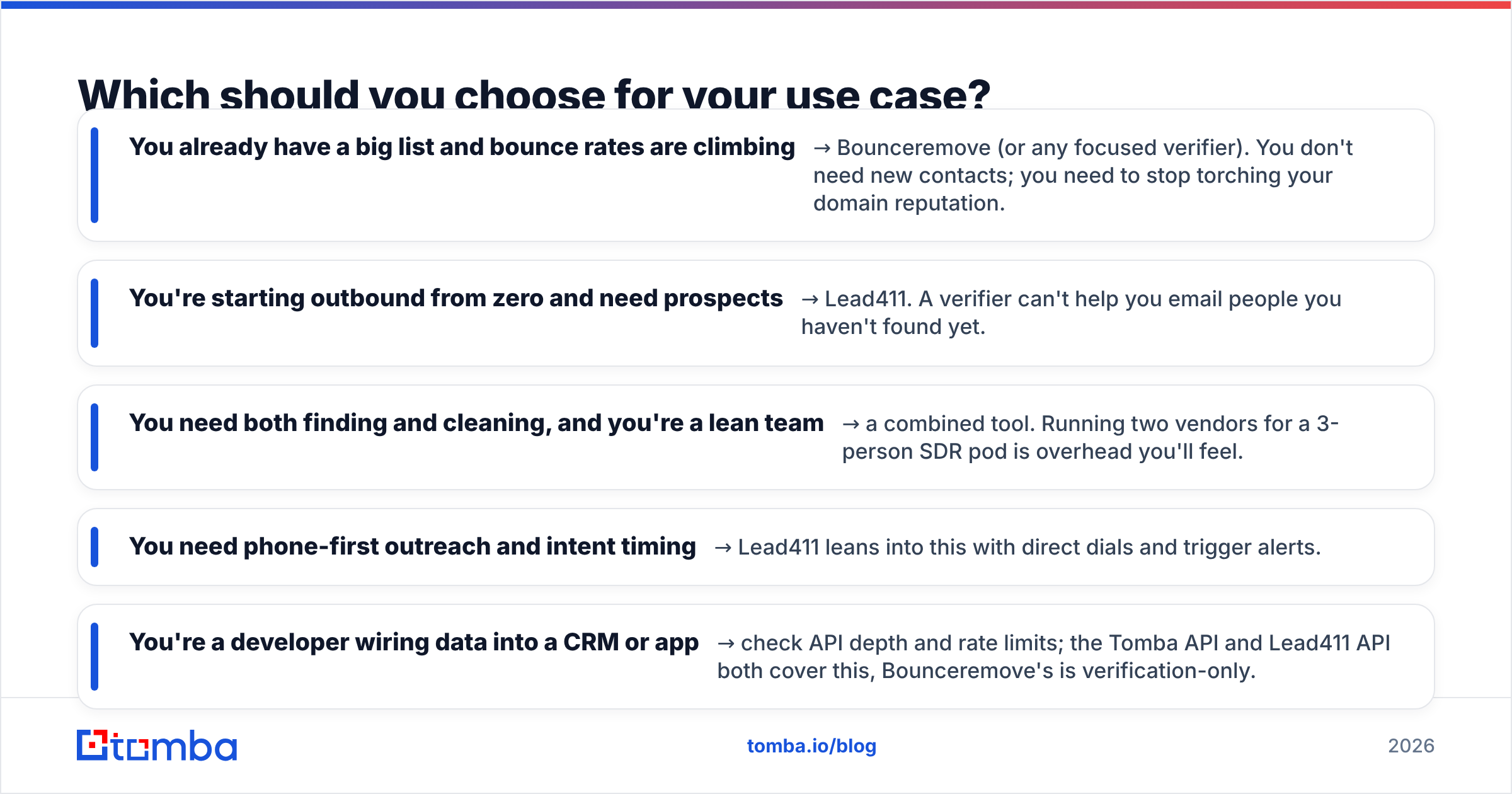
Which should you choose for your use case?#
Match the tool to the gap in your workflow, not to the louder homepage.
- You already have a big list and bounce rates are climbing → Bounceremove (or any focused verifier). You don't need new contacts; you need to stop torching your domain reputation.
- You're starting outbound from zero and need prospects → Lead411. A verifier can't help you email people you haven't found yet.
- You need both finding and cleaning, and you're a lean team → a combined tool. Running two vendors for a 3-person SDR pod is overhead you'll feel.
- You need phone-first outreach and intent timing → Lead411 leans into this with direct dials and trigger alerts.
- You're a developer wiring data into a CRM or app → check API depth and rate limits; the Tomba API and Lead411 API both cover this, Bounceremove's is verification-only.
The honest answer for many teams is "neither alone." If you buy Lead411 you'll still want a verification step at send time. If you buy Bounceremove you'll still need a source for the addresses. That two-tool reality is exactly the gap a unified finder closes.
What's the smarter all-in-one alternative?#
If you'd rather not run two subscriptions, a focused email-intelligence tool handles both ends of the loop. Tomba finds professional addresses by name, company, or domain search, then verifies them in the same workflow — including catch-all handling, which trips up a lot of generic databases.
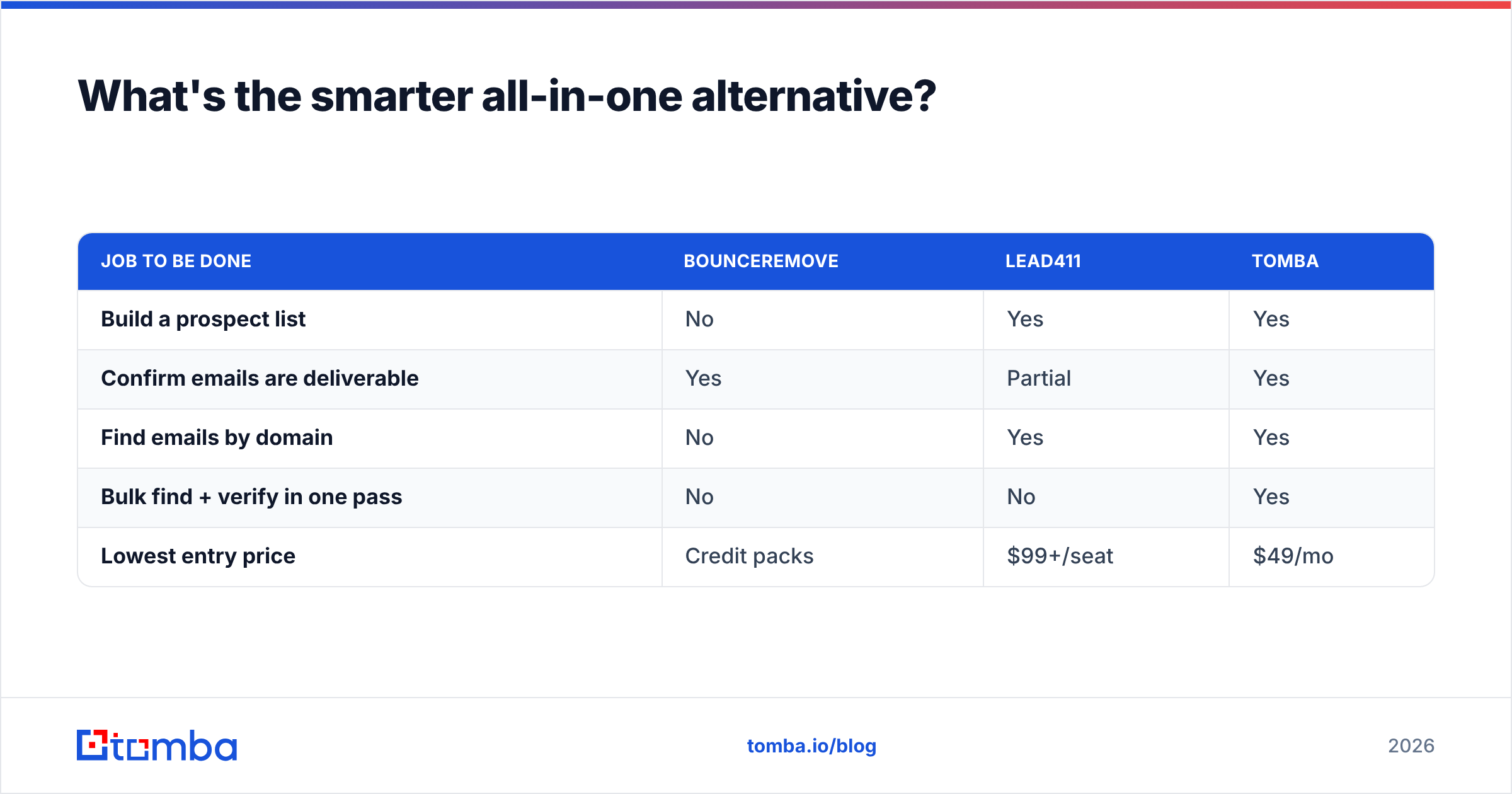
Here's how the combined approach maps to what Bounceremove and Lead411 each do separately:
| Job to be done | Bounceremove | Lead411 | Tomba |
|---|---|---|---|
| Build a prospect list | No | Yes | Yes |
| Confirm emails are deliverable | Yes | Partial | Yes |
| Find emails by domain | No | Yes | Yes |
| Bulk find + verify in one pass | No | No | Yes |
| Lowest entry price | Credit packs | $99+/seat | $49/mo |
For teams running real volume, the bulk email finder lets you upload a company list and get verified contacts back in one job, instead of exporting from one tool and validating in another. That's the practical win: fewer handoffs, one credit pool, one place to audit data quality.
How do you keep any list clean over time?#
Whichever tool you pick, list hygiene is a recurring chore, not a one-time fix. Three habits keep deliverability healthy:
- Re-verify before every major send. Records you validated last quarter may have churned. A quick email verification pass before a campaign catches new bounces.
- Segment risky and catch-all addresses. Don't blast them with your main domain — warm them separately or skip them.
- Track bounce rate per send. If it creeps above 3%, stop and clean before mailbox providers throttle you.
Lead411 keeps records fresh at the source, which helps, but it doesn't substitute for a verification gate right before you hit send. Bounceremove gives you that gate but nothing to put through it. The combined-tool path simply removes the seam between those two steps.
The verdict#
Bounceremove and Lead411 aren't really rivals — they're two-thirds of a stack you'd otherwise have to assemble. Bounceremove wins if your only problem is a dirty list. Lead411 wins if your only problem is an empty pipeline and you need intent timing on top. But most teams have both problems, and paying two vendors to solve them is where the math turns ugly.
If you want one workflow that finds verified B2B emails by name, company, or domain — and confirms they're deliverable before you send — start free with the Tomba Email Finder. The free tier gives you 25 searches a month to test accuracy against your own target accounts, and the $49/mo Starter plan covers finding and verification without a per-seat contract. Find it, verify it, send it — in one place.
// get started
Find, verify and enrich your first contacts today
Start on the free plan with 25 searches a month, then scale when your team is ready.
Free plan · No credit card required · GDPR & CCPA
// about the author