Bounceremove vs Tami AI: Email Verification Compared 2026
Bounceremove vs Tami AI, head to head: accuracy, pricing, catch-all handling, and speed. See which email verifier protects your sender reputation in 2026 — and where a third option wins.
You collected 8,000 emails, loaded them into your sequencer, and watched 14% bounce on day one. Your domain reputation took the hit, and now even your good prospects land in spam. That is the problem email verification tools exist to solve — and Bounceremove and Tami AI are two of the names you will run into when you start shopping. This guide compares them honestly, then shows where a more complete platform fits.
TL;DR — Bounceremove vs Tami AI in one screen#
- Bounceremove is a no-frills, pay-as-you-go bounce remover built around bulk list cleaning. It is cheap and fast, but thin on enrichment, API depth, and catch-all handling.
- Tami AI leans on AI-assisted validation and a friendlier dashboard. It markets higher "deliverable" rates, but real-world accuracy depends heavily on how it scores risky and catch-all domains.
- Both verify lists you already own — neither is built to find the emails in the first place.
- If you need finding + verifying + enrichment in one workflow, a platform like Tomba covers the whole pipeline instead of just the cleanup step.
- Bottom line: for pure list scrubbing on a budget, either works. For accuracy you can defend and a single source of truth, the standalone scrubbers fall short.

What do Bounceremove and Tami AI actually do?#
Think of email verification like airport security for your contact list. Before a message boards your sending infrastructure, the verifier checks each address for a valid "ticket" — correct syntax, a real mailbox, a responsive mail server — and pulls anyone who would bounce out of line. A bounce is not just a wasted send; mailbox providers read high bounce rates as a spam signal, so a dirty list quietly poisons every future campaign.
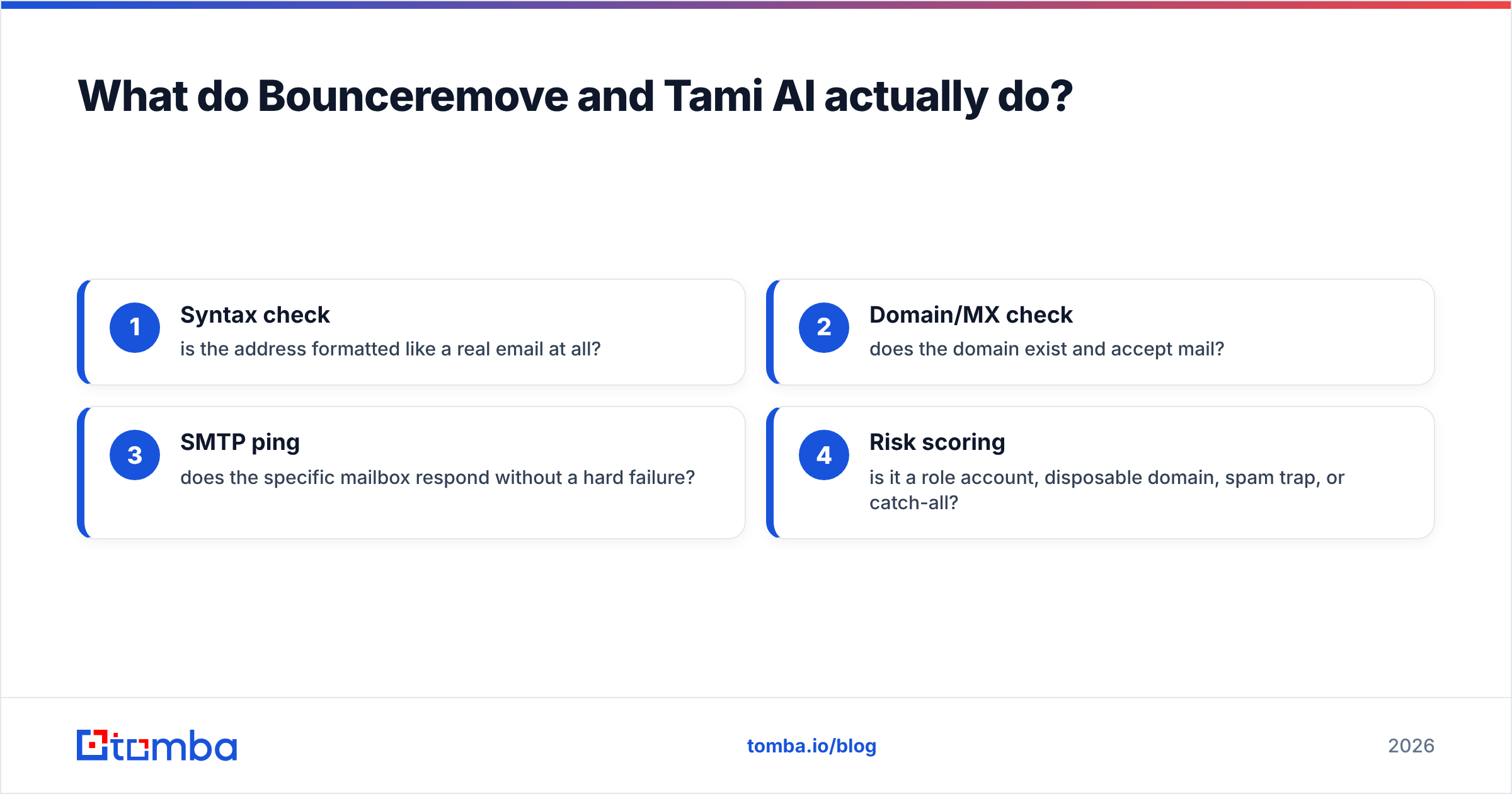
Both tools run the same core sequence:
- Syntax check — is the address formatted like a real email at all?
- Domain/MX check — does the domain exist and accept mail?
- SMTP ping — does the specific mailbox respond without a hard failure?
- Risk scoring — is it a role account, disposable domain, spam trap, or catch-all?
Where they differ is in step 4, in how they handle catch-all domains (servers that accept everything, so you cannot confirm a single mailbox), and in everything around verification — pricing model, API, integrations, and whether they help you build the list in the first place.
How do Bounceremove and Tami AI compare on features?#
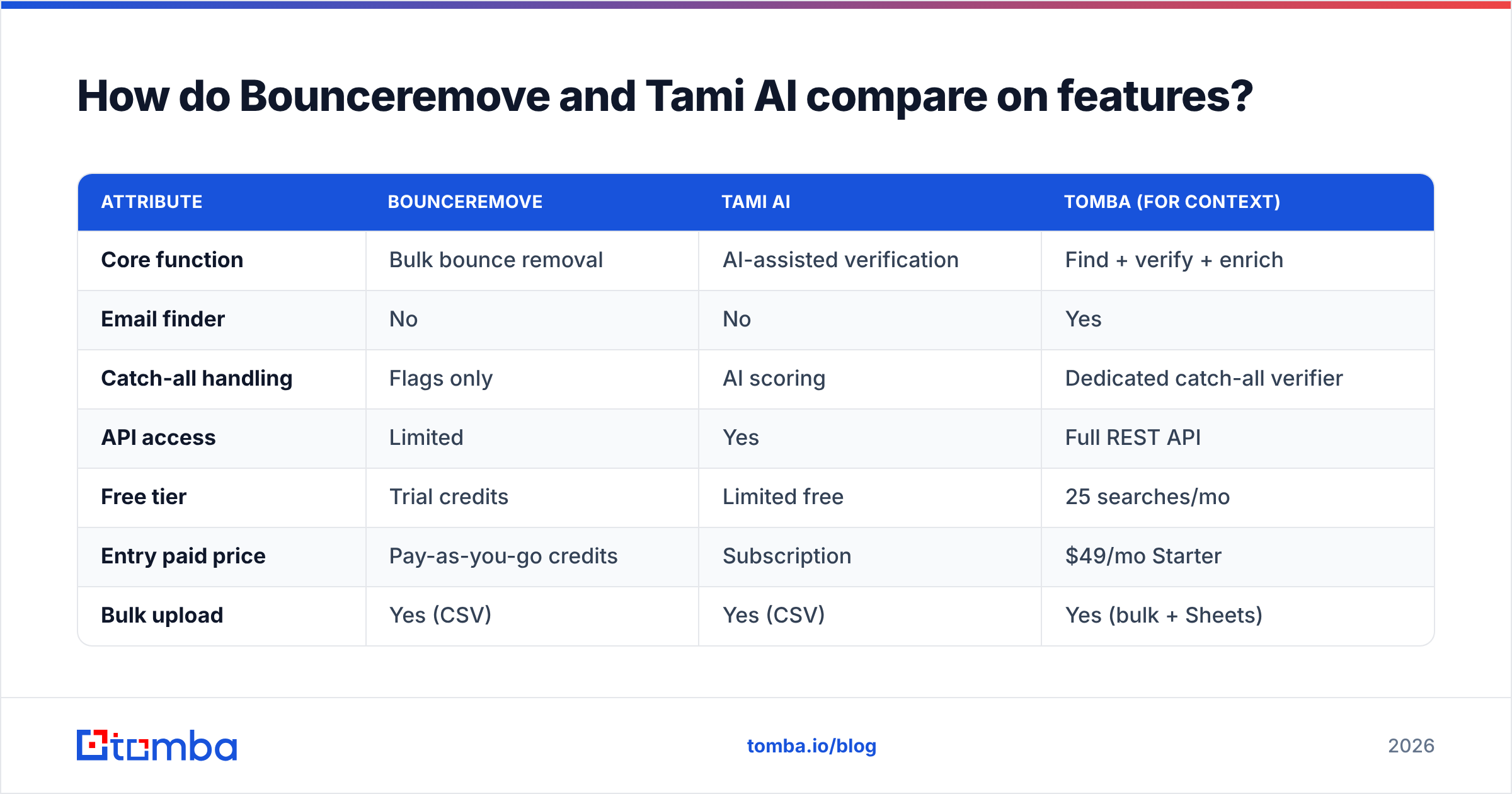
Here is the side-by-side. Treat third-party "accuracy" claims as marketing until you test them on your own list — every vendor benchmarks on data that flatters them.
| Attribute | Bounceremove | Tami AI | Tomba (for context) |
|---|---|---|---|
| Core function | Bulk bounce removal | AI-assisted verification | Find + verify + enrich |
| Email finder | No | No | Yes |
| Catch-all handling | Flags only | AI scoring | Dedicated catch-all verifier |
| API access | Limited | Yes | Full REST API |
| Free tier | Trial credits | Limited free | 25 searches/mo |
| Entry paid price | Pay-as-you-go credits | Subscription | $49/mo Starter |
| Bulk upload | Yes (CSV) | Yes (CSV) | Yes (bulk + Sheets) |
| Enrichment | No | Minimal | Company + contact data |
| Native CRM integrations | Few | Some | HubSpot, Salesforce, Pipedrive |
The pattern is clear: both Bounceremove and Tami AI are point solutions. They clean a list you bring them and stop there. That is fine if cleanup is genuinely all you need — but most teams are verifying because they are about to run outbound, and the finding, enrichment, and CRM-sync steps live in other tools they now have to stitch together.
Is Bounceremove or Tami AI more accurate?#
Accuracy comes down to three things, and you should pressure-test all three before you commit a budget:
- Hard-bounce catch rate. What percentage of truly dead addresses does it flag as undeliverable? This is the number that protects your sender reputation. Anything below ~97% on a known dirty list is a red flag.
- False-positive rate. How many good addresses does it wrongly mark as invalid? A tool that "cleans" aggressively can quietly delete reachable buyers. This number is the one vendors rarely publish.
- Catch-all resolution. Catch-all domains are the hard part. A weak verifier dumps them all into "unknown" and leaves you guessing; a strong one uses pattern data and historical signals to score them.
Bounceremove tends to be conservative and binary — valid, invalid, or unknown — which keeps false positives low but leaves a large "unknown" pile on catch-all-heavy B2B lists. Tami AI markets its AI scoring as the differentiator on exactly those risky addresses, which can shrink the unknown bucket, but AI scoring also introduces the risk of confident-but-wrong calls. Neither approach is automatically "better"; it depends on whether you would rather over-cut or over-keep.
This is where a catch-all verifier purpose-built for ambiguous domains earns its place. Instead of a single AI guess or a flat "unknown," it cross-references mailbox patterns and known-good data so a larger share of catch-all addresses resolve to an actual verdict you can act on.
Run your own 1,000-row sample through any tool before buying. Vendor accuracy charts are calibrated on vendor-friendly data; your list is the only benchmark that pays your bills.
How do Bounceremove and Tami AI price?#
Pricing model matters as much as the sticker number, because verification volume is spiky — you scrub a big list, then go quiet for weeks.
- Bounceremove uses a pay-as-you-go credit model. You buy a block of verifications and burn them down. Good for occasional, lumpy cleaning. Bad if you want predictable monthly tooling, since there is little bundled beyond verification itself.
- Tami AI leans toward subscription tiers. Better for steady, recurring verification, and you usually get API access and a nicer dashboard. Worse if your usage is genuinely sporadic and you would rather not pay a monthly minimum.
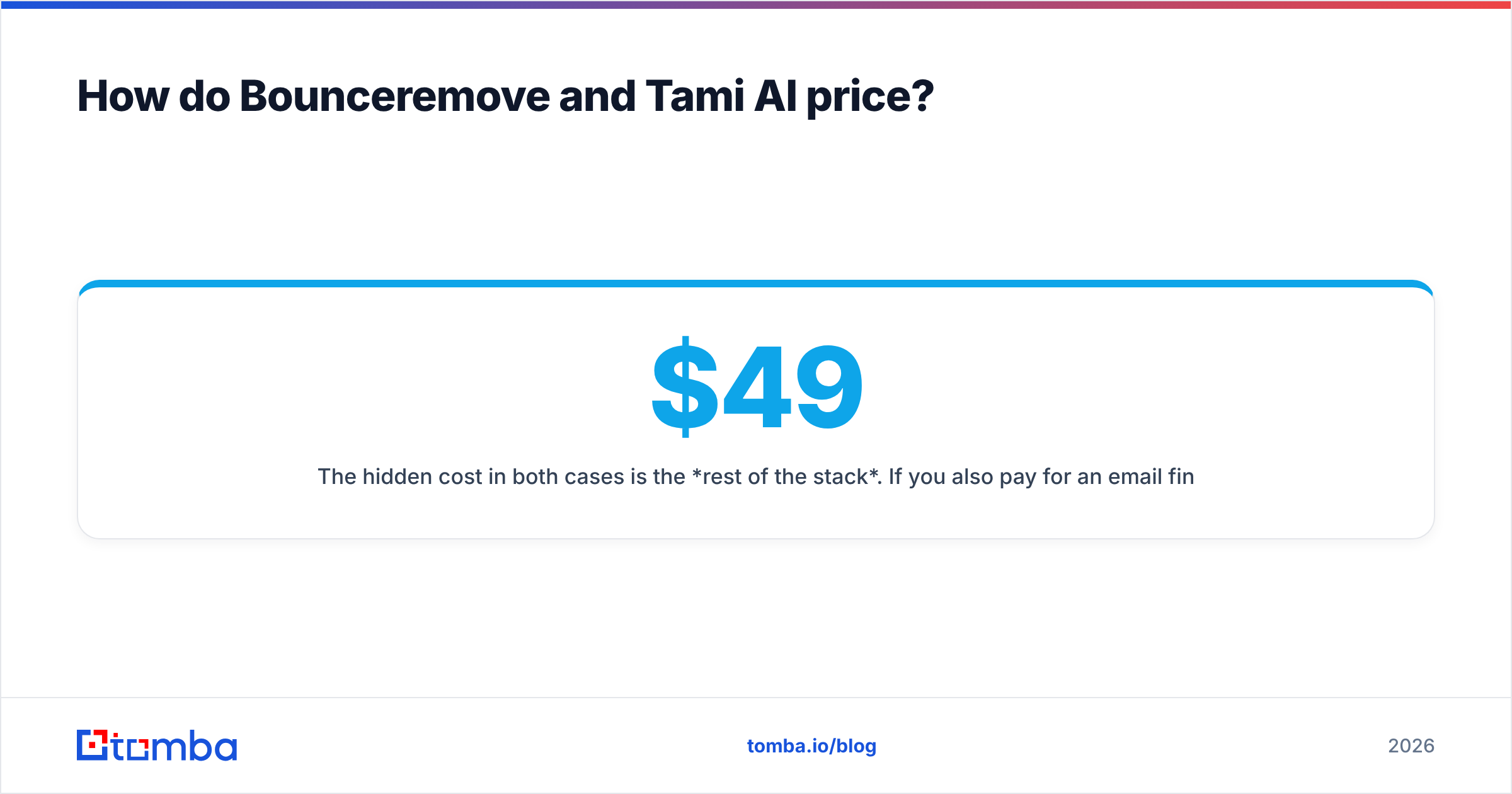
The hidden cost in both cases is the rest of the stack. If you also pay for an email finder, an enrichment vendor, and a CRM connector, three subscriptions quietly replace one. A bundled platform changes that math. For reference, Tomba pricing starts at a Free tier (25 searches/month), then Starter at $49/mo, Growth at $99/mo, and Pro at $249/mo — and verification, finding, domain search, and enrichment all sit under the same plan.
Which should you pick — and when does neither fit?#
Map the tool to the job, not the hype:
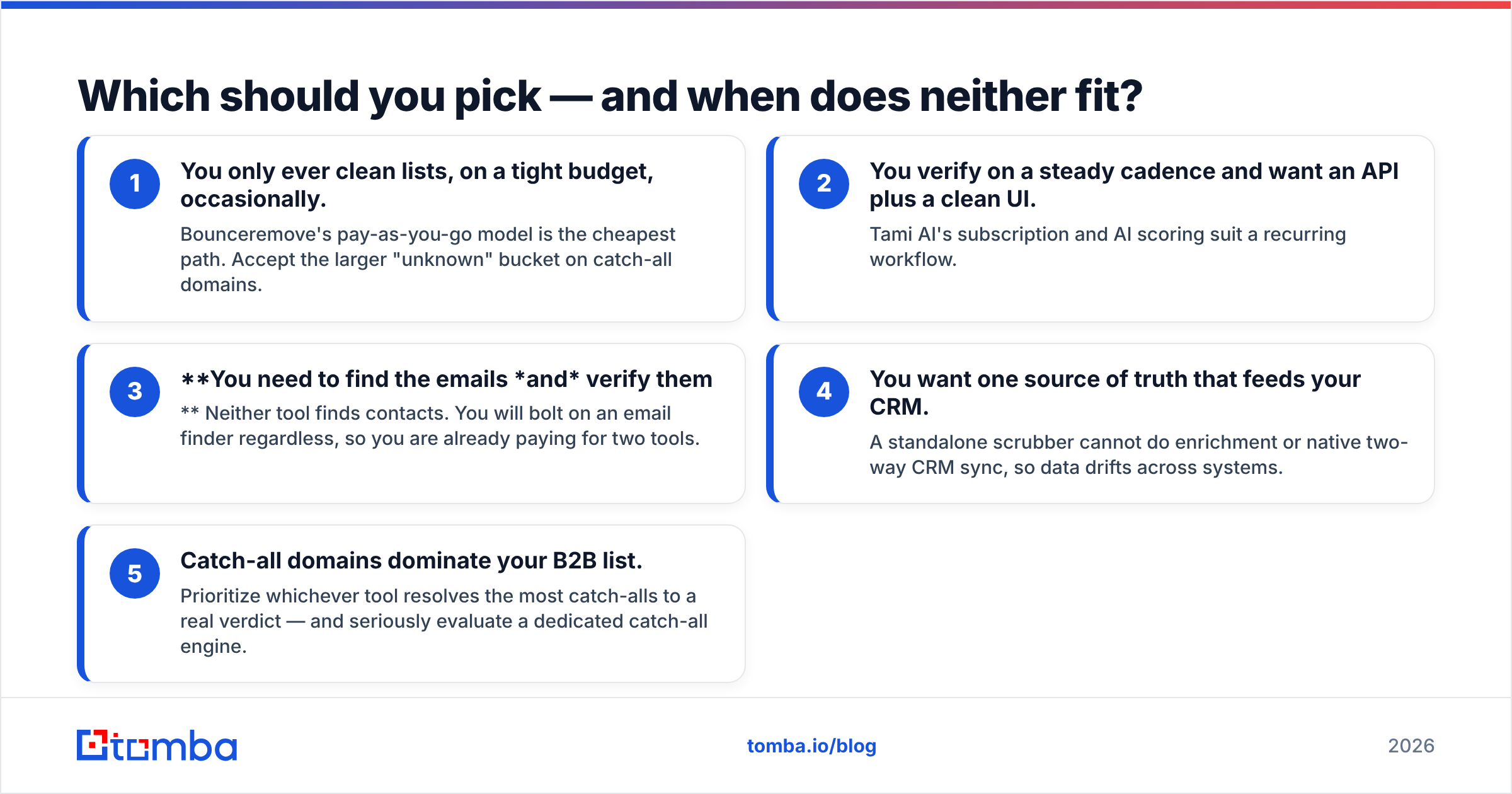
- You only ever clean lists, on a tight budget, occasionally. Bounceremove's pay-as-you-go model is the cheapest path. Accept the larger "unknown" bucket on catch-all domains.
- You verify on a steady cadence and want an API plus a clean UI. Tami AI's subscription and AI scoring suit a recurring workflow.
- You need to find the emails and verify them. Neither tool finds contacts. You will bolt on an email finder regardless, so you are already paying for two tools.
- You want one source of truth that feeds your CRM. A standalone scrubber cannot do enrichment or native two-way CRM sync, so data drifts across systems.
- Catch-all domains dominate your B2B list. Prioritize whichever tool resolves the most catch-alls to a real verdict — and seriously evaluate a dedicated catch-all engine.
That third and fourth scenario is where most outbound teams actually live. You are not verifying for fun; you are about to send. The verify step is one link in a chain that starts with finding the right person and ends with logging them in your pipeline.
How does an all-in-one platform change the workflow?#
Picture the difference between buying flour, eggs, and sugar from three shops versus walking into one bakery. The end product is the same, but the second path has fewer handoffs where things break. That is the structural argument for consolidating find + verify + enrich.
With a platform approach, a single workflow looks like:
- Find decision-makers by company with domain search, pulling every public address pattern at the target domain.
- Verify those addresses in the same pass, including a real verdict on catch-all domains instead of an "unknown" dump.
- Enrich the survivors with company and role data so your reps personalize instead of guessing.
- Sync clean, enriched contacts straight into HubSpot, Salesforce, or Pipedrive without a CSV round-trip.
Bounceremove and Tami AI only own the second of those four steps. That is not a flaw — it is their scope. But it means comparing them to each other answers a narrow question ("which scrubber?") while leaving the bigger one ("what runs my whole outbound data pipeline?") open. If you are evaluating verifiers at all, it is worth pricing the consolidated option in the same spreadsheet.
For teams that have outgrown a single scrubber, browsing dedicated Apollo alternatives and similar all-in-one platforms often reframes the decision entirely — the question stops being "Bounceremove or Tami AI" and becomes "do I still need a standalone verifier at all?"
What do real buyers say?#
Independent review sites are the sanity check on any vendor's own claims. Before you commit, read recent verification-category reviews on G2 and Capterra, filtering for reviewers whose list size and industry match yours. Pay special attention to comments about false positives and catch-all behavior — the two things that quietly cost money. And if you want the textbook background on why bounces hurt deliverability in the first place, the email bounce overview on Wikipedia is a neutral primer.
A few patterns tend to show up across reviews of point-solution scrubbers like these two:
- Praise for speed and simplicity on small, clean lists.
- Complaints when large B2B lists return big "unknown"/catch-all piles.
- Friction when teams realize they still need a separate finder and enrichment tool.
None of that disqualifies Bounceremove or Tami AI for the job they are built for. It just confirms the job is narrow.
Frequently asked questions#
Is Bounceremove or Tami AI better for cold email? For cold email specifically, the verifier matters less than how you build and warm the list. Both will scrub a list adequately; neither finds the contacts or manages warmup. If cold outbound is the goal, weight your decision toward a platform that also handles finding and CRM sync, then layer verification into that same flow.
Can these tools find new email addresses? No. Both Bounceremove and Tami AI verify addresses you already have. To generate new addresses by name or company, you need an email finder, which is a different category of tool.
How accurate is "AI" verification? AI scoring helps most on ambiguous catch-all domains, where deterministic SMTP checks come back inconclusive. It is not magic — confident wrong answers are the failure mode. Always validate any AI-driven verdict against a known sample of your own deliverable addresses.
What about catch-all domains? Catch-all domains accept all mail, so a normal SMTP ping cannot confirm a specific mailbox. This is the single biggest accuracy differentiator between verifiers. If your audience is B2B, test catch-all handling explicitly before you buy.
The verdict#
Bounceremove vs Tami AI is a real choice if — and only if — list scrubbing is the entire job. Bounceremove wins on lumpy, budget-conscious pay-as-you-go cleaning. Tami AI wins on steady-cadence verification with an API and AI scoring for risky domains. But both answer a narrow question, and most teams asking it are really standing at the start of an outbound pipeline that also needs finding, enrichment, and CRM sync.
If that is you, skip the two-tool stitch-up. Tomba's email verifier runs in the same workflow as its email finder, resolves catch-all domains to a real verdict, and pushes clean, enriched contacts straight into your CRM — starting on a Free tier (25 searches/month) and scaling at $49/mo. Verify the list you have, and find the next 10,000 contacts, without paying three vendors to do it. Start free with Tomba and clean your pipeline at the source.
// get started
Find, verify and enrich your first contacts today
Start on the free plan with 25 searches a month, then scale when your team is ready.
Free plan · No credit card required · GDPR & CCPA
// about the author