Bounceshield vs Apollo.io 2026: Full Feature Comparison
Bounceshield protects deliverability while Apollo.io finds and sequences leads. Here is the honest 2026 breakdown of accuracy, pricing, and which tool you actually need.
Bounceshield vs Apollo.io: Which One Belongs in Your 2026 Stack?
Conclusion first: the Bounceshield vs Apolloio choice is not really a fair fight. The two tools solve different halves of the same problem. Bounceshield is a focused email-verification and bounce-protection layer. Apollo.io is a broad sales-intelligence platform that finds, enriches, and sequences leads. If you only compare them on price, you will buy the wrong one. The real question is where each one fits. It is also where a leaner finder-plus-verifier like Tomba quietly beats both on cost per accurate contact.
TL;DR#
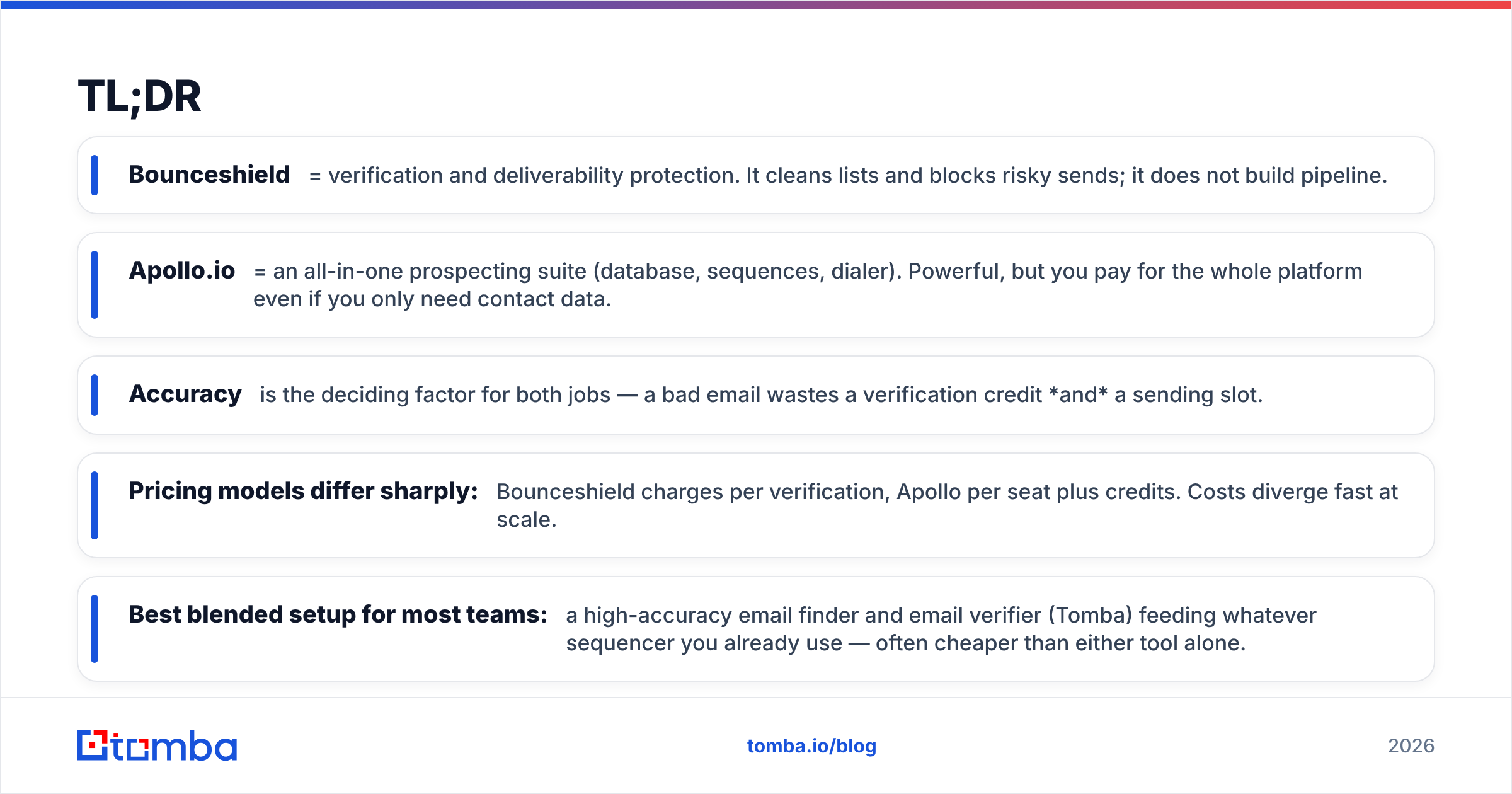
- Bounceshield = verification and deliverability protection. It cleans lists and blocks risky sends. It does not build pipeline.
- Apollo.io = an all-in-one prospecting suite (database, sequences, dialer). It is powerful, but you pay for the whole platform even if you only need contact data.
- Accuracy is the deciding factor for both jobs. A bad email wastes a verification credit and a sending slot.
- Pricing models differ sharply. Bounceshield charges per verification. Apollo charges per seat plus credits. Costs diverge fast at scale.
- Best blended setup for most teams: a high-accuracy email finder and email verifier (Tomba) feeding whatever sequencer you already use. This is often cheaper than either tool alone.
What is Bounceshield?#
Bounceshield is an email-verification tool. Think of it as the bouncer at the door of your sending domain. Before a message goes out, it checks whether the address is real, deliverable, and unlikely to hard-bounce. Technically, it runs SMTP handshakes, MX-record lookups, syntax checks, and risk scoring (disposable domains, role accounts, spam traps). It then returns a verdict — valid, invalid, catch-all, or unknown.
What it is not is a source of new contacts. Bounceshield assumes you already have a list. Its job is to protect your sender reputation and keep your bounce rate under the ~2% threshold that inbox providers punish. That is genuinely valuable. But it is a single link in the chain.
)
If your bounce rate is creeping up and your domain is getting throttled, a verifier is the fix. If your problem is "I have no one to email," a verifier does nothing for you.
What is Apollo.io?#
Apollo.io is a sales-intelligence and engagement platform built around a large B2B contact database (claimed hundreds of millions of contacts). It bundles prospecting, enrichment, email sequencing, a dialer, and CRM-style tracking into one subscription. You search for a persona, pull contacts, push them into a multi-step sequence, and track replies. You do all of it without leaving the app.
Apollo's strength is breadth. Its weakness is the same breadth. You pay per seat for a suite, data accuracy varies by region and seniority, and verification is a secondary feature rather than the core engine. For teams that want one tool to do everything, Apollo is attractive. For teams that want the best version of each job, it is a series of compromises.
Bounceshield vs Apolloio: How do they actually compare?#
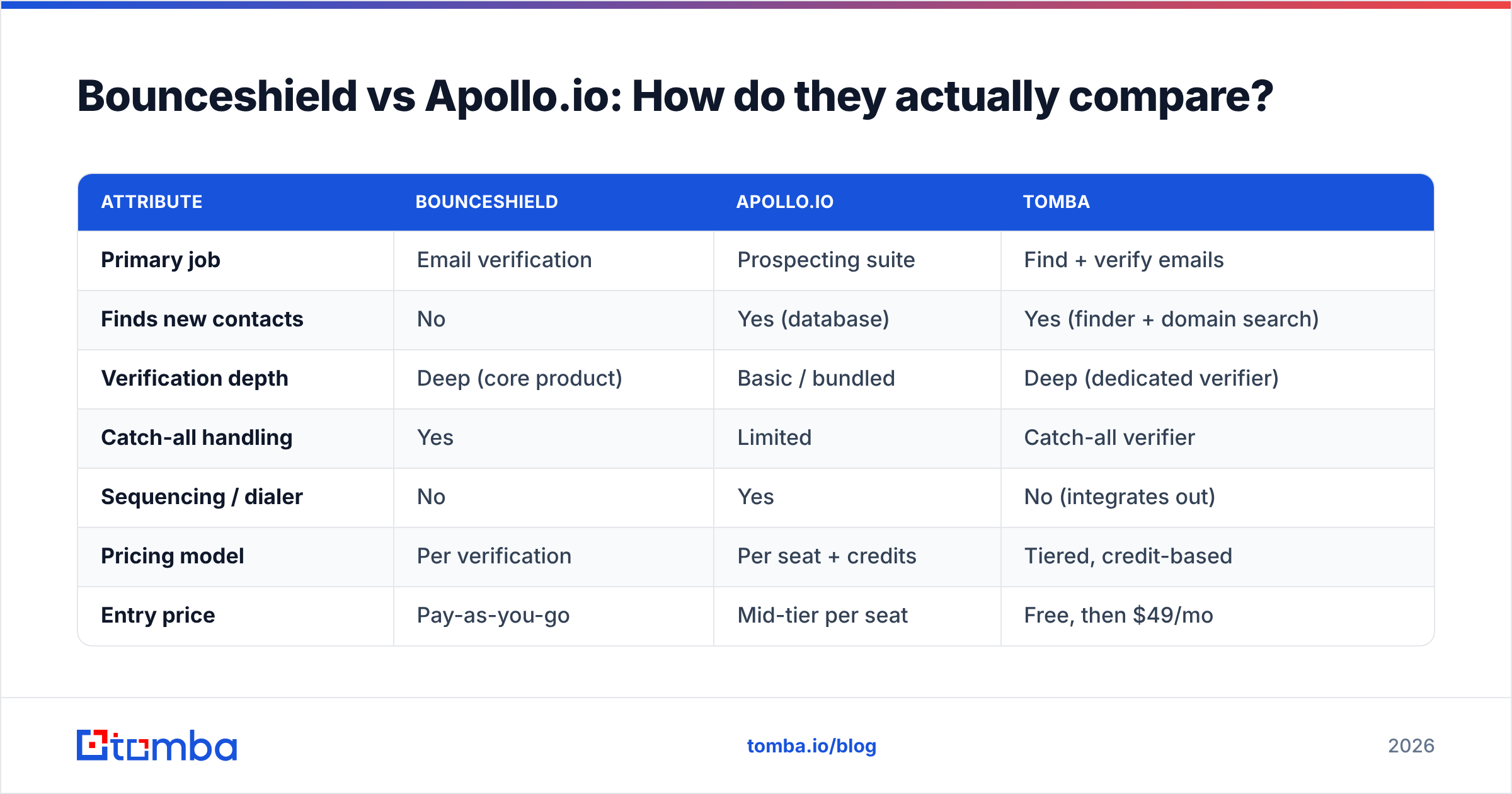
Here is the core breakdown across the attributes that matter when you are choosing between a verifier and a full platform.
| Attribute | Bounceshield | Apollo.io | Tomba |
|---|---|---|---|
| Primary job | Email verification | Prospecting suite | Find + verify emails |
| Finds new contacts | No | Yes (database) | Yes (finder + domain search) |
| Verification depth | Deep (core product) | Basic / bundled | Deep (dedicated verifier) |
| Catch-all handling | Yes | Limited | Catch-all verifier |
| Sequencing / dialer | No | Yes | No (integrates out) |
| Pricing model | Per verification | Per seat + credits | Tiered, credit-based |
| Entry price | Pay-as-you-go | Mid-tier per seat | Free, then $49/mo |
| Free tier | Limited trial | Yes (capped) | 25 searches/mo |
| Best for | List hygiene | All-in-one teams | Accurate data on a budget |
The pattern is clear. Bounceshield wins on verification depth, Apollo wins on breadth, and a dedicated finder-plus-verifier wins on cost-per-accurate-contact. None of them is "best" in the abstract. Each is only best for a job.
Is verification accuracy really the deciding factor?#
Yes. And most buyers underweight it. Accuracy is the one number that affects every other metric. A wrong email costs you twice. It costs a credit when you find or verify it. It costs again when it bounces and drags down your domain reputation. At 50,000 sends a quarter, a five-point accuracy gap is the difference between a healthy sender score and a throttled domain.

This is where the Bounceshield vs Apolloio framing breaks down. Bounceshield verifies well but does not source data, so its accuracy only helps lists you already have. Apollo sources data at scale, but its bundled verification is shallower, so a meaningful share of "valid" contacts still bounce. The teams with the cleanest funnels separate the two functions and pick the most accurate provider for each. That is exactly the gap a focused tool like Tomba fills, pairing a high-precision finder with a dedicated verifier and a catch-all finder for the addresses most tools mislabel.
Want to sanity-check any vendor's claims? Run a known sample of 500 addresses through each tool and compare bounce rates in your own ESP. Vendor-published accuracy figures are marketing. Your bounce log is truth.
How does pricing compare across the two?#
Bounceshield and Apollo.io use fundamentally different billing models. That difference matters more than any headline number.
- Bounceshield — per verification. You pay for what you clean. It is great for occasional list scrubs and predictable for one-off imports. But it scales linearly: ten times the list, ten times the bill. There is no prospecting value bundled in.
- Apollo.io — per seat plus credits. You pay for every user, plus export and enrichment credits. It is cost-effective if a whole team lives in the platform daily. It is wasteful if you bought it mainly for the contact data and three reps never touch the sequencer.
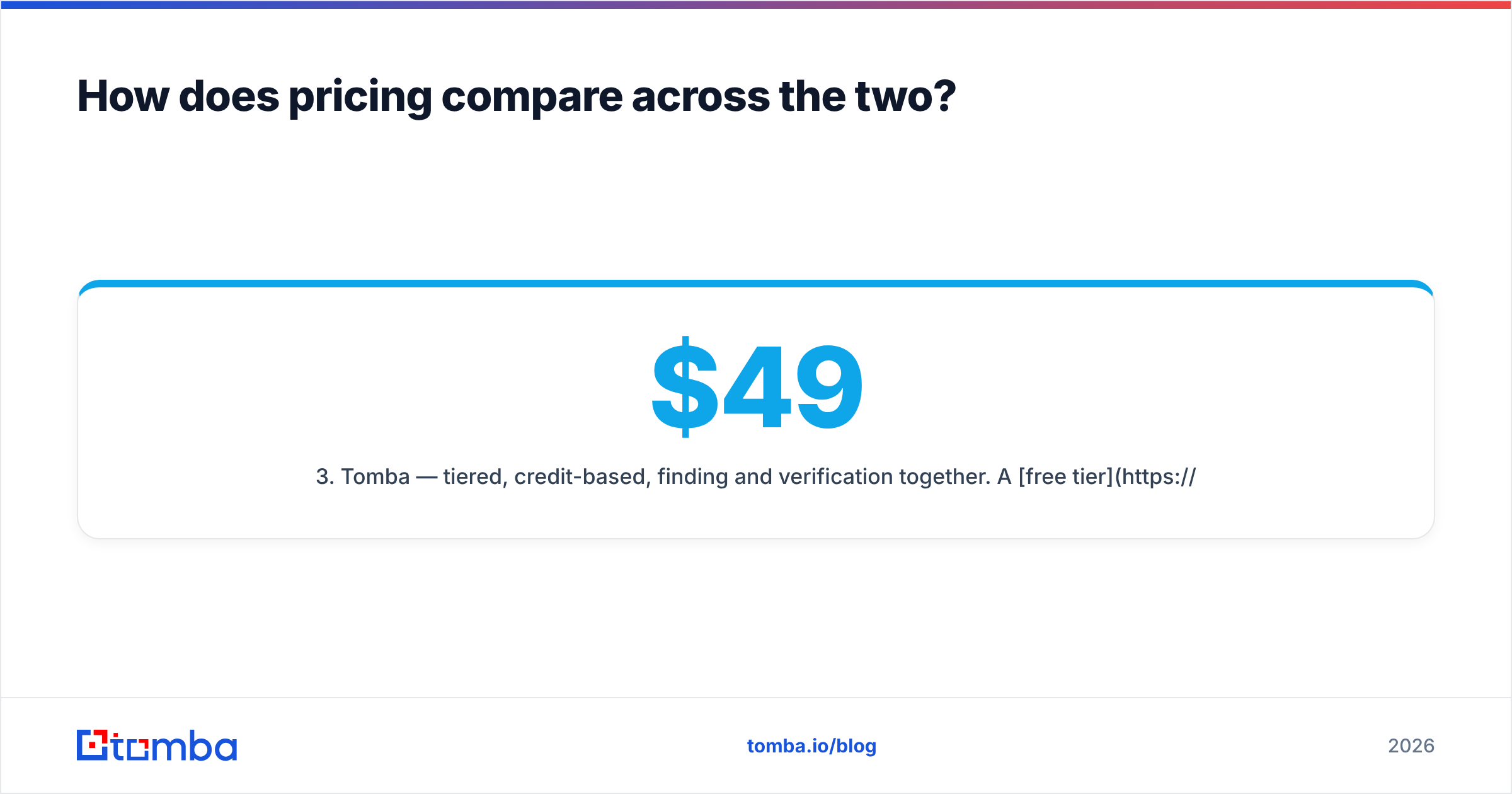
- Tomba — tiered, credit-based, finding and verification together. A free tier (25 searches/mo), then Starter at $49/mo, Growth at $99/mo, Pro at $249/mo, and custom Enterprise. One subscription covers finding and verifying, so you are not stacking two bills.
)
The trap is comparing a single Bounceshield invoice to a single Apollo invoice. In practice, a team that buys Bounceshield for hygiene usually also needs a data source. So the real comparison is "Apollo alone" versus "a finder + a verifier." When you run that math, a combined finder-and-verifier with bulk pricing frequently lands below an Apollo seat-plus-credit bundle, especially for small teams. See the full Tomba pricing breakdown for the per-credit details.
When should you choose Bounceshield?#
Pick Bounceshield (or any dedicated verifier) when:
- You already have lists from events, signups, partners, or a CRM export and need them cleaned before sending.
- Deliverability is your bottleneck, not lead volume. Your bounce rate is over 2–3% and providers are throttling you.
- You send through your own infrastructure and want a verification API in the pipeline rather than a full platform.
- You do not need prospecting. Sourcing happens elsewhere, and you just need a quality gate.
In short, Bounceshield is a specialist. If list hygiene is the entire job, a specialist is the right hire.
When should you choose Apollo.io?#
Pick Apollo.io when:
- You want one tool for the whole motion — find, enrich, sequence, dial, and track in a single login.
- Your team is large enough that the per-seat cost is justified by daily, hands-on use across reps.
- You value workflow consolidation over best-in-class accuracy on any single function.
- You are comfortable verifying separately for high-stakes campaigns, since bundled verification is shallower.
Apollo is the generalist. For teams that prize one pane of glass and have the budget, that consolidation is worth real money. If you like the model but want a cheaper data layer, compare an Apollo alternative before you commit to seats.
Where does Tomba fit between the two?#
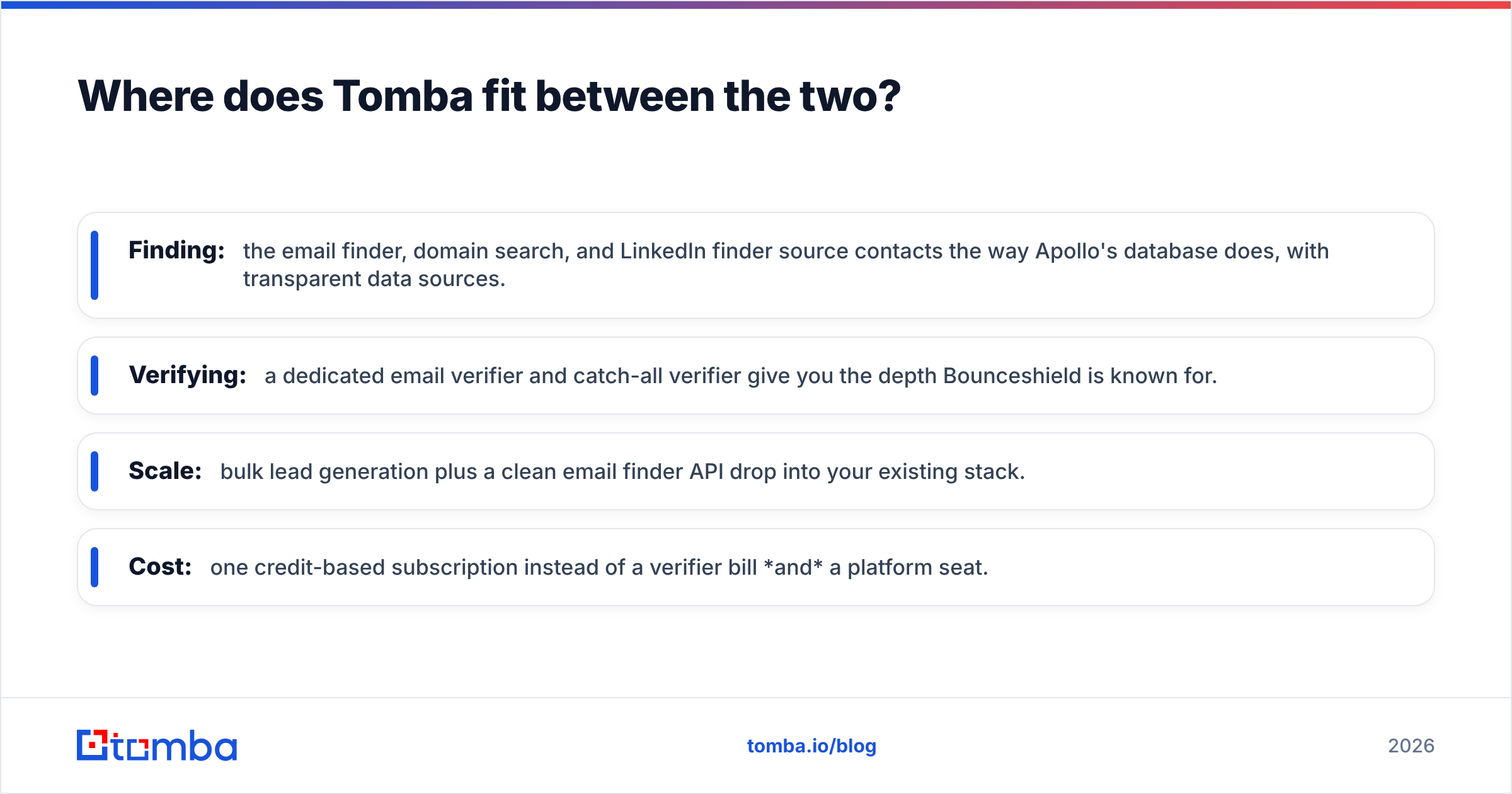
Tomba sits exactly in the gap this comparison exposes. It does the two jobs that actually move pipeline — find accurate emails and verify them — without charging you for a sequencer you may not need.
- Finding: the email finder, domain search, and LinkedIn finder source contacts the way Apollo's database does, with transparent data sources.
- Verifying: a dedicated email verifier and catch-all verifier give you the depth Bounceshield is known for.
- Scale: bulk lead generation plus a clean email finder API drop into your existing stack.
- Cost: one credit-based subscription instead of a verifier bill and a platform seat.
You still bring your own sequencer — Instantly, Smartlead, HubSpot, whatever you run — and connect it through standard integrations. The result is the accuracy of a specialist verifier and the sourcing of a database, at a price closer to a single tool than two.
What do real buyers say?#
Cross-check vendor claims on independent review sites before you decide. Apollo.io has thousands of reviews on G2. The recurring themes are strong reach but inconsistent data quality on senior or non-US contacts. Verification-focused tools like Bounceshield tend to score well on accuracy and poorly on "does it help me find anyone." That is exactly what you would expect from a specialist. Read the one- and two-star reviews specifically. That is where the real limitations surface, not in the marketing copy. For CRM-connected workflows, vendors like HubSpot also document how verification and enrichment plug into a pipeline, which is useful context if you run a CRM-first motion.
Bounceshield vs Apolloio: the verdict#
There is no single winner, because they are not really competitors. They are two parts of one workflow. Choose Bounceshield if you have lists and need them clean. Choose Apollo.io if you want an all-in-one suite and can justify the seats. Choose a finder-plus-verifier like Tomba if what you actually need is accurate contact data and dependable verification without paying for a full platform or stacking two invoices.
Decide by job-to-be-done, not by logo. Map your funnel and find the leakiest stage — no contacts, or bad contacts. Then buy the tool that fixes that stage first.
Ready to get accurate contacts without the platform tax?#
Is your real problem finding verified, deliverable emails — not learning yet another suite? Start with the Tomba Email Finder. The free tier gives you 25 searches a month to test accuracy against your own list. Paid plans start at $49/mo, and finding plus verification live under one subscription. Run a sample batch, compare the bounce rate to whatever you use today, and let your own numbers pick the winner.
// get started
Find, verify and enrich your first contacts today
Start on the free plan with 25 searches a month, then scale when your team is ready.
Free plan · No credit card required · GDPR & CCPA
// about the author