Bounceshield vs UpLead 2026: Which B2B Data Tool Wins?
Bounceshield protects your sends from bounces; UpLead builds your lists. Here's how the two stack up in 2026 — and where a verified-data stack beats both.
You picked two tools that sound like rivals but actually solve different halves of the same problem. Bounceshield keeps bad addresses from wrecking your sender reputation. UpLead hands you a B2B contact database to build lists in the first place. Choosing "one or the other" is the wrong frame — but if you only have budget for one this quarter, this guide tells you which to buy and why.
TL;DR — Bounceshield vs UpLead in one screen#
- Bounceshield is a verification and bounce-protection layer. It shines after you have a list and want to stop hard bounces, spam traps, and reputation damage.
- UpLead is a B2B prospecting database. It shines before outreach, when you need names, titles, emails, and firmographics to build a target list.
- They overlap only at the edges: UpLead verifies emails at export, and Bounceshield can clean lists from any source — but neither replaces the other.
- Pricing reality: UpLead starts around $99/mo for credits; Bounceshield prices per verification volume. Costs diverge fast at scale.
- The smarter play: pair a real-time email finder and verifier so you both source and validate in one workflow — which is where a stack like Tomba's email finder changes the math.

What is Bounceshield?#
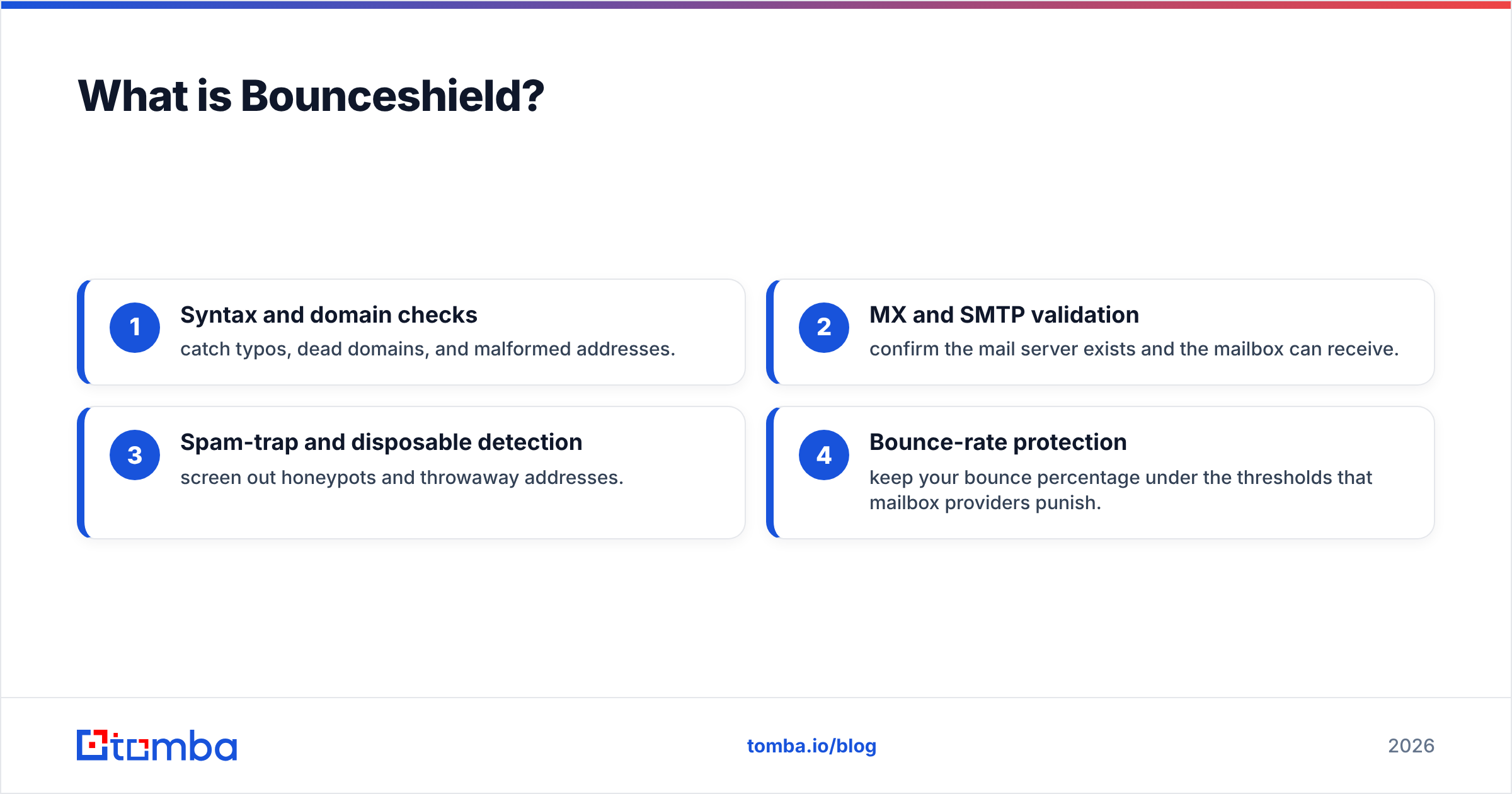
Bounceshield is an email verification and bounce-protection service. Think of it as a bouncer at the door of your sending platform: every address gets checked for syntax, domain health, mailbox existence, and known risk signals before your campaign goes out. If an address is likely to hard-bounce or trip a spam trap, it gets flagged or blocked.
Its core jobs:
- Syntax and domain checks — catch typos, dead domains, and malformed addresses.
- MX and SMTP validation — confirm the mail server exists and the mailbox can receive.
- Spam-trap and disposable detection — screen out honeypots and throwaway addresses.
- Bounce-rate protection — keep your bounce percentage under the thresholds that mailbox providers punish.
What Bounceshield does not do is find new contacts. It cleans what you already have. If your CRM is full of two-year-old emails, Bounceshield tells you which ones are dead — but it can't replace them with fresh, working addresses. That gap matters, and it's the main reason verification-only tools get paired with a data source.
What is UpLead?#
UpLead is a B2B contact and company database. You filter by industry, title, location, company size, and technology stack, then pull contact records with emails and phone numbers. It markets a real-time email verification step at export, so the addresses you download are checked at the moment you grab them.
Its core jobs:
- Prospect search — query a database of company and contact records by firmographic filters.
- Contact export — pull name, title, email, phone, and LinkedIn into your CRM or a CSV.
- Verification at export — validate emails before they count against your credits.
- Enrichment and intent — append firmographic and (on higher tiers) intent data to records.
UpLead is a source, not a cleaner. It's where lists come from. The tradeoff is database-style data: coverage is broad but can lag reality, because any static database is a snapshot of the moment it was compiled, not the moment you send. People change jobs, companies rebrand, and mailboxes get deactivated between the crawl and your campaign.
Bounceshield vs UpLead: the core difference#
Here's the analogy. Bounceshield is a water filter — it makes whatever you pour through it safer to drink. UpLead is the well — it's where the water comes from. You wouldn't argue about which one to "replace" the other with; you'd want both, or a single system that pumps and filters in one pass.
The category confusion happens because both touch "email quality." But they touch it at opposite ends of the funnel:
- UpLead decides who you contact and supplies the address.
- Bounceshield decides whether that address is safe to actually send to.
If your problem is "my lists are empty," buy a data source. If your problem is "my bounce rate is 9% and Google is throttling me," buy verification. Diagnose the bottleneck first.
How do Bounceshield and UpLead compare on features?#
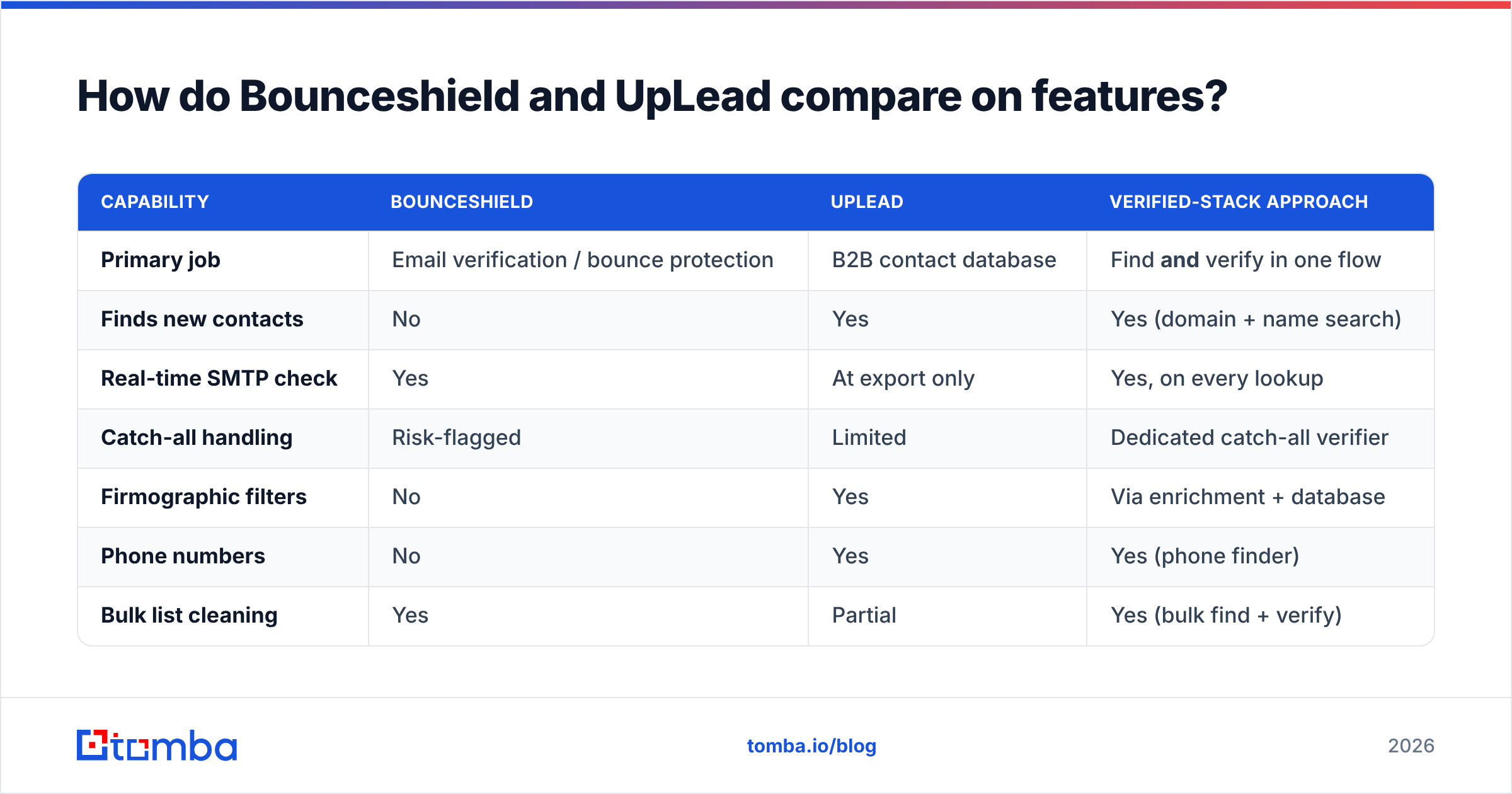
| Capability | Bounceshield | UpLead | Verified-stack approach |
|---|---|---|---|
| Primary job | Email verification / bounce protection | B2B contact database | Find and verify in one flow |
| Finds new contacts | No | Yes | Yes (domain + name search) |
| Real-time SMTP check | Yes | At export only | Yes, on every lookup |
| Catch-all handling | Risk-flagged | Limited | Dedicated catch-all verifier |
| Firmographic filters | No | Yes | Via enrichment + database |
| Phone numbers | No | Yes | Yes (phone finder) |
| Bulk list cleaning | Yes | Partial | Yes (bulk find + verify) |
| API access | Yes | Yes (higher tiers) | Yes, all tiers |
| Best fit | Cleaning existing lists | Building new lists | Teams doing both |
The pattern is clear: Bounceshield is deep on one axis (validation), UpLead is deep on another (sourcing), and neither covers both well. That's not a knock — it's just how single-purpose tools work. The question is whether you want to run, pay for, and reconcile two subscriptions, or collapse the workflow.
Which is more accurate?#
Accuracy means different things for each tool, so compare them on their own terms.
Bounceshield's accuracy is about verdict correctness: when it says "valid," does the email actually accept mail? Verification tools live or die on their SMTP handling and catch-all logic. The honest weak spot for any verifier is catch-all domains — servers that accept everything at the SMTP layer, so a "valid" verdict is really "unknown." Good tools flag these instead of guessing. If you send to a lot of catch-all domains, you'll want a dedicated catch-all verifier rather than a binary valid/invalid result.
UpLead's accuracy is about data freshness: is the email in the database still the person's real, current address? Database accuracy decays continuously. Independent reviews on G2 reflect this — strong overall coverage, with the usual database caveats about stale records and occasional misses on smaller companies. The export-time verification helps, but it can only validate the address on file; it can't conjure a new one if the contact changed jobs.
This is exactly why a real-time approach wins: instead of trusting a stored address, you resolve the email against the live company domain at the moment you need it, then verify it on the same call. You're not betting on a snapshot.
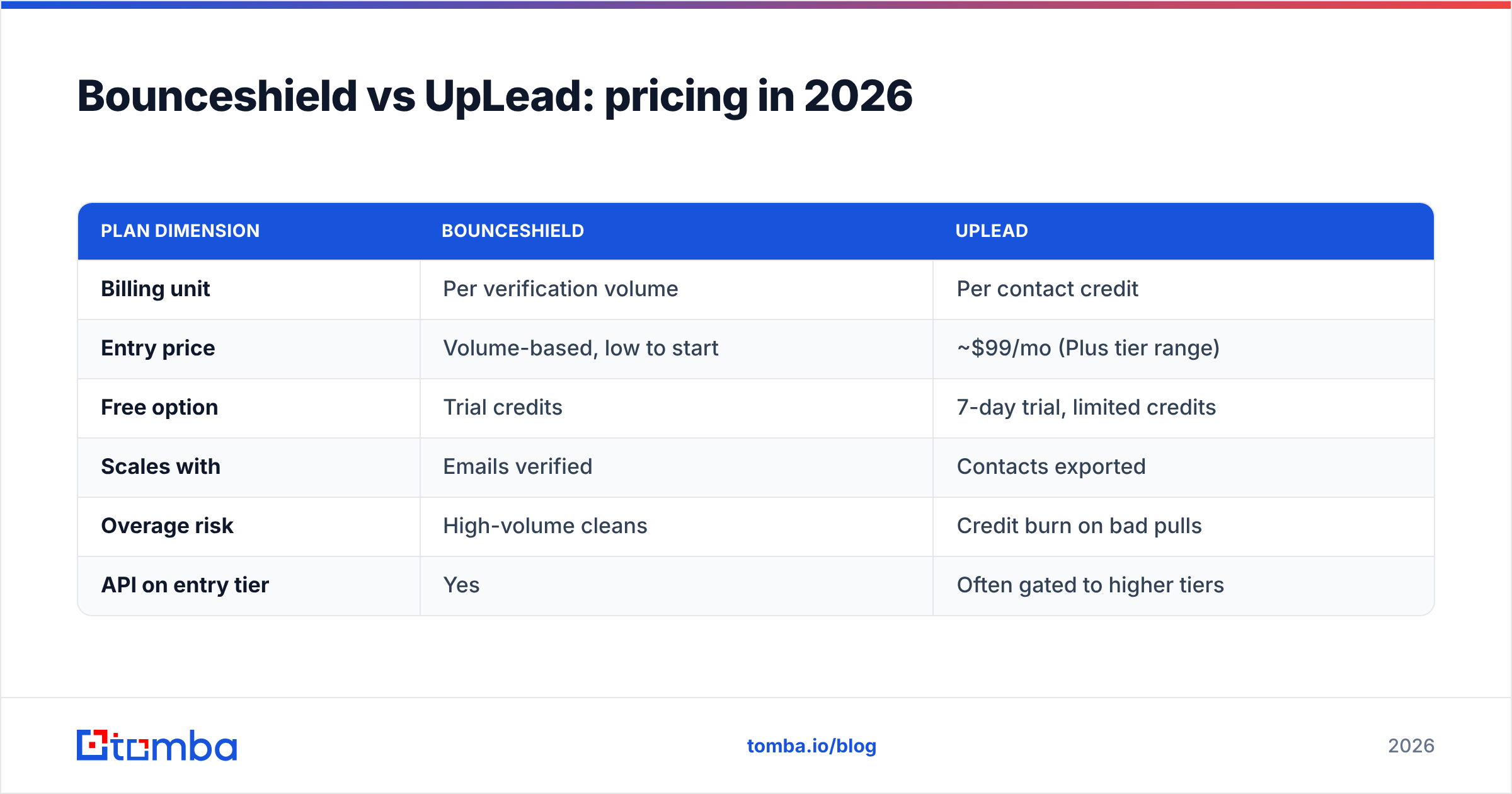
Bounceshield vs UpLead: pricing in 2026#
Pricing models differ enough that a flat "which is cheaper" answer is misleading — they bill for different things.
| Plan dimension | Bounceshield | UpLead |
|---|---|---|
| Billing unit | Per verification volume | Per contact credit |
| Entry price | Volume-based, low to start | ~$99/mo (Plus tier range) |
| Free option | Trial credits | 7-day trial, limited credits |
| Scales with | Emails verified | Contacts exported |
| Overage risk | High-volume cleans | Credit burn on bad pulls |
| API on entry tier | Yes | Often gated to higher tiers |
Two cost traps to watch. With UpLead, credit burn is the silent killer — every export spends a credit whether the contact converts or not, so loose filters waste budget fast. With Bounceshield, volume creep bites if you re-verify the same lists repeatedly instead of maintaining a clean source.
If you run both, you're paying twice to move one contact from "doesn't exist in my CRM" to "safe to email." A consolidated tool removes that double spend. Compare the math against transparent Tomba pricing: a Free tier with 25 searches/mo, Starter at $49/mo, Growth at $99/mo, and Pro at $249/mo — with finding and verification under one meter.
When should you choose Bounceshield?#
Pick Bounceshield (or any dedicated verifier) when:
- You already have a large list from events, sign-ups, or legacy CRM data and need to clean it before sending.
- Your bounce rate is hurting deliverability and you need to drop it under provider thresholds immediately.
- You don't need new contacts — sourcing isn't your bottleneck, hygiene is.
- Compliance demands proof that you scrubbed addresses before contact.
In those cases, verification is the highest-ROI dollar you can spend. A clean list protects your sender reputation, and reputation is the single biggest lever on whether your mail reaches the inbox at all. But remember: verification only confirms what you have. It won't grow your pipeline.
When should you choose UpLead?#
Pick UpLead (or any B2B database) when:
- Your lists are thin and you need volume across new accounts and titles.
- You prospect by firmographics — industry, headcount, tech stack — rather than by known target accounts.
- You want phone plus email in one record for multi-channel outreach.
- You're fine with snapshot data and will verify before sending anyway.
UpLead is a legitimate front-of-funnel engine. The catch is that you'll still want a verification pass on top — which puts you right back into the two-tool problem.
Is there a better option than either?#
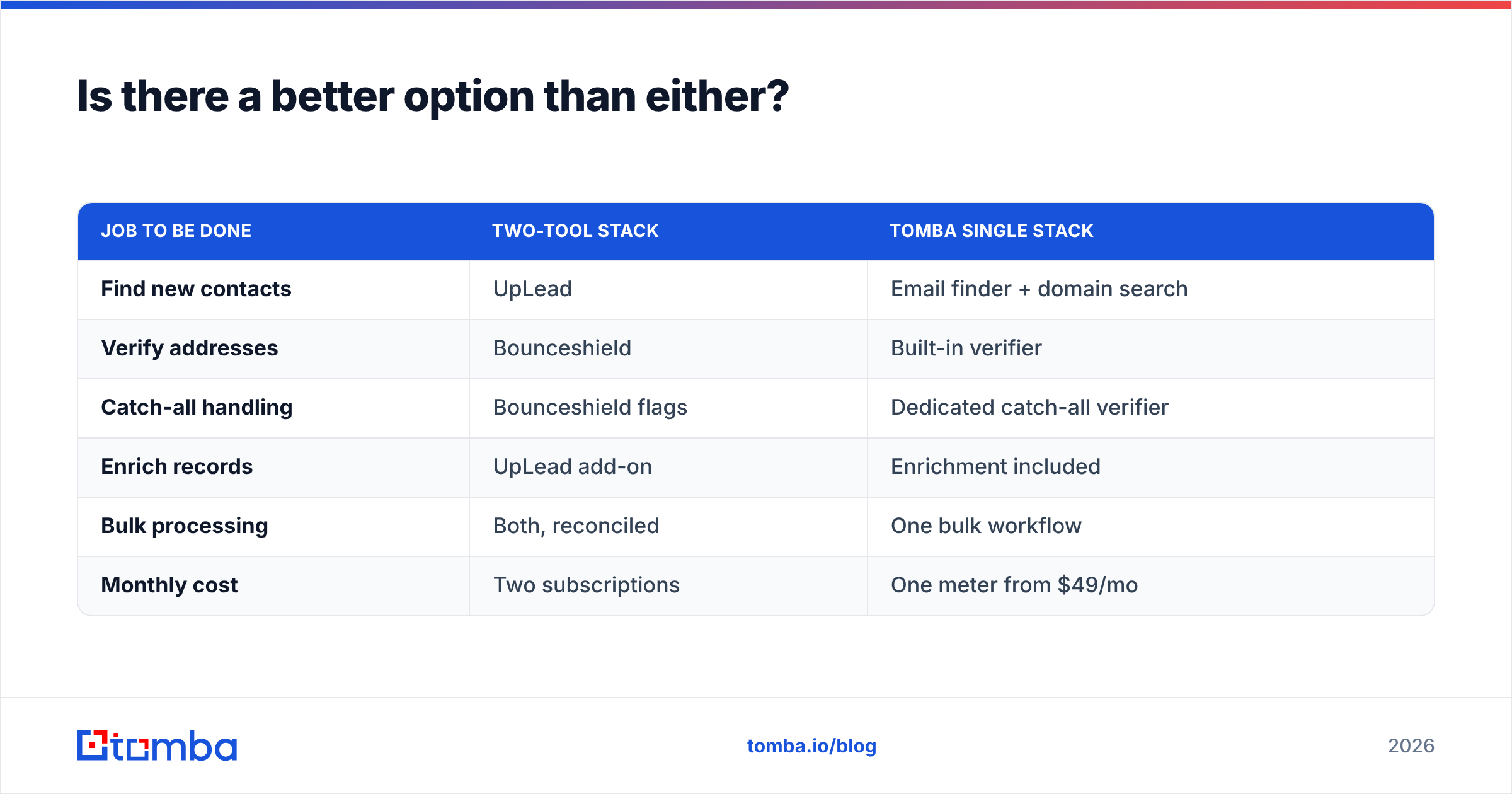
Yes — collapse the two jobs into one workflow. Most teams running Bounceshield and UpLead are really just trying to do two things: get a working email for the right person, and be sure it won't bounce. A modern email-finding stack does both in a single call.
Here's how the consolidated approach maps to what you'd otherwise buy separately:
- Sourcing — instead of a static database, use domain search to pull every reachable contact at a target company, live.
- Finding — resolve a specific person's address by name and domain with the email finder, backed by real public data sources.
- Verifying — validate each address on the same workflow with the email verifier, including catch-all risk scoring.
- Enriching — append titles, company data, and social profiles with data enrichment so records are CRM-ready.
- Scaling — run the whole thing in batches with the bulk email finder when you're processing thousands of accounts.
That's the difference between renting a snapshot and querying live. You don't pay one vendor to find and another to filter — you find verified, or you don't pull the record at all.
| Job to be done | Two-tool stack | Tomba single stack |
|---|---|---|
| Find new contacts | UpLead | Email finder + domain search |
| Verify addresses | Bounceshield | Built-in verifier |
| Catch-all handling | Bounceshield flags | Dedicated catch-all verifier |
| Enrich records | UpLead add-on | Enrichment included |
| Bulk processing | Both, reconciled | One bulk workflow |
| Monthly cost | Two subscriptions | One meter from $49/mo |
How to decide in five minutes#
Run this quick diagnostic:
- Bounces are your pain, lists are full? → A verifier like Bounceshield is your fastest fix.
- Lists are empty, sourcing is your pain? → A database like UpLead gets you moving.
- Both are broken, or you're tired of two bills? → Consolidate into a find-and-verify stack.
- You send at high volume and reputation is fragile? → Real-time verification on every send beats periodic list cleans.
- You sell into SMBs or fast-moving startups? → Live lookups beat snapshot databases, because that's where data decays fastest.
The honest answer for most outbound teams in 2026 is the third bullet. Two narrow tools made sense when finding and verifying were genuinely separate problems. They aren't anymore.
The bottom line#
Bounceshield and UpLead aren't really competitors — they're two pieces of a workflow you've been buying separately. Bounceshield protects deliverability; UpLead fills the top of funnel. If you can only pick one, pick the one that fixes your actual bottleneck: hygiene or sourcing. But if you're evaluating both because your pipeline needs verified contacts at scale, the better move is to stop stitching tools together.
Start with the Tomba Email Finder: find the right person's professional email by name or domain, get a verification verdict on the same call, and skip the second subscription entirely. The Free tier gives you 25 searches a month to test it against whatever Bounceshield or UpLead is quoting you — no reason not to compare on real data before you commit a budget.
Ready to find emails that actually work?
Join 150,000+ professionals who stopped guessing and started sending. Free credits on signup — no credit card required.
Get the Tomba newsletter
Practical outbound tactics and product updates — once every two weeks.
About the author