Bouncify vs Apollo.io 2026: Email Verifier vs Sales Platform
Bouncify verifies email lists; Apollo.io finds and sequences leads. Here's an honest 2026 breakdown of pricing, accuracy, and which one your team actually needs.
Comparing Bouncify and Apollo.io is a little like comparing a quality-control inspector to a whole factory. One checks that your email list is clean. The other tries to build the list, write the outreach, and track the deals. They overlap in exactly one place — email data — and that overlap is where most buyers get confused.
This guide cuts through it: what each tool actually does, where the pricing bites, how accurate the data is, and which one belongs in your stack in 2026.
TL;DR: Bouncify vs Apollo.io at a glance#
- Bouncify is a focused, pay-as-you-go email verification service. It cleans lists you already have. It does not find new contacts.
- Apollo.io is an all-in-one sales platform: a 275M+ contact database, email finder, sequences, dialer, and built-in verification. It is much broader and much heavier.
- They are not direct competitors. Bouncify competes with ZeroBounce and NeverBounce; Apollo competes with ZoomInfo, Lusha, and Cognism.
- Cost shape differs: Bouncify charges per verification with no seat fees; Apollo charges per user per month plus credit limits.
- If you only need clean lists, Bouncify (or a leaner verifier) wins. If you need to find, enrich, and verify in one motion, a tool like the Tomba Email Finder usually beats stitching two products together.
What is Bouncify?#
Bouncify is a dedicated email verification service. You upload a list — from a CRM export, a form, a scraped sheet — and it checks each address for syntax errors, dead domains, role accounts (info@, sales@), disposable addresses, and mailbox existence via SMTP. You get back a list scored as deliverable, undeliverable, risky, or unknown.
That is the entire job. Bouncify has no contact database, no email finder, and no outreach features. Its value is keeping your bounce rate low so your sender reputation survives. If you send cold email and your list is full of stale addresses, a verifier is the difference between landing in the inbox and getting your domain flagged.
Bouncify's selling points are speed, a pay-as-you-go pricing model with no subscription lock-in, and a simple API. It is the kind of tool you bolt onto an existing workflow rather than build your day around.
What is Apollo.io?#
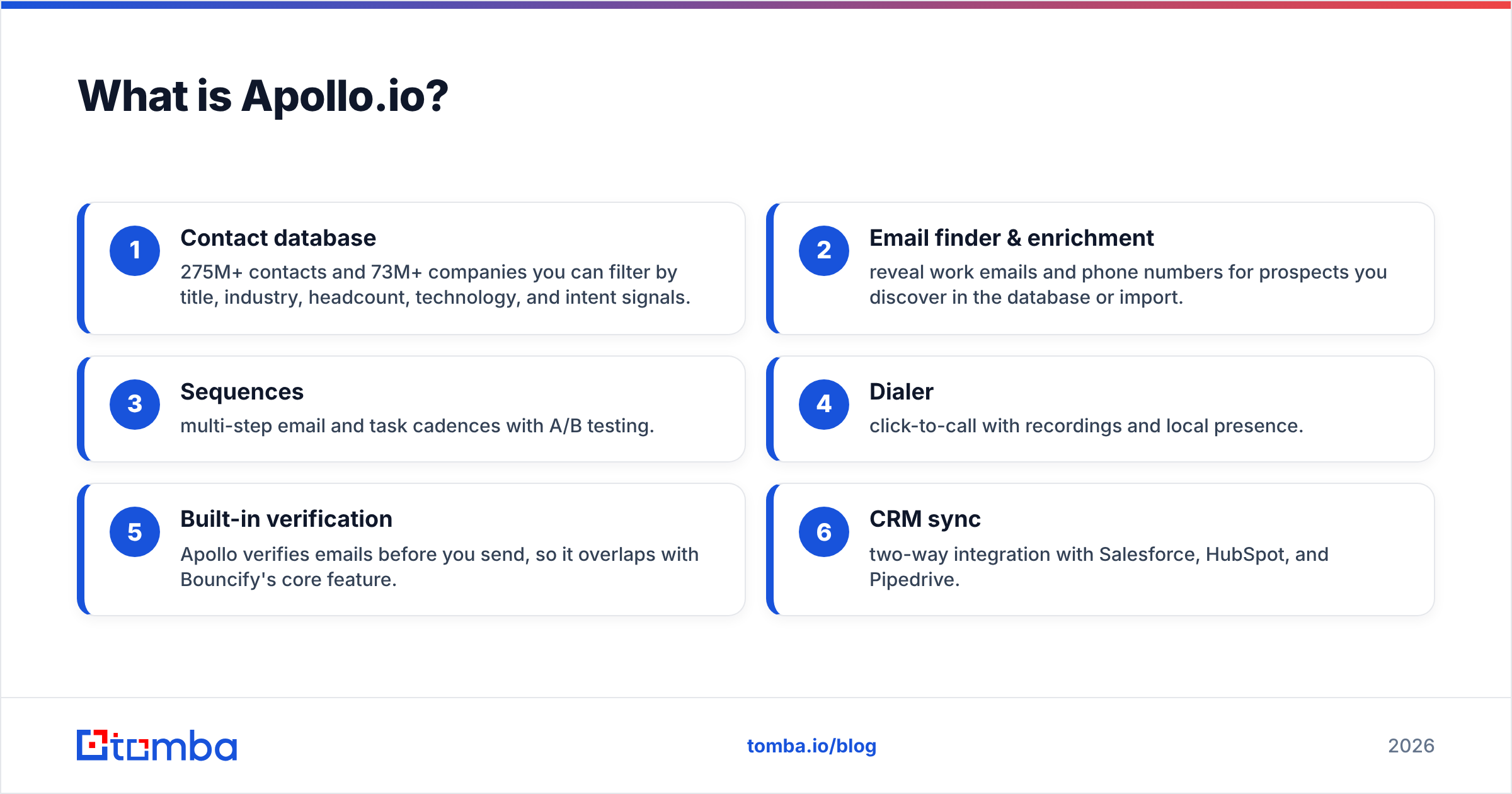
Apollo.io is a full sales intelligence and engagement platform. Where Bouncify does one thing, Apollo tries to own the entire top of your funnel:
- Contact database — 275M+ contacts and 73M+ companies you can filter by title, industry, headcount, technology, and intent signals.
- Email finder & enrichment — reveal work emails and phone numbers for prospects you discover in the database or import.
- Sequences — multi-step email and task cadences with A/B testing.
- Dialer — click-to-call with recordings and local presence.
- Built-in verification — Apollo verifies emails before you send, so it overlaps with Bouncify's core feature.
- CRM sync — two-way integration with Salesforce, HubSpot, and Pipedrive.
Apollo is priced and built for SDR teams that prospect daily. The trade-off is complexity, per-seat cost, and a database whose accuracy varies a lot by region and seniority.

Wait — ignore that mental image of a single chart settling this. The honest answer is that these tools sit at different layers, so the real comparison is about what job you're hiring them for.

Bouncify vs Apollo.io: the core comparison#
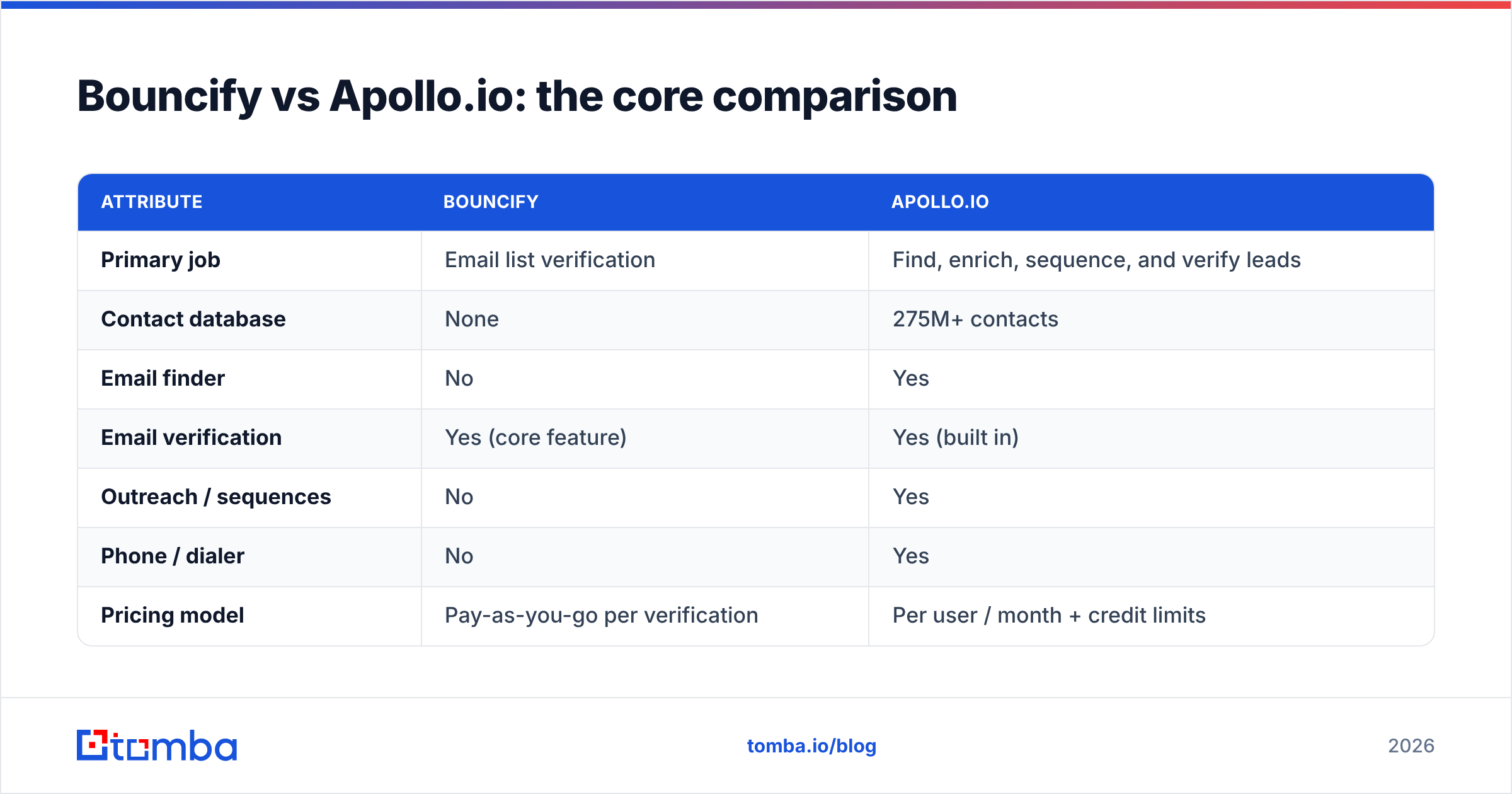
Here is the side-by-side that actually matters. Notice how few rows have a true head-to-head — that tells you most of the story.
| Attribute | Bouncify | Apollo.io |
|---|---|---|
| Primary job | Email list verification | Find, enrich, sequence, and verify leads |
| Contact database | None | 275M+ contacts |
| Email finder | No | Yes |
| Email verification | Yes (core feature) | Yes (built in) |
| Outreach / sequences | No | Yes |
| Phone / dialer | No | Yes |
| Pricing model | Pay-as-you-go per verification | Per user / month + credit limits |
| Free tier | Trial credits | Free plan (limited credits) |
| Best for | Cleaning lists you already own | Building and working a pipeline |
| API | Verification API | Full platform API |
The takeaway: Bouncify is a feature; Apollo is a platform. If you put them in a ring, Apollo's built-in verification is the only place they truly compete — and a standalone verifier usually does that one task more thoroughly.
How does pricing compare?#
Pricing is where the two diverge most, because the models are structurally different.
Bouncify charges per email verified. You buy credits — roughly in the range of a few dollars per thousand verifications, dropping as volume rises — and they don't expire on the pay-as-you-go tier. There are no seats and no monthly minimum. For a team that verifies in bursts (after a scrape, before a campaign), this is efficient: you pay only for what you clean.
Apollo.io charges per user per month, with credit caps on email and mobile reveals tied to each tier.
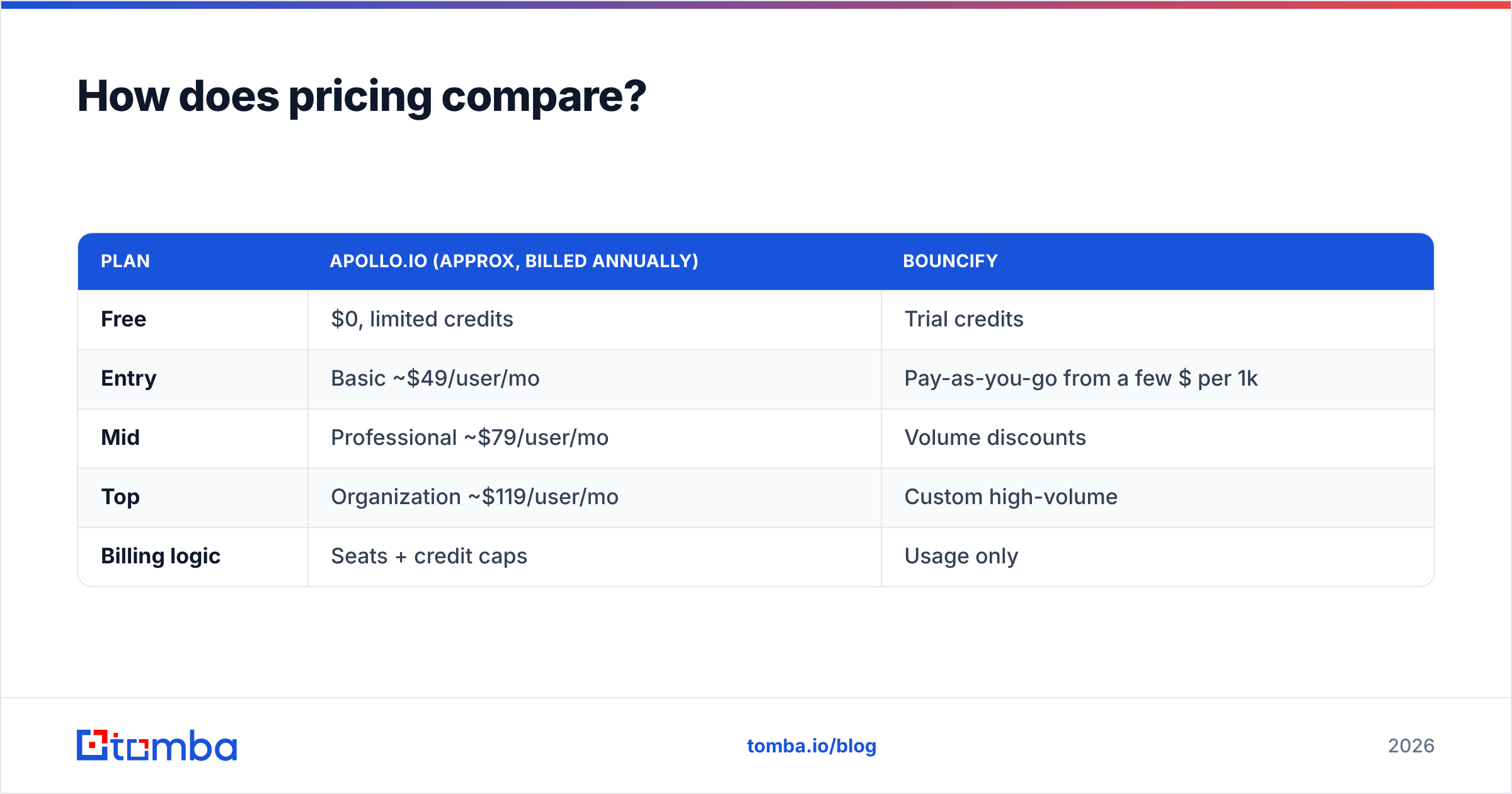
| Plan | Apollo.io (approx, billed annually) | Bouncify |
|---|---|---|
| Free | $0, limited credits | Trial credits |
| Entry | Basic ~$49/user/mo | Pay-as-you-go from a few $ per 1k |
| Mid | Professional ~$79/user/mo | Volume discounts |
| Top | Organization ~$119/user/mo | Custom high-volume |
| Billing logic | Seats + credit caps | Usage only |
Two things to watch with Apollo. First, the headline price is per seat — a five-rep team multiplies fast. Second, the export and mobile-number credits on lower tiers run out quickly, pushing you to upgrade. Check current numbers directly on Apollo's pricing page and read recent Apollo reviews on G2 before committing, since tiers and credit limits change often.
For verification-only spend, Bouncify is almost always cheaper than paying for an Apollo seat you'd use solely to clean lists. For full prospecting, Bouncify simply can't do the job at any price.
Which is more accurate?#
Accuracy means different things for each tool, so judge them on their own task.
For Bouncify, accuracy is verification precision: does it correctly catch dead mailboxes and pass real ones? Dedicated verifiers like Bouncify generally do this well, with the perennial weak spot being catch-all domains — servers that accept every address, so SMTP can't confirm a specific mailbox exists. Every verifier struggles here, which is why a strong catch-all verifier is worth checking before you trust a "valid" result on a catch-all domain.
For Apollo, accuracy is data freshness: when it hands you an email or phone number, is it current? This is where user feedback is mixed. Apollo's database is enormous, but coverage and correctness skew toward US-based, mid-market contacts. European data (with GDPR constraints), senior executives, and smaller companies tend to show more gaps and stale records. Because Apollo verifies its own data, you also can't easily get a neutral second opinion inside the platform — the finder and the verifier share the same source.
That last point is the quiet argument for keeping verification independent of your data source. If the same vendor both guesses the email and grades it, you've lost your check and balance. Running discovered emails through a separate email verifier catches the addresses a finder marks "valid" out of optimism.
When should you choose Bouncify?#
Pick Bouncify (or a comparable standalone verifier) when:
- You already have lists from forms, events, partnerships, or CRM exports and just need them clean.
- You send transactional or newsletter email and want to protect email deliverability without paying for a sales platform.
- Your volume is spiky — pay-as-you-go beats a subscription you'd let idle.
- You don't prospect — you're not hunting new contacts, so a database is dead weight.
Bouncify is the right call for marketers and ops teams whose pipeline already exists and just needs hygiene. It will not help a rep who starts every morning with an empty list.
When should you choose Apollo.io?#
Pick Apollo when:
- You build pipeline from scratch and need a database to find net-new accounts and contacts.
- You run multi-touch outreach and want sequences, tasks, and a dialer in one place.
- You have budget for seats and reps who'll use the platform daily to justify the per-user cost.
- You want fewer tools and accept "good enough" verification as a bundled bonus rather than a best-in-class feature.
Apollo shines for SDR-heavy, outbound-first teams in the US mid-market. It struggles when your ICP is European, very senior, or in long-tail industries where its database thins out.
Is there a better middle path?#
For most teams, yes — and it's the gap neither tool fills cleanly. Bouncify can't find contacts. Apollo can find them but ties verification, data, and outreach into one expensive, US-skewed bundle. What a lot of buyers actually want is the finding + verifying core, accurate across regions, without paying for a dialer and five seats.
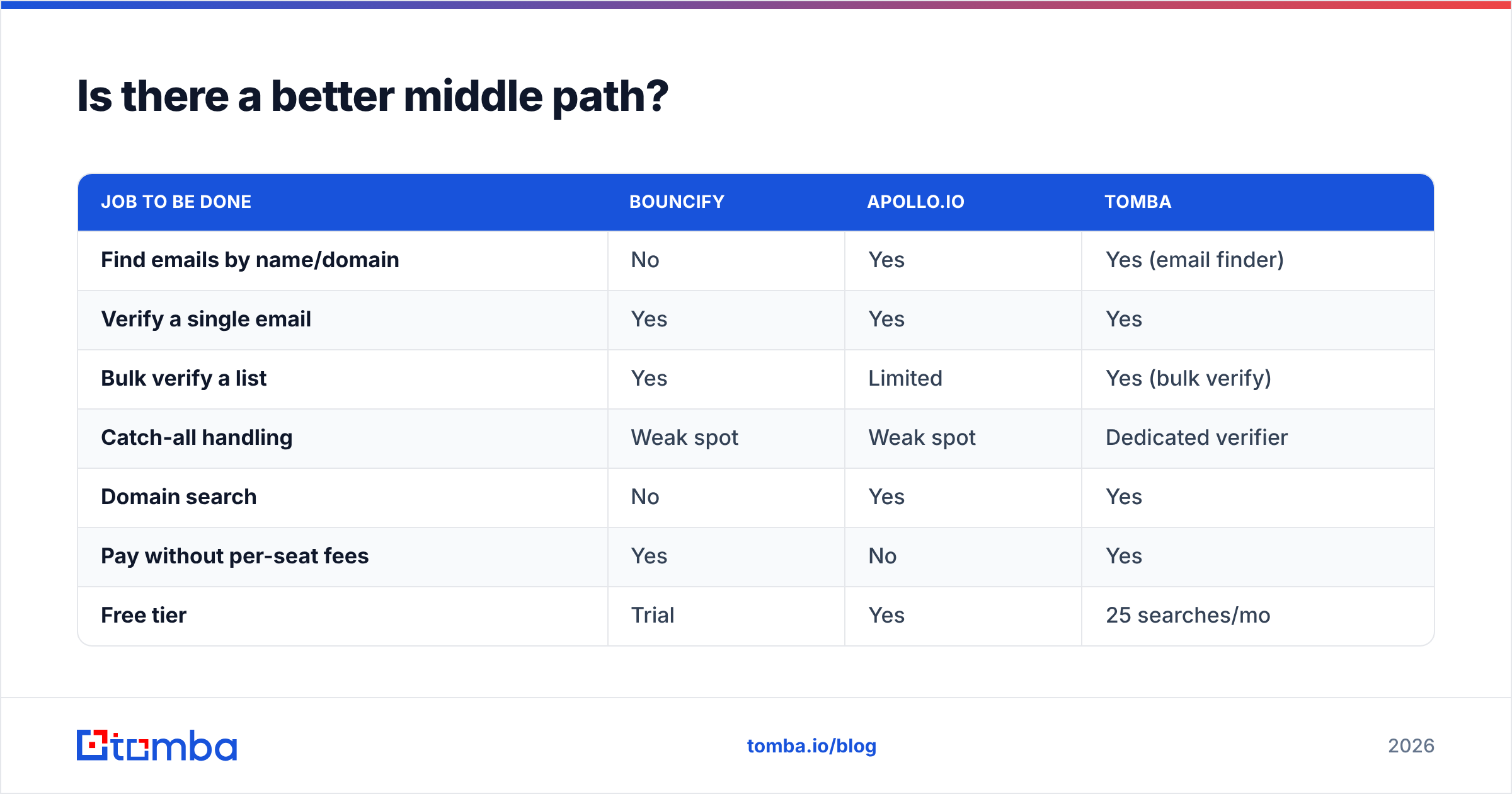
That's the slot a focused email-data tool fills. Here's how the three approaches line up on the jobs that matter for clean, deliverable outreach data:
| Job to be done | Bouncify | Apollo.io | Tomba |
|---|---|---|---|
| Find emails by name/domain | No | Yes | Yes (email finder) |
| Verify a single email | Yes | Yes | Yes |
| Bulk verify a list | Yes | Limited | Yes (bulk verify) |
| Catch-all handling | Weak spot | Weak spot | Dedicated verifier |
| Domain search | No | Yes | Yes |
| Pay without per-seat fees | Yes | No | Yes |
| Free tier | Trial | Yes | 25 searches/mo |
Tomba sits between the two: it finds professional emails by domain or name like Apollo, and it verifies them with a dedicated verifier like Bouncify — without a per-seat platform tax. Pricing is plan-based (Free at 25 searches/month, Starter at $49/mo, Growth at $99/mo, Pro at $249/mo), so you're paying for data work, not dialer minutes. If you've outgrown a pure verifier but don't want Apollo's weight, that's the lane. (If you specifically want a lighter Apollo replacement, see the Apollo alternative breakdown.)
What about combining tools?#
A common real-world setup: use Apollo or a scraper to source contacts, then run everything through a separate verifier before it touches your sending domain. The logic is sound — never trust the finder to also be the judge.
The friction is cost and plumbing. Two subscriptions, two APIs, two dashboards, and a manual export-import step between them. If you go this route, automate the handoff so verification happens on every new record, not just when someone remembers. A single tool that finds and verifies under one API removes that seam entirely, which is why consolidated email-data platforms keep winning this comparison on operational simplicity rather than raw feature count.
Frequently asked questions#
Is Bouncify a competitor to Apollo.io? Not really. Bouncify only verifies email lists. Apollo finds, enriches, sequences, and dials. They overlap solely on verification, and Apollo bundles that as one feature among many.
Does Apollo.io verify emails like Bouncify? Yes, Apollo verifies emails before sending, but it grades data from its own database — so you lose the independent second check a standalone verifier gives you.
Which is cheaper? For verification only, Bouncify's pay-as-you-go model beats buying an Apollo seat. For finding contacts, Bouncify can't do it at all, so cost comparison is moot.
Can I use both? Yes — source with Apollo, verify with a dedicated tool. Just automate the handoff so every new contact gets checked, and watch the combined cost.
The bottom line#
Bouncify and Apollo.io solve different problems. Bouncify keeps lists clean and charges only for what you verify. Apollo builds and works your whole pipeline but costs per seat and skews US mid-market. Don't pick between them as if they're rivals — pick based on the job in front of you.
If that job is "find accurate B2B emails and trust they'll land," skip the false choice. The Tomba Email Finder finds professional addresses by domain, name, or company and verifies them in the same workflow — with a free tier (25 searches/month) and no per-seat tax. Start free, clean your outreach data, and only pay for the volume you actually use.
// get started
Find, verify and enrich your first contacts today
Start on the free plan with 25 searches a month, then scale when your team is ready.
Free plan · No credit card required · GDPR & CCPA
// about the author