Boundo Pros and Cons (2026): Honest Review and Alternatives
Is Boundo the right pick for your outbound team? Here's an honest breakdown of where it shines, where it falls short, and which alternatives are worth a look.
Choosing a prospecting tool is less about the demo and more about what breaks three months in. Boundo gets pitched as an all-in-one B2B outreach and contact tool, but "all-in-one" hides as much as it reveals. This is a straight breakdown of the Boundo pros and cons, who it actually fits, and where a focused alternative does the job for less.
TL;DR — Boundo Pros and Cons at a Glance#
- Best for: small outbound teams that want sequencing, contact lookup, and basic enrichment bundled in one login.
- Biggest strength: an integrated workflow — find a contact, drop them into a sequence, and track replies without juggling four tabs.
- Biggest weakness: bundled data accuracy and verification tend to lag behind specialist tools, which quietly inflates your bounce rate.
- Watch the pricing: all-in-one suites often look cheaper per seat until you hit credit caps and forced upgrades.
- Smart move: pair a dedicated email finder and email verifier for data quality, and use a lightweight sequencer for sends.
What Is Boundo and Who Is It For?#
Boundo positions itself as a B2B prospecting and outreach platform — the kind of suite that promises to replace your contact database, your enrichment step, and your cold email sequencer in one subscription. The appeal is obvious: one bill, one onboarding, one place to look when a deal stalls.
That bundling is the whole pitch. Instead of stitching together a finder, a verifier, and a sending tool, you log into a single dashboard and run the motion end to end. For a two- or three-person sales team that values fewer moving parts over best-in-class accuracy, that simplicity has real value.
But "one tool for everything" is also where the trade-offs hide. Suites spread engineering effort across many features, so no single feature is usually the best in its class. The question isn't whether Boundo works — it's whether the convenience is worth the accuracy and cost penalties that come with it. To answer that, you need to look at each piece honestly.
What Are the Main Pros of Boundo?#
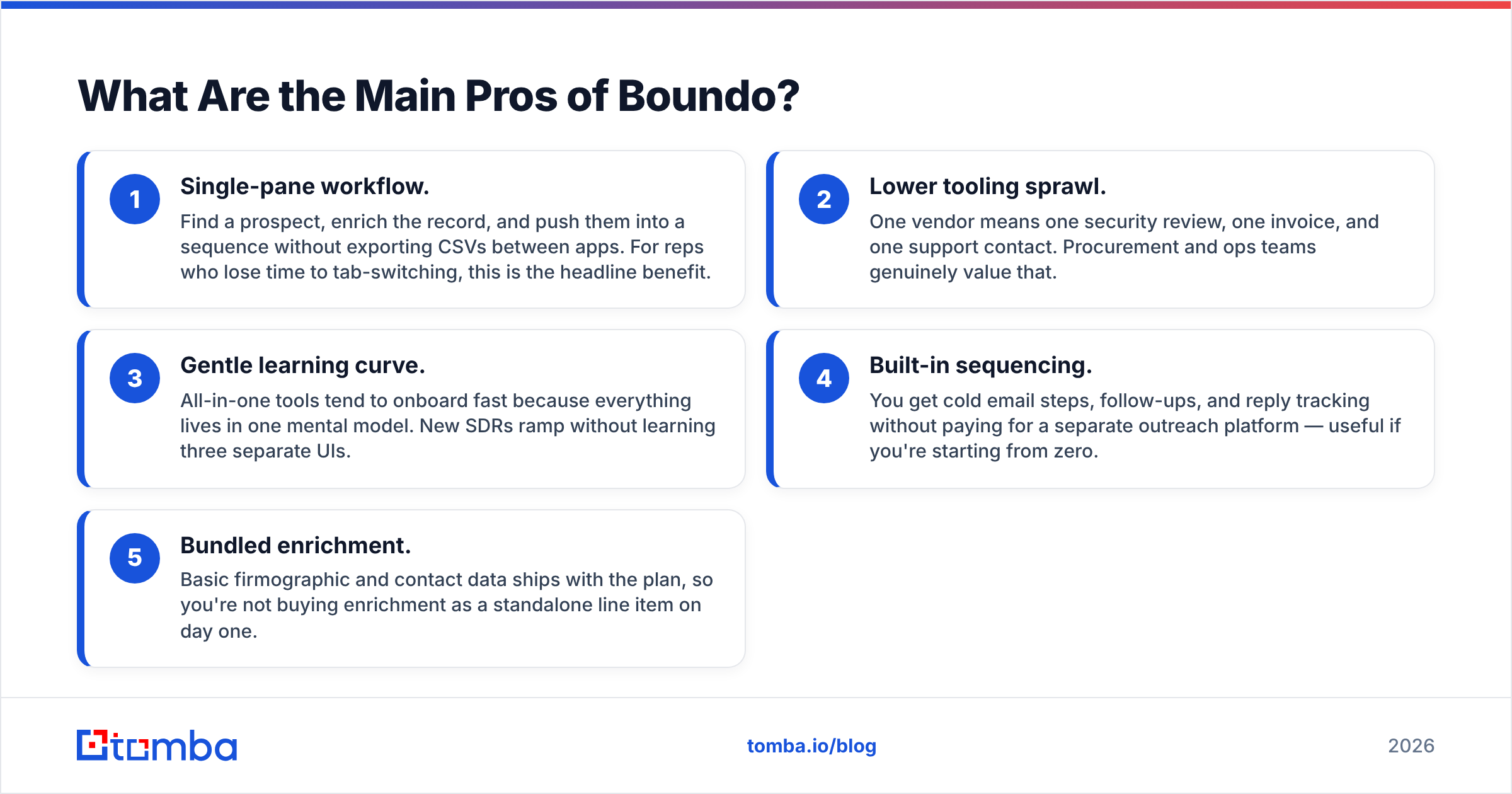
Credit where it's due. The case for an integrated tool like Boundo rests on a few genuine strengths:
- Single-pane workflow. Find a prospect, enrich the record, and push them into a sequence without exporting CSVs between apps. For reps who lose time to tab-switching, this is the headline benefit.
- Lower tooling sprawl. One vendor means one security review, one invoice, and one support contact. Procurement and ops teams genuinely value that.
- Gentle learning curve. All-in-one tools tend to onboard fast because everything lives in one mental model. New SDRs ramp without learning three separate UIs.
- Built-in sequencing. You get cold email steps, follow-ups, and reply tracking without paying for a separate outreach platform — useful if you're starting from zero.
- Bundled enrichment. Basic firmographic and contact data ships with the plan, so you're not buying enrichment as a standalone line item on day one.
For an early-stage team running a simple motion, those points add up. The convenience is real, and pretending otherwise would be dishonest.
What Are the Cons of Boundo?#
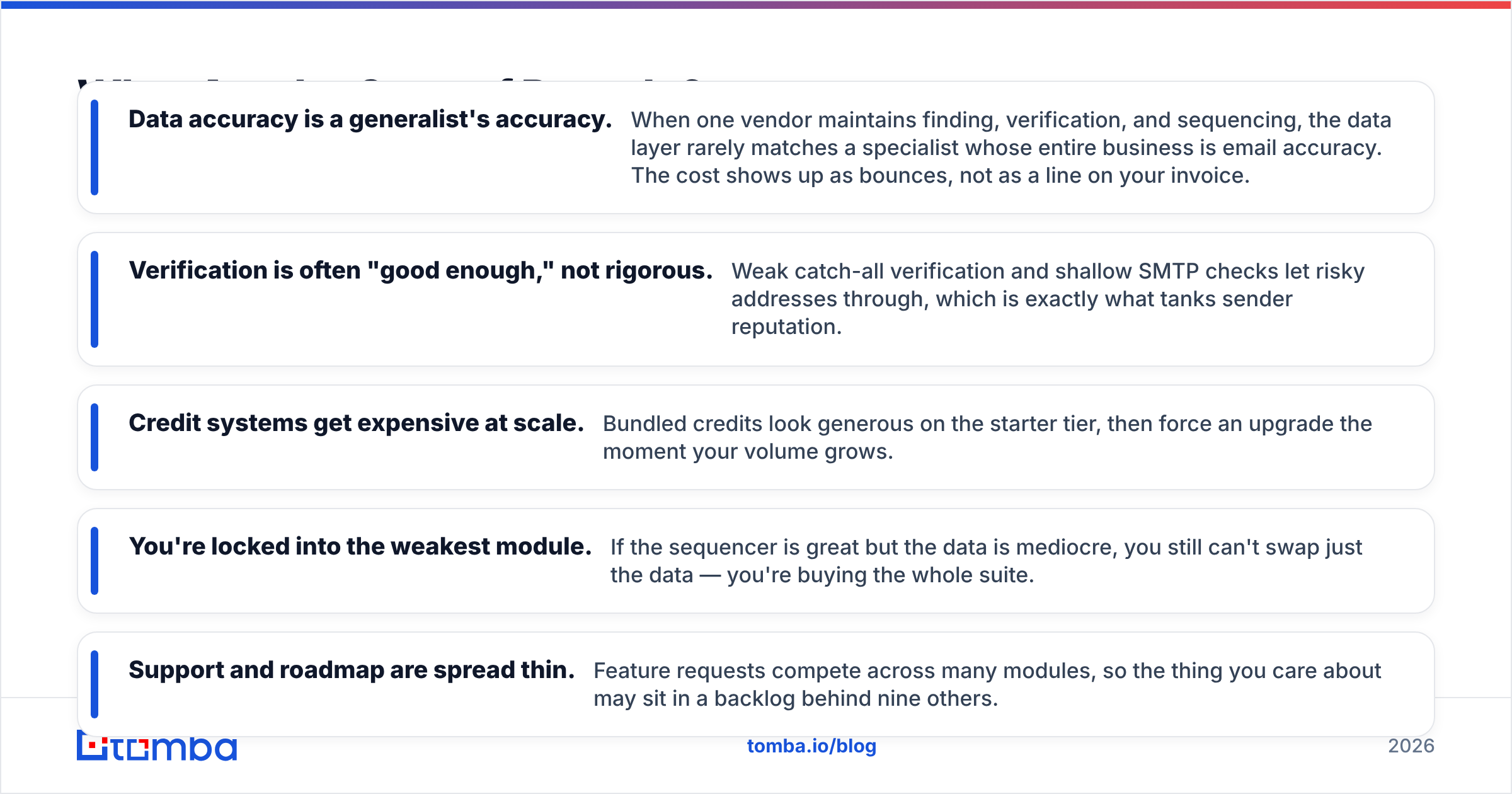
Now the other column. The recurring complaints about bundled prospecting suites — and the structural reasons behind them — show up here too:
- Data accuracy is a generalist's accuracy. When one vendor maintains finding, verification, and sequencing, the data layer rarely matches a specialist whose entire business is email accuracy. The cost shows up as bounces, not as a line on your invoice.
- Verification is often "good enough," not rigorous. Weak catch-all verification and shallow SMTP checks let risky addresses through, which is exactly what tanks sender reputation.
- Credit systems get expensive at scale. Bundled credits look generous on the starter tier, then force an upgrade the moment your volume grows.
- You're locked into the weakest module. If the sequencer is great but the data is mediocre, you still can't swap just the data — you're buying the whole suite.
- Support and roadmap are spread thin. Feature requests compete across many modules, so the thing you care about may sit in a backlog behind nine others.
None of this makes Boundo a bad product. It makes it a generalist product, and generalists cost you precision. In outbound, precision is the difference between landing in the inbox and landing in spam.
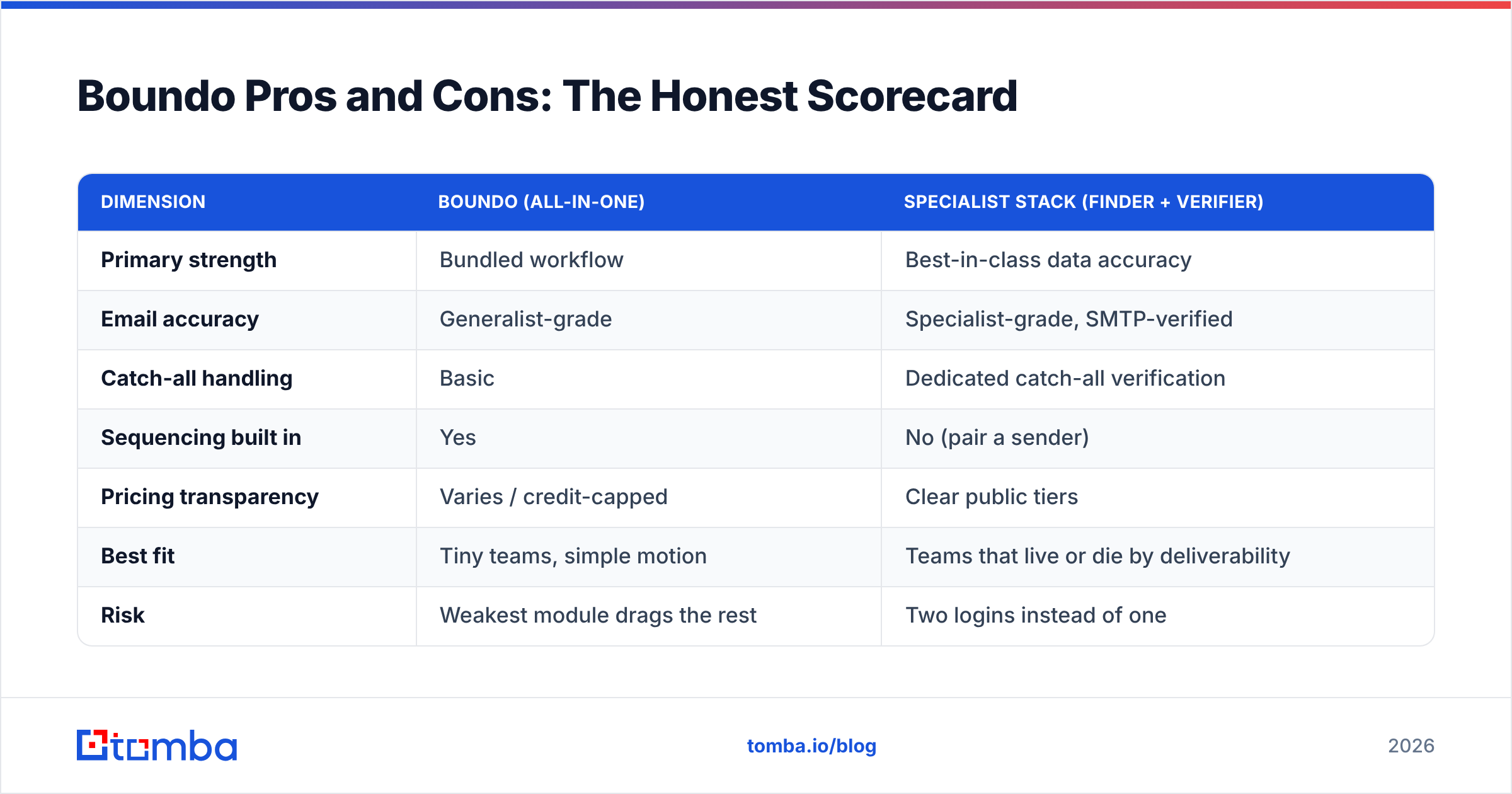
Boundo Pros and Cons: The Honest Scorecard#
Here's the trade-off summarized. Treat any pricing as directional — always confirm current numbers on the vendor's own page, since suite pricing changes often and credit caps vary by tier.
| Dimension | Boundo (all-in-one) | Specialist stack (finder + verifier) |
|---|---|---|
| Primary strength | Bundled workflow | Best-in-class data accuracy |
| Email accuracy | Generalist-grade | Specialist-grade, SMTP-verified |
| Catch-all handling | Basic | Dedicated catch-all verification |
| Sequencing built in | Yes | No (pair a sender) |
| Pricing transparency | Varies / credit-capped | Clear public tiers |
| Best fit | Tiny teams, simple motion | Teams that live or die by deliverability |
| Risk | Weakest module drags the rest | Two logins instead of one |
The pattern is consistent across every all-in-one review you'll read on G2 or Capterra: the suite wins on convenience, the specialist wins on the metric that actually moves pipeline. Which one matters more depends entirely on your volume and how much a bounce costs you.
How Does Boundo Compare to a Specialist Like Tomba?#
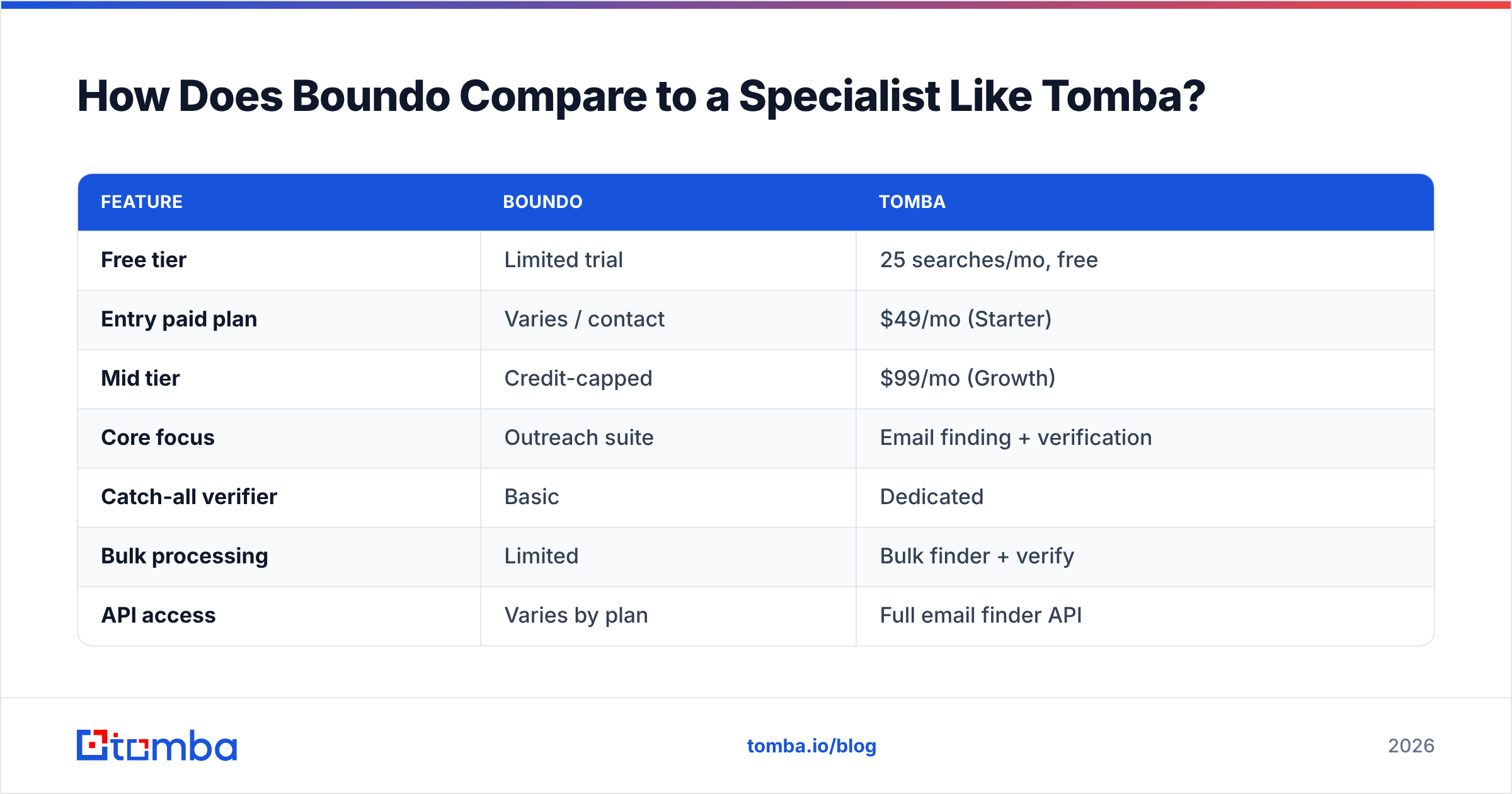
This is the real decision, so let's make it concrete. Boundo bundles. Tomba specializes. The two aren't competing on the same axis.
Tomba focuses on the data layer — finding and verifying professional emails accurately — and lets you bring your own sequencer. That separation is a feature, not a gap: you get specialist-grade accuracy on the part of the funnel where errors are most expensive, and you keep the freedom to send through whatever tool you already trust.
| Feature | Boundo | Tomba |
|---|---|---|
| Free tier | Limited trial | 25 searches/mo, free |
| Entry paid plan | Varies / contact | $49/mo (Starter) |
| Mid tier | Credit-capped | $99/mo (Growth) |
| Core focus | Outreach suite | Email finding + verification |
| Catch-all verifier | Basic | Dedicated |
| Bulk processing | Limited | Bulk finder + verify |
| API access | Varies by plan | Full email finder API |
If your bottleneck is "I need to send sequences and don't want a separate tool," Boundo's bundle has a logic to it. If your bottleneck is "half my list bounces and my domain reputation is suffering," no amount of bundled convenience fixes that — you need accurate data first. You can see Tomba's full pricing details laid out publicly, which is itself a contrast worth noting against credit-capped suites.

Does the All-in-One Trade-Off Actually Hurt Deliverability?#
Yes — and this is the part teams underestimate. Here's the chain of cause and effect.
Bundled finders cast a wider net to maximize coverage, because "we found a contact" is a better demo than "we found nothing." That coverage comes from guessed or loosely-validated addresses. When you send to them, some bounce. Bounces above roughly 2–3% start signaling to mailbox providers that you're not maintaining your list, and your sender reputation drops. Lower reputation means more of your good emails land in spam — so the weak data doesn't just waste the bad contacts, it poisons the deliverability of the good ones.
A specialist verifier breaks that chain. Real SMTP checks, dedicated catch-all logic, and syntax validation strip the risky addresses before you send. You email fewer people, but a far higher share of them actually exist — and your reputation stays intact. This is why mature outbound teams treat verification as non-negotiable infrastructure, not an optional add-on. HubSpot's own deliverability guidance echoes the same principle: list hygiene is the cheapest lever you have on inbox placement (see HubSpot's email resources).
So when you weigh the Boundo pros and cons, don't score "bundled verification" as a pro. Score it honestly as "verification that's adequate until your volume makes its gaps expensive."
When Should You Choose Boundo Anyway?#
Boundo is a defensible choice in specific situations, and it's worth naming them clearly:
- You're a one- or two-person team with a simple motion and no appetite for managing multiple tools.
- Your volume is low enough that a few extra bounces won't meaningfully dent your domain reputation.
- You value a single invoice and one onboarding over squeezing maximum accuracy out of your data.
- You don't already own a sequencer and want sending bundled in rather than bought separately.
If three of those four describe you, the convenience may genuinely outweigh the accuracy penalty. There's no shame in optimizing for simplicity when you're small.
When Should You Skip It for a Specialist Stack?#
Flip every one of those conditions and the math changes:
- You send at real volume — hundreds or thousands of emails a week — where bounce rate directly threatens deliverability.
- You already run a sequencer you like (Instantly, Smartlead, your CRM's native sender), so Boundo's bundled sending is redundant.
- Your deals are high-value, meaning one missed decision-maker because of bad data costs more than your entire tooling budget.
- You want to scale enrichment programmatically via data enrichment and an API rather than clicking through a UI.
In those cases, splitting the stack — a specialist finder and verifier for data, plus a sequencer you choose independently — beats the bundle on every metric that matters except number-of-logins. And that's a trade most serious teams make happily.
What's the Verdict on Boundo Pros and Cons?#
Bottom line: Boundo is a reasonable convenience play for tiny teams and a poor accuracy play for everyone else. The pros are real — integrated workflow, low sprawl, fast onboarding. The cons are structural, not fixable with a settings change — generalist data, soft verification, credit-capped pricing, and lock-in to the weakest module.
The deciding question is simple: what does a bounce cost you? If the answer is "not much," the bundle's simplicity wins. If the answer is "a damaged domain and missed pipeline," buy accuracy from a specialist and bolt sending on separately. Don't let "all-in-one" talk you into paying for convenience with deliverability — that bill always comes due later, and it's bigger than the subscription you saved on.
Get Accurate Contact Data Without the Bundle Tax#
If the part of Boundo that worries you is data quality — and it should be — start where it's cheapest to fix. The Tomba Email Finder gives you specialist-grade accuracy, real SMTP verification, dedicated catch-all handling, and a public, predictable price ladder: a free tier with 25 searches a month, Starter at $49/mo, and Growth at $99/mo. Keep the sequencer you already like, plug Tomba in for the data layer, and watch your bounce rate — and your sender reputation — recover. Run a few searches free, compare the hit rate against whatever you're using now, and let the accuracy make the case for you.
Ready to find emails that actually work?
Join 150,000+ professionals who stopped guessing and started sending. Free credits on signup — no credit card required.
Get the Tomba newsletter
Practical outbound tactics and product updates — once every two weeks.
About the author