Brand Go-To-Market Strategy: A Practical 2026 Playbook
A brand go-to-market strategy aligns positioning, demand, and sales motion around one story. Here's how to build one that actually moves pipeline in 2026.
TL;DR
- A brand go to market strategy is the plan that connects what you stand for (brand) with how you reach buyers (GTM) — positioning, demand, and sales motion working from one story instead of three.
- Most GTM failures aren't execution problems. They're alignment problems: marketing sells a vision, sales sells a feature, and the brand says something different from both.
- The winning 2026 model is brand-led but data-anchored — a sharp narrative on top of a clean ICP and accurate contact data, so messaging and targeting reinforce each other.
- You need four pillars: positioning, ICP and segmentation, channel motion (PLG, sales-led, or hybrid), and a measurement loop tied to pipeline — not vanity reach.
- The unglamorous prerequisite is data quality. A brilliant narrative aimed at the wrong inboxes still converts at zero.
What is a brand go-to-market strategy?#
A brand go-to-market strategy is the single plan that decides who you sell to, what you say, and how you reach them — with your brand as the connective tissue between all three.
Think of it like opening a restaurant. The food (your product) matters, but so does whether people understand what kind of place it is before they walk in. A taco stand and a tasting-menu restaurant can use the same ingredients and fail or thrive purely on how clearly they signal what they are, to whom, and why. Your brand is that signal. Your GTM strategy is the operations that get the right diners through the door at a price they'll pay.
Technically, a brand GTM strategy combines two things companies usually run in separate rooms:
- Brand strategy — positioning, narrative, category, and the emotional and rational reasons a buyer should care.
- Go-to-market strategy — ICP, segmentation, pricing, channels, sales motion, and the metrics that prove it's working.
When these are fused, every touchpoint says the same thing. A cold email, a landing page, a sales deck, and a billboard all ladder up to one promise. When they're split, you get the classic symptom: a beautiful brand campaign that generates traffic sales can't close, or an aggressive outbound machine that burns the brand's reputation one mistargeted message at a time.

Why do most go-to-market strategies fail?#
Most GTM strategies fail because of misalignment, not effort. Teams ship a lot of activity that points in slightly different directions, and the energy cancels out.
Here are the failure modes that show up again and again:
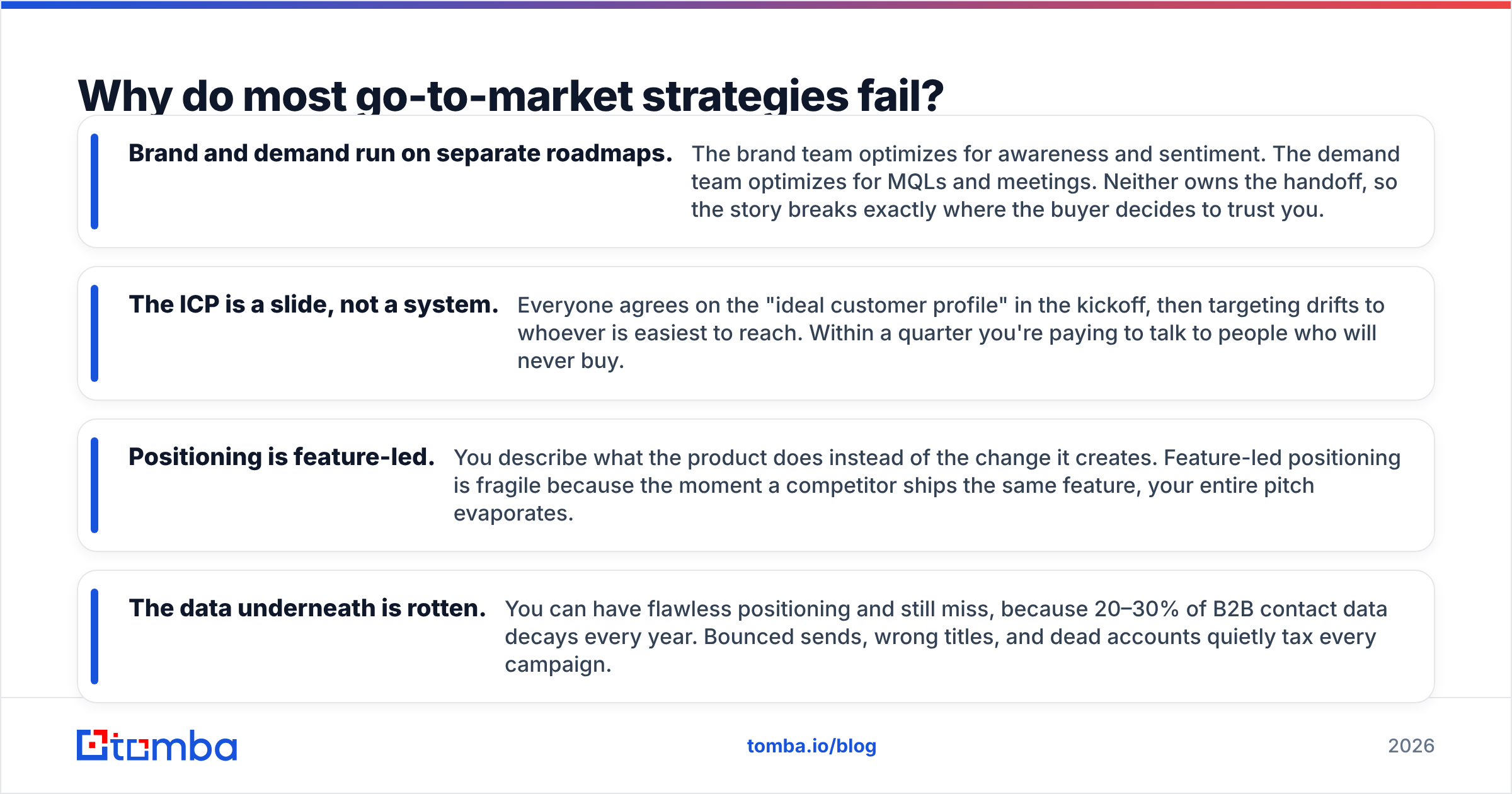
- Brand and demand run on separate roadmaps. The brand team optimizes for awareness and sentiment. The demand team optimizes for MQLs and meetings. Neither owns the handoff, so the story breaks exactly where the buyer decides to trust you.
- The ICP is a slide, not a system. Everyone agrees on the "ideal customer profile" in the kickoff, then targeting drifts to whoever is easiest to reach. Within a quarter you're paying to talk to people who will never buy.
- Positioning is feature-led. You describe what the product does instead of the change it creates. Feature-led positioning is fragile because the moment a competitor ships the same feature, your entire pitch evaporates.
- The data underneath is rotten. You can have flawless positioning and still miss, because 20–30% of B2B contact data decays every year. Bounced sends, wrong titles, and dead accounts quietly tax every campaign.
That last point is the one teams underestimate. A brand go-to-market strategy is only as good as the list it's aimed at. This is why the practical work of GTM keeps circling back to data hygiene — accurate emails, current roles, verified accounts. You can read more on how contact accuracy is sourced and maintained in Tomba's data sources breakdown, because "where does this contact come from" is a GTM question, not just an ops one.
What are the core pillars of a brand GTM strategy?#
A brand go-to-market strategy stands on four pillars. Skip one and the structure leans.
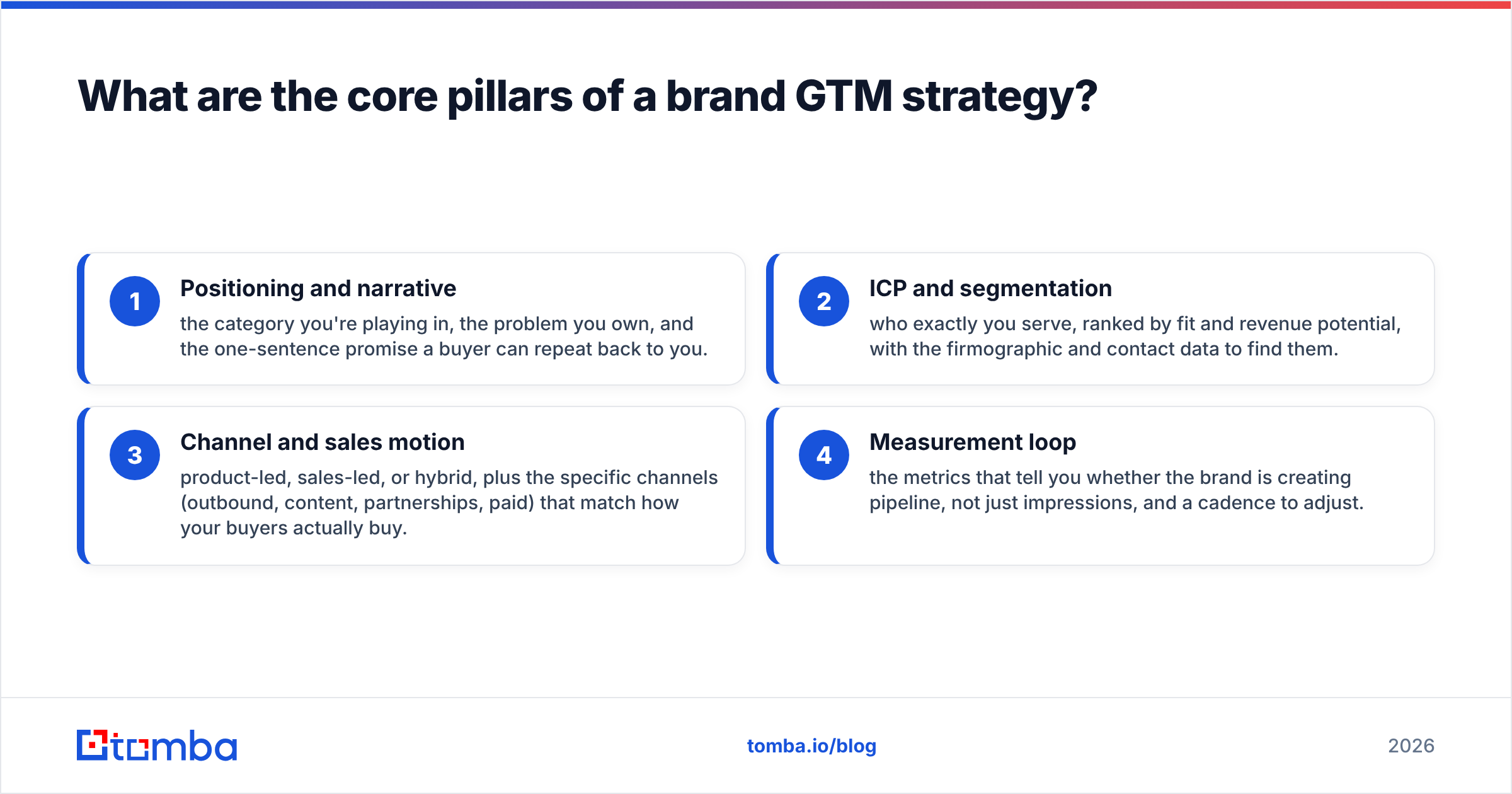
- Positioning and narrative — the category you're playing in, the problem you own, and the one-sentence promise a buyer can repeat back to you.
- ICP and segmentation — who exactly you serve, ranked by fit and revenue potential, with the firmographic and contact data to find them.
- Channel and sales motion — product-led, sales-led, or hybrid, plus the specific channels (outbound, content, partnerships, paid) that match how your buyers actually buy.
- Measurement loop — the metrics that tell you whether the brand is creating pipeline, not just impressions, and a cadence to adjust.
Each pillar feeds the next. Positioning defines the ICP. The ICP defines the channels. The channels define what you measure. Break the chain at any link and you're optimizing a part while the whole drifts.
How do you build a brand go-to-market strategy step by step?#
Build it in phases, and resist the urge to launch everything at once. A phased rollout lets you validate the narrative on a small, well-targeted audience before you spend real money scaling it.
Phase 1 — Sharpen positioning#
Start with the change you create, not the features you ship. Use a simple frame: for [ICP], who struggle with [problem], you are the [category] that [unique value], unlike [alternative]. Pressure-test it against real buyers. If a prospect can't repeat your promise after one conversation, it isn't sharp enough yet.
Phase 2 — Define and enrich the ICP#
Turn the ICP from a slide into a list. Specify firmographics (industry, size, geography, tech stack), the buying committee roles, and the trigger events that signal readiness. Then make it findable. This is where a domain search workflow earns its keep — you start from a target company and pull the verified emails of the exact roles in your buying committee, instead of guessing at info@ addresses. For larger lists, push it through a bulk email finder and enrich the rest with firmographic context.
Phase 3 — Choose the motion#
Match the motion to the buying behavior, not to fashion. The table below maps the three dominant motions to where each one wins.
Phase 4 — Build the measurement loop#
Decide your metrics before launch. Tie brand activity to pipeline-influenced revenue, not just reach. Instrument the handoff between marketing and sales so you can see where the story breaks. Review weekly at first, then settle into a monthly cadence once the signal stabilizes.

Which go-to-market motion fits your brand?#
The right motion depends on deal size, buyer behavior, and how self-serve your product can be. Here's a direct comparison.
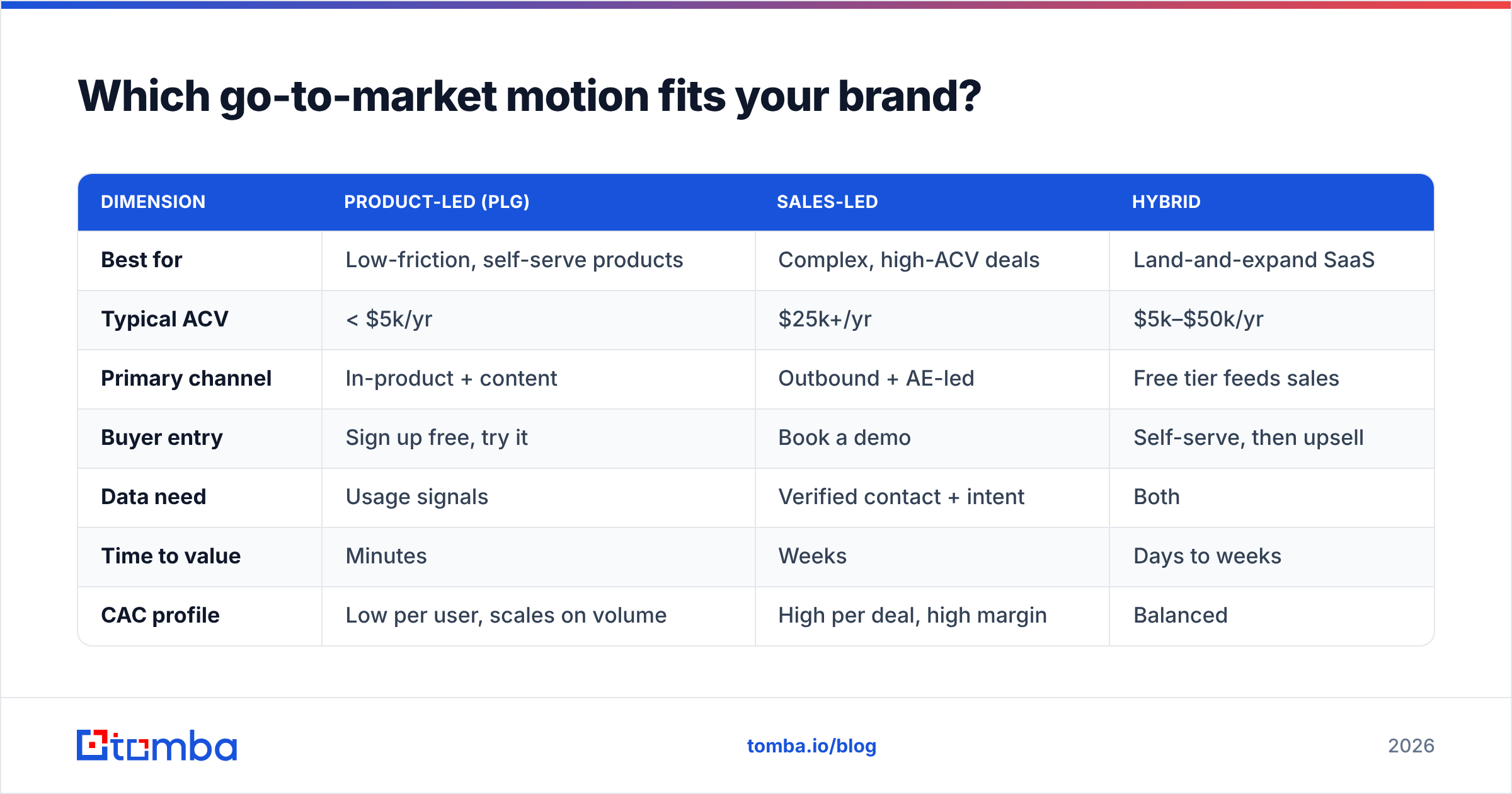
| Dimension | Product-Led (PLG) | Sales-Led | Hybrid |
|---|---|---|---|
| Best for | Low-friction, self-serve products | Complex, high-ACV deals | Land-and-expand SaaS |
| Typical ACV | < $5k/yr | $25k+/yr | $5k–$50k/yr |
| Primary channel | In-product + content | Outbound + AE-led | Free tier feeds sales |
| Buyer entry | Sign up free, try it | Book a demo | Self-serve, then upsell |
| Data need | Usage signals | Verified contact + intent | Both |
| Time to value | Minutes | Weeks | Days to weeks |
| CAC profile | Low per user, scales on volume | High per deal, high margin | Balanced |
Most B2B brands in 2026 land on hybrid, and the data layer is what makes hybrid work. A free tier surfaces engaged users; enrichment tells you which of those users sit in accounts worth a sales touch. If you want the deeper mechanics of automating that motion, the glossary entry on sales automation is a useful primer, and Gartner's research on B2B buying behavior is worth reading on how committees actually decide (gartner.com).
How does brand positioning connect to demand generation?#
Positioning and demand generation are not sequential steps — they're the same message at two volumes. Positioning is the quiet version you believe internally; demand gen is the loud version you broadcast. When they match, demand compounds because every impression reinforces a consistent promise. When they diverge, you pay twice: once to create awareness, again to re-explain yourself at the point of sale.
The connective tissue is your messaging hierarchy:
- Brand promise — the one line everything ladders to.
- Value pillars — the three or four proof points that support the promise.
- Channel messages — how each pillar shows up in an ad, an email, or a sales call.
A cold email is where this gets tested hardest, because there's no brand halo to coast on — just a subject line and a stranger's skepticism. If your outbound voice contradicts your brand voice, prospects feel the seam even if they can't name it. Tools like a subject line tester help you keep that first line on-brand and on-message, and HubSpot's research library is a solid reference for benchmarking demand-gen performance against your category (hubspot.com).
What metrics prove your GTM strategy is working?#
The metrics that matter are the ones tied to revenue, not reach. Impressions and follower counts tell you the brand was seen; they don't tell you it created a customer. Track these instead:
- Pipeline influenced by brand — the share of opportunities that touched a brand asset before converting. This is the single number that proves brand and demand are aligned.
- ICP fit rate — what percentage of generated leads actually match your ideal profile. A low rate means your targeting drifted, no matter how good the volume looks.
- Response and reply rate on outbound — a direct read on message-market fit. Falling response rate usually means the story stopped resonating, the data went stale, or both.
- Velocity — how fast fit leads move from first touch to closed-won. Strong positioning shortens this; weak positioning stretches it.
- CAC payback — months to recover the cost of acquiring a customer. The honest scoreboard for whether the whole motion is economical.
If your ICP fit rate is low, the fastest fix is almost never "more creative." It's better targeting and cleaner data. Verifying contacts before you send — with an email verifier — protects your sender reputation and keeps the fit-rate signal honest, so you're measuring message quality instead of measuring how many dead inboxes you hit.
How do you avoid the most common GTM mistakes?#
Avoid the predictable failures and you're ahead of most of the market. The recurring traps:
- Launching wide before validating narrow. Prove the narrative on a tight, well-chosen segment first. Scale spend only after the message converts on a small list.
- Treating the ICP as fixed. Markets move. Re-examine fit quarterly using closed-won data — let your best customers redraw the profile.
- Confusing activity with progress. More emails, more posts, more ads. Volume without targeting just accelerates the wrong outcome.
- Ignoring data decay. Roles change, companies merge, inboxes die. Refresh and re-verify your core lists on a schedule, not when results crater.
- Letting brand and sales drift apart. Run a shared messaging review monthly so the deck and the campaign keep telling one story.
The thread connecting every fix is the same: a sharp message aimed at the right person, verified to actually reach them. That's the unglamorous core of a brand go to market strategy, and it's where most of the leverage hides.
Putting it together#
A brand go-to-market strategy isn't a brand project or a sales project. It's the discipline of making them the same project — one story, one ideal customer, one motion, one scoreboard. Get the narrative sharp, the ICP specific, the motion matched to your buyers, and the measurement honest, and the parts stop fighting each other.
But none of it converts if your messages land in the wrong inboxes. The fastest, cheapest upgrade to almost any GTM plan is better contact data underneath it. Start by building accurate, verified target lists with the Tomba Email Finder — find the exact decision-makers in your ICP by name, company, or domain, verify them before you send, and aim your brand's best story at the people most likely to buy it. You can try it on the free tier (25 searches/month) and scale to a paid plan once the motion proves out; see Tomba pricing for the Starter ($49/mo), Growth ($99/mo), and Pro ($249/mo) tiers. A great narrative deserves an accurate audience.
// get started
Find, verify and enrich your first contacts today
Start on the free plan with 25 searches a month, then scale when your team is ready.
Free plan · No credit card required · GDPR & CCPA
// about the author