Brandnav Pricing 2026: Plans, Costs, and Top Alternatives
A clear, no-spin breakdown of Brandnav pricing in 2026 — what each plan really costs, where credits get expensive, and how it stacks up against flat-rate alternatives.

Brandnav markets itself as an all-in-one B2B data and email-enrichment platform, but the one question buyers actually ask first is the hardest to answer from the marketing site: what does Brandnav pricing actually cost once you run real volume? This guide answers that directly, then shows you how the credit math compares to flat-rate tools so you can pick without regret.
TL;DR — Brandnav pricing at a glance#
- Brandnav uses a credit-based model, so your real cost depends on how many lookups, verifications, and enrichments you burn — not the sticker price on the plan.
- Entry tiers look cheap, but per-credit cost climbs fast when you bulk-enrich lists or hit catch-all domains that consume extra credits.
- The biggest "hidden" cost is wasted credits spent on stale or unverifiable contacts — a problem that follows every credit-metered tool.
- Flat-rate alternatives like Tomba pricing start at a free tier (25 searches/mo) and a $49/mo Starter plan, which is easier to forecast than variable credits.
- Best move: estimate your monthly contact volume first, then compare cost-per-verified-email — not cost-per-plan.
What is Brandnav and who is it for?#
Brandnav is a B2B data platform that bundles email finding, email verification, and contact/company enrichment into a single dashboard and API. The pitch is consolidation: instead of stitching together a finder, a verifier, and an enrichment vendor, you get one credit balance that powers all of them.
That convenience is real, and for teams that want a single bill it can be attractive. The trade-off is that a shared credit pool makes your spend harder to predict. Every action — a domain search, a single email lookup, a verification, a data-enrichment call — draws down the same balance at different rates. So "how much is Brandnav?" is genuinely answered by "how do you plan to use it?"
If you're a solo founder doing a few hundred lookups a month, the entry tier is fine. If you're a sales or RevOps team enriching tens of thousands of rows, the credit math is where the decision is won or lost.
How does Brandnav pricing work in 2026?#
Brandnav prices on monthly or annual credit packages, with higher tiers offering a lower effective cost per credit and unlocking API access, bulk processing, and team seats. Like most data vendors, exact published numbers shift over time and some tiers are quote-based, so always confirm the live figure on the official Brandnav site before you commit.
Here's the structure you should expect, and the questions that actually move your bill:
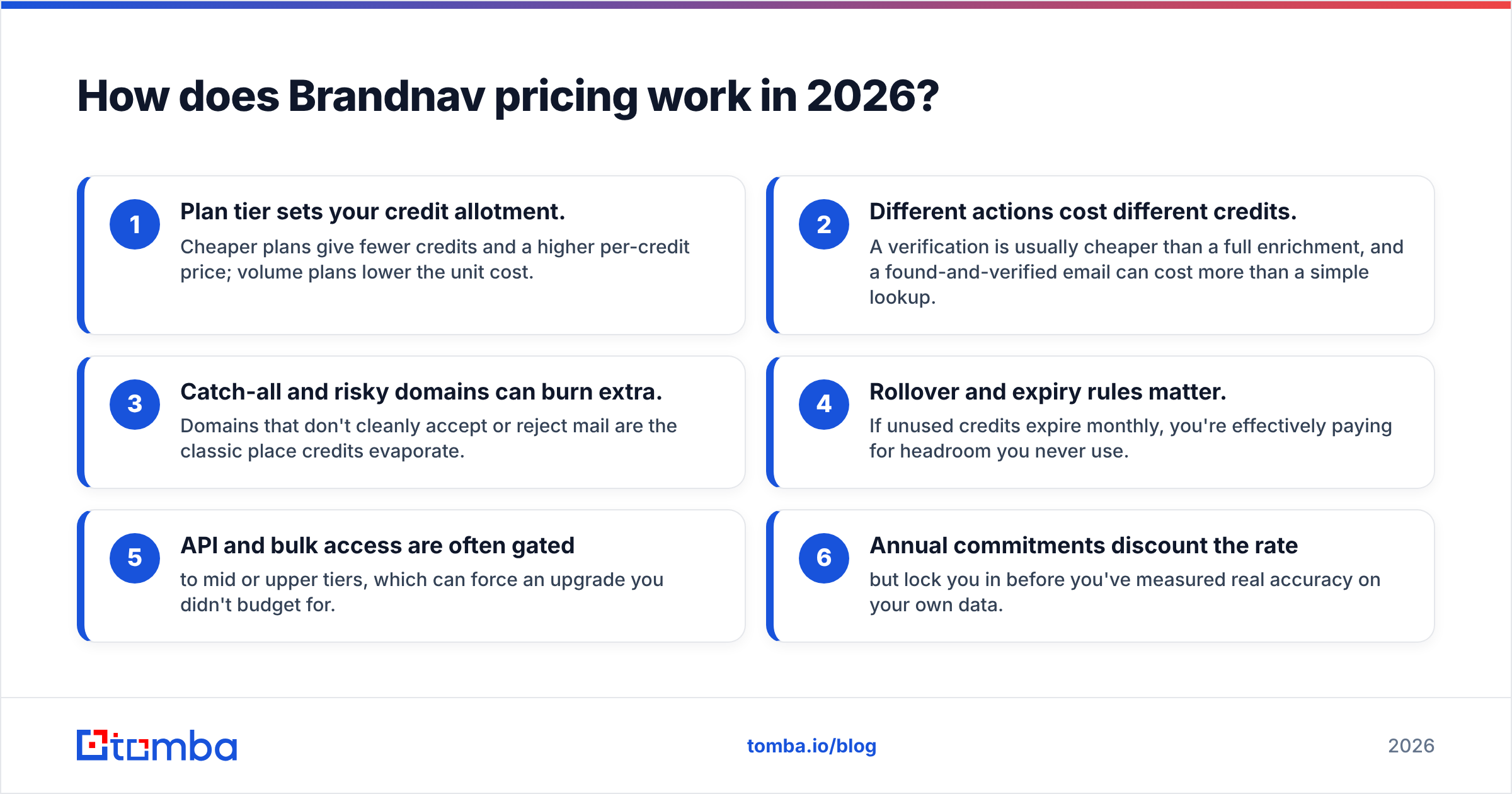
- Plan tier sets your credit allotment. Cheaper plans give fewer credits and a higher per-credit price; volume plans lower the unit cost.
- Different actions cost different credits. A verification is usually cheaper than a full enrichment, and a found-and-verified email can cost more than a simple lookup.
- Catch-all and risky domains can burn extra. Domains that don't cleanly accept or reject mail are the classic place credits evaporate.
- Rollover and expiry rules matter. If unused credits expire monthly, you're effectively paying for headroom you never use.
- API and bulk access are often gated to mid or upper tiers, which can force an upgrade you didn't budget for.
- Annual commitments discount the rate but lock you in before you've measured real accuracy on your own data.
Because of point 2 and 3, the only honest way to compare Brandnav pricing to anything else is cost per verified, usable contact — not the headline price. A plan that looks 20% cheaper but wastes 30% of credits on dead addresses is the more expensive plan.
How accurate is the data you're paying for?#
Pricing is meaningless without accuracy, because a cheap credit spent on a wrong email is money lost twice — once on the credit, once on the bounce that hurts your sender reputation. When you compare any email-data vendor, weigh the match rate and bounce rate alongside the price.

The practical test is simple: take a known sample of 200–500 contacts in your niche, run them through each tool's trial, and measure three numbers — match rate (did it return an address?), verification accuracy (did the address actually exist?), and bounce rate when you send. Vendors that quote a single blended "98% accuracy" without splitting found-vs-verified are usually rounding up. A good email verifier should give you a clear deliverable / risky / undeliverable signal so you don't pay to send to a guess.
Brandnav pricing vs. flat-rate alternatives#
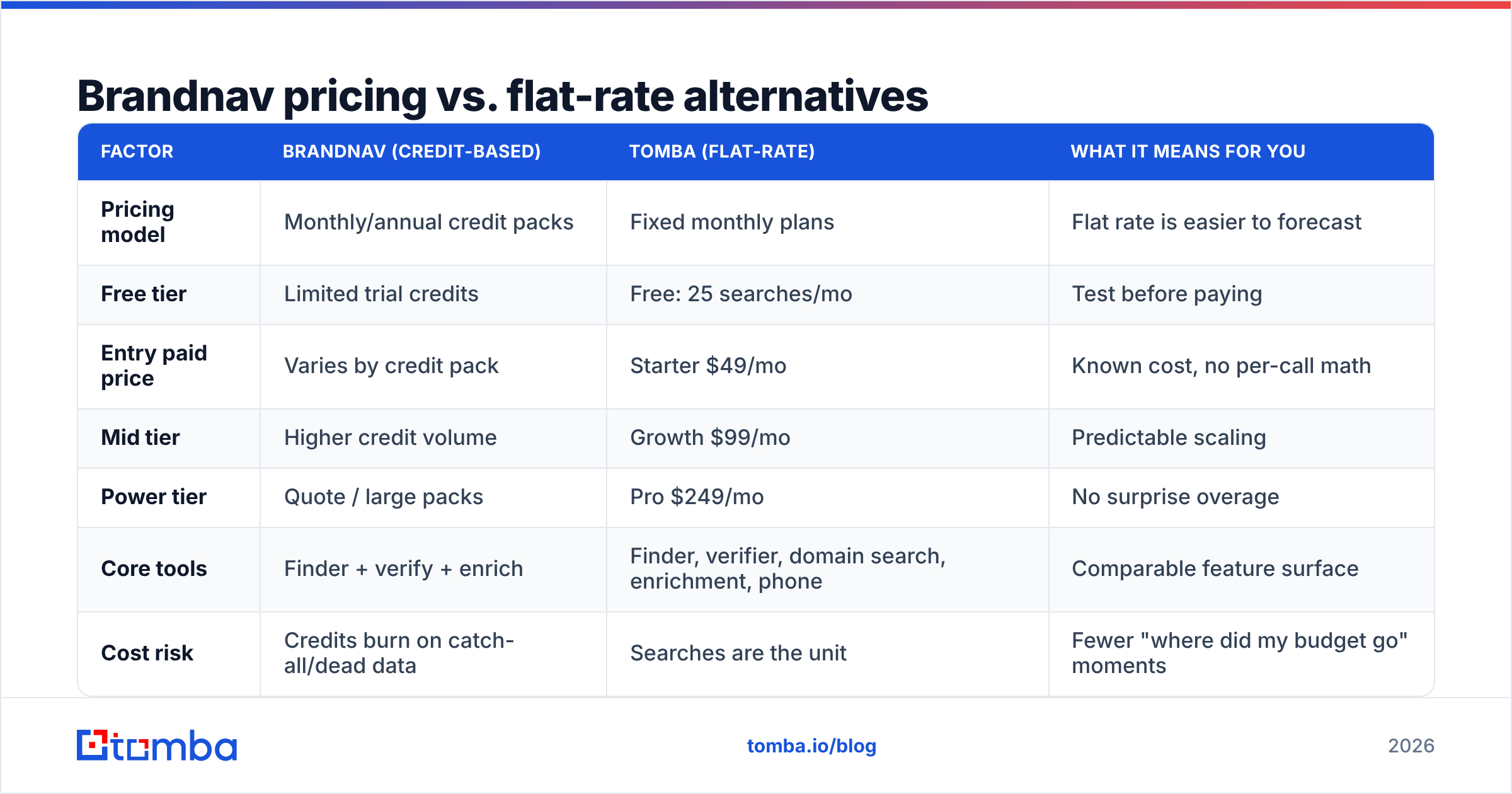
The cleanest contrast in the market is variable credits vs. predictable flat-rate plans. Below is a structural comparison so you can see where each model wins. Treat the Brandnav column as representative of credit-metered platforms generally; confirm exact live numbers on their site.
| Factor | Brandnav (credit-based) | Tomba (flat-rate) | What it means for you |
|---|---|---|---|
| Pricing model | Monthly/annual credit packs | Fixed monthly plans | Flat rate is easier to forecast |
| Free tier | Limited trial credits | Free: 25 searches/mo | Test before paying |
| Entry paid price | Varies by credit pack | Starter $49/mo | Known cost, no per-call math |
| Mid tier | Higher credit volume | Growth $99/mo | Predictable scaling |
| Power tier | Quote / large packs | Pro $249/mo | No surprise overage |
| Core tools | Finder + verify + enrich | Finder, verifier, domain search, enrichment, phone | Comparable feature surface |
| Cost risk | Credits burn on catch-all/dead data | Searches are the unit | Fewer "where did my budget go" moments |
| API access | Often gated to higher tiers | Available on plans | Check tier before building |
The takeaway isn't "credits are bad." It's that credit models reward heavy, predictable usage and punish messy, exploratory usage. If your monthly volume swings, a flat plan removes the anxiety of watching a balance tick down mid-campaign.
What hidden costs should you watch for?#
Three line items quietly inflate the total cost of any credit-based platform, Brandnav included:
- Credits spent on unverifiable contacts. If a found email can't be confirmed, you still paid the credit. Tools that bundle finding and verifying without double-charging save you here.
- Catch-all domains. Many company domains accept all mail, so verification is ambiguous. Decide upfront whether you'll pay to chase those or skip them. A dedicated catch-all verifier helps you handle them deliberately instead of bleeding credits.
- List decay and re-enrichment. B2B data goes stale at roughly 2–3% per month as people change jobs, so an annual plan means re-spending credits to refresh the same contacts. Budget for refresh cycles, not just the initial pull.
For context on how data-vendor pricing and accuracy are evaluated across the category, third-party review sites like G2 and Capterra aggregate verified-user feedback on exactly these pain points — worth a scan before you sign an annual deal.
Is Brandnav worth it, or should you switch?#
Brandnav is worth it if you want one consolidated platform for finding, verifying, and enriching, your monthly volume is steady, and you've validated accuracy on your own sample data. The single-bill simplicity is a legitimate operational win for some teams.
Consider a flat-rate alternative if any of these are true:
- Your usage is spiky — campaign bursts, then quiet weeks. Credits you don't use shouldn't expire on you.
- You want a hard, predictable monthly number for finance, not a balance you have to babysit.
- You mostly need finding + verification, and the heavier enrichment suite is more than you'll use.
- You're testing the waters and a real free tier beats a short credit trial.
This is where Tomba's email finder and its companion tools fit. You get a free tier to validate accuracy on your own list, then flat plans — Starter $49/mo, Growth $99/mo, Pro $249/mo — that don't change based on how many catch-all domains you happened to hit this week. The same account covers data enrichment, domain search, and verification, so you keep the all-in-one convenience without the variable-credit anxiety.
How do you actually compare the two for your team?#
Run this four-step evaluation before paying either vendor a cent:
- Step 1 — Size your volume. Estimate verified contacts needed per month. Multiply by 12 for the annual picture.
- Step 2 — Run identical samples. Use both free trials on the same 200–500 contacts. Measure match rate, verification accuracy, and real-world bounce rate.
- Step 3 — Compute cost per verified contact. Divide what you'd pay by the contacts that survived verification. This is the only number that matters.
- Step 4 — Stress-test the edge cases. Throw catch-all domains and small-company domains at both. See which one drains budget on ambiguous results.
Whichever tool wins your cost-per-verified-contact test is the right answer for your data — regardless of which has the prettier dashboard.

Frequently asked questions about Brandnav pricing#
Does Brandnav have a free plan? It typically offers limited trial credits rather than an ongoing free tier. If a permanent free allowance matters to you, a tool with a standing free plan (like Tomba's 25 free searches/month) lets you test indefinitely before paying.
Why did my Brandnav credits run out faster than expected? Almost always catch-all domains and enrichment calls. Mixed actions draw from one balance at different rates, so a list heavy on ambiguous domains burns disproportionately.
Is annual cheaper than monthly? Usually yes on the unit rate, but you commit before measuring accuracy on your own data and before accounting for list decay refreshes. Validate first, commit second.
How does Brandnav pricing compare to Tomba? Brandnav is credit-metered; Tomba is flat-rate. For steady, high volume the credit model can win on unit cost; for variable or exploratory usage, flat-rate is more predictable and easier to budget.
The bottom line#
Brandnav pricing is competitive if your usage is steady and you've proven the accuracy on your own contacts — but the credit model quietly punishes spiky, exploratory, or catch-all-heavy workflows, and the only metric that protects your budget is cost per verified contact, not the plan sticker.
If you'd rather not babysit a credit balance, start with a tool that lets you forecast spend to the dollar. Tomba's Email Finder gives you a free tier to test accuracy on your own list, then flat $49/$99/$249 plans that cover finding, verifying, domain search, and enrichment from one predictable bill. Run the same sample through both, compare cost per verified contact, and let your data decide.
// get started
Find, verify and enrich your first contacts today
Start on the free plan with 25 searches a month, then scale when your team is ready.
Free plan · No credit card required · GDPR & CCPA
// about the author