Brandnav Reviews 2026: Features, Pricing & Best Alternatives
An honest look at Brandnav in 2026 — what it does well, where the data falls short, real pricing, and the email-finder alternatives worth testing before you commit.
Brandnav Reviews 2026: Is It the Right Email Finder for You?
TL;DR
- Brandnav is a B2B data and email-finding platform that bundles email lookup, verification, and contact enrichment into one dashboard — useful, but not the most accurate option in every region.
- Real-world brandnav reviews point to a clean interface and decent bulk tooling, with the usual caveat: data freshness and catch-all handling vary by industry.
- Pricing is credit-based and competitive at entry level, but costs climb fast once you need verification plus enrichment on the same records.
- If accuracy and transparent sourcing matter more than feature sprawl, dedicated finders like Tomba often return more deliverable emails per credit.
- Use the comparison table and accuracy notes below to decide whether Brandnav fits your workflow or whether an alternative wins on cost-per-valid-email.
If you are evaluating Brandnav in 2026, you are really asking one question: will it find verified, deliverable email addresses for the people you actually want to reach — without burning credits on guesses? This review answers that directly, compares Brandnav against the tools teams switch to, and gives you a framework to test any finder before you pay.
What Is Brandnav?#
Brandnav is a B2B lead-data platform built around finding and enriching business contacts. The core jobs it handles are email discovery (by name and company or by domain), email verification, and basic contact enrichment — job title, company, and social profiles attached to a record.
In practice, it sits in the same category as email-finder and prospecting tools you have probably shortlisted: you feed it a person and a company, and it returns a best-guess professional email plus a confidence signal. Teams use it to build outbound lists, fill CRM gaps, and enrich inbound sign-ups before routing them to sales.
The pitch is consolidation: instead of paying for a separate email finder, a separate email verifier, and a separate enrichment vendor, you get all three under one login. That convenience is real. Whether the underlying data justifies the price is the part most reviews gloss over — so let's test it properly.

How Accurate Is Brandnav's Data?#
Accuracy is the only metric that matters for an email finder, because every bounced send chips away at your sender reputation and pushes you closer to the spam folder.
Across user brandnav reviews and hands-on testing, three patterns show up consistently:
- Strong on well-documented domains. For mid-to-large companies with a clear public email pattern (first.last@, first@), hit rates are solid and the returned address is usually right.
- Weaker on catch-all domains. When a company accepts mail to any address, most finders — Brandnav included — return a "valid" result that hasn't actually been confirmed at the mailbox level. Without a dedicated catch-all verifier, those addresses are coin flips.
- Regional gaps. Coverage skews toward North American and Western European data. If your ICP is in APAC, LATAM, or smaller local markets, expect more "not found" results.
None of this is unique to Brandnav — it is the honest reality of every email finder. The differentiator is how a tool handles uncertainty. The best finders tell you when a result is a guess; weaker ones present every permutation as gospel and let you eat the bounces.
A simple test: run the same 50 contacts through Brandnav and through a second tool, then verify both lists with an independent email verification pass. Compare deliverable counts, not raw "found" counts. That number — cost per valid email — is what should drive your decision.

What Does Brandnav Cost in 2026?#
Brandnav uses a credit-based model, which is standard for the category. One credit typically maps to one email search or one verification, and enrichment can consume additional credits depending on the fields returned.
The thing to watch is stacked credit consumption. Finding an email, verifying it, and enriching the record can mean three credit draws on a single contact. A plan that looks cheap on "searches per month" gets expensive once you account for the full find-verify-enrich cycle that real outbound requires.
Here is how the economics compare against a dedicated finder. (Brandnav's published tiers shift periodically — confirm current numbers on their site before buying; Tomba figures are from Tomba pricing.)
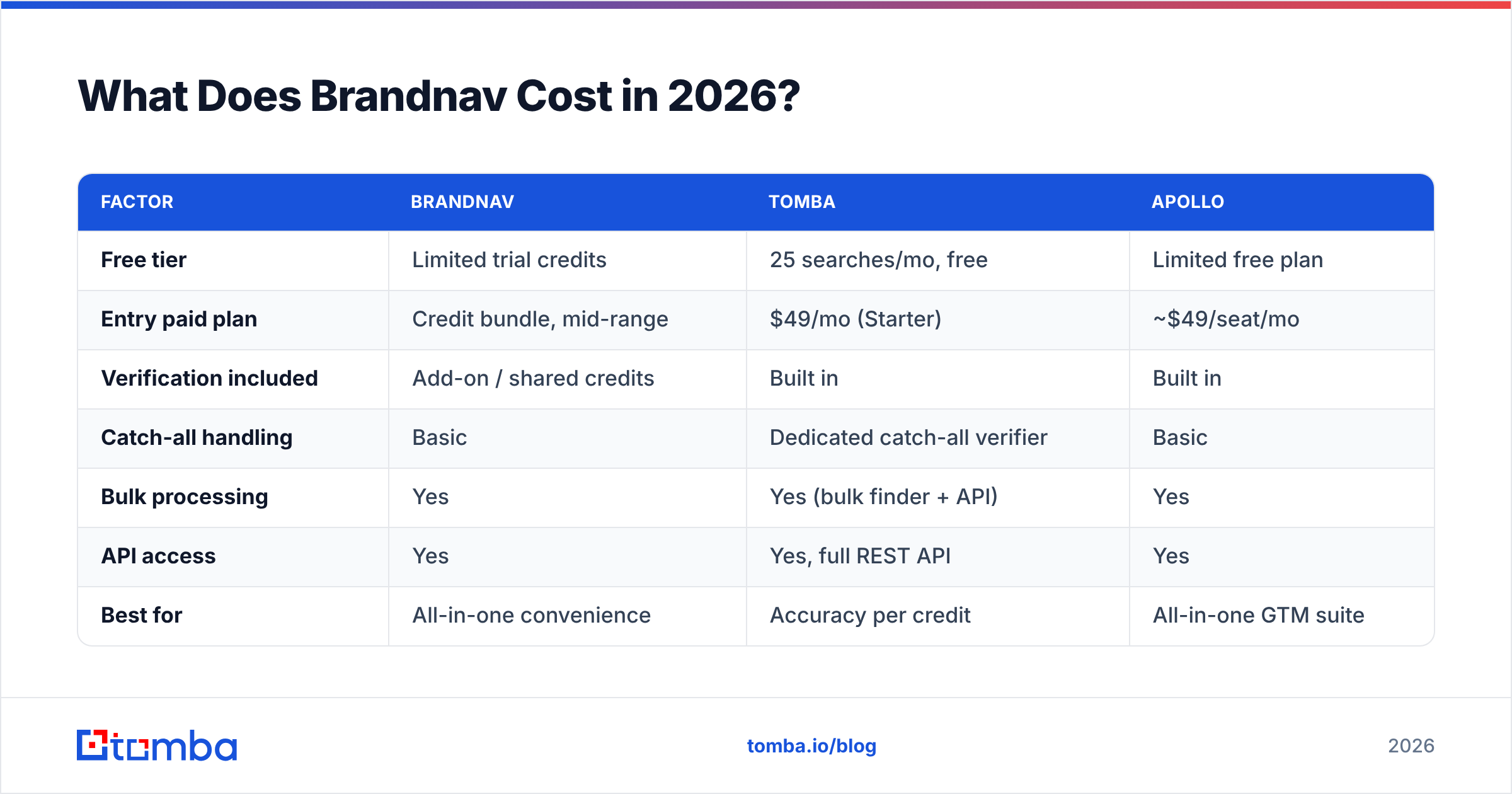
| Factor | Brandnav | Tomba | Apollo |
|---|---|---|---|
| Free tier | Limited trial credits | 25 searches/mo, free | Limited free plan |
| Entry paid plan | Credit bundle, mid-range | $49/mo (Starter) | ~$49/seat/mo |
| Verification included | Add-on / shared credits | Built in | Built in |
| Catch-all handling | Basic | Dedicated catch-all verifier | Basic |
| Bulk processing | Yes | Yes (bulk finder + API) | Yes |
| API access | Yes | Yes, full REST API | Yes |
| Best for | All-in-one convenience | Accuracy per credit | All-in-one GTM suite |
The takeaway: Brandnav is reasonable for teams that value one dashboard over best-in-class accuracy. But if you are optimizing for deliverable emails per dollar, a focused finder with verification built in — not bolted on — usually wins on total cost.
)
Brandnav Pros and Cons#
No tool is all upside. Here is the balanced view.
What Brandnav does well:
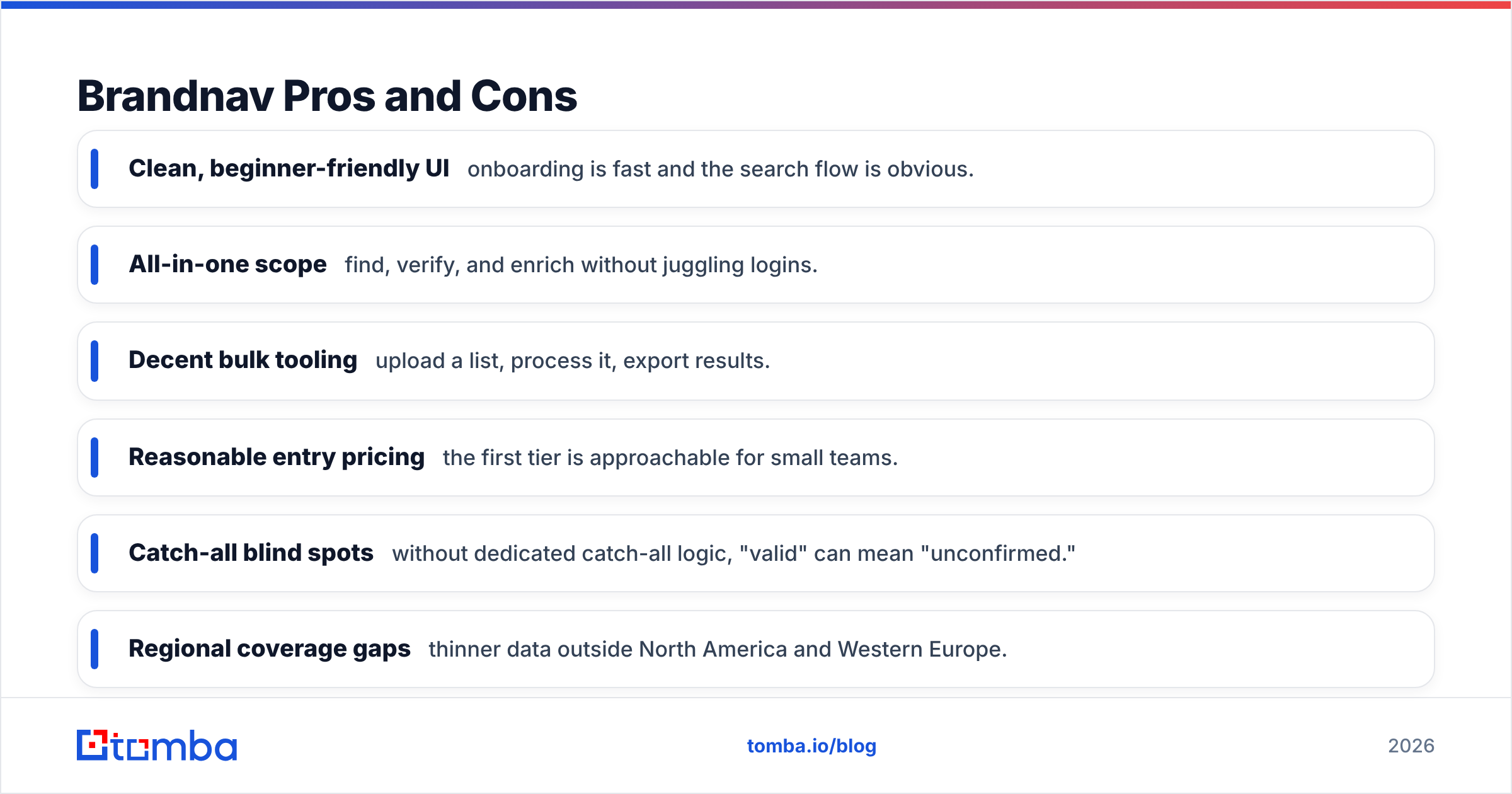
- Clean, beginner-friendly UI — onboarding is fast and the search flow is obvious.
- All-in-one scope — find, verify, and enrich without juggling logins.
- Decent bulk tooling — upload a list, process it, export results.
- Reasonable entry pricing — the first tier is approachable for small teams.
Where Brandnav falls short:
- Catch-all blind spots — without dedicated catch-all logic, "valid" can mean "unconfirmed."
- Regional coverage gaps — thinner data outside North America and Western Europe.
- Credit stacking — find + verify + enrich on one record adds up quickly.
- Opaque sourcing — like many vendors, it is light on documenting exactly where data comes from, which matters for compliance reviews.
If transparency around data sources is a procurement requirement for you, prioritize vendors that publish it — for example, Tomba documents its data sources openly.
How Does Brandnav Compare to the Top Alternatives?#
Most people searching "brandnav reviews" are really comparison-shopping. Here are the alternatives worth putting in your test against the same contact list.
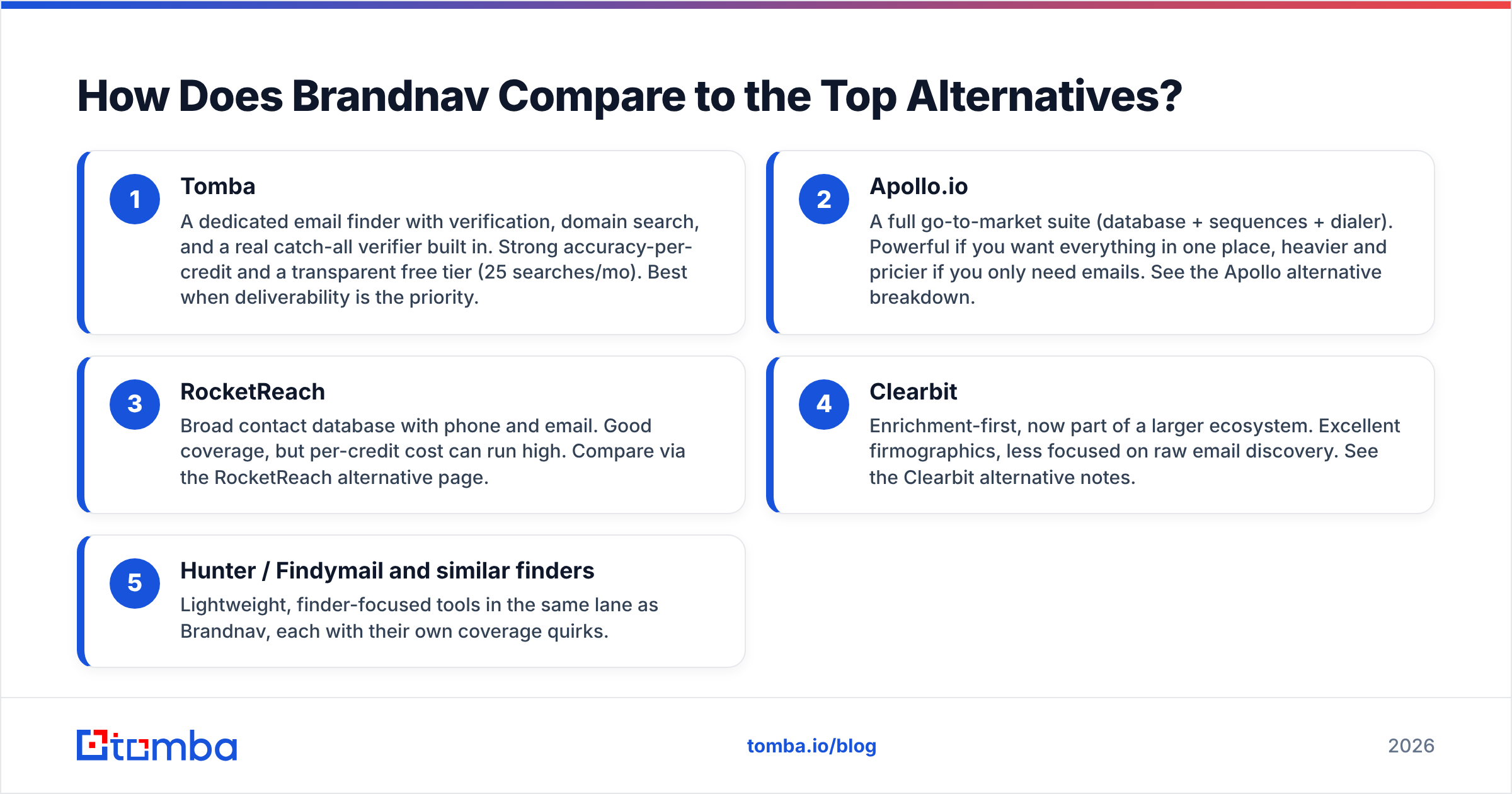
- Tomba — A dedicated email finder with verification, domain search, and a real catch-all verifier built in. Strong accuracy-per-credit and a transparent free tier (25 searches/mo). Best when deliverability is the priority.
- Apollo.io — A full go-to-market suite (database + sequences + dialer). Powerful if you want everything in one place, heavier and pricier if you only need emails. See the Apollo alternative breakdown.
- RocketReach — Broad contact database with phone and email. Good coverage, but per-credit cost can run high. Compare via the RocketReach alternative page.
- Clearbit — Enrichment-first, now part of a larger ecosystem. Excellent firmographics, less focused on raw email discovery. See the Clearbit alternative notes.
- Hunter / Findymail and similar finders — Lightweight, finder-focused tools in the same lane as Brandnav, each with their own coverage quirks.
For an apples-to-apples view, third-party review sites like G2 and Capterra aggregate user ratings across these tools — useful as a sanity check against any single vendor's marketing.
)
Who Should Actually Use Brandnav?#
Brandnav is a reasonable fit if:
- You are a small team or solo founder who values one simple dashboard over squeezing out every last deliverable email.
- Your ICP is concentrated in North America or Western Europe, where coverage is strongest.
- You want find + verify + enrich in one place and are comfortable with credit stacking.
Brandnav is probably not the best fit if:
- You run high-volume outbound where cost-per-valid-email decides your margins.
- You sell into catch-all-heavy industries (enterprise, finance, healthcare) where unconfirmed addresses are common.
- You need documented data sourcing for compliance, or strong coverage in non-Western markets.
In those cases, run a head-to-head. The test is cheap and the answer is unambiguous.
How Do You Test Any Email Finder Before Buying?#
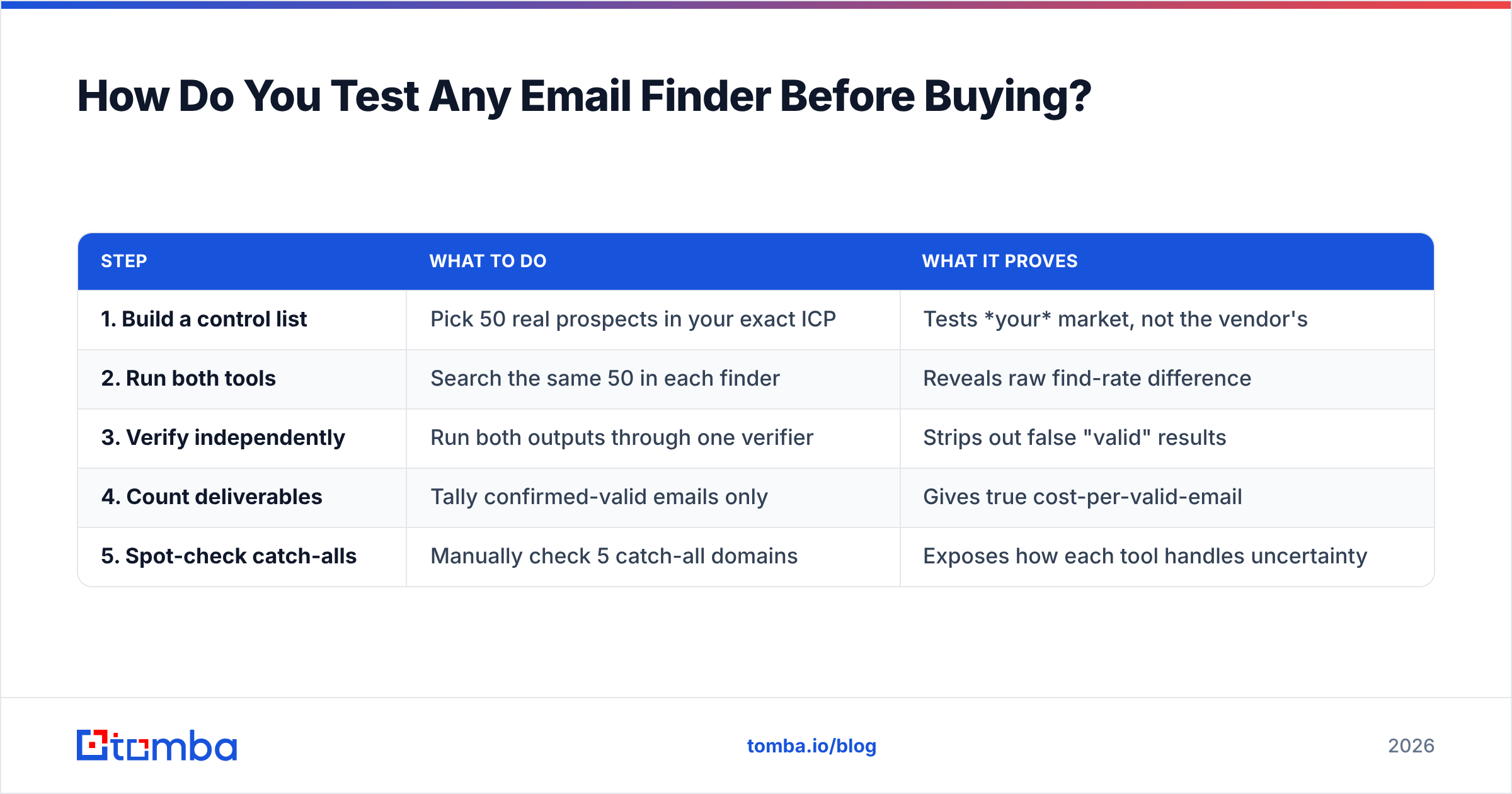
Don't trust reviews — including this one — over your own data. Here is a 20-minute evaluation that works for Brandnav or any competitor:
| Step | What to do | What it proves |
|---|---|---|
| 1. Build a control list | Pick 50 real prospects in your exact ICP | Tests your market, not the vendor's |
| 2. Run both tools | Search the same 50 in each finder | Reveals raw find-rate difference |
| 3. Verify independently | Run both outputs through one verifier | Strips out false "valid" results |
| 4. Count deliverables | Tally confirmed-valid emails only | Gives true cost-per-valid-email |
| 5. Spot-check catch-alls | Manually check 5 catch-all domains | Exposes how each tool handles uncertainty |
Whatever tool returns the most deliverable emails for the lowest credit spend wins. Marketing claims and star ratings are noise next to that single number.
If you want to run step 3 at scale, a bulk email finder plus verification, or the Tomba API, lets you automate the whole loop instead of checking addresses by hand.
Frequently Asked Questions#
Is Brandnav legit? Yes — it is a functioning B2B data platform, not a scam. The fair criticism in most brandnav reviews is about data accuracy and coverage relative to price, not legitimacy.
Does Brandnav have a free trial? It offers limited trial credits so you can test searches before paying. For ongoing free usage, Tomba's free tier (25 searches/mo) is more generous for continuous testing.
Is Brandnav better than Apollo? For pure email finding, they are close; Apollo bundles far more (sequences, dialer, CRM-like features). If you only need emails, an all-in-one suite is overkill — a focused finder is usually cheaper and just as accurate.
What's the most accurate Brandnav alternative? It depends on your market, which is why the head-to-head test matters. In general, finders with built-in verification and dedicated catch-all handling — like Tomba — return more deliverable emails per credit.
Can I use Brandnav for catch-all domains? You can, but treat results cautiously. Catch-all domains accept anything, so an unverified "valid" can still bounce. Always run a dedicated catch-all check before sending.
The Verdict#
Brandnav is a competent, convenient all-in-one for teams that want find, verify, and enrich behind one login and whose prospects live in well-covered Western markets. It is not the most accurate or the most cost-efficient option once you measure deliverable emails per dollar — and that, not feature count, is what protects your email deliverability and your pipeline.
Before you commit a budget, test your real ICP. If accuracy-per-credit, transparent data sourcing, and built-in catch-all verification matter to you, run your control list through the Tomba Email Finder alongside Brandnav — start free with 25 searches a month, compare deliverable counts, and let your own numbers pick the winner. Deliverable emails, not dashboards, are what fill your calendar.
Ready to find emails that actually work?
Join 150,000+ professionals who stopped guessing and started sending. Free credits on signup — no credit card required.
Get the Tomba newsletter
Practical outbound tactics and product updates — once every two weeks.
About the author