Brandnav vs Exactverify: Email Verification Compared 2026
Brandnav vs Exactverify, head to head on accuracy, catch-all handling, pricing, and API speed — plus where a finder-first stack like Tomba fits.
Choosing between Brandnav and Exactverify usually comes down to one question you can't afford to get wrong: which one actually keeps your bounce rate under 2%? Both market themselves as accurate email verifiers, both have free tiers, and both will happily run your list. The differences show up in the details — catch-all handling, API latency, pricing at volume, and what happens when you need to find emails, not just clean them.
This is a neutral breakdown of where each tool wins, where each one stumbles, and how a finder-first platform changes the math entirely.
TL;DR#
- Brandnav leans toward an all-in-one branding and data suite, with verification as one module — good if you want a single dashboard, weaker if verification depth is your priority.
- Exactverify is a focused, verification-only tool with competitive bulk pricing — strong on throughput, thinner on enrichment and finding.
- Accuracy is close on clean lists but diverges on catch-all and role-based addresses, which is where most real-world bounces hide.
- Neither finds emails for you. If your bottleneck is sourcing verified contacts (not just scrubbing a list you already own), you need a finder + verifier together.
- Tomba combines an email finder and email verifier in one workflow, starting at $49/mo — covering the step both Brandnav and Exactverify skip.
What do Brandnav and Exactverify actually do?#
Start with scope, because these two tools are not the same shape.
Brandnav positions itself as a broader data and brand-intelligence platform. Email verification is a feature inside a wider product, alongside company and contact data tooling. That's useful if you want one login for several jobs. The trade-off is that a verification module bundled into a suite rarely gets the same engineering depth as a tool whose entire reputation rides on bounce accuracy.
Exactverify is the opposite philosophy: a single-purpose email verifier. Upload a list, get back valid / invalid / risky / catch-all / unknown verdicts, pay per check. Focused tools like this tend to optimize hard for throughput and price-per-verification, which matters when you're cleaning hundreds of thousands of records.
Here's the catch that applies to both: verification only works on emails you already have. Neither tool solves the harder, earlier problem — getting accurate addresses for the prospects you want to reach. That's a domain search and finder job, and it's why most serious outbound teams run a finder and a verifier side by side.

How accurate is Brandnav vs Exactverify?#
Accuracy claims from any verifier are easy to inflate, so judge them on the cases that actually break campaigns rather than the marketing number.
On a clean, recently-sourced list, both tools land in the same neighborhood — typically 95%+ agreement with reality. That's table stakes. The separation happens in three places:
- Catch-all domains — Servers that accept every address can't be confirmed by a standard SMTP check. A good verifier flags these honestly as "risky/catch-all" and gives you a confidence signal; a weak one guesses "valid" and inflates your bounce rate. Test both tools against a known catch-all domain before you trust either at scale, and consider a dedicated catch-all verifier for that segment.
- Role-based addresses —
info@,sales@,support@. These are deliverable but low-value and often trigger spam complaints. The better tool tags them so you can exclude them. - Greylisting and temporary failures — Some mail servers defer first contact. A verifier that gives up returns "unknown"; a more patient one retries and resolves the verdict.

The honest takeaway: don't trust a single headline accuracy figure from either vendor. Run the same 1,000-row sample list through Brandnav, Exactverify, and a third reference like Tomba's verifier, then compare the catch-all and unknown buckets. The tool that's transparent about uncertainty — rather than the one that claims the fewest "risky" results — is usually the safer choice for your sender reputation.

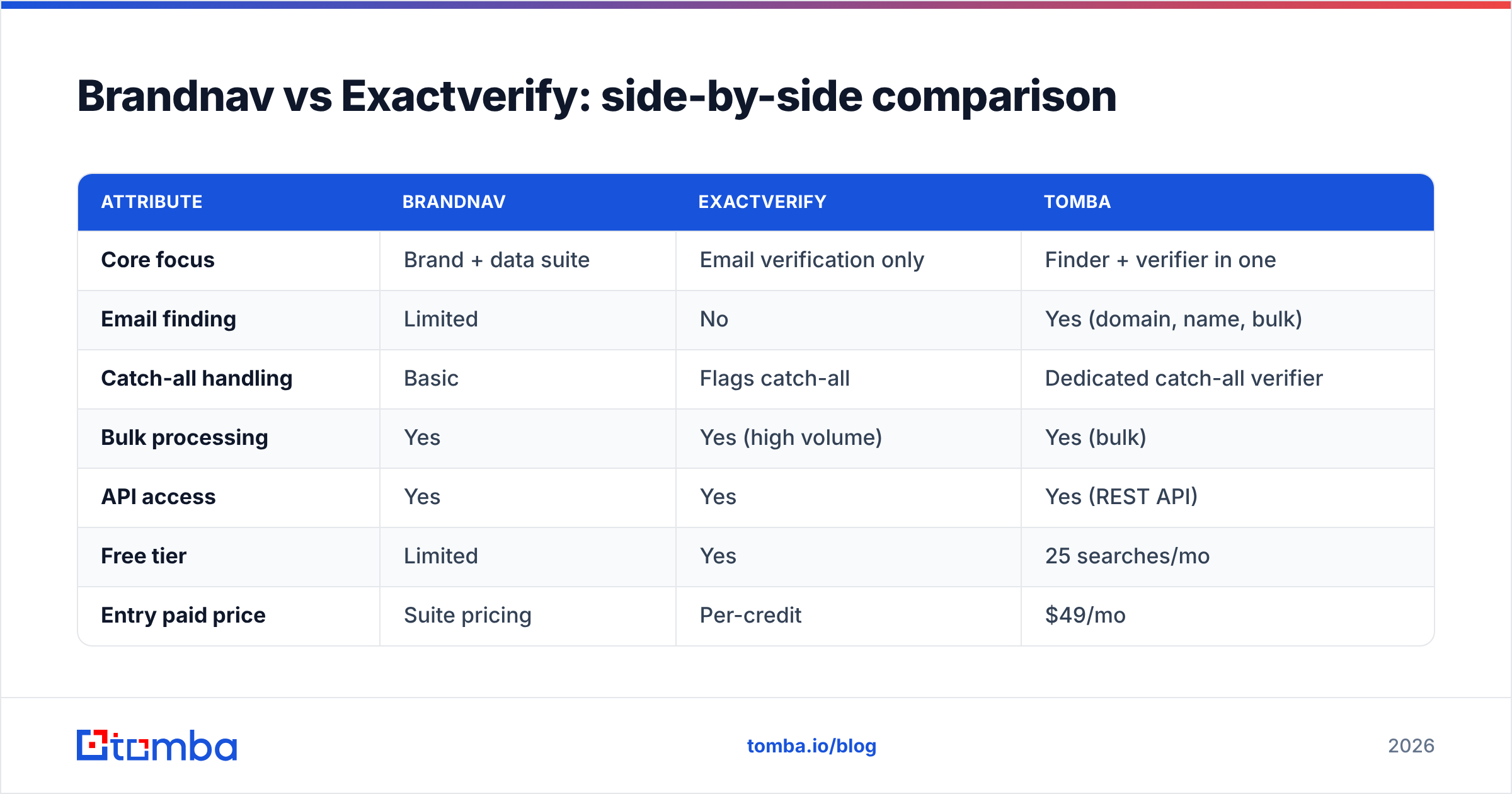
Brandnav vs Exactverify: side-by-side comparison#
Here's the head-to-head on the attributes that drive a buying decision.
| Attribute | Brandnav | Exactverify | Tomba |
|---|---|---|---|
| Core focus | Brand + data suite | Email verification only | Finder + verifier in one |
| Email finding | Limited | No | Yes (domain, name, bulk) |
| Catch-all handling | Basic | Flags catch-all | Dedicated catch-all verifier |
| Bulk processing | Yes | Yes (high volume) | Yes (bulk) |
| API access | Yes | Yes | Yes (REST API) |
| Free tier | Limited | Yes | 25 searches/mo |
| Entry paid price | Suite pricing | Per-credit | $49/mo |
| Enrichment | Some | No | Yes (enrichment) |
| Best for | One-dashboard teams | Pure list cleaning | Full prospecting workflow |
Two things stand out. First, if all you ever do is scrub lists you already own, Exactverify's focus and per-credit pricing are genuinely attractive. Second, the moment your workflow includes building lists — which describes almost every outbound team — a finder-plus-verifier stack closes a gap that neither of these tools addresses alone.
Which is better for bulk verification?#
For pure bulk cleaning, Exactverify's single-purpose design usually edges out Brandnav. Focused verifiers tend to push lists through faster and price per-verification more aggressively, because that throughput is their whole business.
But "better for bulk" depends on what you measure:
- Speed per 100k rows — Exactverify typically wins on raw throughput.
- Cost at volume — Compare per-credit math carefully; suites like Brandnav sometimes bundle verification credits with other features you may not need, which changes the effective price.
- Verdict quality — Throughput is worthless if the "valid" bucket is padded with unconfirmed catch-alls. Re-test the risky/unknown segments after every bulk run.
If you're cleaning a list before a big send, also run it through a free email checker for spot validation and check your domain's SPF record — verification fixes the list, but deliverability also depends on your own sending setup.
What about pricing?#
Neither vendor publishes pricing the way a focused SaaS does, so model your own real volume before committing.
- Exactverify uses a per-credit model typical of standalone verifiers — predictable when your monthly volume is stable, less so when it spikes.
- Brandnav wraps verification into broader suite plans, so the per-check cost is harder to isolate. Ask explicitly how many verification credits a plan includes before comparing.
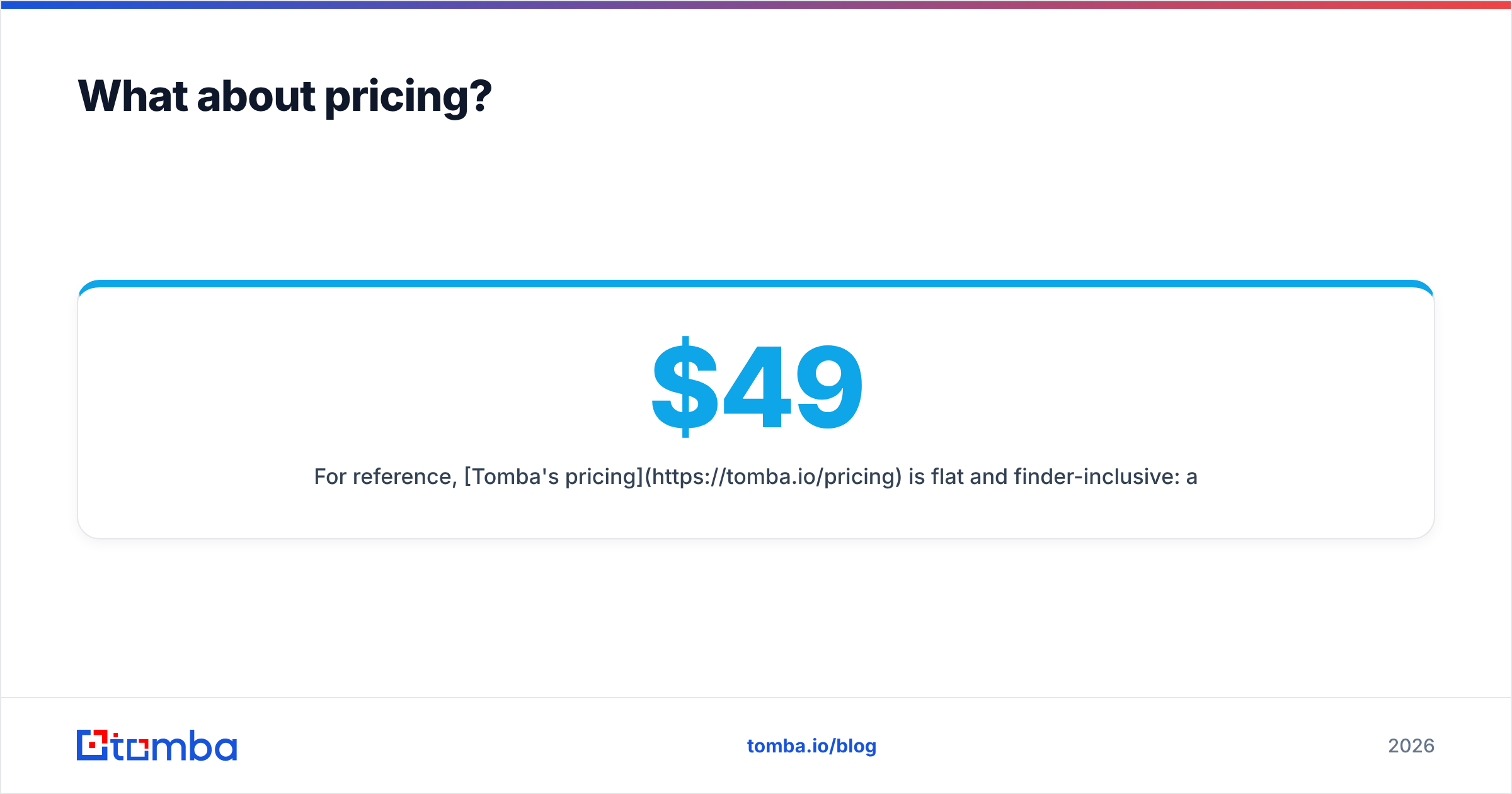
For reference, Tomba's pricing is flat and finder-inclusive: a free tier with 25 searches/mo, Starter at $49/mo, Growth at $99/mo, and Pro at $249/mo, with verification and finding under the same credits. That bundling is the real pricing story — you're not paying two vendors for two halves of the same job.
A quick rule for any of these tools: calculate cost per verified, usable contact, not cost per check. A cheap verification that leaves catch-alls in your "valid" pile costs you far more in bounces and reputation damage than the credit saved.
How do the APIs compare for developers?#
If you're wiring verification into a product or pipeline, the API matters more than the dashboard.
What to test on both Brandnav and Exactverify:
- Latency per call — Real-time form validation needs sub-second responses; batch jobs can tolerate more.
- Rate limits — Check the ceiling on concurrent requests against your peak load.
- Verdict granularity — Does the response distinguish catch-all, role-based, disposable, and unknown, or collapse them into a vague "risky"?
- Webhook support for bulk — For large jobs, polling is painful; webhooks on completion are far cleaner.
Tomba's email verification API returns granular status plus a confidence score, and there are official libraries plus a CLI if you'd rather script it. The deciding factor between any two APIs is rarely the happy path — it's how each one labels the uncertain results, because that's the data your downstream logic actually has to act on.

When should you pick a finder-first tool instead?#
Pick a finder-first platform when your real bottleneck is getting contacts, not just cleaning them — which is most outbound, recruiting, and partnership teams.
The verification-only debate (Brandnav vs Exactverify) silently assumes you already have a list. But where did that list come from? If the answer involves scraping, buying stale data, or manual LinkedIn digging, you've got a sourcing problem that no verifier can fix. Garbage in, verified garbage out.
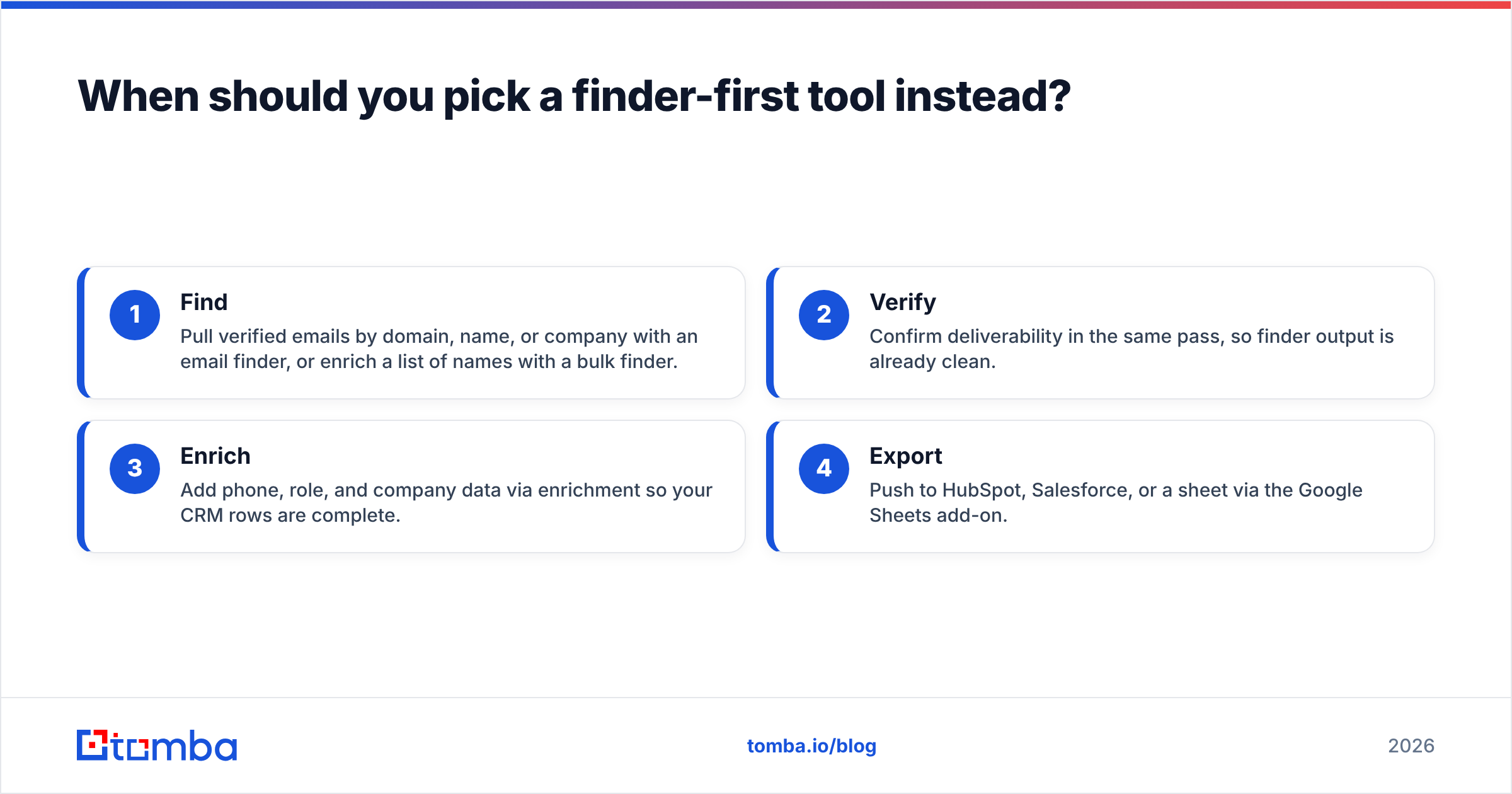
A finder-first workflow looks like this:
- Find — Pull verified emails by domain, name, or company with an email finder, or enrich a list of names with a bulk finder.
- Verify — Confirm deliverability in the same pass, so finder output is already clean.
- Enrich — Add phone, role, and company data via enrichment so your CRM rows are complete.
- Export — Push to HubSpot, Salesforce, or a sheet via the Google Sheets add-on.
Compare that to running Brandnav or Exactverify, which only handles step 2. You'd still need a separate finder, a separate enrichment vendor, and glue code to connect them — three bills and three integration surfaces for one workflow.
This isn't a knock on either verifier. If you genuinely only need list hygiene and nothing else, a focused verifier is the right tool. But be honest about your actual workflow before you buy half of it.
What do reviewers say?#
Cross-check vendor claims against independent reviews before deciding. Public directories like G2 and Capterra carry user reviews for verification tools, and the patterns there tend to be more honest than any landing page. Look specifically for:
- Comments about actual bounce rates after using the tool (the only metric that matters).
- How the vendor handles catch-all domains in practice.
- Support responsiveness when a verdict looks wrong — every verifier has edge cases; the question is whether the vendor helps you resolve them.
For background on the mechanics behind all of this, the concept of email deliverability is worth understanding, since verification is one input into deliverability, not the whole equation.
Brandnav vs Exactverify: the verdict#
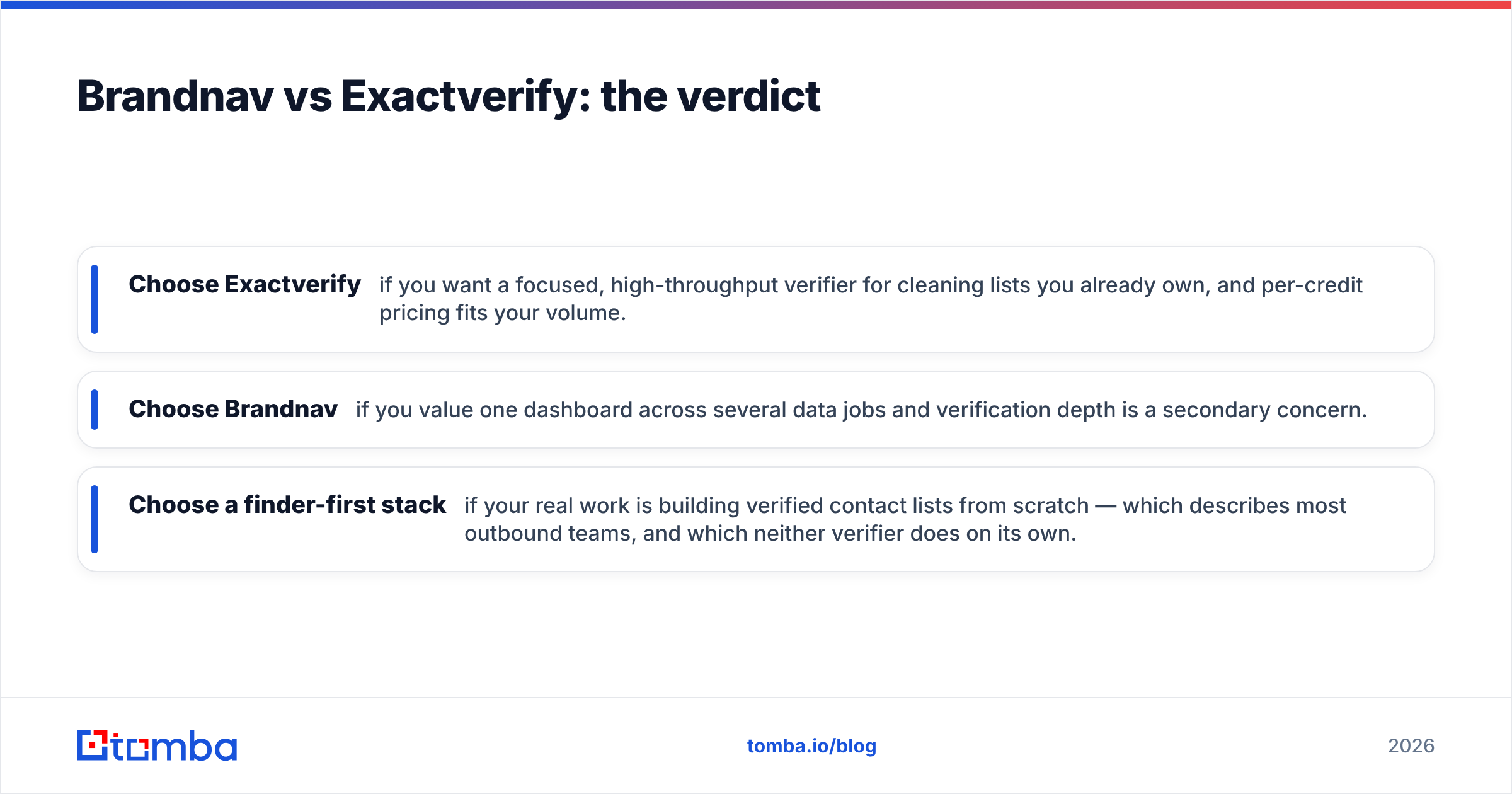
There's no universal winner — there's a winner for your workflow:
- Choose Exactverify if you want a focused, high-throughput verifier for cleaning lists you already own, and per-credit pricing fits your volume.
- Choose Brandnav if you value one dashboard across several data jobs and verification depth is a secondary concern.
- Choose a finder-first stack if your real work is building verified contact lists from scratch — which describes most outbound teams, and which neither verifier does on its own.
The framing "Brandnav vs Exactverify" quietly limits you to the cleaning step. Widen the question to "how do I get verified, usable contacts into my CRM with the fewest tools and bills?" and the answer usually points to a combined finder and verifier.
That's exactly the gap Tomba's Email Finder closes — find professional emails by domain, name, or company, verify them in the same pass, and enrich the rows before they hit your pipeline, starting free with 25 searches a month and scaling from $49/mo. Run a sample list through it alongside whichever verifier you're testing, and compare the catch-all bucket — that single check tells you more than any vendor's accuracy badge. Start finding and verifying emails with Tomba and stop paying two vendors for one job.
// get started
Find, verify and enrich your first contacts today
Start on the free plan with 25 searches a month, then scale when your team is ready.
Free plan · No credit card required · GDPR & CCPA
// about the author