Breakcold Pricing & Reviews 2026: Pros, Cons, Verdict
A no-spin look at Breakcold pricing, real user reviews, and the honest pros and cons — so you can tell if this social-selling CRM fits your 2026 outbound stack.
Breakcold Pricing & Reviews 2026: Pros, Cons, Verdict
Breakcold pitches itself as a "social-selling CRM" — a pipeline tool wrapped around LinkedIn and email engagement instead of static contact records. If you're weighing it for 2026, you want the unglamorous facts: what it costs, what real users say, and where it quietly falls short. This breakdown gives you all three, plus where Breakcold ends and a dedicated data layer like Tomba begins.
TL;DR#
- Breakcold is a CRM-first tool, not a data provider — it organizes outreach across LinkedIn and email but doesn't find or verify contact data for you.
- Pricing runs roughly $29–$80 per user/month depending on plan and billing cycle, with no permanent free plan (only a trial). Always confirm current numbers on their pricing page.
- Reviewers love the LinkedIn-centric inbox and pipeline UX; the most common complaints are integration gaps, a learning curve, and per-seat costs that climb with the team.
- Best fit: small-to-mid B2B teams doing high-touch social selling who want one screen for engagement plus deals.
- Weak fit: teams that need accurate, enriched contact data at scale — pair Breakcold with an email finder rather than expecting it to source leads.
What is Breakcold?#
Breakcold is a sales CRM built around the way modern reps actually prospect: liking, commenting, and DMing on LinkedIn while running email follow-ups in parallel. Instead of treating contacts as rows in a database, it surfaces each prospect's recent activity so you can engage before you pitch. Think of it less like a filing cabinet and more like a newsroom — the people you care about scroll past with their latest posts attached.
Its core modules are a unified social-and-email inbox, a kanban-style deal pipeline, lightweight email sequences, and contact lists you can tag and segment. It leans into social selling as the primary motion, which is its biggest differentiator from traditional CRMs like Pipedrive or HubSpot.
The thing to internalize early: Breakcold manages relationships and conversations. It does not generate verified leads. You still need a source for accurate emails and phone numbers feeding into it.
How much does Breakcold cost in 2026?#
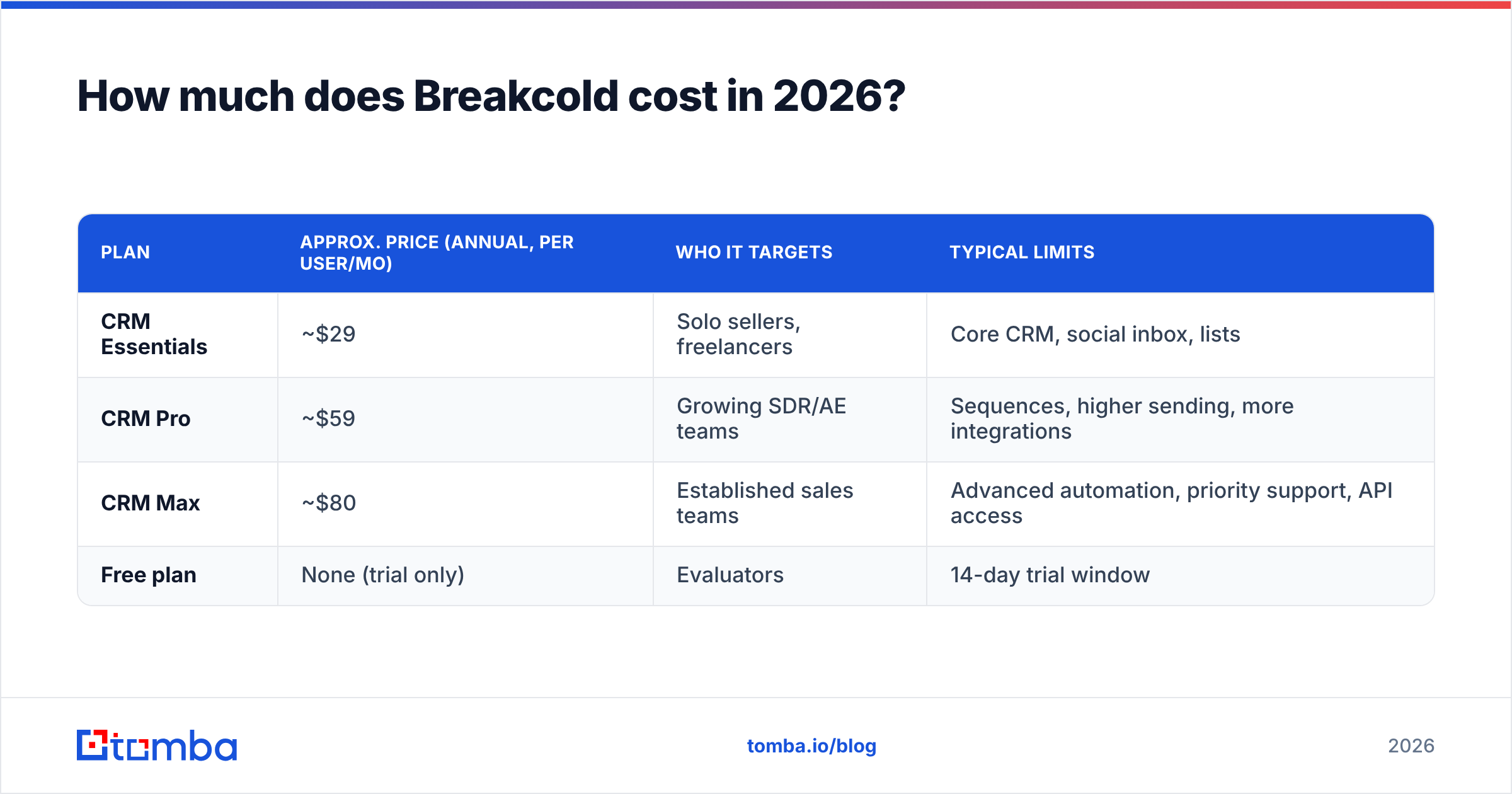
Breakcold uses per-seat pricing across three main tiers, with meaningful discounts for annual billing and no free-forever plan — just a time-limited trial. Prices shift periodically, so treat the table below as a planning reference and verify on the official site before you buy.
| Plan | Approx. price (annual, per user/mo) | Who it targets | Typical limits |
|---|---|---|---|
| CRM Essentials | ~$29 | Solo sellers, freelancers | Core CRM, social inbox, lists |
| CRM Pro | ~$59 | Growing SDR/AE teams | Sequences, higher sending, more integrations |
| CRM Max | ~$80 | Established sales teams | Advanced automation, priority support, API access |
| Free plan | None (trial only) | Evaluators | 14-day trial window |
A few cost realities reviewers flag:
- Monthly billing costs noticeably more than annual — committing yearly is where the advertised prices live.
- It's priced per seat, so a five-person team on Pro is closer to ~$300/month than the sticker number suggests.
- There's no free tier to grow into — once your trial ends, you're paying or you're out.
- Add-on costs stack if you also need an email-finding tool, a verifier, and a dedicated warmup service, which most outbound teams do.
For context on how a usage-based data tool prices differently, compare against transparent Tomba pricing: a free tier with 25 searches/month, Starter at $49/mo, Growth at $99/mo, and Pro at $249/mo. The two tools solve different problems, but the budgeting lesson is the same — map the whole stack, not one line item.
What do Breakcold reviews say?#
Aggregate sentiment on platforms like G2 and Capterra is genuinely positive, clustering in the 4.5–4.8 range, with reviewers praising responsiveness and the social-first design. The praise and the gripes are consistent enough to summarize fairly.
What reviewers consistently like:
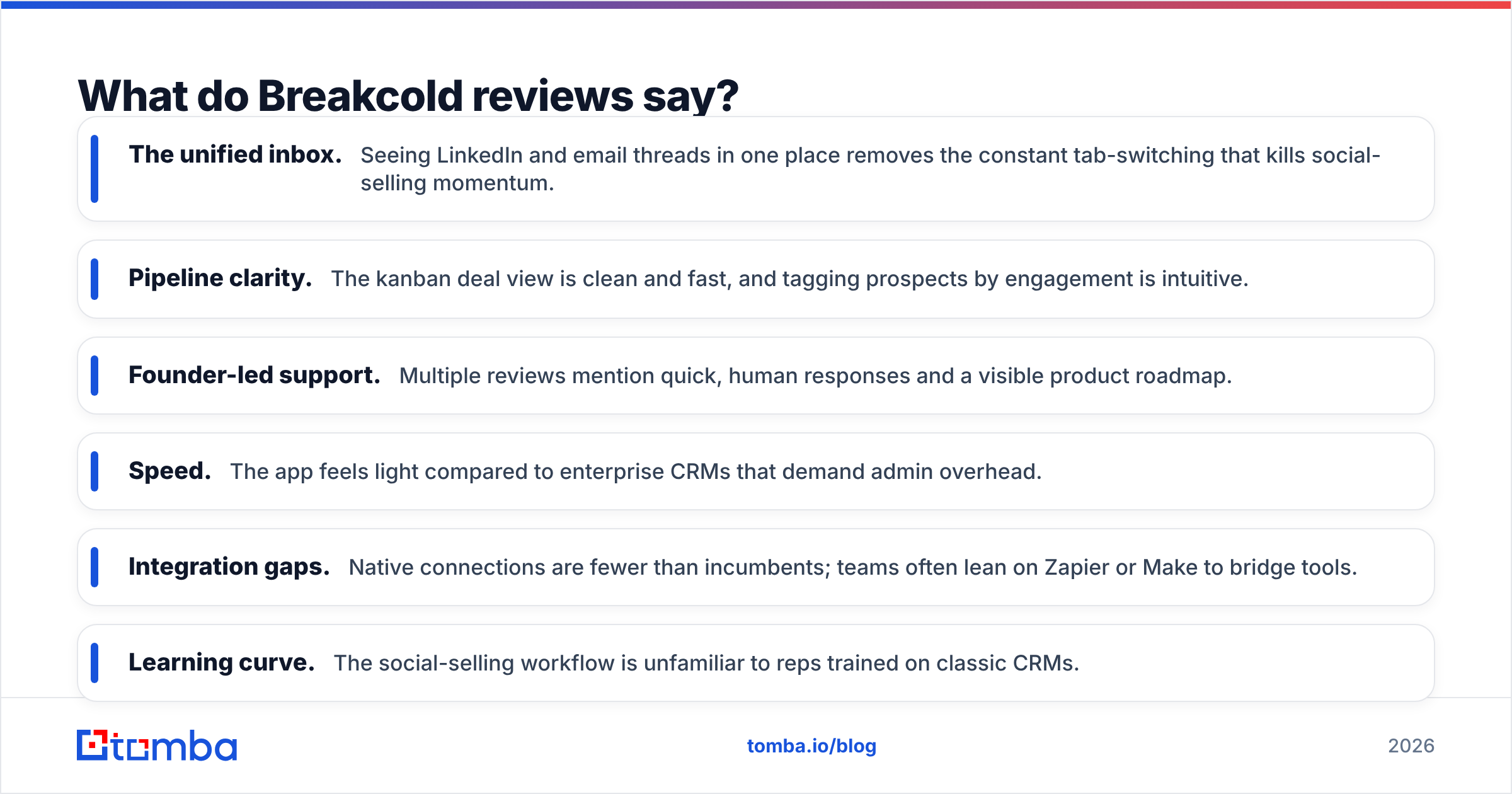
- The unified inbox. Seeing LinkedIn and email threads in one place removes the constant tab-switching that kills social-selling momentum.
- Pipeline clarity. The kanban deal view is clean and fast, and tagging prospects by engagement is intuitive.
- Founder-led support. Multiple reviews mention quick, human responses and a visible product roadmap.
- Speed. The app feels light compared to enterprise CRMs that demand admin overhead.
What reviewers repeatedly criticize:
- Integration gaps. Native connections are fewer than incumbents; teams often lean on Zapier or Make to bridge tools.
- Learning curve. The social-selling workflow is unfamiliar to reps trained on classic CRMs.
- Per-seat pricing pressure. Costs scale linearly as headcount grows.
- Data is your job. The CRM is only as good as the contacts you put in it — there's no built-in enrichment or verification of real depth.
That last point is the one that bites teams in practice. A beautiful pipeline full of stale or guessed emails still bounces.
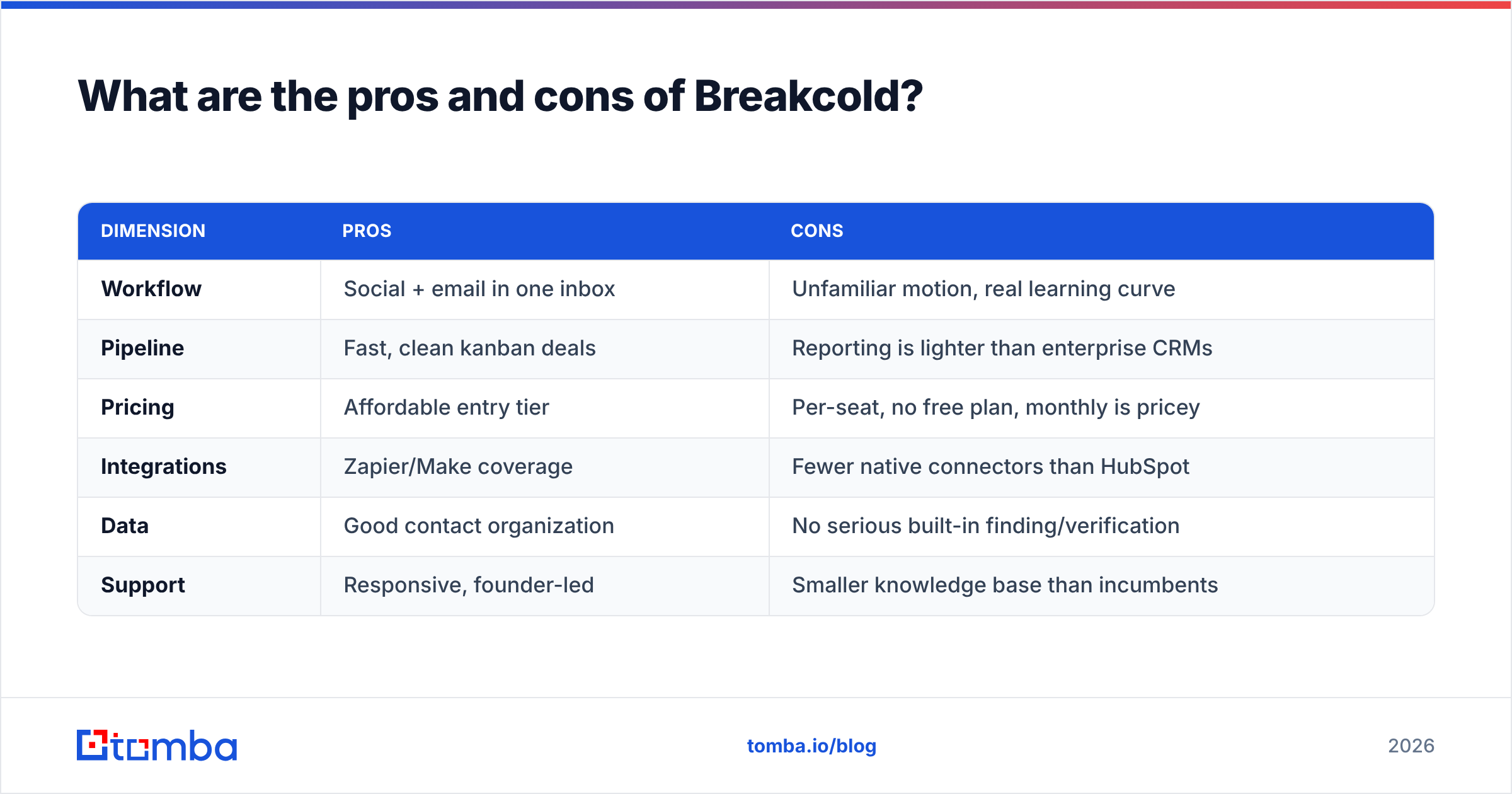
What are the pros and cons of Breakcold?#
Here's the honest ledger. No tool is all upside, and pretending otherwise wastes your evaluation time.
| Dimension | Pros | Cons |
|---|---|---|
| Workflow | Social + email in one inbox | Unfamiliar motion, real learning curve |
| Pipeline | Fast, clean kanban deals | Reporting is lighter than enterprise CRMs |
| Pricing | Affordable entry tier | Per-seat, no free plan, monthly is pricey |
| Integrations | Zapier/Make coverage | Fewer native connectors than HubSpot |
| Data | Good contact organization | No serious built-in finding/verification |
| Support | Responsive, founder-led | Smaller knowledge base than incumbents |
The pattern is clear: Breakcold is excellent at managing high-touch relationships and average-to-weak at supplying the raw data that fills the pipeline. Treat it as the engagement layer, not the data layer.
Is Breakcold worth it for your team?#
Breakcold is worth it if your go-to-market is genuinely social-led and high-touch. Conclusion first: if your reps spend their day on LinkedIn building relationships before pitching, the unified inbox alone can justify the seat cost. If your motion is volume cold email or you need rich firmographic data, you'll outgrow it fast.
Use this quick fit test:
- Strong fit: founders, agencies, and SMB sales teams doing relationship-driven outbound on LinkedIn plus email.
- Mixed fit: mid-market teams that want social selling but also need deep reporting and many native integrations.
- Poor fit: high-volume outbound shops, RevOps-heavy orgs, or anyone expecting the CRM to source and verify leads.
Whatever bucket you're in, the data problem doesn't disappear. A CRM records what your reps do; it doesn't tell you whether j.smith@company.com is real, a typo, or a catch-all that will silently swallow your message. That gap is exactly where a dedicated data stack earns its keep.
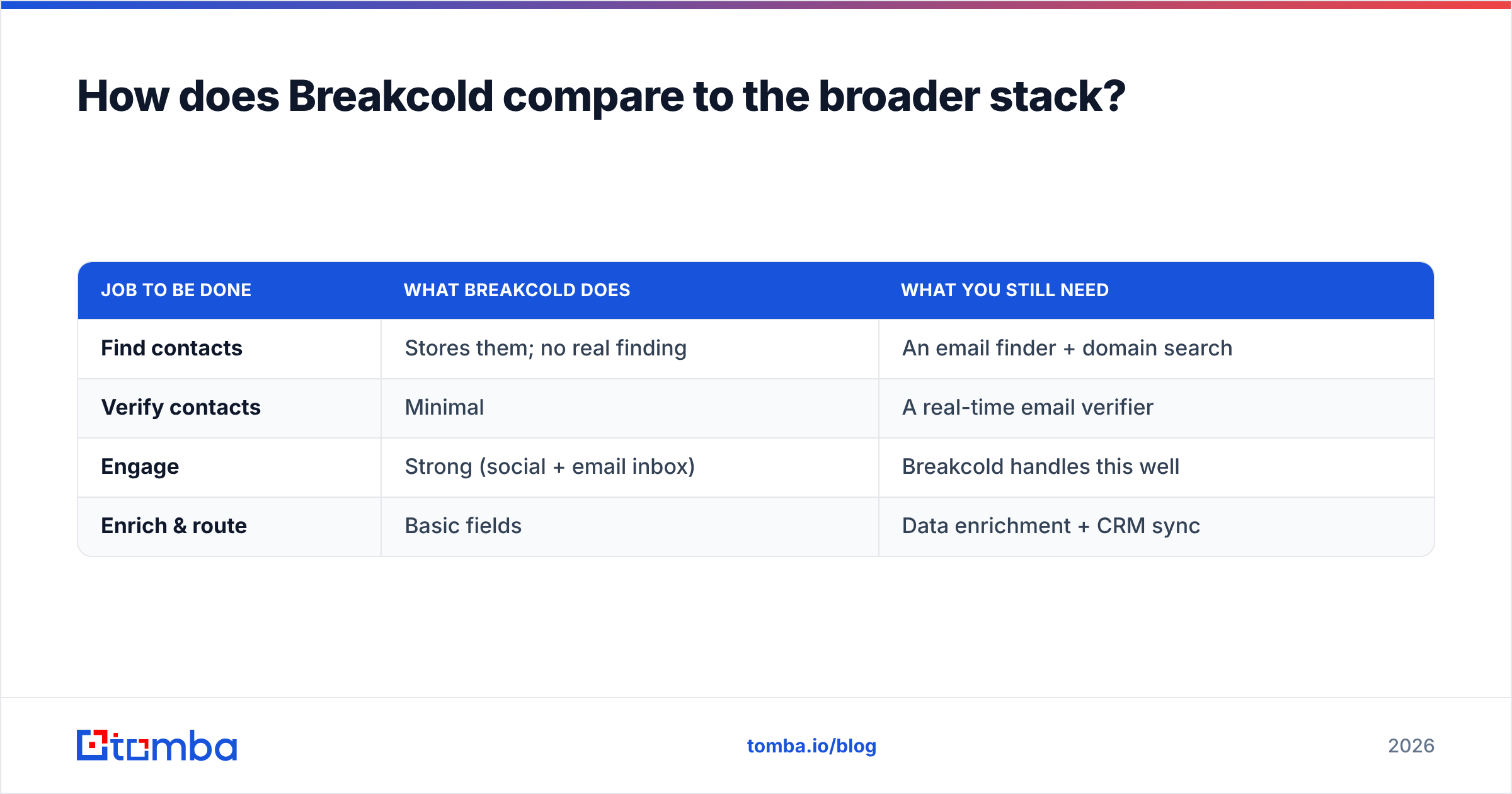
How does Breakcold compare to the broader stack?#
Breakcold is one piece. A complete 2026 outbound stack usually has four jobs, and only one of them is "CRM."
| Job to be done | What Breakcold does | What you still need |
|---|---|---|
| Find contacts | Stores them; no real finding | An email finder + domain search |
| Verify contacts | Minimal | A real-time email verifier |
| Engage | Strong (social + email inbox) | Breakcold handles this well |
| Enrich & route | Basic fields | Data enrichment + CRM sync |
This is why most teams pair Breakcold (or any CRM) with a sourcing-and-accuracy tool. You find and validate the contact first, then push clean records into the pipeline so your beautiful kanban board isn't built on guesses. If you're evaluating where Breakcold sits against pure prospecting platforms, it's closer to a CRM than to an Apollo-style database — see how a data-first option stacks up via this Apollo alternative breakdown.
For broader vendor research beyond marketing pages, cross-check independent reviews on G2 and the official Breakcold site before committing budget. Triangulating sources is the cheapest insurance you'll buy in this process.
Frequently asked questions#
Does Breakcold have a free plan? No. Breakcold offers a time-limited trial rather than a permanent free tier. If a free plan is a hard requirement, factor that into your comparison — some adjacent tools, including Tomba's data products, do offer a free monthly allotment.
Is Breakcold an email finder? No. Breakcold is a CRM for organizing and running outreach. It does not find or verify email addresses at the depth a dedicated tool does. You'll want a separate email finder and verifier feeding it.
How much does Breakcold cost per user? Roughly $29 to $80 per user per month depending on the plan and whether you pay annually. Monthly billing costs more. Confirm live pricing on their site, since tiers change.
What's the biggest weakness in Breakcold reviews? Two recurring themes: integration gaps versus incumbents like HubSpot, and the fact that data accuracy is entirely on you. The CRM organizes contacts; it doesn't guarantee they're valid.
Who should not use Breakcold? High-volume cold outbound teams and RevOps-heavy orgs that need deep reporting, many native integrations, and built-in enrichment. They'll feel the ceiling quickly.
The bottom line and your next step#
Breakcold is a sharp, well-loved social-selling CRM that does one thing — relationship-driven engagement — better than most generalist CRMs, at a fair entry price. Its limits are predictable: per-seat costs that scale, fewer integrations, and zero serious data sourcing. Buy it for the engagement layer, not the data layer.
That data layer is the part that determines whether any of your outreach lands. Before a contact ever reaches your Breakcold pipeline, run it through the Tomba Email Finder to source the right professional address by name, domain, or company — then verify it so your hard-won social conversations actually reach a real inbox. Start free with 25 searches a month, and let your CRM do what it's good at while Tomba keeps the pipeline clean.
// get started
Find, verify and enrich your first contacts today
Start on the free plan with 25 searches a month, then scale when your team is ready.
Free plan · No credit card required · GDPR & CCPA
// about the author