BriteVerify vs Apollo.io 2026: Which B2B Data Tool Wins?
BriteVerify verifies the emails you already have. Apollo.io finds new ones and runs sequences. Here is a feature-by-feature breakdown to pick the right tool in 2026 — plus a leaner alternative.
TL;DR
- BriteVerify is a verifier, not a prospecting tool. It cleans lists you already own — it does not find new contacts. Pricing is pay-as-you-go per email.
- Apollo.io is a prospecting and engagement platform. It surfaces new contacts from a 270M+ contact database, builds sequences, and includes basic verification, but its data accuracy is inconsistent.
- They solve different problems. Comparing them head-to-head only makes sense if you are deciding "do I need to find leads or clean leads?"
- If you want both jobs done cheaply, pairing a focused email finder with a dedicated verifier usually beats paying for one bloated all-in-one seat.
- Our pick for most teams: use a specialist finder + verifier combo. Tomba's email finder plus its email verifier starts at $49/mo and covers both jobs.
What is the real difference between BriteVerify and Apollo.io?#
The short answer: BriteVerify checks email addresses; Apollo.io finds people. Putting them in the same ring is like comparing a car wash to a car dealership. One cleans what you already drove in with. The other sells you a new vehicle.
BriteVerify, now part of Validity, is a real-time email verification service. You hand it a list — or wire it into your signup form — and it tells you which addresses are valid, risky, or dead before you hit send. That is the entire job. No contact database, no dialer, no sequencer.
Apollo.io is a go-to-market platform. It bundles a large B2B contact database, filters for building prospect lists, email sequencing, a Chrome extension, and light CRM features. Verification exists inside Apollo, but it is a feature, not the product.
So when someone searches "briteverify vs apolloio," they usually mean one of two things: "Which one should I buy?" (answer: depends on whether your problem is finding or cleaning) or "Apollo's data is messy — should I add BriteVerify on top?" (a very common real-world stack). This post answers both.

What does BriteVerify actually do?#
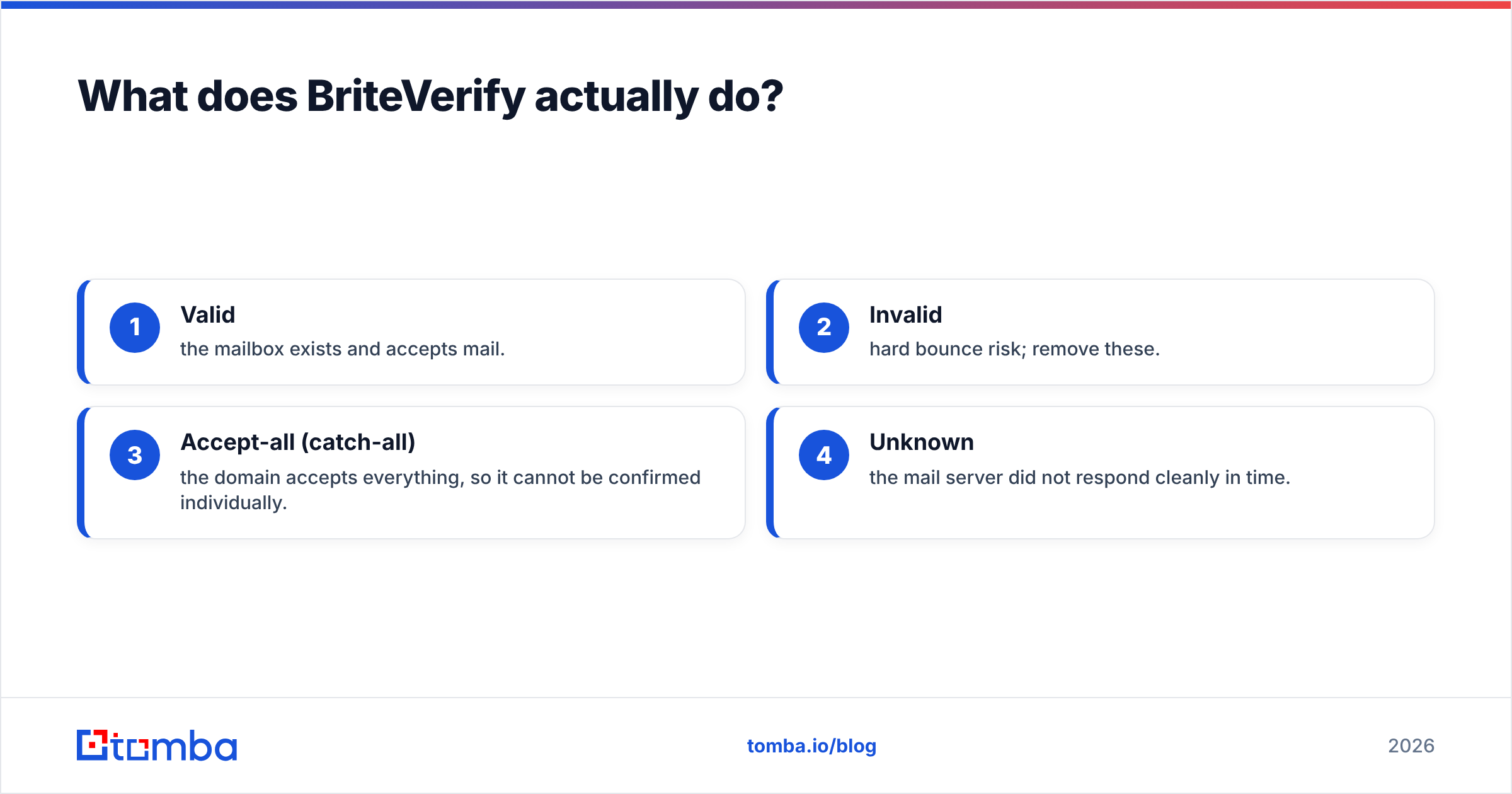
BriteVerify focuses on deliverability hygiene. Before you launch a campaign, you run your list through it and get a status on every address:
- Valid — the mailbox exists and accepts mail.
- Invalid — hard bounce risk; remove these.
- Accept-all (catch-all) — the domain accepts everything, so it cannot be confirmed individually.
- Unknown — the mail server did not respond cleanly in time.
That granularity is genuinely useful. Cutting invalids before a send protects your sender reputation and keeps your bounce rate under the 2% threshold that mailbox providers watch. BriteVerify is fast, integrates with most ESPs (Mailchimp, Marketo, HubSpot), and is trusted by enterprise email teams.
What it does not do: give you a single new lead. If your list is empty, BriteVerify has nothing to work with. It also charges per verification, which scales linearly — clean a million records and you pay for a million checks.
What does Apollo.io actually do?#
Apollo is built for the front of the funnel. Its strengths:
- Database search — filter 270M+ contacts by title, industry, headcount, tech stack, funding, and intent signals.
- Sequencing — multi-step email + task cadences with A/B testing.
- Chrome extension — pull contacts off LinkedIn and company sites.
- Engagement analytics — opens, replies, and meetings booked in one view.
The trade-off is data quality. Apollo's database is broad but crowd-sourced and aging in places, so email accuracy varies by region and seniority. Many teams report needing a second verification pass before sending — which is exactly why "Apollo + a verifier" is a popular search in the first place. If Apollo is your prospecting engine but the data is noisy, look at a dedicated Apollo alternative or bolt a verifier onto your workflow.
BriteVerify vs Apollo.io: full comparison table#
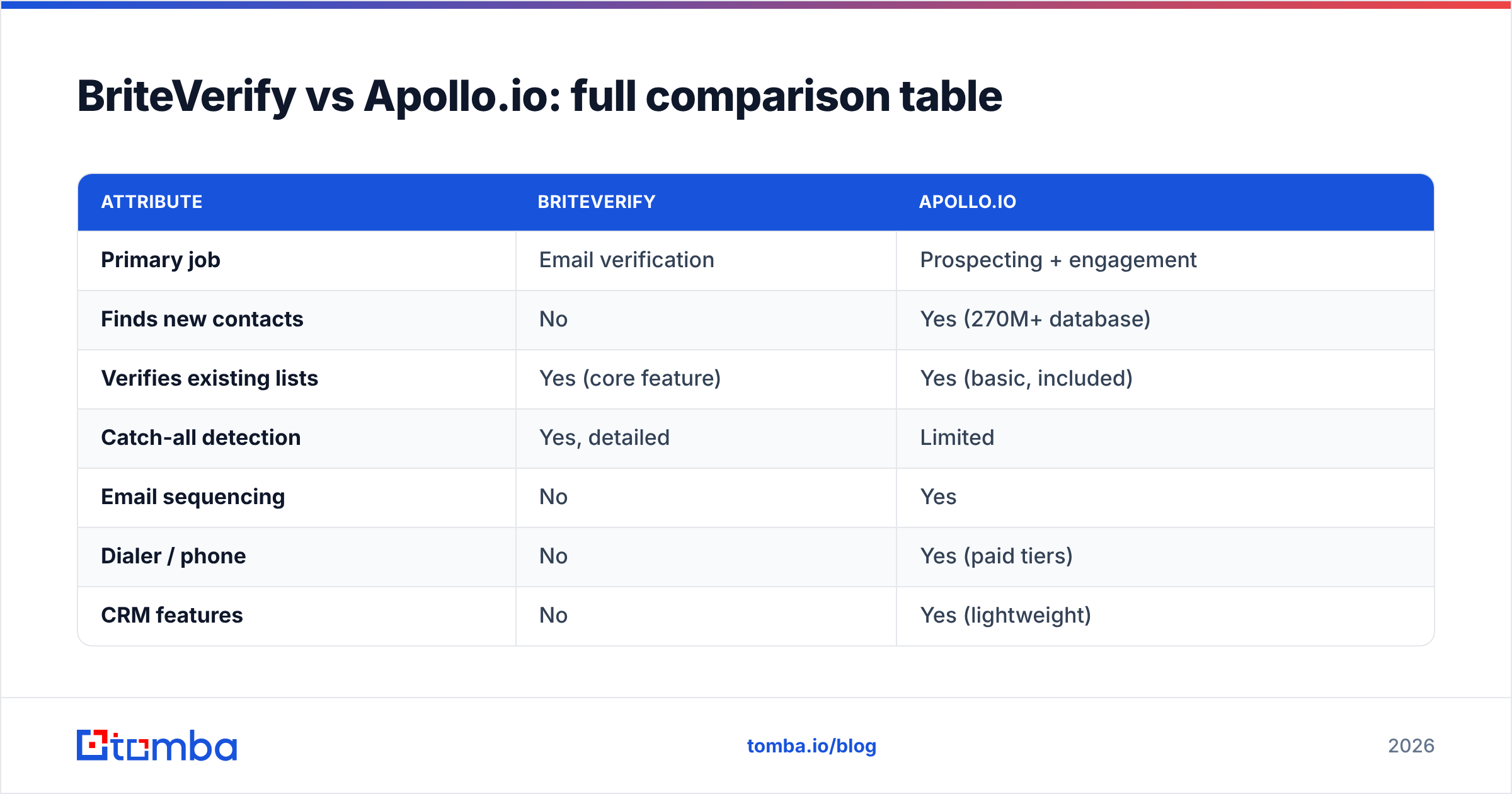
| Attribute | BriteVerify | Apollo.io |
|---|---|---|
| Primary job | Email verification | Prospecting + engagement |
| Finds new contacts | No | Yes (270M+ database) |
| Verifies existing lists | Yes (core feature) | Yes (basic, included) |
| Catch-all detection | Yes, detailed | Limited |
| Email sequencing | No | Yes |
| Dialer / phone | No | Yes (paid tiers) |
| CRM features | No | Yes (lightweight) |
| Pricing model | Pay-per-verification | Per-seat subscription + credits |
| Entry price | ~$0.01/email (volume-based) | Free tier; paid from ~$49/user/mo |
| Best for | List hygiene before sends | Building + working outbound lists |
| Data accuracy focus | Verification only | Coverage over precision |
The takeaway from the table is clear: these are complementary, not competing. The only direct overlap is verification, and there BriteVerify is the specialist while Apollo treats it as a bundled extra.
Which one should you choose?#
Pick based on the job you are trying to do — not the brand.
- You already have lists (signups, CRM exports, event leads) and just need them clean. Choose BriteVerify, or any focused verifier. You do not need Apollo's database, sequencer, or per-seat pricing.
- You have no contacts and need to build outbound lists from scratch. Choose Apollo.io (or an alternative). BriteVerify cannot help you here at all.
- You do both — find and send. You need two capabilities. The question becomes whether to buy one expensive all-in-one or assemble a leaner specialist stack.
That last scenario is where most B2B teams actually live, and it is where a combo approach tends to win on both accuracy and cost.

Is there a better alternative to running BriteVerify and Apollo together?#
For many teams, yes — pairing a dedicated email finder with a dedicated verifier delivers both jobs without paying enterprise prices for features you ignore.
Here is how the math typically shakes out. Apollo's per-seat model means every rep on the team adds cost whether or not they use the sequencer. BriteVerify's per-verification pricing climbs with list size. Stack the two and a small team can clear several hundred dollars a month fast.
A specialist combo decouples those costs. You find emails by domain or name, verify them, and pay for capacity rather than per-seat licenses. Tools like Tomba bundle both jobs:
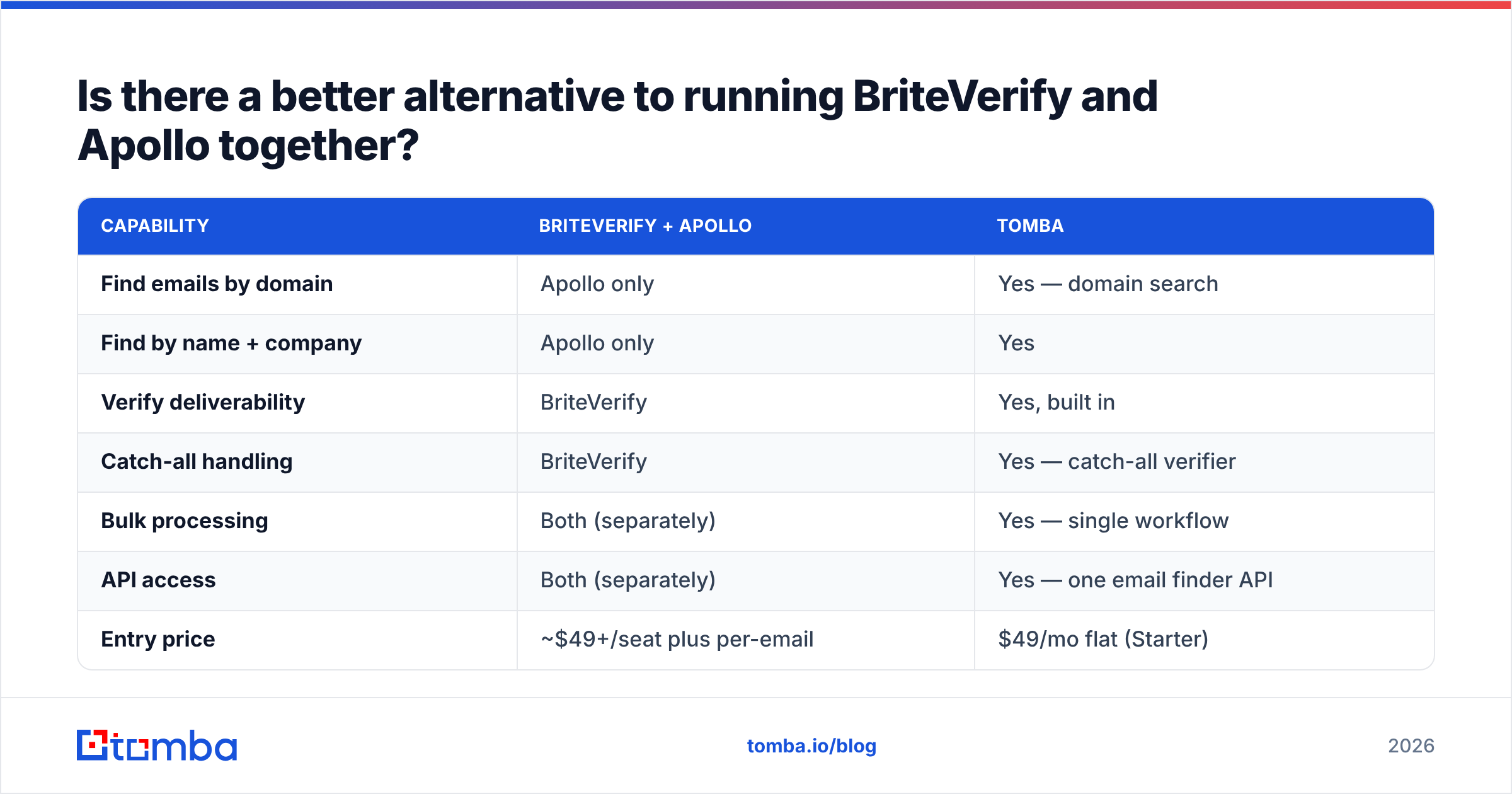
| Capability | BriteVerify + Apollo | Tomba |
|---|---|---|
| Find emails by domain | Apollo only | Yes — domain search |
| Find by name + company | Apollo only | Yes |
| Verify deliverability | BriteVerify | Yes, built in |
| Catch-all handling | BriteVerify | Yes — catch-all verifier |
| Bulk processing | Both (separately) | Yes — single workflow |
| API access | Both (separately) | Yes — one email finder API |
| Entry price | ~$49+/seat plus per-email | $49/mo flat (Starter) |
| Tools to manage | Two vendors | One |
The operational win is one vendor, one API, and one bill instead of stitching two products together and reconciling their credit systems.
How accurate is each tool, really?#
Accuracy splits along the two jobs.
For verification, BriteVerify is strong — that is its only job, and it does it well, especially on catch-all and role-based detection. Apollo's built-in verification is serviceable but treated as a convenience layer; teams running high-volume cold outreach frequently re-verify Apollo's output before sending.
For finding, Apollo's coverage is wide but precision varies. A large database is not the same as an accurate one. Outdated job titles and recycled emails are the usual complaints you will see on review sites like G2. If a contact left the company, a stale record still counts toward "coverage" — but it bounces when you send.
The practical rule: never send to unverified found data. Whatever finds your emails, run them through a verifier before the first send. That is true whether the source is Apollo, a scraper, or a manual list. A good email verification step is non-negotiable for protecting email deliverability.
What about pricing in 2026?#
Pricing is where the "which tool" question gets concrete.
- BriteVerify is volume-based pay-as-you-go, roughly a penny per verification at smaller volumes with discounts as you scale. There is no monthly seat cost — you pay for what you check.
- Apollo.io offers a free tier with limited credits, then per-seat subscriptions that climb as you add reps and unlock the dialer, advanced filters, and higher credit caps.
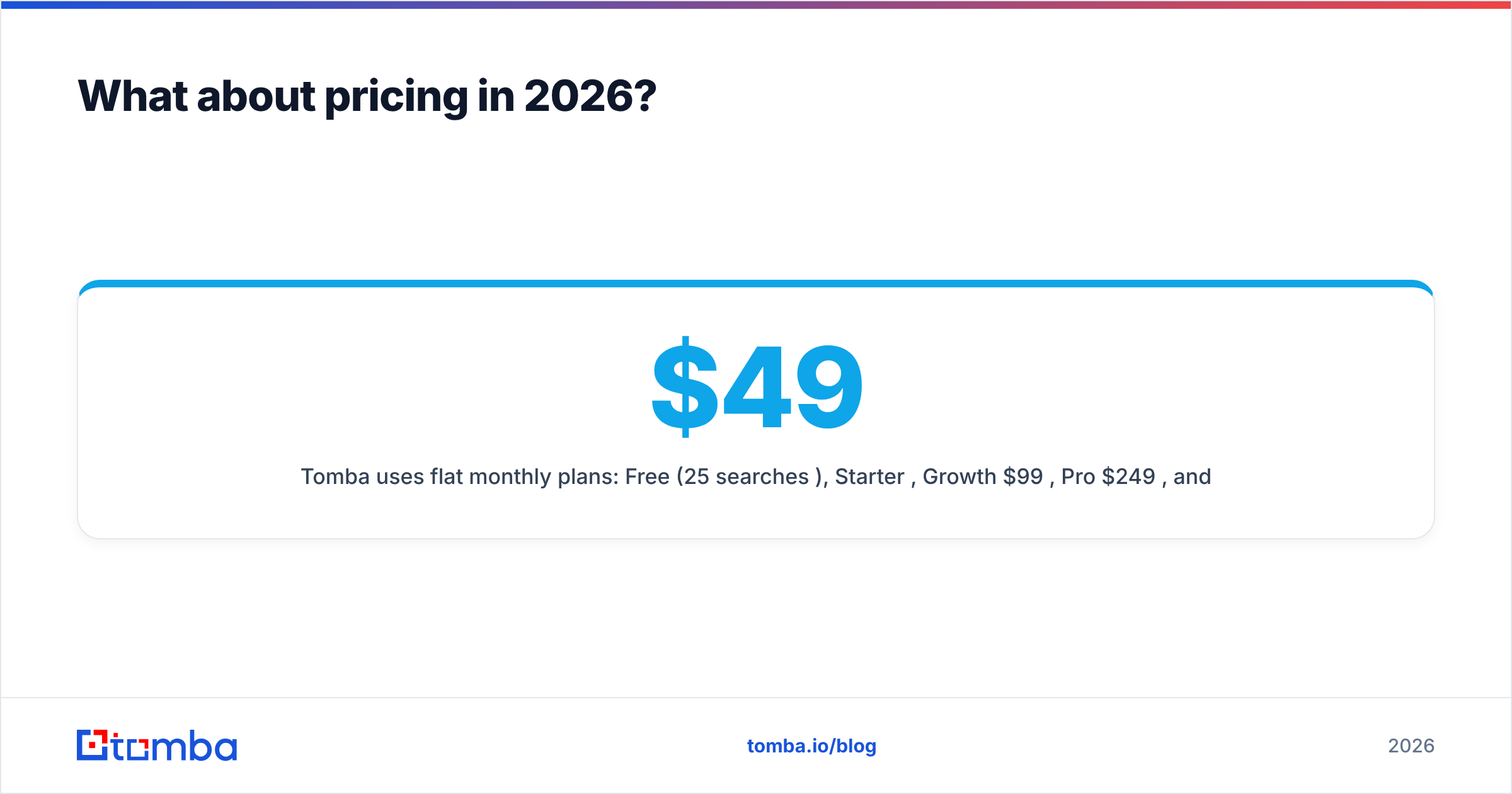
- Tomba uses flat monthly plans: Free (25 searches/mo), Starter $49/mo, Growth $99/mo, Pro $249/mo, and custom Enterprise. Full details are on the Tomba pricing page.
The pattern: BriteVerify scales with list size, Apollo scales with team size, and a flat-plan finder+verifier scales with neither until you genuinely outgrow the tier. For a lean SDR team that finds and verifies a predictable volume each month, the flat plan is the easiest to budget.
Frequently asked questions#
Is BriteVerify a competitor to Apollo.io? Not really. BriteVerify verifies email lists; Apollo finds and engages contacts. They overlap only on the verification step, where BriteVerify is the specialist and Apollo offers a basic bundled version.
Can Apollo.io replace BriteVerify? For light verification, Apollo's built-in checker may be enough. For high-volume cold outreach where deliverability is critical, most teams add a dedicated verifier on top of Apollo's data.
Do I need both tools? Only if you need to both find and clean contacts. If you already have lists, you just need a verifier. If you need to build lists, you need a finder. A combined tool can cover both jobs in one workflow.
Which is cheaper? It depends on volume and team size. BriteVerify's per-email cost suits occasional cleaning; Apollo's per-seat cost suits dedicated outbound teams. A flat-rate finder+verifier is often the most predictable for steady monthly volume.
Is Apollo's data accurate enough to send without verifying? Treat any found data as unverified until proven otherwise. Always run a verification pass before your first send to protect bounce rates and sender reputation.
The bottom line#
BriteVerify and Apollo.io are not rivals — they are two halves of an outbound workflow. BriteVerify cleans; Apollo finds. If your problem is one of those, buy the specialist for that job. If your problem is both, the cleanest path is usually a single tool that finds and verifies in one place, billed on a flat plan you can actually forecast.
That is the gap Tomba fills. Find verified professional emails by domain, name, or company, run them through a built-in verifier, and push them straight into your sequencer or CRM — without juggling two vendors or two credit systems. Start free with 25 searches, then scale to the Starter plan at $49/mo when you are ready. Try the Tomba Email Finder and clean your prospecting stack down to one tool.
// get started
Find, verify and enrich your first contacts today
Start on the free plan with 25 searches a month, then scale when your team is ready.
Free plan · No credit card required · GDPR & CCPA
// about the author