BriteVerify vs DiscoverOrg: The 2026 Comparison Guide
BriteVerify verifies emails; DiscoverOrg sells contact data. Here's how the two actually compare on price, accuracy, and fit — plus where a leaner stack wins.
You typed "BriteVerify vs DiscoverOrg" into a search bar expecting two versions of the same thing. They aren't. One scrubs your email list so messages land; the other sells you the contacts in the first place. Comparing them is less "Coke vs Pepsi" and more "a water filter vs the grocery store." This guide untangles what each tool actually does, where they overlap, what they cost in 2026, and how to decide which problem you're really trying to solve.
TL;DR#
- BriteVerify (owned by Validity) is an email verification service. It tells you whether an address is deliverable before you hit send. It does not find new contacts.
- DiscoverOrg is a B2B sales-intelligence database — now folded into ZoomInfo — that supplies company and contact data, org charts, and intent signals. It is not a list-cleaning tool.
- They solve different stages of the pipeline: DiscoverOrg gets you the leads, BriteVerify keeps the list clean. Many teams run both.
- On price, BriteVerify is pay-per-verification and cheap to start; DiscoverOrg/ZoomInfo is a per-seat annual contract that frequently lands in five figures.
- If you want find + verify in one place without an enterprise contract, a combined platform like Tomba covers both jobs from $49/mo.
What is BriteVerify and what does it actually do?#
BriteVerify is an email-verification engine. You feed it a list of addresses — uploaded as a CSV or piped through its API — and it returns a status for each: valid, invalid, accept-all (catch-all), unknown, or disposable. The goal is simple: stop you from emailing addresses that will bounce, because high bounce rates wreck sender reputation and get your domain throttled by inbox providers.
It does this with SMTP-level checks, syntax validation, domain/MX record lookups, and a known-complainer database. BriteVerify sits inside Validity's broader deliverability suite (alongside Everest and the GridBuyer/Sender Score tooling), so it's often sold to email marketers who already care about list hygiene.
What BriteVerify does not do: it won't find you a single new prospect. If your list is empty, BriteVerify has nothing to verify. It's a filter, not a faucet.
What is DiscoverOrg and how is it different?#
DiscoverOrg is a sales-intelligence platform — a searchable database of companies and the people inside them. You filter by industry, headcount, revenue, technology stack, or job title, and it hands back names, titles, direct dials, email addresses, and org-chart relationships. In 2019 DiscoverOrg acquired ZoomInfo and adopted the ZoomInfo brand, so today most buyers encounter this product as ZoomInfo with DiscoverOrg's deep org-chart heritage baked in.
Where BriteVerify is a quality-control checkpoint, DiscoverOrg is a sourcing engine. It answers "who should I contact and how do I reach them?" rather than "is this address still good?" Its data is human-researched and machine-enriched, and it leans heavily toward enterprise go-to-market teams that need account intelligence, buying-committee maps, and intent data — not just contact rows.

BriteVerify vs DiscoverOrg: the core difference in one section#
If you remember nothing else, remember this — they occupy different stages of the funnel:
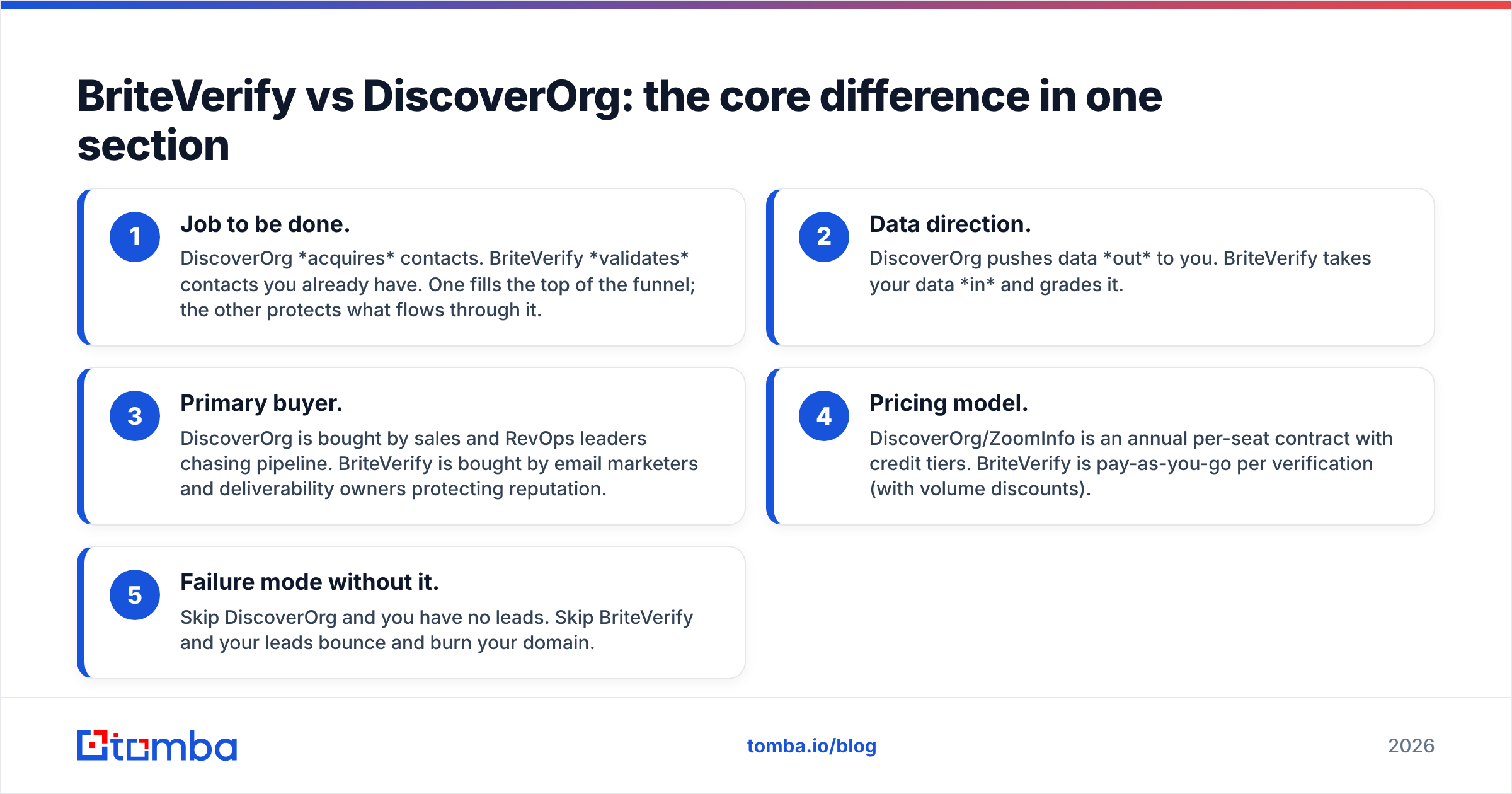
- Job to be done. DiscoverOrg acquires contacts. BriteVerify validates contacts you already have. One fills the top of the funnel; the other protects what flows through it.
- Data direction. DiscoverOrg pushes data out to you. BriteVerify takes your data in and grades it.
- Primary buyer. DiscoverOrg is bought by sales and RevOps leaders chasing pipeline. BriteVerify is bought by email marketers and deliverability owners protecting reputation.
- Pricing model. DiscoverOrg/ZoomInfo is an annual per-seat contract with credit tiers. BriteVerify is pay-as-you-go per verification (with volume discounts).
- Failure mode without it. Skip DiscoverOrg and you have no leads. Skip BriteVerify and your leads bounce and burn your domain.
That's why "vs" is slightly the wrong framing. A complete outbound stack usually needs a sourcing layer and a verification layer. The real question is whether you buy two specialist tools or one platform that does both.
How do BriteVerify and DiscoverOrg compare side by side?#
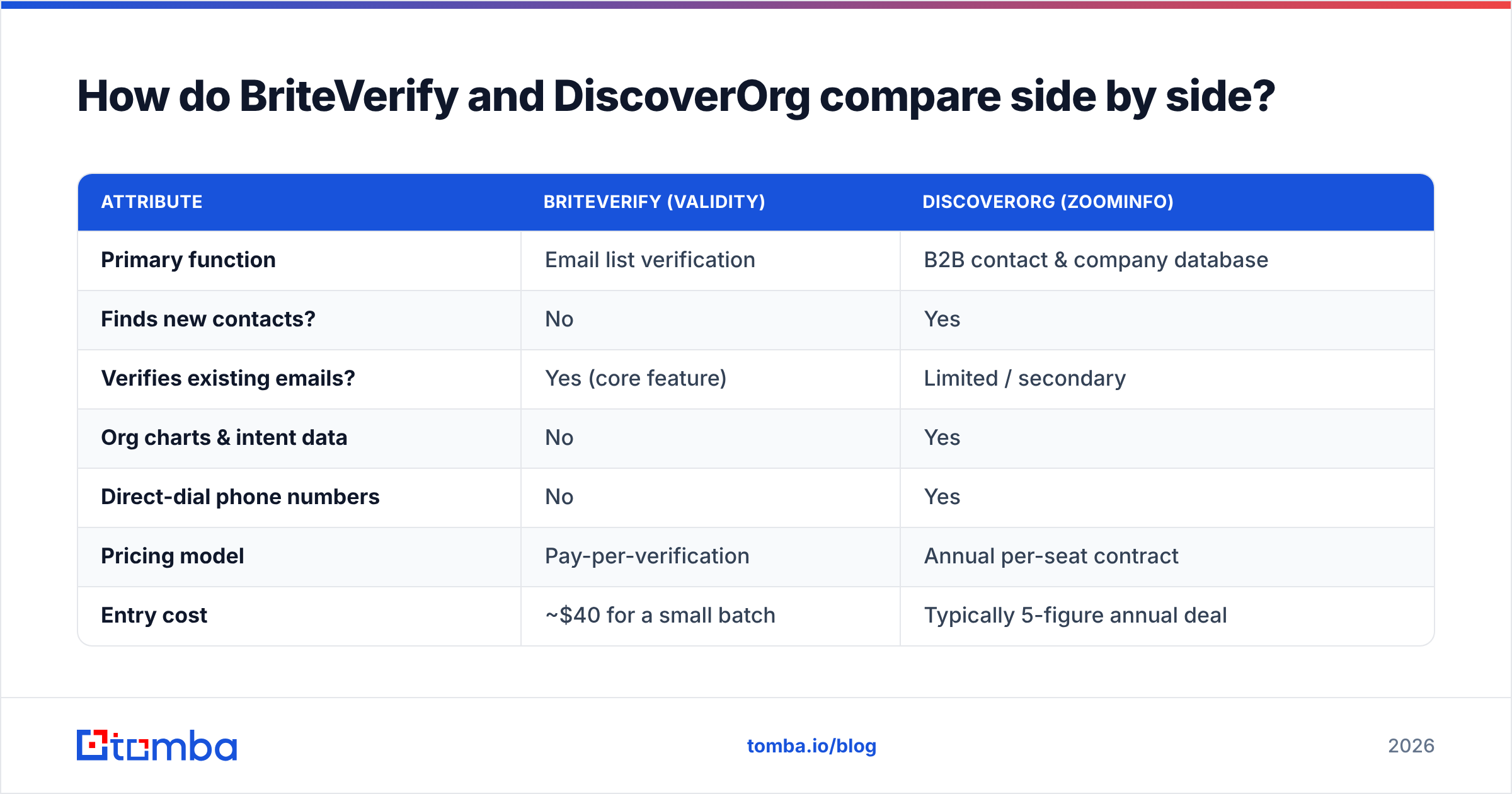
| Attribute | BriteVerify (Validity) | DiscoverOrg (ZoomInfo) |
|---|---|---|
| Primary function | Email list verification | B2B contact & company database |
| Finds new contacts? | No | Yes |
| Verifies existing emails? | Yes (core feature) | Limited / secondary |
| Org charts & intent data | No | Yes |
| Direct-dial phone numbers | No | Yes |
| Pricing model | Pay-per-verification | Annual per-seat contract |
| Entry cost | ~$40 for a small batch | Typically 5-figure annual deal |
| Best for | Marketers protecting deliverability | Enterprise sales & RevOps |
| API access | Yes | Yes (higher tiers) |
| Contract commitment | None required | Annual, often multi-year |
The table makes the trade-off obvious. BriteVerify is cheap, narrow, and contract-free. DiscoverOrg is expensive, broad, and locked in. Neither is "better" — they're built for different buyers with different problems.
How accurate is each tool's data?#
Accuracy means two different things here, so judge them on the right axis.
For BriteVerify, accuracy means verification precision — when it says "valid," does the message actually deliver? Validity's engine is well regarded among email marketers, and independent reviews on G2 consistently praise its catch-all handling and low false-positive rate. The honest caveat: no verifier can fully confirm a catch-all domain that accepts everything at the SMTP layer, so "accept-all" results still carry risk no matter which vendor you use. That's a property of how mail servers work, not a flaw unique to BriteVerify.
For DiscoverOrg, accuracy means data freshness and coverage — are the contacts real, current, and reachable? Its human-verified research process has historically been a selling point, but any large database decays. People change jobs roughly every two to three years, so even a 95%-accurate database loses a meaningful slice of validity every quarter. This is exactly why teams that source from DiscoverOrg still run the output through a verifier before sending — sourcing accuracy and deliverability accuracy are not the same thing.
The practical takeaway: even if you own DiscoverOrg, you benefit from a verification step. And if you only own BriteVerify, you still need a source for the addresses. Run the math on your own data with a free email verifier before you assume any list is send-ready.
What does BriteVerify vs DiscoverOrg cost in 2026?#
Pricing is where these two diverge most sharply.
BriteVerify uses consumption pricing. You buy verification credits and spend them per address checked — small batches start in the tens of dollars, and per-email cost drops with volume. There's no seat fee and no annual lock-in, which makes it easy to start and easy to leave.
DiscoverOrg / ZoomInfo is sold as an annual, per-seat platform contract. Public reporting and buyer reviews put typical deals in the five-figure range per year, scaling with seats, credit allotments, and add-on modules (intent, scoops, enrichment). You'll talk to a sales rep, not a checkout page. For enterprise teams the ROI can be real; for a three-person startup it's usually overkill.
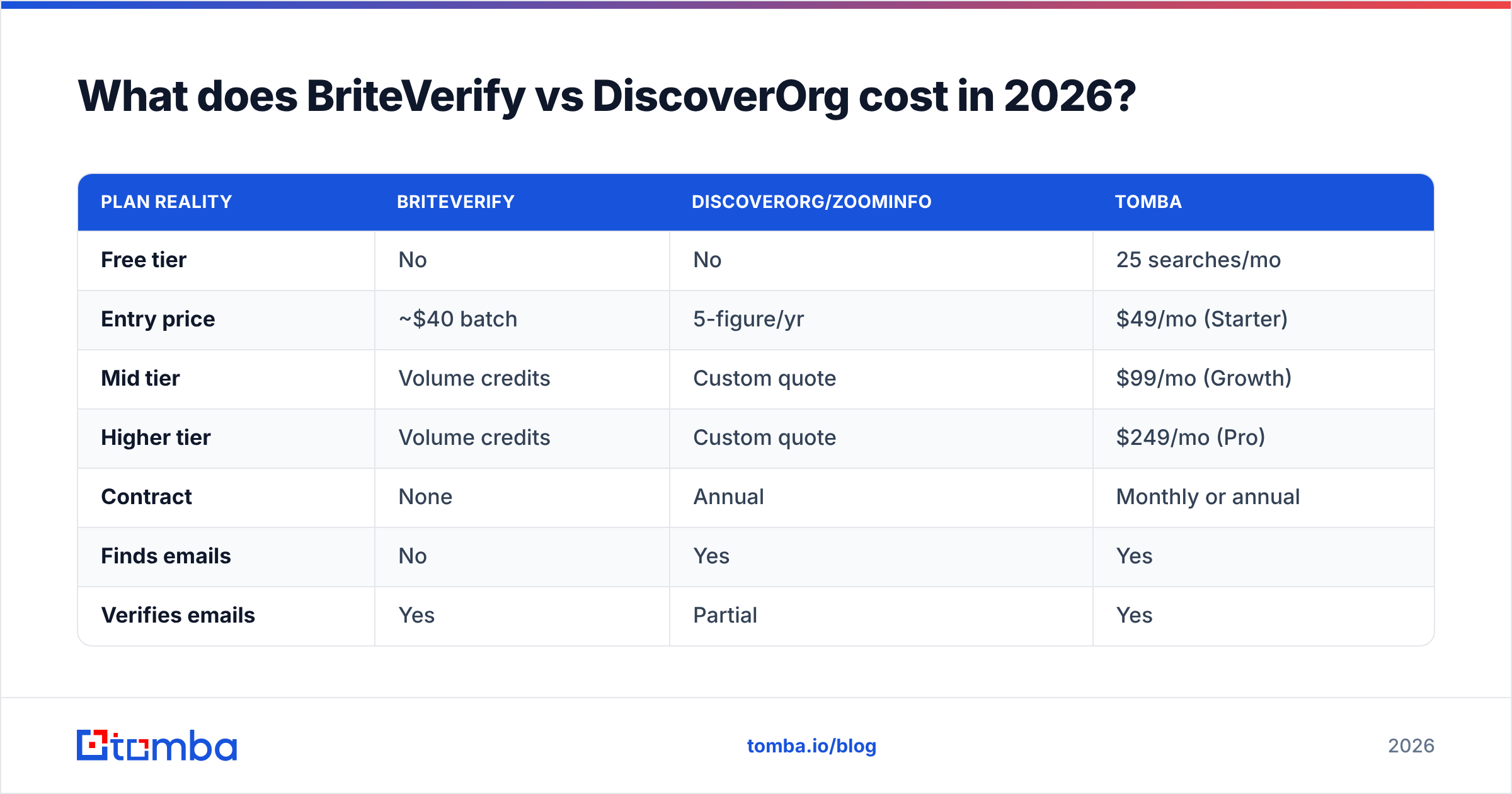
| Plan reality | BriteVerify | DiscoverOrg/ZoomInfo | Tomba |
|---|---|---|---|
| Free tier | No | No | 25 searches/mo |
| Entry price | ~$40 batch | 5-figure/yr | $49/mo (Starter) |
| Mid tier | Volume credits | Custom quote | $99/mo (Growth) |
| Higher tier | Volume credits | Custom quote | $249/mo (Pro) |
| Contract | None | Annual | Monthly or annual |
| Finds emails | No | Yes | Yes |
| Verifies emails | Yes | Partial | Yes |
That last column is the point of this whole comparison. A platform built to find and verify collapses two line items into one. You can see full Tomba pricing without booking a demo.

Who should choose BriteVerify?#
Pick BriteVerify if list hygiene is your actual problem. Specifically:
- You're an email marketer or lifecycle/CRM owner with large lists and you need bounce rates under control before a campaign.
- You already have a sourcing motion (inbound forms, events, an existing database) and just need a clean-up layer.
- You want pay-as-you-go pricing with zero contract commitment.
- You're already inside the Validity/Everest ecosystem and want verification that plugs into your deliverability dashboard.
BriteVerify is a focused, well-built tool. The limitation is scope: buy it expecting it to also find prospects and you'll be disappointed, because that was never its job.
Who should choose DiscoverOrg?#
Pick DiscoverOrg/ZoomInfo if your bottleneck is finding the right accounts and people, and you have budget to match:
- You're an enterprise sales or RevOps team that needs org charts, buying-committee maps, and intent signals — not just contact rows.
- You run account-based marketing and need firmographic depth and technographic filters to build target lists.
- You have the budget for an annual platform contract and the volume to justify it.
- You want direct-dial phone numbers and account intelligence alongside emails.
The limitation is cost and commitment. For SMBs, solo founders, or anyone testing a new outbound channel, the annual contract is a heavy bet to place before you've proven the motion works. You can read more about how this category of data enrichment overlaps with sourcing if that's your core need.
Is there a middle ground that does both?#
Yes — and for most teams under enterprise scale, it's the smarter buy. The gap between BriteVerify and DiscoverOrg is "a verifier with no source" versus "a source so expensive you need procurement." A combined find-and-verify platform sits in between: it locates professional email addresses by name or domain, then verifies them in the same workflow.
That's the lane Tomba plays in. With the email finder you supply a name and company domain and get a verified work email; the built-in verifier scores deliverability before the address ever reaches your sequencer; and a searchable B2B database plus domain search covers the sourcing side that BriteVerify lacks entirely. You get DiscoverOrg's "find people" job and BriteVerify's "make sure they're real" job from one login, starting at $49/mo instead of a five-figure contract.
It's not a like-for-like replacement for every enterprise feature DiscoverOrg ships — you won't get the same depth of intent scoring or org-chart research. But for the core outbound loop of find the contact, confirm it's valid, send, it removes a tool from your stack and a zero from your invoice.
How do I decide between BriteVerify, DiscoverOrg, and an all-in-one?#
Run your situation through three quick questions:
- What's actually broken — sourcing or deliverability? No leads → you need DiscoverOrg-class sourcing (or Tomba's finder). Bouncing leads → you need BriteVerify-class verification (or Tomba's verifier). Both → you need either two tools or one platform.
- What's your scale and budget? Enterprise ABM with six-figure ACVs can absorb DiscoverOrg's contract and will use its depth. SMB and mid-market teams rarely recoup it and are better served by usage-based tools.
- How many tools do you want to run? Specialists give you best-in-class depth at the cost of integration overhead and multiple invoices. A combined platform trades a little depth for one workflow and one bill.
There's no universal winner — only a best fit for your funnel stage and budget. The mistake is treating BriteVerify and DiscoverOrg as interchangeable; they aren't, and buying the wrong one means solving a problem you don't have while ignoring the one you do. (For context on the broader vendor landscape, ZoomInfo's own product pages and Validity's BriteVerify docs lay out each tool's full feature depth.)
The bottom line#
BriteVerify verifies; DiscoverOrg sources. They're complements, not competitors, and most mature outbound stacks end up needing both jobs done. The open question is whether you pay two vendors — one cheap, one very much not — or consolidate.
If your goal is to find verified B2B emails without an enterprise contract, start with the Tomba Email Finder. You can pull verified work emails by name or domain, confirm deliverability in the same step, and test the whole loop on the free tier (25 searches/mo) before spending a dollar — no demo call, no annual lock-in, no five-figure quote. Find the contact, verify it's real, and send with confidence.
Ready to find emails that actually work?
Join 150,000+ professionals who stopped guessing and started sending. Free credits on signup — no credit card required.
Get the Tomba newsletter
Practical outbound tactics and product updates — once every two weeks.
About the author