BriteVerify vs Kickbox 2026: Email Verification Compared
BriteVerify and Kickbox both promise cleaner lists and fewer bounces — but they price, score, and scale very differently. Here's the honest 2026 breakdown.
You have a list, a sender reputation to protect, and two verifiers in the tab bar: BriteVerify and Kickbox. Both will lower your bounce rate. The real question is which one fits how you actually buy, scale, and integrate email verification in 2026 — and whether either is the right tool for a sales team that also needs to find contacts, not just clean them.
TL;DR — BriteVerify vs Kickbox in one screen#
- BriteVerify lives inside Validity's deliverability suite. It's enterprise-friendly, marketer-trusted, and tightly coupled to tools like Everest — but pricing is opaque and per-record costs run high.
- Kickbox is the developer-leaning option: transparent pay-as-you-go pricing, a clean API, a "Sendex" quality score, and a free 100-verification trial with no card.
- Accuracy is close. Both clear 95%+ on deliverable/undeliverable. The gap shows up in catch-all handling, batch speed, and how much you pay per thousand.
- Neither finds emails. They verify what you already have. If your bottleneck is sourcing contacts, a combined finder-plus-verifier like Tomba covers both jobs on one bill.
- Quick pick: Kickbox for transactional/developer use, BriteVerify for marketers already inside Validity, and an all-in-one if cost-per-lead and finding matter more than brand familiarity.

What do BriteVerify and Kickbox actually do?#
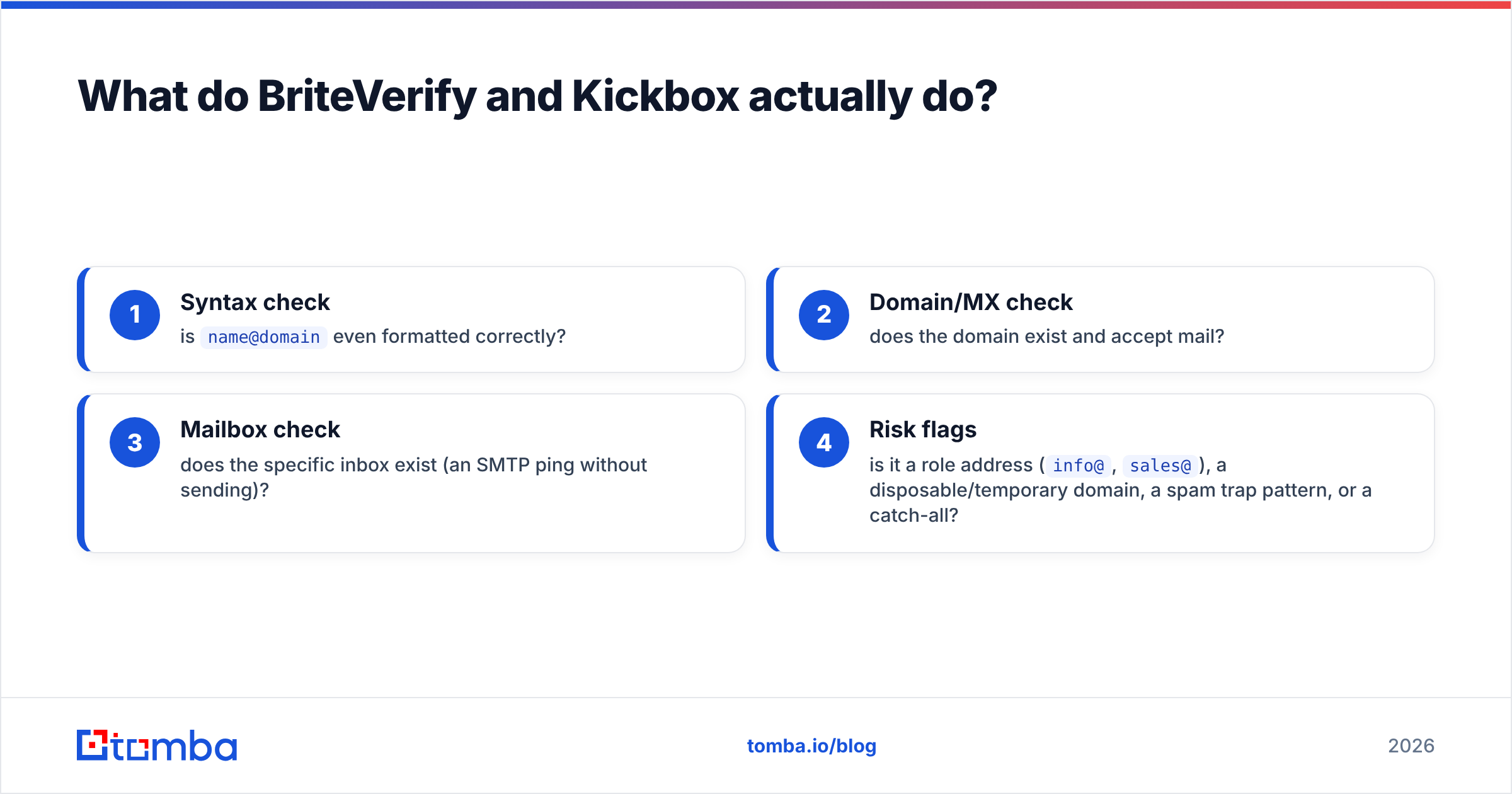
Both are email verification services. Think of them as a bouncer at the door of your list: before a message goes out, they check whether the address is real, reachable, and safe to mail. That check happens in a few layers:
- Syntax check — is
name@domaineven formatted correctly? - Domain/MX check — does the domain exist and accept mail?
- Mailbox check — does the specific inbox exist (an SMTP ping without sending)?
- Risk flags — is it a role address (
info@,sales@), a disposable/temporary domain, a spam trap pattern, or a catch-all?
The output is a status you can act on: send, don't send, or proceed with caution. Clean lists protect your sender reputation and your email deliverability, which is the entire point — a 30% bounce rate gets your domain throttled fast.
Where they diverge is everything around that core check: pricing model, API ergonomics, batch handling, scoring philosophy, and what ecosystem they pull you into.
How do BriteVerify and Kickbox compare head-to-head?#
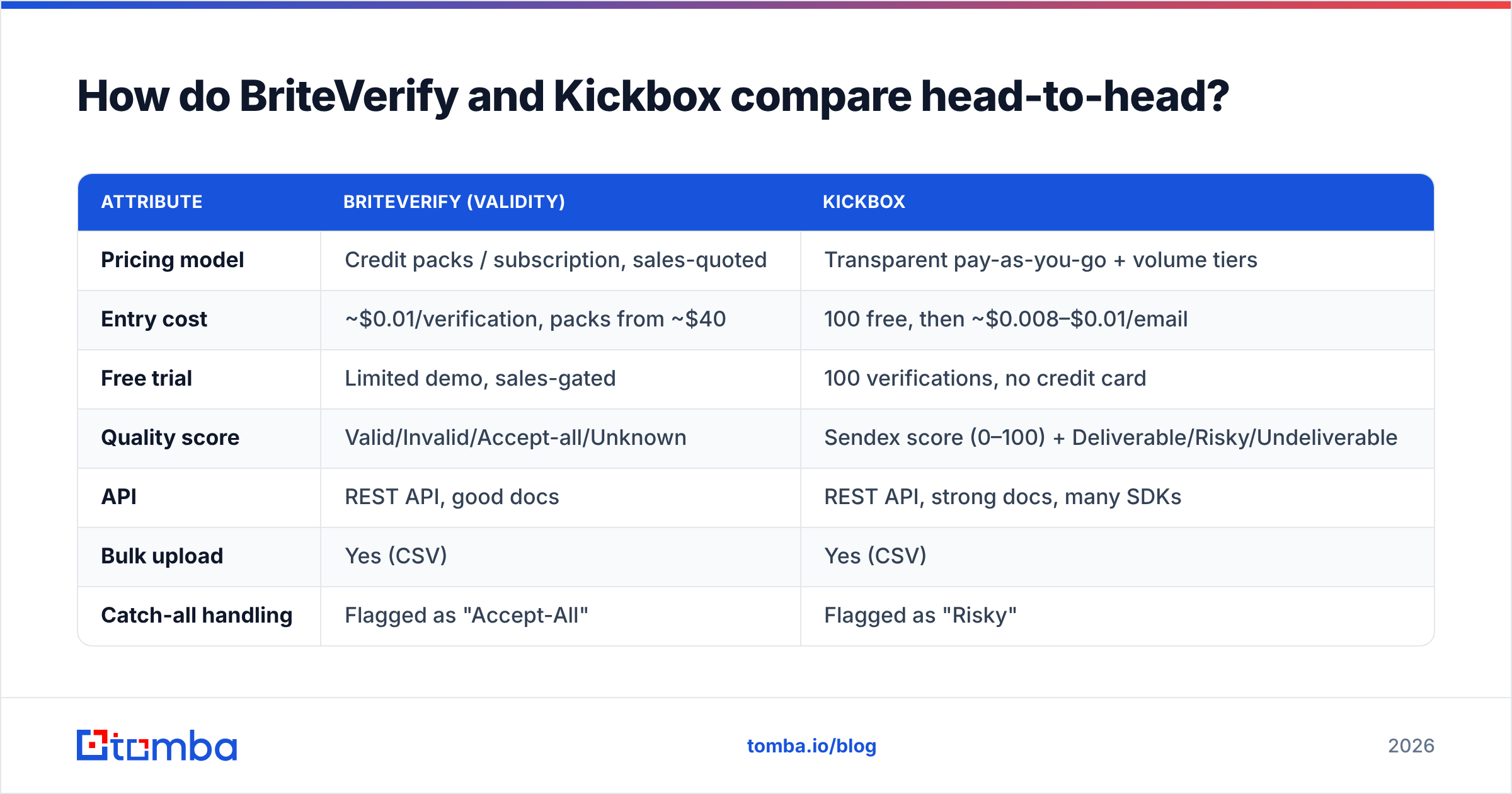
Here is the side-by-side that most "vs" posts bury. Prices are list/public figures as of 2026 and shift with volume — always confirm on the vendors' own pages.
| Attribute | BriteVerify (Validity) | Kickbox |
|---|---|---|
| Pricing model | Credit packs / subscription, sales-quoted | Transparent pay-as-you-go + volume tiers |
| Entry cost | ~$0.01/verification, packs from ~$40 | 100 free, then ~$0.008–$0.01/email |
| Free trial | Limited demo, sales-gated | 100 verifications, no credit card |
| Quality score | Valid/Invalid/Accept-all/Unknown | Sendex score (0–100) + Deliverable/Risky/Undeliverable |
| API | REST API, good docs | REST API, strong docs, many SDKs |
| Bulk upload | Yes (CSV) | Yes (CSV) |
| Catch-all handling | Flagged as "Accept-All" | Flagged as "Risky" |
| Best-known for | Marketers, Salesforce/Marketo crowd | Developers, transactional senders |
| Ecosystem | Validity suite (Everest, GridBuster) | Standalone, integration-friendly |
| Email finding | No | No |
The headline: Kickbox wins on transparency and developer experience; BriteVerify wins on enterprise integration and brand trust. Neither is dramatically more accurate than the other on standard lists.
Is BriteVerify more accurate than Kickbox?#
Conclusion first: accuracy is effectively a tie on clean data, and both struggle in the same place — catch-all domains.
Independent buyers on G2 report both tools landing in the mid-to-high 90s for correctly classifying deliverable vs. undeliverable addresses. That's table stakes for any serious verifier in 2026.
The interesting divergence is how they label uncertainty:
- BriteVerify returns "Accept-All" (a.k.a. catch-all) and "Unknown" as distinct buckets. It's conservative — it would rather flag than guess.
- Kickbox folds ambiguity into a "Risky" status plus a numeric Sendex score, so you get a gradient instead of a binary. A 75 Sendex is a different bet than a 40.
For a marketer, BriteVerify's clean Valid/Invalid split is easy to action. For an engineer building send-time logic, Kickbox's score is more programmable — you can set your own threshold.
The shared weakness is the catch-all domain: a server configured to accept mail for every address, so an SMTP ping can't confirm a specific mailbox exists. Both tools punt here. This is exactly where a dedicated catch-all verifier earns its keep, applying pattern analysis and historical data to resolve addresses these two leave as "Risky" or "Accept-All."
Which is cheaper — BriteVerify or Kickbox?#
Conclusion first: Kickbox is cheaper and clearer for most mid-size buyers; BriteVerify can win at true enterprise volume if you negotiate.
BriteVerify's pricing is sales-quoted above the entry packs, which means two companies verifying the same volume can pay very different rates. Kickbox publishes its tiers, so you can model cost before talking to anyone — a real advantage when you're comparing line items.
But cost-per-verification is only half the math. Ask what the list cost is:
- If you already have addresses and just need to clean them, either tool's per-record fee is your whole bill.
- If you're paying a separate vendor to find those addresses first, your true cost-per-usable-lead is finder price + verifier price stacked.
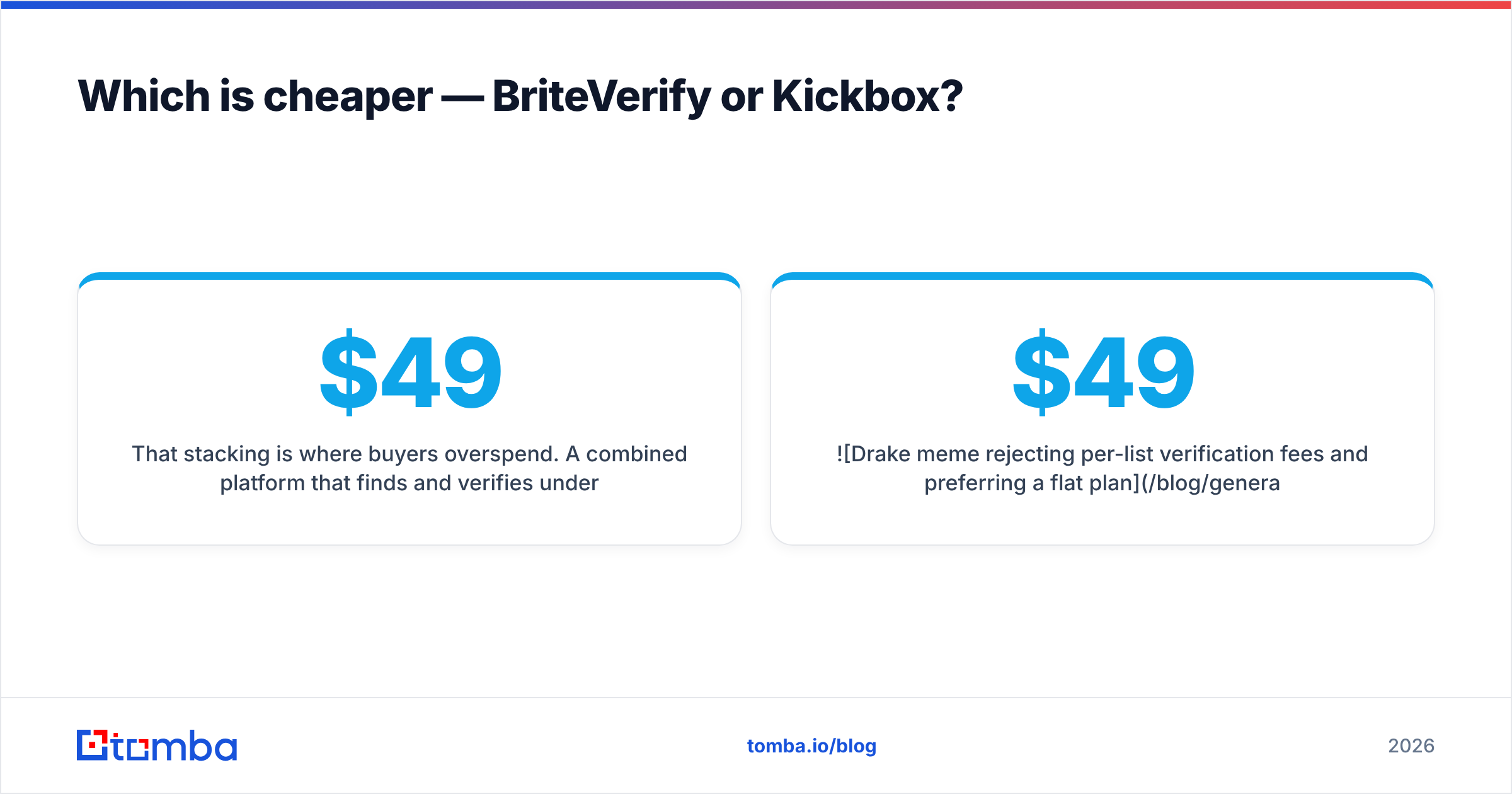
That stacking is where buyers overspend. A combined platform that finds and verifies under one subscription collapses two bills into one. For reference, Tomba pricing runs Free (25 searches/mo), Starter at $49/mo, Growth at $99/mo, and Pro at $249/mo — with verification included rather than billed as a separate per-record line.
What about API, bulk verification, and integrations?#
This is where the two tools sort themselves by audience.
Kickbox for developers. The API is the product's center of gravity: clean REST endpoints, real-time single verification, batch jobs, webhooks, and SDKs across major languages. If you're verifying at signup, at form submission, or inside an app, Kickbox feels native. Its documentation is genuinely good — you can be live in an afternoon.
BriteVerify for the marketing stack. Its strength is sitting inside Validity and connecting to the tools marketers already run — Salesforce, Marketo, HubSpot-style flows. If your verification needs to happen inside a campaign workflow rather than a codebase, BriteVerify's integrations reduce friction.
For pure batch work — uploading a 50,000-row CSV the night before a campaign — both handle it, but throughput and queue times vary with plan. If batch is your main use case, test both with a real file before committing.
A third path worth weighing: if your verification is part of a broader data pipeline, an email verification API that shares credentials and billing with your email finder and bulk email finder means one integration instead of three. Fewer keys, fewer invoices, one rate limit to reason about.
When should you pick BriteVerify?#
Pick BriteVerify when:
- You're already a Validity customer. Everest, sender certification, and BriteVerify share a console and a contract. Consolidation has real value.
- Marketers, not engineers, own the workflow. The Valid/Invalid output and native CRM connectors mean no code.
- Enterprise procurement is involved. A known brand with SOC 2, a security questionnaire on file, and a named account rep clears legal faster than a scrappy upstart.
- You verify inside campaign tools rather than at the application layer.
The trade-off you accept: opaque pricing, higher per-record cost at small scale, and a tool that only verifies — it won't help you build the list in the first place.
When should you pick Kickbox?#
Pick Kickbox when:
- A developer owns verification. The API and SDKs are the best part of the product.
- You want transparent, model-able pricing without a sales call.
- You verify in real time — at signup, checkout, or form submit — and need low-latency single lookups.
- The Sendex score helps your logic. A numeric gradient beats a binary when you're automating send/hold decisions.
- You're testing the waters. 100 free verifications with no card is the lowest-commitment way to evaluate quality on your own data.
The trade-off: it's a standalone verifier. No deeper deliverability suite, and — like BriteVerify — no finding.
What neither BriteVerify nor Kickbox does: find the email#
Here's the gap both tools share, and it's the one that quietly costs sales teams the most. Verification cleans a list you already have. It does not build one.
If your pipeline looks like "scrape a list → verify → send," you're paying a separate sourcing tool before either verifier sees a single address. That's two vendors, two contracts, two failure points. And the sourcing step is usually the more expensive, more error-prone one.
A combined platform handles both jobs. With Tomba you can:
- Run a domain search to pull every public email pattern at a target company.
- Use the email finder to resolve a specific person from name + company.
- Verify emails in the same flow, so found addresses are confirmed before they ever hit your sequencer.
- Resolve the hard cases with the catch-all finder instead of writing them off as "Risky."
Same credits, same dashboard, same API. For a sales or growth team, the question isn't really "BriteVerify or Kickbox" — it's "do I want to pay for finding and verifying separately, or once?"
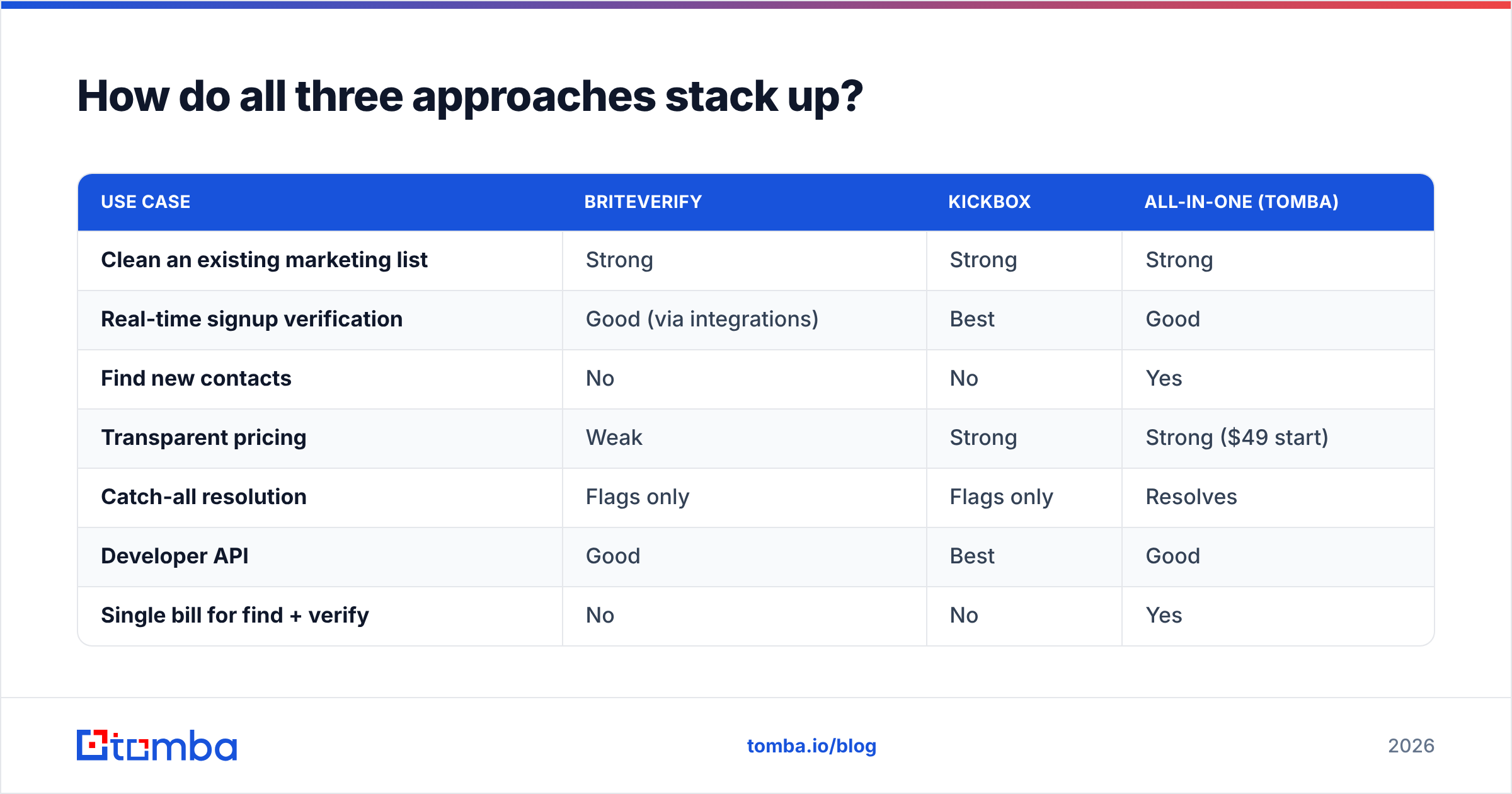
How do all three approaches stack up?#
| Use case | BriteVerify | Kickbox | All-in-one (Tomba) |
|---|---|---|---|
| Clean an existing marketing list | Strong | Strong | Strong |
| Real-time signup verification | Good (via integrations) | Best | Good |
| Find new contacts | No | No | Yes |
| Transparent pricing | Weak | Strong | Strong ($49 start) |
| Catch-all resolution | Flags only | Flags only | Resolves |
| Developer API | Good | Best | Good |
| Single bill for find + verify | No | No | Yes |
The pattern is clear: for verification alone, both incumbents are solid and Kickbox edges ahead on price and DX. The moment "find the contact" enters the job description, the calculus changes.
Frequently asked questions#
Is Kickbox or BriteVerify better for cold email? Both reduce bounces, which protects deliverability. But cold email's bigger risk is sourcing bad data in the first place. Pair verification with a quality finder, and warm the domain before volume sends — check a warmup calculator to set a safe ramp.
Do these tools verify catch-all addresses? Not really. Both flag catch-alls ("Accept-All" / "Risky") rather than resolving them. A dedicated catch-all verifier is the better tool for those domains.
Can I try them free? Kickbox offers 100 free verifications with no credit card. BriteVerify's free access is more limited and sales-gated. Tomba's free tier includes 25 searches per month.
Will a cheaper verifier hurt accuracy? Price and accuracy aren't tightly linked above the budget floor. The mid-90s accuracy band is common across reputable vendors — the differentiators are catch-all handling, speed, and total cost including sourcing.
The bottom line#
Choose Kickbox if a developer owns verification and you want transparent pricing. Choose BriteVerify if you're already inside Validity and marketers run the workflow. They're both legitimate, accurate verifiers — the decision is about fit and ecosystem, not a quality chasm.
But if you're a sales or growth team whose real bottleneck is finding the right contacts — not just scrubbing a list someone handed you — paying for a standalone verifier is solving half the problem at full price. Start with the Tomba Email Finder to source verified, accurate B2B emails and confirm them in the same step, on one plan from $49/mo. Find it, verify it, send it — without stitching three vendors together.
// get started
Find, verify and enrich your first contacts today
Start on the free plan with 25 searches a month, then scale when your team is ready.
Free plan · No credit card required · GDPR & CCPA
// about the author