BriteVerify vs ZeroBounce 2026: Which Email Verifier Wins?
BriteVerify and ZeroBounce both clean your lists, but they price, score catch-alls, and integrate very differently. Here's the honest 2026 breakdown.
BriteVerify vs ZeroBounce: The 2026 Email Verifier Showdown
Choosing between BriteVerify and ZeroBounce comes down to one question most comparison posts dodge: do you want a simple pay-per-verify utility bolted onto an email-marketing suite, or a standalone deliverability platform with scoring, monitoring, and a generous API? This post answers that, then shows where a third option fits if you also need to find the addresses you're cleaning.
TL;DR#
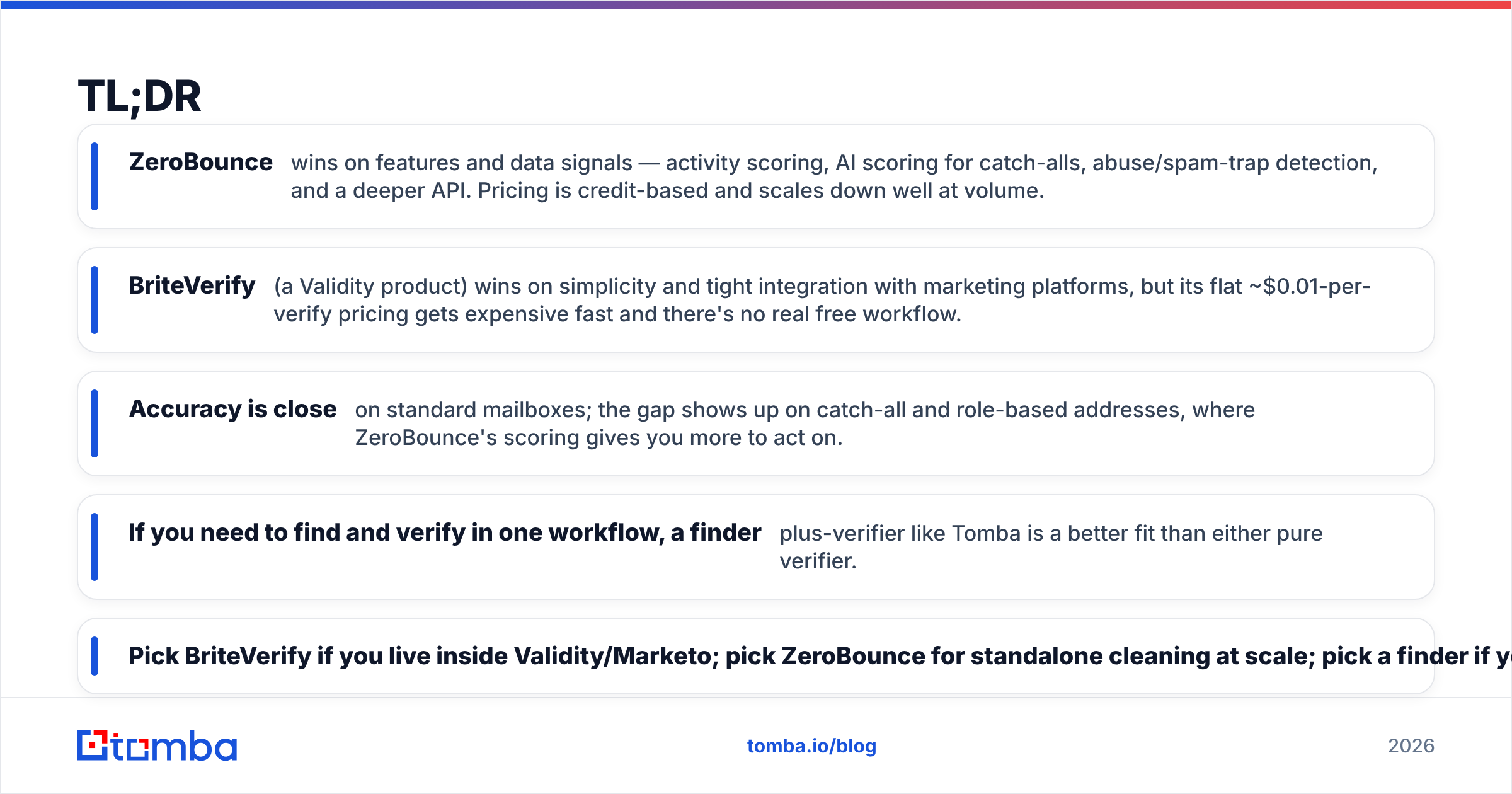
- ZeroBounce wins on features and data signals — activity scoring, AI scoring for catch-alls, abuse/spam-trap detection, and a deeper API. Pricing is credit-based and scales down well at volume.
- BriteVerify (a Validity product) wins on simplicity and tight integration with marketing platforms, but its flat ~$0.01-per-verify pricing gets expensive fast and there's no real free workflow.
- Accuracy is close on standard mailboxes; the gap shows up on catch-all and role-based addresses, where ZeroBounce's scoring gives you more to act on.
- If you need to find and verify in one workflow, a finder-plus-verifier like Tomba is a better fit than either pure verifier.
- Pick BriteVerify if you live inside Validity/Marketo; pick ZeroBounce for standalone cleaning at scale; pick a finder if your list is still incomplete.
What do BriteVerify and ZeroBounce actually do?#
Both tools take a list of email addresses and tell you which ones are safe to send to. Think of them like a bouncer checking IDs at the door: they confirm the address exists, the domain accepts mail, and the mailbox isn't a known trap or complainer. Neither tool finds new contacts — they validate ones you already have.
BriteVerify is part of Validity, the company behind Everest and the sender-reputation tooling many enterprise email teams already use. That lineage is its biggest selling point: if your marketing stack is Marketo, Salesforce Marketing Cloud, or HubSpot, BriteVerify drops in with almost no friction.
ZeroBounce is a standalone deliverability company. Beyond verification it sells an inbox-placement tester, a blacklist monitor, and an email-finder add-on. Its verification engine returns richer metadata per address, which matters when you're making send/no-send decisions at scale.
Before you clean a list, it helps to understand what good email deliverability depends on — verification is one input, but sender reputation and authentication carry just as much weight.

How do BriteVerify and ZeroBounce compare on pricing and features?#
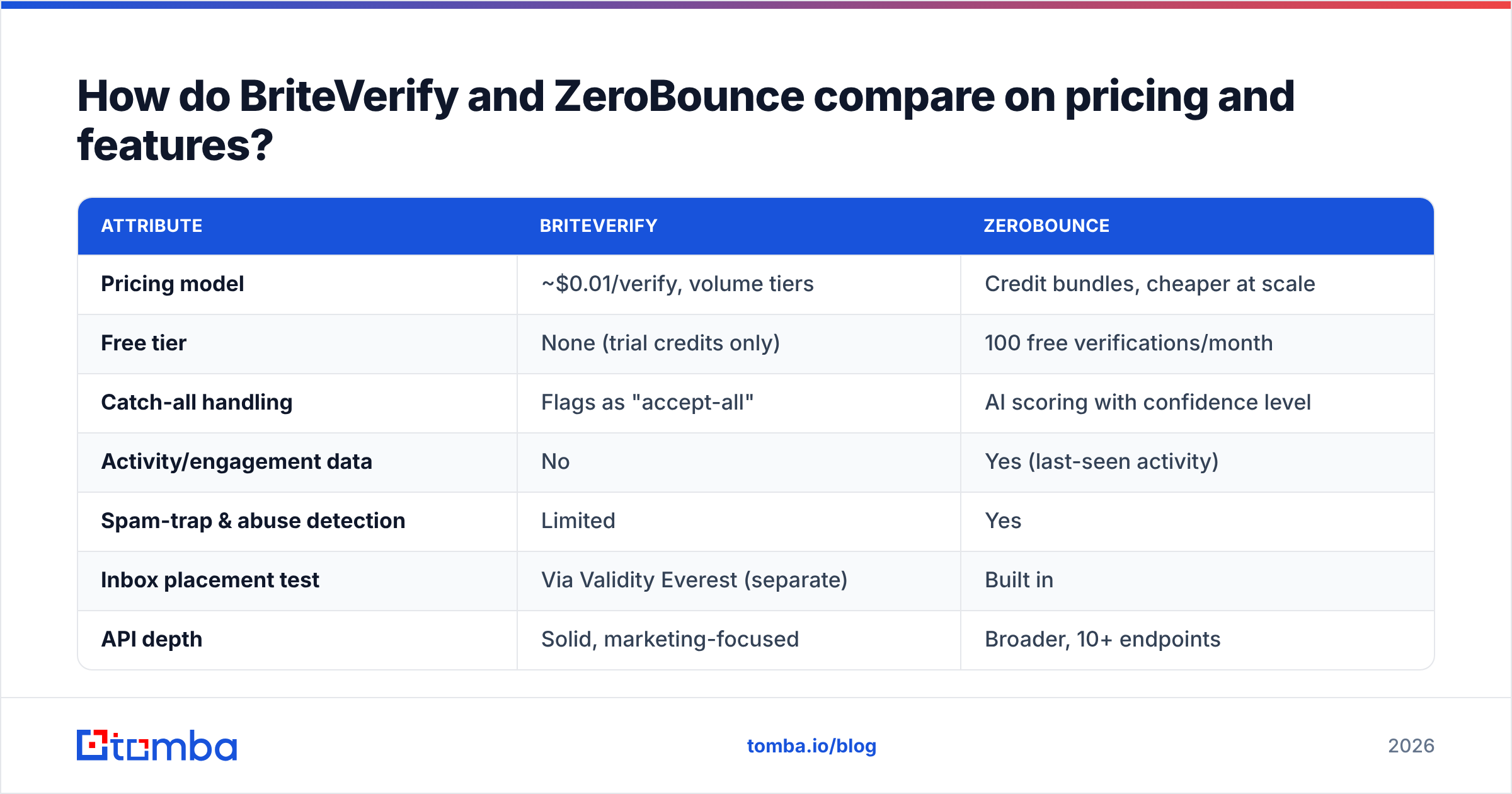
This is where the two diverge most. BriteVerify charges roughly a penny per verification with volume discounts, billed as pay-as-you-go credits or a subscription. ZeroBounce uses credit bundles that get cheaper per unit as you buy more, plus a small monthly free allotment.
| Attribute | BriteVerify | ZeroBounce |
|---|---|---|
| Pricing model | ~$0.01/verify, volume tiers | Credit bundles, cheaper at scale |
| Free tier | None (trial credits only) | 100 free verifications/month |
| Catch-all handling | Flags as "accept-all" | AI scoring with confidence level |
| Activity/engagement data | No | Yes (last-seen activity) |
| Spam-trap & abuse detection | Limited | Yes |
| Inbox placement test | Via Validity Everest (separate) | Built in |
| API depth | Solid, marketing-focused | Broader, 10+ endpoints |
| Best-fit user | Validity/Marketo teams | Standalone cleaning at scale |
The practical takeaway: BriteVerify's flat rate is predictable but punishing on big lists — verifying 500,000 addresses at a penny each is $5,000 with little room to negotiate unless you're enterprise. ZeroBounce's bundles push the effective per-verify cost well below that at the same volume, and the free 100/month lets you spot-check without a contract.
ZeroBounce also returns why an address failed and an activity signal (when the mailbox was last active), which is genuinely useful for re-engagement segmentation. BriteVerify keeps the output lean: valid, invalid, accept-all, unknown. Simpler to parse, less to act on.
Which is more accurate — BriteVerify or ZeroBounce?#
On standard, single-mailbox addresses (jane@company.com), both tools land in the high-90s percent accuracy range, and you won't notice a meaningful difference. Independent G2 reviews on both BriteVerify and ZeroBounce reflect this — satisfaction is high for routine cleaning.
The accuracy gap appears in three edge cases:
- Catch-all (accept-all) domains — These accept any address at the SMTP layer, so a naive verifier can't confirm the mailbox exists. BriteVerify simply labels them "accept-all" and leaves the decision to you. ZeroBounce layers AI scoring on top, giving a confidence estimate so you can send to the high-confidence ones instead of discarding the whole bucket.
- Role-based addresses —
info@,sales@,support@. Both flag them, but ZeroBounce separates role detection from validity, which helps when role addresses are legitimately your targets (common in B2B). - Spam traps and abuse addresses — ZeroBounce's detection here is stronger and more transparent, which directly protects your sender reputation.
If catch-all domains make up a big share of your list — typical in B2B, where many companies run accept-all — that scoring advantage is the single best reason to choose ZeroBounce. You can also pre-screen catch-alls with a dedicated catch-all verifier before paying to verify the rest.
When should you use a finder instead of a verifier?#
Here's the gap neither BriteVerify nor ZeroBounce closes well: both assume you already have the addresses. If your CRM is full of company names, LinkedIn profiles, or domains but missing actual emails, verification alone leaves you stuck — you can clean a list, but you can't build one.
That's the case for an email finder that verifies as it discovers. Instead of a two-tool workflow (find somewhere, export, upload to a verifier, re-import), you get verified addresses in one pass. For outbound and prospecting teams this is the more common need — the list isn't dirty, it's incomplete.

Tomba pairs an email finder with a built-in email verifier, domain search, and data enrichment, so the "find" and "validate" steps collapse into one. You only reach for a standalone cleaner like BriteVerify or ZeroBounce when you've imported a large, aging list from elsewhere.
How do the three options stack up for different jobs?#
Match the tool to the job rather than chasing a single "best" verdict:
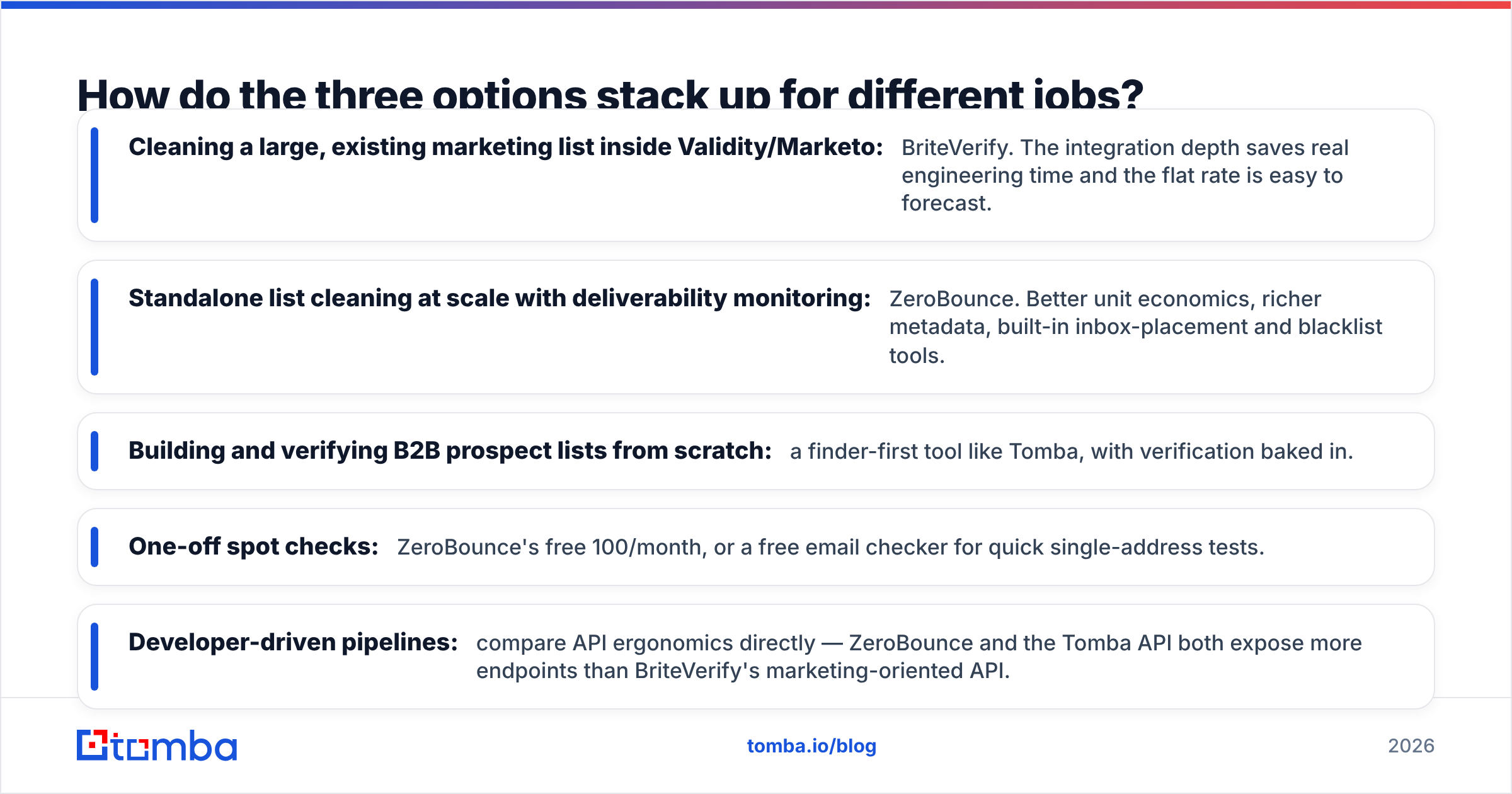
- Cleaning a large, existing marketing list inside Validity/Marketo: BriteVerify. The integration depth saves real engineering time and the flat rate is easy to forecast.
- Standalone list cleaning at scale with deliverability monitoring: ZeroBounce. Better unit economics, richer metadata, built-in inbox-placement and blacklist tools.
- Building and verifying B2B prospect lists from scratch: a finder-first tool like Tomba, with verification baked in.
- One-off spot checks: ZeroBounce's free 100/month, or a free email checker for quick single-address tests.
- Developer-driven pipelines: compare API ergonomics directly — ZeroBounce and the Tomba API both expose more endpoints than BriteVerify's marketing-oriented API.
What about the API and integrations?#
If you're wiring verification into a product or an automation, the API matters more than the dashboard. BriteVerify's API is reliable and well-documented but scoped around marketing use cases — real-time single verification and bulk list jobs. It shines when paired with Validity's broader suite.
ZeroBounce exposes a wider surface: validation, activity data, email finding, scoring, and account usage, all REST endpoints with SDKs in the major languages. For teams that want one vendor to handle validation and lightweight enrichment, that breadth is appealing.
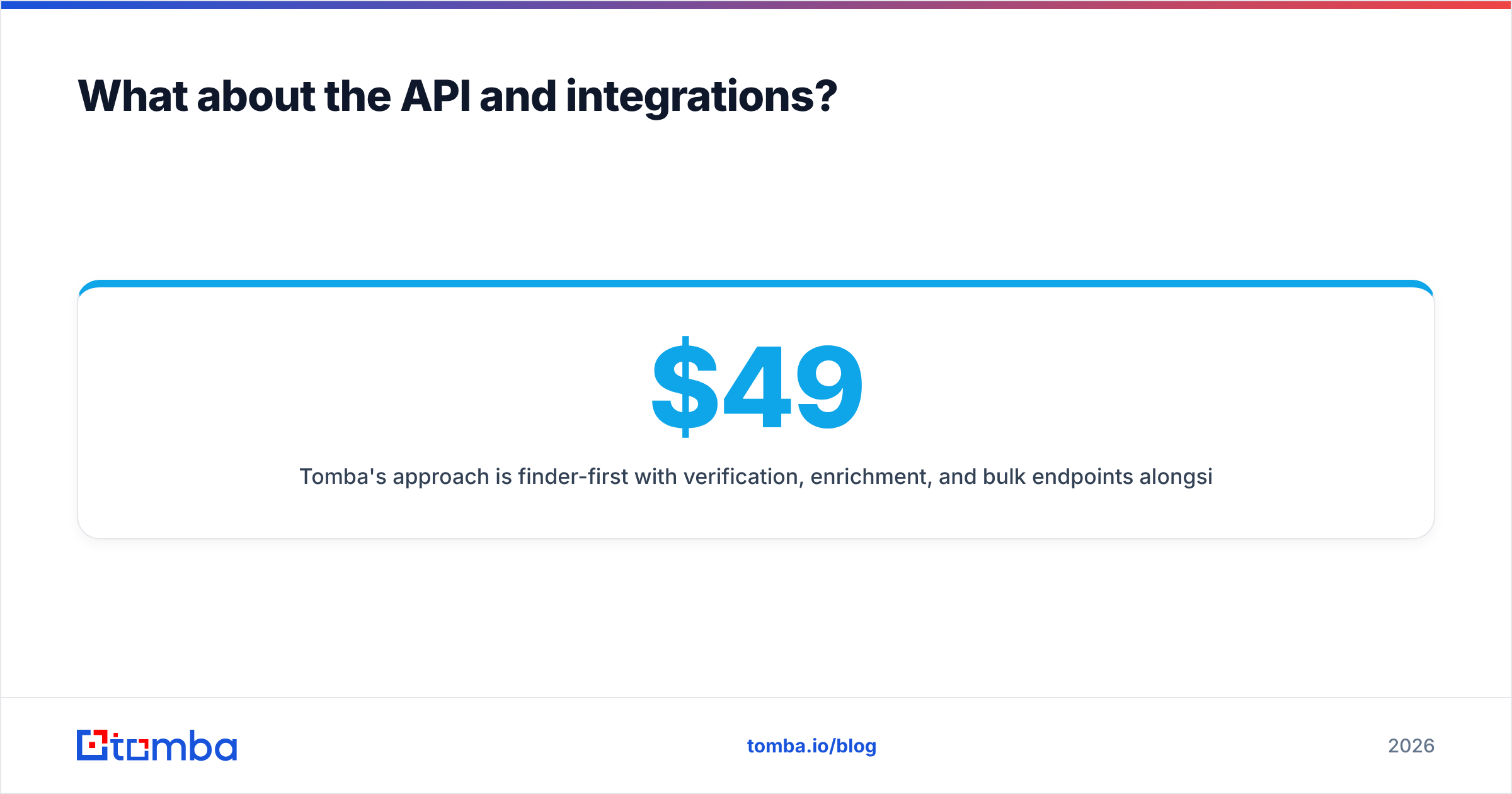
Tomba's approach is finder-first with verification, enrichment, and bulk endpoints alongside — useful when your pipeline needs to create contacts, not just clean them. You can also run it through bulk email finder jobs or check Tomba pricing to compare credit costs against ZeroBounce bundles. Tomba's published plans are Free (25 searches/mo), Starter at $49/mo, Growth at $99/mo, Pro at $249/mo, and custom Enterprise — credit-based like ZeroBounce rather than flat-rate like BriteVerify.
Common mistakes when comparing email verifiers#
A few traps trip up teams during a head-to-head trial:
- Testing on a clean list. If your sample is already valid, every tool scores ~100% and you learn nothing. Test on a messy, real export with known-bad addresses.
- Ignoring catch-all share. If 40% of your list is accept-all, the catch-all scoring feature is the whole ballgame — not the headline accuracy number.
- Forgetting downstream cost. A penny per verify feels trivial until you multiply by your real list size and refresh cadence.
- Treating verification as a deliverability fix. Clean lists help, but authentication, warmup, and content still determine inbox placement. Verification is necessary, not sufficient.
So which should you choose: BriteVerify or ZeroBounce?#
Choose BriteVerify if you're already inside the Validity ecosystem or a marketing platform it integrates with natively, you value a dead-simple valid/invalid output, and predictable flat pricing matters more than squeezing the lowest unit cost.
Choose ZeroBounce if you're cleaning lists standalone, you want catch-all scoring and activity data to make smarter send decisions, you're verifying at volume where bundle pricing wins, or you want inbox-placement and blacklist tooling under one roof.
And if the real problem is that your list is incomplete — not dirty — neither pure verifier solves it. That's where a finder-plus-verifier earns its place.
Find verified emails in one step with Tomba#
If you spend more time hunting for addresses than cleaning them, skip the two-tool shuffle. The Tomba Email Finder discovers professional emails by name, domain, or company and verifies them in the same pass — with domain search, a catch-all verifier, and data enrichment alongside, plus a Tomba API for pipelines. Start on the free tier (25 searches/month), and reach for BriteVerify or ZeroBounce only when you've got a big legacy list that genuinely needs a dedicated scrub. Build the list once, verified, and stop paying to clean what you could have captured clean.
// get started
Find, verify and enrich your first contacts today
Start on the free plan with 25 searches a month, then scale when your team is ready.
Free plan · No credit card required · GDPR & CCPA
// about the author