BriteVerify vs ZoomInfo (2026): Which B2B Data Tool Wins?
BriteVerify verifies emails; ZoomInfo builds prospect lists. They solve different problems. Here's how they compare in 2026 — and the cheaper stack that beats both.
TL;DR
- BriteVerify and ZoomInfo are not the same kind of tool. BriteVerify is an email verification service. ZoomInfo is a full B2B data and sales-intelligence platform. Comparing them is like comparing a smoke detector to a whole security system.
- Pick BriteVerify if you already have a list and only need to scrub it for invalid, risky, or duplicate addresses before sending.
- Pick ZoomInfo if you need to build lists from scratch — company firmographics, contact data, intent signals, and org charts — and have a five-figure budget.
- The catch: ZoomInfo is expensive and locks you into annual contracts, while BriteVerify charges per verification and does nothing to help you find contacts.
- The leaner play: a focused email finder plus a verifier (like Tomba) covers the "find + validate" loop most teams actually need, at a fraction of ZoomInfo's price.
What do BriteVerify and ZoomInfo actually do?#
The short answer: they sit at opposite ends of the prospecting workflow.
BriteVerify, owned by Validity, is a list hygiene tool. You feed it email addresses you already have, and it tells you which ones are valid, invalid, risky (catch-all), or known-bad. Think of it as the spell-checker you run before hitting send — it doesn't write the email, it just stops you from looking foolish or torching your sender reputation.
ZoomInfo is a data acquisition platform. You start with nothing and end with a targeted list: companies filtered by industry, headcount, and revenue, plus the named decision-makers inside them, their direct dials, and buying-intent signals. It's the research department, the contact database, and a chunk of your sales workflow rolled into one expensive subscription.
So "BriteVerify vs ZoomInfo" is really a question about where your gap is. Do you have lists that need cleaning, or do you have no lists at all? Most teams discover they need both capabilities — which is exactly why the pricing math gets interesting later.
)
How do BriteVerify and ZoomInfo compare head-to-head?#
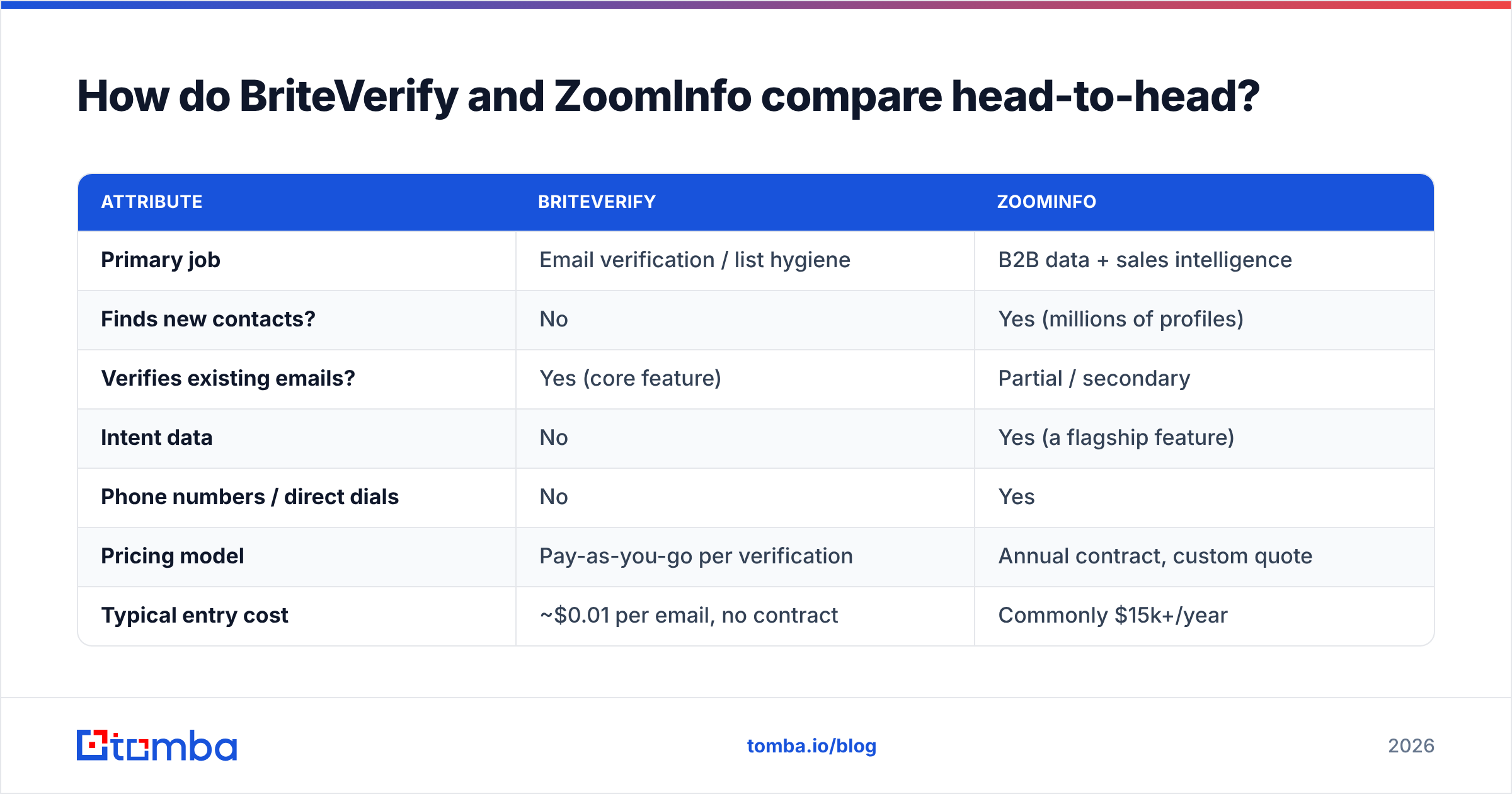
Here's the side-by-side. Note that several rows are "N/A" precisely because these tools weren't built for the same job.
| Attribute | BriteVerify | ZoomInfo |
|---|---|---|
| Primary job | Email verification / list hygiene | B2B data + sales intelligence |
| Finds new contacts? | No | Yes (millions of profiles) |
| Verifies existing emails? | Yes (core feature) | Partial / secondary |
| Intent data | No | Yes (a flagship feature) |
| Phone numbers / direct dials | No | Yes |
| Pricing model | Pay-as-you-go per verification | Annual contract, custom quote |
| Typical entry cost | ~$0.01 per email, no contract | Commonly $15k+/year |
| Free tier | Limited trial credits | Free "lite" community tier |
| Best for | Cleaning lists before send | Building lists from zero |
| Contract lock-in | None | Annual, often multi-year |
A few things jump out. BriteVerify wins on flexibility and entry cost — you pay only for what you verify, with no salesperson and no annual commitment. ZoomInfo wins on breadth — there is simply no list-building, intent, or org-chart capability inside BriteVerify, because that was never its purpose.
For background on why verification matters at all, the concept of email deliverability explains how invalid addresses and high bounce rates quietly damage your ability to reach the inbox.
Is BriteVerify accurate enough for cold outreach?#
Yes, for what it does. BriteVerify is a mature, well-regarded verifier with strong syntax checks, MX-record validation, and known-bad detection. If your only goal is to drop bounce rates before a campaign, it does the job reliably.
The honest limitation is catch-all domains. Like most verifiers, BriteVerify often returns an "accept-all" or "risky" verdict for domains that accept every address at the SMTP layer, which leaves you guessing on a meaningful slice of B2B lists. This isn't a BriteVerify flaw so much as a structural problem with how corporate mail servers respond — but it's where a dedicated catch-all verifier can squeeze out extra usable contacts.
The bigger point: verification accuracy is only half the battle. A perfectly verified list of the wrong people still fails. That's the gap ZoomInfo fills — and the gap a verifier alone can never close.
Is ZoomInfo worth the price in 2026?#
It depends entirely on your scale. ZoomInfo's database is genuinely deep, its intent data is best-in-class, and for a large enterprise sales org running coordinated account-based plays, the ROI can be real. According to peer reviews aggregated on G2, buyers consistently praise data depth while flagging cost and contract rigidity as the main pain points.
That second part matters. ZoomInfo is a sales-led, annual-contract product. You'll talk to a rep, negotiate seats and credits, and commit for at least a year — often more. For a five-person startup or a solo founder, that's a non-starter. The platform is also more than most teams use: you're paying for intent scoring, org charts, and workflow automation even if all you needed was accurate contact data.
If ZoomInfo's price tag made you wince but you still need real B2B data, the market has shifted hard toward modular, usage-based tools. You can read a fuller breakdown of Apollo alternatives and similar platforms to see how the new generation prices itself — almost always monthly, almost always self-serve.
)
BriteVerify vs ZoomInfo: which should you choose?#
Match the tool to your actual bottleneck. Here's the decision in five clear cases:
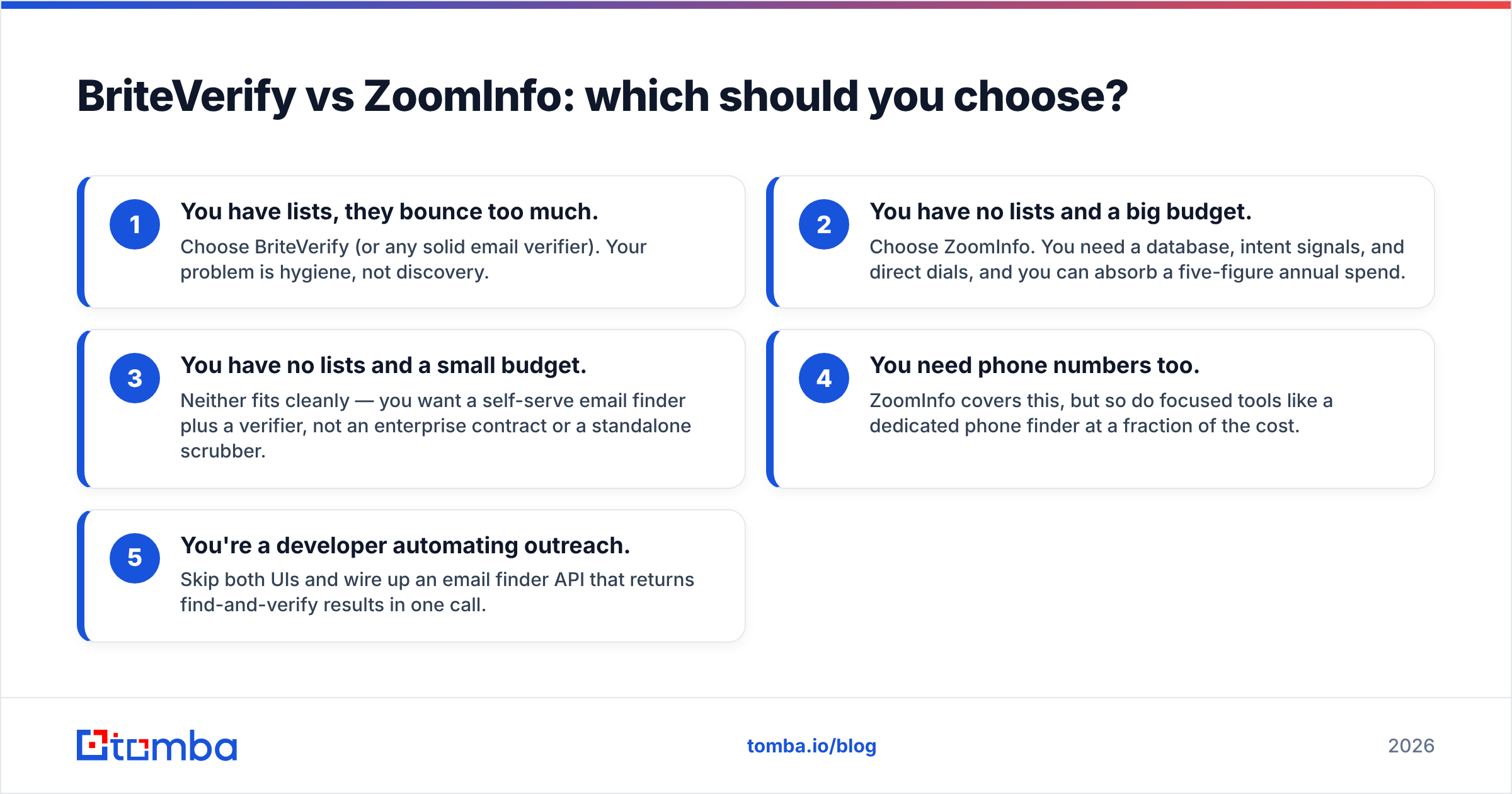
- You have lists, they bounce too much. Choose BriteVerify (or any solid email verifier). Your problem is hygiene, not discovery.
- You have no lists and a big budget. Choose ZoomInfo. You need a database, intent signals, and direct dials, and you can absorb a five-figure annual spend.
- You have no lists and a small budget. Neither fits cleanly — you want a self-serve email finder plus a verifier, not an enterprise contract or a standalone scrubber.
- You need phone numbers too. ZoomInfo covers this, but so do focused tools like a dedicated phone finder at a fraction of the cost.
- You're a developer automating outreach. Skip both UIs and wire up an email finder API that returns find-and-verify results in one call.
The uncomfortable truth in cases 3 through 5: the BriteVerify-vs-ZoomInfo framing is a false binary. You're being asked to choose between a tool that only cleans and a tool that only the enterprise can afford. Most growth-stage teams need something in between.
What's the better-value alternative for most teams?#
A combined find-and-verify tool. The workflow nearly every outbound team runs is simple: identify a target company, find the right person's email, confirm it's valid, then reach out. ZoomInfo does this but overshoots on price and scope. BriteVerify only handles the "confirm it's valid" step.
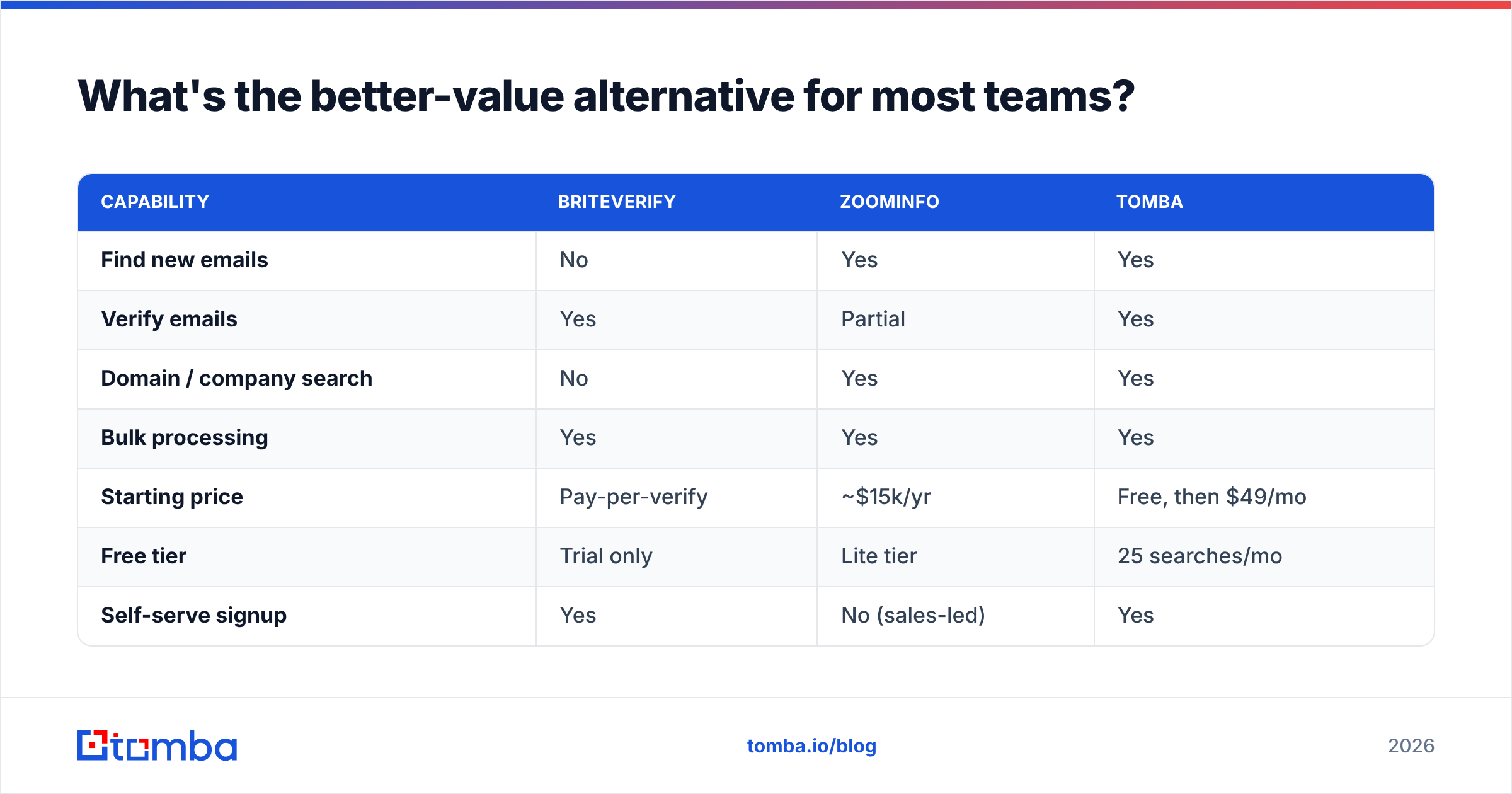
Tomba is built around exactly this loop. You start with a company domain and use domain search to pull every public email pattern and named contact, run results through built-in verification, and export clean — without an annual contract. Here's how the value stacks up against the two incumbents:
| Capability | BriteVerify | ZoomInfo | Tomba |
|---|---|---|---|
| Find new emails | No | Yes | Yes |
| Verify emails | Yes | Partial | Yes |
| Domain / company search | No | Yes | Yes |
| Bulk processing | Yes | Yes | Yes |
| Starting price | Pay-per-verify | ~$15k/yr | Free, then $49/mo |
| Free tier | Trial only | Lite tier | 25 searches/mo |
| Self-serve signup | Yes | No (sales-led) | Yes |
| API access | Yes | Yes (enterprise) | Yes (all paid plans) |
Tomba's published pricing runs Free (25 searches/month), Starter at $49/month, Growth at $99/month, and Pro at $249/month, with custom enterprise options. That means you can find and verify on a monthly plan that costs less than a single seat of most enterprise data platforms — and walk away any month without breaking a contract.
This isn't a knock on either incumbent doing its specialized job. If you're a Fortune 500 sales org, ZoomInfo's intent engine may justify itself. If you're a high-volume email marketer who only needs hygiene, BriteVerify is proven. But for the broad middle — startups, agencies, and SMB sales teams — a focused find-plus-verify stack delivers the part of both tools you'll actually use every day.
How do these tools affect deliverability and reputation?#
Directly, and this is where verification quietly earns its keep. Every hard bounce signals to mailbox providers that you're sending to addresses you shouldn't have. Stack up enough of those, and your sender reputation drops, which means even your valid recipients start landing in spam.
This is the strongest argument for BriteVerify's core function — and for never skipping verification regardless of where you sourced the data. ZoomInfo's contacts are generally fresh, but no database is bounce-proof; titles change, people leave, domains get retired. Whatever tool builds your list, a verification pass before send is non-negotiable.
The trap with running two separate vendors is friction: export from your data tool, import to your verifier, re-export, import to your sender. Each hop adds time and a chance to ship a stale list. A combined tool collapses those steps, which is part of why teams consolidate as they scale. You can also pressure-test individual addresses on the fly with a free email checker before committing a whole campaign.
Frequently asked questions#
Is BriteVerify a competitor to ZoomInfo? Not really. BriteVerify verifies emails; ZoomInfo builds B2B prospect lists. They overlap only in that both touch contact data. Many teams could conceivably use both — ZoomInfo to source, BriteVerify to scrub — though that's an expensive combination.
Does ZoomInfo verify emails like BriteVerify? ZoomInfo provides data it claims is accurate, but it is not a dedicated verification engine. For high-stakes sends, teams often still run ZoomInfo exports through a verifier. A standalone email verification step remains best practice.
Which is cheaper, BriteVerify or ZoomInfo? BriteVerify, by a wide margin, because it charges per verification with no contract. ZoomInfo is an annual enterprise commitment, commonly starting around five figures per year. But they do different jobs, so cost alone shouldn't decide it.
Can a single tool replace both? For most non-enterprise teams, yes. A find-and-verify platform like Tomba covers list building and hygiene in one self-serve subscription, removing the need to pay for a separate data platform and a separate scrubber.
The bottom line#
BriteVerify and ZoomInfo aren't rivals — they're two specialized answers to two different questions. BriteVerify keeps your existing lists clean. ZoomInfo builds lists from nothing, for a price only larger orgs comfortably absorb. If your real need is the everyday loop of finding the right contact and confirming the email works, neither extreme is a perfect fit.
That's where a focused tool wins. Spin up the Tomba Email Finder on the free tier, search a domain, watch it return verified contacts in seconds, and decide for yourself whether you ever needed the five-figure contract — or the second vendor — in the first place. Start free, scale to $49/month when you're ready, and keep the budget you'd have spent on tools you only half-used.
Ready to find emails that actually work?
Join 150,000+ professionals who stopped guessing and started sending. Free credits on signup — no credit card required.
Get the Tomba newsletter
Practical outbound tactics and product updates — once every two weeks.
About the author