9 Best Broadvoice Alternatives for 2026 (Compared & Ranked)
Broadvoice is solid for SMB voice, but it isn't the only option. Here are 9 Broadvoice alternatives for 2026 compared on price, call quality, and sales features.
9 Best Broadvoice Alternatives for 2026
Broadvoice built a loyal base of small and mid-market customers with its b-hive UCaaS platform, unlimited US/Canada calling, and friendly pricing. But "friendly" isn't the same as "right for you." If you're hitting limits on integrations, international coverage, contact-center depth, or you simply want a second quote, it pays to know the field.
This guide ranks nine Broadvoice alternatives for 2026 and shows you exactly where each one wins.
TL;DR#
- Broadvoice is best for SMBs that want simple UCaaS plus a light contact center without enterprise complexity.
- RingCentral and 8x8 are the heavyweight replacements when you need deep integrations, global PSTN, and analytics.
- Nextiva and Dialpad win on service quality and built-in AI, respectively.
- Ooma and GoTo Connect are the budget-friendly picks for very small teams.
- For outbound sales teams, the dialer matters less than the data feeding it — bad phone numbers kill any platform. Pair your VoIP with verified contact data from a phone finder.
Why look for a Broadvoice alternative?#
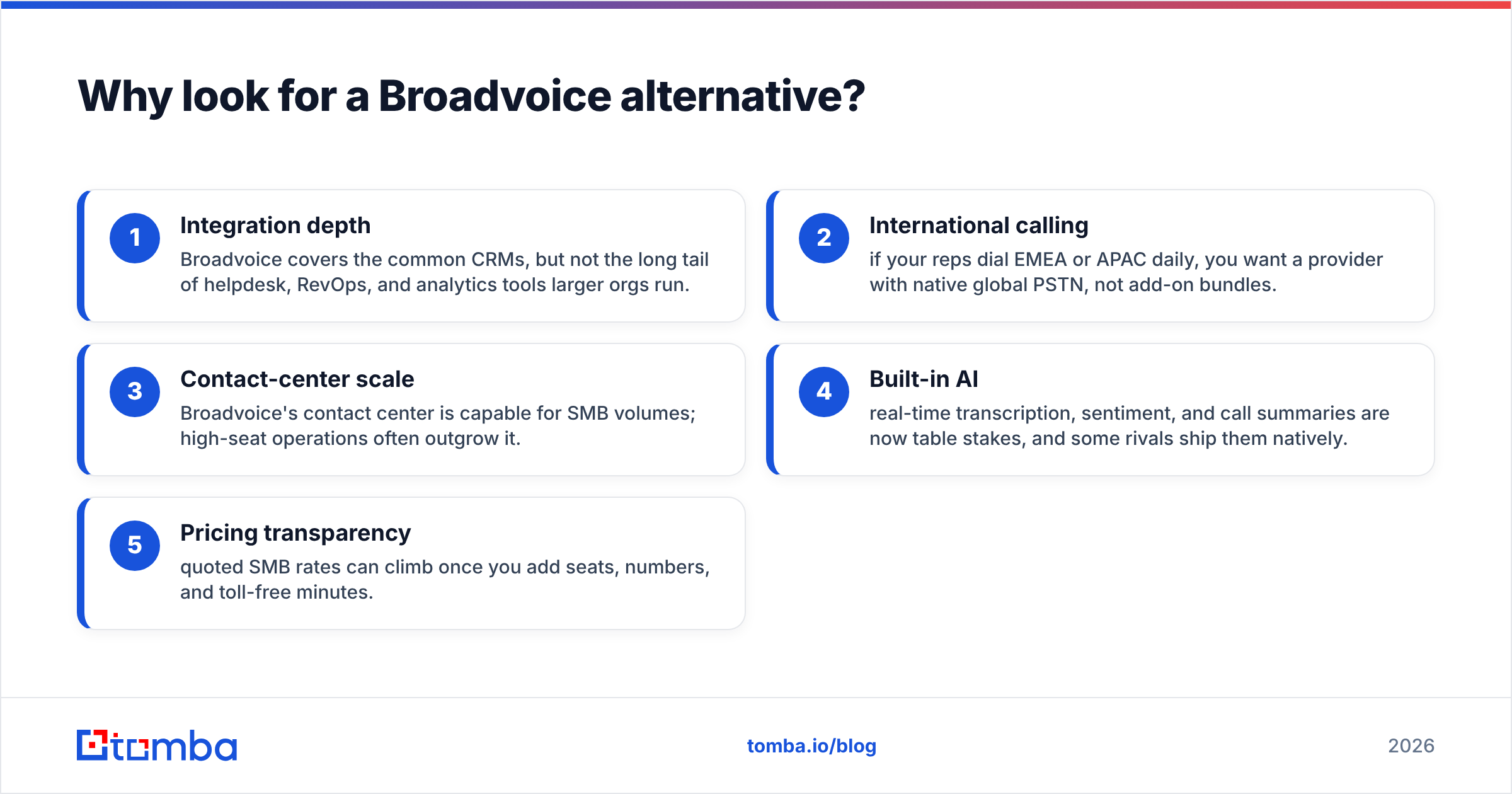
The short answer: feature ceilings and fit. Broadvoice does the fundamentals well, but teams typically shop around for one of five reasons.
- Integration depth — Broadvoice covers the common CRMs, but not the long tail of helpdesk, RevOps, and analytics tools larger orgs run.
- International calling — if your reps dial EMEA or APAC daily, you want a provider with native global PSTN, not add-on bundles.
- Contact-center scale — Broadvoice's contact center is capable for SMB volumes; high-seat operations often outgrow it.
- Built-in AI — real-time transcription, sentiment, and call summaries are now table stakes, and some rivals ship them natively.
- Pricing transparency — quoted SMB rates can climb once you add seats, numbers, and toll-free minutes.
None of these mean Broadvoice is bad. They mean the "best" phone system is the one that matches your call volume, geography, and stack. A platform is only as good as the numbers you load into it — which is why clean data sits upstream of every tool below.
)
What are the best Broadvoice alternatives in 2026?#
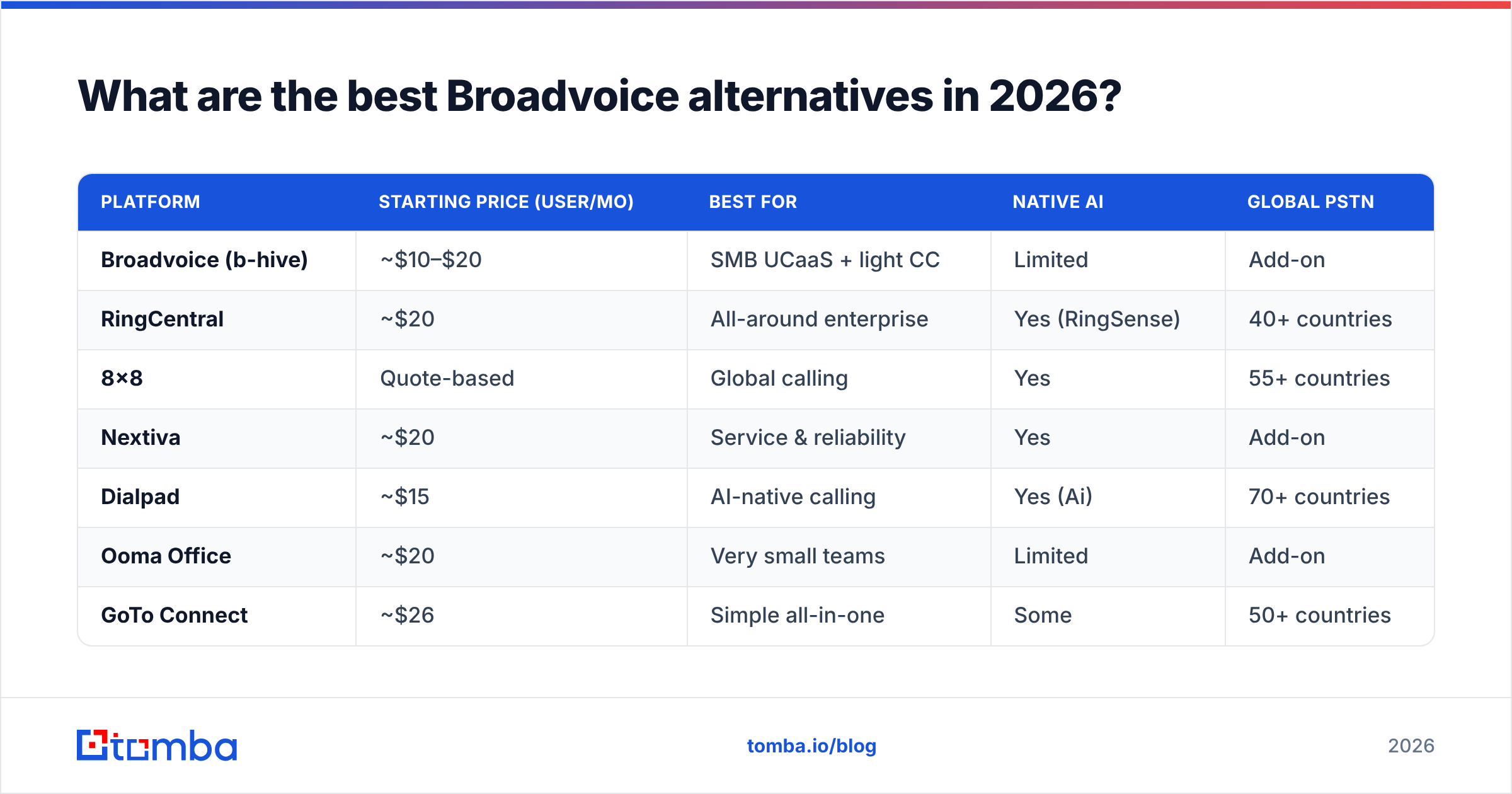
Here's the at-a-glance comparison. Prices are entry-tier list rates per user/month billed annually and move around, so treat them as a starting line, not gospel.
| Platform | Starting price (user/mo) | Best for | Native AI | Global PSTN |
|---|---|---|---|---|
| Broadvoice (b-hive) | ~$10–$20 | SMB UCaaS + light CC | Limited | Add-on |
| RingCentral | ~$20 | All-around enterprise | Yes (RingSense) | 40+ countries |
| 8x8 | Quote-based | Global calling | Yes | 55+ countries |
| Nextiva | ~$20 | Service & reliability | Yes | Add-on |
| Dialpad | ~$15 | AI-native calling | Yes (Ai) | 70+ countries |
| Ooma Office | ~$20 | Very small teams | Limited | Add-on |
| GoTo Connect | ~$26 | Simple all-in-one | Some | 50+ countries |
| Vonage | ~$20 | API/CPaaS builders | Yes | Wide |
| Zoom Phone | ~$10–$15 | Zoom-first orgs | Yes | 45+ countries |
RingCentral — the all-around heavyweight#
RingCentral (RingEX) is the default "safe" enterprise pick. You get voice, SMS, fax, video, and a mature contact-center option, plus one of the largest integration libraries in UCaaS — Salesforce, HubSpot, ServiceNow, and hundreds more. Its RingSense AI handles transcription and call scoring. The trade-off is cost and configuration overhead: it's more platform than a five-person shop needs. See their product lineup to scope tiers.
8x8 — best for global voice#
If your reps live on international calls, 8x8's unlimited calling across dozens of countries on higher tiers is hard to beat. It bundles UCaaS and CCaaS tightly, so a blended support-plus-sales operation can run on one vendor. Pricing is quote-based, which means you'll talk to sales — annoying for fast buyers, useful for negotiation.
Nextiva — best for reliability and support#
Nextiva consistently scores high on uptime and customer service, two things that matter more than feature checklists once you're live. Its platform now leans into AI-driven workflows and customer experience. For SMBs that found Broadvoice's support stretched thin, Nextiva is the natural step up. G2's category grids are a useful reality check on satisfaction scores.
Dialpad — best AI-native experience#
Dialpad was built around its Ai voice engine: live transcription, real-time coaching cards, automatic call summaries, and sentiment analysis come standard rather than as premium add-ons. For sales teams that want their dialer to double as a coaching tool, it's the strongest fit on this list.
Ooma & GoTo Connect — best budget all-in-ones#
Ooma Office targets micro-businesses with flat, predictable pricing and near-zero setup. GoTo Connect rolls voice and video into one tidy bundle with a clean admin panel. Neither will satisfy a 200-seat contact center, but for a lean team replacing Broadvoice's entry plan, they're frictionless.
How do these Broadvoice alternatives compare on sales features?#
Business phone systems and sales phone systems overlap but aren't identical. A sales-led team should weight a few specific capabilities far more heavily.
- Power/parallel dialing — Dialpad and RingCentral offer or integrate dialers that crush manual click-to-call; Broadvoice and Ooma lag here.
- CRM logging — automatic call and disposition logging into your CRM saves reps 20+ minutes a day. RingCentral and Nextiva lead.
- Local presence — dialing from an area code that matches your prospect lifts pickup rates; 8x8 and RingCentral handle this at scale.
- Conversation intelligence — Dialpad Ai and RingSense surface objections and keywords automatically, feeding your enablement loop.
- Voicemail drop — a small feature with an outsized impact on outbound throughput.
The uncomfortable truth no VoIP vendor will tell you: none of this matters if the numbers in your list are wrong. A 30% bad-data rate means a third of your perfectly-routed, AI-transcribed, locally-presenced calls go to disconnected lines. The dialer is the last mile; the data is the road.
)
Does the phone platform or the data matter more?#
The data matters more — and it's the part most teams under-invest in. You can swap Broadvoice for RingCentral and gain better routing, but you won't gain a single extra connect if your contact list is stale.
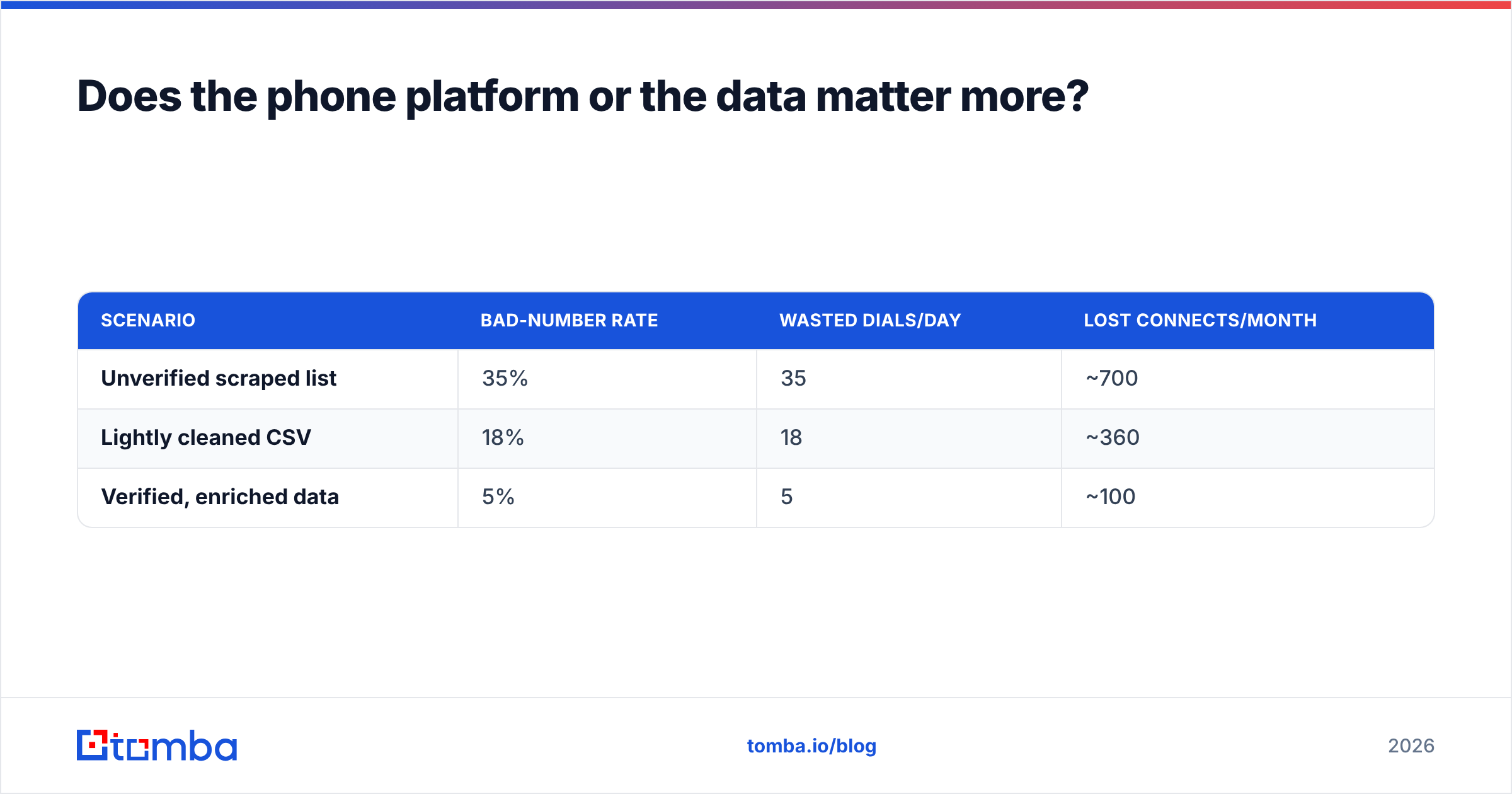
Here's the math. Say a rep makes 100 dials a day:
| Scenario | Bad-number rate | Wasted dials/day | Lost connects/month |
|---|---|---|---|
| Unverified scraped list | 35% | 35 | ~700 |
| Lightly cleaned CSV | 18% | 18 | ~360 |
| Verified, enriched data | 5% | 5 | ~100 |
That gap — 700 wasted dials versus 100 — is the difference between a quota-crushing month and a flat one, and it has nothing to do with which VoIP logo is on the softphone.
This is where your prospecting stack earns its keep. Before a number ever hits the dialer, it should be sourced and validated. Tomba's phone finder pulls direct-dial and company numbers tied to verified business contacts, and the phone validator confirms a line is active and correctly formatted so you're not burning rep hours on dead ends. If you're building lists from a target account list, company-to-phone maps an organization straight to a reachable number.
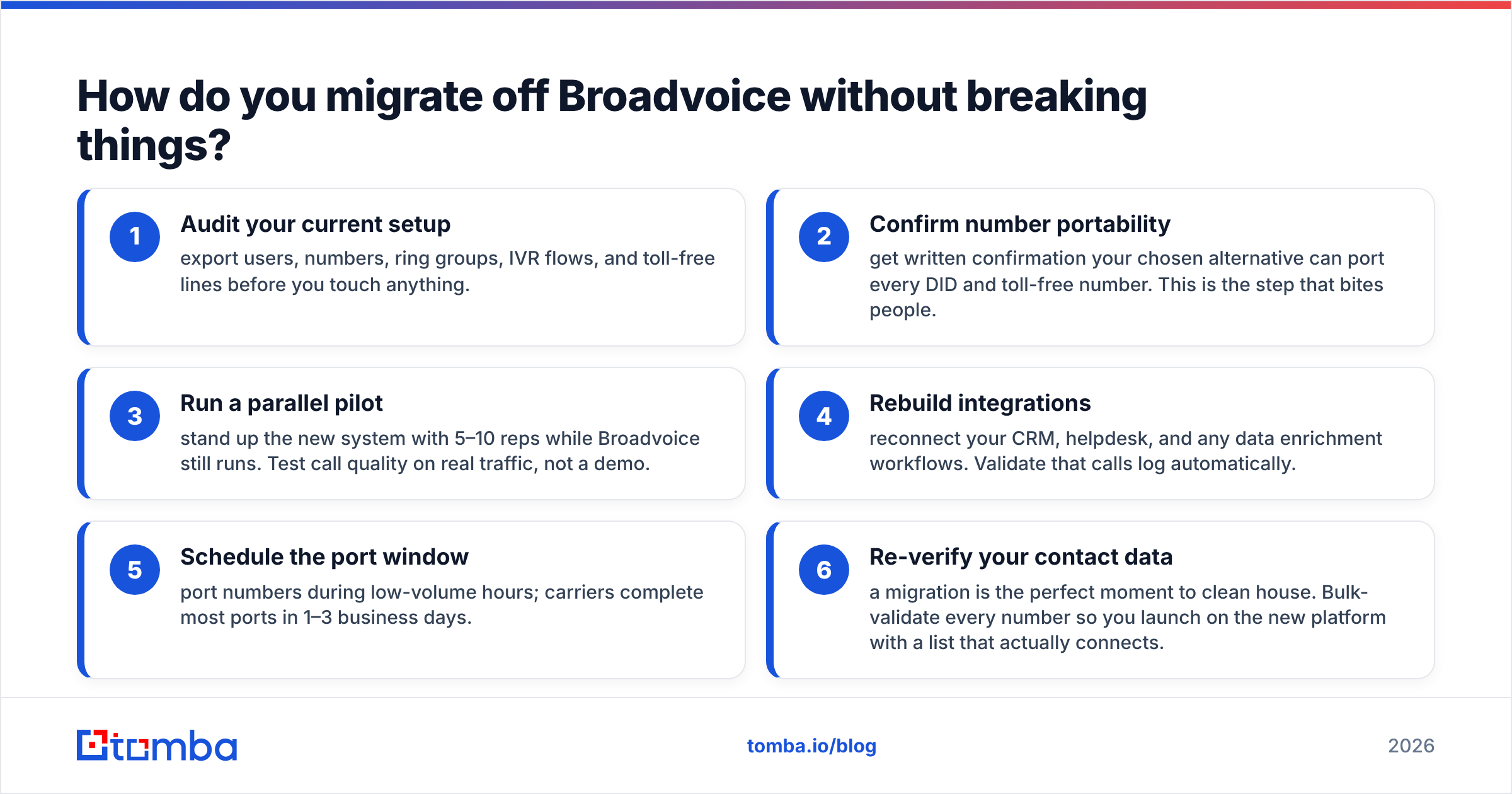
How do you migrate off Broadvoice without breaking things?#
Switching VoIP providers sounds scary; it's mostly logistics. Follow this order and porting downtime stays near zero.
- Audit your current setup — export users, numbers, ring groups, IVR flows, and toll-free lines before you touch anything.
- Confirm number portability — get written confirmation your chosen alternative can port every DID and toll-free number. This is the step that bites people.
- Run a parallel pilot — stand up the new system with 5–10 reps while Broadvoice still runs. Test call quality on real traffic, not a demo.
- Rebuild integrations — reconnect your CRM, helpdesk, and any data enrichment workflows. Validate that calls log automatically.
- Schedule the port window — port numbers during low-volume hours; carriers complete most ports in 1–3 business days.
- Re-verify your contact data — a migration is the perfect moment to clean house. Bulk-validate every number so you launch on the new platform with a list that actually connects.
Treat step 6 as non-negotiable. Moving a dirty list to a shiny new dialer just makes your bad data more expensive.
Which Broadvoice alternative should you choose?#
Match the tool to the job, not the hype:
- Pick RingCentral if you want one platform to cover everything and you'll grow into the integrations.
- Pick 8x8 if international calling is your daily reality.
- Pick Nextiva if uptime and human support outrank feature counts.
- Pick Dialpad if you want AI coaching baked into every call.
- Pick Ooma or GoTo Connect if you're a small team that wants simple and cheap.
- Stay on Broadvoice if its SMB UCaaS already does the job — switching for switching's sake is its own kind of waste.
Whatever softphone you land on, remember the order of operations: source verified contacts first, validate them, then dial. The platform routes the call; your data decides whether anyone picks up.
The data layer behind every great dialer#
The best Broadvoice alternative for your team depends on geography, seat count, and integration needs — but every option on this list performs better with clean, verified contact data underneath it.
Start there. Use Tomba's Email Finder to build accurate, enriched B2B contact records — emails, direct-dial phone numbers, and company data — so your reps spend their day talking to real prospects instead of dialing disconnected lines. You can begin on the free tier (25 searches/month) and scale up through Tomba's pricing plans starting at $49/mo when your outbound engine is ready to run at full volume. Pick your phone platform, then feed it data worth dialing.
// get started
Find, verify and enrich your first contacts today
Start on the free plan with 25 searches a month, then scale when your team is ready.
Free plan · No credit card required · GDPR & CCPA
// about the author