Broadvoice vs Vonage 2026: Which VoIP Wins for Sales?
Broadvoice vs Vonage compared for 2026: pricing, call quality, CRM integrations, and which cloud phone system actually fits an outbound sales team.
Broadvoice vs Vonage: Which Business Phone System Wins in 2026?
Picking a cloud phone system feels like choosing a foundation before you build the house. Get it wrong and every cold call, every transfer, every voicemail drop reminds you of the mistake for the next three years. Broadvoice and Vonage are two of the names that keep showing up on shortlists, and they solve the same core problem in very different ways.
This is a neutral, hands-on comparison aimed at sales and revenue teams. No fluff, no "synergy." Just what each platform costs, where it shines, and where it quietly falls down.
TL;DR#
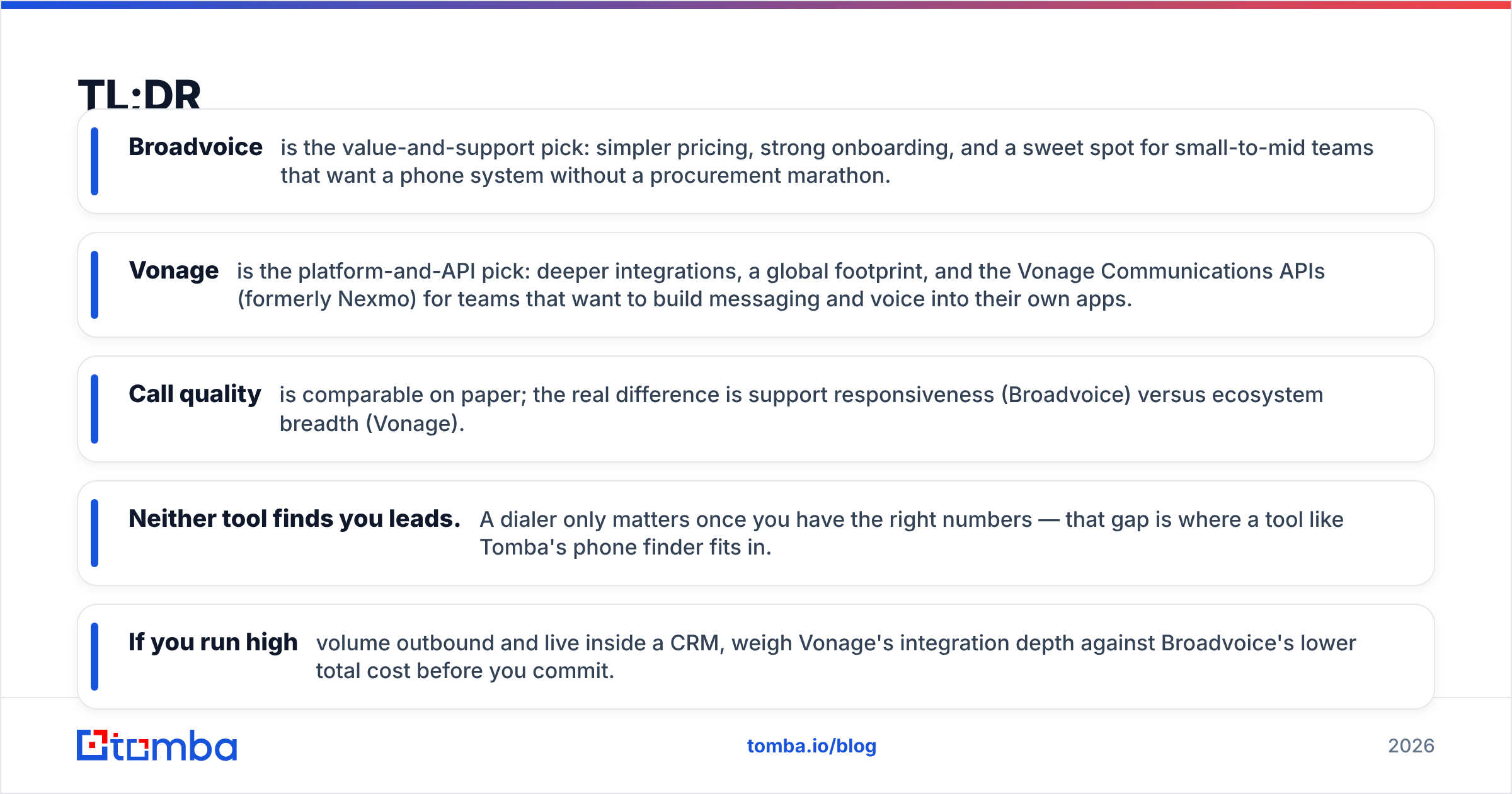
- Broadvoice is the value-and-support pick: simpler pricing, strong onboarding, and a sweet spot for small-to-mid teams that want a phone system without a procurement marathon.
- Vonage is the platform-and-API pick: deeper integrations, a global footprint, and the Vonage Communications APIs (formerly Nexmo) for teams that want to build messaging and voice into their own apps.
- Call quality is comparable on paper; the real difference is support responsiveness (Broadvoice) versus ecosystem breadth (Vonage).
- Neither tool finds you leads. A dialer only matters once you have the right numbers — that gap is where a tool like Tomba's phone finder fits in.
- If you run high-volume outbound and live inside a CRM, weigh Vonage's integration depth against Broadvoice's lower total cost before you commit.
What is Broadvoice and who is it for?#
Broadvoice is a cloud communications provider focused on unified communications (UCaaS) and contact-center tooling for small and mid-sized businesses. Its flagship products bundle business phone, video, chat, and SMS into a single subscription, with a reputation built largely on customer support and onboarding rather than raw feature count.
The pitch is straightforward: you are a 10-to-200-person company, you do not have a dedicated telecom admin, and you want a phone system that works on day one without a six-week implementation. Broadvoice leans into that. Its support team is U.S.-based, its pricing is published, and its plans avoid the à-la-carte sprawl that makes enterprise telecom quotes unreadable.
Where Broadvoice gets less attention is at the high end. If you need a sprawling international presence, programmable voice APIs, or a contact center handling thousands of concurrent agents, you will start to feel the ceiling.
What is Vonage and who is it for?#
Vonage is the older, broader brand — a public-company-scale provider (now owned by Ericsson) that splits into two worlds. There's Vonage Business Communications (VBC), the UCaaS product that competes head-to-head with Broadvoice, and there's the Vonage Communications Platform (CPaaS), a set of APIs for voice, SMS, video, and verification that developers embed directly into applications.
That second world is the real differentiator. If your team wants to send programmatic SMS, build click-to-call into a custom CRM, or run two-factor verification flows, Vonage gives you the building blocks. Broadvoice simply doesn't play in that arena.
The trade-off is complexity and cost. Vonage's plans add up fast once you layer on the integrations and add-ons that make the platform sing. For a small team that just wants extensions and voicemail, that breadth is overhead you pay for and never use.
)
Broadvoice vs Vonage: how do they compare at a glance?#
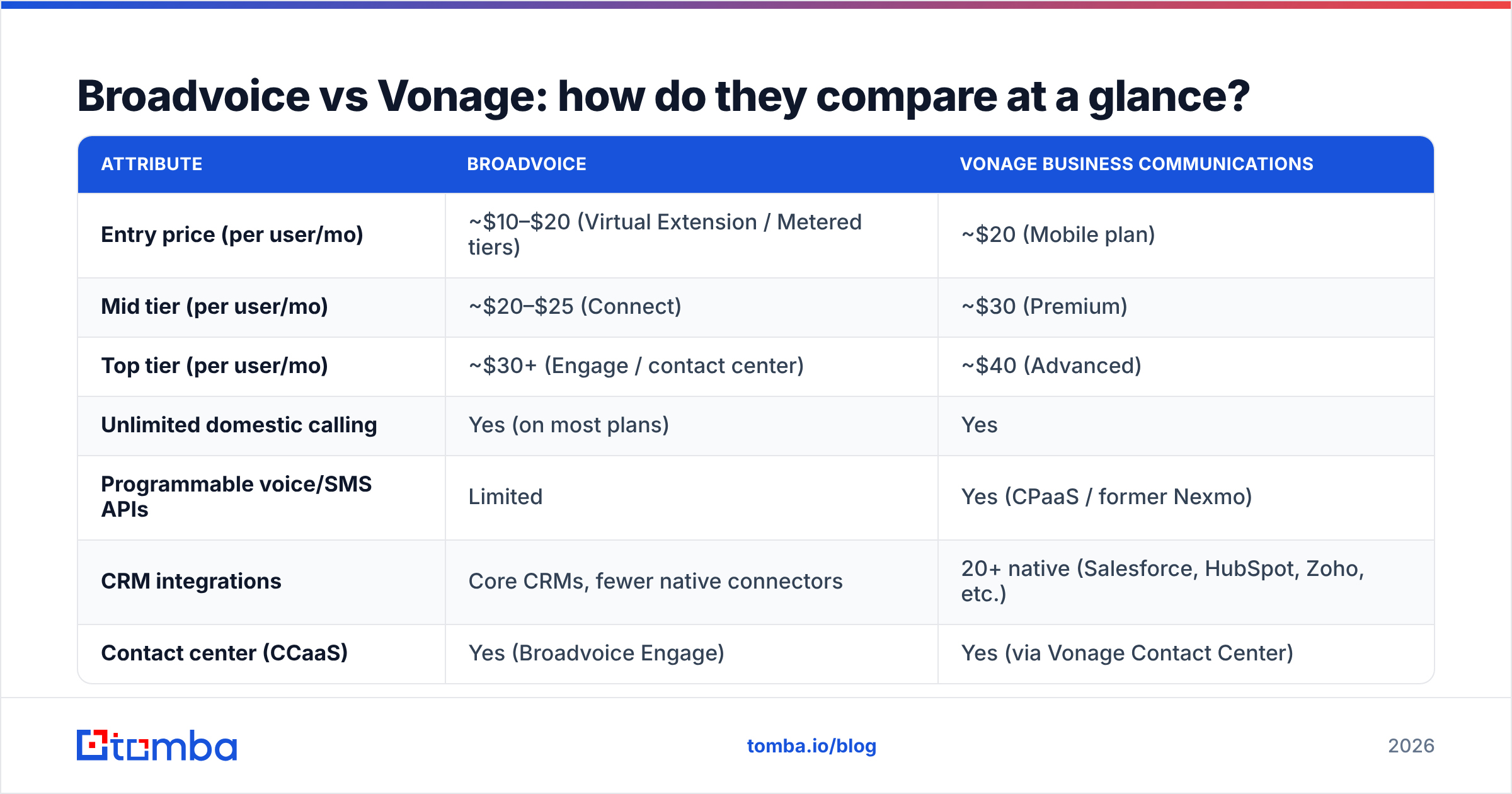
Here's the side-by-side that matters for a sales-team buyer. Prices are entry-tier list prices and move with seat count and contract length, so treat them as a starting point, not a quote.
| Attribute | Broadvoice | Vonage Business Communications |
|---|---|---|
| Entry price (per user/mo) | ~$10–$20 (Virtual Extension / Metered tiers) | ~$20 (Mobile plan) |
| Mid tier (per user/mo) | ~$20–$25 (Connect) | ~$30 (Premium) |
| Top tier (per user/mo) | ~$30+ (Engage / contact center) | ~$40 (Advanced) |
| Unlimited domestic calling | Yes (on most plans) | Yes |
| Programmable voice/SMS APIs | Limited | Yes (CPaaS / former Nexmo) |
| CRM integrations | Core CRMs, fewer native connectors | 20+ native (Salesforce, HubSpot, Zoho, etc.) |
| Contact center (CCaaS) | Yes (Broadvoice Engage) | Yes (via Vonage Contact Center) |
| Global coverage | U.S.-centric | 100+ countries |
| Support reputation | Strong, U.S.-based, fast | Mixed, larger-org bureaucracy |
| Best fit | SMB wanting simplicity + support | Teams needing integrations + APIs |
The pattern is consistent: Broadvoice wins on price and human support, Vonage wins on breadth, integrations, and developer flexibility.
Which has better call quality and reliability?#
Conclusion first: on day-to-day call quality, the two are close enough that it won't decide your purchase. Both run on modern VoIP infrastructure, both publish uptime SLAs in the 99.9% range, and both depend far more on your network than on their backbone.
The honest truth about VoIP reliability is that most "bad call quality" complaints trace back to the buyer's own bandwidth, router QoS settings, or Wi-Fi, not the carrier. Before you blame Broadvoice or Vonage, you want jitter under 30ms, packet loss under 1%, and proper Quality-of-Service prioritization on your network.
Where a real difference shows up is what happens when something breaks. Broadvoice's smaller scale and U.S.-based support mean you tend to reach a human faster. Vonage, as a much larger organization, has deeper engineering resources but more layers between you and a fix. For a sales team that loses money every hour the phones are down, time-to-resolution matters more than a fractional uptime difference on a marketing page.
Which integrates better with your sales stack?#
This is where Vonage pulls ahead for most revenue teams. Vonage Business Communications ships native integrations with Salesforce, HubSpot, Microsoft Dynamics, Zoho, Bullhorn, and roughly two dozen others, plus the CPaaS APIs for anything custom. If your reps live in a CRM and you want click-to-dial, automatic call logging, and screen-pops, Vonage gives you more of that out of the box.
Broadvoice covers the core CRMs but with a thinner connector library. For a team running a mainstream stack, that may be perfectly fine. For a team with a homegrown system or an unusual tool, the gap is real.
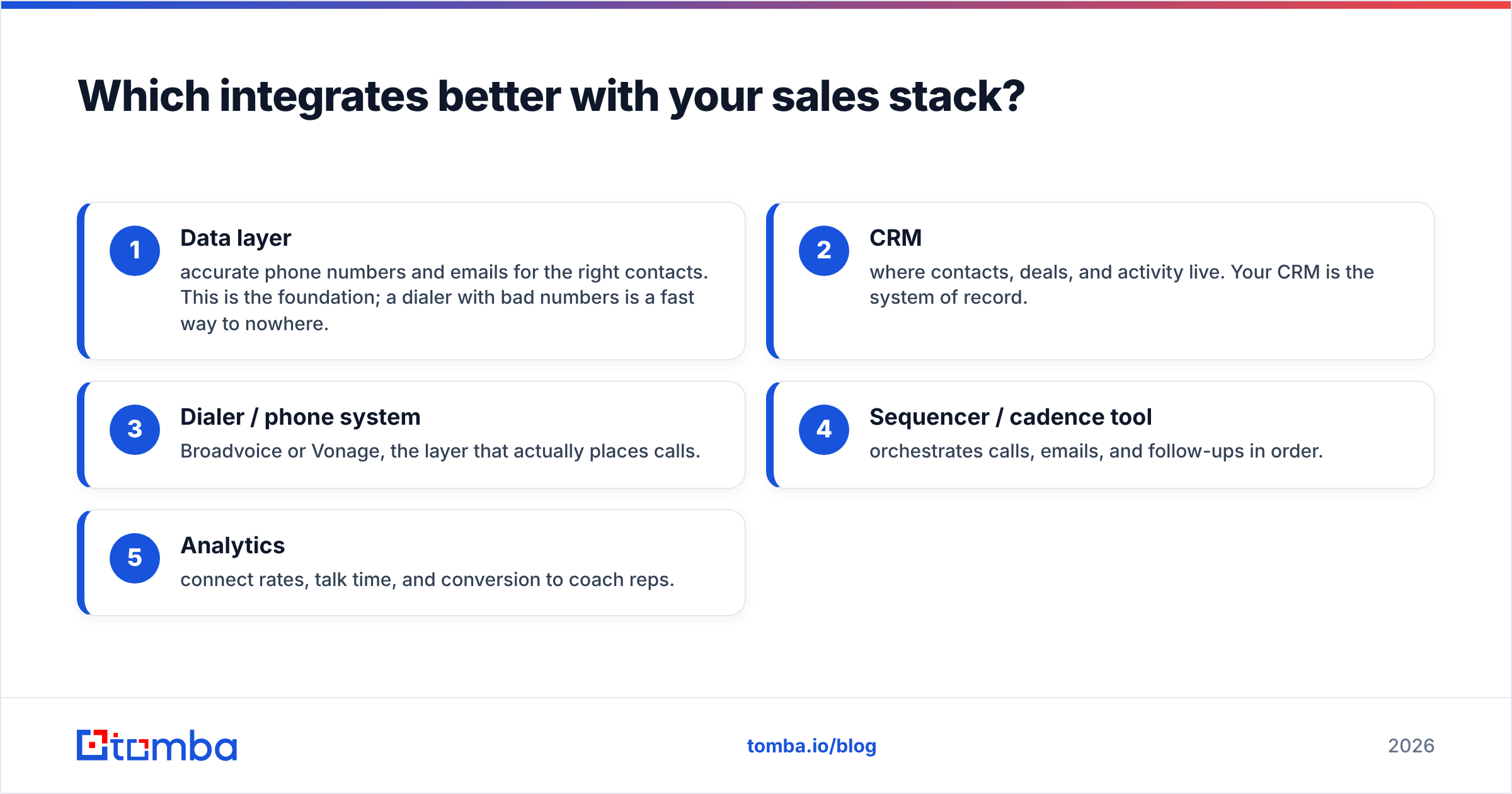
A phone system is only one layer of the outbound stack, though. The full picture looks more like this:
- Data layer — accurate phone numbers and emails for the right contacts. This is the foundation; a dialer with bad numbers is a fast way to nowhere.
- CRM — where contacts, deals, and activity live. Your CRM is the system of record.
- Dialer / phone system — Broadvoice or Vonage, the layer that actually places calls.
- Sequencer / cadence tool — orchestrates calls, emails, and follow-ups in order.
- Analytics — connect rates, talk time, and conversion to coach reps.
Most teams obsess over layer 3 and underinvest in layer 1. That's backwards. A great dialer dialing wrong numbers still produces a 5% connect rate.
How do pricing and total cost really compare?#
Sticker price favors Broadvoice; total cost of ownership depends on how much of Vonage's platform you actually use.
For a 25-seat team that just needs phones, messaging, and basic CRM logging, Broadvoice will almost always come in cheaper — both on per-seat list price and on the soft costs of setup, since onboarding is faster and lighter. You can verify current published tiers on the Broadvoice and Vonage sites, as both adjust pricing regularly.
For a team that needs international numbers, programmable SMS, advanced contact-center routing, and a dozen integrations, Vonage's higher base price buys capabilities Broadvoice can't match at any price. Here, the question isn't "which is cheaper" but "which can do the job at all."
A useful mental model: Broadvoice is a well-built sedan, Vonage is a modular truck platform. If you need the truck bed and the towing package, the sedan's lower price is irrelevant. If you're commuting solo, you're paying for capability you'll never touch.
)
Broadvoice vs Vonage: pros and cons#
Broadvoice — pros
- Lower entry and mid-tier pricing
- Fast, U.S.-based support with strong onboarding
- Simpler plans, less add-on sprawl
- Solid fit for SMB UCaaS and light contact-center needs
Broadvoice — cons
- Thinner native integration library
- No serious CPaaS / programmable API story
- U.S.-centric; limited global footprint
- Fewer advanced contact-center features at the top end
Vonage — pros
- Deep native CRM integrations (20+)
- Powerful CPaaS APIs for voice, SMS, and verification
- Global coverage across 100+ countries
- Mature contact-center product for larger operations
Vonage — cons
- Higher total cost once add-ons stack up
- Support can feel slower and more bureaucratic
- More complexity than a small team needs
- À-la-carte pricing makes quotes harder to predict
Which should an outbound sales team choose?#
Pick Broadvoice if you're a small-to-mid sales team, you run a mainstream CRM, and you value getting a human on the phone when something breaks over having every integration imaginable. You'll spend less and ramp faster.
Pick Vonage if you're scaling internationally, you want to build communications into your own software, or your operations depend on deep CRM automation and contact-center routing. The higher price buys real capability you'll actually use.
But here's the part both vendors gloss over: the phone system is not your bottleneck. Your bottleneck is almost always the quality of the contact data feeding it. A 200-seat Vonage deployment dialing a list scraped from a stale spreadsheet will underperform a 10-seat Broadvoice setup calling verified, accurate numbers. Connect rate is a data problem before it's a dialer problem.
That's why smart teams treat number accuracy as a first-class concern. Pulling direct-dial numbers tied to the right decision-maker — and verifying them before a rep ever burns a call slot — does more for pipeline than any feature on either platform's comparison page. Pair that with verified email so you can follow a missed call with a relevant message, and your cadence actually connects. Tools like Tomba's email verifier and data enrichment handle the layer your phone system can't.
How do you evaluate either one before buying?#
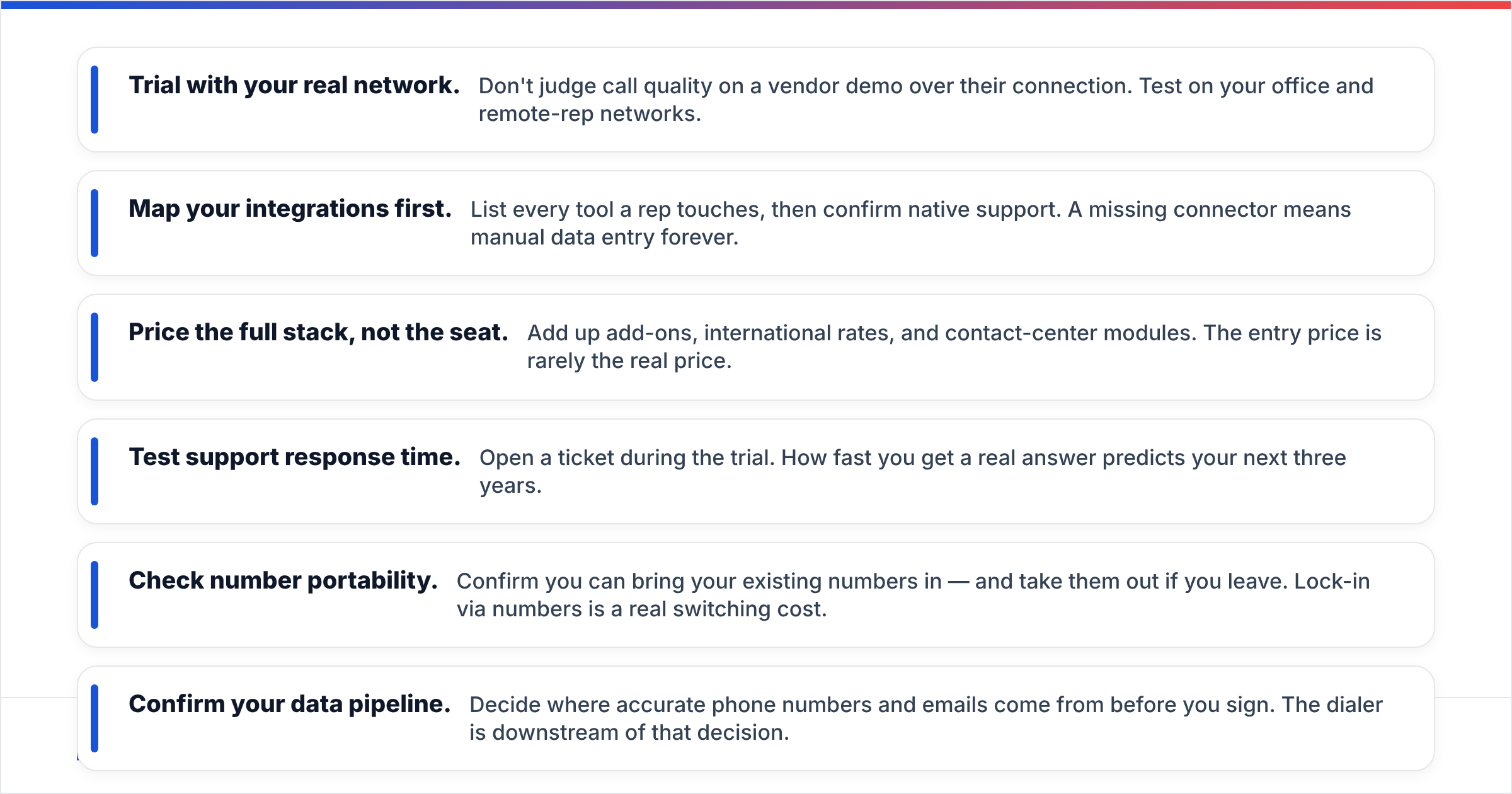
Run the same checklist on both, then let the trial decide:
- Trial with your real network. Don't judge call quality on a vendor demo over their connection. Test on your office and remote-rep networks.
- Map your integrations first. List every tool a rep touches, then confirm native support. A missing connector means manual data entry forever.
- Price the full stack, not the seat. Add up add-ons, international rates, and contact-center modules. The entry price is rarely the real price.
- Test support response time. Open a ticket during the trial. How fast you get a real answer predicts your next three years.
- Check number portability. Confirm you can bring your existing numbers in — and take them out if you leave. Lock-in via numbers is a real switching cost.
- Confirm your data pipeline. Decide where accurate phone numbers and emails come from before you sign. The dialer is downstream of that decision.
Compare the live G2 grids for Broadvoice and Vonage as a sanity check on current user sentiment — review patterns shift between releases, and recent reviews surface support and reliability trends faster than any vendor page.
The bottom line#
Broadvoice and Vonage are both legitimate choices; they're just aimed at different buyers. Broadvoice wins on price, simplicity, and support — the right call for most SMB sales teams. Vonage wins on integrations, APIs, and global reach — the right call for teams that need to build, scale, or operate internationally.
Whichever you pick, remember the order of operations. The dialer is the last mile. The first mile is having the right person's correct number in front of your rep. If your connect rates are flat, the fix usually isn't a new phone system — it's better data feeding the one you have.
Start with better numbers, not just a better dialer#
Before you spend months migrating phone systems, fix the input. Tomba's phone finder and Email Finder help you build accurate, verified contact lists tied to real decision-makers — so every call your Broadvoice or Vonage seats place has a real shot at connecting. Start free with 25 searches a month, then scale on the Starter plan at $49/mo when your outbound engine is humming. A great dialer deserves great data. Give it some.
Ready to find emails that actually work?
Join 150,000+ professionals who stopped guessing and started sending. Free credits on signup — no credit card required.
Get the Tomba newsletter
Practical outbound tactics and product updates — once every two weeks.
About the author