How to Build GDPR Compliant Database Records in 2026 (Step-by-Step)
A practical 2026 guide to building a GDPR compliant database for B2B outreach — lawful basis, consent, data minimization, and the tooling that keeps your CRM clean.
It is easy to build a B2B database that drives pipeline. It is much harder to build GDPR compliant database records that also pass a regulator's audit. Most teams learn this the expensive way. The bill comes after a data access request, a complaint, or a fine.
This guide shows how to build a GDPR compliant database from scratch in 2026. You will see the lawful basis you stand on, the records you keep, the fields you collect (and the ones you skip), and the tools that keep it clean.
TL;DR#
- A GDPR compliant database starts with lawful basis, not data collection. For B2B outreach, legitimate interest is usually your footing. But you must document the balancing test before the first record lands.
- Collect less, verify more. Data minimization and accuracy are GDPR duties, not nice-to-haves. Verified business emails beat bloated scraped lists every time.
- Every record needs provenance. Where did it come from, when, and on what basis? If you cannot answer in one click, you have a compliance gap.
- Retention and deletion are features, not afterthoughts. Build automated expiry and a working opt-out path before you import a single contact.
- Tooling matters. Use enrichment and verification platforms that show their data sources. Then you inherit defensible provenance instead of mystery data.
What makes a database "GDPR compliant" in the first place?#
A GDPR compliant database is one where you can prove four things for every personal record. Why you hold it. How you got it. How long you will keep it. And how a person can get out. Compliance is less about a single switch and more about a chain of evidence.
The General Data Protection Regulation applies whenever you process personal data of people in the EU and UK. A work email like jane.doe@acme.com is personal data, because it identifies a person. Job titles, phone numbers, and LinkedIn URLs count too. The official EU GDPR text lays out the principles. The UK ICO guidance turns them into the practical rules regulators enforce.
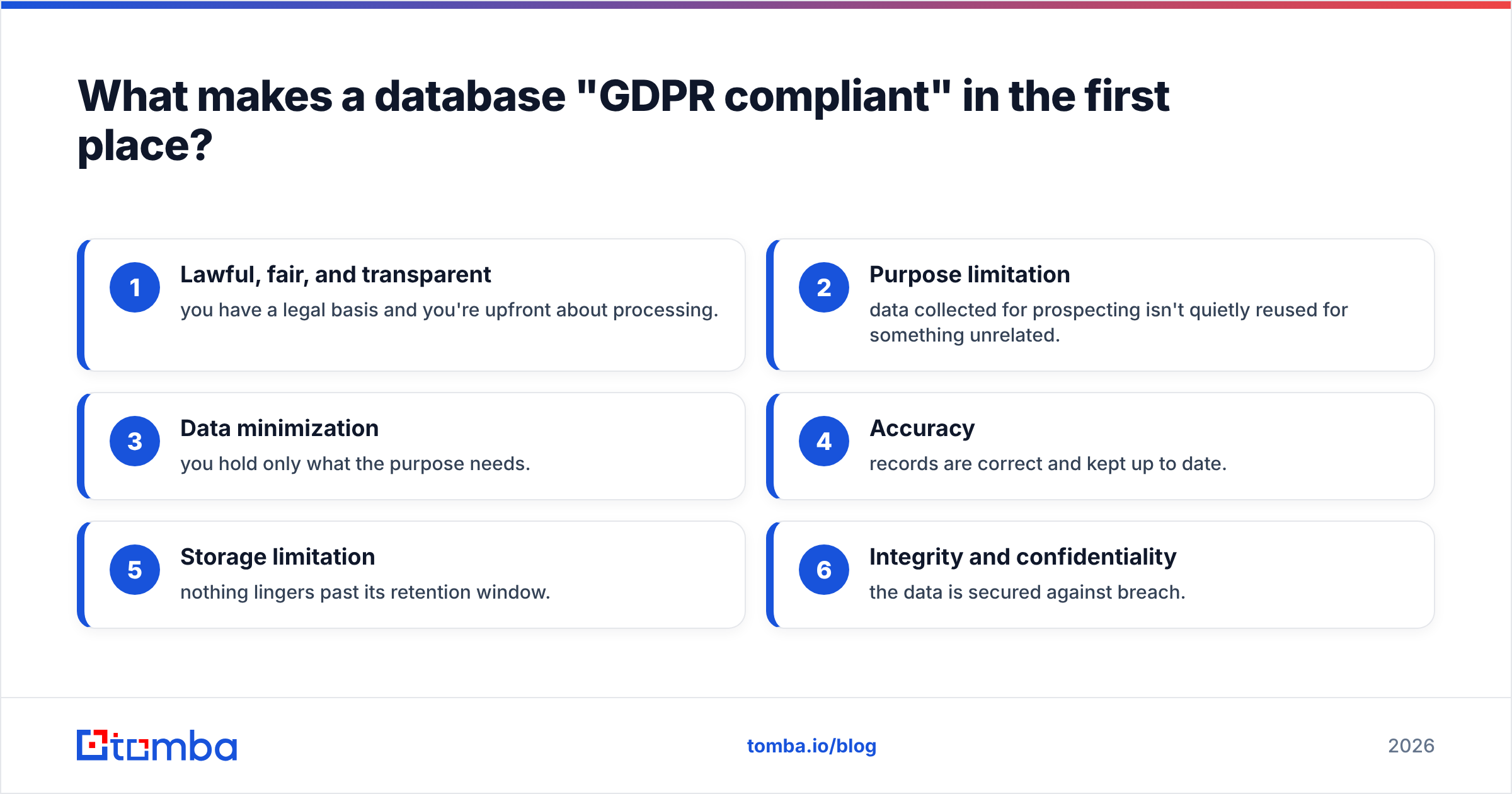
The six principles you're building toward:
- Lawful, fair, and transparent — you have a legal basis and you're upfront about processing.
- Purpose limitation — data collected for prospecting isn't quietly reused for something unrelated.
- Data minimization — you hold only what the purpose needs.
- Accuracy — records are correct and kept up to date.
- Storage limitation — nothing lingers past its retention window.
- Integrity and confidentiality — the data is secured against breach.

Miss any one of these and the database is not compliant, no matter how good your encryption is.
Which lawful basis should a B2B database use?#
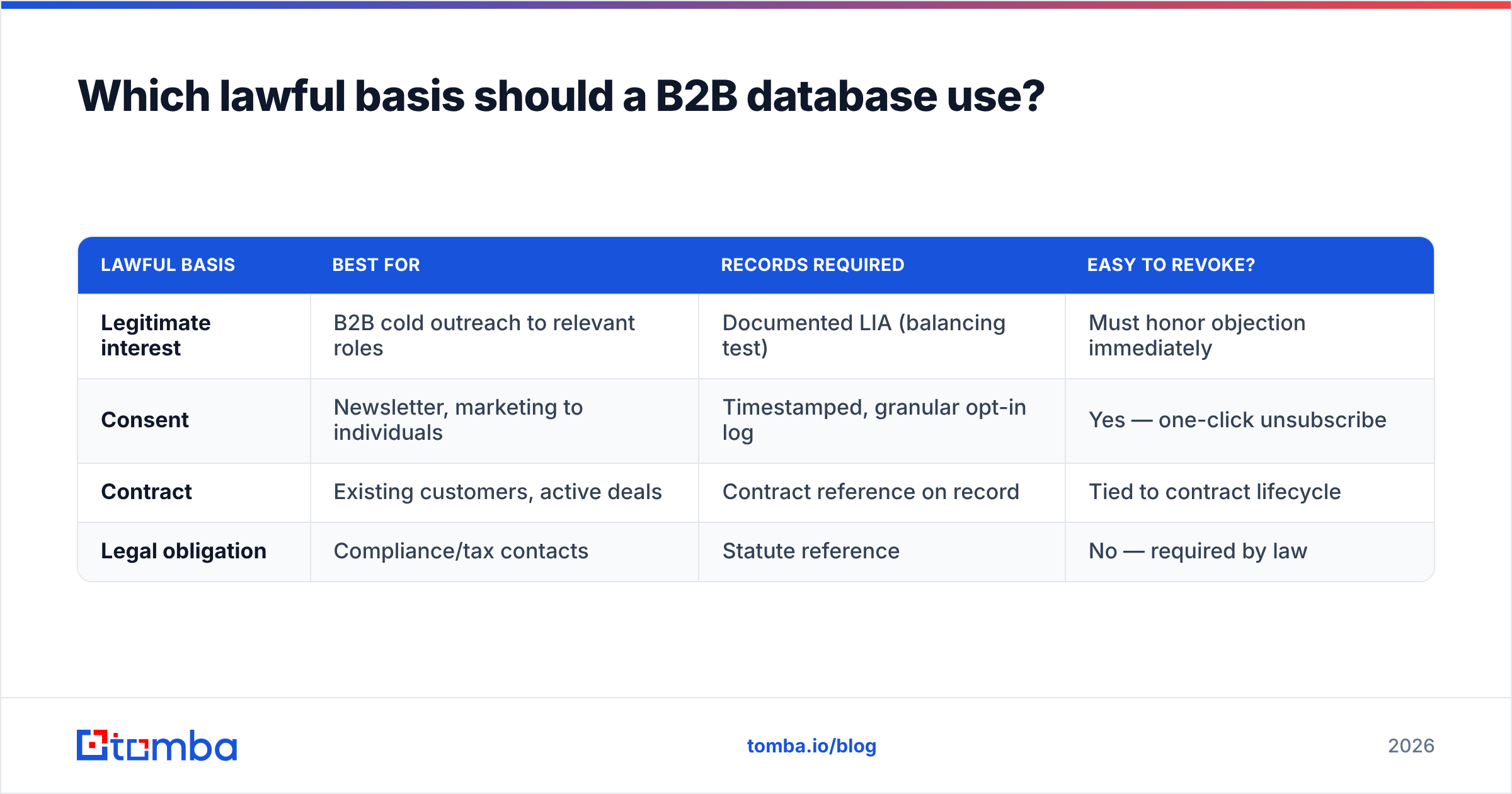
For most B2B prospecting, legitimate interest is the right lawful basis. But it is conditional, not automatic. Consent is cleaner when you market to individuals. Legitimate interest fits business-to-business outreach, where the recipient would reasonably expect contact at work.
Here's how the common bases stack up for a sales and marketing database:
| Lawful basis | Best for | Records required | Easy to revoke? |
|---|---|---|---|
| Legitimate interest | B2B cold outreach to relevant roles | Documented LIA (balancing test) | Must honor objection immediately |
| Consent | Newsletter, marketing to individuals | Timestamped, granular opt-in log | Yes — one-click unsubscribe |
| Contract | Existing customers, active deals | Contract reference on record | Tied to contract lifecycle |
| Legal obligation | Compliance/tax contacts | Statute reference | No — required by law |
If you lean on legitimate interest, run and store a Legitimate Interest Assessment (LIA) before you import data. State the interest. Show the processing is necessary. Prove it does not override the person's rights. Target decision-makers whose role is relevant to your offer, not every email you can scrape. A CFO expects to hear from a finance-tooling vendor. A junior designer at the same company does not.
Whichever basis you pick, store it on the record, not in a policy document nobody reads.
How to Build GDPR Compliant Database Records, Step by Step#
Step 1 — Define the schema with minimization baked in#
Start from the purpose and work backward to fields. For B2B email outreach, you need name, business email, company, role, and source. You almost certainly do not need home address, personal mobile, or demographic data. Every extra column is a liability. You have to justify it, secure it, and eventually delete it.
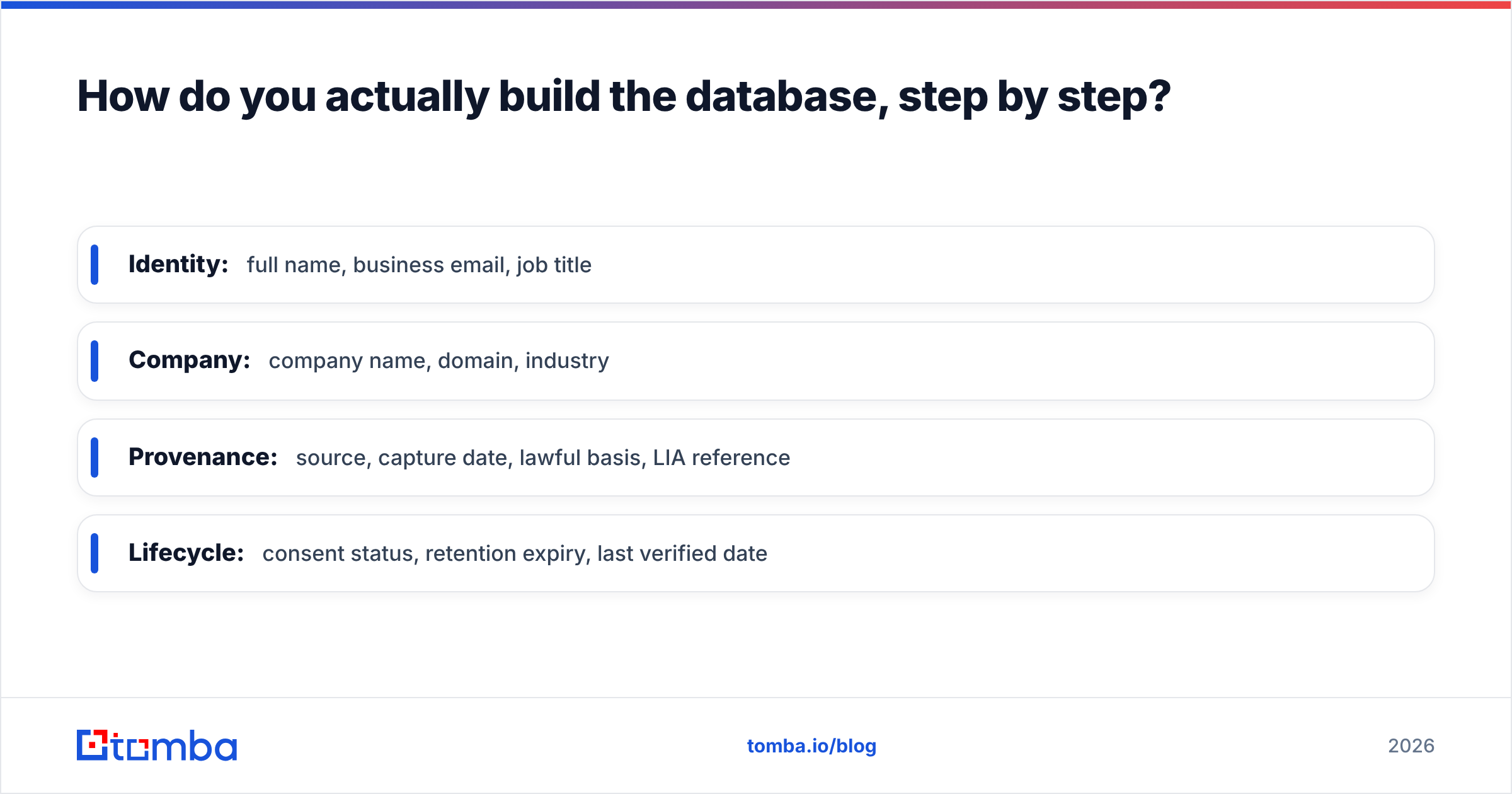
A defensible minimal schema:
- Identity: full name, business email, job title
- Company: company name, domain, industry
- Provenance: source, capture date, lawful basis, LIA reference
- Lifecycle: consent status, retention expiry, last verified date
Step 2 — Source data you can defend#
This is where most databases go wrong. Buying a 2-million-row list off a marketplace gives you zero provenance and zero defense. Source contacts through tools that disclose where their data comes from. Tomba publishes its data sources and ties each result to a known origin. The provenance then travels with the record into your CRM.
Use a domain search to find role-relevant contacts at target companies. That beats mass-scraping. You collect fewer records, but each one is purposeful. That is exactly what data minimization demands.
Step 3 — Verify before you store#
Inaccurate data is non-compliant data. The accuracy principle means you cannot sit on bounced, stale, or fake addresses. Run every contact through an email verifier at import and on a regular schedule. Verification does double duty. It protects deliverability and it satisfies the GDPR accuracy duty in one pass.
Step 4 — Stamp provenance and basis on every row#
For each record, capture the source, the capture time, and the lawful basis at the moment it enters the system. A subject access request will arrive. Under GDPR you have 30 days to respond. You want to answer it with a query, not a forensic investigation.
Step 5 — Wire up retention and deletion#
Set a retention period per record type. For example, 24 months from last engagement for cold prospects. Then automate expiry. Build the opt-out path first. That means a working unsubscribe link, an objection inbox that someone monitors, and a deletion routine that truly removes data instead of just flagging it.
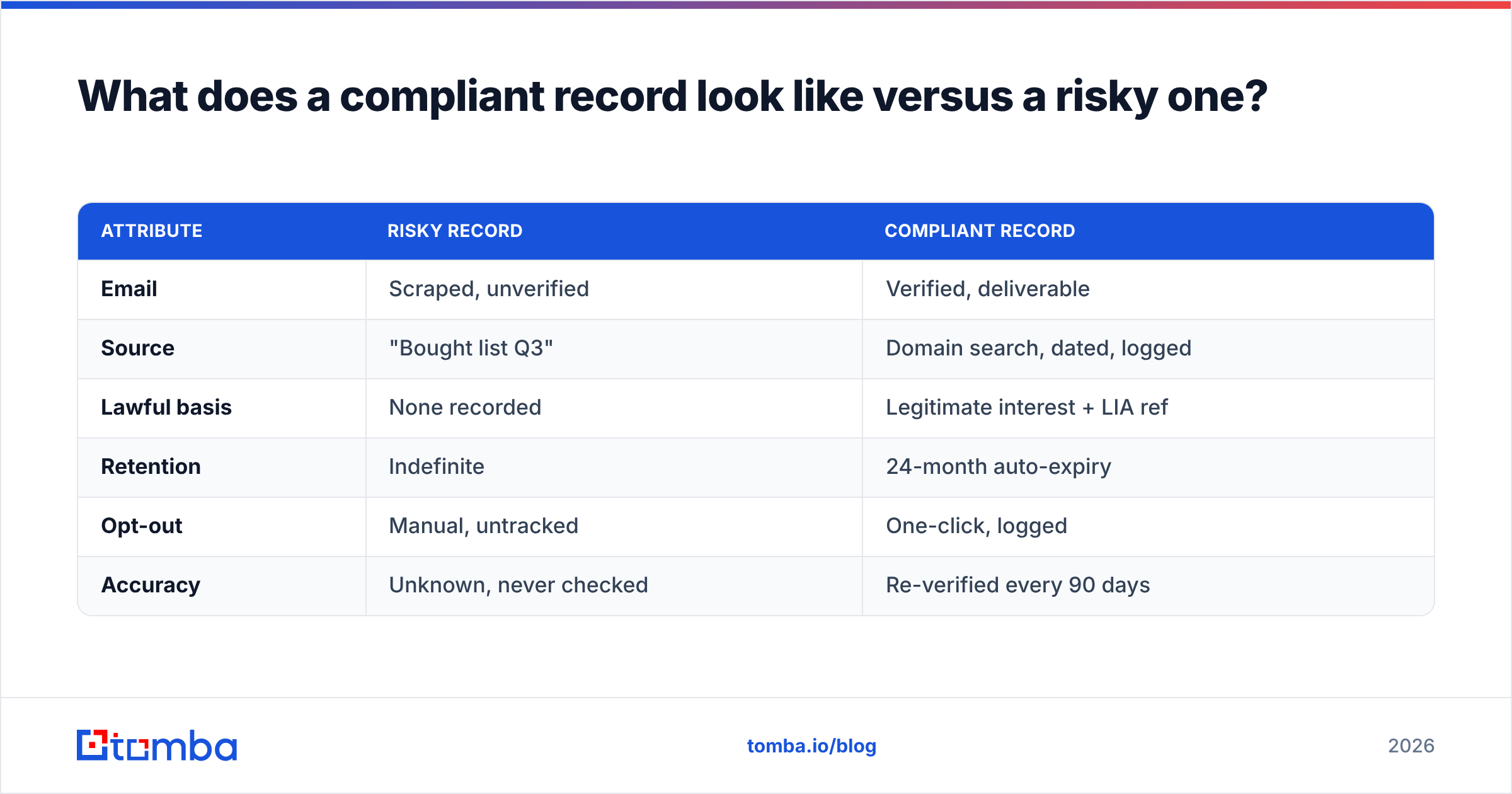
What does a compliant record look like versus a risky one?#
The difference is visible at the row level. Here's a side-by-side of the same contact, captured two ways:
| Attribute | Risky record | Compliant record |
|---|---|---|
| Scraped, unverified | Verified, deliverable | |
| Source | "Bought list Q3" | Domain search, dated, logged |
| Lawful basis | None recorded | Legitimate interest + LIA ref |
| Retention | Indefinite | 24-month auto-expiry |
| Opt-out | Manual, untracked | One-click, logged |
| Accuracy | Unknown, never checked | Re-verified every 90 days |
The compliant record is not more expensive to maintain. It is cheaper. It bounces less, converts better, and never triggers a regulator's curiosity. Gartner's research on data governance links provenance discipline to lower operational risk. You can browse their data and analytics coverage for the broader case.

How do you keep the database compliant over time?#
A compliant database on day one is easy. Keeping it compliant on day 200 is where teams slip. Contacts change jobs. Emails go dead. Consent expires, and objections pile up. Build these recurring jobs:
- Quarterly re-verification. Stale data violates the accuracy principle. Re-run your list through verification on a schedule and purge hard bounces.
- Retention sweeps. A monthly job that deletes anything past its expiry window. Automate it so compliance doesn't depend on someone remembering.
- Objection and erasure handling. Route opt-outs and "right to be forgotten" requests into a tracked queue with an SLA. GDPR gives you a deadline; treat it like one.
- Source audits. Periodically confirm that every enrichment feed still discloses its provenance. If a vendor goes opaque, your inherited defensibility evaporates.
- Access controls. Limit who can export the database. The integrity-and-confidentiality principle is about people as much as encryption.
For ongoing accuracy, data enrichment refreshes role and company fields and keeps records current. You do not re-collect from scratch. That also respects minimization, since you update rather than hoard new data.
Is consent always required for a B2B database?#
No. And assuming it is can actually weaken your position. Under GDPR, consent and legitimate interest are alternative lawful bases, not a hierarchy. For genuine B2B outreach to relevant professional contacts, legitimate interest is often the better fit. It is also more durable, because consent can be withdrawn and must then be re-collected.
That said, watch two traps:
- ePrivacy / PECR overlay. Electronic marketing rules (especially in the UK and parts of the EU) can require consent for some email marketing even when GDPR's legitimate interest would otherwise apply — particularly when contacting individuals rather than corporate entities like
info@company.com. Check the jurisdiction. - "Soft opt-in" misuse. The soft opt-in for existing customers is narrow. Don't stretch it to cover cold prospects.
When in doubt, document your reasoning. A regulator forgives an honest, well-evidenced legitimate-interest decision far more readily than an undocumented one.
What tools help you build and maintain it?#
You can build GDPR compliant database records with a spreadsheet and discipline, but it will not scale. The practical stack:
- A finder with provenance — to source role-relevant contacts you can defend, instead of scraping.
- A verifier — to satisfy the accuracy principle at import and on schedule.
- Enrichment — to keep records current without re-collecting.
- Your CRM — as the system of record where basis, provenance, and retention live on each row.
Tomba covers the first three and pushes clean, sourced, verified data straight into your CRM. Pricing scales with volume. See the full Tomba pricing breakdown. It starts free at 25 searches per month and moves to the $49/mo Starter tier when you outgrow it.
Build it clean from the first record#
The cheapest GDPR compliant database is the one you build correctly from day one. It is not the one you fix after a complaint. Document your lawful basis. Minimize what you collect. Verify what you keep. Automate retention. The compliance work and the deliverability work are the same work.
Start by sourcing contacts you can actually defend. The Tomba Email Finder finds role-relevant business emails by domain, name, or company. It ties each result to a disclosed source and verifies before it reaches your database. So provenance and accuracy are built in, not bolted on. Spin up a free account, pull your first 25 contacts, and start your database the compliant way.
Ready to find emails that actually work?
Join 150,000+ professionals who stopped guessing and started sending. Free credits on signup — no credit card required.
Get the Tomba newsletter
Practical outbound tactics and product updates — once every two weeks.
About the author