Building a B2B Sales Pipeline: A Step-by-Step 2026 Guide
A pipeline isn't a CRM screenshot — it's a repeatable system for turning strangers into revenue. Here's how to build a B2B sales pipeline that actually forecasts in 2026.
Most "sales pipelines" are just a CRM with optimistic deal names. They look full, they feel productive, and they forecast about as well as a coin flip. A real B2B sales pipeline is something else: a repeatable system that moves a defined buyer from "never heard of you" to "signed the contract," with measurable conversion at every step.
This guide walks through how to build one that actually predicts revenue — the stages, the math, the data hygiene, and the tooling that holds it together.
TL;DR#
- A pipeline is a system, not a list. It defines stages, entry/exit criteria, and conversion rates between each — so you can forecast instead of guess.
- Garbage in, garbage forecast. Most pipelines break at the top: bad contact data and a fuzzy ICP poison everything downstream. Fix the inputs first.
- Seven stages cover most B2B motions: ICP → list → outreach → qualified → demo → proposal → closed. Track conversion between each.
- Three numbers run the whole thing: stage conversion rate, average deal size, and sales cycle length. Pipeline value = these three multiplied.
- Tooling matters at the edges: an accurate email finder and email verifier at the top, a clean CRM in the middle, honest stage definitions throughout.
What is a B2B sales pipeline (and what it isn't)?#
A B2B sales pipeline is the visual, stage-by-stage representation of every deal your team is working, organized by how close each one is to closing. Think of it like a factory conveyor belt: raw material (a cold contact) enters one end, passes through fixed stations (qualification, demo, proposal), and exits as a finished product (revenue) — or gets rejected along the way.
The "conveyor belt" detail people miss is that each station has entry and exit criteria. A deal doesn't move to "Demo Scheduled" because a rep feels good about it; it moves because a specific, observable thing happened (a calendar invite was accepted). Without those criteria, your pipeline is a mood board.
A pipeline is not the same as a sales funnel. The funnel is the marketing-led, top-of-mouth view of volume narrowing over time. The pipeline is the sales-led, deal-by-deal operational view. They overlap, but you forecast off the pipeline.
It's also not your CRM. The CRM is where the pipeline lives; the pipeline is the logic you impose on it. You can run a disciplined pipeline in a spreadsheet and a chaotic one in the most expensive CRM on the market.
)
Why do most B2B pipelines fail to forecast?#
They fail at the top, not the close. When leaders see deals slipping, they obsess over closing tactics. But the most common root cause is upstream: the people entering the pipeline were never the right people, or their contact data was wrong, so half the "activity" was wasted on bad fits and bounced emails.
Three failure patterns show up again and again:
- No exit criteria. Deals advance on optimism. "I think they're interested" becomes a Stage 4 deal. The forecast inflates.
- A vague ICP. If anyone with a pulse qualifies, your conversion rates become meaningless averages across wildly different buyers.
- Dirty data at intake. Bounced emails, wrong titles, and dead phone numbers mean reps burn hours on contacts who could never convert — and the pipeline looks busy while going nowhere.
You can't out-close bad inputs. Building a B2B sales pipeline that forecasts starts with fixing what enters it.
What are the 7 stages of a B2B sales pipeline?#
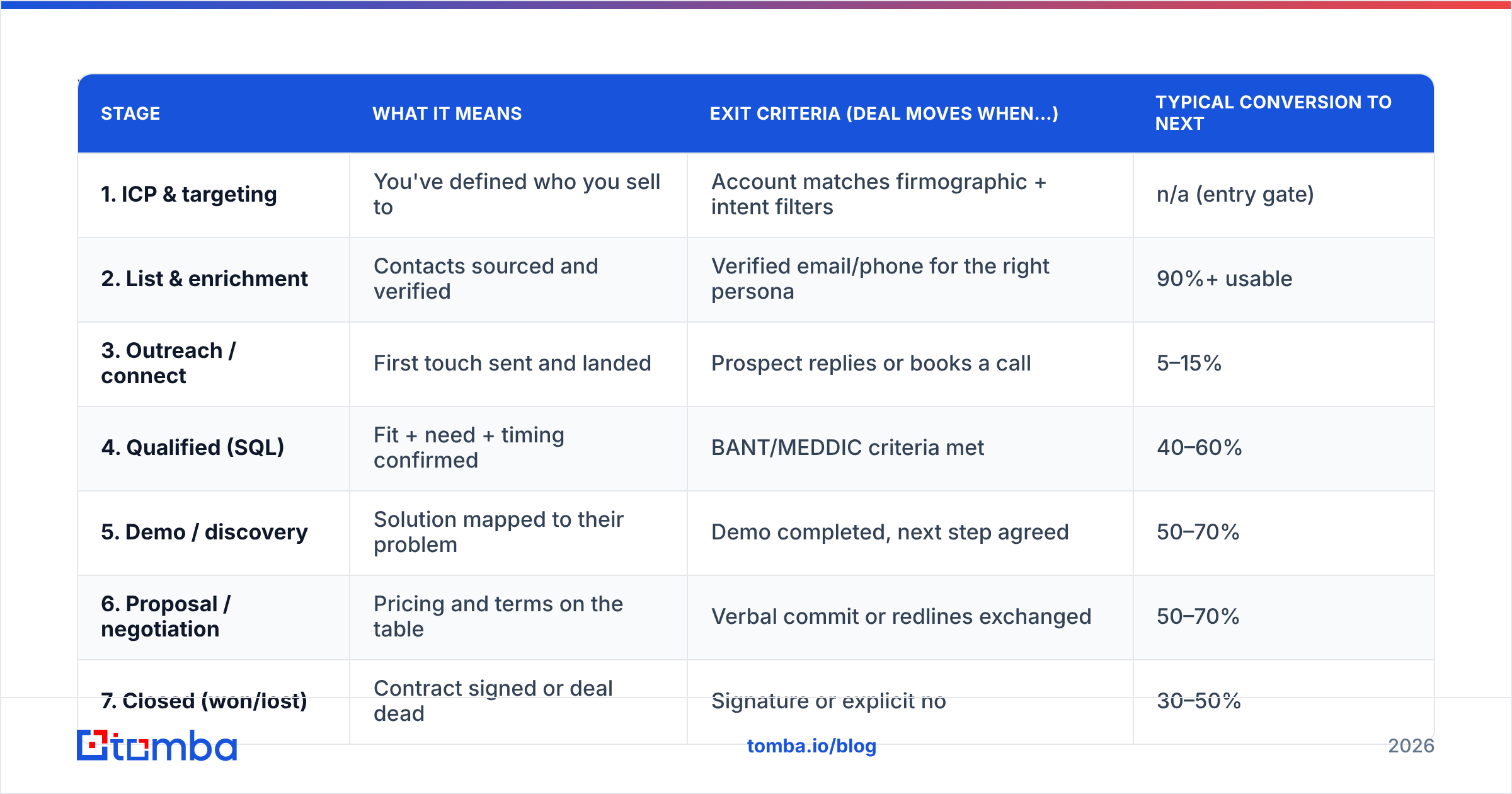
Most B2B motions — even complex, multi-threaded enterprise deals — map onto seven stages. Adjust the names to your business, but keep the structure and, critically, the exit criteria.
| Stage | What it means | Exit criteria (deal moves when…) | Typical conversion to next |
|---|---|---|---|
| 1. ICP & targeting | You've defined who you sell to | Account matches firmographic + intent filters | n/a (entry gate) |
| 2. List & enrichment | Contacts sourced and verified | Verified email/phone for the right persona | 90%+ usable |
| 3. Outreach / connect | First touch sent and landed | Prospect replies or books a call | 5–15% |
| 4. Qualified (SQL) | Fit + need + timing confirmed | BANT/MEDDIC criteria met | 40–60% |
| 5. Demo / discovery | Solution mapped to their problem | Demo completed, next step agreed | 50–70% |
| 6. Proposal / negotiation | Pricing and terms on the table | Verbal commit or redlines exchanged | 50–70% |
| 7. Closed (won/lost) | Contract signed or deal dead | Signature or explicit no | 30–50% |
A few notes on reading this table. The conversion column is illustrative, not gospel — your numbers come from your historical data. But the shape is consistent: the biggest leak is almost always between outreach and qualified (Stage 3 → 4), because that's where weak fit and bad data get exposed. If only 5% of your outreach converts, the problem is usually targeting and deliverability, not your reps' charm.
The data layer underneath every stage#
Each stage depends on knowing who you're talking to. That's the unglamorous data layer:
- Firmographics — company size, industry, tech stack, revenue band
- Persona — the right title and seniority for your deal
- Contact details — a deliverable email and, increasingly, a B2B phone number
- Intent signals — hiring, funding, tech changes, or website visits that say "now"
Get this layer right and stages 3 through 7 get dramatically easier. Get it wrong and no amount of pipeline review fixes it.
How do you build a B2B sales pipeline from scratch?#
Here's the sequence. Do it in order — each step assumes the previous one is solid.
Step 1 — Define your ICP precisely. Not "mid-market SaaS." Something like "Series B–C B2B SaaS, 50–500 employees, using HubSpot, with a VP of Sales hired in the last 12 months." The tighter the definition, the cleaner every downstream metric. Vague ICPs produce vague forecasts.
Step 2 — Source and verify contacts. Pull a target list that matches the ICP, then enrich and verify it. This is where an accurate email finder earns its keep: you want verified, deliverable addresses for the exact persona, not a scraped dump of role accounts. Run the list through an email verifier before a single message goes out — bounces wreck both your forecast and your sender reputation.
Step 3 — Design stages with exit criteria. Write down, for each stage, the one observable thing that must be true to advance. Put it in your CRM as a required field. This is the single highest-leverage discipline in building a B2B sales pipeline.
Step 4 — Instrument the metrics. Decide how you'll measure conversion between stages, average deal size, and cycle length. If you can't measure a stage, you can't manage it.
Step 5 — Set entry volume from a reverse-engineered target. Work backwards from revenue (see the math below) to know how many contacts you need at the top.
Step 6 — Run, review, and prune weekly. A pipeline is a living system. Stale deals lie to you; kill them. A deal with no activity in 30 days is usually dead — mark it lost and protect the forecast.
)
What metrics actually matter in a sales pipeline?#
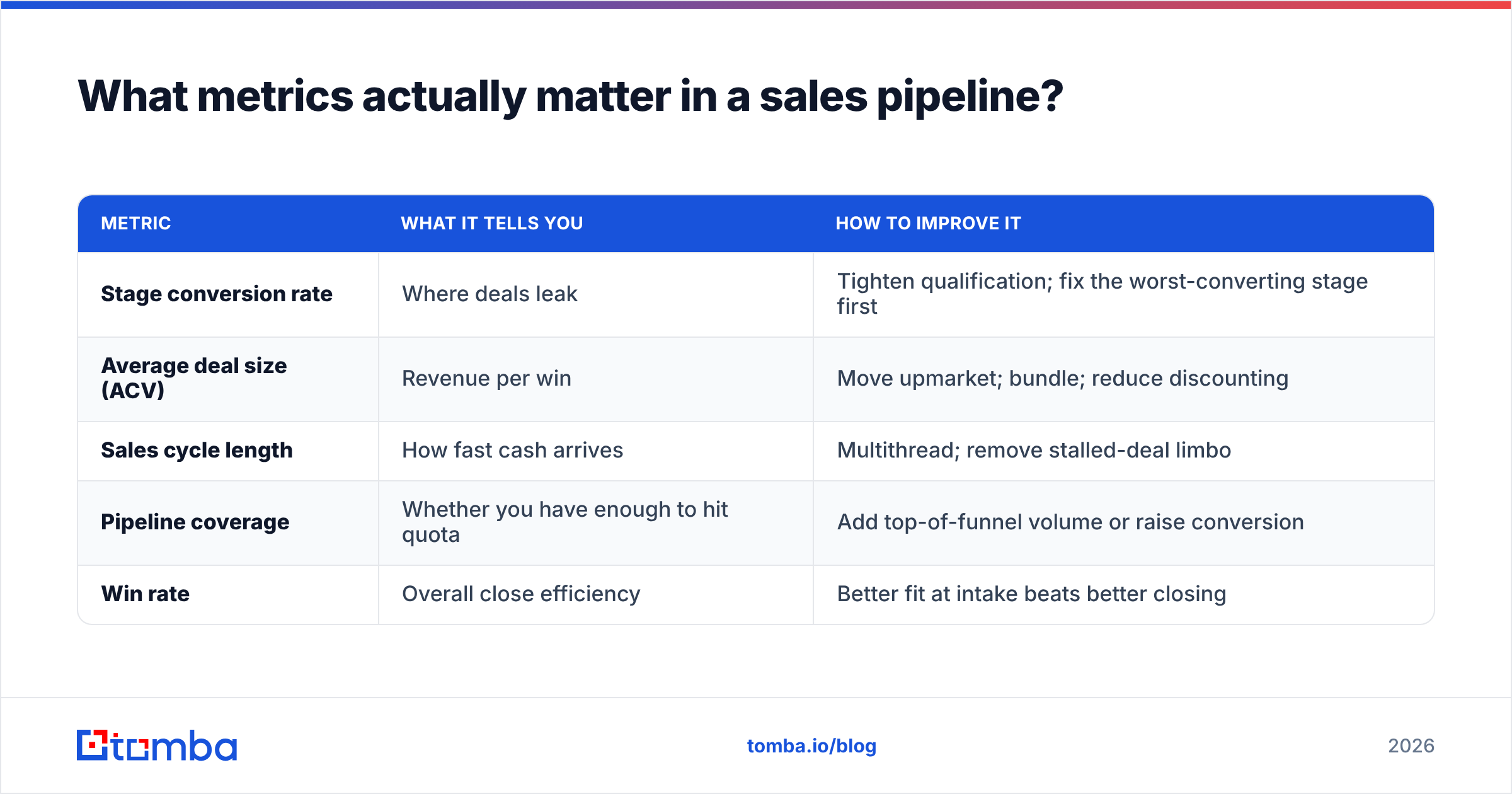
Three numbers do most of the work. Everything else is diagnostic.
| Metric | What it tells you | How to improve it |
|---|---|---|
| Stage conversion rate | Where deals leak | Tighten qualification; fix the worst-converting stage first |
| Average deal size (ACV) | Revenue per win | Move upmarket; bundle; reduce discounting |
| Sales cycle length | How fast cash arrives | Multithread; remove stalled-deal limbo |
| Pipeline coverage | Whether you have enough to hit quota | Add top-of-funnel volume or raise conversion |
| Win rate | Overall close efficiency | Better fit at intake beats better closing |
The forecast formula is simple once you have these:
Expected revenue = (number of deals at a stage) × (conversion rate to close from that stage) × (average deal size)
If you have 100 deals at Stage 4, a 20% Stage-4-to-close rate, and a $12,000 average deal, that's roughly $240,000 of weighted pipeline. Now you can reverse it: to hit a $1M quarter, you need about four times that Stage-4 volume — which tells you exactly how many verified contacts to load at the top. This is why your win rate and response rate aren't vanity metrics; they're the multipliers that size your entire intake.
How does data quality make or break the pipeline?#
Your forecast is only as honest as the data feeding it. A pipeline built on a stale, unverified list doesn't just underperform — it lies to you, because the "activity" looks identical whether the contacts are real or not.
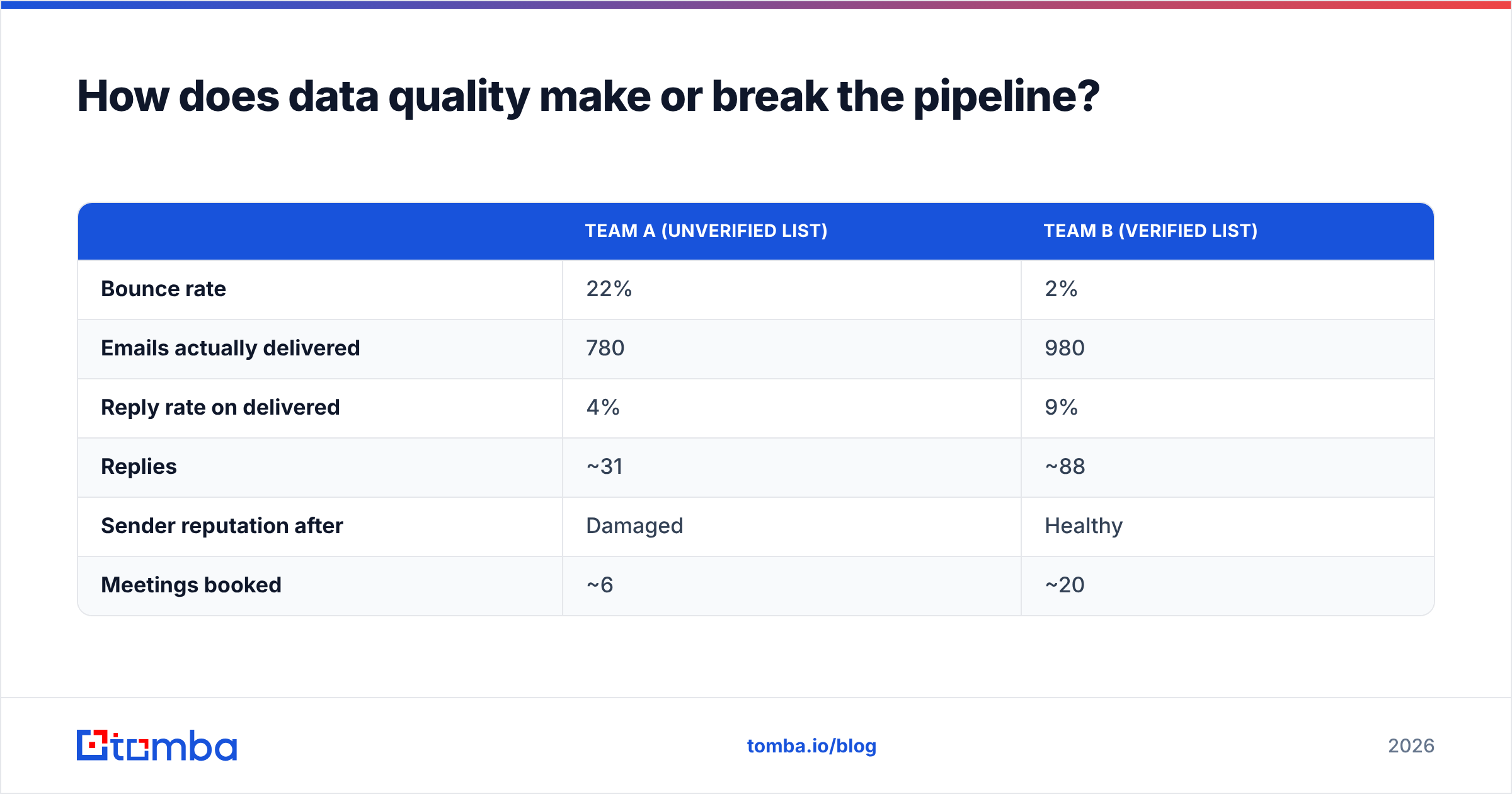
Consider two teams sending 1,000 cold emails:
| Team A (unverified list) | Team B (verified list) | |
|---|---|---|
| Bounce rate | 22% | 2% |
| Emails actually delivered | 780 | 980 |
| Reply rate on delivered | 4% | 9% |
| Replies | ~31 | ~88 |
| Sender reputation after | Damaged | Healthy |
| Meetings booked | ~6 | ~20 |
Same effort, same copy, more than 3x the meetings — purely from data quality. And Team A's damaged email deliverability makes every future campaign worse, a compounding tax that never shows up on the pipeline board.
This is the part teams underinvest in. They'll spend weeks A/B testing subject lines while loading the pipeline with 20% junk. The cheapest forecast improvement available to most B2B teams isn't a new playbook — it's verifying the list before it enters the pipeline. Tools like bulk verification and a catch-all verifier exist precisely because this is where pipelines quietly rot.
What tools do you need to build a B2B sales pipeline?#
You need three layers, and you can mix vendors at each. Here's how the common options compare for a team building a pipeline in 2026.
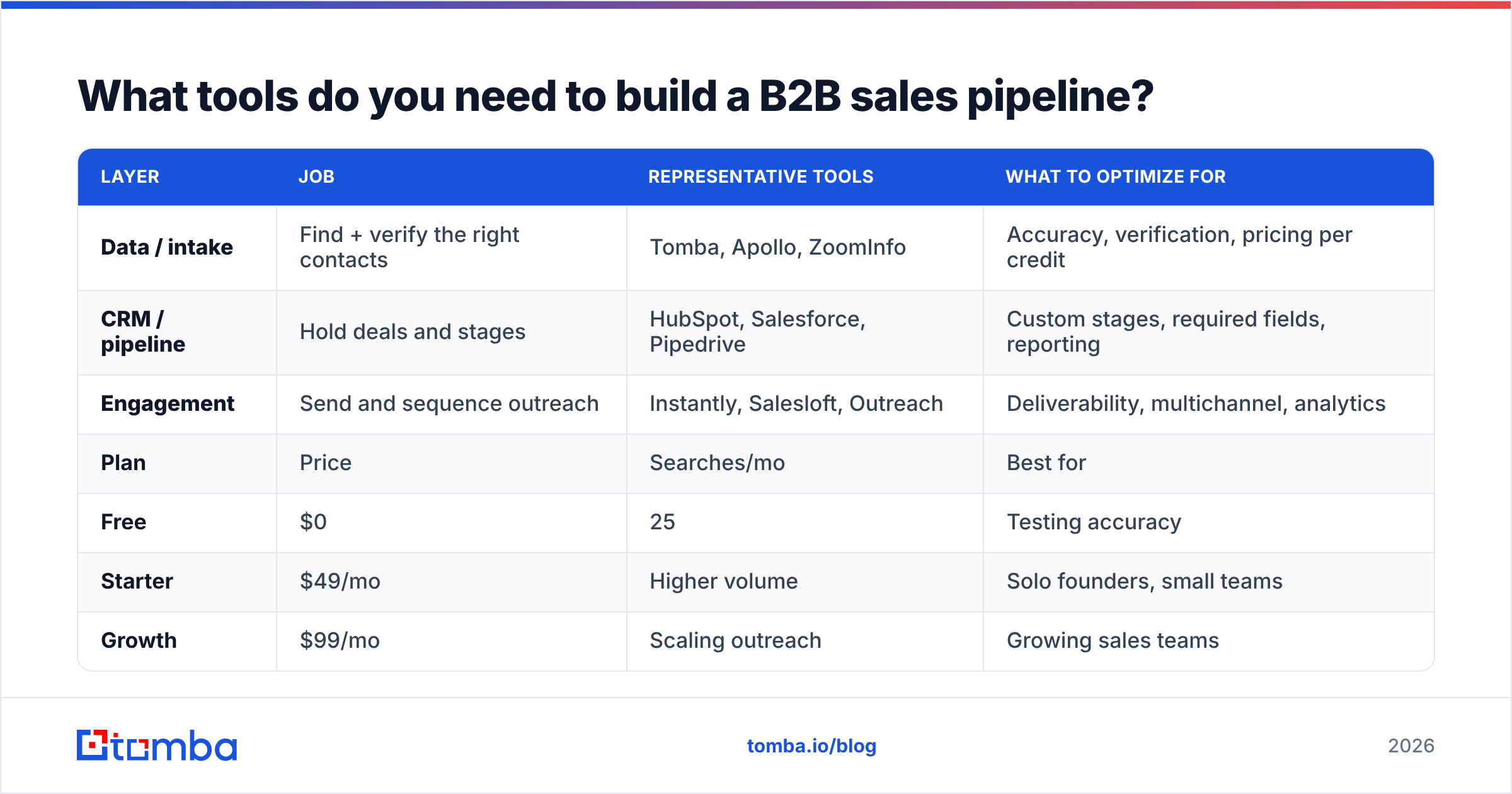
| Layer | Job | Representative tools | What to optimize for |
|---|---|---|---|
| Data / intake | Find + verify the right contacts | Tomba, Apollo, ZoomInfo | Accuracy, verification, pricing per credit |
| CRM / pipeline | Hold deals and stages | HubSpot, Salesforce, Pipedrive | Custom stages, required fields, reporting |
| Engagement | Send and sequence outreach | Instantly, Salesloft, Outreach | Deliverability, multichannel, analytics |
For the data layer specifically — the one that determines whether the rest of the pipeline is fed real or fake fuel — pricing and accuracy matter most. Here's where Tomba sits:
| Plan | Price | Searches/mo | Best for |
|---|---|---|---|
| Free | $0 | 25 | Testing accuracy |
| Starter | $49/mo | Higher volume | Solo founders, small teams |
| Growth | $99/mo | Scaling outreach | Growing sales teams |
| Pro | $249/mo | High volume | Established teams |
| Enterprise | Custom | Custom | Large orgs + API |
You don't need the most expensive stack. You need an honest CRM with enforced stage criteria and an accurate top-of-funnel data source. Compare the full Tomba pricing against whatever you're paying per usable, verified contact today — the metric that matters isn't price per credit, it's price per deliverable contact. A cheap tool that returns 30% bounces is more expensive than a verified one. Independent reviews on G2 are a useful sanity check before you commit.
How do you keep the pipeline healthy over time?#
Building the pipeline is a one-time project. Keeping it accurate is a weekly habit. Three routines protect it:
- Prune stalled deals. Anything untouched for 30 days gets a forcing function — advance it or mark it lost. Limbo deals are the leading cause of forecast inflation.
- Re-verify aging data. B2B contact data decays at roughly 2–3% per month as people change jobs. Lists you sourced six months ago are now ~15% wrong. Periodic re-verification and data enrichment keep the intake clean.
- Review conversion, not activity. In your weekly pipeline review, ask "what's our Stage 3→4 rate this month vs. last?" not "how many calls did we make?" Activity is an input; conversion is the truth.
Do these three things and your pipeline stops being a wish list and becomes a forecast you can take to the board.
Conclusion: start where pipelines actually break#
Building a B2B sales pipeline that forecasts reliably comes down to a sequence: a precise ICP, verified contacts at intake, stages with real exit criteria, and a weekly habit of pruning and re-verifying. Most teams skip straight to closing tactics and wonder why the forecast lies. Fix the top of the pipeline first.
That top is where Tomba does its job. Before a contact ever enters your CRM, the Tomba Email Finder gets you a verified, deliverable address for the exact persona in your ICP — so the deals you load are real, your bounce rate stays near zero, and your sender reputation survives to fight another quarter. Start on the free tier, verify your next list, and watch how much cleaner the forecast gets when the inputs are honest.
// get started
Find, verify and enrich your first contacts today
Start on the free plan with 25 searches a month, then scale when your team is ready.
Free plan · No credit card required · GDPR & CCPA
// about the author