Building Customer Relationships in 2026: A B2B Playbook
Building customer relationships in B2B is a system, not charm. Here's the 2026 playbook for trust, cadence, clean data, and tools that turn one deal into a loyal account.
Building Customer Relationships in 2026: A B2B Playbook
Building customer relationships is the difference between a pipeline that resets to zero every quarter and one that compounds. In B2B, the average deal touches five to eight stakeholders and takes months to close — so the relationship is the product, long before the contract is. This guide breaks down how to build, measure, and scale customer relationships in 2026 without relying on vague "be authentic" advice.
TL;DR#
- Relationships are a system, not a personality trait. Trust comes from consistent, relevant follow-through — which you can engineer with process and clean data.
- Bad contact data quietly kills relationships. You can't nurture an account you can't reach; verified emails and direct dials are the foundation.
- Cadence beats intensity. Predictable, value-led touchpoints outperform sporadic "just checking in" blasts.
- Measure leading indicators (response rate, multi-threading, time-to-value) — not just revenue, which lags by quarters.
- The right stack — CRM, enrichment, and a reliable email finder — removes the friction that makes reps skip relationship work.
What does "building customer relationships" actually mean in B2B?#
Building customer relationships means creating enough mutual trust and value that a buyer chooses you repeatedly — and defends that choice internally. It is not small talk, and it is not a loyalty punch card.
Think of it like tending a garden versus buying cut flowers. A one-off transaction is cut flowers: bright today, dead next week. A relationship is a garden: you prepare the soil (research), plant consistently (cadence), and water on a schedule (follow-through). The yield isn't a single sale — it's renewals, expansions, and referrals that arrive without a cold start.
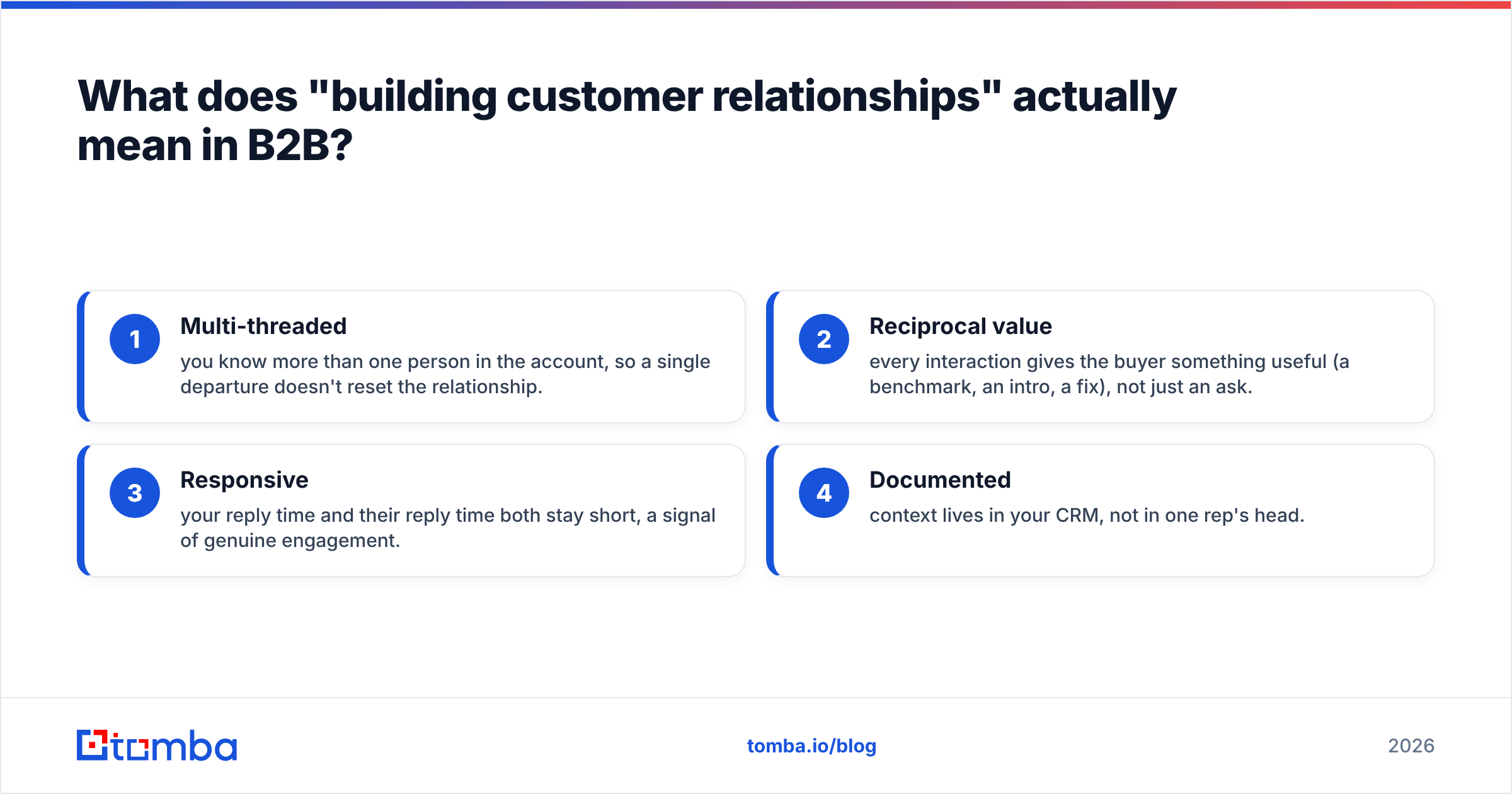
In practice, a strong B2B customer relationship has four observable traits:
- Multi-threaded — you know more than one person in the account, so a single departure doesn't reset the relationship.
- Reciprocal value — every interaction gives the buyer something useful (a benchmark, an intro, a fix), not just an ask.
- Responsive — your reply time and their reply time both stay short, a signal of genuine engagement.
- Documented — context lives in your CRM, not in one rep's head.
Why do most customer relationships fail before they start?#
Most relationships fail at the contact layer, not the conversation layer. You can't build trust with a bounced email or a wrong number, and reps abandon accounts that feel like dead ends.
Here are the failure modes, ranked by how often they quietly sabotage teams:
- Stale or wrong data. Decision-makers change jobs every ~2 years. A CRM that isn't enriched is a list of ghosts.
- One-threaded accounts. You befriend a champion, they leave, the relationship evaporates.
- Pitch-first behavior. Leading with your product instead of their problem trains buyers to ignore you.
- Inconsistent cadence. Five emails in week one, silence for three months. Buyers read this as "you only want me when you have a quota."
- No memory. Asking a question the buyer already answered signals you weren't listening.
The fixable root cause behind most of these is data and process. If your team spends 30% of its day hunting for valid contact details, relationship-building is the first thing that gets cut. That's why data enrichment and verification aren't "nice to have" — they're the soil.
How do you build customer relationships step by step?#
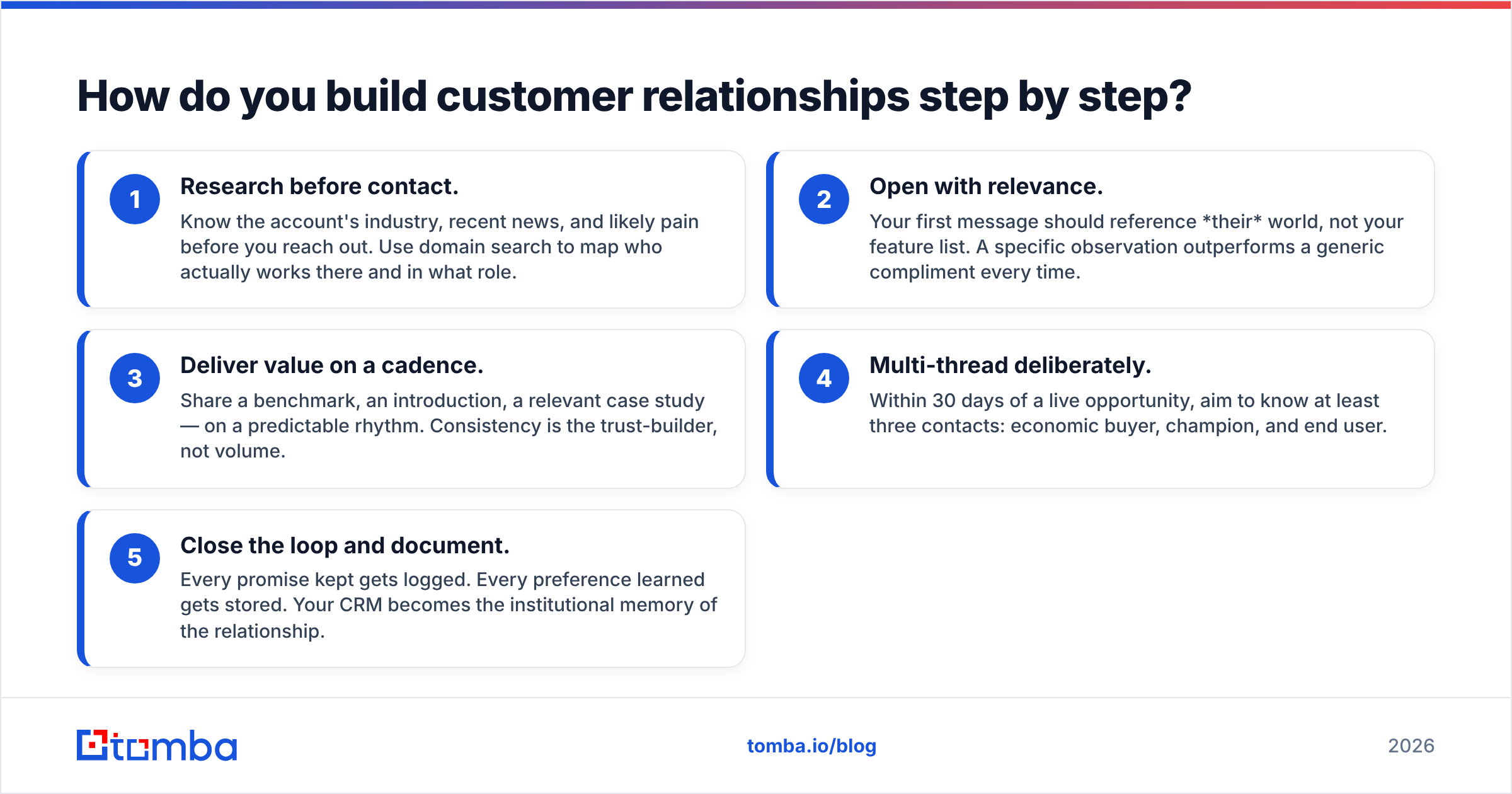
You build customer relationships in five repeatable stages. Treat this as a loop, not a funnel — every renewal restarts it.
- Research before contact. Know the account's industry, recent news, and likely pain before you reach out. Use domain search to map who actually works there and in what role.
- Open with relevance. Your first message should reference their world, not your feature list. A specific observation outperforms a generic compliment every time.
- Deliver value on a cadence. Share a benchmark, an introduction, a relevant case study — on a predictable rhythm. Consistency is the trust-builder, not volume.
- Multi-thread deliberately. Within 30 days of a live opportunity, aim to know at least three contacts: economic buyer, champion, and end user.
- Close the loop and document. Every promise kept gets logged. Every preference learned gets stored. Your CRM becomes the institutional memory of the relationship.
The teams that win treat steps 1 and 5 as non-negotiable. Anyone can send an email; few do the research and the documentation that make the next email land.
What tools support building customer relationships?#
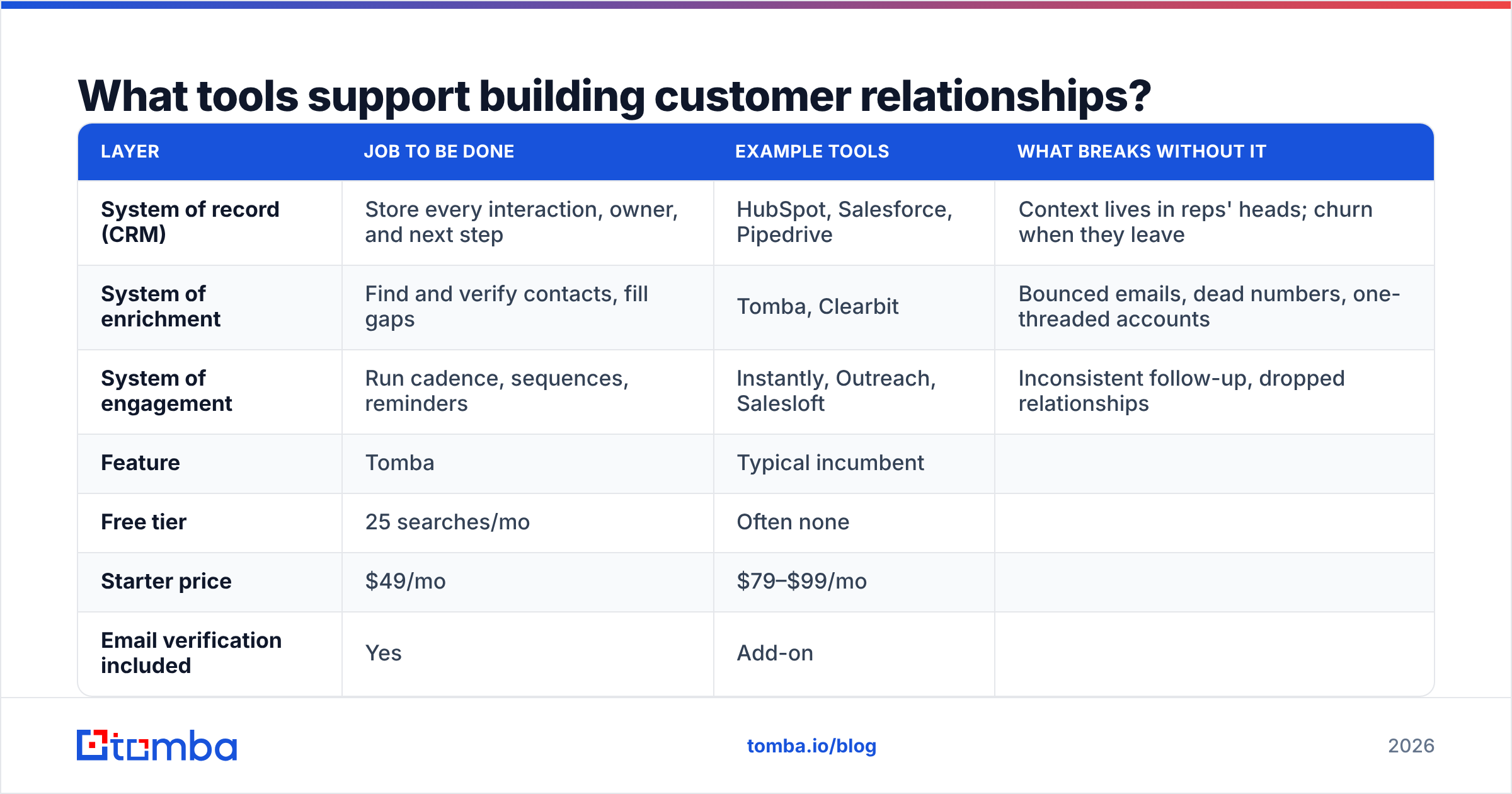
The right stack removes friction so reps spend time on conversations, not data entry. You need three layers: a system of record, a system of enrichment, and a system of engagement.
| Layer | Job to be done | Example tools | What breaks without it |
|---|---|---|---|
| System of record (CRM) | Store every interaction, owner, and next step | HubSpot, Salesforce, Pipedrive | Context lives in reps' heads; churn when they leave |
| System of enrichment | Find and verify contacts, fill gaps | Tomba, Clearbit | Bounced emails, dead numbers, one-threaded accounts |
| System of engagement | Run cadence, sequences, reminders | Instantly, Outreach, Salesloft | Inconsistent follow-up, dropped relationships |
A common mistake is buying engagement tools before fixing data. A perfectly sequenced campaign sent to invalid addresses just automates failure. Get the email verifier and enrichment layer right first, then layer cadence on top.
Here's how the enrichment layer compares on the attributes that matter for relationship work:
| Feature | Tomba | Typical incumbent |
|---|---|---|
| Free tier | 25 searches/mo | Often none |
| Starter price | $49/mo | $79–$99/mo |
| Email verification included | Yes | Add-on |
| Domain + role mapping | Yes | Partial |
| Catch-all handling | Dedicated catch-all verifier | Limited |
| API + integrations | Full API, Sheets, HubSpot | Varies |
You don't need every tool on day one. Start with a clean CRM and reliable contact data, then add engagement automation once your cadence is proven. For full plan details, see the Tomba pricing page.
How do you keep customer relationships alive after the sale?#
You keep relationships alive by making post-sale value visible and routine. Most churn isn't caused by a competitor — it's caused by silence. The buyer forgets why they signed, the champion gets busy, and renewal becomes a cold conversation.
Build a post-sale rhythm around three moments:
- Time-to-first-value. The fastest way to cement a relationship is to help the buyer hit a win in the first 30 days. Track it like a KPI.
- Quarterly value reviews. Not a sales pitch — a recap of outcomes delivered, with a forward plan. This is where expansion conversations happen naturally.
- Proactive saves. Watch for usage drops or stakeholder changes. When your champion's title changes on LinkedIn, that's your cue to re-thread, not to panic. A quick reverse email lookup or LinkedIn check tells you when an account's map has shifted.
Multi-threading is your insurance policy here. According to HubSpot's sales research, deals with multiple engaged stakeholders close at meaningfully higher rates and renew more reliably. The same logic applies post-sale: an account where you know four people survives one person leaving.
How do you measure relationship strength before revenue tells you?#
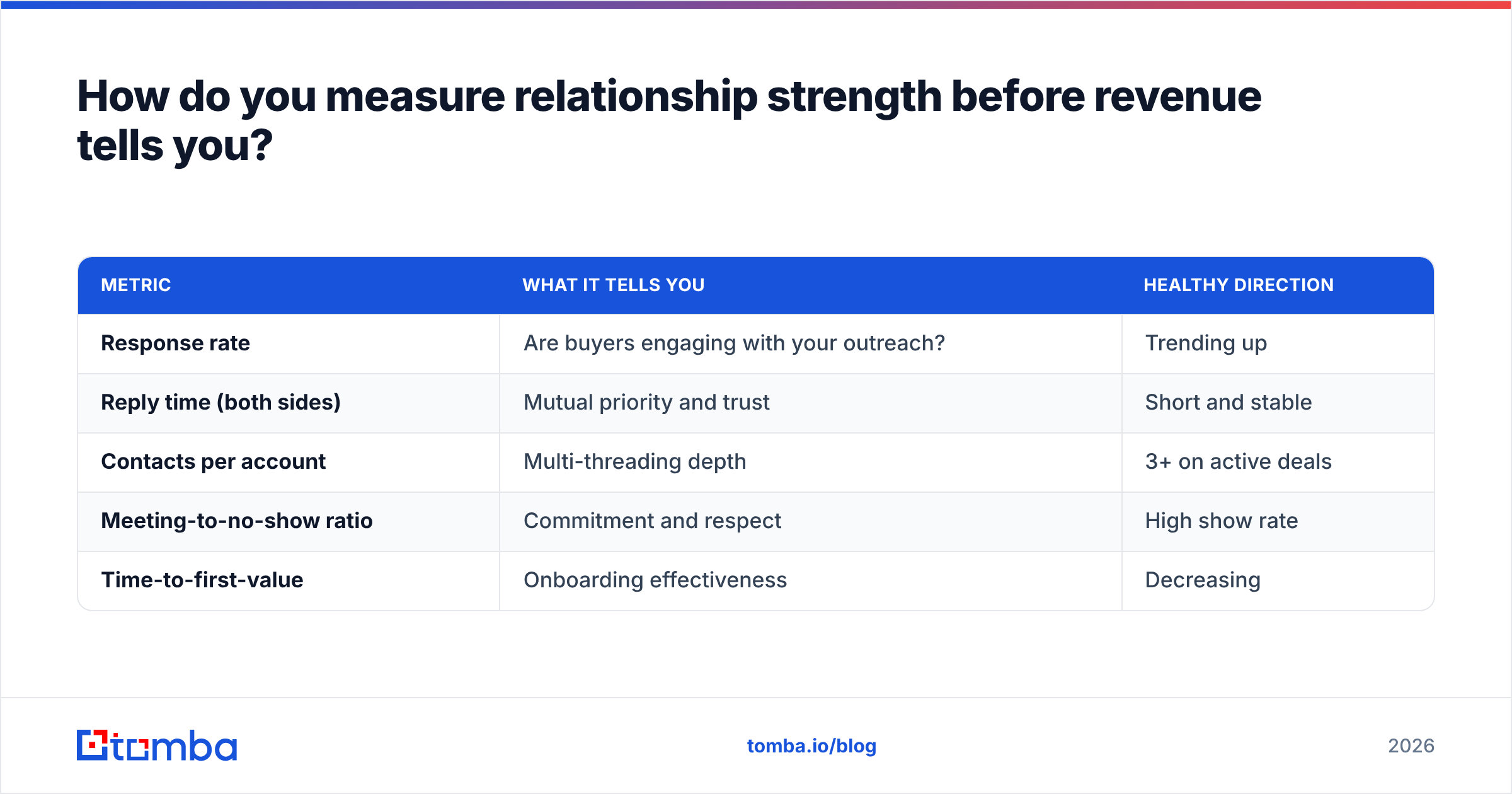
Measure the leading indicators, because revenue is a lagging one — by the time it drops, the relationship has already eroded. Waiting for churn to show up in your numbers is like waiting for the smoke alarm to learn the kitchen is on fire.
Track these signals weekly:
| Metric | What it tells you | Healthy direction |
|---|---|---|
| Response rate | Are buyers engaging with your outreach? | Trending up |
| Reply time (both sides) | Mutual priority and trust | Short and stable |
| Contacts per account | Multi-threading depth | 3+ on active deals |
| Meeting-to-no-show ratio | Commitment and respect | High show rate |
| Time-to-first-value | Onboarding effectiveness | Decreasing |
If you only watch revenue, you'll diagnose problems a quarter too late. Industry analysts at Gartner have long noted that B2B buyers spend only a fraction of their journey with any single vendor — which means the relationship signals you control matter more than ever. Pair these metrics with your win rate tracking to see how relationship health flows into closed revenue.
A practical move: review the contacts-per-account number in your CRM every Monday. Any active opportunity stuck at one contact is a relationship risk, full stop. Use a bulk email finder to fill in the missing stakeholders before the deal depends on a single person.
What are the most common relationship-building mistakes to avoid?#
The biggest mistakes are predictable and fixable. Avoiding them puts you ahead of most teams.
- Pitching before listening. If your first three messages are all about you, you've already lost the thread. Lead with their problem.
- Treating the CRM as optional. Undocumented relationships don't scale and don't survive turnover.
- Confusing activity with progress. Fifty calls to bad numbers is not prospecting; it's noise. Verify contacts first with a phone validator so your effort lands.
- Going quiet after the close. The post-sale gap is where churn is born.
- Ignoring the data layer. Every relationship strategy assumes you can actually reach the human. Make that assumption true with verified data and you remove the single most common point of failure.
The throughline: building customer relationships scales only when the boring infrastructure — clean data, consistent cadence, documented context — is solid. Charm gets you the first meeting. Systems get you the renewal.
Where should you start this quarter?#
Start with the layer that everything else depends on: contact data you can trust. You cannot build a relationship with someone you can't reach, and you can't multi-thread an account whose stakeholders you can't find. Map each active account, find the two or three contacts you're missing, verify them, and log them in your CRM with a clear next step.
That's where Tomba Email Finder earns its place in the stack. Find professional emails by domain, name, or company, verify them before you send, and enrich your CRM so every relationship starts on solid ground instead of a bounce. Begin on the free tier with 25 searches a month, then scale to the $49/mo Starter plan when your pipeline does. Build the soil first — the garden follows.
Ready to find emails that actually work?
Join 150,000+ professionals who stopped guessing and started sending. Free credits on signup — no credit card required.
Get the Tomba newsletter
Practical outbound tactics and product updates — once every two weeks.
About the author