Building Radar Pricing Reviews 2026: Honest Pros and Cons
An honest 2026 breakdown of Building Radar pricing, real user reviews, and the pros and cons for construction sales teams — plus where it falls short and how to fill the gaps.
Building Radar gets pitched as the tool that lets construction suppliers win deals before rivals even know a project exists. That is a strong claim. If you sell into construction, it deserves a hard look. This guide to Building Radar pricing reviews breaks down what the tool actually costs, what real users say, and where it shines or struggles — without the marketing gloss.
TL;DR#
- Building Radar is a construction-specific sales intelligence platform that uses AI to detect new building projects early, score them, and route leads into your CRM.
- Pricing is not public. It's a custom, sales-led, annual-contract model — expect a four-to-five-figure yearly commitment, not a self-serve $49/mo signup.
- Strongest for mid-market and enterprise manufacturers, distributors, and subcontractors who sell materials or services into new construction.
- Weakest on transparency, SMB affordability, and contact-level data — you often still need a separate tool to find decision-maker emails and phones.
- Best move: pair early project signals with a dedicated email finder so a hot project actually turns into a reply.
What is Building Radar?#
Building Radar is a German-founded B2B platform. It finds construction projects at the earliest possible stage. That is often when a project is first announced in planning or permitting, long before it goes to tender. Think of it as a smoke detector for construction demand. Instead of waiting for the building to catch fire (a public RFP everyone bids on), it alerts you to the first wisp of smoke. Your sales team gets there first.
Under the hood, it crawls thousands of public and licensed sources — news, permits, tenders, and planning portals. Machine learning then classifies and scores each project. Qualified opportunities get pushed to sales reps. The pitch is "first mover advantage": reach a general contractor or architect before the spec is locked, and you have a real shot at being designed in.
That early-signal angle is genuinely useful in a slow-moving industry. But a signal is only half the job. Once Building Radar tells you which project and which company, your reps still have to reach a human. That's where a lot of teams bolt on contact-data tooling like data enrichment or an email finder.
How does Building Radar pricing work in 2026?#
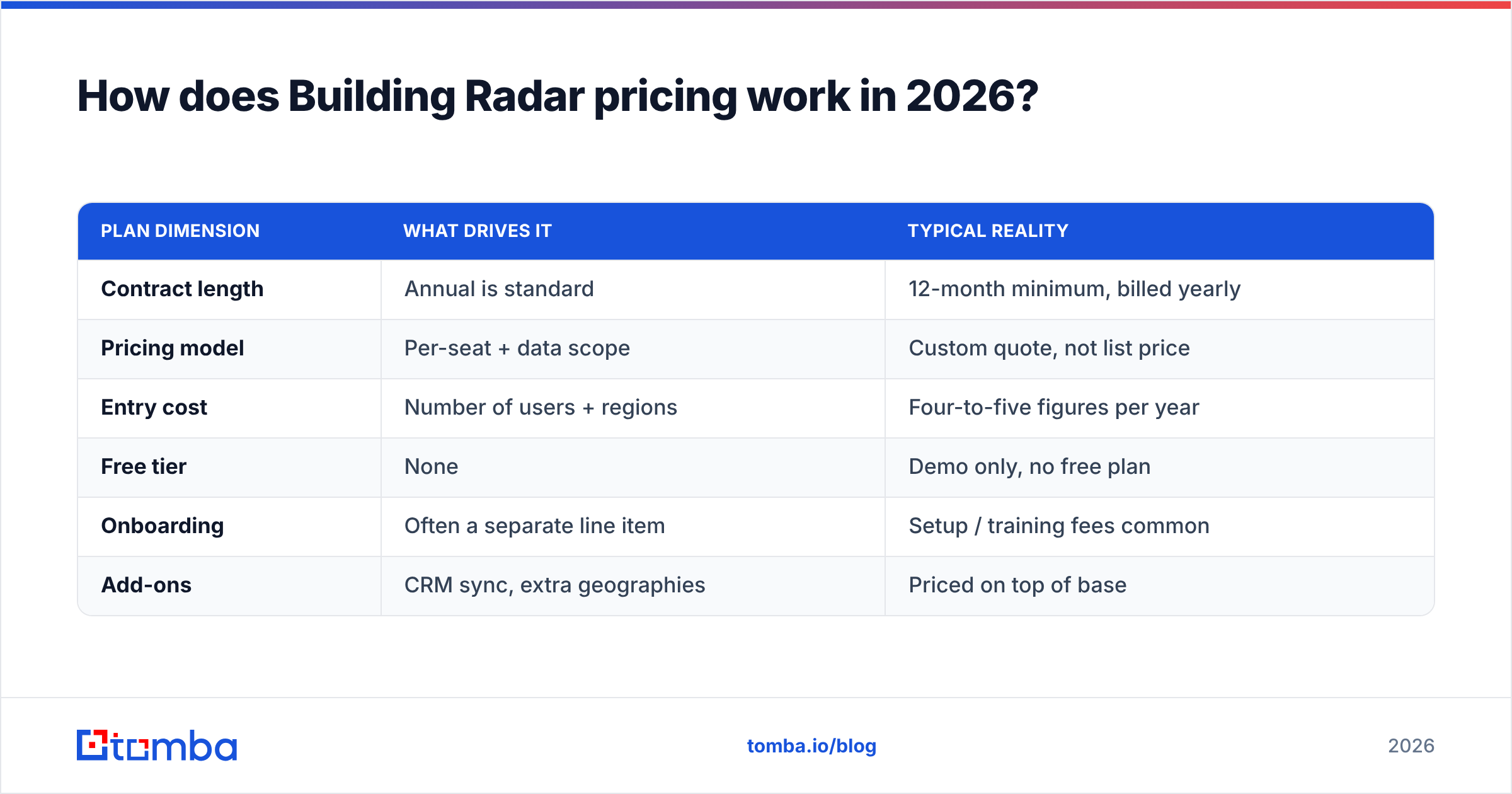
Here's the short version: Building Radar does not publish pricing. There is no public price list, no free self-serve tier, and no monthly credit-card checkout. You book a demo, talk to sales, and get a custom quote. The quote is based on seats, regions, and data scope.
From aggregated user reports and review sites, here's the realistic shape of what to expect. Treat these as directional ranges, not quotes. Only Building Radar can confirm your number.
| Plan dimension | What drives it | Typical reality |
|---|---|---|
| Contract length | Annual is standard | 12-month minimum, billed yearly |
| Pricing model | Per-seat + data scope | Custom quote, not list price |
| Entry cost | Number of users + regions | Four-to-five figures per year |
| Free tier | None | Demo only, no free plan |
| Onboarding | Often a separate line item | Setup / training fees common |
| Add-ons | CRM sync, extra geographies | Priced on top of base |
Why the opacity? Enterprise sales tools price this way on purpose. Value varies wildly by company size and territory, and sales-led pricing lets them capture more from large accounts. The trade-off is real. Smaller teams can't quickly judge fit, and you'll spend a sales cycle just to learn the number.
Want to see how transparent, published pricing feels by contrast? The Tomba pricing page lists every tier openly — Free, $49/mo Starter, $99/mo Growth, and up. It's a different product category, but a useful benchmark for what "no surprises" looks like.
What do Building Radar pricing reviews say?#
Building Radar holds solid ratings on the major directories. On G2 and Capterra it generally lands in the 4.4–4.7 range. Across those sites, the Building Radar pricing reviews cluster around a few consistent themes.
What reviewers consistently praise:
- Early project detection — the #1 reason people stay. Reps repeatedly mention catching projects months before competitors.
- Time savings on research — analysts stop manually scraping permit portals and news.
- Account management — onboarding and customer success get frequent shout-outs.
- Lead scoring and relevance — the AI filtering is rated as genuinely useful once tuned.
What reviewers consistently flag:
- Price and contract rigidity — the most common complaint, especially from smaller firms.
- Data gaps in some regions — coverage is strongest in DACH and Europe, thinner elsewhere.
- Contact data is limited — you find the project and company, but often not the right person's direct email or phone.
- Learning curve — getting the scoring and CRM workflow dialed in takes effort.
That third point comes up enough to matter. Building Radar is excellent at project intelligence and weaker at contact intelligence. Many teams describe a two-step workflow. Building Radar surfaces the opportunity. Then a separate tool finds the actual decision-maker — using a domain search to pull verified emails for the architecture firm or contractor that just popped up.
Building Radar pros and cons#
Let's lay it out plainly.
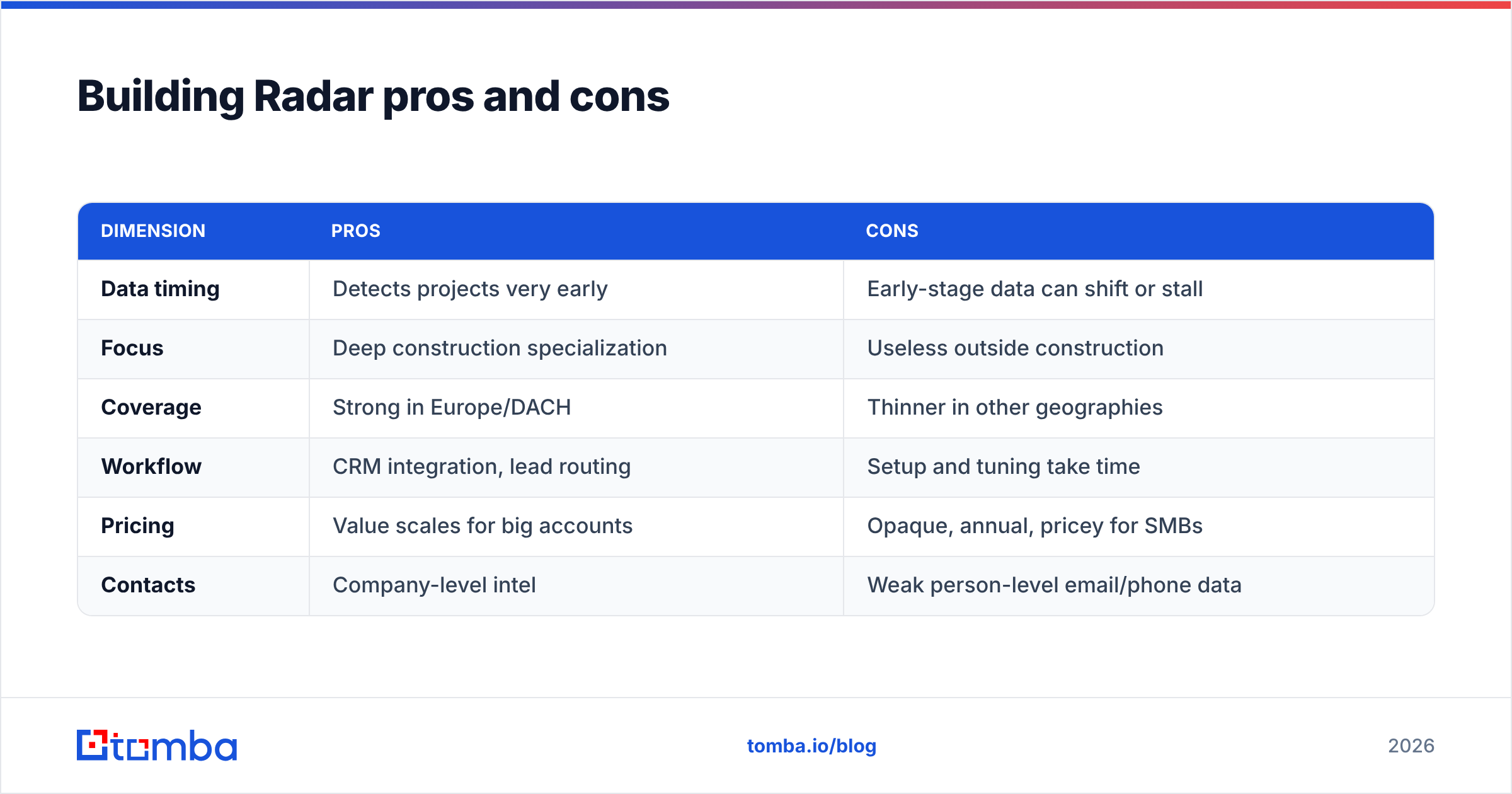
| Dimension | Pros | Cons |
|---|---|---|
| Data timing | Detects projects very early | Early-stage data can shift or stall |
| Focus | Deep construction specialization | Useless outside construction |
| Coverage | Strong in Europe/DACH | Thinner in other geographies |
| Workflow | CRM integration, lead routing | Setup and tuning take time |
| Pricing | Value scales for big accounts | Opaque, annual, pricey for SMBs |
| Contacts | Company-level intel | Weak person-level email/phone data |
The honest summary: if you are a mid-market or enterprise supplier selling into new construction in Europe, Building Radar can pay for itself with one or two early-won projects. If you're a small team, sell outside construction, or need rich contact data more than project signals, the value gets harder to justify.
Who is Building Radar actually for?#
Match the tool to the motion. Building Radar fits a specific seller profile and frustrates everyone else.
- Strong fit: Building-material manufacturers, HVAC and electrical distributors, façade and structural subcontractors, and equipment rental firms with field sales teams and a 6–18 month deal cycle.
- Weak fit: Agencies, SaaS, recruiters, or any B2B seller whose buyers aren't tied to physical construction projects.
- Borderline: Small construction-adjacent firms that love the data but can't absorb an annual enterprise contract.
Are you in that "borderline" or "weak fit" bucket and landed here looking for prospecting data? Then your real need is probably contact discovery and verification — not construction project feeds. That's a different and far cheaper category of tool.
How does Building Radar compare to general prospecting stacks?#
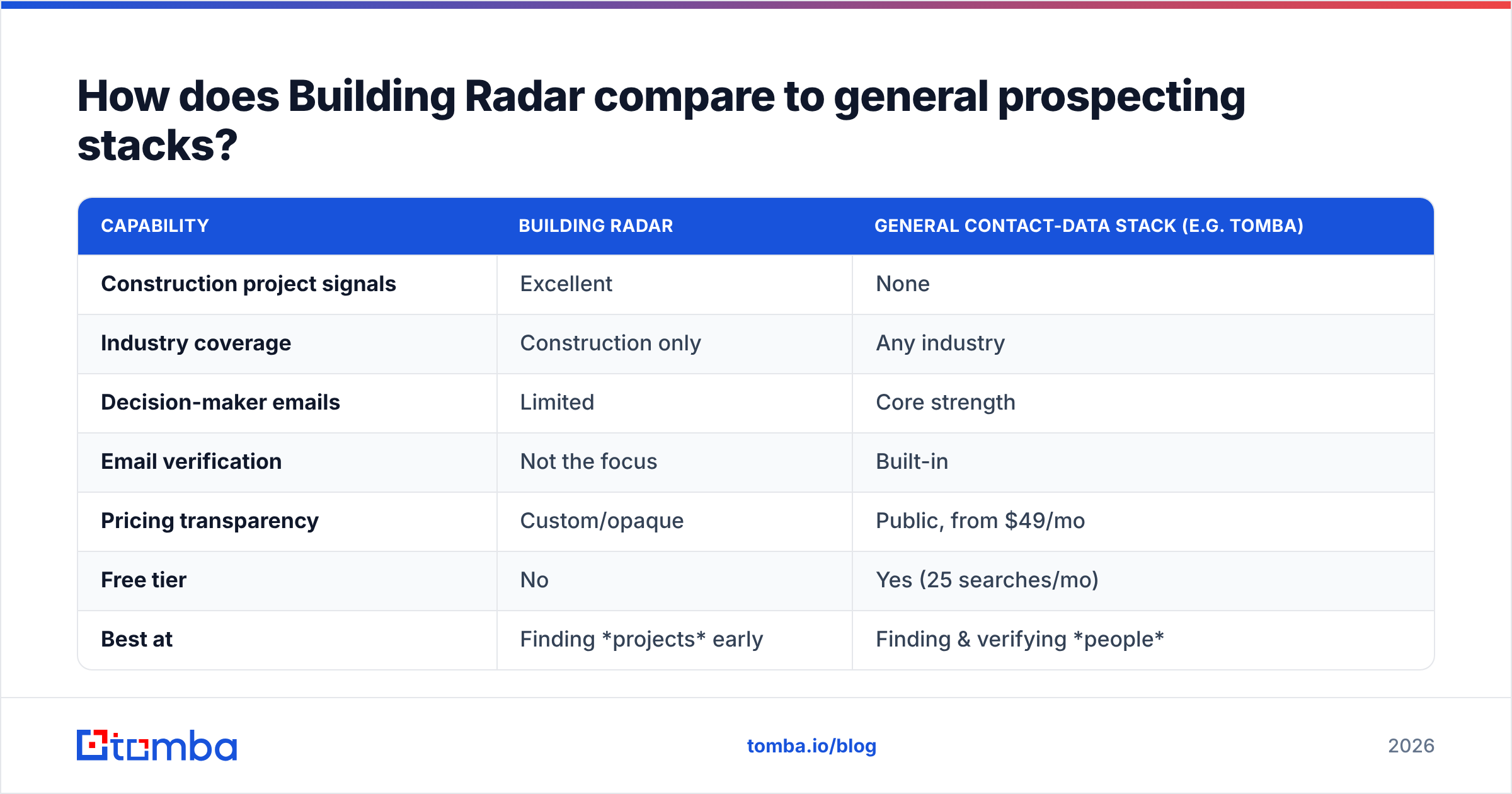
Building Radar is a vertical (construction-only) intelligence tool. Most sales teams also run a horizontal prospecting layer. That layer finds and verifies contacts across any industry. The two solve different problems. So the comparison is about where each one wins, not which is "better."
| Capability | Building Radar | General contact-data stack (e.g. Tomba) |
|---|---|---|
| Construction project signals | Excellent | None |
| Industry coverage | Construction only | Any industry |
| Decision-maker emails | Limited | Core strength |
| Email verification | Not the focus | Built-in |
| Pricing transparency | Custom/opaque | Public, from $49/mo |
| Free tier | No | Yes (25 searches/mo) |
| Best at | Finding projects early | Finding & verifying people |
The takeaway: these tools are complementary, not competing. Building Radar tells you a 40-story development just entered planning. A tool like the Tomba Email Finder then gets you the verified email of the project's procurement lead. Now your outreach actually lands. Skip the second step and your early-warning advantage evaporates in a generic info@ inbox.
Want to go deeper on contact accuracy? Email verification before you send keeps your bounce rate low and protects sender reputation. That matters a lot when you're cold-emailing senior construction buyers who never opted in.
What are the best Building Radar alternatives?#
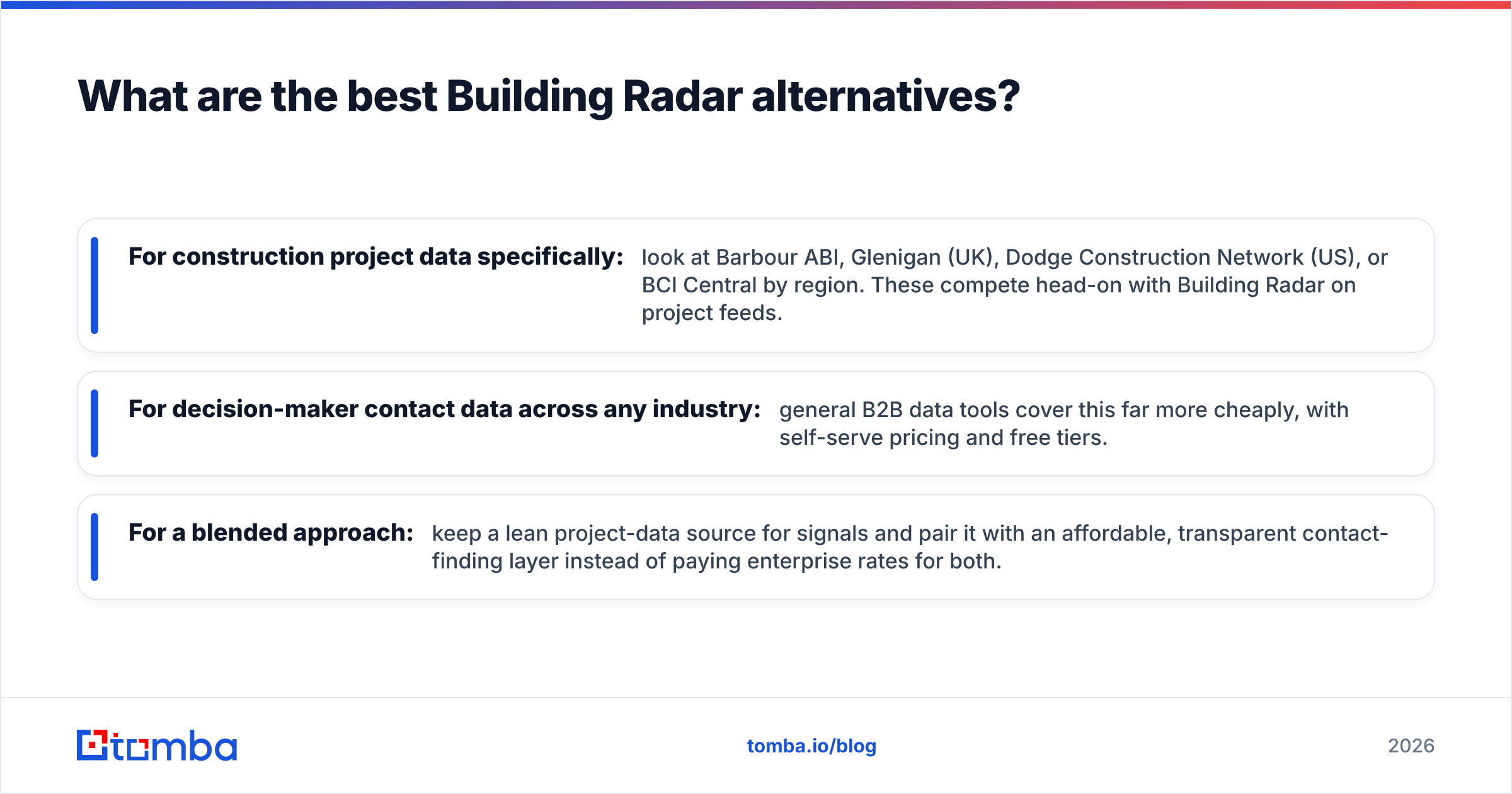
Maybe Building Radar isn't the right fit — usually because of price, geography, or the need for contact data. Here's how the landscape breaks down:
- For construction project data specifically: look at Barbour ABI, Glenigan (UK), Dodge Construction Network (US), or BCI Central by region. These compete head-on with Building Radar on project feeds.
- For decision-maker contact data across any industry: general B2B data tools cover this far more cheaply, with self-serve pricing and free tiers.
- For a blended approach: keep a lean project-data source for signals. Then pair it with an affordable, transparent contact-finding layer instead of paying enterprise rates for both.
The mistake to avoid is simple. Don't buy a heavyweight, opaque annual contract when your actual gap is "I can't find the right person's email." That problem is solved for a fraction of the cost.
Is Building Radar worth it?#
Conclusion first: Building Radar is worth it for funded, construction-focused sales teams in its strong-coverage regions, and overkill for almost everyone else. The early-detection engine is real and the reviews back it up. The friction is pricing opacity, annual lock-in, and thin contact data.
Before you sign, pressure-test three things:
- Coverage in your exact regions and project types — ask for live examples, not averages.
- Total cost including onboarding and add-ons, not just the headline seat price.
- Contact workflow — confirm whether you'll still need a separate tool to reach humans (you probably will).
The bottom line#
Building Radar earns its reputation as a best-in-class construction project-intelligence platform, and the Building Radar pricing reviews are genuinely strong. Just go in clear-eyed. It's a premium, sales-led, construction-only product. It surfaces opportunities but rarely hands you the decision-maker's inbox.
That last mile — turning a detected project into a verified, reply-ready contact — is exactly where a dedicated, transparently priced tool earns its keep. The Tomba Email Finder finds and verifies professional emails by name, company, or domain across any industry. It starts free with 25 searches a month and scales from $49/mo, with no opaque enterprise quote required. Run it alongside whatever project-intelligence source you choose. Then every early signal turns into outreach that actually reaches a person. Start free, find your first decision-maker, and stop letting hot projects die in a generic inbox.
// get started
Find, verify and enrich your first contacts today
Start on the free plan with 25 searches a month, then scale when your team is ready.
Free plan · No credit card required · GDPR & CCPA
// about the author