Building Relationships in Sales: The 2026 Playbook for Reps
Quotas are won on trust, not pitch volume. Here is a concrete, repeatable framework for building relationships in sales that actually shortens deal cycles in 2026.
TL;DR
- Building relationships in sales is a system, not a personality trait — it runs on research, relevance, consistent follow-up, and value delivered before the ask.
- The reps who win in 2026 lead with insight and proof, not pitch volume; trust is now the single biggest predictor of close rate in long cycles.
- You need clean contact data first. You cannot build a relationship with a bounced email or a wrong-number dial.
- Use a tiered cadence: research, personalized first touch, value drops, and multi-channel persistence without becoming noise.
- Track relationship health with leading indicators (reply rate, meeting-to-opportunity rate) — not just closed revenue.
Why does building relationships in sales still matter in 2026?#
Because buyers trust people, not pipelines. The average B2B purchase now involves more stakeholders, longer evaluation windows, and more self-directed research than five years ago. By the time a prospect talks to you, they have already read reviews on G2 and formed an opinion. Your job is no longer to deliver information — it is to become the person they trust to interpret it.
That shift is measurable. Research from Gartner consistently shows that buyers who find a supplier "helpful in navigating the purchase" are dramatically more likely to close a high-quality, low-regret deal. Helpfulness is a relationship behavior, not a feature list.
Here is the uncomfortable part: relationships do not scale the way spam does. You can blast 5,000 generic emails in an afternoon, but you cannot fake 5,000 genuine connections. The teams that win treat relationship-building as a repeatable process with inputs, steps, and metrics — which is exactly what this playbook gives you.
What is the foundation of a strong sales relationship?#
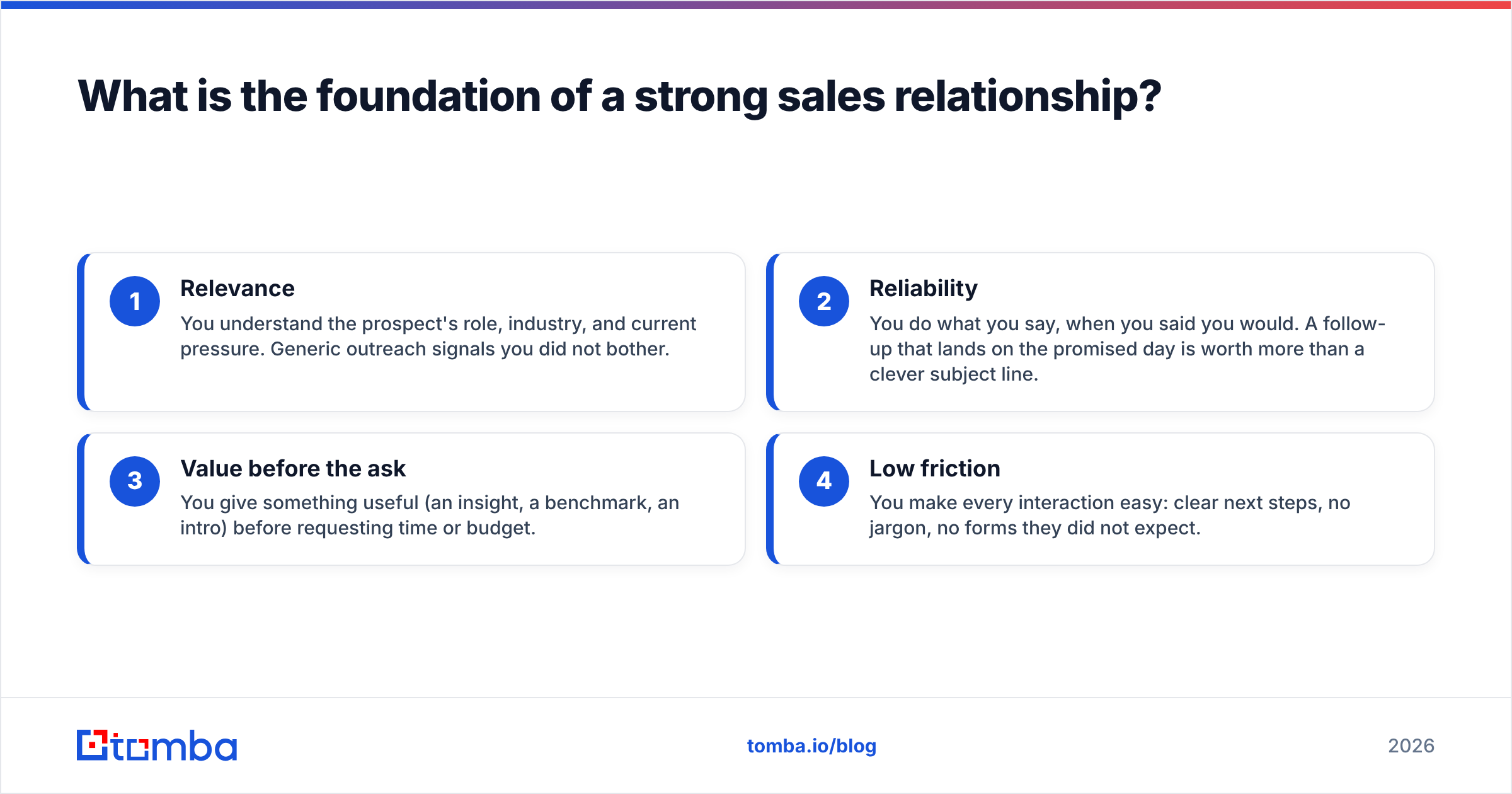
Trust, and trust breaks down into four things you can actually control:
- Relevance — You understand the prospect's role, industry, and current pressure. Generic outreach signals you did not bother.
- Reliability — You do what you say, when you said you would. A follow-up that lands on the promised day is worth more than a clever subject line.
- Value before the ask — You give something useful (an insight, a benchmark, an intro) before requesting time or budget.
- Low friction — You make every interaction easy: clear next steps, no jargon, no forms they did not expect.
Notice none of these are about charisma. They are habits. A quiet, organized rep who delivers on all four will out-earn a charming one who delivers on none.
The prerequisite under all four is accurate contact data. Relevance is impossible if you are guessing the email format; reliability collapses if half your follow-ups bounce. This is where most "relationship" advice quietly fails — it assumes you already reached a real human. Start by sourcing verified contacts with an email finder and validating them through an email verifier so your first impression is not a hard bounce.
How do you actually build relationships in sales, step by step?#
Treat it as a four-stage loop you run per account, not a one-off email.
Stage 1 — Research the human, not just the company. Spend ten minutes before any outreach. What did they post on LinkedIn? What does their company's recent news suggest about their priorities? Pull their role-level data and direct line — a phone finder and data enrichment turn a name into a real, reachable person with context.
Stage 2 — Open with relevance, not a pitch. Your first touch should prove you did the homework and offer one specific, useful observation. No demo request in message one.
Stage 3 — Deliver value on a cadence. Space out 5–8 touches across email, phone, and LinkedIn over a few weeks. Each touch carries something — a relevant case study, a benchmark, a question that makes them think. Persistence without value is harassment; persistence with value is service.
Stage 4 — Earn the meeting, then keep the promise. When they agree to talk, your reliability is on trial. Show up prepared, send the recap you promised, and hit every committed date. This is where most relationships are won or lost.
Then you loop: every interaction generates new research that feeds the next touch. Strong relationships compound because each cycle makes you more relevant.
Relationship selling vs. transactional selling: what's the difference?#
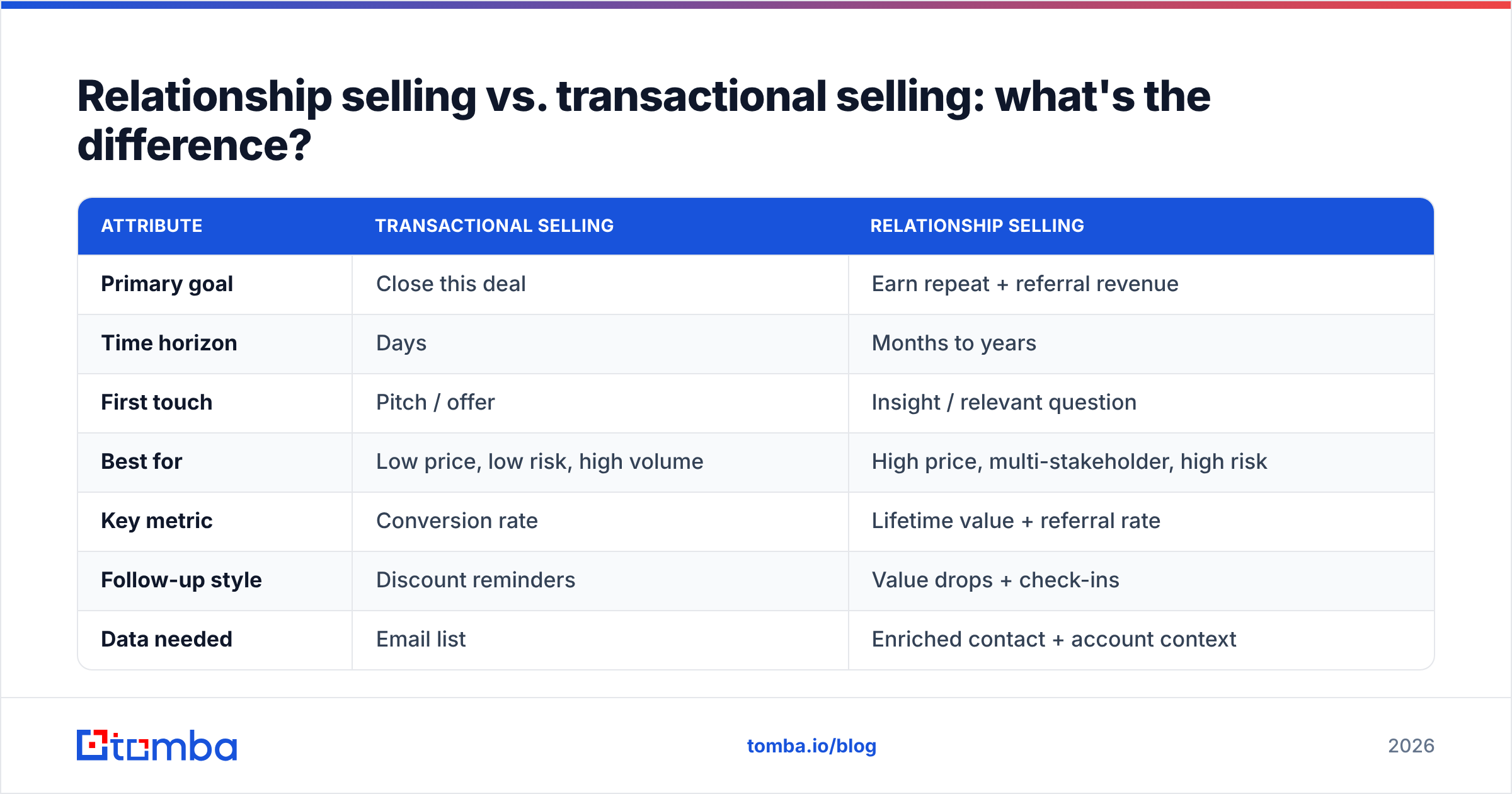
The two are not opposites you choose between — they sit on a spectrum, and your deal size and cycle length tell you where to operate. Here is how they compare on the attributes that matter.
| Attribute | Transactional selling | Relationship selling |
|---|---|---|
| Primary goal | Close this deal | Earn repeat + referral revenue |
| Time horizon | Days | Months to years |
| First touch | Pitch / offer | Insight / relevant question |
| Best for | Low price, low risk, high volume | High price, multi-stakeholder, high risk |
| Key metric | Conversion rate | Lifetime value + referral rate |
| Follow-up style | Discount reminders | Value drops + check-ins |
| Data needed | Email list | Enriched contact + account context |
| Failure mode | Burned lists, spam flags | Slow ramp if no process |
If you sell a $49/month tool, transactional motion is fine. If you sell a $40,000 platform to a buying committee of six, relationship selling is the only thing that works — and the data demands go up accordingly. You need the right contact at each stakeholder, which is why a domain search across the whole account beats hunting one email at a time.
Which tools and channels support relationship-building?#
The channel mix matters less than consistency across it. The point of tooling is to remove friction so you spend your energy on the human part, not on data entry or guessing addresses.
- Email — Still the workhorse for value drops and recaps. Keep deliverability clean; a relationship dies fast if your messages land in spam. Mind your sender reputation and warm your domain before volume ramps.
- Phone — Underused and therefore powerful. A well-timed call after a value email cuts through. Reach the direct line, not the switchboard.
- LinkedIn — Best for low-pressure, ongoing presence: comment, share, react. Social selling keeps you visible between formal touches.
- CRM — The memory of the relationship. Log every commitment so reliability is systematic, not dependent on what you happen to recall.
The thread connecting all of these is accurate, enriched contact data. A wrong number or stale email does not just waste a touch — it actively damages trust when the prospect notices you got their details wrong.
How do you scale relationships without losing the personal touch?#
You template the structure, never the substance. This is the line most teams cross at exactly the wrong moment.
The right way to scale: build reusable frameworks — a research checklist, a value-drop library, a cadence template — and fill them with specifics per prospect. The wrong way: copy-paste the same paragraph and swap {{first_name}}. Buyers spot the second instantly, and it costs you the trust you were trying to build.
Practically, that means:
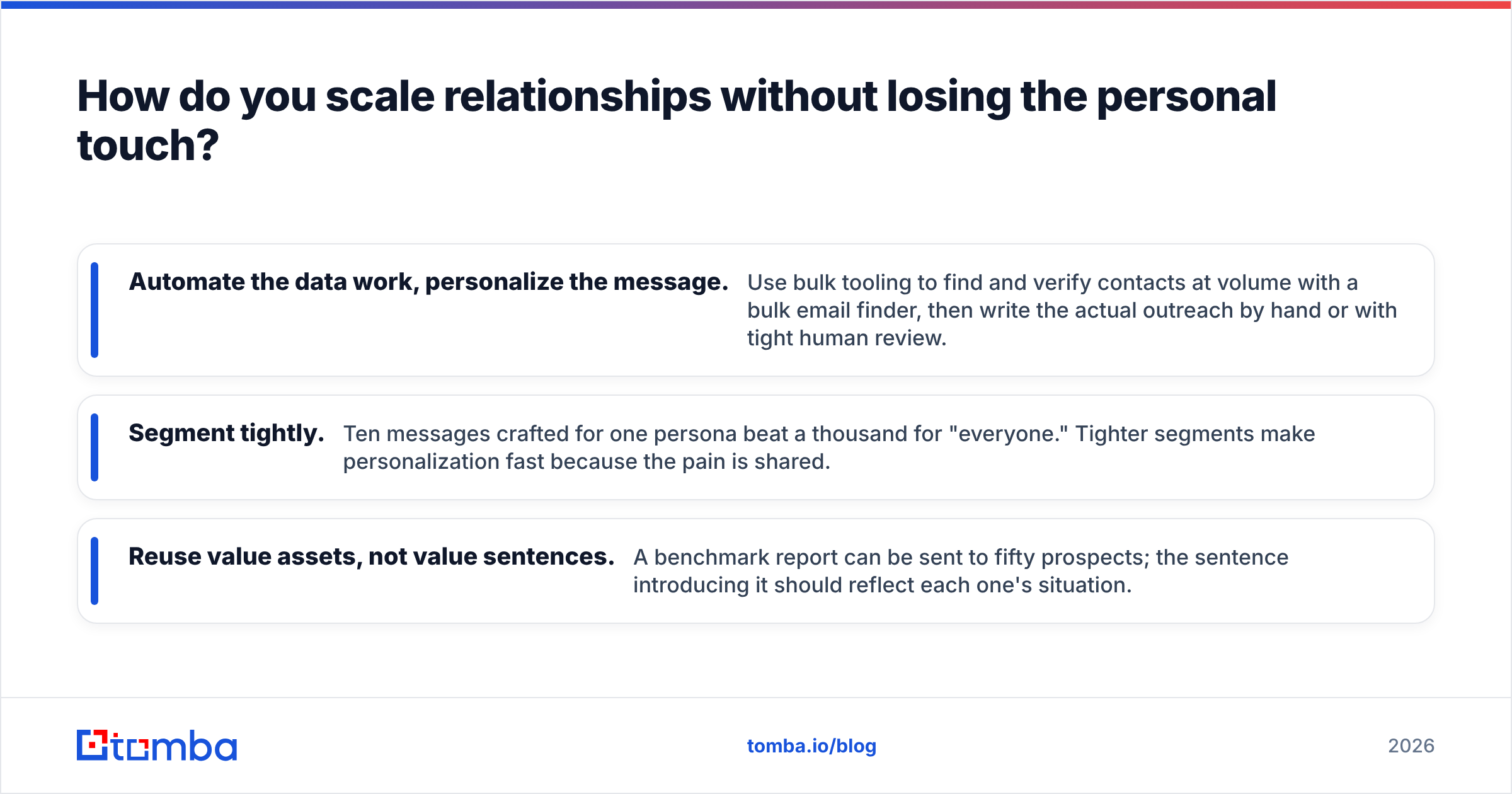
- Automate the data work, personalize the message. Use bulk tooling to find and verify contacts at volume with a bulk email finder, then write the actual outreach by hand or with tight human review.
- Segment tightly. Ten messages crafted for one persona beat a thousand for "everyone." Tighter segments make personalization fast because the pain is shared.
- Reuse value assets, not value sentences. A benchmark report can be sent to fifty prospects; the sentence introducing it should reflect each one's situation.
Done right, you can run dozens of genuine relationships at once. The automation handles plumbing — finding, verifying, enriching, logging — while you handle judgment. For ops-heavy teams, the Tomba API and integrations push verified data straight into your CRM so reps never touch a spreadsheet.
How do you measure whether your relationships are working?#
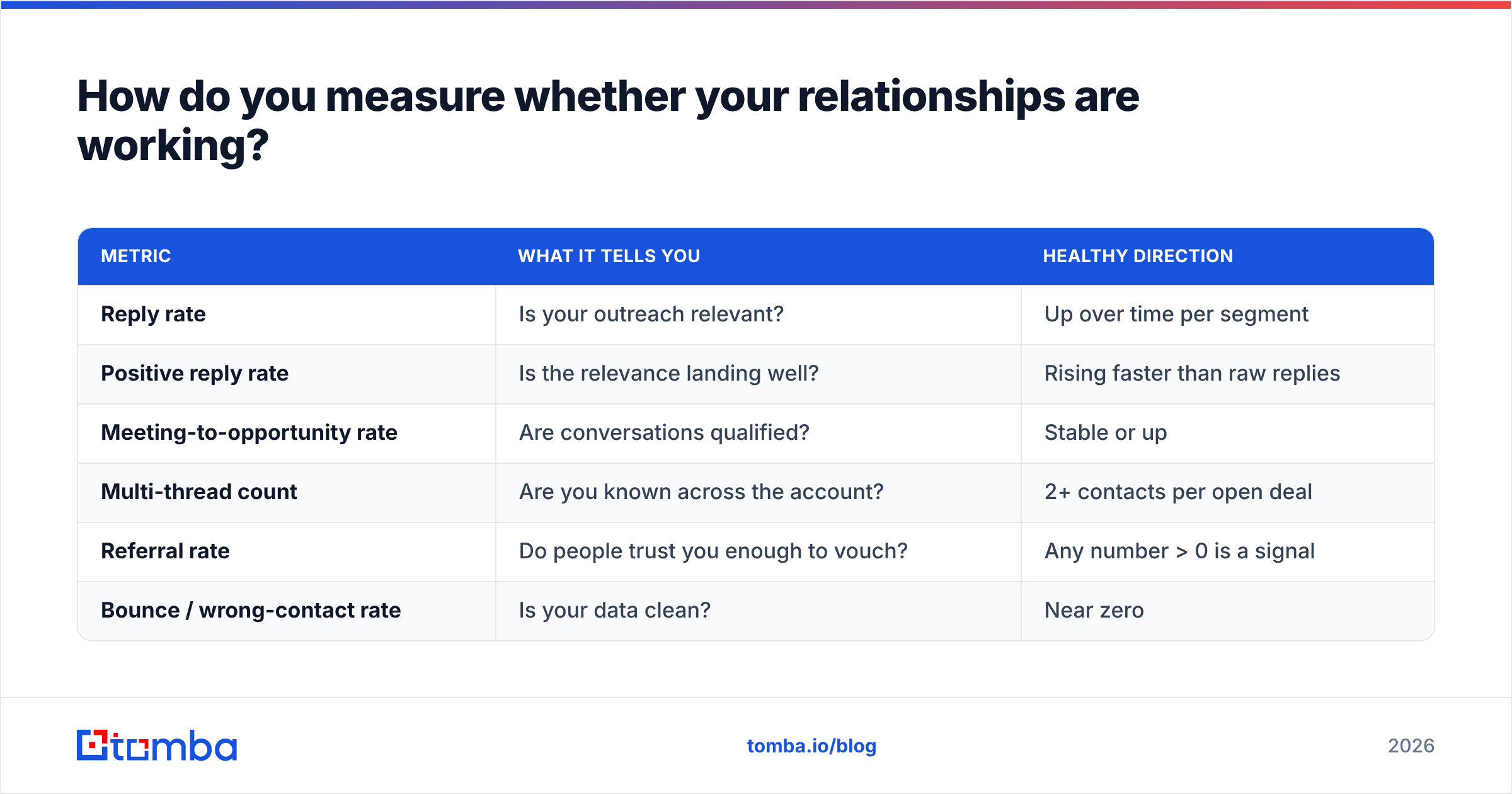
Stop waiting for closed revenue to tell you — by then it is too late to adjust. Track leading indicators that move weeks before the deal does:
| Metric | What it tells you | Healthy direction |
|---|---|---|
| Reply rate | Is your outreach relevant? | Up over time per segment |
| Positive reply rate | Is the relevance landing well? | Rising faster than raw replies |
| Meeting-to-opportunity rate | Are conversations qualified? | Stable or up |
| Multi-thread count | Are you known across the account? | 2+ contacts per open deal |
| Referral rate | Do people trust you enough to vouch? | Any number > 0 is a signal |
| Bounce / wrong-contact rate | Is your data clean? | Near zero |
That last row is the canary. A creeping bounce rate means your data is decaying, and decaying data quietly poisons every metric above it. Tie your relationship health back to your win rate and response rate so you can see which inputs actually move revenue. Tools like HubSpot make these pipeline metrics easy to chart once the underlying contact data is trustworthy.
What are the most common relationship-building mistakes?#
- Pitching before earning attention. Message one is for relevance, not your demo link.
- Inconsistent follow-up. Going dark after a good call kills more deals than rejection does.
- Faking personalization. A mail-merge token is not personalization; it is an insult with the prospect's name on it.
- Ignoring data quality. Building rapport on a bounced address or a dead number is building on sand.
- Measuring only closed revenue. You will learn too late. Watch the leading indicators.
Avoid those five and you are ahead of most of the field — because most reps still optimize for volume over trust.
Start with contacts you can actually trust#
Relationships in sales are won on relevance and reliability, and both depend on reaching the right human with the right details. Before you craft a single value-driven message, make sure the email is real, the number connects, and the context is current. Start free with the Tomba Email Finder — find and verify professional emails by domain, name, or company, then enrich each contact so your first touch proves you did the homework. The Free tier gives you 25 searches a month to test it; paid plans start at $49/month, and you can see full Tomba pricing before you commit. Clean data is the foundation every great sales relationship is built on — start there.
// get started
Find, verify and enrich your first contacts today
Start on the free plan with 25 searches a month, then scale when your team is ready.
Free plan · No credit card required · GDPR & CCPA
// about the author