Business 2 Business Examples: 12 B2B Models Explained (2026)
From SaaS platforms to industrial wholesalers, here are 12 concrete business 2 business examples — what they sell, how they price, and how they find buyers in 2026.
TL;DR
- "Business 2 business" (B2B) means one company sells to another company, not to individual consumers — and the buying cycle, pricing, and sales motion all change because of it.
- The clearest business 2 business examples fall into six buckets: SaaS, manufacturing/wholesale, distribution, professional services, marketplaces, and infrastructure providers.
- B2B deals are bigger, slower, and committee-driven: average B2B purchases now involve 6–10 stakeholders, so your go-to-market has to reach more than one person.
- The common thread across every example below is the same: you need accurate contact data to reach the right decision-makers before competitors do.
- Use the comparison table and the model-by-model breakdown to find the pattern closest to your own company, then copy its lead-gen playbook.
What does "business 2 business" actually mean?#
Business 2 business (B2B) is any transaction where the customer is an organization rather than a private individual. A company that sells project-management software to other companies is B2B. A company that sells running shoes to you on a Saturday is B2C (business-to-consumer).
Think of it like a restaurant supply chain. The farm sells crates of tomatoes to a distributor (B2B), the distributor sells to the restaurant (B2B), and the restaurant sells you a plate of pasta (B2C). Same tomato, three different business models — and only the last one is consumer-facing.
The distinction matters because the mechanics change completely. B2B buyers spend other people's money, justify purchases to a committee, and sign contracts that can run for years. According to Gartner, a typical B2B buying group for a complex solution involves six to ten decision-makers, each armed with their own research. That single fact reshapes everything: your pricing, your sales cycle, and how you generate leads.
What are the main types of business 2 business examples?#
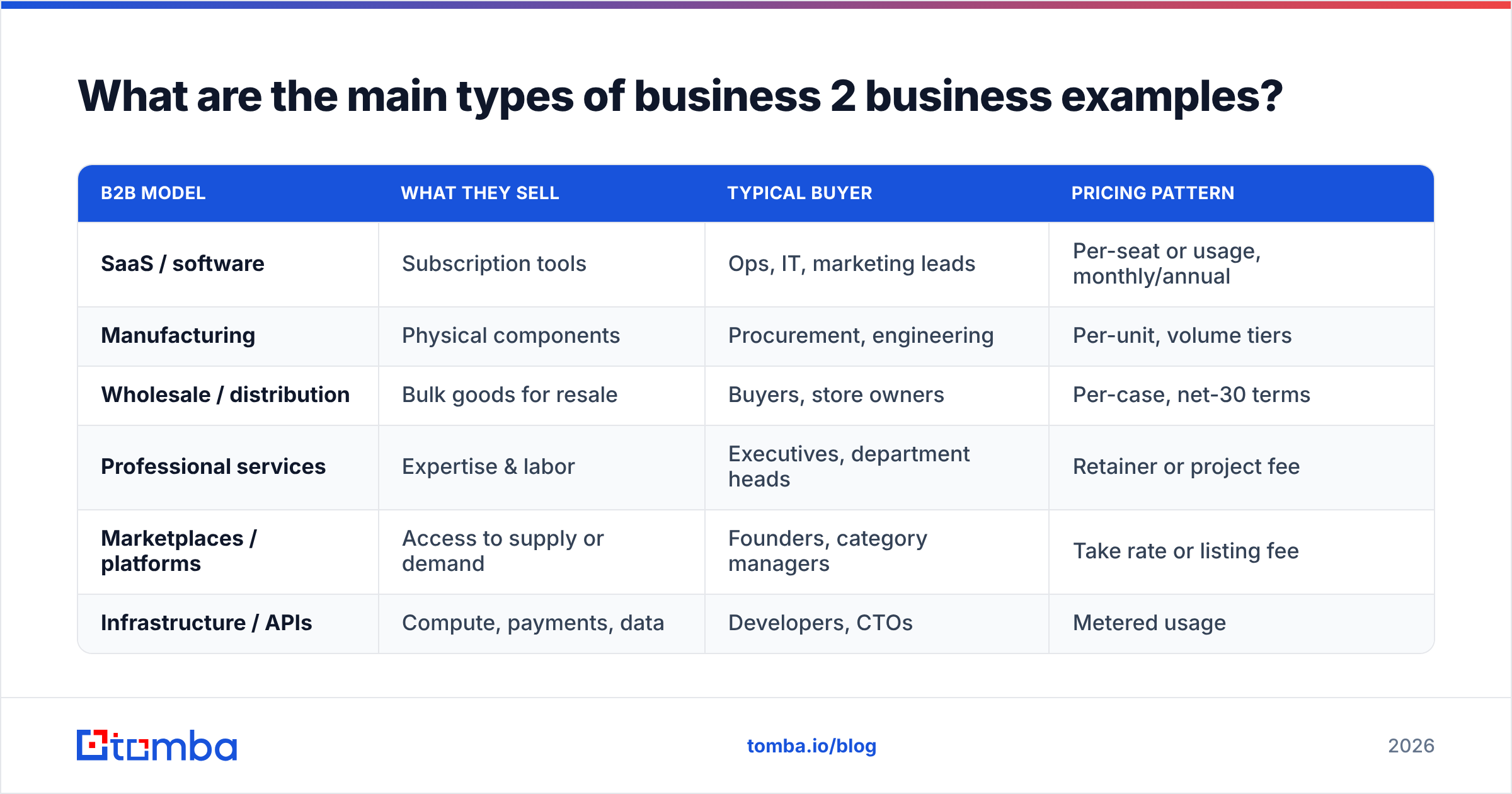
Before the individual examples, it helps to see the categories side by side. Most real-world B2B companies are a blend of two or three of these, but almost every one has a dominant model.
| B2B model | What they sell | Typical buyer | Pricing pattern |
|---|---|---|---|
| SaaS / software | Subscription tools | Ops, IT, marketing leads | Per-seat or usage, monthly/annual |
| Manufacturing | Physical components | Procurement, engineering | Per-unit, volume tiers |
| Wholesale / distribution | Bulk goods for resale | Buyers, store owners | Per-case, net-30 terms |
| Professional services | Expertise & labor | Executives, department heads | Retainer or project fee |
| Marketplaces / platforms | Access to supply or demand | Founders, category managers | Take rate or listing fee |
| Infrastructure / APIs | Compute, payments, data | Developers, CTOs | Metered usage |
Each row is a different revenue engine, but they share one dependency: reaching the right person inside the buying organization. Get that wrong and even a great product stalls. That is exactly where a B2B database and clean contact data earn their keep.
Business 2 business examples: SaaS and software#
This is the most visible category in 2026, and the easiest to picture.
- Salesforce — sells CRM and a sprawling cloud platform to sales, service, and marketing teams. It pioneered the per-seat subscription model that most of SaaS now copies. See their own breakdown of B2B for how they frame the category.
- Slack — sells team messaging by the seat. Classic land-and-expand: one team adopts it, then it spreads across the company until procurement signs an enterprise deal.
- HubSpot — sells marketing, sales, and service software to small and mid-market businesses, with a generous free tier that converts into paid plans. Their marketing statistics library is itself a B2B lead magnet worth studying.
- Datadog — sells observability tooling to engineering teams, priced by hosts and data volume. A usage-based model that grows automatically as the customer grows.
The SaaS playbook is consistent: low-friction entry, expansion revenue, and a sales motion that targets a champion inside the account. To run that motion you need to find those champions — which is why SaaS teams lean hard on an email finder to turn a company name into a real, reachable contact.
Business 2 business examples: manufacturing and wholesale#
Software gets the headlines, but the largest B2B dollar volume still moves through physical goods.
- Intel — sells processors to device makers like Dell and HP, not to you directly. The chip in your laptop arrived through a pure B2B relationship measured in millions of units.
- Alibaba — connects manufacturers (mostly in Asia) with bulk buyers worldwide. It is effectively a B2B wholesale marketplace operating at planetary scale.
- Grainger — sells industrial maintenance, repair, and operations (MRO) supplies — everything from safety gloves to motors — to facilities and procurement teams across North America.
- A regional food distributor — buys from farms and packagers, then sells cases to restaurants and grocers on net-30 terms. Unglamorous, high-volume, deeply relationship-driven.
The manufacturing and wholesale motion runs on procurement relationships, volume pricing, and long contract cycles. Sales reps here win by knowing exactly who handles purchasing at each account — and reaching them by phone as often as by email. Tools like a phone finder matter as much as email when the buyer expects a call.
Business 2 business examples: services, marketplaces, and infrastructure#
The remaining categories round out the picture, and several of them quietly power the companies above.
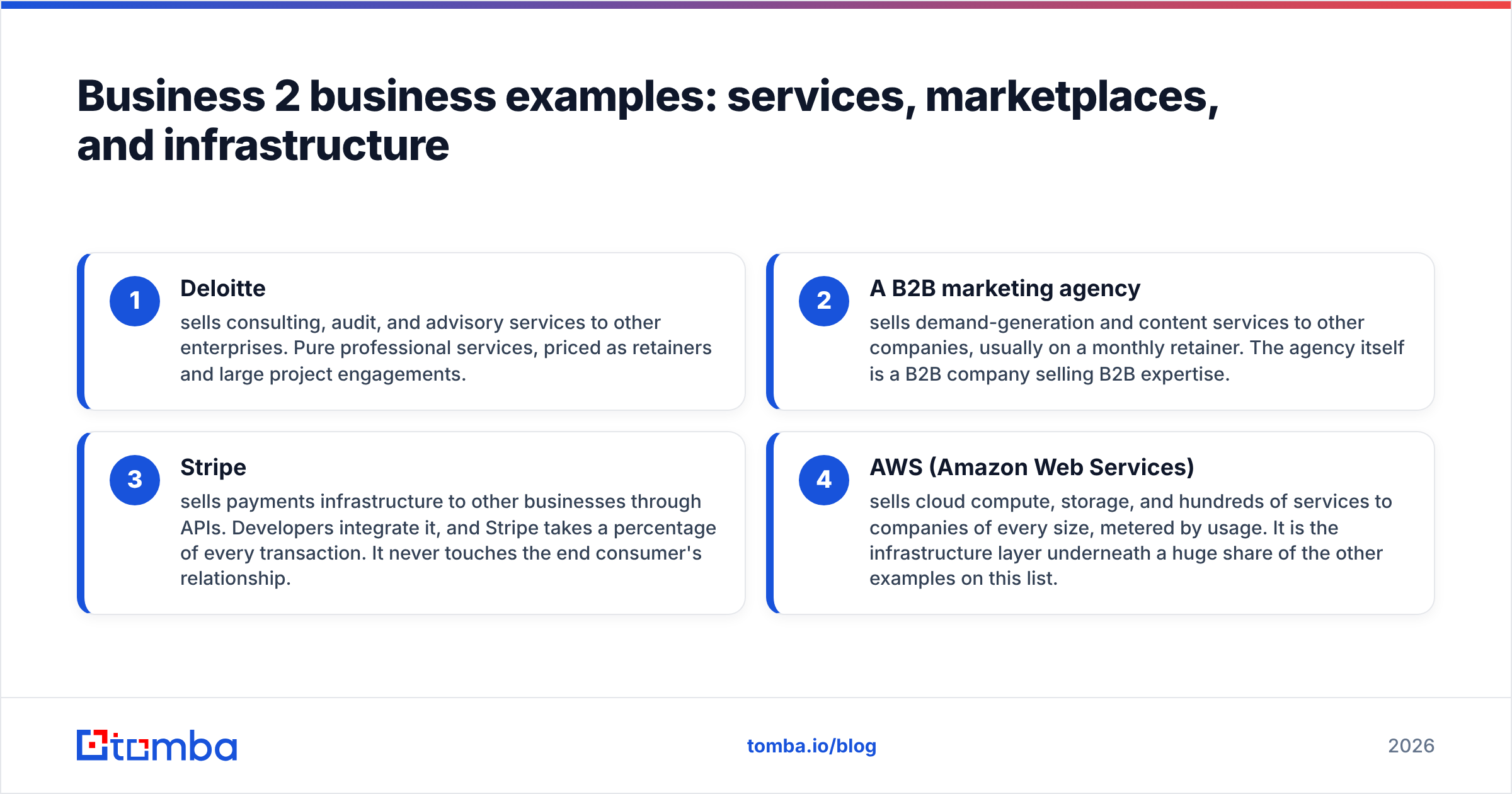
- Deloitte — sells consulting, audit, and advisory services to other enterprises. Pure professional services, priced as retainers and large project engagements.
- A B2B marketing agency — sells demand-generation and content services to other companies, usually on a monthly retainer. The agency itself is a B2B company selling B2B expertise.
- Stripe — sells payments infrastructure to other businesses through APIs. Developers integrate it, and Stripe takes a percentage of every transaction. It never touches the end consumer's relationship.
- AWS (Amazon Web Services) — sells cloud compute, storage, and hundreds of services to companies of every size, metered by usage. It is the infrastructure layer underneath a huge share of the other examples on this list.
Notice the pattern: services and infrastructure companies sell to technical and executive buyers, which means the contact you need is often a CTO, a VP of engineering, or a head of operations — people who are hard to reach through generic channels. Enriching a thin lead list with titles, seniority, and verified emails (see how data enrichment works) is what separates a targeted outreach campaign from spray-and-pray.
How is B2B different from B2C in practice?#
The examples above share a DNA that sets them apart from consumer business. Here is the practical contrast, the part that actually changes how you sell.
- Deal size and cycle. A consumer buys a $120 pair of shoes in two minutes. A B2B buyer signs a $120,000 annual contract over three months, with legal and finance reviews along the way.
- Number of stakeholders. B2C is one person deciding. B2B is a committee — champion, economic buyer, technical evaluator, and a procurement gatekeeper who can veto everyone.
- Emotion vs. ROI. Consumer purchases lean on desire and brand. B2B purchases must be defensible: someone has to explain the spend to a boss with a spreadsheet.
- Relationship length. A B2C sale often ends at checkout. A B2B sale starts a multi-year relationship with renewals, upsells, and support obligations.
- Data dependency. Because you are selling to specific roles inside specific companies, B2B lives or dies on the quality of its contact data. B2C can advertise to a broad audience; B2B has to find named individuals.
That last point is the bridge between "interesting examples" and "what do I do Monday morning." Every model in this article needs a way to identify and reach the right person.
What do all these business 2 business examples have in common?#
They all start the same way: with a list of target companies and the problem of turning that list into conversations with real humans.
A SaaS startup, an industrial distributor, and a consulting firm look nothing alike on the surface. But each one runs a version of this loop:
- Define the ideal customer — industry, size, region, tech stack.
- Find the companies that match it.
- Find the right people inside those companies — by role and seniority.
- Get verified contact details — email and phone that actually connect.
- Reach out, qualify, and close through a multi-touch sequence.
Steps 3 and 4 are where most pipelines leak. You can have a perfect ICP and still fail if you are emailing info@ addresses or guessing at name formats. Using a domain search to pull every known address pattern at a target company, then running each candidate through an email verifier before you send, is the difference between a 2% bounce rate and a blocked sending domain.
If you want to benchmark your own outbound numbers, G2's B2B software categories are a useful reference point for what tools companies in each model actually buy.
Which B2B model should you copy?#
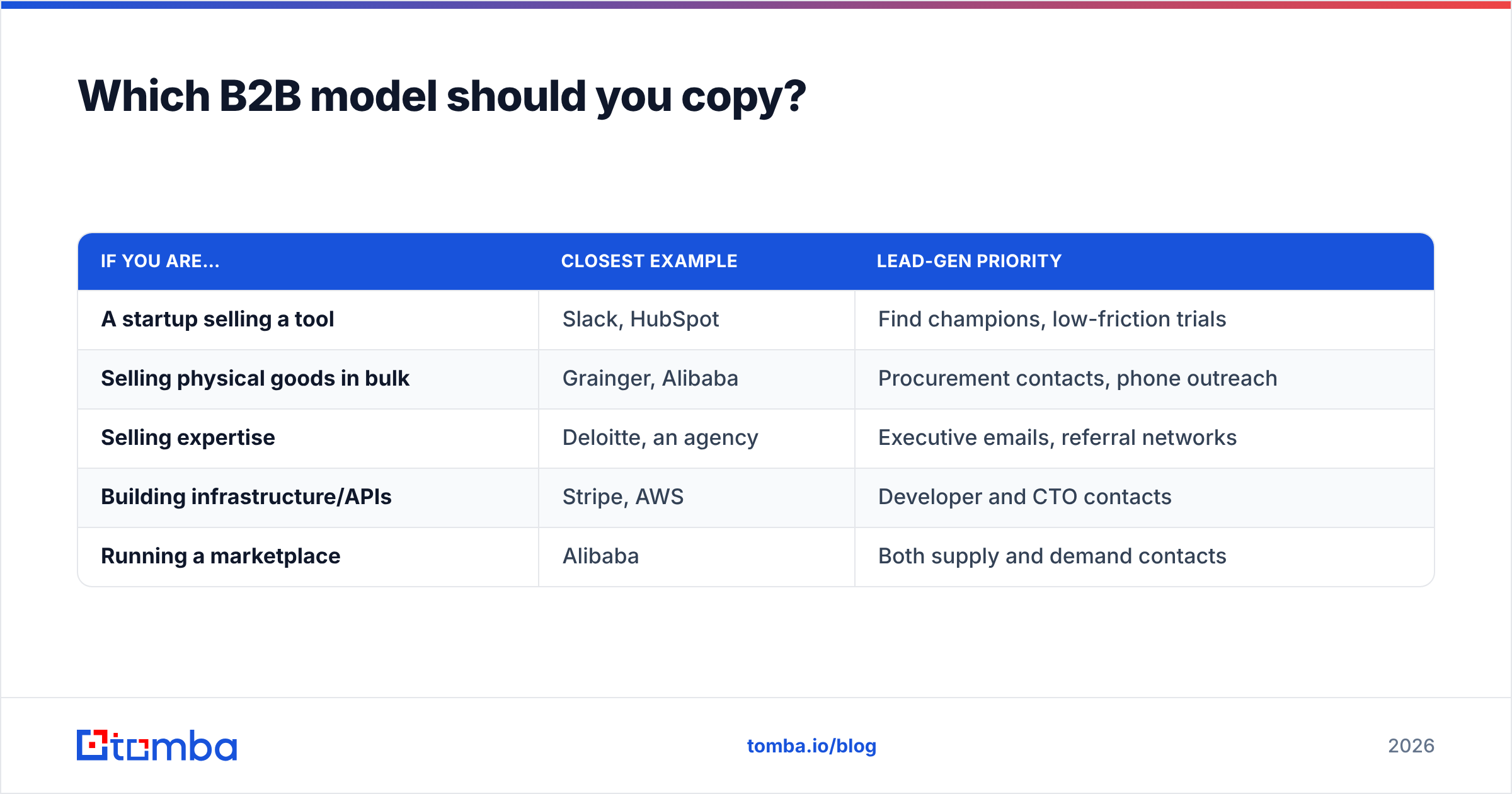
Match your situation to the dominant pattern, then borrow its lead-gen motion.
| If you are… | Closest example | Lead-gen priority |
|---|---|---|
| A startup selling a tool | Slack, HubSpot | Find champions, low-friction trials |
| Selling physical goods in bulk | Grainger, Alibaba | Procurement contacts, phone outreach |
| Selling expertise | Deloitte, an agency | Executive emails, referral networks |
| Building infrastructure/APIs | Stripe, AWS | Developer and CTO contacts |
| Running a marketplace | Alibaba | Both supply and demand contacts |
Whatever row you land on, the unlock is the same: accurate, verified contact data at the top of the funnel. You cannot run a committee-driven, multi-stakeholder B2B sale if you can only reach one generic inbox.
Where to start#
Pick the example that mirrors your business, copy its model, and then fix the part every B2B company struggles with — reaching the right people. That is where Tomba's Email Finder fits. Drop in a company domain or a prospect's name and company, and you get verified professional emails ready for outreach, with the email verification baked in so your sender reputation stays clean.
Tomba's Free plan gives you 25 searches a month to test it on your own target list; paid plans start at $49/mo (Starter) and scale to Growth at $99/mo and Pro at $249/mo as your pipeline grows. Start with the model, finish with the data — that is how every business 2 business example on this list turns a target account into a closed deal.
// get started
Find, verify and enrich your first contacts today
Start on the free plan with 25 searches a month, then scale when your team is ready.
Free plan · No credit card required · GDPR & CCPA
// about the author