Business Buying Behavior in 2026: A B2B Seller's Guide
Business buying behavior has shifted toward larger committees, self-serve research, and risk-averse consensus. Here's how B2B sellers adapt their process in 2026.
TL;DR
- Business buying behavior describes how organizations research, evaluate, and approve purchases — and in 2026 it looks nothing like a single decision-maker signing a PO.
- The average B2B deal now involves a buying group of 6–11 stakeholders, most of whom do their research anonymously before they ever talk to a rep.
- Buyers are risk-averse and consensus-driven; "do nothing" is your biggest competitor, not the rival vendor.
- Sellers who map the committee, time their outreach to real buying triggers, and reach the right contacts win more and discount less.
- Accurate contact data is the foundation: you can't influence a buying group you can't reach.
What is business buying behavior?#
Business buying behavior is the set of processes, motivations, and decision patterns that organizations follow when they purchase products or services. Think of it like a household deciding to buy a car — except instead of two spouses negotiating, you have a finance lead worried about budget, an end user who wants specific features, a security reviewer checking the warranty, and an executive who only cares about the outcome. Everyone has a veto, and nobody wants to be blamed if it goes wrong.
Technically, business buying behavior (also called organizational buying behavior) covers the full journey: how a need gets recognized, how options are researched, how vendors are shortlisted, how risk is evaluated, and how the final purchase is approved internally. It differs sharply from consumer buying because the stakes are higher, the cycle is longer, and the decision is rarely made by one person.
Understanding it matters because your entire sales process should mirror how your buyers actually buy — not how you wish they bought. When the two are misaligned, deals stall in "no decision" limbo, which is where most B2B pipeline goes to die.
How is B2B buying different from consumer buying?#
The short version: B2B purchases are collective, rational on the surface, emotional underneath, and slow. Consumer purchases are mostly individual, fast, and emotionally driven.
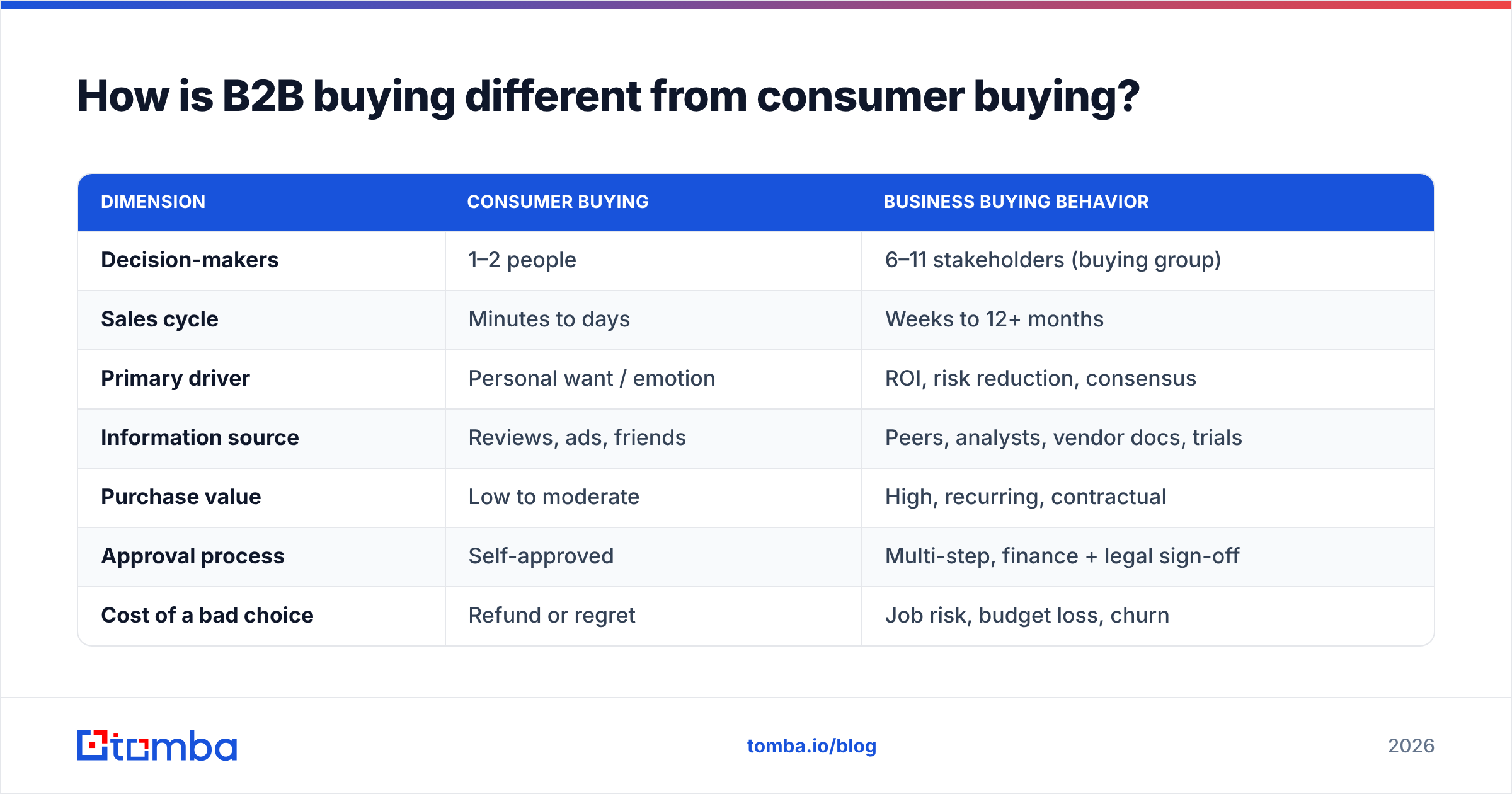
Here's a side-by-side breakdown of the core differences that should shape your strategy.
| Dimension | Consumer buying | Business buying behavior |
|---|---|---|
| Decision-makers | 1–2 people | 6–11 stakeholders (buying group) |
| Sales cycle | Minutes to days | Weeks to 12+ months |
| Primary driver | Personal want / emotion | ROI, risk reduction, consensus |
| Information source | Reviews, ads, friends | Peers, analysts, vendor docs, trials |
| Purchase value | Low to moderate | High, recurring, contractual |
| Approval process | Self-approved | Multi-step, finance + legal sign-off |
| Cost of a bad choice | Refund or regret | Job risk, budget loss, churn |
The most important row is the last one. In consumer buying, a bad call costs you money. In business buying, a bad call can cost someone their reputation or their job. That fear of being wrong is the single biggest force shaping modern buying behavior — and it explains why "we decided to hold off" beats your competitor more often than your competitor does.
Who is in the B2B buying group?#
The era of the lone decision-maker is over. Research from Gartner has repeatedly shown that a typical complex B2B purchase involves six to ten decision-makers, each armed with their own information and agenda. Map these roles and you stop selling to a title and start selling to a system.
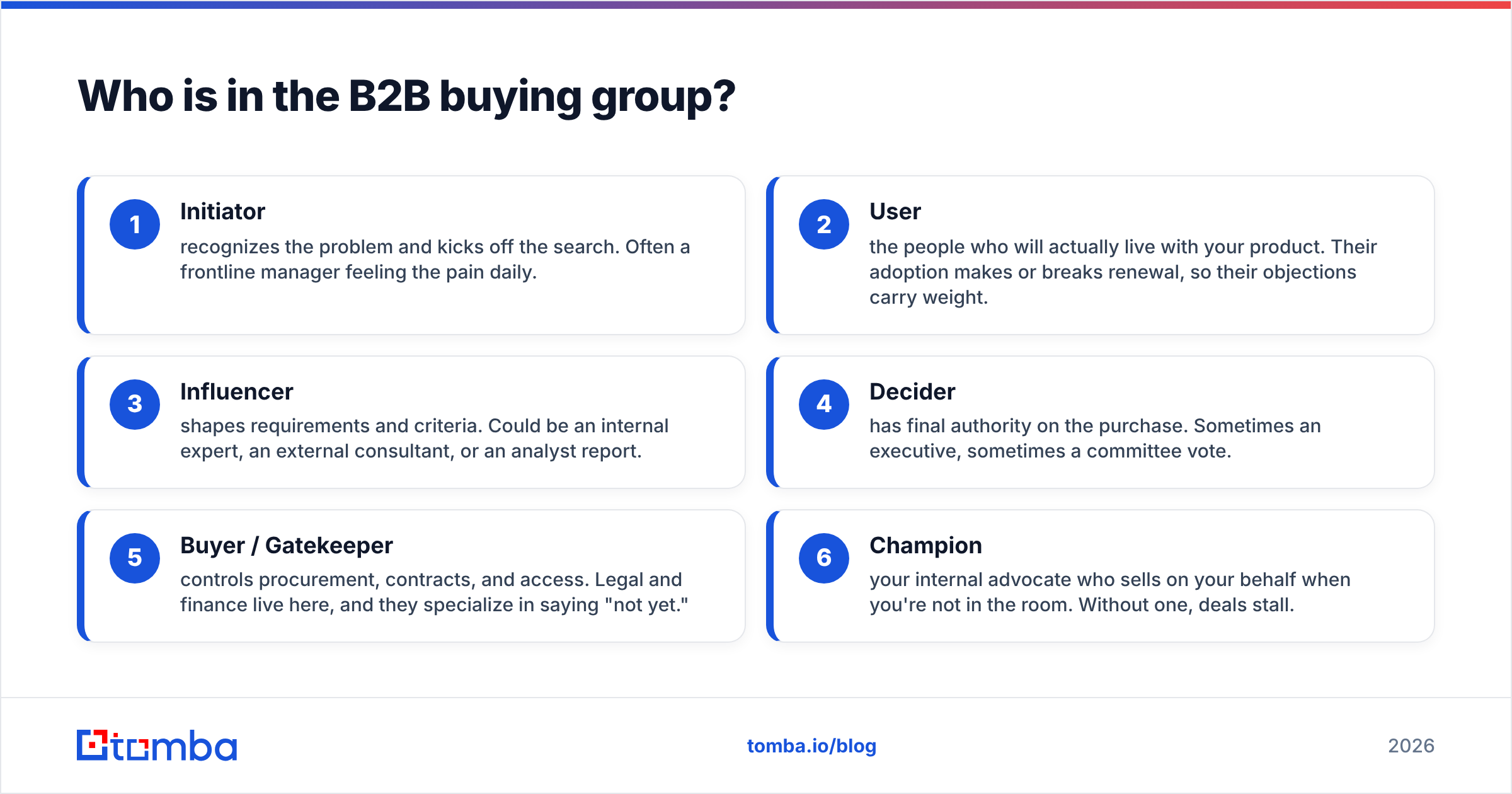
The classic buying-center roles, updated for 2026:
- Initiator — recognizes the problem and kicks off the search. Often a frontline manager feeling the pain daily.
- User — the people who will actually live with your product. Their adoption makes or breaks renewal, so their objections carry weight.
- Influencer — shapes requirements and criteria. Could be an internal expert, an external consultant, or an analyst report.
- Decider — has final authority on the purchase. Sometimes an executive, sometimes a committee vote.
- Buyer / Gatekeeper — controls procurement, contracts, and access. Legal and finance live here, and they specialize in saying "not yet."
- Champion — your internal advocate who sells on your behalf when you're not in the room. Without one, deals stall.
The practical takeaway: if you only have one contact inside an account, you are one reorg, one ignored email, or one job change away from losing the deal. Multi-threading — building relationships across several roles — is no longer optional. To do that, you need verified contact details for more than just the person who filled out your form, which is exactly where tools like a domain search earn their keep by surfacing the wider team behind a single inbound lead.
What are the stages of the business buying decision process?#
Most B2B purchases move through a recognizable sequence. Buyers don't always go in a straight line — they loop back, revisit, and stall — but the stages are predictable enough to plan around.
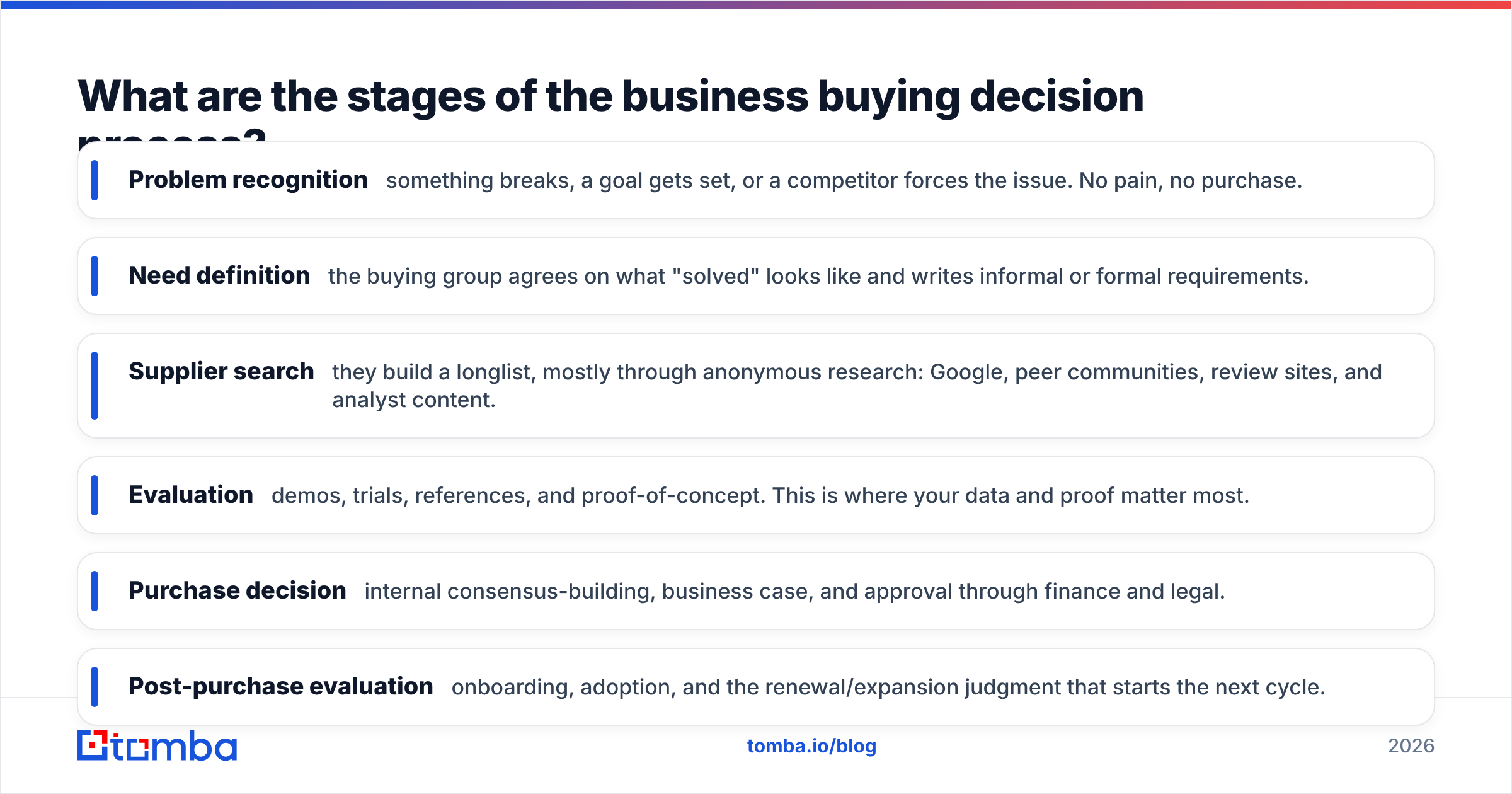
- Problem recognition — something breaks, a goal gets set, or a competitor forces the issue. No pain, no purchase.
- Need definition — the buying group agrees on what "solved" looks like and writes informal or formal requirements.
- Supplier search — they build a longlist, mostly through anonymous research: Google, peer communities, review sites, and analyst content.
- Evaluation — demos, trials, references, and proof-of-concept. This is where your data and proof matter most.
- Purchase decision — internal consensus-building, business case, and approval through finance and legal.
- Post-purchase evaluation — onboarding, adoption, and the renewal/expansion judgment that starts the next cycle.
The uncomfortable truth backed by years of buyer research: a large share of the buying journey now happens before a rep is involved. Forrester and others have documented that buyers complete much of their research independently. By the time someone fills out a "contact sales" form, they've often already shortlisted you against two or three competitors. Your content, your reviews on platforms like G2, and your reputation do the early selling for you.
What drives modern business buying behavior in 2026?#
Four forces dominate how companies buy right now.
Risk aversion. Budgets are scrutinized and buyers want certainty. They favor vendors who reduce perceived risk through guarantees, references, transparent pricing, and easy exit terms. The job of your sales process is partly to de-risk the decision for your champion.
Consensus and "buy-in tax." With more stakeholders comes more friction. Gartner's research on buyer "decision difficulty" shows that the hardest part of buying isn't choosing a vendor — it's getting internal agreement. Sellers who arm their champion with tools to build consensus (one-pagers, ROI calculators, mutual action plans) move faster.
Self-serve and digital-first research. Buyers want to learn on their own terms before talking to anyone. They expect documentation, transparent pricing, and free trials. Hiding your price behind a "request a quote" wall increasingly signals friction — one reason transparent options like Tomba's pricing tend to build trust faster than gated quotes.
Data and timing. The best-performing teams reach out when a real trigger fires — a funding round, a new hire in a relevant role, a tech-stack change, or expansion into a new market. Spray-and-pray outreach is dead. Timing your message to a genuine response rate signal beats volume every time.
How do you align your sales process to business buying behavior?#
The goal is simple to state and hard to execute: make your selling motion match your buyer's buying motion at every stage. Here's how that maps out.
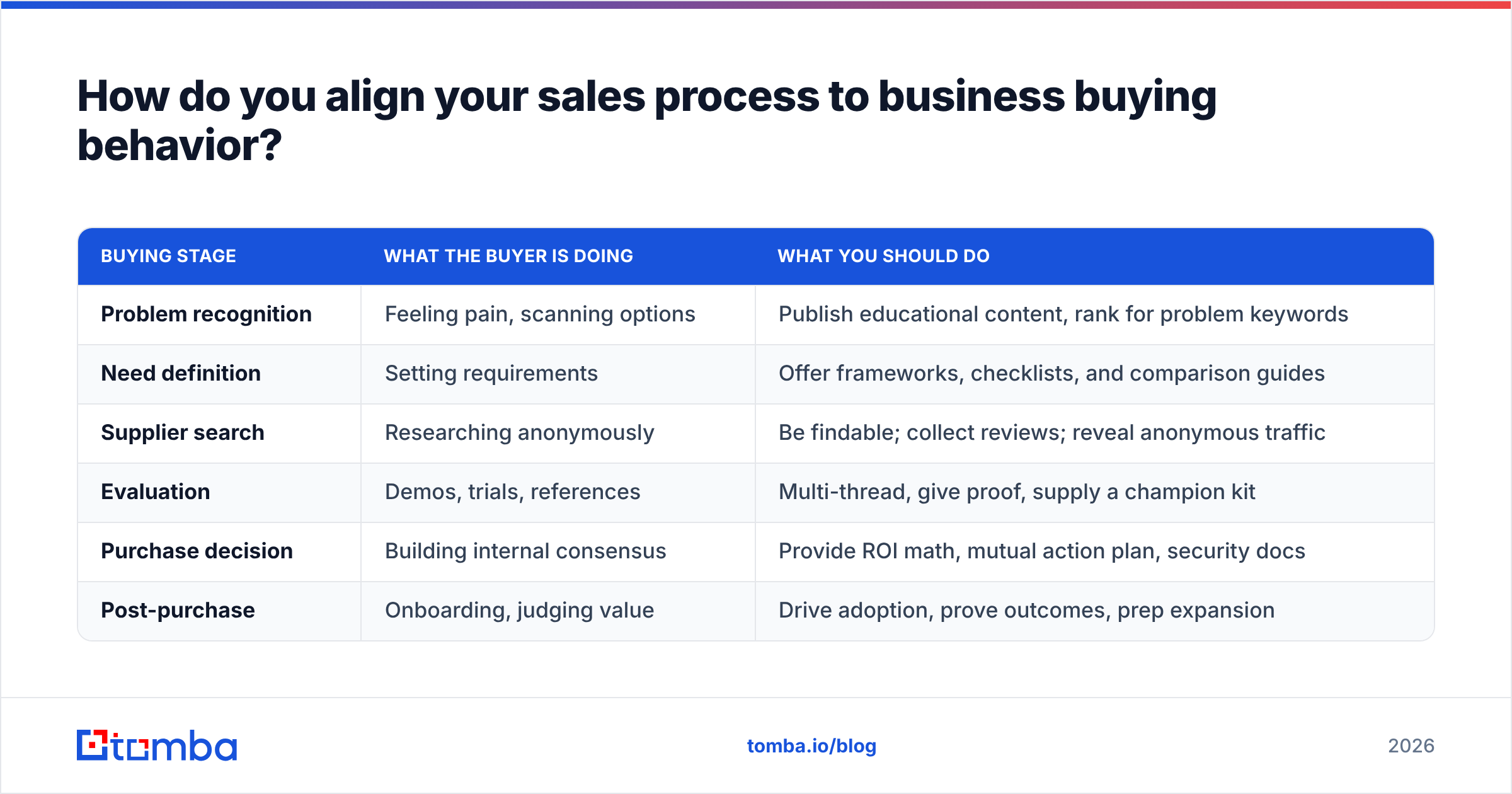
| Buying stage | What the buyer is doing | What you should do |
|---|---|---|
| Problem recognition | Feeling pain, scanning options | Publish educational content, rank for problem keywords |
| Need definition | Setting requirements | Offer frameworks, checklists, and comparison guides |
| Supplier search | Researching anonymously | Be findable; collect reviews; reveal anonymous traffic |
| Evaluation | Demos, trials, references | Multi-thread, give proof, supply a champion kit |
| Purchase decision | Building internal consensus | Provide ROI math, mutual action plan, security docs |
| Post-purchase | Onboarding, judging value | Drive adoption, prove outcomes, prep expansion |
A few moves separate the teams that win from the ones that stall:
Identify demand earlier. Much of your buying group is researching anonymously. Tools that handle website visitor reveal help you spot accounts showing intent before they fill out a form, so you can reach the buying group while you're still in the consideration set.
Multi-thread deliberately. Don't rely on one contact. Once you've identified an active account, build out the committee with verified contacts so your champion isn't your only line in. A reliable email finder lets you reach the user, the decider, and the finance gatekeeper without guessing email formats.
Verify before you send. Outreach to stale or invalid addresses tanks your sender reputation and wastes the window. Running contacts through an email verifier before a campaign protects your deliverability and keeps your bounce rate clean.
Sell the business case, not the feature list. Your champion has to defend this purchase internally. Give them the numbers, the risk mitigation, and the peer proof they need to win the room when you're not there.
What mistakes do sellers make about business buying behavior?#
Most lost deals trace back to a handful of avoidable misreads.
- Single-threading. Betting the deal on one relationship. When that person goes quiet, goes on leave, or leaves the company, the deal evaporates.
- Ignoring the "no decision" risk. Treating the competitor as the only threat. In reality, inertia and internal disagreement kill more deals than rivals do.
- Pitching too early. Hitting a buyer with a demo before they've defined their need, when they wanted education and got a sales pitch instead.
- Bad timing. Reaching out with no trigger, no relevance, and no reason for the buyer to care right now.
- Dirty data. Working from outdated lists, guessing emails, and burning deliverability on contacts who left the company a year ago.
Notice how many of these come back to information. You can't multi-thread without contacts. You can't time outreach without signals. You can't protect deliverability without verification. Modern business buying behavior rewards the seller who shows up to the right person, at the right account, at the right moment — with a message that fits where the buyer actually is.
How will business buying behavior keep evolving?#
Three shifts are worth watching as 2026 progresses.
First, buying groups are getting larger and more cautious, not smaller. As more functions (security, data privacy, procurement) get a formal say, the consensus tax rises. Sellers who simplify the decision will keep winning.
Second, AI is entering the buyer's research loop. Buyers increasingly use AI assistants to summarize options, compare vendors, and draft requirements. That raises the bar on having clear, accurate, machine-readable information about your product everywhere it can be found.
Third, data quality becomes a competitive moat. As outbound gets noisier and inboxes get more protected, the teams with accurate, enriched, verified contact data will reach buyers the rest can't. Layering data enrichment onto your CRM keeps your view of each account current as people change roles and companies reorganize.
The constant through all of it: buyers buy from sellers who understand how they buy. Map the committee, respect the stages, time your outreach, and lead with proof.
Reach the whole buying group with Tomba#
Understanding business buying behavior only pays off if you can act on it — and acting on it means reaching every stakeholder in the buying group, not just the one who replied. Tomba's Email Finder helps you find and verify professional email addresses for the user, the decider, the gatekeeper, and the champion across any target account, so you can multi-thread with confidence instead of betting your deal on a single contact. Start free with 25 searches a month, then scale on the Starter plan at $49/mo as your pipeline grows. Build your list on how companies actually buy — and stop losing deals to silence. Find your buying group with Tomba Email Finder today.
Ready to find emails that actually work?
Join 150,000+ professionals who stopped guessing and started sending. Free credits on signup — no credit card required.
Get the Tomba newsletter
Practical outbound tactics and product updates — once every two weeks.
About the author