Business Development in 2026: A Practical Growth Playbook
Business development is more than closing deals. Here's how to build a 2026 BD engine that finds the right accounts, opens doors, and turns relationships into revenue.
TL;DR
- Business development (BD) is the long-game function that builds the relationships, partnerships, and market access that sales later converts into revenue.
- BD is not the same as sales: BD opens markets and creates opportunities; sales closes the specific deals inside them.
- A modern BD engine runs on five repeatable stages — research, targeting, outreach, qualification, and handoff — each measurable.
- Clean contact data is the bottleneck. Most BD pipelines stall on bad emails, missing decision-makers, and stale account records.
- Pair a tight ICP with verified contact data and you can cut wasted outreach dramatically while raising reply and meeting rates.
Business development gets talked about like a vibe — "go build relationships" — when it is actually a process you can engineer. This guide breaks down what BD really is in 2026, how it differs from sales and marketing, the exact stages of a working BD motion, the tooling that powers it, and the metrics that tell you whether it is working before the revenue shows up.
What is business development, really?#
Business development is the work of creating long-term value through new markets, partnerships, and customer relationships — before those relationships are ready to buy. Think of BD as the team that builds the roads; sales is the team that drives the trucks. Without roads, even great trucks go nowhere.
Technically, BD sits upstream of revenue. A BD professional identifies which markets, segments, or partners are worth pursuing, makes first contact, validates fit, and creates qualified opportunities that someone else — an account executive, a partnerships lead, a founder — converts. In a startup, the founder usually is the BD function. In a scale-up, BD becomes a dedicated role feeding the pipeline that account executives close.
The confusion is understandable because the boundaries blur by company size. At a five-person company, one person prospects, demos, negotiates, and signs. At a 500-person company those are four different teams. The function is the same; only the division of labor changes.
A few responsibilities define the role no matter the company size:
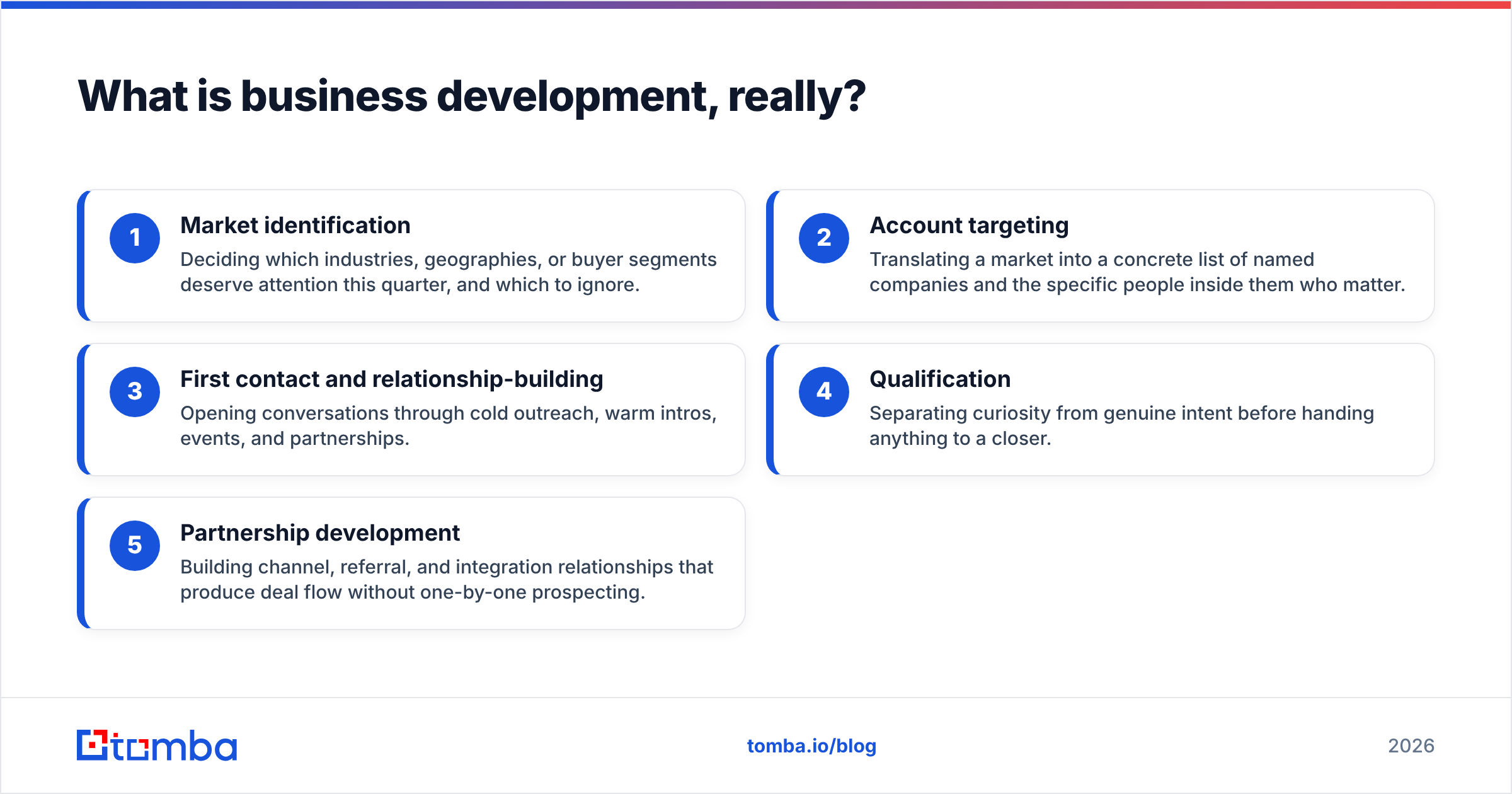
- Market identification — Deciding which industries, geographies, or buyer segments deserve attention this quarter, and which to ignore.
- Account targeting — Translating a market into a concrete list of named companies and the specific people inside them who matter.
- First contact and relationship-building — Opening conversations through cold outreach, warm intros, events, and partnerships.
- Qualification — Separating curiosity from genuine intent before handing anything to a closer.
- Partnership development — Building channel, referral, and integration relationships that produce deal flow without one-by-one prospecting.
That last point — partnerships — is what separates BD from a glorified SDR seat. A good BD hire does not just send more emails; they create structural advantages (a reseller agreement, a co-marketing deal, an integration listing) that generate pipeline on their own.
How is business development different from sales and marketing?#
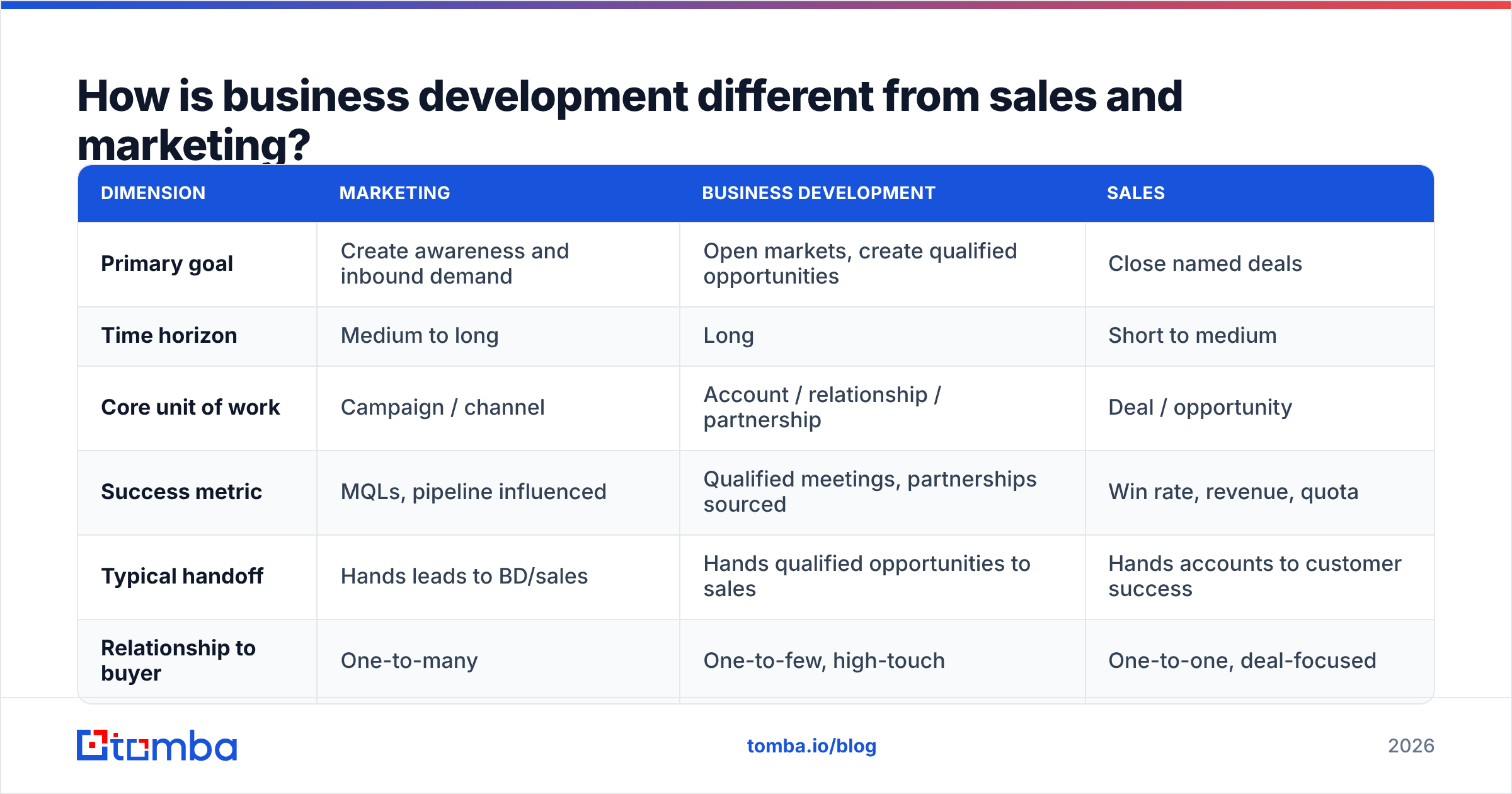
Short answer: timing and ownership. Marketing creates demand at scale, BD creates specific opportunities, and sales converts named opportunities into signed revenue. They overlap, but their goals and metrics are distinct.
| Dimension | Marketing | Business Development | Sales |
|---|---|---|---|
| Primary goal | Create awareness and inbound demand | Open markets, create qualified opportunities | Close named deals |
| Time horizon | Medium to long | Long | Short to medium |
| Core unit of work | Campaign / channel | Account / relationship / partnership | Deal / opportunity |
| Success metric | MQLs, pipeline influenced | Qualified meetings, partnerships sourced | Win rate, revenue, quota |
| Typical handoff | Hands leads to BD/sales | Hands qualified opportunities to sales | Hands accounts to customer success |
| Relationship to buyer | One-to-many | One-to-few, high-touch | One-to-one, deal-focused |
In practice, BD is the connective tissue. When marketing's inbound dries up, BD's outbound and partnership motions keep pipeline alive. When sales needs more at-bats, BD widens the top of the funnel with the right accounts rather than just more of them. The teams share definitions — a marketing qualified lead means the same thing across the org — but each owns a different slice of the journey.
Gartner's research on B2B buying consistently shows that buyers spend only a small fraction of their journey talking to any single vendor's sales team, which is exactly why BD matters: it earns a place in the consideration set long before a formal sales cycle starts. (Gartner)
What does a modern business development process look like?#
A working BD motion is five repeatable stages, each with an input, an output, and a number you can watch. Treat it like a manufacturing line, not an art form.
Stage 1 — Research and ICP definition. Before any outreach, define the ideal customer profile (ICP): firmographics (size, industry, geography), technographics (the stack they run), and trigger events (funding, hiring, leadership change). A sharp ICP is the single highest-leverage decision in BD because every later stage multiplies its quality or its waste.
Stage 2 — Account and contact targeting. Turn the ICP into a list. This is where most pipelines quietly break: you can have a perfect ICP and still fail because you can't reach the right person. You need the company, the specific decision-maker, and a verified way to contact them. A domain search across a target account surfaces who works there and which email patterns the company uses, so you target the VP of Operations rather than a generic info@ inbox.
Stage 3 — Multichannel outreach. Email remains the workhorse, supported by LinkedIn, phone, and warm intros. The mechanics matter less than the sequencing: a relevant first touch, value before the ask, and persistence without nagging. Deliverability is a prerequisite — even a perfect message fails if it never lands, which is why email deliverability is a BD concern, not just a marketing one.
Stage 4 — Qualification. Not every reply is an opportunity. Use a lightweight framework (budget, authority, need, timing) to separate signal from politeness. The goal is to protect your closers' time so they only get conversations worth having.
Stage 5 — Handoff and feedback loop. A qualified opportunity moves to a closer with full context: who, why now, what they said, what they need. Then BD watches what happens to those opportunities and feeds the result back into ICP and targeting. BD without a feedback loop is just guessing louder.
The stages are simple. The discipline is hard. Most teams skip Stage 1, half-do Stage 2, over-invest in Stage 3, and forget Stage 5 entirely — then wonder why pipeline is noisy.
Why does contact data make or break business development?#
Because every stage after targeting inherits the quality of your data. A BD process is only as good as its weakest input, and the weakest input is almost always the contact list. Bounced emails wreck sender reputation, wrong-contact outreach wastes your best messaging on people who can't buy, and stale records send your team chasing people who left the company two roles ago.
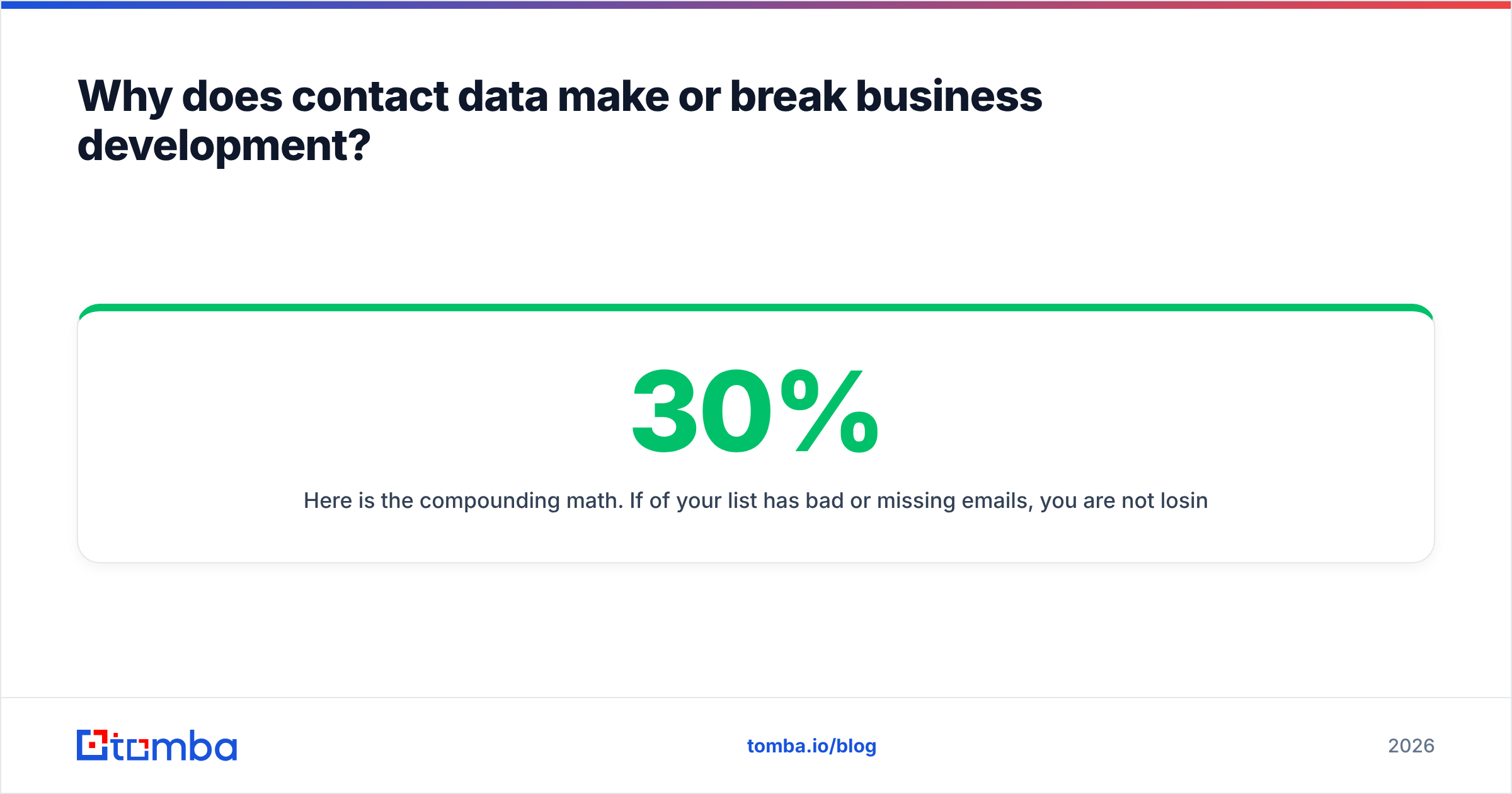
Here is the compounding math. If 30% of your list has bad or missing emails, you are not losing 30% of your output — you are degrading deliverability for the other 70% too, because mailbox providers read your bounce rate as a spam signal. Bad data doesn't subtract from BD results; it multiplies against them.
This is why verification and enrichment belong inside the BD workflow, not bolted on afterward:
- Find the right person. Use an email finder to get the decision-maker's address from a name and company, instead of guessing or settling for a gatekeeper inbox.
- Confirm it's deliverable. Run addresses through an email verifier before sending so bounces never touch your sending domain.
- Fill the gaps. Apply data enrichment to add titles, company size, and other firmographics so your sequencing and personalization actually have something to work with.
- Reach the harder accounts. A catch-all verifier helps you judge risky catch-all domains instead of either spraying or skipping them blindly.
Get this layer right and your reply rate, your response rate, and your meeting count all move at once — because they were all being held back by the same root cause.
Which tools power a business development stack in 2026?#
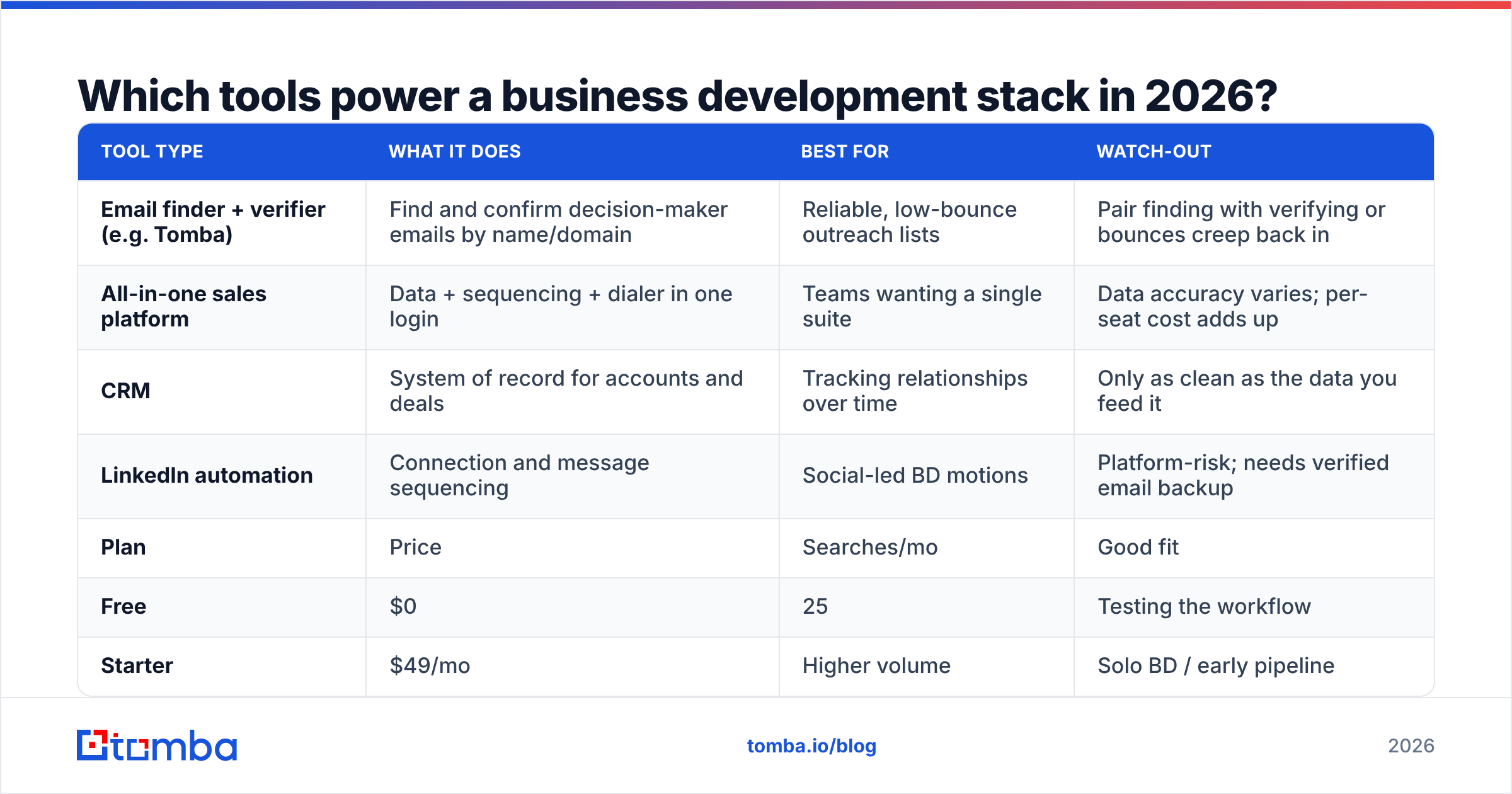
A modern BD stack has four jobs to cover: find contacts, verify them, sequence outreach, and track relationships in a CRM. You can buy one bloated suite or assemble focused tools; the right answer depends on volume and budget. Here's how the common building blocks compare on the dimension BD teams actually feel — getting accurate, reachable contacts into the funnel.
| Tool type | What it does | Best for | Watch-out |
|---|---|---|---|
| Email finder + verifier (e.g. Tomba) | Find and confirm decision-maker emails by name/domain | Reliable, low-bounce outreach lists | Pair finding with verifying or bounces creep back in |
| All-in-one sales platform | Data + sequencing + dialer in one login | Teams wanting a single suite | Data accuracy varies; per-seat cost adds up |
| CRM | System of record for accounts and deals | Tracking relationships over time | Only as clean as the data you feed it |
| LinkedIn automation | Connection and message sequencing | Social-led BD motions | Platform-risk; needs verified email backup |
For the find-and-verify layer specifically, transparent pricing matters because BD lists scale fast. Tomba's tiers are straightforward:
| Plan | Price | Searches/mo | Good fit |
|---|---|---|---|
| Free | $0 | 25 | Testing the workflow |
| Starter | $49/mo | Higher volume | Solo BD / early pipeline |
| Growth | $99/mo | Team volume | Active outbound teams |
| Pro | $249/mo | High volume | Scaled BD operations |
| Enterprise | Custom | Custom | Large orgs, API-heavy use |
You can review full Tomba pricing before committing, and the free tier is enough to validate whether verified data actually lifts your reply rate. Independent reviews on G2 are a useful sanity check when you compare any of these categories — read how teams of your size rate accuracy, not just feature lists.
Whatever you assemble, the integration story matters. Your finder and verifier should push clean records straight into the CRM your closers live in — whether that's HubSpot, Salesforce, or Pipedrive — so BD's work doesn't die in a spreadsheet.
How do you measure whether business development is working?#
Measure leading indicators, not just revenue — because revenue is a lagging result that shows up a quarter or two after the BD work that caused it. If you only watch closed deals, you're steering by your rear-view mirror.
Track these, in roughly this order of immediacy:
- Data quality rate — Percentage of your list with verified, deliverable contacts. This is the upstream metric that gates everything else. Below ~90% and you are sabotaging the rest of the funnel.
- Outreach-to-reply rate — Replies per 100 contacts. Healthy B2B cold outreach with good data and targeting tends to land in the low-to-mid single digits and up; a sharp drop usually signals a data or relevance problem, not a copy problem.
- Reply-to-meeting rate — How many conversations convert to booked meetings. This tests qualification and messaging.
- Meeting-to-opportunity rate — How many meetings become real, sales-accepted opportunities. This tests targeting quality.
- Sourced pipeline and influenced revenue — The lagging outcomes that justify the function.
The trap is optimizing one number in isolation. Pump up reply rate with clickbait subject lines and your meeting quality collapses. Chase meeting volume and your closers drown in unqualified calls. The point of measuring the full chain is to see where the funnel leaks so you fix the actual constraint instead of the loudest symptom.
One more discipline: attribute backwards. When a deal closes, trace it to the BD activity that started it — the partnership, the cold sequence, the event. That backward trace is how you learn which BD motions to double down on and which to cut.
What are the most common business development mistakes?#
The failures are predictable, which means they're avoidable.
- Spraying instead of targeting. Sending 5,000 generic emails feels like progress and produces almost none. A tighter list to the right 500 people beats it every time.
- Skipping verification. Sending to unverified addresses to "save time" costs far more time later in deliverability damage and wasted follow-up.
- Treating BD as pure cold outreach. Ignoring partnerships and referrals leaves the highest-converting channel untouched.
- No feedback loop. Failing to learn from what closes means repeating the same mis-targeting forever.
- Confusing activity with outcomes. Dials and sends are inputs, not results. Reward booked, qualified meetings.
Most of these share a root: working hard on the wrong inputs. BD rewards precision far more than volume, and precision starts with knowing exactly who you're talking to and being certain you can actually reach them.
Putting it together#
Business development in 2026 is an engineering problem dressed up as a relationship problem. Define a sharp ICP, turn it into a precise target list, reach the right people with verified contact data, qualify honestly, and feed every result back into the top of the funnel. Do that and BD stops being a mysterious cost center and becomes a predictable pipeline machine.
The single highest-leverage fix for most teams is the data layer — because it silently caps every other metric. If your reply rates are soft and your bounce rate is creeping up, start there before you touch a single line of copy. Tomba's Email Finder lets you find and verify decision-maker emails by name, company, or domain, with a free tier of 25 searches to prove the lift before you pay a cent. Build your BD engine on contacts you can actually reach, and the rest of the funnel finally gets to do its job.
// get started
Find, verify and enrich your first contacts today
Start on the free plan with 25 searches a month, then scale when your team is ready.
Free plan · No credit card required · GDPR & CCPA
// about the author